1.1: Introduction
This chapter briefly reviews the historical evolution of classical mechanics since considerable insight can be gained from study of the history of science. There are two dramatically different approaches used in classical mechanics. The first is the vectorial approach of Newton which is based on vector quantities like momentum, force, and acceleration. The second is the analytical approach of Lagrange, Euler, Hamilton, and Jacobi, that is based on the concept of least action and variational calculus. The more intuitive Newtonian picture reigned supreme in classical mechanics until the start of the twentieth century. Variational principles, which were developed during the nineteenth century, never aroused much enthusiasm in scientific circles due to philosophical objections to the underlying concepts; this approach was merely tolerated as an efficient tool for exploiting classical mechanics. A dramatic advance in the philosophy of scientific thinking occurred at the start of the 20 century leading to widespread acceptance of the superiority of variational principles.
1.2: Greek Antiquity
The great philosophers in ancient Greece played a key role by using the astronomical work of the Babylonians to develop scientific theories of mechanics. Thales of Miletus (624 - 547 B.C.), the first of the seven great greek philosophers, developed geometry and is hailed as the first true mathematician. Pythagoras (570 - 495 BC) developed mathematics and postulated that the earth is spherical.
Democritus (460 - 370 B.C.) has been called the father of modern science, while Socrates (469 - 399BC) is renowned for his contributions to ethics. Plato (427-347 B.C.) who was a mathematician and student of Socrates, wrote important philosophical dialogues. He founded the Academy in Athens which was the first institution of higher learning in the Western world that helped lay the foundations of Western philosophy and science.
Aristotle (384-322 B.C.) is an important founder of Western philosophy encompassing ethics, logic, science, and politics. His views on the physical sciences profoundly influenced medieval scholarship that extended well into the Renaissance. He presented the first implied formulation of the principle of virtual work in statics and his statement that “what is lost in velocity is gained in force” is a veiled reference to kinetic and potential energy. He adopted an Earth centered model of the universe.
Aristarchus (310 - 240 B.C.) argued that the Earth orbited the Sun and used measurements to imply the relative distances of the Moon and the Sun. The greek philosophers were relatively advanced in logic and mathematics and developed concepts that enabled them to calculate areas and perimeters. Unfortunately their philosophical approach neglected collecting quantitative and systematic data that is an essential ingredient to the advancement of science.
Archimedes (287-212 B.C.) represented the culmination of science in ancient Greece. As an engineer he designed machines of war while as a scientist he made significant contributions to hydrostatics and the principle of the lever. As a mathematician he applied infinitesimal in a way that is reminiscent of modern integral calculus which he used to derive a value for . Unfortunately much of the work of the brilliant Archimedes subsequently fell into oblivion.
Hero of Alexandria (10 - 70 A.D.) described the principle of reflection that light takes the shortest path. This is an early illustration of variational principle of least time. Ptolemy (83 - 161 A.D.) wrote several scientific treatises that greatly influenced subsequent philosophers. Unfortunately he adopted the incorrect geocentric solar system in contrast to the heliocentric model of Aristarchus and others.
1.3: Middle Ages
The decline and fall of the Roman Empire in ∼410 A.D. marks the end of Classical Antiquity and the beginning of the Dark Ages in Western Europe (Christendom) while the Muslim scholars in Eastern Europe continued to make progress in astronomy and mathematics. For example, in Egypt, Alhazen (965 - 1040 A.D.) expanded the principle of least time to reflection and refraction. The Dark Ages involved a long scientific decline in Western Europe that languished for about 900 years. Science was dominated by religious dogma, all western scholars were monks, and the important scientific achievements of Greek antiquity were forgotten. The works of Aristotle were reintroduced to Western Europe by Arabs in the early 13 century leading to the concepts of forces in static systems which were developed during the fourteenth century. This included concepts of the work done by a force, and the virtual work involved in virtual displacements. Leonardo da Vinci (1452-1519) was a leader in mechanics at that time. He made seminal contributions to science, in addition to his well known contributions to architecture, engineering, sculpture, and art.
Nicolaus Copernicus (1473-1543) rejected the geocentric theory of Ptolemy and formulated a scientifically based heliocentric cosmology that displaced the Earth from the center of the universe. The Ptolemaic view was that heaven represented the perfect unchanging divine while the earth represented change plus chaos and the celestial bodies moved relative to the fixed heavens. The book, "De revolutionibus orbium coelestium "(On the Revolutions of the Celestial Spheres), published by Copernicus in 1543, is regarded as the starting point of modern astronomy and the defining epiphany that began the Scientific Revolution. The book “De Magnete” written in 1600 by the English physician William Gilbert (1540-1603) presented the results of well-planned studies of magnetism and strongly influenced the intellectual-scientific evolution at that time.
Johannes Kepler (1571-1630), a German mathematician, astronomer and astrologer, was a key figure in the 17 century Scientific Revolution. He is best known for recognizing the connection between the motions in the sky and physics. His laws of planetary motion were developed by later astronomers based on his written work “Astronomia nova”, “Harmonices Mundi”, and “Epitome of Copernican Astronomy”. Kepler was an assistant to Tycho Brahe (1546-1601) who for many years recorded accurate astronomical data that played a key role in the development of Kepler’s theory of planetary motion. Kepler’s work provided the foundation for Isaac Newton’s theory of universal gravitation. Unfortunately Kepler did not recognize the true nature of the gravitational force.
Galileo Galilei (1564-1642) built on the Aristotle principle by recognizing the law of inertia, the persistence of motion if no forces act, and the proportionality between force and acceleration. This amounts to recognition of work as the product of force times displacement in the direction of the force. He applied virtual work to the equilibrium of a body on an inclined plane. He also showed that the same principle applies to hydrostatic pressure that had been established by Archimedes, but he did not apply his concepts in classical mechanics to the considerable knowledge base on planetary motion. Galileo is famous for the apocryphal story that he dropped two cannon balls of different masses from the Tower of Pisa to demonstrate that their speed of descent was independent of their mass.
1.4: Age of Enlightenment
The Age of Enlightenment is a term used to describe a phase in Western philosophy and cultural life in which reason was advocated as the primary source and legitimacy for authority. It developed simultaneously in Germany, France, Britain, the Netherlands, and Italy around the 1650’s and lasted until the French Revolution in 1789. The intellectual and philosophical developments led to moral, social, and political reforms. The principles of individual rights, reason, common sense, and deism were a revolutionary departure from the existing theocracy, autocracy, oligarchy, aristocracy, and the divine right of kings. It led to political revolutions in France and the United States. It marks a dramatic departure from the Early Modern period which was noted for religious authority, absolute state power, guild-based economic systems, and censorship of ideas. It opened a new era of rational discourse, liberalism, freedom of expression, and scientific method. This new environment led to tremendous advances in both science and mathematics in addition to music (Johann Sebastian Bach, Mozart), literature (Goethe), philosophy (Spinoza, Kant) and art (Rubens). Scientific development during the 17 century included the pivotal advances made by Newton and Leibniz at the beginning of the revolutionary Age of Enlightenment, culminating in the development of variational calculus and analytical mechanics by Euler and Lagrange. The scientific advances of this age include publication of two monumental books “Philosophiae Naturalis Principia Mathematica” by Newton in 1687 and Mécanique analytique by Lagrange in 1788. These are the definitive two books upon which classical mechanics is built.
René Descartes (1596-1650) attempted to formulate the laws of motion in 1644. He talked about conservation of motion (momentum) in a straight line but did not recognize the vector character of momentum.Pierre de Fermat (1601-1665) and René Descartes were two leading mathematicians in the first half of the 17 century. Independently they discovered the principles of analytic geometry and developed some initial concepts of calculus. Fermat and Blaise Pascal (1623-1662) were the founders of the theory of probability.
Isaac Newton (1642-1727) made pioneering contributions to physics and mathematics as well as being a theologian. At 18 he was admitted to Trinity College Cambridge where he read the writings of modern philosophers like Descartes, and astronomers like Copernicus, Galileo, and Kepler. By 1665 he had discovered the generalized binomial theorem, and began developing infinitesimal calculus. Due to a plague, the university closed for two years in 1665 during which Newton worked at home developing the theory of calculus that built upon the earlier work of Barrow and Descartes. He was elected Lucasian Professor of Mathematics in 1669 at the age of 26. From 1670 Newton focused on optics leading to his Hypothesis of Light published in 1675 and his book Opticks in 1704. Newton described light as being made up of a flow of extremely subtle corpuscles that also had associated wavelike properties to explain diffraction and optical interference that he studied. Newton returned to mechanics in 1677 by studying planetary motion and gravitation that applied the calculus he had developed. In 1687 he published his monumental treatise entitled Philosophiae Naturalis Principia Mathematica which established his three universal laws of motion, the universal theory of gravitation, derivation of Kepler’s three laws of planetary motion, and was his first publication of the development of calculus which he called “the science of fluxions”. Newton’s laws of motion are based on the concepts of force and momentum, that is, force equals the rate of change of momentum. Newton’s postulate of an invisible force able to act over vast distances led him to be criticized for introducing “occult agencies” into science. In a remarkable achievement, Newton completely solved the laws of mechanics. His theory of classical mechanics and of gravitation reigned supreme until the development of the Theory of Relativity in 1905. The followers of Newton envisioned the Newtonian laws to be absolute and universal. This dogmatic reverence of Newtonian mechanics prevented physicists from an unprejudiced appreciation of the analytic variational approach to mechanics developed during the 17 through 19 centuries. Newton was the first scientist to be knighted and was appointed president of the Royal Society
Gottfried Leibniz (1646-1716) was a brilliant German philosopher, a contemporary of Newton, who worked on both calculus and mechanics. Leibniz started development of calculus in 1675, ten years after Newton, but Leibniz published his work in 1684, which was three years before Newton’s Principia. Leibniz made significant contributions to integral calculus and developed the notation currently used in calculus. He introduced the name calculus based on the Latin word for the small stone used for counting. Newton and Leibniz were involved in a protracted argument over who originated calculus. It appears that Leibniz saw drafts of Newton’s work on calculus during a visit to England. Throughout their argument Newton was the ghost writer of most of the articles in support of himself and he had them published under nonde-plume of his friends. Leibniz made the tactical error of appealing to the Royal Society to intercede on his behalf. Newton, as president of the Royal Society, appointed his friends to an “impartial” committee to investigate this issue, then he wrote the committee’s report that accused Leibniz of plagiarism of Newton’s work on calculus, after which he had it published by the Royal Society. Still unsatisfied he then wrote an anonymous review of the report in the Royal Society’s own periodical. This bitter dispute lasted until the death of Leibniz. When Leibniz died his work was largely discredited. The fact that he falsely claimed to be a nobleman and added the prefix “von” to his name, coupled with Newton’s vitriolic attacks, did not help his credibility. Newton is reported to have declared that he took great satisfaction in “breaking Leibniz’s heart.” Studies during the 20 century have largely revived the reputation of Leibniz and he is recognized to have made major contributions to the development of calculus.
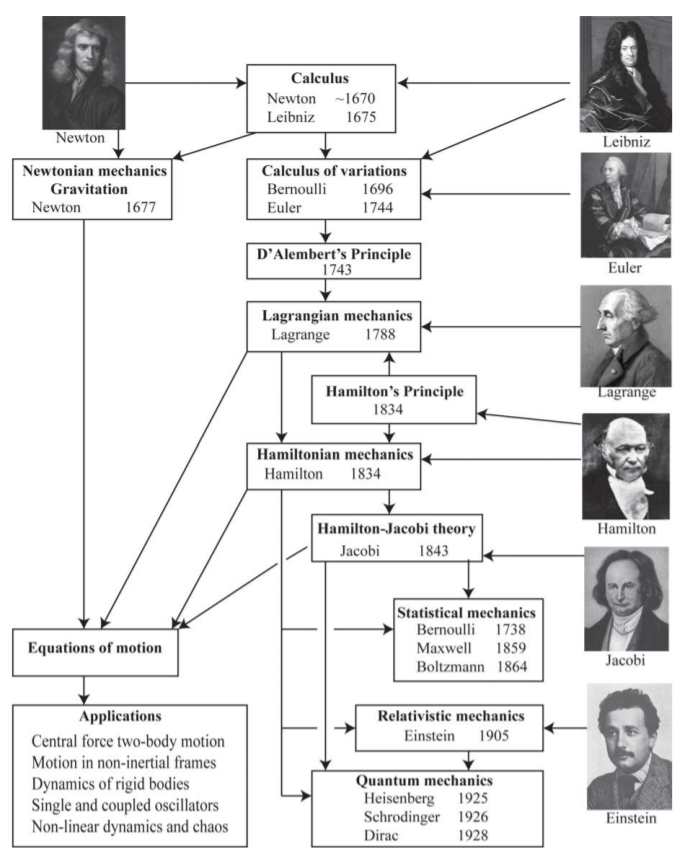
Figure 1.4.1:Chronological roadmap of the parallel development of the Newtonian and Variational-principles approaches to classical mechanics.
1.5: Variational methods in physics
Pierre de Fermat (1601-1665) revived the principle of least time, which states that light travels between two given points along the path of shortest time and was used to derive Snell’s law in 1657. This enunciation of variational principles in physics played a key role in the historical development of the variational principle of least action that underlies the analytical formulations of classical mechanics.
Gottfried Leibniz (1646-1716) made significant contributions to the development of variational principles in classical mechanics. In contrast to Newton’s laws of motion, which are based on the concept of momentum, Leibniz devised a new theory of dynamics based on kinetic and potential energy that anticipates the analytical variational approach of Lagrange and Hamilton. Leibniz argued for a quantity called the “vis viva”, which is Latin for living force, that equals twice the kinetic energy. Leibniz argued that the change in kinetic energy is equal to the work done. In 1687 Leibniz proposed that the optimum path is based on minimizing the time integral of the vis viva, which is equivalent to the action integral. Leibniz used both philosophical and causal arguments in his work which were acceptable during the Age of Enlightenment. Unfortunately for Leibniz, his analytical approach based on energies, which are scalars, appeared contradictory to Newton’s intuitive vectorial treatment of force and momentum. There was considerable prejudice and philosophical opposition to the variational approach which assumes that nature is thrifty in all of its actions. The variational approach was considered to be speculative and “metaphysical” in contrast to the causal arguments supporting Newtonian mechanics. This opposition delayed full appreciation of the variational approach until the start of the 20 century.
Johann Bernoulli (1667-1748) was a Swiss mathematician who was a student of Leibniz’s calculus, and sided with Leibniz in the Newton-Leibniz dispute over the credit for developing calculus. Also Bernoulli sided with the Descartes’ vortex theory of gravitation which delayed acceptance of Newton’s theory of gravitation in Europe. Bernoulli pioneered development of the calculus of variations by solving the problems of the catenary, the brachistochrone, and Fermat’s principle. Johann Bernoulli’s son Daniel played a significant role in the development of the well-known Bernoulli Principle in hydrodynamics.
Pierre Louis Maupertuis (1698-1759) was a student of Johann Bernoulli and conceived the universal hypothesis that in nature there is a certain quantity called action which is minimized. Although this bold assumption correctly anticipates the development of the variational approach to classical mechanics, he obtained his hypothesis by an entirely incorrect method. He was a dilettante whose mathematical prowess was behind the high standards of that time, and he could not establish satisfactorily the quantity to be minimized. His teleological[1] argument was influenced by Fermat’s principle and the corpuscle theory of light that implied a close connection between optics and mechanics.
Leonhard Euler (1707-1783) was the preeminent Swiss mathematician of the 18 century and was a student of Johann Bernoulli. Euler developed, with full mathematical rigor, the calculus of variations following in the footsteps of Johann Bernoulli. Euler used variational calculus to solve minimum/maximum isoperimetric problems that had attracted and challenged the early developers of calculus, Newton, Leibniz, and Bernoulli. Euler also was the first to solve the rigid-body rotation problem using the three components of the angular velocity as kinematical variables. Euler became blind in both eyes by 1766 but that did not hinder his prolific output in mathematics due to his remarkable memory and mental capabilities. Euler’s contributions to mathematics are remarkable in quality and quantity; for example during 1775 he published one mathematical paper per week in spite of being blind. Euler implicitly implied the principle of least action using vis viva which is not the exact form explicitly developed by Lagrange.
Jean le Rond d’Alembert (1717-1785) was a French mathematician and physicist who had the clever idea of extending use of the principle of virtual work from statics to dynamics. D’Alembert’s Principle rewrites the principle of virtual work in the form
where the inertial reaction force is subtracted from the corresponding force . This extension of the principle of virtual work applies equally to both statics and dynamics leading to a single variational principle.
Joseph Louis Lagrange (1736-1813) was an Italian mathematician and a student of Leonhard Euler. In 1788 Lagrange published his monumental treatise on analytical mechanics entitled Mécanique Analytique which introduces his Lagrangian mechanics analytical technique which is based on d’Alembert’s Principle of Virtual Work. Lagrangian mechanics is a remarkably powerful technique that is equivalent to minimizing the action integral defined as
The Lagrangian frequently is defined to be the difference between the kinetic energy and potential energy . His theory only required the analytical form of these scalar quantities. In the preface of his book he refers modestly to his extraordinary achievements with the statement “The reader will find no figures in the work. The methods which I set forth do not require either constructions or geometrical or mechanical reasonings: but only algebraic operations, subject to a regular and uniform rule of procedure.” Lagrange also introduced the concept of undetermined multipliers to handle auxiliary conditions which plays a vital part of theoretical mechanics. William Hamilton, an outstanding figure in the analytical formulation of classical mechanics, called Lagrange the “Shakespeare of mathematics,” on account of the extraordinary beauty, elegance, and depth of the Lagrangian methods. Lagrange also pioneered numerous significant contributions to mathematics. For example, Euler, Lagrange, and d’Alembert developed much of the mathematics of partial differential equations. Lagrange survived the French Revolution, and, in spite of being a foreigner, Napoleon named Lagrange to the Legion of Honour and made him a Count of the Empire in 1808. Lagrange was honored by being buried in the Pantheon.
Carl Friedrich Gauss (1777-1855) was a German child prodigy who made many significant contributions to mathematics, astronomy and physics. He did not work directly on the variational approach, but Gauss’s law, the divergence theorem, and the Gaussian statistical distribution are important examples of concepts that he developed and which feature prominently in classical mechanics as well as other branches of physics, and mathematics.
Simeon Poisson (1781-1840), was a brilliant mathematician who was a student of Lagrange. He developed the Poisson statistical distribution as well as the Poisson equation that features prominently in electromagnetic and other field theories. His major contribution to classical mechanics is development, in 1809, of the Poisson bracket formalism which featured prominently in development of Hamiltonian mechanics and quantum mechanics.
The zenith in development of the variational approach to classical mechanics occurred during the 19 century primarily due to the work of Hamilton and Jacobi.
William Hamilton (1805-1865) was a brilliant Irish physicist, astronomer and mathematician who was appointed professor of astronomy at Dublin when he was barely 22 years old. He developed the Hamiltonian mechanics formalism of classical mechanics which now plays a pivotal role in modern classical and quantum mechanics. He opened an entirely new world beyond the developments of Lagrange. Whereas the Lagrange equations of motion are complicated second-order differential equations, Hamilton succeeded in transforming them into a set of first-order differential equations with twice as many variables that consider momenta and their conjugate positions as independent variables. The differential equations of Hamilton are linear, have separated derivatives, and represent the simplest and most desirable form possible for differential equations to be used in a variational approach. Hence the name “canonical variables” given by Jacobi. Hamilton exploited the d’Alembert principle to give the first exact formulation of the principle of least action which underlies the variational principles used in analytical mechanics. The form derived by Euler and Lagrange employed the principle in a way that applies only for conservative (scleronomic) cases. A significant discovery of Hamilton is his realization that classical mechanics and geometrical optics can be handled from one unified viewpoint. In both cases he uses a “characteristic” function that has the property that, by mere differentiation, the path of the body, or light ray, can be determined by the same partial differential equations. This solution is equivalent to the solution of the equations of motion.
Carl Gustave Jacob Jacobi (1804-1851), a Prussian mathematician and contemporary of Hamilton, made significant developments in Hamiltonian mechanics. He immediately recognized the extraordinary importance of the Hamiltonian formulation of mechanics. Jacobi developed canonical transformation theory and showed that the function, used by Hamilton, is only one special case of functions that generate suitable canonical transformations. He proved that any complete solution of the partial differential equation, without the specific boundary conditions applied by Hamilton, is sufficient for the complete integration of the equations of motion. This greatly extends the usefulness of Hamilton’s partial differential equations. In 1843 Jacobi developed both the Poisson brackets, and the Hamilton-Jacobi, formulations of Hamiltonian mechanics. The latter gives a single, first-order partial differential equation for the action function in terms of the generalized coordinates which greatly simplifies solution of the equations of motion. He also derived a principle of least action for time-independent cases that had been studied by Euler and Lagrange. Jacobi developed a superior approach to the variational integral that, by eliminating time from the integral, determined the path without saying anything about how the motion occurs in time.
James Clerk Maxwell (1831-1879) was a Scottish theoretical physicist and mathematician. His most prominent achievement was formulating a classical electromagnetic theory that united previously unrelated observations, plus equations of electricity, magnetism and optics, into one consistent theory. Maxwell’s equations demonstrated that electricity, magnetism and light are all manifestations of the same phenomenon, namely the electromagnetic field. Consequently, all other classic laws and equations of electromagnetism were simplified cases of Maxwell’s equations. Maxwell’s achievements concerning electromagnetism have been called the “second great unification in physics”. Maxwell demonstrated that electric and magnetic fields travel through space in the form of waves, and at a constant speed of light. In 1864 Maxwell wrote “A Dynamical Theory of the Electromagnetic Field” which proposed that light was in fact undulations in the same medium that is the cause of electric and magnetic phenomena. His work in producing a unified model of electromagnetism is one of the greatest advances in physics. Maxwell, in collaboration with Ludwig Boltzmann (1844-1906), also helped develop the Maxwell—Boltzmann distribution, which is a statistical means of describing aspects of the kinetic theory of gases. These two discoveries helped usher in the era of modern physics, laying the foundation for such fields as special relativity and quantum mechanics. Boltzmann founded the field of statistical mechanics and was an early staunch advocate of the existence of atoms and molecules.
Henri Poincaré (1854-1912) was a French theoretical physicist and mathematician. He was the first to present the Lorentz transformations in their modern symmetric form and discovered the remaining relativistic velocity transformations. Although there is similarity to Einstein’s Special Theory of Relativity, Poincaré and Lorentz still believed in the concept of the ether and did not fully comprehend the revolutionary philosophical change implied by Einstein. Poincaré worked on the solution of the three-body problem in planetary motion and was the first to discover a chaotic deterministic system which laid the foundations of modern chaos theory. It rejected the long-held deterministic view that if the position and velocities of all the particles are known at one time, then it is possible to predict the future for all time.
The last two decades of the 19 century saw the culmination of classical physics and several important discoveries that led to a revolution in science that toppled classical physics from its throne. The end of the 19 century was a time during which tremendous technological progress occurred; flight, the automobile, and turbine-powered ships were developed, Niagara Falls was harnessed for power, etc. During this period, Heinrich Hertz (1857-1894) produced electromagnetic waves confirming their derivation using Maxwell’s equations. Simultaneously he discovered the photoelectric effect which was crucial evidence in support of quantum physics. Technical developments, such as photography, the induction spark coil, and the vacuum pump played a significant role in scientific discoveries made during the 1890’s. At the end of the 19 century, scientists thought that the basic laws were understood and worried that future physics would be in the fifth decimal place; some scientists worried that little was left for them to discover. However, there remained a few, presumed minor, unexplained discrepancies plus new discoveries that led to the revolution in science that occurred at the beginning of the 20 century.
1.6: The 20th Century Revolution in Physics
The two greatest achievements of modern physics occurred in the beginning of the 20th century. The first was Einstein’s development of the Theory of Relativity; the Special Theory of Relativity in 1905 and the General Theory of Relativity in 1915. This was followed in 1925 by the development of quantum mechanics.****
Albert Einstein (1879-1955) developed the Special Theory of Relativity in 1905 and the General Theory of Relativity in 1915; both of these revolutionary theories had a profound impact on classical mechanics and the underlying philosophy of physics. The Newtonian formulation of mechanics was shown to be an approximation that applies only at low velocities while the General Theory of Relativity superseded Newton’s Law of Gravitation and explained the Equivalence Principle. The Newtonian concepts of an absolute frame of reference, plus the assumption of the separation of time and space were shown to be invalid at relativistic velocities. Einstein’s postulate that the laws of physics are the same in all inertial frames requires a revolutionary change in the philosophy of time, space and reference frames which leads to a breakdown in the Newtonian formalism of classical mechanics. By contrast, the Lagrange and Hamiltonian variational formalisms of mechanics, plus the principle of least action, remain intact using a relativistically invariant Lagrangian. The independence of the variational approach to reference frames is precisely the formalism necessary for relativistic mechanics. The invariance to coordinate frames of the basic field equations also must remain invariant for the General Theory of Relativity. Thus the development of the Theory of Relativity unambiguously demonstrated the superiority of the variational formulation of classical mechanics over the vectorial Newtonian formulation, and thus the considerable effort made by Euler, Lagrange, Hamilton, Jacobi, and others in developing the analytical variational formalism of classical mechanics finally came to fruition at the start of the 20th century. Newton’s two crowning achievements, the Laws of Motion and the Laws of Gravitation, that had reigned supreme since published in the Principia in 1687, were toppled from the throne by Einstein.
Emmy Noether (1882-1935) has been described as “the greatest ever woman mathematician”. In 1915 she proposed a theorem that a conservation law is associated with any differentiable symmetry of a physical system. Noether’s theorem evolves naturally from Lagrangian and Hamiltonian mechanics and she applied it to the four-dimensional world of general relativity. Noether’s theorem has had an important impact in guiding the development of modern physics.
Other profound developments that had revolutionary impacts on classical mechanics were quantum physics and quantum field theory. The 1913 model of atomic structure by Niels Bohr (1885-1962) and the subsequent enhancements by Arnold Sommerfeld (1868-1951), were based completely on classical Hamiltonian mechanics. The proposal of wave-particle duality by Louis de Broglie (1892-1987), made in his 1924 thesis, was the catalyst leading to the development of quantum mechanics. In 1925 Werner Heisenberg (1901-1976), and Max Born (1882-1970) developed a matrix representation of quantum mechanics using non-commuting conjugate position and momenta variables.
Paul Dirac (1902-1984) showed in his Ph.D. thesis that Heisenberg’s matrix representation is based on the Poisson Bracket generalization of Hamiltonian mechanics, which, in contrast to Hamilton’s canonical equations, allows for non-commuting conjugate variables. In 1926 Erwin Schrödinger (1887-1961) independently introduced the operational viewpoint and reinterpreted the partial differential equation of Hamilton-Jacobi as a wave equation. His starting point was the optical-mechanical analogy of Hamilton that is a built-in feature of the Hamilton-Jacobi theory. Schrödinger then showed that the wave mechanics he developed, and the Heisenberg matrix mechanics, are equivalent representations of quantum mechanics. In 1928 Dirac developed his relativistic equation of motion for the electron and pioneered the field of quantum electrodynamics. Dirac also introduced the Lagrangian and the principle of least action to quantum mechanics and these ideas were developed into the path-integral formulation of quantum mechanics and the theory of electrodynamics by Richard Feynman (1918-1988).
The concepts of wave-particle duality, and quantization of observables, both are beyond the classical notions of infinite subdivisions in classical physics. In spite of the radical departure of quantum mechanics from earlier classical concepts, the basic feature of the differential equations of quantal physics is their selfadjoint character which means that they are derivable from a variational principle. Thus both the Theory of Relativity, and quantum physics are consistent with the variational principle of mechanics, and inconsistent with Newtonian mechanics. As a consequence Newtonian mechanics has been dislodged from the throne it occupied since 1687, and the intellectually beautiful and powerful variational principles of analytical mechanics have been validated.
The 2015 observation of gravitational waves is a remarkable recent confirmation of Einstein’s General Theory of Relativity and the validity of the underlying variational principles in physics. Another advance in physics is the understanding of the evolution of chaos in non-linear systems that have been made during the past four decades. This advance is due to the availability of computers which has reopened this interesting branch of classical mechanics, that was pioneered by Henri Poincaré about a century ago. Although classical mechanics is the oldest and most mature branch of physics, there still remain new research opportunities in this field of physics.
The focus of this book is to introduce the general principles of the mathematical variational principle approach, and its applications to classical mechanics. It will be shown that the variational principles, that were developed in classical mechanics, now play a crucial role in modern physics and mathematics, plus many other fields of science and technology.
Excellent sources of information regarding the history of major players in the field of classical mechanics can be found on Wikipedia, and the book “Variational Principle of Mechanics” by Lanczos.[La49]
Teleology is any philosophical account that holds that final causes exist in nature, analogous to purposes found in human actions, nature inherently tends toward definite ends.