In this chapter, we will apply energy conservation to solve problems in physics. Throughout this chapter, compare the method of energy conservation to using Newton’s laws.
where E is the mechanical energy of the system. If E is a constant, then your mechanical energy equals the total (kinetic plus potential) energy of your system.
Because energy is scalar instead of a vector quantity, it is sometimes easier to solve a question using energy conservation than using Newton’s Laws. The important points to consider are:
What are your sources of kinetic energy (translation versus rotation)?
What are your sources of potential energy?
How can you write both forms of energy in terms of the parameters needed and in terms of time?
If you can answer those questions, you can solve physics problems using energy conservation.
If energy is conserved, you can compare the energy before and after the motion. The total energy initially must equal the total energy at the end. Any gain or loss in kinetic energy corresponds to a gain or loss in potential energy. This is similar to how we applied the conservation of momentum and angular momentum to problems.
in the case of Cartesian coordinates and linear motion.
Now, the rate of change of the kinetic energy for this particle is given by dK/dt. This does not need to be constant with time (although E is assumed to be constant).
which is just our work-kinetic energy theorem again.
What about the potential energy? Well, our potential energy must be dependent on position (a conservative force depends on position). Assume that U→U(r).
for any velocity for the particle. So if you have a system that is fully described by conservative forces in any dimension, then that system will have its total energy conserved.
Keep in mind that not all forces that are functions of position are conservative forces. For a system to have a conservative force, ∇×F = 0 (see Chapter 8) or the work done on the system within a closed loop must be zero.
There is a loss of potential energy, which means there will be a gain in kinetic energy, as expected.
Kinetic energy: Initially, everything is at rest, so Ki = 0. But after the mass m moves, there are three sources of kinetic energy. There is the moving mass m, the rotating pulley, and the rotating spherical shell.
where v=y˙ is the speed of the mass, Ip and ωp are the moment of inertia and angular velocity of the pulley, and Is and ωs are the moment of inertia and angular velocity for the spherical shell.
The pulley is a disk, so Ip=21MpRp2. The moment of inertia for a spherical shell is Is=32MsRs2 (see Appendix A.4). Since the rope is massless and cannot be stretched (it is inextensible), the velocity at any point of the rope must be constant. If we say that the mass moves at a velocity v, then the velocity vector where the rope meets the pulley has a speed v and the velocity vector where the rope meets the shell has a speed v. So the pulley and shell have the same linear velocity v at the radii where the rope contacts them. That means the linear velocity is v at a radius of Rs for the shell and at a radius of Rp for the pulley.
First step is to consider all sources of kinetic energy and all sources of potential energy.
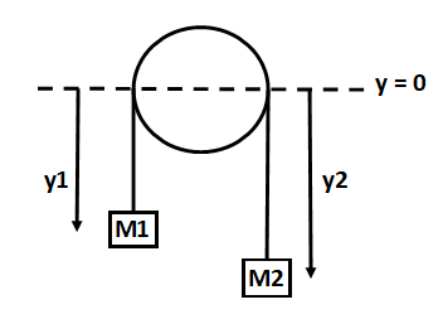
For potential energy, we have the two masses within a gravitational field. For small distances, we can assume that Fg=mg and that means that U=mgΔy, where Δy indicates the change in vertical. If we set y = 0 to be at the midpoint of the pulley (see Figure 9.4), then the potential energy of the masses are U1=−m1gy1 and U2=−m2gy2, where y1 and y2 are the positions of the masses relative to the pulley.
Figure 9.4:Position of masses in the Atwood machine. The midpoint of the pulley sets the y = 0 point, with the masses distances y1 and y2 being measured from the y = 0.
Note that there is no potential energy from the pulley because the pulley does not move vertically. So there is no work done by gravity in moving the pulley (by its centre of mass).
So our potential energy of the system is given by:
This is the potential energy for a given time, t. We don’t know which mass will move up and which one will move down. All we know is that m1 and m2 are at specific positions y1 and y2 at t.
For the kinetic energy, there are three sources of kinetic energy in this system. We have the translation motion of m1, the translation motion of m2, and the rotational motion of the pulley. For the translation motion, we have K1=21m1(y˙1)2 and K2=21m2(y˙2)2. For the rotational motion, we have Kp=21Iω2.
Similar to the previous problem, we need to connect the rotational motion to the translation motion. The pulley rotates at an angular speed of ω. Since the rope is inextensible (does not stretch), we can assume that the two masses move at the same speed
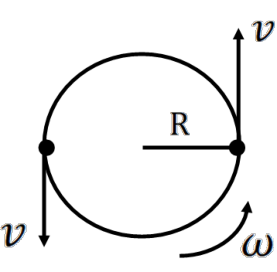
(∣y˙1∣=∣y˙2∣=v) and with the same linear speed as the contact point of the pulley, which is v=Rω (e.g., see Figure 9.5).
Figure 9.5:Rotation of the pulley assuming m1>m2. The pulley rotates at the angular speed ω. The velocity of that angular speed at the two points shown will be v=ωR where v is the speed of the masses.
Similar to the potential energy, this kinetic energy is for time t when the masses are moving at a speed of v. If the system starts at rest, we would need to calculate the change in position of y1 and y2 to get the change in kinetic energy. But we were not told of an initial configuration. Instead, we have determined U and K at time t. So we will use Equation 9.3:
In general, you can use Newton’s laws or energy conservation to solve simple harmonic motion problems. But there are many cases where energy conservation can save you a lot of extra work. Consider using Newton’s laws to calculate the following problem instead.
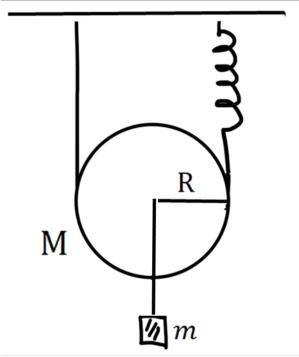
Figure 9.6:A “simple” harmonic oscillator formed by a pulley and spring. The pulley is a disk of radius R and mass M that is held up by an inextensible cord that is attached to the ceiling on one end and attached to a spring of spring constant k on the other end. A small mass m hangs from the centre of the disk.
Solution
Find the equilibrium position. When you are in equilibrium, there is no movement, so there is no rotation and no velocity. That means that all forces are zero. But before we can answer this question, how do the pulley, mass, and spring move relative to each other?
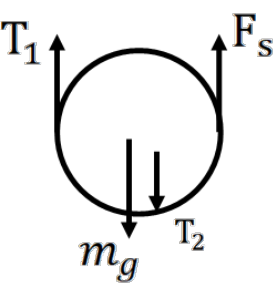
We can solve for this equilibrium point by setting the net force and net torque on the pulley equal to zero (that will be the equilibrium point). Figure 9.7 shows the free-body diagram for the pulley.
Figure 9.7:Free-body diagram of the pulley. There is a tension T1 from the rope on the left, and a tension T2 from the small mass m acting at the centre of mass. The pulley has its own gravity Mg. And there is the spring force Fs acting on the right side of the pulley.
Since we’re in equilibrium, the net torque must be zero. Therefore, T1=Fs, otherwise the pulley would rotate. For a spring, Fs=−kx=T1. The other unknown force is T2, but that is simply the tension caused by the hanging mass m and therefore T2=mg.
What is the period of small oscillations? We want the differential equation of motion. If you can get the equation in the form of x¨+Cx = 0, then you can read off ω02 and can get the period.
You can solve this problem using forces and torques, but we will use the conservation of energy here.
The potential energy is given by the gravitational potential energy of the two masses and the potential energy of the spring. Thus, our potential energy is:
where we have specified that the potential energy is zero for the masses at x = 0. A convenient reference point (e.g., setting x = 0 for the gravitational energy) is at x0, since this is a known reference point. Note that the spring potential is not zero at x=x0. So we need to consider Δx for the spring.
The kinetic energy of the system is given by the motion of translation energy of the mass, the translation energy of the pulley, and the rotation of the pulley.
Before we combine the energies for this question, let’s first ask how this system will move. The spring will stretch and compress, and this will lower and raise m and the pulley, and the pulley will also rotate. At first glance, you may be tempted to assume that if the mass moves down a distance x, then the pulley should move down a distance x and the spring should be stretched a distance x. But for this system, the spring will stretchtwice as much as m and M move down because some of the kinetic energy that goes into the pulley and mass is used to rotate the pulley rather than translate the pulley. This is the same principle behind rolling without slipping (see Chapter 7).
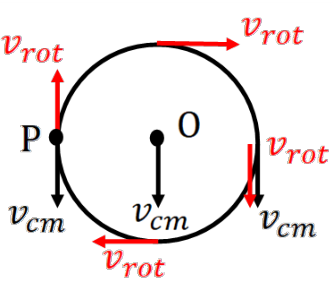
Let’s look at the motion of the pulley. Figure 9.8 shows the translational and rotational motion of the pulley. First, consider the motion of the mass and pulley. The mass is connected to the pulley at its centre-of-mass by an inextensible rope. Whatever distance one moves, the other will move the same amount, and this motion will equal the motion of the centre-of-mass of the pulley, vcm. Since the pulley is also rotating without slipping, we can connect the centre of mass motion directly to the rotation
Figure 9.8:Translation and rotational motion of the pulley from Figure 9.6. The entire disk moves down with v=vcm. But when the pulley moves, it will also rotate without slipping with ω=vcm/R. So at point P on the fixed side, the velocity is instantaneously zero.
Second, let’s consider how the spring stretches relative to the pulley’s motion. As the pulley moves down with the stretch of the spring, the pulley will rotate clockwise (see Figure 9.8). Point P is the contact point for the rotation and the net velocity there will be zero. Note that the contact point will be on the side of pulley that is fixed to the ceiling. That’s because the other side with the spring is able to change in height, not the fixed side. On the side with the spring, however, the velocities from the translation and rotation add together such that pulley moves away from the spring at twice the speed of the centre of mass.
So this means that if the mass and pulley move x in time t, the spring stretches (or compresses) by a displacement of 2x in the same time. We must take into account this difference in the spring’s displacement relative to the vertical displacement of the mass and pulley in our energy conservation.
where the change in potential energy depends on a displacement of 2x−x0, because we set our reference position to x0 and the spring stretches and compresses at twice the rate that the pulley and mass move.