In this chapter, we will review linear momentum and the conservation of momentum. We will also discuss impulse, collisions, and variable mass problems.
We will look at the case where the mass changes with time in Section 6.5.
If the net external force is equal to zero (∑F=0), then the total momentum of a system is constant, dp/dt=0, and p is a constant. This result is the conservation of linear momentum.
where ∑F1 is the net force on particle 1, ∑F2 is the net force on particle 2, and ∑F3 is the net force on particle 3.
The net force on particle 1 should be the force from particle 2 (F21) and the force from particle 3 (F31). There are no other forces on particle 1 because the system is isolated (e.g., the system has no outside influences). The same argument can be made for particles 2 and
So the time derivative of our net momentum becomes:
But because of Newton’s third law (every action has an equal and opposite reaction), the force of particle 2 on particle 1 (F21) must be equal and opposite to the force of particle 1 on particle 2 (F12). You can think of two masses in space pulling on each other due to gravity. Or two isolated charges attracting or repelling each other. As a result, F21=−F12, F31=−F13, and F32=−F23. So we finally obtain:
The above example is for three particles, but we can easily generalize the solution to N particles as long as the system is isolated (no external forces). For a system of n−particles,
where the unique pairs of forces are represented by double sums. To break down what the nested sums mean, first let’s consider a single particle, represented by i. We can write
which is basically saying that the time derivative of the momentum for the ith particle is just the sum of all the forces from the other particles. The condition of j=i is needed because each particle acts on the other particles in the system, but not on themselves (F11,F22, and F33 are not allowed).
To then get the total momentum of an isolated system, we need to sum over individual particles, ptot=∑pi. This gives us our nested sums,
where you start with the outer summation and set a value for i before cycling through the inner summation and setting all possible values for j. For an example, if N = 3, the nested sums would give F12,F13,F21,F23,F31, and F32 in that order.
The conservation of linear momentum draws directly from Newton’s third law. In an isolated system, all forces balance (equal and opposite reactions) such that the total momentum of the system is constant. But if there is an external force, then the total linear momentum is no longer constant. For a simple particle in a system,
where Fi,int is the force on the particle from the system itself (internal force) and Fi,ext is the external force on the particle. If you then look at all particles in the system:
The impulse of a force represents the change in linear momentum in the system. Note that mass does not need to be constant in the definition of an impulse.
An impulse is an instantaneous event, where the interaction time is short (Δt≈0). We can assume that the system does not change during the impulse, but it will change drastically as a result of the impulse (it just hasn’t had time for that to happen).
In general practice, an impulse is a fast, powerful force that quickly changes the momentum of a system rather than a slow process that slowly changes the momentum of a system. The distinction between fast and slow, however, is not well defined. What is necessary is that your force can be approximated by an average value over the small time duration. If you have a relatively constant force, then you can take a longer time duration, but if your force changes quickly, you need a shorter time interval.
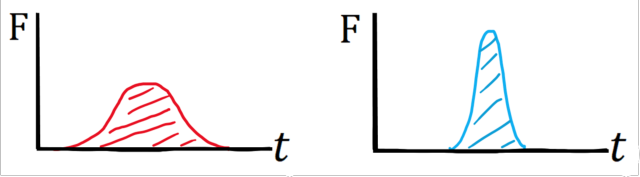
Figure 6.1 shows two identical impulses with the same area ∫F dt, which means they have the same impulse magnitude. Note the differences between them. The average impulse is Iavg=FavgΔt. So if you increase the interaction time, Δt, you decrease the average force necessary for the same impulse. In the figure, the blue curve has a shorter Δt and requires a stronger force than the red curve to produce the same change in momentum. You can minimize the force by increasing the time of interaction.
Figure 6.1:Sketch of two forces with the same impulse (area under the curve).
Collisions are a way that the momentum of a system can change. There are two types of collisions that we’ll consider, inelastic and elastic collisions.
Case 1: Inelastic Collision
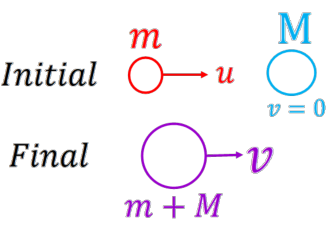
In a totally inelastic collision, the colliding systems merge (stick together). Figure 6.2 illustrates the basic case of an inelastic collision in 1D, where two masses (m and M) collide and stick together. After the collision, the two masses move as one system (m+M).
Figure 6.2:Example of an inelastic collision. A mass m moving at a speed u approaches another mass M that is at rest. The two objects collide and merge into one system m+M that moves at a new speed, v.
Since there are no external forces (m and M are internal to the system), momentum must be conserved between the initial state and final state of the system. Thus, pi=pf.
If M≫m, then v is small relative to u. If M≪m, then v≈u.
Solution
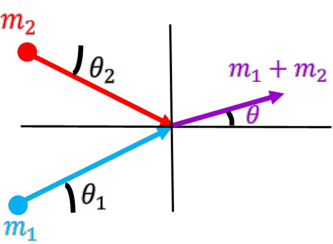
We want to find the velocity (speed and direction) of the system after an inelastic collision. The first thing we need to do is draw the initial set up of the problem. Figure 6.3 shows the motion of particle 1, m1, and particle 2, m2, as described by the problem. The two masses collide at the origin and then stick together.
Figure 6.3:The motion of two identical particles, m1 and m2, on a coordinate grid. The velocity of the post-collision system is shown by the purple vector.
When the masses collide, they continue their journey as m1+m2=2m (purple vector). We do not know the exact direction of motion for the post-collision system, however. The m1+m2 system may move at an angle θ above or below the horizontal. Figure 6.3 shows the above case. If we chose wrong, we will get a negative angle.
Since this is an isolated system, the total momentum must be conserved and it must be conserved in both x and y, where
For a completely elastic collision, the particles rebound off each other and there is no change in their mass pre-collision and post-collision. In this case, there is no loss of energy (kinetic energy is completely conserved) and once again, momentum is conserved.
Another important concept in motion and momentum is the centre of mass. Whether you have a system of independent particles (e.g., a cluster of stars) or an irregularly shaped rigid body (e.g., a car), every system has a special point called the centre of mass. The centre of mass is not a mass, but a position. It’s the centroid position and it is defined as:
where ri is the position of the ith particle relative to the origin and mi is the mass of that particle. Since ∑mi=M is the total mass of the system, the centre of mass is:
where xi is the quantity and wi is a weight. Note that the ∑ used above has the limits of ∑i=1N, where N is the total number of particles.
The centre of mass is where you can perfectly balance a system and it doesn’t need to be at the centre of the object. For example, if you try to hold a hammer at its centre, it will feel unbalanced. That’s because a hammer has an uneven distribution of mass. The head of the hammer is much heavier than the handle, so the centre of mass for the hammer will be closer to the head than the middle of the handle because most of the mass is located near the head (Rcm will be weighted more heavily toward the head than the handle).
In Cartesian coordinates, we can also describe the centre of mass in terms of the x,y, and z axes. The position of a particle in the system is given by ri=xi^+yi^+zik^ . The centre of mass for the system is then determined by Rcm=xcm^+ycm^+zcmk^ , where
Note that the term in the summation from the above equation is equivalent to MRcm from Equation 6.11. Thus, we can put the total momentum in terms of the centre of mass.
where vcm is the velocity of the centre of mass. In other words, the total momentum of a system of particles is equivalent to the total mass of the system times the velocity of the centre of mass (how the centre of mass of the system is moving).
Equation 6.13 is a way to approximate a complicated system. In physics, we like to simplify problems as much as possible. Rather than trying to solve a complicated problem of a system of particles or an irregularly shaped body, you can instead use one giant particle with a mass given by the total mass of the system located at and moving with the centre of mass and moving. You are basically condensing the problem from a collection of particles down to a representative particle at a mass-weighted average position.
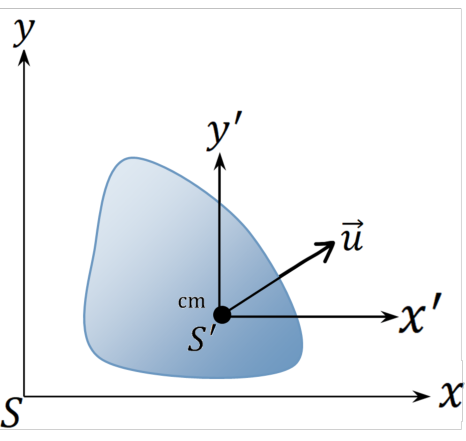
It can also be useful to consider a coordinate system relative to the centre of mass rather than a stationary observer. Figure 6.5 shows the difference between an initial reference frame from a stationary observer, S, and a moving frame, S′, located at the centre of mass of an irregular object. For simplicity, the centre of mass is moving with a constant velocity, u (so S′ is also an inertial frame). To an observer in S′, the irregular object would appear to be stationary (both the observer and the object are moving together). This means that the total momentum in the CM frame is zero.
Figure 6.5:Comparison between a stationary observer coordinate system (S) and a centre-ofmass coordinate system (S′). An irregular object is moving in the stationary frame. The centre of mass (cm) of this object has a speed u relative to the stationary frame. The S′ frame is fixed relative to the centre of mass and moves with it (such that the object would be stationary in the centre-of-mass frame).
Consider the same particle in both reference frames. The particle has a velocity vi in frame S and a velocity vi′ in frame S′. Since the two frames differ by a relative velocity u, the velocity in S and S′ are connected by,
This equation implies that if the total momentum must be conserved in both frames, because the final and initial momentum shifted by a constant amount (u). This case is true if there are no external forces (only internal forces) and no acceleration.
Stationary frame: To a stationary observer, the masses are moving before and after collision. From the conservation of momentum, we have:
CM frame: In the CM frame, the observer is moving with a speed of vcm corresponding to the centre of mass of the system. Note that the centre-of-mass velocity must be the same after the collision as before the collision because the centre-of-mass momentum is conserved (no external forces).
First, we can find vcm. For our two particles, their individual masses are constant and
Now we need to relate vcm to the final velocity, v. After the collision, M and m are stuck together and the system moves as one particle with a speed of v in the observer’s frame. In the CM frame, the post-collision system has a speed of:
But with only one particle, that particle represents the centre-of-mass position for the post-collision system. In the CM frame, the observer is moving with the centre of mass of the system, so there is no net velocity. That means v(M+m)′ = 0.
Thus, we can now find the final velocity, v in the CM frame.
Up until now, we have applied Newton’s second law as ∑F=ma. This equation is applicable if the system mass is constant with time. But you can have problems in physics where the mass changes.
Note that you recover ∑F=ma if the mass is constant (m˙ = 0). But if the mass is changing, then you must include the m˙ term as well when applying Newton’s second law.
A classic variable mass problem is a rocket (or car or airplane) using fuel. These objects lose mass with time, which will affect their momentum.
Recreational activities like air hockey, billiards (pool), and bumper cars are all built around the principle of collisions, whether elastic or inelastic. In general, these applications will always involve friction which will make the puck, balls, or car come to a halt given time. Each uses a different method to try to reduce that friction as far as possible: a layer of air to keep the puck off the table for air hockey, smooth paint on the balls and low-friction felt for billiards, and graphite sprinkled across a smooth metal floor for bumper cars.
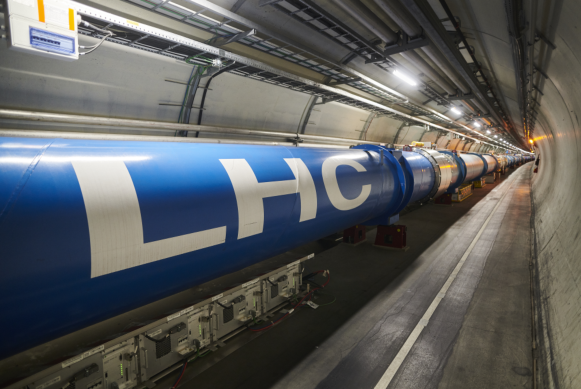
On a larger scale, collisions and momentum conservation are also crucial for particle physics. The Large Hadron Collider (LHC) at CERN, routinely collides particle beams. The particle beams travel in opposite directions around a 27-km accelerator ring, guided and accelerated to very high energies (very close to the speed of light) using thousands of super-cooled superconducting magnets, before being made to collide. While operating at relativistic velocities and energies, the same basic physics of conservation of momentum and energy applies in these collisions.
The objective of studying these ultra-high-energy collisions is to understand more about matter and how the universe evolved. The LHC is able to simulate energy levels and temperatures similar to those that existed approximately 10-12 seconds after the Big Bang. In relativistic collisions between free particles, energy and momentum are always conserved. The LHC has detectors to measure the speed, mass, and charge of the post-collision particles, which enables them to identify new particles based on the fundamental requirement that momentum must be conserved.
Figure 6.8:A very small section of the Large Hadron Collider tunnel. Image credit: CERN.