Learning Objectives¶
By the end of this chapter, you should be able to:
Distinguish the direct sound, the early reflections, and the reverberant field, and sketch the echogram of a room.
Explain why the inverse-square law fails indoors, and define the critical distance at which the reverberant field equals the direct sound.
Define the absorption coefficient, calculate the total absorption of a room from its surfaces, and explain why absorption depends on frequency.
Apply the Sabine equation to estimate reverberation time from room volume and absorption, and state the assumptions under which it is valid.
State the reverberation times appropriate to speech, chamber music, orchestral music, and organ music, and explain why they differ.
Explain the roles of specular reflection, diffusion, and absorption in a hall, and identify the acoustic defects each is used to address.
Calculate the lowest room modes of a rectangular room, and explain why they matter in a small room and not in a large one.
Identify the objective measures that correlate with the subjective judgment of a hall -- early decay time, clarity, and lateral energy -- and state what each measures.
Compare the shoebox, fan, and vineyard hall plans, and explain the acoustic argument for and against each.
Introduction¶
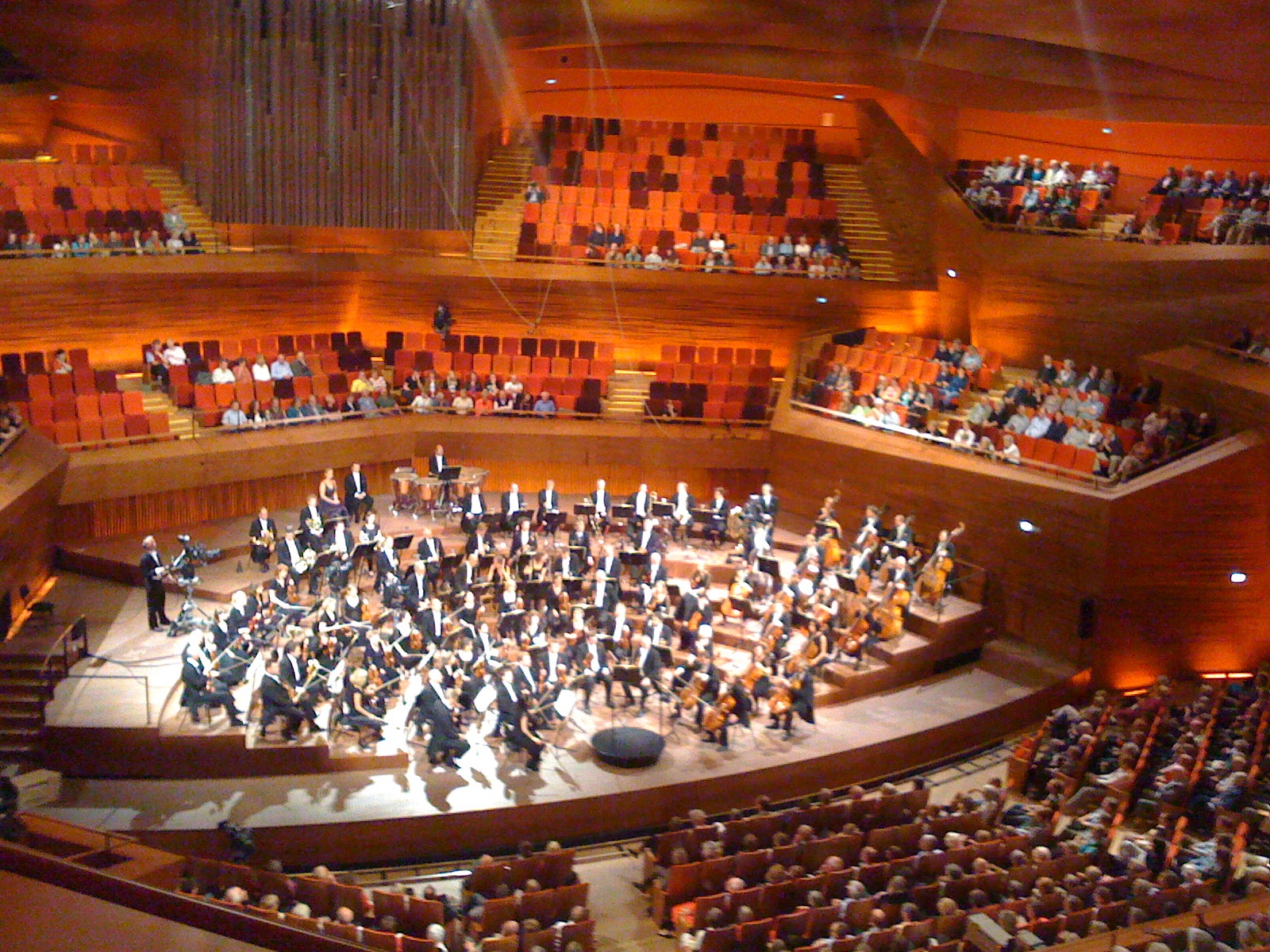
Figure 14.1:The Copenhagen Concert Hall, its seating rising around the stage on every side rather than facing it from one end. §14.5 returns to why a “vineyard” plan like this one is one of three basic answers to the same design problem. Jacob Bøtter, CC BY 2.0.
Everything so far has treated the instrument as the source of the sound a listener hears. It is not. Between the instrument and the ear is a room, and in almost every case most of what reaches the listener has bounced off something.
In a concert hall, a listener in the middle of the stalls receives perhaps a tenth of their sound energy directly from the stage. The rest arrives later, from every direction, having reflected once, twice, or a hundred times. The room is not a transparent medium through which music passes; it is part of the instrument.
This has two consequences that run through the chapter.
The room is unavoidable. A performance in a different hall is a different performance, in a way a listener notices immediately. Composers have written for particular acoustics, Gabrieli for the reverberation of San Marco, chamber composers for small dry rooms, and a piece played in the wrong acoustic can be incoherent.
The room is designable, but only partly. The quantities that matter have been measurable for a century and the correlations with subjective judgment are good but not perfect. Halls built on the best available understanding have failed, and the failures have generally taught more than the successes.
The chapter builds three things in order: a picture of what arrives at a listener and when; the single most useful number, the reverberation time; and then the harder question of why some halls with the right reverberation time are nevertheless bad.
14.1Sound in an Enclosure¶
Direct, Early, and Reverberant¶
A short sound on stage produces, at a listener’s ear, a long and structured sequence of arrivals.
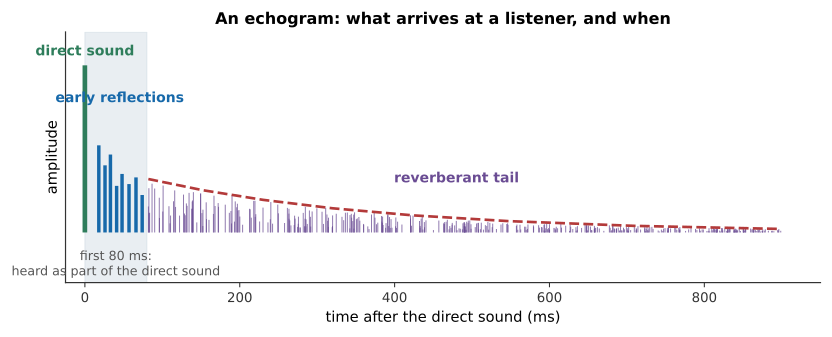
Figure 14.2:An echogram. The direct sound arrives first, by the shortest path. Early reflections follow within about 80 ms, having bounced once or twice. The reverberant tail is the accumulation of everything else, arriving so densely and from so many directions that individual reflections can no longer be distinguished.
The three parts do different perceptual jobs.
The direct sound tells you where the source is. It arrives first, and the auditory system’s precedence effect locates the source by it, disregarding the later arrivals for the purpose of direction.
The early reflections are not heard as echoes. Anything arriving within roughly 50–80 ms of the direct sound is fused with it, this is the Haas effect, and it makes the sound louder and fuller rather than doubled. Early reflections are therefore free loudness, and §14.4 shows that where they come from matters a great deal.
The reverberant tail provides the sense of a space. It is what makes a hall sound large, and it is what a recording engineer adds artificially when a recording sounds dead.
The Echogram¶
The echogram is the room’s impulse response: what a listener at one position receives from a source at one position, in response to a single impulse.
It contains everything linear about the room. Convolve any dry signal with it and you obtain what that signal would sound like at that seat, which is exactly how the audio examples in this chapter were made, and exactly how convolution reverb works in a recording studio (Chapter 15).
Critical Distance¶
Chapter 2 noted that the inverse-square law fails indoors. The place where it fails is the critical distance: the distance at which the direct sound and the reverberant field are equally strong.
with the prefactor 0.057 in , in cubic meters, and in seconds.
Inside , moving closer makes a real difference. Beyond it, the reverberant field dominates and moving further away changes the level very little. That is how the back row of a large hall stays audible at all, and also why it is so much less clear than the front.
14.2Absorption and Reverberation Time¶
The Absorption Coefficient¶
Every reflection loses energy. The absorption coefficient of a surface is the fraction of incident energy it does not reflect: 0 for a perfect mirror, 1 for an open window.
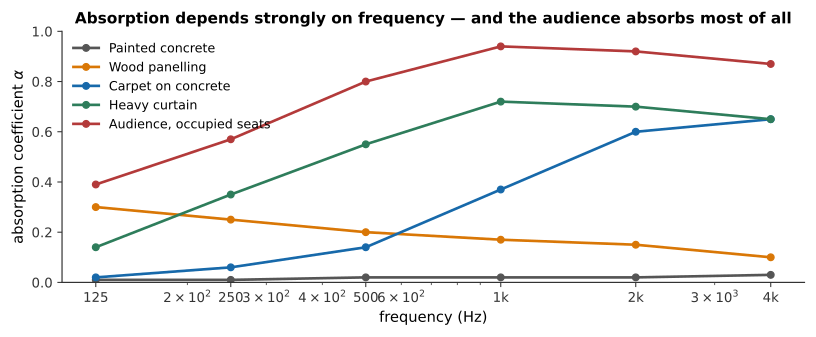
Figure 14.3:Absorption coefficients of common surfaces. Two things matter here. Absorption depends strongly on frequency, most soft materials absorb treble far better than bass, so untreated rooms tend to sound boomy. And the audience is the most absorbent thing in the hall.
That last point is a practical problem rather than a curiosity. A full hall and an empty hall are acoustically different rooms, and a rehearsal in an empty hall is a poor guide to the concert. Halls are designed with heavily upholstered seats chosen so that an empty seat absorbs approximately as much as an occupied one: concert-hall seating is therefore much plusher than cinema seating, and it is a specified acoustic component rather than a comfort decision.
The Sabine Equation¶
Wallace Sabine, working at Harvard in the 1890s on a lecture room that nobody could hear in, established the first quantitative result in architectural acoustics.
The reverberation time is the time for the sound level to fall by 60 dB after the source stops: a factor of a million in energy. Sabine found
with the volume in cubic meters, each surface’s area, the total absorption in square meters of equivalent open window, and the constant 0.161 in s/m (it is at room temperature; see Exercise 14.11).
The equation says something simple: bigger rooms ring longer, more absorbent rooms ring less, and the trade is linear in both.
How Long Should a Hall Ring?¶
There is no single right answer, because different music wants different things.
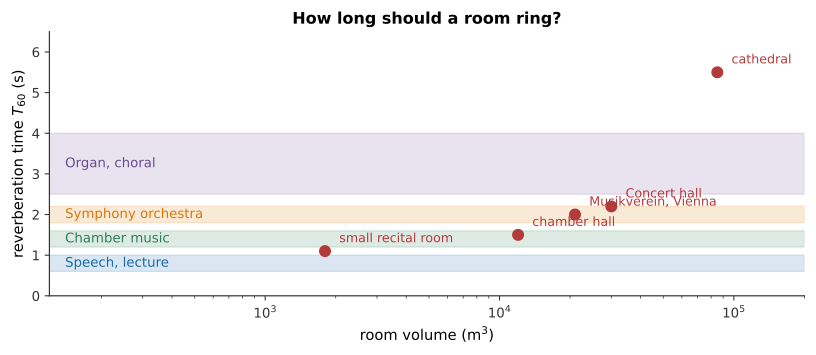
Figure 14.4:Reverberation times for different purposes. Speech needs a short time, because syllables arriving on top of one another destroy intelligibility. Orchestral music wants around 2 s. Organ and choral music, written for buildings with 4 s or more, want the reverberation to be part of the texture.
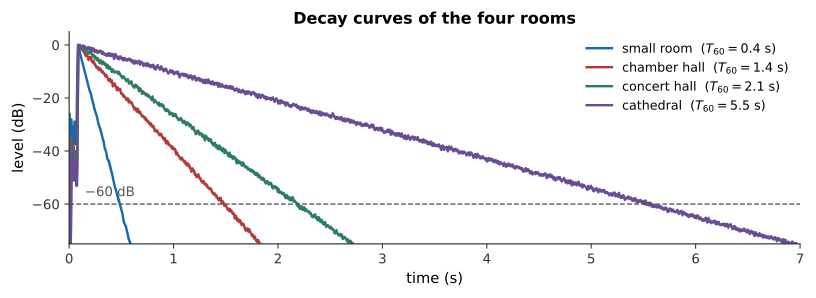
Figure 14.5:One phrase, four rooms. Listen to the last note in each: in the cathedral it is still audible long after the phrase has ended, and the earlier notes are still sounding underneath it. That blurring is why music written for such buildings moves slowly and changes harmony rarely.
What you hear: The same four-note phrase four times. The first is completely dry and sounds artificial and close. The second is natural but small. The third is full and spacious. The fourth blurs the notes into each other so that the last chord contains all of them.
Listen: Dry (anechoic), Small room, Concert hall, Cathedral
The conflict between speech and music is real and unresolvable. A hall optimized for an orchestra is poor for a lecture and vice versa, and a multi-purpose hall is a compromise that satisfies nobody completely. Section 14.5 therefore takes up variable acoustics.
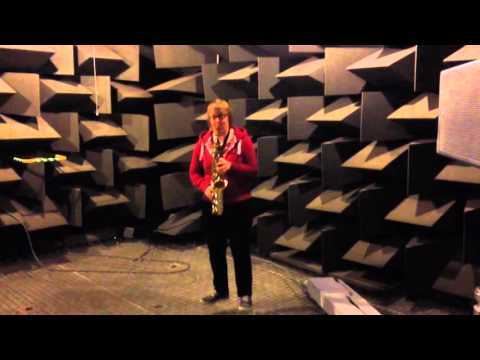
Figure 14.6:The same saxophone is heard in two acoustic extremes: first surrounded by a long reverberant tail, then almost entirely stripped of reflected sound. The contrast isolates how strongly a room becomes part of an instrument’s sound.
Watch on YouTube: Saxophone in a Reverberation Room and an Anechoic Chamber
14.3Reflection, Diffusion, and Modes¶
Specular Reflection and Its Defects¶
A flat, hard surface reflects sound specularly: angle in equals angle out, like a mirror. Useful for directing sound where you want it, and the source of three classic defects.
An echo is a single reflection arriving late enough, more than about 80 ms after the direct sound, so more than about 27 m of extra path, and strongly enough to be heard separately. A flat rear wall in a long hall is the usual culprit.
Flutter echo is a rapid series of reflections bouncing between two parallel hard surfaces, heard as a metallic ringing after a handclap. Splaying one wall by a few degrees eliminates it entirely.
Focusing occurs when a concave surface, a domed ceiling, a curved rear wall, concentrates reflections at a point. The focus is much too loud and the surrounding seats are starved. Concave surfaces facing an audience are avoided for this reason, and where architecture demands one it is usually broken up or covered.
Diffusion¶
The remedy for all three is diffusion: surfaces that scatter sound in many directions rather than reflecting it in one.
Diffusion is why historic halls sound as good as they do. The Musikverein in Vienna and the Concertgebouw in Amsterdam are covered in statuary, coffered ceilings, niches, balustrades, and moldings, all on the scale of a few tens of centimeters, comparable to the wavelengths of musical sound, and therefore excellent scatterers. The decoration was not acoustically motivated, and it turned out to be acoustically essential.
Twentieth-century halls with large smooth surfaces often disappointed for exactly this reason, and modern designs restore diffusion deliberately, sometimes using mathematically designed diffusers whose depths follow a number-theoretic sequence.
Room Modes and Why Small Rooms Are Hard¶
In a large hall the sound field is dense enough to treat statistically. In a small room it is not.
A rectangular room’s modes are at
and at low frequencies they are sparse.
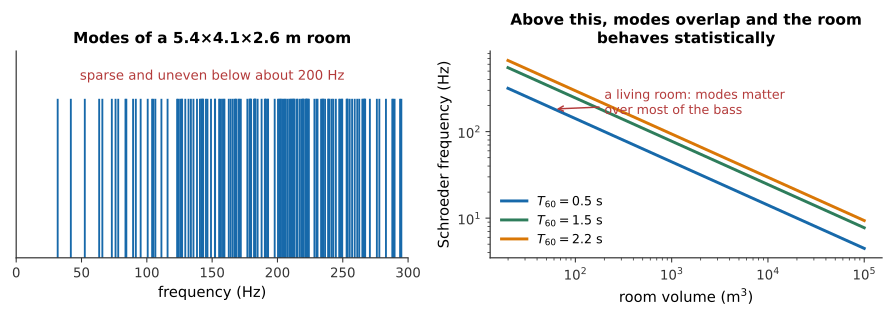
Figure 14.7:Left: the modes of a small room, individually resolvable below about 200 Hz. Right: the Schroeder frequency, above which modes overlap enough that the room behaves statistically. For a living room it is a few hundred hertz; for a concert hall it is around 20 Hz. Halls can therefore be analyzed statistically; bedrooms cannot.
Below the Schroeder frequency the room’s response is a sparse set of peaks and nulls that does not average out. Bass notes at a modal frequency boom; bass notes between modes disappear. Moving your head changes the bass. This is the fundamental difficulty of small-room acoustics, and a studio control room costs more to treat than a concert hall costs per cubic meter for just that reason.
14.4What Makes a Hall Sound Good¶
Beyond Reverberation Time¶
By the mid-twentieth century was well understood, and halls were being built with correct reverberation times that musicians disliked. Something was missing.
What was missing was that is a single number describing an average over the whole room and the whole decay, and listeners respond to much more: to when the energy arrives, from which direction, and at which frequencies.
Clarity, Warmth, and Intimacy¶
Several measures now supplement , and each corresponds to something a musician can name.
Early decay time (EDT) measures the slope of the first 10 dB of decay rather than extrapolating from 60. It corresponds far better to perceived reverberance, because the first 10 dB is what a listener actually hears before the next note arrives.
Clarity is the ratio, in decibels, of energy arriving in the first 80 ms to everything after:
High means detail and articulation; low means blend and wash. Around 0 dB suits orchestral music; higher suits opera, where words matter.
Warmth (bass ratio) compares reverberation time at low frequencies to that at mid frequencies. A hall whose bass rings longer sounds warm; one whose bass dies first sounds thin. Since Chapter 14’s absorption figure showed that soft materials absorb bass worst, warmth is usually easy to obtain and thinness usually means too much paneling.
Intimacy is the delay between the direct sound and the first reflection. A short delay makes a large hall feel small, and it is the reason side walls close to the audience matter.
Lateral Energy and Spatial Impression¶
The most important discovery of twentieth-century hall acoustics is that the direction the early reflections come from matters more than their strength.
Reflections arriving from the sides make the sound seem to come from a broad source and make the listener feel surrounded. Reflections from the ceiling do not, because they reach both ears nearly identically.
The reason is binaural: a lateral reflection reaches the two ears at different times and levels, and that difference is what produces the impression of spaciousness. A ceiling reflection is symmetric and the auditory system simply folds it into the direct sound.
The measure is the lateral fraction, the proportion of early energy arriving from the sides, and it correlates with subjective preference better than almost anything else.
This single result explains the enduring success of the shoebox hall. A narrow rectangular room puts every listener close to a side wall; a wide fan-shaped one does not.
14.5Halls in Practice¶
Shoebox, Fan, and Vineyard¶
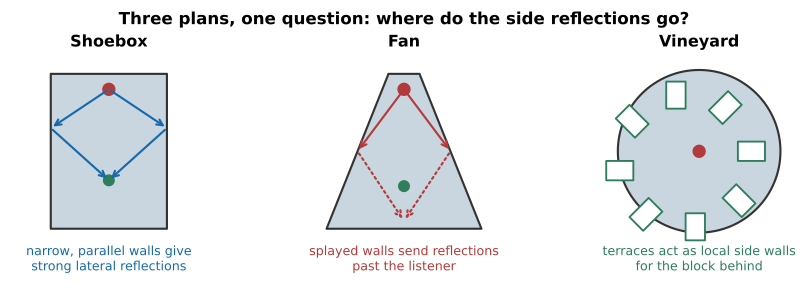
Figure 14.8:Three plans. The question in each case is where the early side reflections go.
The shoebox, Vienna’s Musikverein (1870), Amsterdam’s Concertgebouw (1888), Boston Symphony Hall (1900), is narrow, high, rectangular, and heavily decorated. It is consistently at the top of every ranking of concert halls, and the reasons are now understood: narrow width gives strong lateral reflections, high ceilings give volume without width, and the decoration diffuses.
Its disadvantage is capacity. A shoebox cannot be widened without losing what makes it work, so seats must go into balconies, and the hall becomes tall and expensive.
The fan shape spread in the twentieth century because it seats more people closer to the stage. Acoustically it is usually worse: splayed side walls reflect sound toward the back of the hall rather than across it, so the lateral fraction is low and the sound is clear but flat.
The vineyard, introduced at the Berlin Philharmonie (1963), surrounds the orchestra with terraced blocks of seating. The retaining walls of each terrace act as local side walls for the block behind, providing lateral reflections that a single large volume could not. It also allows large capacity with everyone close to the stage.
Famous Successes and Famous Failures¶
The literature’s standard cautionary tale is the original Philharmonic Hall at New York’s Lincoln Center (1962), which was widely judged a failure on opening, thin bass and poor blend, and was rebuilt more than once, eventually being gutted entirely.
The useful lesson is not that its designers were careless; they were not. It is that the quantities known to matter in 1962 were fewer than the quantities that do matter, and that a hall is a single very expensive experiment that cannot be run twice. Much of what is now known about lateral energy was learned from halls that had already been built.
Variable Acoustics and Electronic Enhancement¶
Since no fixed acoustic suits everything, modern halls increasingly vary theirs.
Mechanically: retractable curtains and banners over wall and ceiling absorbers; adjustable reverberation chambers, which are volumes coupled to the main hall through openings that can be closed; movable ceiling reflectors above the stage.
Electronically: a system of microphones, processors, and many distributed loudspeakers that adds reverberant energy. Modern systems are good enough that listeners cannot reliably detect them, and they can turn a dry drama theater into a plausible concert hall at the press of a button.
Electronic enhancement remains controversial, and the argument is worth stating honestly. The objection is not that it does not work, it does, but that a hall’s acoustic has been part of the compositional and performing tradition, and that a variable acoustic makes it a production decision rather than a fact about the building. That is an aesthetic disagreement rather than a physical one, and this book takes no side in it.
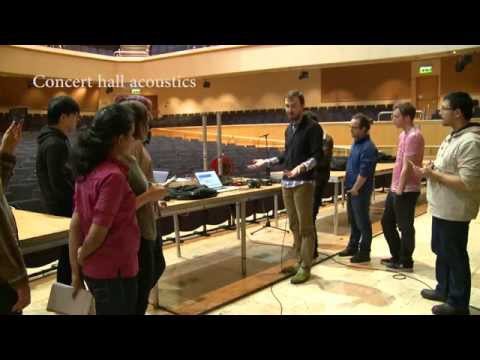
Figure 14.9:Students from the University of Edinburgh measure the Glasgow Royal Concert Hall. Their tests connect reverberation time and reflections to the practical work of characterizing a real performance space.
Watch on YouTube: Glasgow Royal Concert Hall Acoustics
14.6Summary¶
Most of what a listener hears has reflected. The room is part of the instrument, and beyond the critical distance the reverberant field dominates and the inverse-square law fails.
Three parts of the arrival: the direct sound locates the source; early reflections within about 80 ms fuse with it and add loudness and fullness (the Haas effect); the reverberant tail gives the sense of space.
The echogram is the room’s impulse response, and convolving a dry signal with it reproduces what that seat would hear, which is how convolution reverb works.
The absorption coefficient is frequency-dependent: soft materials absorb treble far better than bass. The audience is the most absorbent element, so seats are designed to absorb like occupied ones.
The Sabine equation (with 0.161 in s/m) gives reverberation time from volume and total absorption. It assumes a diffuse field and fails for very absorbent, awkwardly shaped, or unevenly treated rooms.
Target reverberation times run from 0.6–1.0 s for speech through 1.8–2.2 s for orchestral music to 4 s and beyond for organ and choral music.
Specular reflection produces echo, flutter, and focusing; diffusion cures all three, and is why heavily decorated historic halls sound good.
Below the Schroeder frequency, room modes are individually audible. This is the fundamental difficulty of small rooms and is why bass is position-dependent in a living room and not in a hall.
is not enough. Early decay time, clarity , warmth, and intimacy each correspond to something musicians can name.
Lateral energy is the key discovery: early reflections from the sides produce spaciousness because they reach the two ears differently, while ceiling reflections do not. Narrow shoebox halls outperform wide fan-shaped ones for that reason.
14.7Check Your Understanding¶
Five short, auto-graded questions cycle within one compact activity, using five different response styles.
Multiple choice. A diffuse room has volume and total absorption sabins. Does the Sabine equation predict about 0.16, 1.6, 6.2, or 16 s?
True or false. Beyond the critical distance, level continues to fall by 6 dB for every doubling of distance because direct sound dominates.
Drag the words. Match direct sound, early reflections, the reverberant tail, and lateral energy to their perceptual roles.
Fill in the blanks. Beyond the ___ distance, the ___ field dominates over direct sound.
Mark the words. Identify three specular-reflection defects that diffusion helps cure: “Diffusion helps prevent distinct echo, repeated flutter, and curved-wall focusing by scattering reflections.”
14.8Conceptual Questions¶
Explain why a listener in the back row of a large hall hears a sound only a little quieter than one in row ten, but appreciably less clear.
Explain why a reflection arriving 30 ms after the direct sound is not heard as an echo, while one arriving 150 ms later is.
A hall sounds very different when empty and when full. Explain why, and say what hall designers do about it.
Explain why a room treated only with thin carpet and curtains tends to sound boomy.
A handclap in a corridor produces a metallic ringing. Name the defect, explain its cause, and give a cure.
Explain why room modes are a serious problem in a living room and not in a concert hall.
Explain why an early reflection from a side wall contributes more to a sense of spaciousness than an equally strong one from the ceiling.
Explain why fan-shaped halls seat more people and generally sound worse than shoebox halls.
14.9Problems¶
Solution to Exercise 14.1 #
(a) Using the Sabine equation:
(b) Yes. Two seconds sits squarely in the 1.8–2.2 s band that orchestral music wants, as Figure 14.4 shows.
Solution to Exercise 14.2 #
Solution to Exercise 14.3 #
(a) Empty: m²:
(b) Full: m²:
(c) The hall is 0.6 s longer empty: a difference every musician would notice. An orchestra rehearsing in the empty hall hears more reverberation than the audience will, so it will tend to play with less sustain and less blend than the concert requires, and balances set in rehearsal will be wrong.
This is exactly why hall designers specify seats whose empty absorption is close to their occupied absorption. Here the ratio is 0.45 to 0.85, which is poor; a well-designed seat would be nearer 0.75 to 0.85.
Solution to Exercise 14.4 #
(a)
(b) Both positions are beyond the critical distance, so both are in the reverberant field, where the level is essentially uniform. The drop is small: a couple of decibels at most.
Outdoors, the inverse-square law gives
Therefore the room saves the distant listener about 10 dB, which is most of the reason a two-thousand-seat hall works without amplification.
Solution to Exercise 14.5 #
(a) s ms.
(b) Fused. Anything within about 80 ms is integrated with the direct sound by the Haas effect, and contributes loudness rather than being heard separately.
(c) The threshold is about 80 ms, so
of extra path. In a hall 40 m long, a listener near the front and a hard rear wall can easily produce this, so rear walls are treated.
Solution to Exercise 14.6 #
(a) Axial modes are at along each dimension:
(b) m³:
(c) Below 163 Hz the modes are individually resolvable, and the three lowest are widely separated at 29, 38, and 61 Hz. A bass note landing on a mode will boom; one landing between modes will nearly disappear; and both effects depend on where the listener sits.
Therefore bass in this room is position-dependent and uneven over the whole of the lowest two octaves of music, which is the normal state of domestic listening, and the reason studio control rooms need extensive low-frequency treatment.
Solution to Exercise 14.7 #
(a) From :
(b) For 0.8 s:
(c) The extra absorption needed is m². Panels of provide 0.85 m² of absorption per square meter, but they also cover an existing surface. Taking the existing wall as roughly , each square meter of panel adds a net 0.80 m²:
Therefore about 84 m² of paneling: a substantial fraction of the room’s surface, and the reason retrofitting a bad lecture room is expensive. This is essentially the problem Sabine was hired to solve.
Solution to Exercise 14.8 #
(a) The bass ratio is the low-frequency reverberation time divided by the mid:
(b) Warm. A bass ratio above about 1.1–1.2 is the usual criterion for warmth, and this hall exceeds it.
(c) Anything that absorbs more mid and high frequency or less bass. In practice the lever is usually the other way round: to lower a bass ratio you add bass traps, since Chapter 14’s absorption figure shows that ordinary soft furnishing absorbs bass poorly. To raise it further one would reduce thin paneling, which acts as a low-frequency absorber by flexing, and use massive rigid surfaces instead, which is what the stone and plaster of historic halls provide.
Solution to Exercise 14.9 #
The critical distance is
By definition, at the direct and reverberant energies are equal. The reverberant energy is uniform throughout the room, while the direct energy falls as . So at 30 m the direct sound has fallen relative to its value at by
while the reverberant energy is unchanged.
Therefore the direct sound is only about of the total: the listener is receiving roughly reflected energy. In decibels the direct sound is dB relative to the reverberant field.
This is the quantitative form of the chapter’s opening claim, and it is why the room matters as much as the orchestra.
Solution to Exercise 14.10 #
(a)
(b) Symphonic music. A slightly negative means the late energy slightly exceeds the early, which gives blend and fullness at some cost in articulation, good for orchestral texture. Opera wants words to be intelligible and is usually happier with around +1 to +4 dB.
(c) Raising means shifting energy earlier. In practice: reflectors placed to return sound to the audience quickly, a lower ceiling over the stage, and more absorption on distant surfaces to shorten the tail. Reducing the overall volume does both at once.
Solution to Exercise 14.11 #
In a diffuse field, the mean free path between reflections is , where is the total surface area. The mean time between reflections is therefore
At each reflection a fraction of the energy is absorbed, so after reflections the energy is . Writing :
For small , , so
Set , which is -60 dB:
Therefore the constant 0.161 s/m is , it contains the speed of sound, and would differ in another medium or at another temperature. Note also where the small- approximation entered: it is exactly why the equation fails for very absorbent rooms, and the Eyring correction is what you get by keeping intact.
Solution to Exercise 14.12 #
(a) Take the source on the center line at the stage and the listener 20 m back. For a wall at distance from the center line, the reflected path is approximately
Shoebox, m: path m, against 20 m direct: an extra 9.7 m, so a delay of 28 ms.
Fan, m: path m: an extra 26.5 m, so a delay of 77 ms.
(b) The shoebox. Its side reflections arrive at 28 ms, comfortably inside the fusion window, strongly, and from the sides, exactly the lateral energy that produces spatial impression. The fan’s arrive at 77 ms, at the very edge of the window, much weaker for having traveled further, and from a shallower angle that is closer to frontal than lateral.
Therefore the same reverberation time can produce very different halls, which is the whole point of §14.4 and the reason alone was never enough.
Solution to Exercise 14.13 #
(a) The impulse response of the hall, from the source position to the listening position, in practice measured with a swept sine or a starter pistol and a microphone, then processed to recover the response.
(b) Convolution of the dry recording with the impulse response. Every sample of the dry signal is replaced by a scaled copy of the whole impulse response, and the copies are summed.
(c) That the room is linear and time-invariant. Linear means superposition holds (Chapter 3), so the response to a sum of sounds is the sum of the responses, true for any room at musical levels. Time-invariant means the room does not change during the recording, which fails if the audience arrives, the temperature drifts, or a door opens.
It also assumes the source and listener stay where they were when the response was measured, so a moving source in a convolution reverb never sounds quite right.
Solution to Exercise 14.14 #
(a) For speech:
For music:
(b) The difference is m² of absorption that must be introduced for speech and removed for music, more than the entire absorption required in the music configuration.
(c) Two mechanisms:
Retractable absorbers: heavy velour banners on motorized rollers, deployed over wall and ceiling surfaces. Roughly 1400 m² of banner at would do it, which is a great deal of fabric and storage volume.
Coupled reverberation chambers: volumes adjoining the hall, connected through motorized doors. Opening them increases the effective volume and the reverberation; closing them shortens it. This is the more elegant solution, since it changes rather than , and it is used in several modern halls.
Therefore the required change is large, and a hall that does both well is a genuinely difficult and expensive building. Most venues therefore choose one purpose and accept being mediocre at the other.