Learning Objectives¶
By the end of this chapter, you should be able to:
State the superposition principle, apply it graphically to find the resultant of two overlapping waves, and identify the condition under which it fails.
Convert a path-length difference into a phase difference, and predict whether two waves from separated sources interfere constructively or destructively at a given point.
Explain why two loudspeakers playing the same tone produce dead spots in a room, and estimate the spacing between them.
Describe what happens to a wave pulse reflected from a fixed end and from a free end, and explain the inversion at a fixed end.
Explain how a standing wave arises from two identical waves traveling in opposite directions, and locate its nodes and antinodes.
Derive the frequencies of the standing-wave modes of a string fixed at both ends, , and use them to explain why a shorter or tighter string sounds higher.
Derive the mode frequencies of an open and of a stopped air column, and explain why a stopped pipe sounds an octave lower than an open pipe of the same length and produces only odd harmonics.
Explain why a standing wave is the reason an instrument has a definite pitch at all.
Introduction¶
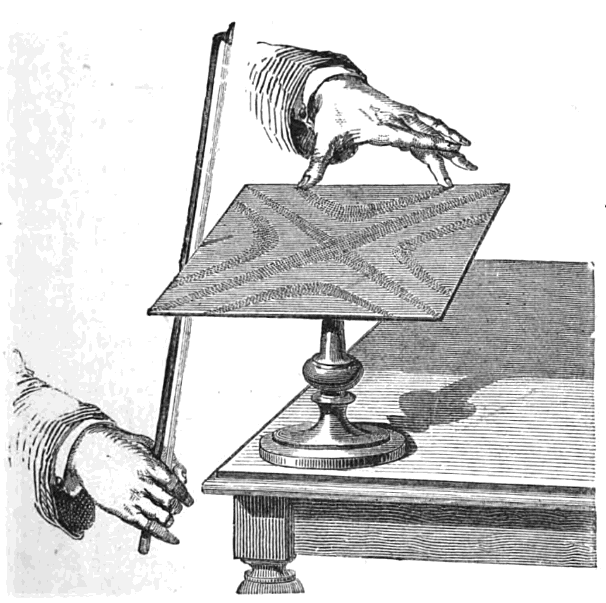
Figure 3.1:An early experiment in making modes visible: a bowed plate gathers sand along its nodal lines. Public-domain illustration from 1879.
So far the book has followed one wave at a time. Music never does. A room is full of waves, the direct sound from the instrument, the reflection off the back wall, the note the second violin is playing, the reflection of that off the ceiling, all arriving at your ear at once and all adding up.
What they add up to is the subject of this chapter, and it is governed by one very simple rule with one very surprising consequence.
The rule is superposition: where two waves overlap, the displacements simply add. There is no interaction, no collision, no scattering of one wave off the other. Two waves pass through each other and emerge unchanged, as though nothing had happened.
The consequence is that waves can cancel. Two sounds can arrive at a point and produce silence there. And when a wave meets a wall, reflects, and runs back into itself, the adding-and-canceling settles into a stationary pattern, a standing wave, that can only exist at certain frequencies.
That last sentence is the reason musical instruments have pitches. Everything in Part V is an elaboration of it.
3.1The Superposition Principle¶
Adding Waves Point by Point¶
The rule is as simple as it sounds. If wave 1 alone would produce a displacement at some point and some moment, and wave 2 alone would produce there and then, the two together produce
That is all. The waves do not know about each other.
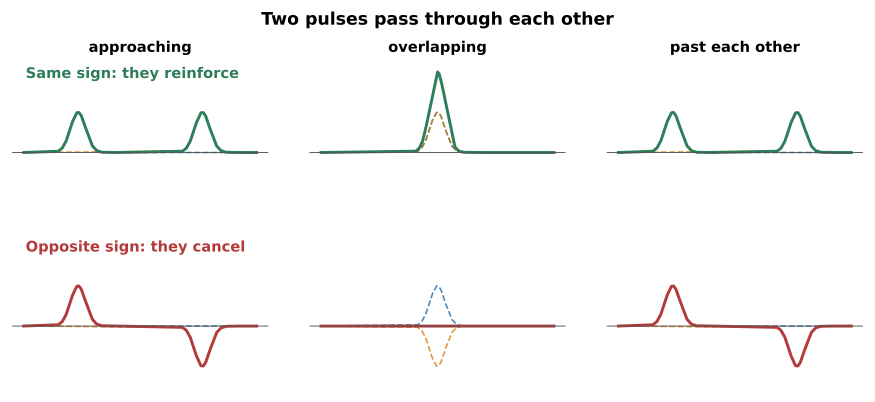
Figure 3.2:Two pulses passing through each other. In the top row they have the same sign and momentarily reinforce; in the bottom row they have opposite signs and momentarily cancel. In both cases they emerge on the other side exactly as they went in. The cancellation in the middle of the bottom row is complete, at that instant the medium is flat, but it is not the end of the pulses.
The bottom row of that figure deserves a moment’s thought, because it looks like a violation of energy conservation. At the instant the two pulses exactly cancel, the string is perfectly straight. Where has the energy gone?
Into motion. The string is straight but it is not still: every point of it is moving, fast, and the energy is entirely kinetic at that instant. A moment later the pulses re-emerge. Superposition adds displacements, and displacement is not the only place a wave keeps its energy.
Constructive and Destructive Interference¶
When two waves of the same frequency overlap steadily, what matters is their relative phase.
In step, crest on crest, they reinforce. This is constructive interference, and the resulting amplitude is the sum of the two.
Exactly out of step, crest on trough, they cancel. This is destructive interference, and if the amplitudes are equal the result is nothing at all.
In between, something in between.
Two loudspeakers playing the same steady tone are the standard demonstration. Walk across the room in front of them and the tone rises and falls: loud where the two arrivals are in step, and startlingly near-silent where they are opposed.
Where Superposition Breaks Down¶
Superposition holds because the wave equation is linear: the restoring force is proportional to the displacement, as in Chapter 1. Everything in this chapter depends on that.
It is an approximation, and it fails at large amplitudes. In an extremely loud sound wave the compressions travel slightly faster than the rarefactions, because compressed air is hotter and therefore stiffer; a wave that starts sinusoidal steepens as it travels, and at the limit it becomes a shock. This is not a musical regime, it takes something like a jet engine or an explosion, but it lurks in two places the book will return to: inside a brass instrument played very loudly, where the wave really does steepen on its way down the bore and adds a characteristic brightness to a fortissimo (Chapter 11), and in a cymbal driven hard, where nonlinearity spills energy into a dense forest of new frequencies (Chapter 12).
3.2Interference in Space¶
Path Difference and Phase Difference¶
The phase relationship between two arrivals at a listener is set by how far each has traveled. If the two sources emit in step, then all that matters is the path difference
A path difference of exactly one wavelength puts the two arrivals back in step: the second has been delayed by exactly one full cycle. A path difference of half a wavelength puts them exactly opposed. In general, the phase difference is
and the conditions are:
with
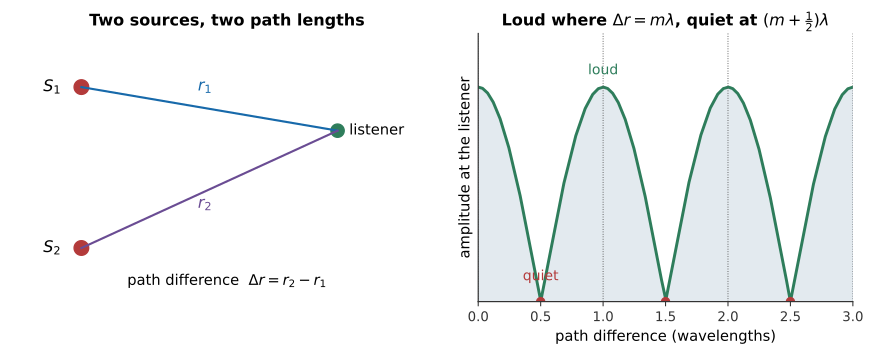
Figure 3.3:Two sources and a listener sweeping past them. Everything depends on the difference between the two path lengths, measured in wavelengths, tracked by the moving dot on the right. The listener hears maximum loudness whenever that difference is a whole number of wavelengths and silence whenever it is a half-integer.
Two Sources in a Room¶
The worked example understates the problem in a real room, because a real room has far more than two sources. Every reflecting surface acts as an image of the loudspeaker, so a single speaker in a rectangular room behaves like a large array of them, all radiating the same signal from different distances.
The result is that the sound field in a small room at low frequencies is a lumpy landscape of loud and quiet regions that does not change with time. Move your head and the bass changes. This is the room-mode problem, and Chapter 14 shows that it is worst exactly where it is most annoying: at low frequencies, where wavelengths are comparable to the room dimensions.
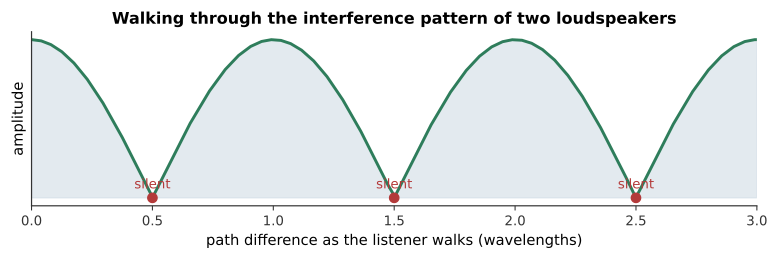
Figure 3.4:What a listener hears walking through the interference pattern of two loudspeakers playing the same 500 Hz tone. The loudspeakers are not changing; the listener’s position is, and with it the path difference. Each near-silence is a half-integer number of wavelengths.
What you hear: A steady tone that fades almost completely to silence three times, then returns to full loudness, as though someone were walking slowly past two loudspeakers.
Listen: Walking Through Interference
Interference You Can Walk Through¶
Two things about that demonstration are worth drawing out, because both bear on music.
It is frequency-dependent. The pattern’s spacing scales with the wavelength, so a given pair of sources produces a coarse pattern for bass and an extremely fine one for treble. Play music through two speakers rather than a single tone and no listener hears silence, because the nulls for different frequencies are in different places. What they hear instead is a position-dependent coloring of the sound, some frequencies reinforced, others suppressed, which is precisely the “comb filtering” that recording engineers work to avoid.
It requires a stable phase relationship. Two speakers fed from the same source stay in step indefinitely, so the pattern stands still. Two different instruments playing the same written note do not: their frequencies differ slightly and continuously, so the pattern drifts rather than standing still, and the listener hears beats (Chapter 8) rather than a fixed geography of loud and quiet.
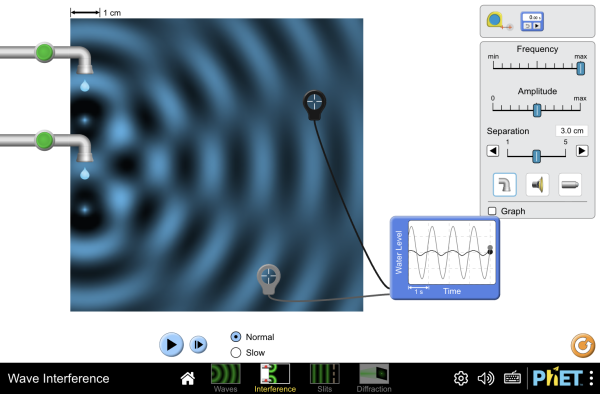
Figure 3.5:Two sources on the sound screen, with the interference pattern drawn out. Raise the frequency and note that the pattern’s spacing narrows, the geometry is fixed, and only the wavelength has changed. The water screen shows the identical geometry with ripples instead of sound, if a visible medium helps first.
Interactive simulation: Wave Interference
3.3Reflection and the Standing Wave¶
Reflection at a Fixed and a Free End¶
A wave traveling along a string reaches the end. What happens next depends entirely on what is there.
If the end is clamped, it cannot move. But the arriving pulse is trying to move it, so the clamp must push back with an equal and opposite force, and the reflected pulse comes back inverted.
If the end is free, attached to a ring that can slide on a frictionless rod, say, nothing resists the motion. The end overshoots, and the pulse comes back the same way up.
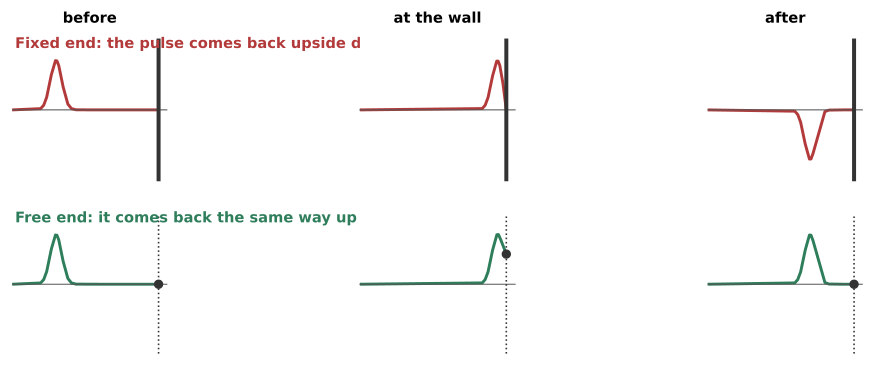
Figure 3.6:Reflection at the two extreme boundaries. A fixed end forces the displacement to zero there, which can only be arranged if the reflected pulse is inverted; a free end imposes no such condition and the pulse returns upright. Real boundaries lie between these extremes, and the fraction of energy reflected is governed by the impedance mismatch of §2.4.
The same distinction applies to air columns, with one twist that catches everyone out. The closed end of a pipe is a place where the air cannot move: a displacement node, but it is a place where the pressure swings most: a pressure antinode. The open end is the reverse. Section 3.5 returns to this; you need to decide now which of the two quantities you are drawing, because the two pictures look like each other’s opposites.
Two Waves, Opposite Directions¶
Now put the two together. Send a continuous wave down a string toward a fixed end. It reflects and travels back, and from then on the string carries two identical waves traveling in opposite directions at once. Superposition says to add them.
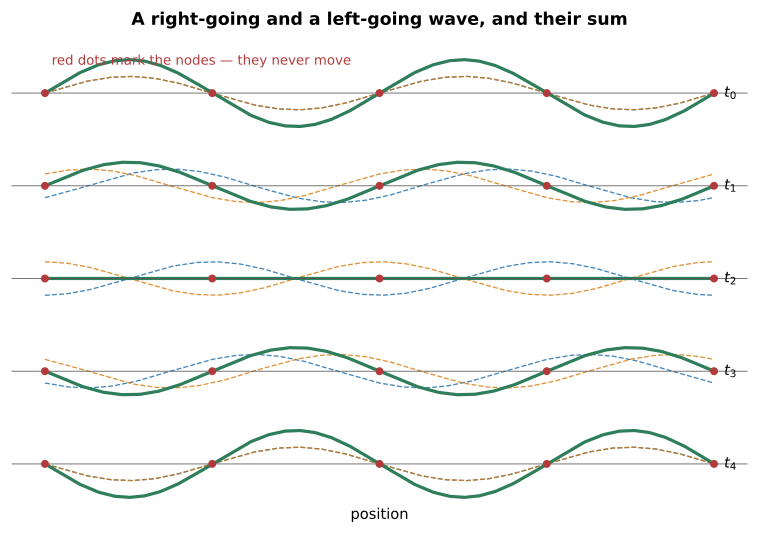
Figure 3.7:A right-going wave and a left-going wave of the same frequency and amplitude, added continuously. The sum does not travel. It stands still and breathes: the whole pattern grows, shrinks, inverts, and grows again, but the points where it crosses zero never move.
That is a standing wave, and the striking thing about it is that nothing propagates. Energy sloshes back and forth locally; the pattern itself goes nowhere.
The trigonometry, in two lines
Two identical waves traveling in opposite directions are and . Adding them, and using :
The result has factored: one factor depends only on position, the other only on time. That separation is the standing wave. The shape is fixed in space; the factor scales the whole of it up and down together.
Compare this with the traveling wave it came from, , in which and appear only in the combination , which is what makes the pattern move. The difference between a wave that travels and a wave that stands is exactly whether space and time can be separated.
The nodes are where , that is , or . They are spaced half a wavelength apart, and they are permanently at zero: no value of makes them move.
Nodes, Antinodes, and What Does Not Move¶
Two names for the parts of a standing wave:
A node is a point that never moves. Nodes are half a wavelength apart.
An antinode is a point that moves most. Antinodes lie halfway between nodes, also half a wavelength apart.
You can find the nodes of a guitar string by touching it very lightly at various points while it sounds. Touch an antinode and the note dies; touch a node and it carries on, because you are holding a point that was not moving anyway. This is not a party trick, it is exactly how a string player produces harmonics, and §3.4 uses it.
3.4Standing Waves on a String¶
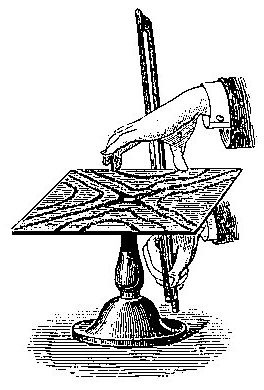
Figure 3.8:Nodal lines are not merely a drawing convention: powder makes them visible on a vibrating surface. Émile Desbeaux, public domain.
Fitting Half-Wavelengths Between Two Ends¶
A string fixed at both ends must have a node at each end. That is a boundary condition, and it is very restrictive: only those standing waves which happen to have nodes exactly apart can exist on the string at all.
Since nodes are half a wavelength apart, the condition is that a whole number of half-wavelengths must fit into the length:
so
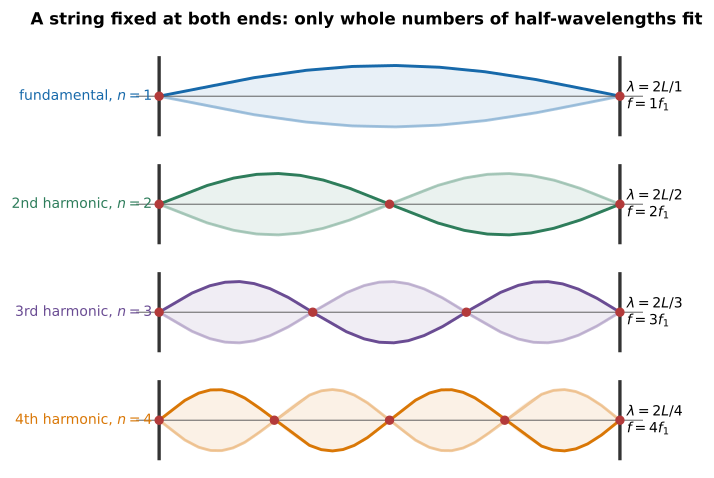
Figure 3.9:The first four modes of a string fixed at both ends, each drawn as an envelope the string sweeps between, with the instantaneous shape oscillating inside it. The th mode has half-wavelengths in the length, nodes between the ends, and a frequency times the fundamental — watch the higher modes oscillate faster.
Combining this with the string’s wave speed from Chapter 2, :
This is the single most useful formula in the book’s treatment of instruments, and every term in it is a lever an instrument maker or player can pull:
| Change | Effect on pitch | Who uses it |
|---|---|---|
| Shorten | Higher | Every fretting or stopping hand |
| Raise tension | Higher | Tuning pegs |
| Raise mass per length | Lower | Wound bass strings |
Note the square roots. Doubling the tension does not double the frequency; it raises it by a factor of , about seven semitones. To raise a string by an octave you must quadruple its tension; so instruments are tuned by shortening rather than by tightening, and the strings of a piano are of enormously varied length and mass rather than of varied tension alone.
The Harmonic Series of a String¶
The set of frequencies is the harmonic series, and the fact that it comes out as exact whole-number multiples is not an accident of the algebra. It is a consequence of the boundary conditions being the same at both ends and of the wave speed being the same at every frequency.
It is also, arguably, the reason Western music sounds the way it does. Chapters 5, 8, and 9 are all downstream of it: the harmonic series determines what a plucked string’s spectrum contains, which determines which intervals sound smooth, which determines what a scale is.
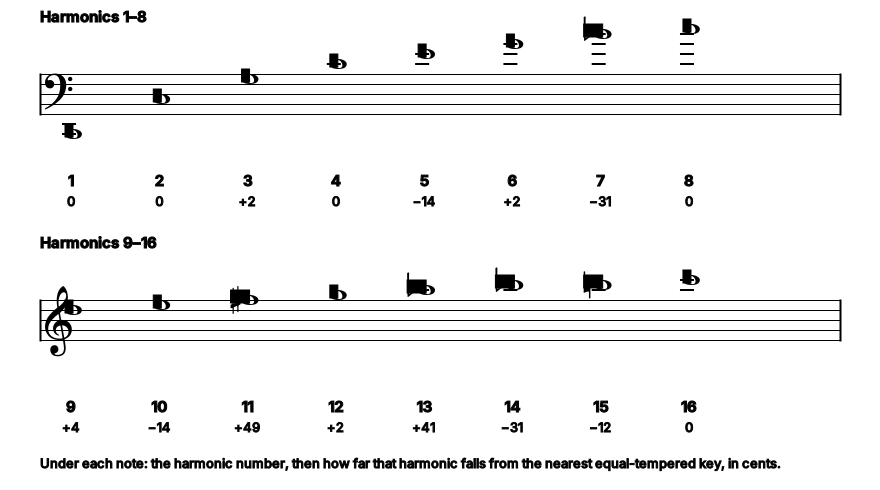
Figure 3.10:The harmonic series on C2, written out. The first few partials are the intervals a musician already knows: an octave, a fifth, another octave, a major third. Further up, the series starts to disagree with the piano, the seventh partial is a third of a semitone flat of any key, and the eleventh sits almost exactly between two. That disagreement is the subject of Chapter 9. Notice early that the notes in this figure are what a string produces, not what a keyboard can play.
Playing Harmonics¶
Touch a sounding string lightly at its midpoint. You have forced a node there. Every mode with a node at the midpoint: the 2nd, 4th, 6th, …, survives untouched; every mode without one: the 1st, 3rd, 5th, …, is killed. What remains sounds at , an octave above.
Touch at a third of the length and the surviving modes are the 3rd, 6th, 9th, …, sounding at , an octave and a fifth above. Touch at a quarter and you get , two octaves up.
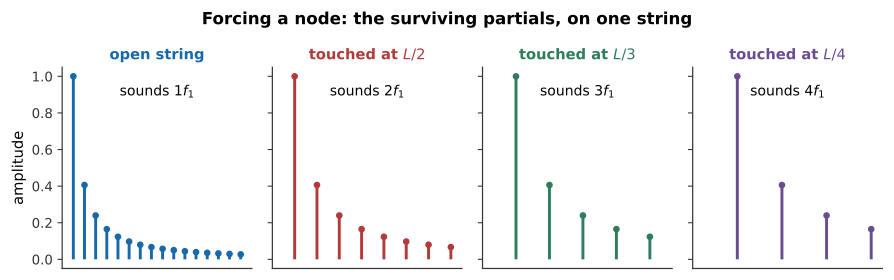
Figure 3.11:One string, touched at four places. The pitch rises through the harmonic series, and the tone becomes progressively thinner, because each touch removes more partials than the last. The glassy quality of a string harmonic is the sound of a spectrum with most of its members missing.
What you hear: Four notes on one string. The first is the full open string; the next three rise by an octave, an octave and a fifth, and two octaves, and each sounds purer and glassier than the last.
Listen: String Harmonics
This is why the technique is called “playing harmonics”, and it is a direct, audible demonstration that the modes really are all present at once in an ordinary plucked note. You are not adding anything by touching the string. You are subtracting.
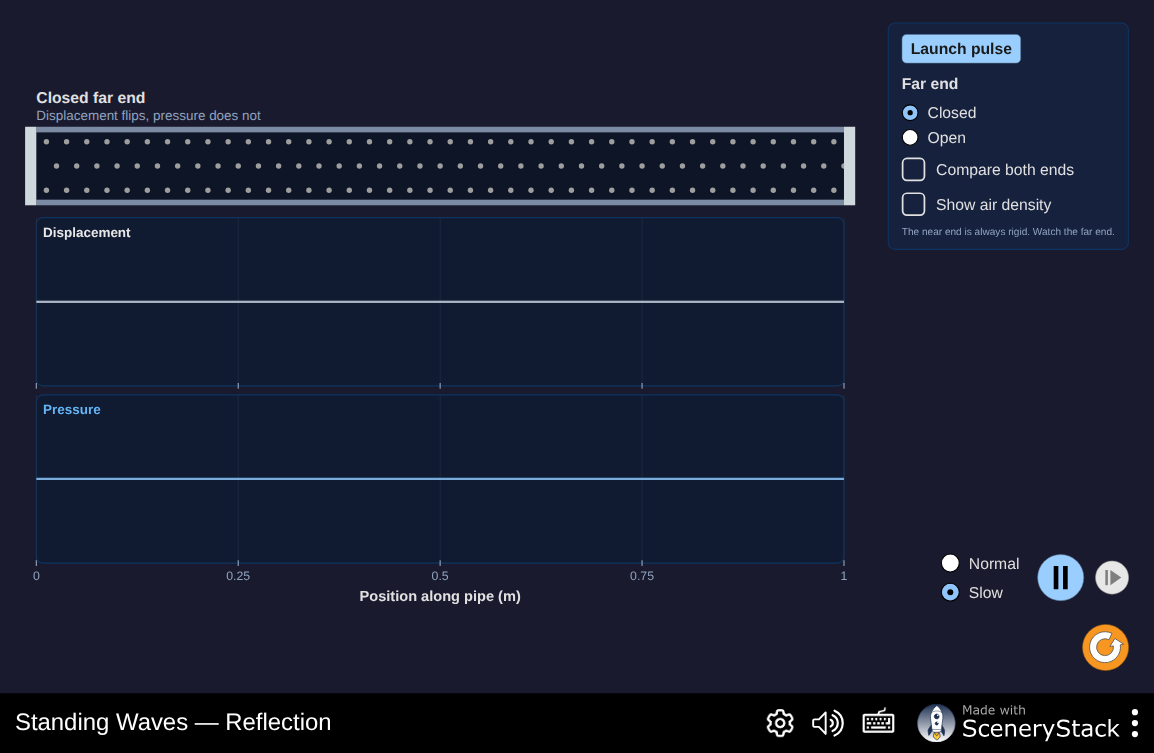
Figure 3.12:Drive one end of a string and sweep the frequency slowly. Almost everywhere nothing much happens; at a handful of frequencies the string leaps into a clean pattern. Count the loops and check against , then change the tension and watch every resonance move by the same factor.
Interactive simulation: Standing Waves

Figure 3.13:Successive resonances on a driven string make the nodes, antinodes, and first several harmonics directly visible. Each higher mode fits one additional half-wavelength between the fixed ends.
Watch on YouTube: Standing Wave Harmonics
3.5Standing Waves in an Air Column¶
Open and Stopped Pipes¶
The same argument applies to the air in a tube, with different boundary conditions.
At a closed end the air cannot move, so there is a displacement node. At an open end the air is free to move and the pressure is forced to atmospheric, so there is a displacement antinode.
A pipe open at both ends therefore needs antinodes at both ends. That is satisfied by the same family as the string, a whole number of half-wavelengths, and gives
A pipe stopped at one end needs a node at one end and an antinode at the other, which are a quarter wavelength apart. The shortest fit is , and the next fits are , , and so on:
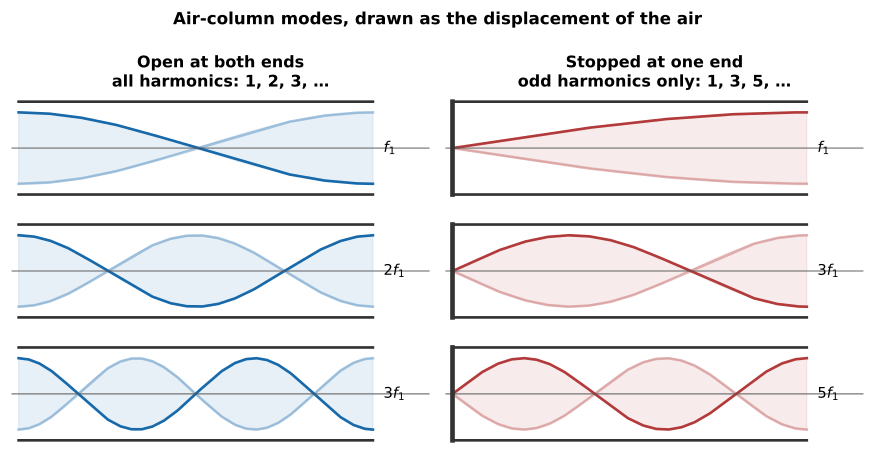
Figure 3.14:Air-column modes, drawn as the displacement of the air, oscillating inside their envelopes. The open pipe has antinodes at both ends and supports every harmonic. The stopped pipe has a node at the closed end and supports only the odd ones. Drawing the same modes as pressure would interchange nodes and antinodes everywhere, so a figure like this must say which quantity it shows.
Odd Harmonics and the Missing Even Ones¶
Two consequences follow from that pair of formulas, and both are audible.
A stopped pipe of a given length sounds an octave lower than an open pipe of the same length. Compare with . Organ builders use this constantly: a stopped rank gives a 16-foot pitch from 8 feet of pipe, which is a considerable saving in a church.
A stopped pipe has only odd harmonics. This is not a small change of color. Removing every even partial removes the octave, the second octave, and the octave-plus-fifth from the spectrum, leaving a characteristic hollow, woody sound. It is why the clarinet, effectively a stopped pipe, since the reed end is closed, sounds so unlike the flute, which is an open one, and it is why a clarinet overblows to a twelfth rather than an octave (Chapter 11).
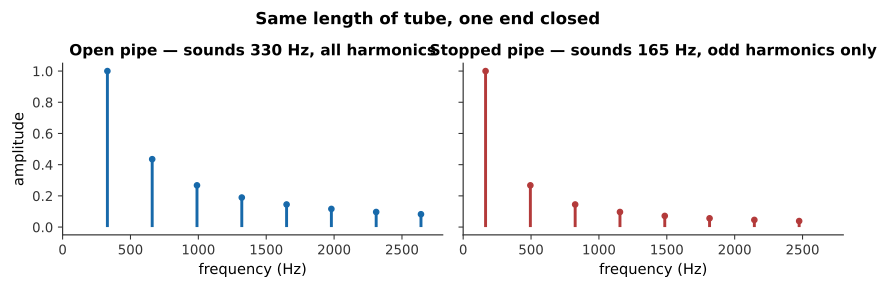
Figure 3.15:The same length of tube, played open and then stopped. Two things change at once; try to hear them separately: the pitch drops an octave, and the tone goes hollow because every even harmonic has vanished.
What you hear: Two tones. The first is bright and full; the second is an octave lower and noticeably hollow, as though something had been taken out of the middle of it.
Listen: Open pipe, Stopped pipe
Why the Pipe Length Is Not Quite the Wavelength¶
One correction, because it matters for anyone who tries to check these formulas by measurement.
The pressure at an open end is not exactly atmospheric, because the air just outside the tube is still being pushed around by the air inside it. The antinode therefore falls a little way beyond the physical opening, and the pipe behaves as though it were slightly longer than it is. The correction is about 0.6 times the tube’s radius, per open end.
For a narrow pipe this is negligible. For a wide one it is not: a pipe 30 cm long and 5 cm across has an effective length of about 31.5 cm at one open end, or 33 cm at two: a pitch error of nearly a semitone if you ignore it. Chapter 11 treats the correction properly, and the laboratory exercise in Laboratory Exercises measures it.
3.6Summary¶
Superposition: where waves overlap, displacements add, and the waves emerge unchanged. This holds because the wave equation is linear, and it fails at extreme amplitudes, audibly so in a loud brass instrument and in a struck cymbal.
Interference is superposition with a steady phase relationship. Two waves in step reinforce; two exactly opposed cancel. Energy is redistributed, not destroyed: the loud spots are four times the intensity of one source, not twice.
Path difference sets phase difference: . Constructive interference requires , destructive requires . The pattern is fine at high frequencies and coarse at low ones, which is why music through two speakers is colored rather than silenced.
Reflection inverts a pulse at a fixed end and returns it upright at a free end. For air columns, a closed end is a displacement node and a pressure antinode; an open end is the reverse.
A standing wave is two identical waves traveling in opposite directions, and it factorizes: . The shape is fixed in space and only its amplitude varies in time. Nodes never move and are half a wavelength apart.
A string fixed at both ends admits only , giving : a complete harmonic series. Shorter, tighter, or lighter means higher, but tension enters as a square root, so an octave costs four times the tension.
Touching a string at a node kills every mode that lacks one there, leaving a harmonic. This demonstrates that all the modes are present simultaneously in an ordinary note.
An open pipe gives with all harmonics; a stopped pipe gives with odd harmonics only. A stopped pipe sounds an octave lower than an open pipe of the same length and sounds hollow, because every even partial is missing.
The effective length of a pipe exceeds its physical length by about per open end, which matters for wide tubes.
3.7Check Your Understanding¶
Five short, auto-graded questions cycle within one compact activity. The set mixes multiple choice, true/false, drag-the-words, fill-in-the-blank, and mark-the-words formats, and opens by counting nodes on a figure.
Multiple choice, from a figure. The activity reproduces the string-mode figure from earlier in this chapter. Its bottom panel shows the 4th harmonic of a string fixed at both ends. How many nodes lie strictly between the two fixed ends: two, three, four, or five?
True or false. Where two equal sources interfere constructively, the intensity is four times that of one source alone.
Drag the words. Complete: a pulse returns ___ from a fixed end and ___ from a free end; two loudspeakers reinforce where the path difference is a ___ number of wavelengths, and cancel where it includes one extra ___ wavelength. (Terms: inverted, upright, whole, half, doubled, quarter.)
Fill in the blanks. A pipe stopped at one end resonates at divided by ___ times , sounds ___ harmonics only, and sits an ___ below an open pipe of the same length.
Mark the words. Identify the two changes that raise a string’s fundamental frequency: “Shortening the string and tightening it both raise the pitch, while loosening it or fitting a heavier string lowers it.”
3.8Conceptual Questions¶
Two pulses of opposite sign meet on a string and momentarily cancel completely, leaving the string straight. Explain where the energy is at that instant.
Two loudspeakers play the same steady 1 kHz tone. A listener walks slowly across the room and hears the loudness rise and fall. Explain why playing music instead of a tone produces no such silences.
Explain why a pulse reflecting from a clamped end comes back inverted, using only the requirement that the clamped point cannot move.
A standing wave transports no energy along the string, yet the string is full of moving parts. Reconcile these two statements.
A guitarist touches a sounding string lightly at its exact midpoint and the pitch jumps up an octave. Explain what has been removed, and why touching at the midpoint removes it.
Explain why raising a string’s tension by a factor of two does not raise its pitch by an octave, and state what factor would.
A clarinet and a flute of similar length sound roughly an octave apart. Explain which sounds lower and why, in terms of boundary conditions.
The end correction for an open pipe is roughly . Explain why this makes the correction important for an organ’s largest pipes and negligible for a piccolo, even though the fractional pitch error is what matters.
3.9Problems¶
Solution to Exercise 3.1 #
(a) m.
(b) Destructive interference needs ; the smallest is
(c) Constructive interference needs . The smallest non-zero value is m (the case , equal paths, is also loud but is not a difference).
Therefore, 25 cm of extra path silences the tone and 50 cm restores it.
Solution to Exercise 3.2 #
Solution to Exercise 3.3 #
(a) From :
(b) The tension and mass per length are unchanged, so is unchanged and :
measured from the bridge; so the finger goes cm from the nut.
(c) In air,
against m on the string. They differ because the wave speeds differ, 251 m/s on the string against 343 m/s in air, while the frequency is necessarily shared, the string being what drives the air.
Solution to Exercise 3.4 #
Since , the tension ratio is the square of the frequency ratio.
(a) .
(b) .
(c) Quadrupling the tension is not practical. String tensions are already set close to the breaking point of the material for good reasons, higher tension gives a louder, brighter note, so a factor of four would break the string, and if it did not, it would very likely pull the instrument apart. This is exactly why instruments span their range by changing length and mass per unit length rather than tension alone.
Solution to Exercise 3.5 #
Solution to Exercise 3.6 #
(a) From :
(b) A stopped pipe has one open end, so one correction of about :
The effective length must be 0.655 m, so the physical length cut should be
Therefore, cutting the naive 65.5 cm would give an effective length of 67.9 cm and a pitch of 126 Hz, about 67 cents flat, two-thirds of a semitone, and grossly out of tune.
Solution to Exercise 3.7 #
(a) Touching at forces a node there, which only modes with a multiple of 3 possess. The lowest survivor is :
(b) Harmonics 3, 6, 9, 12, … of the original string: that is, 1, 2, 3, 4, … of the new sounding pitch.
(c) Because two-thirds of the original partials have been removed. The surviving set is still a complete harmonic series on 1320 Hz, but each of its members was a high partial of the original string and was therefore weak to begin with. The result is a spectrum with far less energy in it and fewer strong partials, which the ear reports as thin and glassy.
Solution to Exercise 3.8 #
(a) . (b) Zero.
(c) Intensity goes as the square of amplitude, so the in-step case has times the intensity of one wave alone, not twice.
The extra energy comes from the places where the waves cancel. Averaged over all positions, the mean intensity is , exactly twice one wave’s, as conservation of energy requires. Interference redistributes energy from the nulls into the maxima; it does not create it.
Solution to Exercise 3.9 #
(a) From :
(b) At fixed and , , so doubling the mass per unit length doubles the required tension:
Therefore, the original tension is about 204 N, roughly the weight of a 21 kg mass, and the heavier string would need twice that. This is the trade-off behind wound strings: mass lowers the pitch, but keeping the pitch while adding mass costs tension.
Solution to Exercise 3.10 #
(a) On the perpendicular bisector the two distances are equal, so and the listener is at a maximum.
(b) Put the speakers at m and the listener at . Then
so m. The wavelength is m, so
Therefore, the path difference is 1.84 wavelengths, close to 1.5 or 2.5? It is nearer the whole number 2 than the half-integer 1.5, so the listener is closer to a loud position than a quiet one, though not exactly at a maximum.
Solution to Exercise 3.11 #
A node is a position where for all . Since is not always zero, this requires
using . Successive nodes therefore differ by .
An antinode is a position where reaches its largest value, which requires , that is
These are the odd multiples of , which lie exactly halfway between the even multiples that give the nodes.
Therefore, nodes and antinodes alternate at intervals of a quarter wavelength, with each kind spaced half a wavelength from its own neighbors.
Solution to Exercise 3.12 #
(a) For a stopped pipe, :
(b) For an open pipe of the same length, Hz, exactly an octave higher.
(c) Because a stopped pipe sounds at while an open one sounds at . The stopped pipe gets an octave lower out of the same physical length, since the shortest standing wave it can hold is a quarter wavelength rather than a half. A clarinet is therefore about half the length of a flute sounding the same low note: a real and substantial advantage, paid for by having only odd harmonics.
Solution to Exercise 3.13 #
(a) Stopped: m. Open: m.
(b) Stopped, odd harmonics only: 220, 660, 1100, 1540 Hz. Open, all harmonics: 220, 440, 660, 880 Hz.
(c) The stopped pipe’s second mode is 660 Hz; the open pipe’s is 440 Hz. The ratio is .
Therefore, the listener hears a perfect fifth, and one which is exactly 3:2, since both frequencies are exact harmonics of the same fundamental. Chapter 9 takes up what happens when a keyboard has to approximate that ratio.
Solution to Exercise 3.14 #
(a) Ignoring corrections:
(b) Two open ends, each adding about m:
(c) In cents:
Therefore, ignoring the correction would put the pipe more than two semitones sharp of where it actually sounds. For a tube this wide relative to its length, the end correction is not a refinement, it dominates any attempt to predict the pitch.