Learning Objectives¶
By the end of this chapter, you should be able to:
Describe the voice as a source-filter system, and identify the anatomical structure serving as each.
Explain how the vocal folds oscillate, and why the oscillation is self-sustaining rather than driven at a chosen frequency.
Relate the fundamental frequency of phonation to vocal-fold length, mass, and tension, and explain the typical difference between adult voices.
Describe the spectrum of the glottal source, and state approximately how its harmonic amplitudes fall with frequency.
Define a formant, explain how the vocal tract produces formants, and calculate the formant frequencies of a uniform tube of the length of the adult vocal tract.
Identify vowels from the frequencies of the first two formants, and read a vowel chart in the - plane.
Explain why the vowel of a sung note is harder to identify at high pitch, in terms of harmonic spacing relative to formant width.
Describe the vocal registers and what changes physically between them.
Explain the singer’s formant, state approximately where it lies, and explain how it lets an unamplified soloist be heard over an orchestra.
Introduction¶
The voice is the oldest instrument and the only one everybody has. It is also the one that shows most clearly a model this book has been assembling since Chapter 4: the source–filter model.
The idea is that an instrument can be described as two independent stages. A source produces a raw signal with a rich spectrum, and a filter shapes that spectrum by emphasizing some frequencies and suppressing others. The two can be varied independently, and what a listener hears is the product.
In the voice, the separation is unusually clean. The vocal folds are the source: they chop the airflow into puffs, producing a harmonic series whose fundamental is the pitch. The vocal tract, the tube from the larynx to the lips, is the filter: its resonances, called formants, emphasize whichever harmonics fall near them.
The crucial point, and the one that makes speech possible at all, is that the two are independent. You can change the pitch without changing the vowel, by tensing the folds; and you can change the vowel without changing the pitch, by moving the tongue and jaw. Singing is exactly the ability to do both at once, deliberately.
This chapter also explains one thing that ought to be impossible: how a single unamplified voice is heard over a hundred-piece orchestra. The answer is a trick of spectrum placement, and it is a good one.
13.1The Voice as Source and Filter¶
Two Independent Stages¶
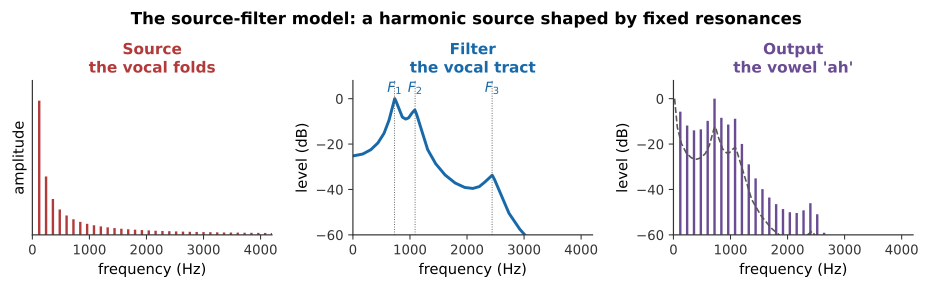
Figure 13.1:The source–filter model. The source supplies a harmonic series at the pitch being sung. The filter has fixed resonances. The output is their product: the same harmonics, with their amplitudes reshaped. Note that the filter is drawn in decibels, the third formant is some 35 dB below the first, and on a linear axis it would be invisible.
The model is an idealization, and the idealization is good. There is some interaction, the tract’s pressure fluctuations feed back on the folds, and at extremes of range a singer can exploit this deliberately, but for most purposes the two stages can be treated as independent, and doing so explains a great deal.
Why the Model Works¶
The reason the separation holds so well is a difference of impedance, and it is the same argument as Chapter 11’s reed.
The vocal folds present a high impedance to the tract: they are relatively massive and stiff, and the tract’s pressure oscillations are not strong enough to push them around much. So the tract does not tell the folds what to do, and the source frequency is set by the folds alone.
This is the opposite of a wind instrument, where the bore controls the reed. Acoustically, then, the voice is more like a string instrument, source sets pitch, resonator shapes tone, than like the wind instrument it superficially resembles.
The Anatomy in Brief¶
Three parts, in the order air meets them.
The lungs and diaphragm supply a steady pressure: a few hundred pascals above atmospheric for normal speech, more for loud singing. This is the power supply, and the entire art of breath support is keeping it steady.
The larynx houses the vocal folds: two layered flaps of muscle and ligament, about 17–25 mm long in adult men and 12–17 mm in adult women, covered in mucous membrane. They can be brought together to close the airway or held apart to breathe.
The vocal tract runs from the folds to the lips, about 17 cm in an adult man. It includes the pharynx, the mouth, and, when the soft palate is lowered, the nasal cavity. Its shape can be changed continuously by the tongue, jaw, lips, and larynx height.
13.2The Source: The Vocal Folds¶
Self-Sustained Oscillation¶
The folds are not vibrated by anything. They oscillate themselves, driven by a steady airflow, and the mechanism is a feedback loop with no oscillating input at all.
The cycle runs like this. Air pressure below the closed folds builds until it forces them apart. Air rushes through the gap, and, by the Bernoulli effect, the fast-moving air in the narrow gap is at reduced pressure, which sucks the folds back together. Their own elasticity helps. They close, the pressure builds again, and the cycle repeats.
The essential feature is that the folds do not move as a single stiff object. They have a layered structure, and the mucous membrane travels over the deeper tissue as a surface wave, so the lower edge opens before the upper edge and closes before it too. That phase difference between the opening and the closing is what allows net energy to be extracted from a steady airflow, without it, the work done pushing the folds open would exactly cancel the work recovered as they close, and the oscillation would die.
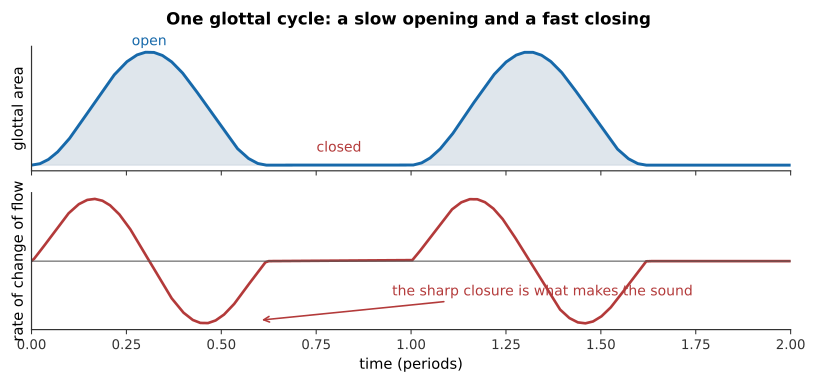
Figure 13.2:One glottal cycle. The opening is gradual and the closing is abrupt, and the folds stay shut for a substantial fraction of each cycle. The sharp closure is what makes the sound: it produces a rapid change in airflow, which is a broadband excitation of the tract, in the same way that a sharp-cornered waveform contains high harmonics (Chapter 5).
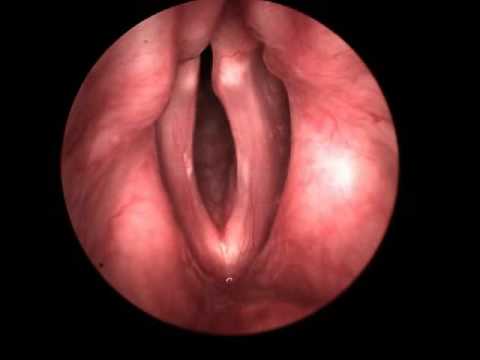
Figure 13.3:High-speed laryngeal imaging slows the vocal folds’ oscillation enough to reveal the opening and closing cycle. The footage shows the vibrator that supplies the source in the source--filter model.
Watch on YouTube: High-Speed Video of the Vocal Folds
What Sets the Fundamental¶
The folds are a mass–spring system, so Chapter 1 applies: frequency rises with tension and falls with mass.
| Change | Effect on pitch | How a singer does it |
|---|---|---|
| Increase fold tension | Higher | Cricothyroid muscle tilts the thyroid cartilage |
| Increase effective mass | Lower | Thicker, looser folds; chest voice |
| Increase subglottal pressure | Slightly higher | More breath pressure |
That last row is a nuisance for singers: getting louder tends to sharpen the pitch, so a singer must actively compensate. It is also why breath support and intonation are taught together.
The anatomical difference between voice types is straightforward. Adult male folds are longer and more massive, hence roughly 85–180 Hz in speech, while adult female folds are shorter and lighter, at roughly 165–255 Hz. The ratio is close to a factor of two, so men and women speaking naturally are about an octave apart.
The Spectrum of the Glottal Pulse¶
The glottal waveform is not a sine. It is a series of pulses, and Chapter 5 guarantees that a periodic pulse train has a full harmonic series.
The amplitudes fall at roughly 12 dB per octave: that is, as . This is the source spectrum, and it is important that it is smooth: it has no peaks of its own, so every peak in the output belongs to the filter.
A singer can change the source spectrum. Pressed, forceful phonation with a sharper closure produces a brighter source; breathy phonation with incomplete closure produces a weaker, noisier one with a steeper roll-off. These are real timbral controls, but they are secondary to what the tract does.
13.3The Filter: The Vocal Tract¶
A Tube, Stopped at One End¶
To a first approximation the vocal tract is a uniform tube about 17 cm long, closed at the glottis and open at the lips: a stopped pipe, exactly as in Chapter 3:
With m and m/s (warm, moist air):
Roughly 500, 1500, 2500 Hz, and those are, to a remarkable degree, the measured formant frequencies of a neutral vowel. A crude stopped-pipe model gets the human vocal tract approximately right.
Formants¶
A formant is a resonance of the vocal tract. It is a property of the tube, not of the pitch being sung, and this is the single most important fact in the chapter.
Formants are numbered upward: , , . Each has a bandwidth of 50–150 Hz, which is a of order ten, deliberately low, so that the tract responds usefully over a wide range of pitches rather than only at isolated frequencies (Chapter 4).
Formants do not move when the pitch does. Sing “ah” on a low note and then on a high one: the fundamental changes, every harmonic changes, and the formants stay exactly where they were, because the shape of your throat has not changed. That is why the vowel is still recognizable.
Shaping the Tube¶
A singer changes formants by changing the tract’s shape, and the controls map onto the first two formants in a usefully simple way.
tracks how open the tract is. Constricting the tract near the front raises ; opening the jaw raises it. Roughly, says how open your mouth is.
tracks where the tongue is. A tongue hump far forward raises ; a tongue pulled back lowers it.
and above depend on finer details, including the space under the tongue and the position of the larynx, and §13.5 shows that is where trained singing does something distinctive.

Figure 13.4:Real-time MRI makes the filter half of the voice visible. As Tyley Ross changes vowels and pitch, the tongue, jaw, lips, and vocal tract reshape the resonant cavities that determine the formants.
Watch on YouTube: Singing in the MRI: Making the Voice Visible
13.4Vowels, Registers, and Range¶
Vowels in the Formant Plane¶
Because and are controlled by two roughly independent gestures, vowels occupy a two-dimensional space.
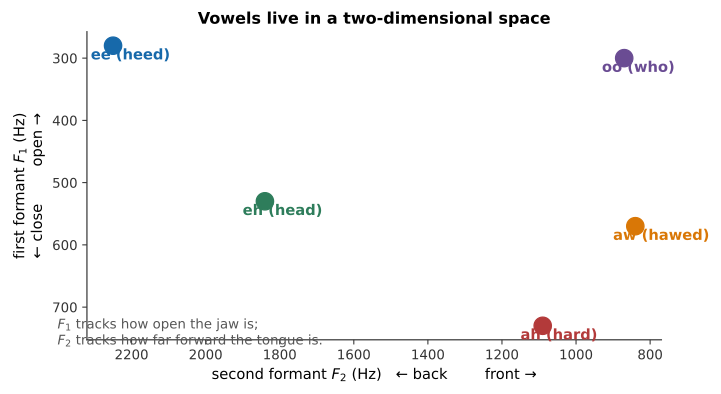
Figure 13.5:Vowels plotted by their first two formants. With both axes reversed, the plot reproduces the vowel quadrilateral that phoneticians drew from articulation long before formants could be measured, which is a nice confirmation that the acoustic and articulatory descriptions are the same thing.
The identification is robust. Two speakers with very different vocal tract lengths produce quite different absolute formant frequencies for the same vowel, yet listeners have no difficulty: the auditory system evidently normalizes by the speaker rather than reading absolute values.
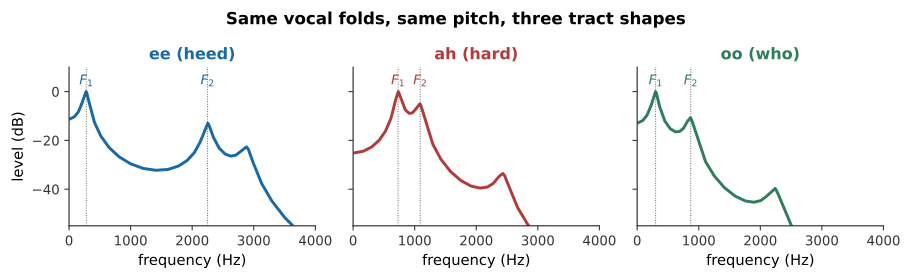
Figure 13.6:Three vowels at 130 Hz. The source is identical in all three, the same harmonic series at the same pitch. Only the filter differs, and it is enough to produce three recognizably different speech sounds.
What you hear: Three sung vowels at the same pitch. They are clearly different vowels and clearly the same note, sung by the same voice.
Formant Tuning at High Pitch¶
Now a problem that is specific to singing, and it is the reason opera has the reputation it does for incomprehensibility.
The tract’s formants are sampled by the harmonics of whatever is being sung. At a low pitch the harmonics are closely spaced, so there is always one near any formant, and the formant’s peak is well represented in the output. At a high pitch they are widely spaced, and a formant can fall in the gap between two harmonics, in which case there is nothing in the output to tell the listener the formant is there.
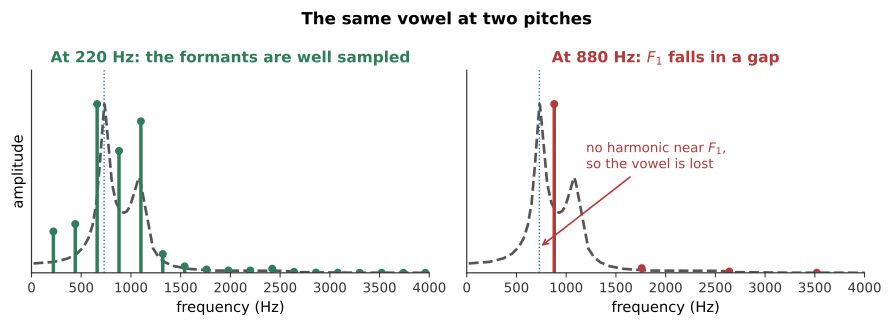
Figure 13.7:The same vowel, sung at 220 Hz and 880 Hz. At the low pitch the harmonics sample the filter closely and the formant peaks are faithfully rendered. At the high pitch the first formant falls between harmonics, and its peak simply does not appear in the output.
Figure 13.8:The vowel at a low and a high pitch, with an identical filter. The vowel identity degrades at the top, and no amount of effort by the singer can put information into a frequency region where there is no harmonic to carry it.
What you hear: The same vowel at two pitches two octaves apart. The low one is clearly "ah"; the high one is much less definite, and could be almost any open vowel.
Listen: "ah" at 196 Hz, "ah" at 784 Hz
Sopranos deal with this by formant tuning: they modify the vowel, opening the jaw to raise until it coincides with a harmonic, usually the fundamental itself. The note becomes much louder, because a harmonic is now sitting on a resonance peak, and the vowel becomes whatever placement requires. Above about C6 a soprano is essentially singing one vowel whatever the text says, and this is a physical necessity rather than a failure of technique.
Registers and the Passaggio¶
Registers are distinct modes of vocal fold vibration, and they are physically real rather than metaphorical.
In chest voice (or modal register) the folds vibrate over their full depth, closing completely on each cycle. The tone is strong and rich in harmonics.
In head voice (or falsetto) only the thin upper edges vibrate, and the folds may not close completely. The tone is weaker and much poorer in harmonics.
Between them lies the passaggio, where the singer must change from one mode to the other. Left to itself the transition is abrupt and audible, the “break”, and a great deal of vocal training consists of learning to blend across it by adjusting fold tension and tract shape together so that the change is gradual.
The whistle register, available to some sopranos above about C6, involves only a small portion of the folds and produces a nearly pure tone with very few harmonics, which is exactly why it sounds flute-like and why the words are entirely lost.
13.5Being Heard¶
The Singer’s Formant¶
Here is the problem. An orchestra playing fortissimo produces around 100 dB in the hall. A single unamplified human voice produces perhaps 90 dB at a meter, and less by the time it reaches the audience. Adding one voice to a hundred instruments should be inaudible, by Chapter 7’s addition rule.
Yet an opera singer is heard clearly. The trick is not loudness but spectral placement.
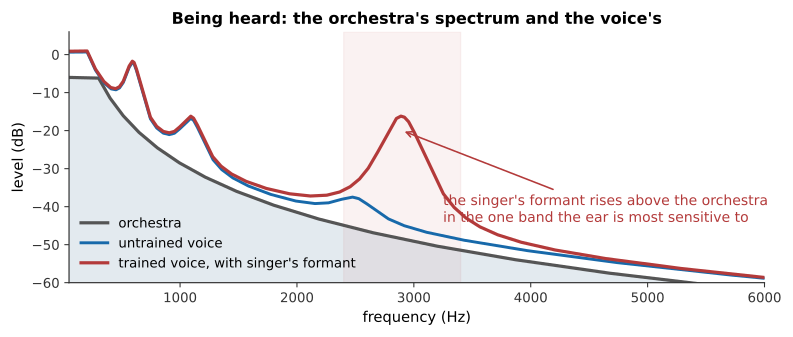
Figure 13.9:Why a trained soloist is heard. An orchestra’s spectrum is concentrated below about 500 Hz and falls away steeply. A trained voice puts a strong resonance near 2.9 kHz, precisely where the orchestra has little energy and where the ear is most sensitive (Chapter 7).
The singer’s formant is a strong peak around 2.8–3.2 kHz, and it is produced by clustering , , and together. The mechanism is lowering the larynx, which widens the pharynx just above it and creates a small, separately resonant cavity; that cavity’s resonance coincides with the upper formants and reinforces them.
Its effect is large: 20 dB or more of extra output in that band.
Figure 13.10:A voice mixed with a low-biased orchestral background, with and without the singer’s formant. The overall level of the voice is the same in both. What has changed is where its energy sits.
What you hear: The same voice against the same orchestral background twice. In the first it is buried and hard to follow; in the second it cuts through clearly, without being obviously louder overall.
Competing With an Orchestra¶
Three features of the solution are worth drawing together, because it is a genuinely clever piece of physics that nobody designed.
It exploits a gap in the competition. The orchestra’s energy is concentrated low, so the 3 kHz region is comparatively empty.
It exploits the ear’s sensitivity peak. Chapter 6 showed the ear canal resonates near 3.4 kHz, and Chapter 7 showed that hearing is most sensitive there. A decibel spent in that band buys more loudness than a decibel spent anywhere else.
It exploits masking asymmetry. Chapter 7 showed that masking spreads upward far more readily than downward, so low-frequency orchestral energy masks the voice’s low harmonics severely and its 3 kHz region much less.
The same logic appears elsewhere. A violin’s bridge hill is at 3 kHz (Chapter 10), and a trumpet’s bell radiates most efficiently in the same region (Chapter 11). Several unrelated instrument traditions converged on the same band, because that is where the ear is listening.
Vibrato, Projection, and the Limits of the Voice¶
Vibrato is a periodic modulation of pitch, typically 5–7 Hz and to cents. It arises partly from a natural oscillation in the laryngeal muscles and partly from training.
Two things it does. It makes a voice stand out against a steady background, because the auditory system groups components that change together and separates those that do not: a moving signal against a static one is easier to follow. And because the harmonics sweep back and forth across the formant peaks, vibrato samples the filter over a range rather than at a point, which fills in the missing information of §13.4 and makes the vowel more identifiable at high pitch than a steady tone would be.
Finally, the limits. The voice is a small instrument. A trained singer produces perhaps 1 mW of acoustic power at full voice, comparable to a single violin, and against sixty of them. Its range is about two and a half octaves for most singers and rarely more than three. Its dynamic range is far narrower than an orchestra’s.
Everything in this chapter is, in one way or another, a response to those constraints. The voice cannot win on power, so it wins on placement.
13.6Summary¶
The voice is a source–filter system. The vocal folds are the source, producing a harmonic series at the pitch; the vocal tract is the filter, whose resonances, formants, shape it. The two are essentially independent, so pitch and vowel can vary separately.
The folds oscillate on their own, driven by steady airflow. The layered structure makes the upper and lower edges move out of phase, which is what allows net energy extraction from a steady flow.
The sharp closure makes the sound. A rapid cut-off of airflow is a broadband excitation, and the glottal source spectrum falls smoothly at about 12 dB per octave with no peaks of its own.
Fundamental frequency rises with fold tension and falls with fold mass, and rises slightly with breath pressure; so loud singing tends to go sharp.
The tract is approximately a 17 cm stopped pipe, giving formants near 500, 1500, 2500 Hz. tracks jaw opening; tracks tongue position; vowels occupy the – plane.
Formants do not move when the pitch does, so a vowel survives across a singer’s range, up to a point.
At high pitch the harmonics are too widely spaced to sample the formants. Sopranos respond with formant tuning, opening the jaw to put on a harmonic, which gains loudness and loses vowel identity.
Registers are distinct modes of fold vibration: chest voice uses the full fold depth, falsetto only the edges, and the passaggio between them is what training smooths.
The singer’s formant, near 2.9 kHz, is produced by clustering to via a lowered larynx. It exploits a gap in the orchestra’s spectrum, the ear’s sensitivity peak, and the asymmetry of masking, and it is worth 20 dB where it matters.
Vibrato helps the ear separate the voice from a steady background, and sweeps the harmonics across the formants, restoring some of the information lost at high pitch.
13.7Check Your Understanding¶
Five short, auto-graded questions cycle within one compact activity, using five different response styles.
Multiple response. Why does the singer’s formant near 2.9 kHz improve projection? Consider the orchestral spectrum, ear sensitivity, masking, and the vocal fundamental.
True or false. In the source–filter model, the vocal folds can change pitch while the vocal tract largely preserves the vowel filter.
Drag the words. Match vocal folds, vocal tract, jaw opening, and tongue position to the harmonic source, formant filtering, , and .
Fill in the blanks. A roughly ___ cm tract has formants near 500, ___, and 2500 Hz.
Mark the words. Identify two vocal registers: “Chest voice uses more of the fold depth, while falsetto uses mainly the edges; the passaggio is the transition between them.”
13.8Conceptual Questions¶
Explain what it means to say the voice is a source–filter system, and give one observation that shows the two stages are independent.
Explain why the vocal tract controls the timbre of the voice but not its pitch, and contrast this with a clarinet.
Explain why the abrupt closure of the vocal folds, rather than their opening, is what produces most of the sound.
A singer gets louder and the pitch drifts sharp. Explain the mechanism.
Explain why a vowel remains recognizable when the same person sings it an octave higher, and why this eventually fails.
A soprano singing above C6 is hard to understand whatever the language. Explain why this is a physical limitation rather than a matter of diction.
Explain how a single unamplified voice is heard over an orchestra, naming the three separate effects that make it work.
Explain two distinct benefits of vibrato, one about separating the voice from the background and one about vowel identity.
13.9Problems¶
Solution to Exercise 13.1 #
(a) A stopped pipe gives odd harmonics of :
(b) The agreement is essentially exact.
Therefore a uniform tube of the right length predicts the neutral vowel’s formants almost perfectly. Departures from this pattern are what produce the other vowels: a vowel is a deviation from the neutral tube.
Solution to Exercise 13.2 #
(a) Male: 500, 1500, 2500 Hz. Female, with m:
(b) The ratio is :
between a whole tone and a minor third.
(c) The auditory system normalizes for the speaker rather than reading absolute formant values. It uses the pattern of formants relative to one another, and cues from the speaker’s fundamental and from surrounding speech, to calibrate. A child, a woman, and a man can all say “ah” and be understood as saying the same thing despite formants differing by a factor of 1.3.
Solution to Exercise 13.3 #
(a) Bass: , so the 7th harmonic at 686 Hz. Soprano: , so the fundamental at 880 Hz is the nearest, there is nothing below it.
(b) Bass: Hz away. Soprano: Hz away.
(c) The bass has a harmonic essentially sitting on the formant, so the formant’s peak appears faithfully in the output and the vowel is clear. The soprano’s nearest harmonic is 180 Hz above the formant, well outside its 100 Hz bandwidth, so the formant contributes almost nothing and the vowel is poorly defined.
Therefore this is the formant-sampling problem of §13.4 in numbers, and it is why sopranos resort to formant tuning.
Solution to Exercise 13.4 #
(a) The fundamental moves from the skirt of the resonance onto its peak, gaining most of the 15 dB. In intensity terms:
a thirty-twofold increase in the fundamental’s radiated intensity: an enormous gain for a change in jaw position.
(b) has been moved from 700 Hz to 880 Hz. Consulting the vowel chart, raising moves the vowel toward a more open one, “ah” territory and beyond, whatever the text calls for.
Therefore the singer trades intelligibility for power, and above a certain pitch she has no real choice: the alternative is to be inaudible. Sung text at the top of the soprano range is conventionally supported by surtitles for that reason.
Solution to Exercise 13.5 #
(a) .
(b) dB in that band.
(c) The orchestra’s 95 dB is its total level across the spectrum; in the narrow 3 kHz band it produces far less, perhaps 70 dB. The trained voice’s 92 dB in that band therefore exceeds the orchestra’s contribution there by some 22 dB, even though the voice’s total output is 20 dB below the orchestra’s.
Therefore the voice loses the broadband contest decisively and wins the 3 kHz contest decisively, and the second is the one that determines whether it is heard.
Solution to Exercise 13.6 #
(a) , so doubling the frequency needs
(b) Stretching the folds makes them thinner, which reduces the effective vibrating mass. Since , a falling contributes to the rise in , so less than a fourfold increase in stiffness is needed.
Therefore the naive answer of four times overestimates the tension required. This is one reason the vocal folds can cover two and a half octaves while a guitar string covers far less by tension alone: the folds change both levers at once.
Solution to Exercise 13.7 #
(a) cents is a ratio of and 0.9604:
(b) The nearest harmonic to 700 Hz is the 2nd, at 880 Hz, too high. Actually , so no harmonic is near at all; the fundamental at 440 Hz is the closest below.
The fundamental sweeps from 422.6 to 458.1 Hz, a range of 35.5 Hz. Since ’s bandwidth is around 100 Hz, this sweep moves the fundamental appreciably across the lower skirt of the resonance.
Therefore vibrato causes the output amplitude of each harmonic to fluctuate as it moves across the filter’s slopes. Vibrato therefore produces amplitude modulation as well as frequency modulation, and makes a voice easier to pick out of a texture.
Solution to Exercise 13.8 #
Chapter 7 established that masking spreads upward in frequency far more than downward, because a low-frequency traveling wave must traverse the whole basilar membrane to reach its own place and excites the high-frequency region on the way (Chapter 6).
The orchestra’s energy is concentrated below about 500 Hz. That energy therefore masks:
the voice’s fundamental and low harmonics, which lie in the same region, strongly, since masker and masked coincide;
the voice’s mid harmonics, at 1–2 kHz, appreciably, by upward spread;
the voice’s 3 kHz region, much less, because the upward spread has weakened considerably by two and a half octaves above the masker.
Therefore the region where the voice is least masked is the region where the singer’s formant puts its energy, and it is also where the ear is most sensitive. The three effects reinforce each other, and the solution works as well as it does.
Solution to Exercise 13.9 #
(a) W/m²:
(b) A thousand times the power is 30 dB more: 89 dB.
(c) The voice is 30 dB below the orchestra overall, which by Chapter 7’s addition rule should make it entirely inaudible: a sound 30 dB down adds nothing.
It is heard because the comparison is not made broadband. In the narrow 3 kHz band where the singer’s formant concentrates the voice’s output and where the orchestra has little, the voice is above the orchestra. The ear analyzes by critical band (Chapter 7), so what matters is the signal-to-masker ratio within a band, not the total.
Therefore the solution is to lose the overall contest and win a local one, and the ear’s band-by-band analysis is what makes that a winning strategy.
Solution to Exercise 13.10 #
(a) Shortening the tract raises the formants in proportion to :
so moves from 500 to 547 Hz and from 1500 to 1641 Hz, and so on, about 155 cents upward.
(b) Treating the pharyngeal cavity as a stopped pipe resonating at 2.9 kHz:
Therefore the extra cavity is about 3 cm long, which is roughly the dimension of the widened pharynx just above a lowered larynx, and the reason the technique works.
Solution to Exercise 13.11 #
The closed end requires a displacement node and the open end a displacement antinode. Node and antinode are separated by a quarter wavelength, so the shortest fit is , and further fits add half-wavelengths:
so and
Three reasons the real tract departs from this:
It is not uniform. The tract’s cross-section varies enormously along its length, and that variation is precisely what distinguishes one vowel from another. A uniform tube describes only the neutral vowel.
The end correction applies (Chapter 11). The lips are an open end of substantial radius, so the effective length exceeds the anatomical one.
The nasal cavity can be coupled in by lowering the soft palate, which adds a side branch with its own resonances and, more importantly, its own anti-resonances.
Therefore the stopped-pipe model gives the right ballpark and the right ordering, and everything interesting about vowels is a departure from it.
Solution to Exercise 13.12 #
(a) In chest voice the folds vibrate through their full depth and close completely on each cycle. In falsetto only the thin upper edges vibrate, and closure is often incomplete.
(b) Complete, abrupt closure produces a sharp discontinuity in the airflow, which by Chapter 5 means strong high harmonics. Incomplete, gentler closure produces a smoother waveform and a spectrum that rolls off much faster, plus added breath noise where air leaks through continuously.
So falsetto is spectrally poorer and breathier, and this is audible as a change of timbre quite apart from any change in pitch.
(c) At the transition, the mode of vibration changes discontinuously, so the spectrum changes discontinuously. The listener hears a sudden shift in tone quality, often with a momentary instability or crack as the folds reorganize.
Therefore training consists of learning to blend the two modes, mixing partial fold depth with adjusted tension, so that the spectral change is spread over several semitones instead of happening at one note.
Solution to Exercise 13.13 #
The distinction is which stage sets the pitch.
In a clarinet (Chapter 11), the bore’s impedance peaks control the reed. The reed’s own natural frequency is a couple of kilohertz and irrelevant; it oscillates at whatever the resonator dictates. Change the fingering and the pitch changes without touching the reed.
In a violin (Chapter 10), the string sets the pitch and the body merely responds. The body could be replaced with a different one and the same notes would sound, differently colored.
In the voice, the folds set the pitch, determined by their own mass and tension, and the tract merely shapes the result. Change the tract and the vowel changes; the pitch does not. The reason is impedance: the folds are massive and stiff enough that the tract’s pressure oscillations cannot push them around.
Therefore the voice belongs with the violin: source sets pitch, resonator shapes timbre. Its wind-driven appearance is misleading, and the source–filter model is exactly the statement that the two stages are separable, which is what fails in a clarinet.
Solution to Exercise 13.14 #
Pitch variation. Real speech has continuous intonation contours and small random fluctuations (jitter) of a fraction of a percent. A perfectly steady fundamental is the single strongest cue that a voice is synthetic, because no biological oscillator is that stable.
Breath noise. Real phonation leaks air continuously, adding a noise component with a continuous spectrum that no harmonic synthesis contains (Chapter 5). Its absence is what makes synthetic speech sound clean in an unnatural way.
Moving formants. Formants do not jump between target values; they glide, and the glides between vowels, the transitions, carry much of the information that identifies neighboring consonants. A synthesizer that hits formant targets and holds them produces separately correct vowels and unnatural speech.
A fourth worth adding is amplitude variation: real speech varies in level constantly with stress and syllable structure.
Therefore what is missing is again everything the steady-state model leaves out, which is the same conclusion Chapter 5 reached about synthesized instruments, and for the same reason.