Learning Objectives¶
By the end of this chapter, you should be able to:
Describe sound as a longitudinal pressure disturbance in a medium, and explain why sound cannot travel through a vacuum while light can.
Distinguish the physical properties of a sound wave (frequency, amplitude, spectrum, duration) from the perceptual attributes they mostly control (pitch, loudness, timbre, length), and give an example where the correspondence fails.
State the condition a restoring force must satisfy to produce simple harmonic motion, and explain why so many different vibrating objects satisfy it approximately.
Write the displacement of a simple harmonic oscillator as a sinusoid, and identify its amplitude, frequency, period, and phase from a graph or an equation.
Calculate the natural frequency of a mass on a spring and of a simple pendulum, and explain why the frequency of a mass on a spring does not depend on how hard it is struck.
Relate the energy of a vibrating system to the square of its amplitude, and trace the exchange between kinetic and potential energy over one cycle.
Explain what damping does to a free vibration, and connect the rate of decay to how long a note sounds after the player stops driving it.
Estimate the frequency, wavelength, and period of a musical tone from its pitch name, and place it on the range of human hearing.
Introduction¶
Strike a tuning fork and hold it up. Nothing looks as though it is happening. Touch the tines and you feel a buzz, and the sound stops; let go and it starts again. Put the base of the fork against a table and the room fills with the note. Take the fork into a vacuum chamber and pump the air out, and the tines go on vibrating in plain sight while the sound dies away to nothing.
Those four observations contain most of what this chapter is about. Something has to vibrate. The vibration has to be passed to the air: a fork alone is quiet and a fork on a table is loud. Without air, or water, or wood, or some other material, there is no sound at all, however vigorously the source moves. And the sound has a definite pitch, the same one every time that fork is struck, whether it is struck gently or hard.
This book is about the physics that connects those facts, and it begins at the beginning: with what sound is, and with the particular kind of motion that musical sources almost always turn out to be doing. That motion is simple harmonic motion. Everything later, from the string and air column to the drumhead, vocal folds, microphone diaphragm, and basilar membrane inside your ear, either does it or is built from things that do.
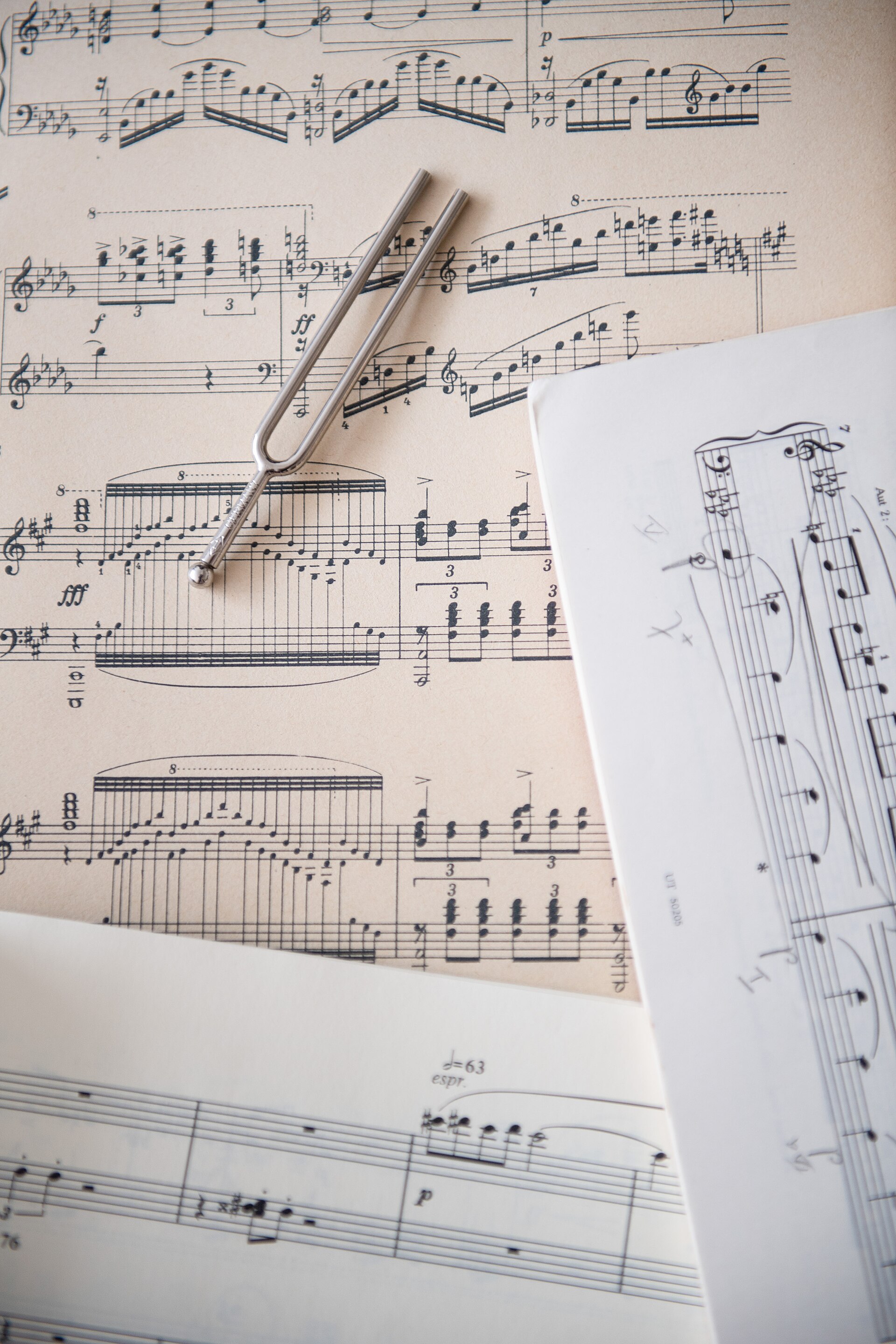
Figure 1.1:A tuning fork makes the central idea visible: a small vibrating source can have a definite musical frequency. Image: Lukasz Kobus / European Commission, CC BY 4.0.
1.1What Sound Is¶
A Disturbance, Not a Substance¶
Sound is not a substance that travels from a source to your ear. Nothing material makes that trip. What travels is a disturbance: a pattern of squeezing and stretching that passes through the air, leaving the air itself essentially where it was.
The standard picture is a line of people standing shoulder to shoulder. Shove the person at one end, and they bump into the next, who bumps into the next, and a shove travels down the line. Everyone ends up roughly where they started; only the shove moves along the row. Sound is the same, with molecules of air instead of people and with collisions instead of bumping.
This matters because it explains the vacuum chamber. A disturbance needs something to disturb. Take away the air and there is nothing to pass the shove along, and no matter how hard the source vibrates, nothing arrives. Light behaves differently, and that difference is worth holding onto: light reaches us across the emptiness between stars, and sound does not cross a meter of vacuum.
Longitudinal Waves and Pressure¶
The shove down the row of people has a direction, and it is the same direction the disturbance travels. That makes a sound wave longitudinal: the air moves back and forth along the direction of travel, not across it.
Waves on a string are the other kind. There, the string moves up and down while the wave moves sideways, and the motion of the medium is perpendicular to the motion of the wave. Those are transverse waves. Both kinds matter in this book: a guitar string carries transverse waves, while the air around it carries longitudinal ones. The handover between them at the bridge and soundboard is one of the central problems of instrument design (Chapter 10).
Because the air bunches up in some places and thins out in others, sound can be described either as a displacement of the air or as a pressure variation. The two descriptions are equivalent but they are not the same picture, and confusing them is the most common early mistake in acoustics.
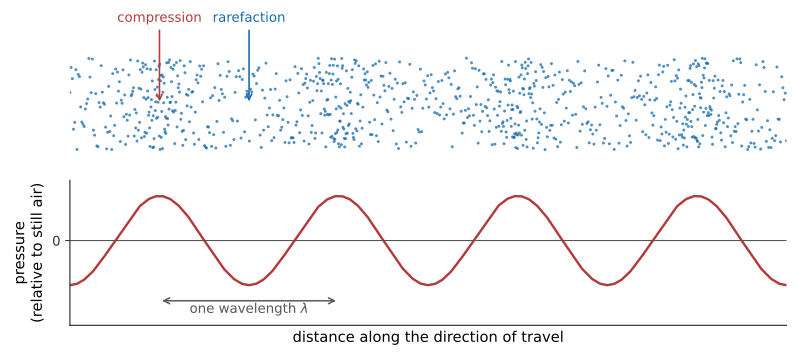
Figure 1.2:A sound wave drawn twice. Above: air molecules, bunched where the wave has pushed them together and thinned where it has pulled them apart. Below: the pressure that bunching produces. A compression is a pressure maximum and a rarefaction is a pressure minimum. Note that the pressure peaks are a quarter of a wavelength away from where the displacement of the air is greatest, where the air has moved furthest, it has not yet piled up.
Where the molecules are packed more tightly than usual, the pressure is above atmospheric: a compression. Where they are spread thinner, the pressure is below atmospheric: a rarefaction. The pressure changes involved are startlingly small. Atmospheric pressure is about Pa; the quietest sound a healthy young ear can detect is a pressure variation of about Pa, some five thousand million times smaller. A very loud sound, a rock concert at the front, is perhaps 20 Pa, still only two ten-thousandths of the pressure it rides on. Sound is a whisper of a ripple on an ocean of static pressure.
What a Microphone and an Eardrum Measure¶
Both a microphone and an eardrum are pressure detectors. Each is a thin membrane with air on one side, and each is pushed in when the pressure outside rises and pushed out when it falls. What the membrane does is trace, over time, the pressure at one point in space.
That is worth dwelling on, because it means everything the rest of this book discusses is somehow encoded in a single wiggling number: pitch, loudness, timbre, the difference between a violin and a clarinet, and the sound of a concert hall: the pressure at your eardrum as a function of time. Two eardrums give two such numbers. There is nothing else. Whatever your auditory system knows about the world of sound, it works it out from that.
The graph of that pressure against time is the waveform, and it is the object an oscilloscope displays and an audio file stores. Chapter 5 will show that a waveform contains more structure than it looks like it does, and Chapter 6 will show how the ear takes it apart.
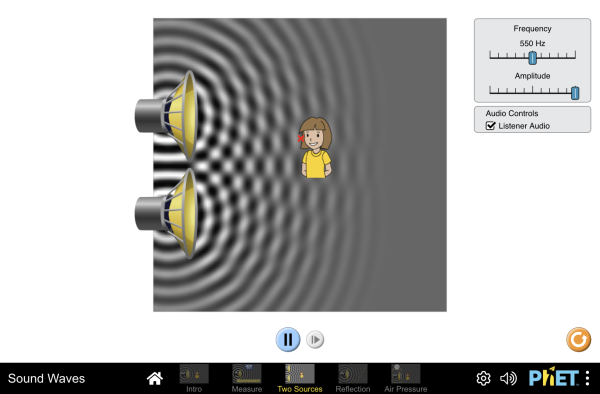
Figure 1.3:A loudspeaker driving air, with the compressions and rarefactions drawn directly. Switch between the particle view and the pressure view and check that a compression really does sit where the pressure graph peaks; then change the frequency and watch the spacing of the bands change while their speed does not.
Interactive simulation: Sound Waves
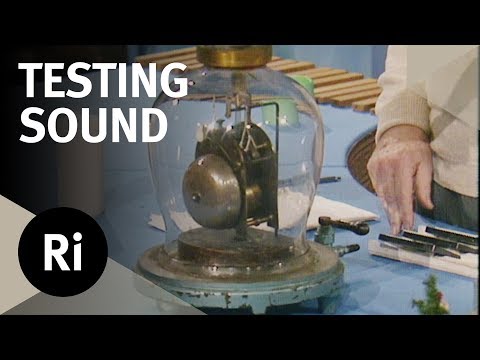
Figure 1.4:The Royal Institution pumps the air from a bell jar while a bell continues to vibrate. The fading sound isolates the role of the material medium: motion at the source is not enough if there is no air to carry the pressure disturbance.
Watch on YouTube: Why Sound Can't Travel in a Vacuum
1.2From Sound to Music: Four Attributes¶

Figure 1.5:Music begins with a physical performer and instrument, then becomes a signal at the ear. The guitarist is Django Reinhardt, who lost the use of the third and fourth fingers of his left hand in a caravan fire at eighteen. He rebuilt his technique around the two fingers that still worked, fretting melodies with index and middle and reaching the damaged pair across only the top strings for chords. The constraint became a style: the fast single-note lines and compact voicings of gypsy jazz. Physics fixes what a vibrating string can do, but it leaves the player remarkable freedom in how to get there. William P. Gottlieb, public domain.
Pitch, Loudness, Timbre, Duration¶
Ask a musician to describe a note and you will get four things: how high or low it is, how loud, what it sounds like, and how long it lasts. Those are pitch, loudness, timbre, and duration, and they are the perceptual vocabulary this book has to connect to physics.
The connections are, to a first approximation:
| Perceptual attribute | Physical property mostly responsible |
|---|---|
| Pitch | Frequency, how many times per second the pattern repeats |
| Loudness | Amplitude, how large the pressure variation is |
| Timbre | Spectrum and envelope, which frequencies are present, and how they change |
| Duration | Duration |
The phrase “mostly responsible” is doing real work in that table, and the four chapters of Part III are largely about the exceptions. Loudness depends on frequency as well as amplitude: a 40 Hz tone and a 1000 Hz tone of identical amplitude are not equally loud, and are not close (Chapter 7). Pitch depends slightly on loudness. Most strikingly, a sound can have a definite pitch at a frequency that is not present in it at all (Chapter 8).
For now the first column is a useful map and the second column is where the physics is. One entry is exact: duration is duration.
Physical Cause and Perceptual Effect¶
The difference between the two columns needs care, because the language of music runs them together constantly and the physics does not.
Frequency is a property of the sound. Pitch is a property of your experience of it. A frequency can be measured with a counter, by anyone, with no listener present. A pitch cannot: it is a judgment, made by an auditory system, and it can be influenced by things the frequency counter knows nothing about. The same is true of amplitude and loudness, and of spectrum and timbre.
This is not pedantry. It is the reason Chapter 9 has something to explain: if pitch were simply frequency, there would be no such thing as a tuning system, only arithmetic. And it is the reason Chapter 15 can compress an audio file to a tenth of its size: the parts of the physical signal that the perceptual system cannot use can be thrown away.
Tone and Noise¶
One more distinction, and then the physics. Some sounds repeat and some do not.
A sound whose waveform repeats, the same shape, over and over, many times a second, is periodic, and periodic sounds have a clear pitch. A sung vowel, a bowed string, a blown pipe: hold any of them steady and the waveform settles into a pattern that repeats. The number of repeats per second is the frequency, measured in hertz (Hz), and one cycle takes the period .
A sound whose waveform does not repeat is noise, and noise has no definite pitch. A cymbal crash, a handclap, a consonant, the hiss of air escaping: the waveform wanders and never comes back to where it was.
Music uses both, and the boundary is not sharp. A snare drum is mostly noise, a flute is mostly tone, and the breathy attack of a flute note is noise on the front of a tone. Chapter 5 makes this quantitative; Chapter 12 is largely about instruments that sit between the two.
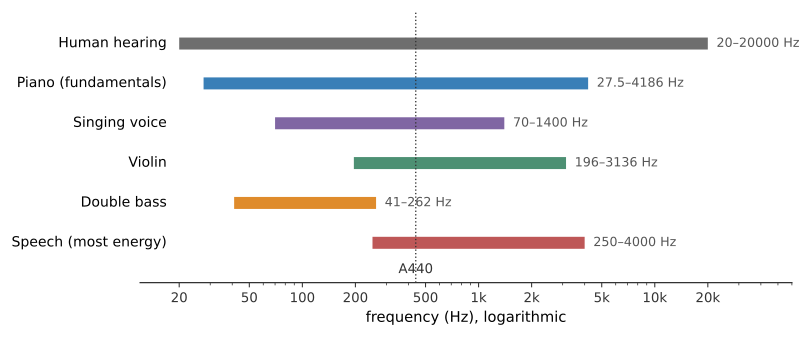
Figure 1.6:Where music sits inside the range of hearing. The frequency axis is logarithmic, because that is how pitch works: each doubling of frequency is one octave, and the octaves are therefore equally spaced along this axis. A piano’s lowest note is 27.5 Hz and its highest is 4186 Hz, seven octaves, and less than half the span of human hearing, most of which is above the highest note any orchestral instrument plays.
Two things in that figure deserve comment. First, the audible range is about 20 Hz to Hz: a factor of a thousand, or very nearly ten octaves. Second, almost all musical fundamentals live in the bottom half of it. The upper octaves are not empty, but what fills them is the harmonics that give instruments their character (Chapter 5). A recording that discards everything above 5 kHz therefore sounds muffled rather than merely missing a few high notes.
1.3Simple Harmonic Motion¶
The Linear Restoring Force¶
Something has to vibrate. The question is why so many different somethings vibrate in the same way.
Take any object sitting at a stable equilibrium: a mass hanging on a spring, a pendulum at the bottom of its swing, a guitar string pulled taut, a diving board, a wine glass rim. “Stable” means that if you displace it slightly, something pushes it back. Call the displacement and the restoring force . The force is zero at , by the definition of equilibrium, and it points back toward on either side.
Now the key step. For small displacements, the restoring force of essentially any stable system is proportional to the displacement:
The constant is the stiffness, measured in newtons per meter, and the minus sign says the force opposes the displacement. This is Hooke’s law, and the reason it applies so widely is not that nature is fond of springs. It is that any smooth restoring force, whatever its true form, looks like a straight line if you zoom in far enough on the point where it crosses zero, and small vibrations never leave that neighborhood.
Why any stable system obeys Hooke’s law for small displacements
This is the argument that justifies the whole chapter, and it needs one line of calculus.
Let the potential energy of the system be , with a stable equilibrium at . Expand it as a Taylor series:
is a constant and can be set to zero; it does not affect the force. , because the force vanishes at equilibrium, that is what equilibrium means. So the first surviving term is the quadratic one, and
For small enough , the term and everything after it are negligible beside the term, and what remains is with . Stability requires , a minimum, not a maximum, so is positive.
The generality is the point: nothing was assumed about the system beyond having a smooth potential with a minimum. A mass on a spring, a molecule in a crystal, and a drumhead all vibrate sinusoidally at small amplitude for that reason, and “small amplitude” is the caveat on nearly every result in this book. Where it fails, a cymbal driven hard (Chapter 12), a loudspeaker pushed past its limits (Chapter 15), the consequences are audible and specific.
The Sinusoid and Its Four Numbers¶
A system obeying moves in a particular way, and only that way. Displaced and released, it traces out a sine curve in time:
This is simple harmonic motion, and the equation has exactly four numbers in it. Three describe the motion and the fourth describes when you started the clock.
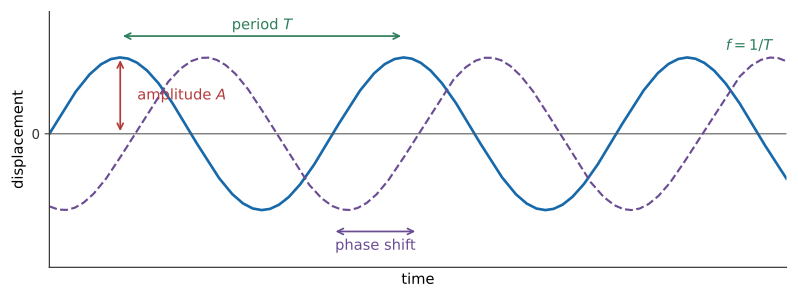
Figure 1.7:The anatomy of a sinusoid. The amplitude is measured from the equilibrium line to the peak, not from trough to peak. The period is the time for one complete cycle, and the frequency is its reciprocal. The dashed curve has the same amplitude and the same frequency and differs only in phase, it is the same motion, started at a different moment.
Amplitude is the maximum displacement, measured from equilibrium. It is half the peak-to-trough distance, and confusing the two is worth a factor of two in any calculation that follows.
Frequency is the number of complete cycles per second, in hertz. Its reciprocal is the period , the time one cycle takes.
Phase says where in the cycle the motion is at . On its own it means nothing, shifting your clock changes it, but the phase difference between two sinusoids is physical and important, and it is the whole subject of Chapter 3.
You will also meet the angular frequency , which is measured in radians per second and exists to keep s out of equations. In terms of it, .
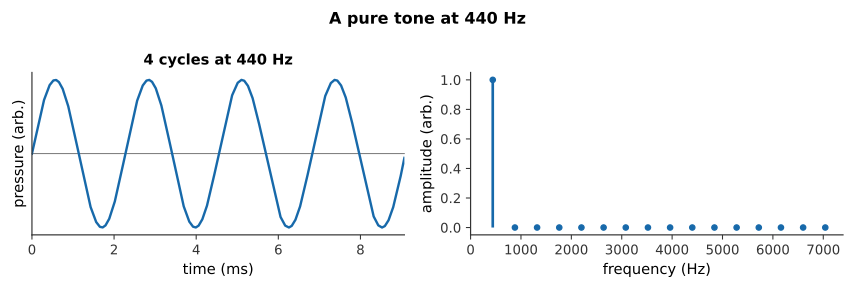
Figure 1.8:A pure tone at 440 Hz: a single sinusoid, and nothing else. Almost nothing in music sounds like this, and that is the point, every musical instrument in this book produces something more complicated, and Chapter 5 explains what it is made of.
What you hear: A steady, plain, slightly thin tone at concert A. It sounds a little like a hearing test, which is exactly what a pure tone is.
Listen: A440
Mass on a Spring¶
The simplest system that obeys Hooke’s law exactly is a mass on a spring of stiffness , and its frequency is
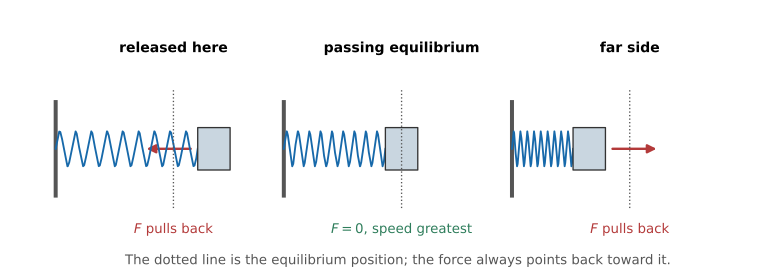
Figure 1.9:One cycle of simple harmonic motion, in three snapshots. The restoring force is largest where the displacement is largest and the mass is momentarily at rest; it is zero as the mass passes through equilibrium, where the speed is greatest. Force and displacement are always in opposite directions, which is the entire content of .
Two features of that formula are worth more than the formula itself.
Stiffer means faster; heavier means slower. Tighten the spring and the frequency rises; hang more mass on it and the frequency falls. Every pitch-changing mechanism in every instrument in this book is a version of one of those two levers. A guitar string is tuned by changing its tension, stiffness, and a bass string is made low by winding metal around it, mass. The vocal folds go up in pitch when their tension rises.
The frequency does not depend on the amplitude. Pull the mass twice as far and release it, and it takes exactly as long to come back. This is a peculiar property of the linear restoring force, and it is not a general fact about vibrating things. But it is the property that makes music possible at all: a piano string struck gently and struck hard sounds the same note. If frequency depended on amplitude, every instrument would go sharp or flat as it got louder, and no fixed-pitch instrument could exist.
The Pendulum, and the Small-Angle Approximation¶
A pendulum is the other classic example, and it is instructive precisely because it obeys Hooke’s law only approximately. A bob of mass on a string of length , displaced by an angle , feels a restoring force along its arc. That is not proportional to , but for small angles, , and it becomes so. The frequency is then
which, strikingly, does not contain the mass at all.
The approximation is good to better than out to about , and it fails slowly rather than suddenly: at the real period is about longer than the formula predicts, and a pendulum swinging through is nearly slow. This is the general behavior of a real vibrating system driven beyond its linear range; keep it in mind when Chapter 12 reaches instruments that are never in it.
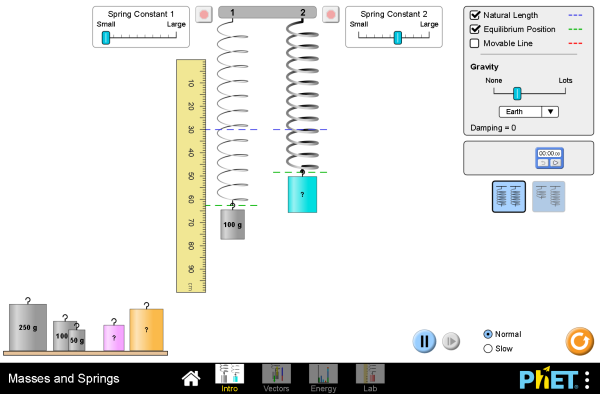
Figure 1.10:Hang masses on springs of different stiffness and time the oscillations. Two experiments are worth doing deliberately: change the amplitude while keeping the mass and spring fixed, and confirm that the period does not move; then quadruple the mass and confirm that the period exactly doubles.
Interactive simulation: Masses and Springs
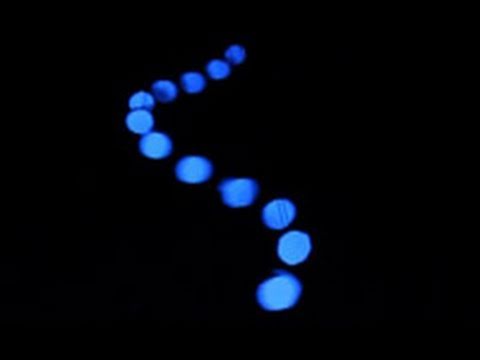
Figure 1.11:Brusspup’s pendulum array turns small differences in period into traveling patterns, beating, and repeated returns to alignment. Each bob is an independent oscillator; the apparent wave comes from their steadily changing relative phases.
Watch on YouTube: Amazing Pendulum Wave Effect!
1.4Energy, Amplitude, and Damping¶
Energy Goes as Amplitude Squared¶
A vibrating system carries energy, and it carries it in two forms that trade back and forth. At the extremes of the motion the mass is momentarily at rest and all the energy is stored in the stretched spring; as it passes through equilibrium the spring is relaxed and all the energy is kinetic. In between, it is some of each. For a system obeying , the total is
and the fact to carry forward is the square. Doubling the amplitude of a vibration quadruples its energy. A sound wave of twice the pressure amplitude carries four times the energy, and delivers four times the power to your eardrum.
That squaring is why Chapter 7 needs logarithms. The range of sound energies the ear handles is not merely large, it is the square of an already large range of pressures, about 1012 to one, from the quietest audible sound to the threshold of pain. No linear scale is usable across that span, and the decibel exists to tame it.
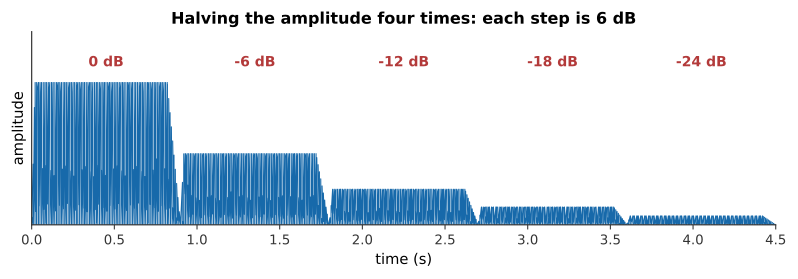
Figure 1.12:The same 440 Hz tone at five amplitudes, each half the one before. Each halving of amplitude is a factor of four in energy, and a drop of 6 dB. Notice how undramatic four steps sound: a sixteen-fold reduction in amplitude, a 256-fold reduction in energy, is not remotely “a sixteenth as loud”. Making that observation precise is the business of Chapter 7.
What you hear: One tone, five times, each quieter than the last by a clearly audible but not dramatic step. The last is about a sixteenth the amplitude of the first, and still perfectly audible.
Listen: Amplitude Steps
Damped Vibration and the Decay of a Note¶
An undamped oscillator would ring forever. Real ones do not, because energy leaks away: into friction inside the material, into the mountings, and, usefully, since this is the point of a musical instrument, into the surrounding air as sound.
The result is that the amplitude falls off over time, and for light damping it falls off exponentially:
The decay time is the time for the amplitude to fall to , about , of where it started. A large means a long ring; a small means a quick thud.
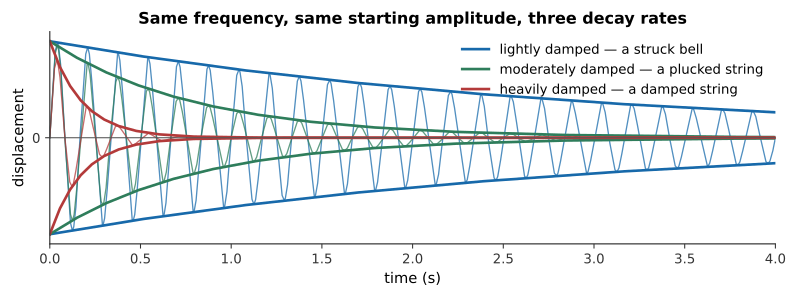
Figure 1.13:Three decay rates at the same frequency and the same starting amplitude. The frequency is barely affected by damping this light, the zero crossings stay where they were, but the length of the note is completely transformed. An instrument’s sustain is therefore a design parameter independent of its pitch.
Every instrument makes a choice here, and the choice is a trade-off that Chapter 4 makes precise. Energy radiated as sound is energy lost from the vibration, so a loud instrument is a short-lived one. A guitar string coupled tightly to a good soundboard is loud and dies quickly; the same string on a solid plank is quiet and rings for a long time. A pianist who wants a longer note lifts the dampers; a pianist who wants a shorter one puts them back.
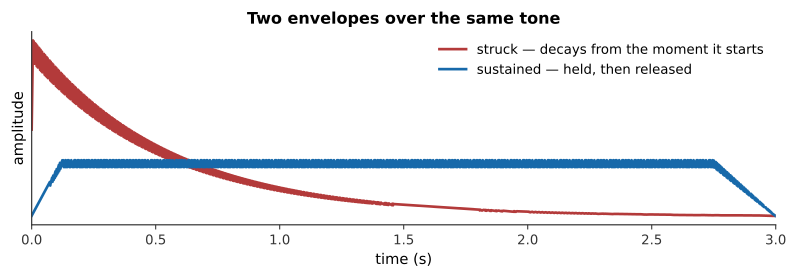
Figure 1.14:The same pitch, the same harmonics, the same loudness, and two envelopes. Nothing differs between these but how the amplitude changes with time, and it is enough to make the first sound struck and the second sound bowed or blown. Chapter 5 shows that this is not a minor effect: strip the attack off a recorded note and listeners struggle to name the instrument.
What you hear: Two notes of the same pitch and the same tone color. The first begins abruptly and fades away like a plucked string; the second grows in, holds steady, and stops.
Why Anything Vibrates Sinusoidally At All¶
Why does simple harmonic motion deserve a chapter to itself, given that almost nothing in music is a mass on a spring?
The answer has three parts, and each is developed later in the book.
First, everything stable is a spring for small displacements. That is the Taylor-series argument above. Air in a pipe, a stretched membrane, a steel bar, the fluid in your cochlea: displace any of them slightly and the restoring force is linear in the displacement, so the motion is sinusoidal.
Second, complicated objects are collections of simple ones. A guitar string does not have one natural frequency; it has an unlimited number, and each of them behaves exactly like an independent mass on a spring. These are its normal modes, and Chapter 4 shows that any motion of any such system, however complicated, is a sum of its modes vibrating simultaneously.
Third, any periodic sound is a sum of sinusoids. This is Fourier’s theorem, the subject of Chapter 5, and it is the reason a chapter about the simplest possible vibration is the right place to start a book about the most complicated ones. A clarinet’s waveform looks nothing like a sine curve. It is nevertheless a sum of sine curves, and once you know which ones, you know why a clarinet sounds like a clarinet.
Simple harmonic motion is not an approximation the book will later outgrow. It is the alphabet.
1.5Summary¶
Sound is a longitudinal disturbance in a medium, not a substance in transit. The medium moves back and forth along the direction of travel and stays where it was; only the disturbance goes anywhere. No medium, no sound, light crosses a vacuum and sound does not.
A sound wave can be described as displacement or as pressure, and the two are a quarter of a wavelength out of step. Compressions are pressure maxima and rarefactions are pressure minima. Both microphones and eardrums measure pressure, so the whole of what a listener has to work with is pressure at a point as a function of time.
Musical sounds are described by four perceptual attributes, pitch, loudness, timbre, duration, which correspond roughly to frequency, amplitude, spectrum-and-envelope, and duration. Only the last correspondence is exact, and the exceptions are the subject of Part III.
Periodic waveforms have pitch; non-periodic ones are noise. Frequency and period are reciprocals, . Human hearing spans roughly 20 Hz to 20 kHz; musical fundamentals occupy only the lower half of it.
Any stable system obeys for small displacements, because any smooth potential looks quadratic near its minimum. That is how so many unlike objects come to vibrate in the same way, and why “small amplitude” qualifies nearly every result in this book.
Simple harmonic motion is a sinusoid, , described by amplitude, frequency, and phase. For a mass on a spring : stiffer is faster, heavier is slower, and the frequency does not depend on the amplitude, without which no fixed-pitch instrument could exist.
Energy goes as the square of the amplitude, . The enormous dynamic range this produces is why loudness is measured logarithmically (Chapter 7).
Damping makes amplitude decay exponentially, . Radiating sound is a loss of energy from the vibration, so loudness and sustain trade against each other: a design decision every instrument maker has to make.
1.6Check Your Understanding¶
Five short, auto-graded questions cycle within one compact activity. The set mixes multiple choice, true/false, drag-the-words, fill-in-the-blank, and mark-the-words formats, and opens on the anatomy of a sinusoid.
Multiple choice, from a figure. The activity reproduces the anatomy-of-a-sinusoid figure from earlier in this chapter, which draws two sinusoids of equal amplitude and equal period. Which quantity distinguishes them: phase, amplitude, frequency, or period?
True or false. Doubling the amplitude of a vibrating string doubles the energy stored in the vibration.
Drag the words. Complete: in a ___ the air is bunched and the pressure is ___ atmospheric; in a ___ the air is spread out and the pressure is ___ atmospheric; an eardrum and a microphone both respond to ___. (Terms: compression, above, rarefaction, below, pressure, displacement, equal to.)
Fill in the blanks. A steady tone at 250 Hz has a period of ___ ms, because frequency and period are ___.
Mark the words. Identify the three numbers that specify a simple harmonic motion: “A sinusoid is fixed by its amplitude, its frequency, and its phase; loudness, pitch, and timbre are the perceptions those give rise to.”
1.7Conceptual Questions¶
An alarm clock ringing inside a bell jar goes silent as the air is pumped out, but the hammer can still be seen striking the bell. Explain what has stopped and what has not.
A tuning fork held in the air is quiet; the same fork with its base pressed against a table is loud, and stops ringing sooner. Account for both observations with one explanation.
A sound wave is sometimes drawn as a wavy line. Explain what is actually wavy, given that the air does not move up and down at all, and say what quantity the vertical axis of such a drawing represents.
At the moment a small parcel of air has been displaced furthest from its rest position, is the pressure there a maximum, a minimum, or atmospheric? Explain your answer without using calculus.
A piano string struck hard and struck gently produces the same pitch. Which property of simple harmonic motion guarantees this, and what would music be like if it did not hold?
Two guitar strings have the same length and the same tension, but one is twice as massive per unit length. Which sounds the lower note, and by roughly what interval?
A pendulum clock keeps good time when its swing is small, but runs slow when the swing is large. Explain which assumption of §1.3 has failed, and in which direction the error goes.
Explain, in terms of where the vibrational energy goes, why an electric guitar unplugged is both quieter and longer-sustaining than an acoustic guitar.
1.8Problems¶
Solution to Exercise 1.1 #
Solution to Exercise 1.2 #
(a) An octave is a factor of two in frequency. One octave above: Hz. One octave below: Hz.
(b) Four octaves is a factor of :
Therefore, the note is 7040 Hz, which is well inside the audible range of roughly 20 Hz to 20 kHz, though it is above the highest note on a piano (4186 Hz).
Solution to Exercise 1.3 #
Solution to Exercise 1.4 #
Solution to Exercise 1.5 #
Solution to Exercise 1.6 #
(a) Using :
(b) Setting and solving:
(c) Energy goes as amplitude squared, so at amplitude the energy is of its initial value.
Therefore, about of the amplitude remains after 3.0 s, remains after 4.1 s, and at that point only one part in a hundred of the energy is left, yet the note is still clearly audible, which is another demonstration of the ear’s range.
Solution to Exercise 1.7 #
Two springs in parallel both stretch by the same displacement , and each contributes a restoring force , so the total force is . The effective stiffness is therefore .
Since ,
Therefore, the frequency rises by a factor of , about , which, as Chapter 9 will point out, is almost exactly a musical tritone, the interval of six equal-tempered semitones.
Solution to Exercise 1.8 #
Solution to Exercise 1.9 #
First, .
(a) The maximum speed is
(b) For simple harmonic motion the maximum acceleration is :
which is times .
Therefore, the cone reaches 0.75 m/s and . Accelerations of this order are routine in loudspeakers, and they are the reason cones are made as light and as stiff as materials allow (Chapter 15).
Solution to Exercise 1.10 #
(a) The frequency is the reciprocal of the period:
(b) The ratio to A440 is . One semitone is , so the number of semitones is
Therefore, the note is A440, sharp by about four hundredths of a semitone, four cents, in the units of Chapter 9. That is far too small to hear as mistuning, and is well within the precision with which a violinist places a finger.
Solution to Exercise 1.11 #
Energy is conserved, and the total is the potential energy at the turning point:
Solving for :
using . Taking the square root gives , which correctly gives at and at .
The two energies are equal when each is half the total:
Therefore, the energy is evenly split at about of the amplitude, not at half the amplitude, which is the natural but wrong guess.
Solution to Exercise 1.12 #
(a) Setting gives :
(b) The string. A short decay time means energy is leaving the vibration quickly, and for an instrument designed to be heard, the dominant loss channel is radiation as sound. The glass holds its energy, which is why a wine glass is loud only when it is rubbed continuously, and why the string, losing its energy fast, is loud straight away.
(c) A factor of 103 takes :
Therefore, the string rings for about 9 s and the glass for about 45 s. The comparison is the trade-off of §1.4 in numbers: the glass sustains five times longer because it is five times worse at the job of turning vibration into sound.
Solution to Exercise 1.13 #
(a) At a steady 0.75 m/s:
(b) The actual travel time is about 15 ms, some 440 times shorter. Worse, the cone’s motion is oscillatory, it moves out and back, so no parcel of air makes net progress at all; each one jiggles about a fixed position with an amplitude of a fraction of a millimeter.
Therefore, the student’s picture is wrong in both magnitude and kind. What travels from the loudspeaker to the ear is not air but a disturbance in the air, and its speed is set by how quickly molecular collisions pass the squeeze along: a property of the medium, not of the source (Chapter 2).
Solution to Exercise 1.14 #
(a) Identical, since contains no amplitude.
(b) , so the second is three times faster.
(c) , so the second has times the energy.
(d) Part (a). The independence of frequency from amplitude is exactly what guarantees that a string struck harder sounds the same note, only louder. Were it otherwise, the instrument would go out of tune with every change of dynamic, and fixed-pitch instruments could not exist.