Learning Objectives¶
By the end of this chapter, you should be able to:
Express a musical interval as a frequency ratio, and explain why intervals multiply where pitches add.
Define the cent, convert between a frequency ratio and an interval in cents, and use cents to compare tunings that differ by only a few parts per thousand.
Construct the Pythagorean scale from a chain of pure fifths, and calculate the Pythagorean comma that results from twelve of them.
Explain why no stack of pure fifths ever closes into an octave, as a consequence of the fact that no power of 3/2 is a power of 2.
Construct a just major scale from the ratios 3:2, 5:4, and 6:5, and identify the syntonic comma and the two sizes of whole tone it produces.
Explain concretely why a keyboard tuned in just intonation cannot modulate, using the wolf fifth as the example.
Describe quarter-comma meantone and the well temperaments as deliberate distributions of the comma, and state what each was optimizing for.
Derive equal temperament from the requirement that twelve equal semitones make an octave, and calculate the ratio of the equal-tempered semitone.
Compare equal-tempered intervals with their just counterparts in cents, and identify which are nearly exact and which are noticeably wide or narrow.
Explain why fretted and keyboard instruments are bound to a fixed tuning while singers, string quartets, and trombonists are not.
Introduction¶
Figure 9.1:Instrument makers have repeatedly reshaped resonators to change how partials reach the listener. Historical image, public domain.
Chapter 8 ended with a result worth restating: intervals whose frequency ratios are simple whole numbers sound smooth, because the partials of the two tones coincide instead of clashing. The octave is , the perfect fifth is , the major third is .
So building a musical scale ought to be easy. Take the good ratios and stack them up.
It cannot be done. Not approximately, not with more effort, not with better arithmetic, the good ratios do not fit into an octave, and no amount of cleverness will make them. This is an arithmetical fact, not a historical accident or a limitation of any instrument, and every tuning system ever devised is a different answer to the question of what to do about it.
The obstruction is easy to state. Stack twelve perfect fifths and you get almost seven octaves, missing by about a quarter of a semitone. Stack four perfect fifths and you get almost a major third plus two octaves, missing by about a fifth of a semitone. Those two small discrepancies, the Pythagorean comma and the syntonic comma, are the entire subject of this chapter. Every tuning system is a decision about where to put them.
That decision has consequences musicians can hear, and the history of Western music is bound up with it. The reason Bach could write in all twenty-four keys, and his grandfather’s generation could not, is a change in where the comma was hidden.
9.1Intervals as Ratios¶
The Octave and the Fifth¶
An interval is a ratio of frequencies, not a difference. The octave above 220 Hz is 440 Hz, and the octave above 440 Hz is 880 Hz. The differences are 220 and 440 Hz; the ratio is 2 in both cases, and it is the ratio the ear reports.
This follows directly from Chapter 6: the cochlea’s frequency map is logarithmic, so equal ratios occupy equal distances along it, and Chapter 8 showed that pitch discrimination is likewise constant in proportional terms.
The intervals that matter most are the first few of the harmonic series:
| Interval | Ratio | Harmonics involved |
|---|---|---|
| Octave | 1 and 2 | |
| Perfect fifth | 2 and 3 | |
| Perfect fourth | 3 and 4 | |
| Major third | 4 and 5 | |
| Minor third | 5 and 6 |
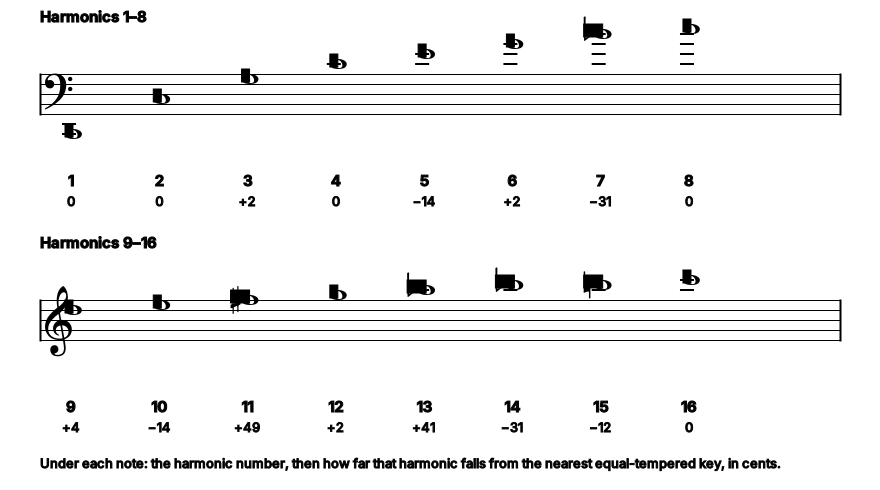
Figure 9.2:The harmonic series again, now read as a source of intervals. The first six partials give the octave, the fifth, the fourth, and the major third, the consonances of Western music, in order. From the seventh partial upward the series diverges sharply from anything a keyboard can play, which is why those partials play almost no part in common-practice harmony.
Intervals Multiply¶
Stack two intervals and the ratios multiply:
This is why a fifth plus a fourth is an octave, and it is also the source of a persistent confusion. Musicians count intervals by adding, a third plus a third is a fifth, because they are counting note names, which is a logarithmic count. The physics multiplies. The two are consistent, and cents are what reconciles them.
The Cent¶
The cent is one hundredth of an equal-tempered semitone, so there are 1200 to the octave. Converting between a ratio and an interval in cents:
Cents are logarithmic, so they add the way musicians expect while representing ratios exactly. And the unit is well matched to the ear: Chapter 8 put the just-noticeable difference at 3–6 cents, so an error of a cent or two is inaudible and one of fifteen is obvious.
The essential values, worth memorizing:
| Interval | Ratio | Cents |
|---|---|---|
| Octave | 1200.0 | |
| Pure fifth | 701.955 | |
| Pure fourth | 498.045 | |
| Pure major third | 386.314 | |
| Pure minor third | 315.641 | |
| Equal semitone | 100.0 |
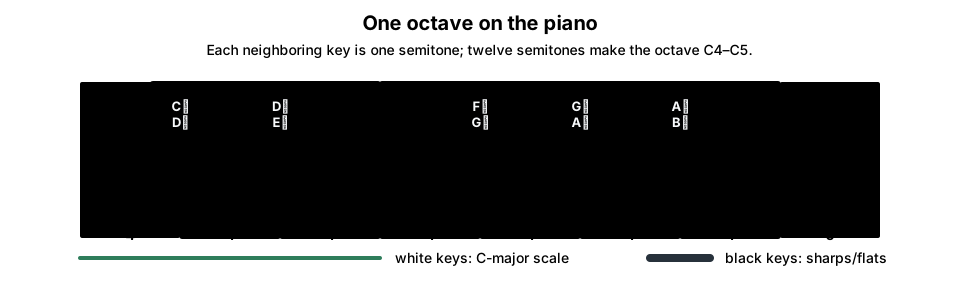
Figure 9.3:Reading notes on a keyboard. The white keys trace the C-major scale, while each black key has two names: for example, C-sharp and D-flat are the same equal-tempered key. Moving to the next key, white or black, raises the pitch by one semitone; the octave from C4 to C5 contains twelve such steps.
9.2Pythagorean Tuning¶
A Chain of Pure Fifths¶
The oldest systematic tuning takes the two simplest ratios, the octave and the fifth , and uses nothing else.
Start on a note and go up by fifths: C, G, D, A, E, B, F♯, … Each new note is times the last; whenever the pitch leaves the octave, halve it to bring it back. After twelve steps every chromatic note has been generated.
This produces beautiful fifths, by construction: every fifth in the chain is exactly pure. The fourths are pure too, being octave complements of fifths.
The Pythagorean Comma¶
Now the problem. Twelve fifths should return to the starting note, seven octaves higher. They do not.
The ratio between them is
which is
This is the Pythagorean comma, and it is not going away. The reason is elementary number theory: , and no power of 3 is ever a power of 2, since 3 and 2 are distinct primes. The chain of fifths can never close, at twelve steps or at any other number.
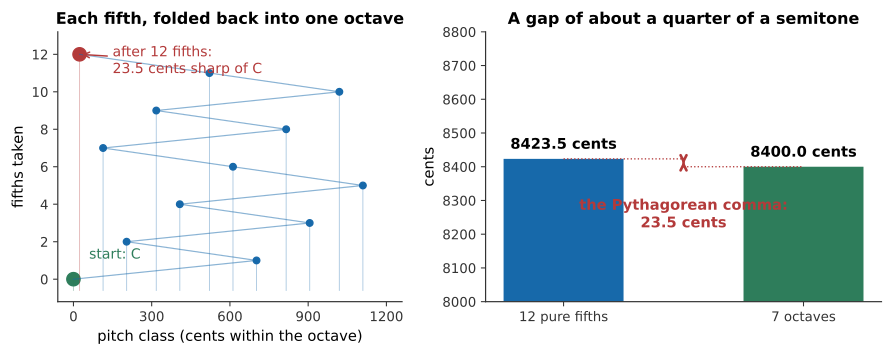
Figure 9.4:The chain of fifths fails to close. Left: each fifth folded back into a single octave; the twelfth lands not on C but 23.5 cents above it. Right: the same fact as arithmetic. Twelve pure fifths overshoot seven octaves by the Pythagorean comma.
The Scale It Produces¶
Pythagorean tuning gives pure fifths and fourths, and, as the price, a major third of
against a pure of 386.3 cents. That is 21.5 cents sharp, an error known as the syntonic comma.
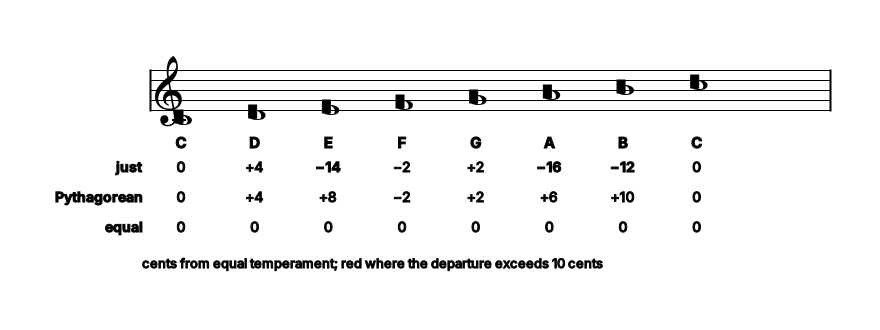
Figure 9.5:The same seven notes, tuned three ways. Every system agrees on C, F, and G to within a couple of cents; they disagree about the thirds and sixths, and they disagree in opposite directions. Pythagorean thirds are sharp, just thirds are flat of equal temperament, and the gap between them is the syntonic comma.
Twenty-one cents is four times the threshold of detection, and on sustained tones it beats audibly. For medieval music this was tolerable, because the third was treated as a dissonance requiring resolution: the consonances were the octave, fifth, and fourth, which Pythagorean tuning renders perfectly. When the third became a consonance in the fifteenth century, the tuning had to change.
9.3Just Intonation¶
Bringing In the Fifth Harmonic¶
Just intonation adds the ratio to the toolkit and builds the scale from three pure triads: on the tonic, the subdominant, and the dominant. Each triad is tuned : a pure major third and a pure fifth.
The resulting C major scale:
| Note | Ratio | Cents |
|---|---|---|
| C | 0 | |
| D | 203.9 | |
| E | 386.3 | |
| F | 498.0 | |
| G | 702.0 | |
| A | 884.4 | |
| B | 1088.3 | |
| C | 1200 |
Played in C, this is gorgeous. The tonic, subdominant, and dominant triads are all exactly pure, with every partial coinciding and nothing beating at all.
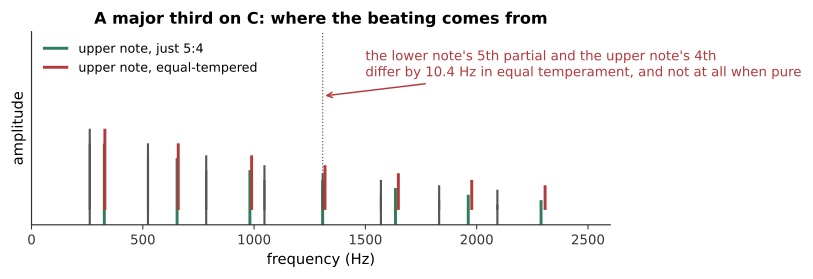
Figure 9.6:A C major triad, tuned justly and in equal temperament. The difference is not one of pitch, both are unmistakably C major, but of stillness. The just triad has nothing beating in it; the tempered one beats about ten times a second in its third.
What you hear: Two C major triads. The first is still and glassy, with no movement in it at all. The second has an audible shimmer, a slow waver that the first does not have.
Listen: Just, Equal-tempered
Figure 9.7:The major third alone, where the effect is clearest. The figure shows why: the lower note’s fifth partial and the upper note’s fourth partial coincide exactly when the third is pure, and differ by about 10 Hz when it is tempered.
What you hear: Two major thirds. The first is perfectly steady; the second has a distinct and rather fast beating in it, about ten beats a second.
Listen: Just 5:4, Equal-tempered
Two Sizes of Whole Tone, and the Wolf¶
The trouble appears as soon as you look at the intervals between the scale degrees.
There are two different whole tones, differing by 21.5 cents: the syntonic comma again. A keyboard has one key for each, so it must choose.
The consequence is a fifth that is badly out of tune:
against a pure 702 cents. That fifth is 21.5 cents narrow, and it beats violently. It is the wolf fifth, named for its howl.
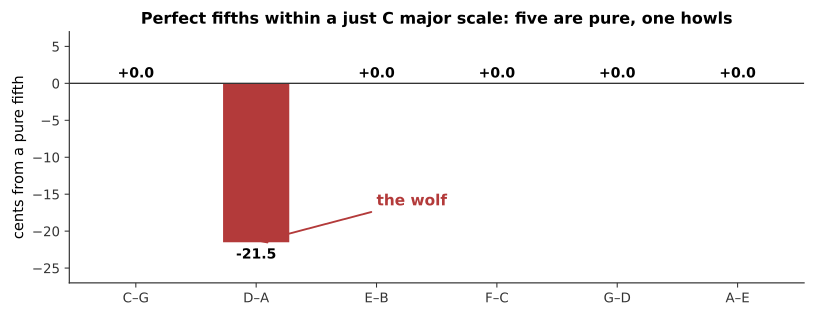
Figure 9.8:The fifths inside a just C major scale. Five are exactly pure. One, D–A, is a syntonic comma narrow, and it is unusable in sustained harmony.
Figure 9.9:A pure fifth and the wolf. The wolf is not subtly out of tune; it is the kind of thing a listener assumes is a mistake.
What you hear: Two fifths. The first is perfectly still. The second has a fast, insistent beating that makes it sound actively wrong rather than merely different.
Listen: A pure fifth, The wolf fifth
Why Just Intonation Cannot Modulate¶
The deeper problem is not the single wolf. It is that just intonation is tuned for one key, and there is no way to make a fixed set of twelve pitches serve them all.
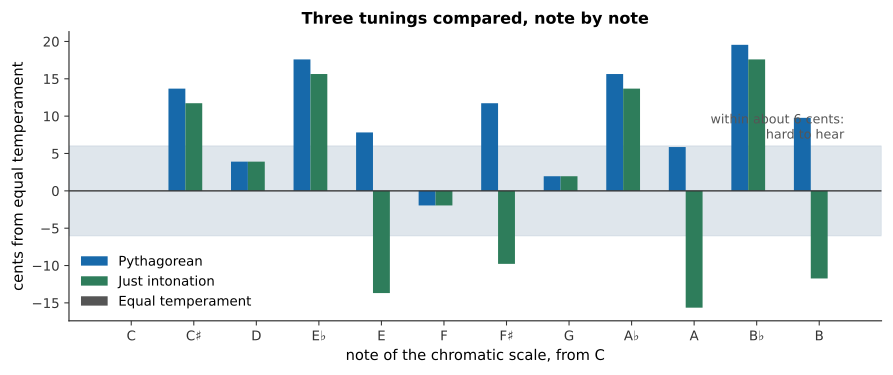
Figure 9.10:One set of twelve pitches, tuned justly for C, playing the same progression in two keys. The instrument has not been retuned between the two; the music has moved, and the tuning has not moved with it. This is the practical argument that ended just intonation as a keyboard tuning.
What you hear: The same four-chord progression, played twice on the same twelve fixed pitches. In C it is clean and settled. Moved up a tone to D, the same chords are audibly sour, with obvious beating.
Listen: I–IV–V–I in C, The same progression in D
Singers, string quartets, and trombonists do not have this problem, because they adjust continuously. They routinely play closer to just intonation than to equal temperament: a good choir will tune a sustained chord pure without being asked. Just intonation was never abandoned by musicians who can bend their pitch. It was abandoned by keyboards, and only because a keyboard has to decide in advance.
9.4Meantone and the Well Temperaments¶
Spending the Comma Deliberately¶
The insight that unlocked the problem is that the comma has to go somewhere, but it does not have to go all in one place. Distribute it and no single interval is ruined.
A system that does this deliberately is a temperament, and the choice of how to distribute is a choice about which keys will sound best.
Quarter-Comma Meantone¶
The most important historical temperament narrows every fifth by a quarter of a syntonic comma, about 5.4 cents, which is just at the edge of audibility.
Four narrowed fifths then produce a major third that is exactly pure:
which, less two octaves, is 386.3 cents: the pure .
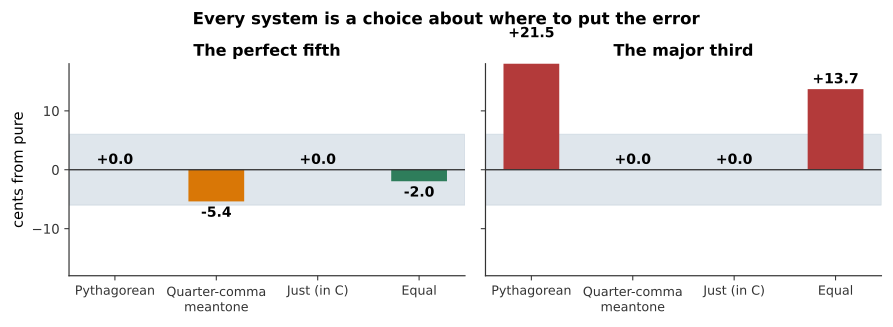
Figure 9.11:Where each system puts its error. Pythagorean tuning buys pure fifths at the cost of a 22 cent third. Quarter-comma meantone buys pure thirds at the cost of a 5 cent fifth, which is barely audible. Equal temperament splits the difference, with a fifth 2 cents narrow and a third 14 cents sharp.
Meantone dominated European keyboard music for two centuries, and for good reason: it makes major thirds beatless, and thirds are what Renaissance and early Baroque harmony is built on. Its price is that the twelve fifths still cannot close, so the accumulated error is dumped into one interval, traditionally G♯–E♭, which becomes a wolf of about 737 cents, 35 cents wide and completely unusable. Composers simply avoided the keys that needed it.
Well Temperament and Key Color¶
By the late seventeenth century composers wanted more keys, and well temperaments were the answer: distribute the comma unevenly, so that no interval is unusable but the distribution is not uniform either.
The consequence is that each key sounds different. Keys with few accidentals are nearly pure; remote keys are progressively more tempered and sound more restless. This is “key color”, and eighteenth-century writers described keys in terms that sound like synesthesia, D major brilliant, E♭ major solemn, F minor mournful, and were describing something real about their instruments.
9.5Equal Temperament¶
Twelve Equal Semitones¶
Equal temperament takes the distribution to its limit: divide the octave into twelve exactly equal steps.
The requirement is that twelve semitones make an octave, so each semitone is
which is 100 cents by definition. Every interval of semitones is .
The mathematics is forced. Twelve equal multiplicative steps making a factor of two admits exactly one solution, and the twelfth root of two is irrational; so no equal-tempered interval except the octave is ever a whole-number ratio.
What It Costs and What It Buys¶
Figure 9.12:Three tunings, note by note. Equal temperament is the zero line by construction. Pythagorean and just intonation disagree with it, and with each other, by up to about 20 cents, mostly on the thirds and sixths.
The accounting for equal temperament:
| Interval | Equal | Pure | Error |
|---|---|---|---|
| Octave | 1200 | 1200 | 0 |
| Fifth | 700 | 701.96 | -1.96 |
| Fourth | 500 | 498.04 | +1.96 |
| Major third | 400 | 386.31 | +13.69 |
| Minor third | 300 | 315.64 | -15.64 |
| Major sixth | 900 | 884.36 | +15.64 |
The fifth is 2 cents narrow, well below the threshold of detection, and essentially perfect. The thirds and sixths are 14 to 16 cents out, which is clearly audible on sustained tones.
So equal temperament is a worse compromise than meantone for any single key. What it buys is that the compromise is the same everywhere. Every key is equally usable, unlimited modulation is possible, and any piece can be transposed without retuning.
The nineteenth century decided that was worth an audibly imperfect third, and the decision has held. Notice that this was a trade of quality for freedom, made by a musical culture that had begun to care more about harmonic adventure than about the purity of a sustained chord.
Comparing the Systems in Cents¶
A summary of the three main systems in one table:
| Fifths | Major thirds | Modulation | |
|---|---|---|---|
| Pythagorean | All pure | 22 cents sharp | Impossible (comma) |
| Just | Mostly pure, one wolf | Pure in home key | Impossible (wrong key) |
| Quarter-comma meantone | 5 cents narrow | Pure | Limited (wolf at G♯–E♭) |
| Equal | 2 cents narrow | 14 cents sharp | Unlimited |
Read down the last column and the history explains itself.

Figure 9.13:Adam Neely compares equal temperament with just intonation from a working musician’s perspective. The examples make audible both the pure intervals that just tuning gains and the freedom to change key that equal temperament buys.
Watch on YouTube: Equal Temperament vs. Just Intonation
9.6Tuning in Practice¶
Fixed-Pitch and Flexible-Pitch Instruments¶
Equal temperament is universal on fixed-pitch instruments, piano, organ, harp, fretted strings, mallet percussion, because those instruments must commit in advance.
It is much less universal among flexible-pitch instruments, which adjust as they play:
A string quartet tunes sustained chords toward just intonation, narrowing thirds instinctively.
A choir does the same, more strongly; a well-tuned a cappella chord is close to pure.
A trombonist has a continuously variable slide and uses it.
Wind players adjust with embouchure and alternate fingerings continuously.
Ensembles mixing the two families negotiate. A string quartet plays closer to just; add a piano and the strings bend toward it, because the piano cannot bend toward them.
Stretched Tuning on the Piano¶
One place where even equal temperament is not quite applied is the piano, for the reason Chapter 5 gave.
Piano strings are stiff, so their partials are inharmonic: the th partial is sharp of times the fundamental. A tuner setting an octave listens to the lower note’s second partial against the upper note’s fundamental, and since that second partial is sharp, the octave must be stretched to match it.
The result is the Railsback curve: a piano’s treble is tuned progressively sharp and its bass progressively flat, by as much as 30 cents at the extremes. A piano tuned to a mathematically exact equal temperament sounds out of tune, and every tuner stretches without needing to be told to. Chapter 10 works through the mechanism.
Scales Outside the Western Tradition¶
Twelve equal divisions is one solution among many, and the alternatives are not approximations to it.
Indian classical music uses shrutis, traditionally twenty-two per octave, and raga performance draws on just ratios with ornaments that pass between them. The tradition has no fixed-pitch keyboard to force a compromise, so it never needed one.
Arabic and Turkish music use intervals near the quarter tone, including the neutral third of about 350 cents computed in §9.1: an interval with no equal-tempered equivalent at all.
Javanese and Balinese gamelan use slendro (roughly five near-equal steps) and pelog (seven unequal steps), and no two gamelan sets are tuned alike. Chapter 8 gave the reason this is coherent rather than arbitrary: gamelan instruments have inharmonic partials, so their dissonance curve has its minima somewhere other than the simple ratios, and the scales sit on those minima.
The general principle is the one §8.4 established. A scale and a timbre belong together. Western tuning theory is the theory of scales for instruments with harmonic partials, and it is not more fundamental than the alternatives, it is more specialized, and its specialization is to strings and pipes.
9.7Summary¶
An interval is a ratio, and intervals multiply. The cent, 1200 to the octave, , makes ratios additive and is well matched to the ear, whose discrimination is 3–6 cents.
The chain of fifths never closes. Twelve pure fifths exceed seven octaves by the Pythagorean comma, 23.5 cents, because no power of 3 is a power of 2. Four pure fifths exceed a pure major third plus two octaves by the syntonic comma, 21.5 cents.
Pythagorean tuning gives every fifth pure and every major third 22 cents sharp. Acceptable while the third was a dissonance; untenable once it became a consonance.
Just intonation gives pure triads on the tonic, subdominant, and dominant, at the cost of two sizes of whole tone, a wolf fifth at D–A, and the impossibility of modulating.
Quarter-comma meantone narrows every fifth by 5.4 cents to make major thirds exactly pure, and dumps the remaining error into one unusable wolf. Well temperaments distribute it unevenly, making every key usable and each key different.
Equal temperament makes every semitone . Fifths are 2 cents narrow (inaudible), thirds 14 cents sharp (audible). It is a worse compromise than meantone in any one key and the only one that is the same in all of them.
Fixed-pitch instruments use equal temperament; flexible-pitch ones do not. Singers and string players bend toward just intonation harmonically and away from it melodically, and negotiate with any keyboard present.
Pianos are tuned stretched, because string stiffness makes their partials sharp, and an octave must match the partial rather than the arithmetic.
Other traditions divide the octave differently, and where their instruments have inharmonic partials those divisions are as well founded as ours.
9.8Check Your Understanding¶
Five short, auto-graded questions cycle within one compact activity, using five different response styles.
Multiple response. Which statements are true of twelve-tone equal temperament? Consider its semitone ratio, equivalence of keys, fifth size, and major-third purity.
True or false. A chain of twelve acoustically pure fifths closes exactly at seven octaves.
Drag the words. Match Pythagorean tuning, just intonation, quarter-comma meantone, and equal temperament to their characteristic compromises.
Fill in the blanks. An octave contains ___ cents, so an equal-tempered semitone contains ___ cents.
Mark the words. Identify the performers who can continuously bend pitch toward just intonation: “A singer and a violinist can adjust each note continuously; a pianist and an organist are constrained by fixed pitches.”
9.9Conceptual Questions¶
Explain why intervals are ratios rather than differences, and connect the answer to the cochlea.
Explain, in terms of prime factorization, why a chain of pure fifths can never close into a whole number of octaves, at twelve steps or at any other number.
Pythagorean tuning was satisfactory for medieval music and unsatisfactory for Renaissance music. Explain what changed.
A choir sings a sustained chord and a piano plays the same chord. Explain why the choir’s version is likely to be closer to just intonation, and why the piano’s cannot be.
Explain why the wolf fifth in just intonation arises from there being two sizes of whole tone.
Quarter-comma meantone has a fifth 5.4 cents narrow and equal temperament has one 2.0 cents narrow, yet meantone’s thirds are much better. Explain how meantone can be worse on fifths and better on thirds.
Explain what “key color” meant in a well temperament and why the concept largely evaporates in equal temperament.
A piano tuned to mathematically exact equal temperament sounds out of tune. Explain why, and say what a tuner does instead.
9.10Problems¶
Solution to Exercise 9.1 #
Using .
(a) cents.
(b) cents.
(c) cents.
Therefore 702.0, 386.3, and 266.9 cents. The last lies between the equal-tempered minor third (300) and major second (200), and belongs to no Western key.
Solution to Exercise 9.2 #
Using .
(a) .
(b) .
(c) .
Therefore 1.4983, 1.2599, and 2. Comparing with the pure values 1.5 and 1.25: the tempered fifth is narrow and the tempered third sharp: the third is seven times worse.
Solution to Exercise 9.3 #
(a) .
(b) .
(c)
Therefore the comma is 23.5 cents, very nearly a quarter of a semitone, about four to eight times the threshold of detection, and unmistakable on sustained tones.
Solution to Exercise 9.4 #
(a) . Dividing by 4 to bring it into one octave: .
(b) The pure third is .
(c)
Therefore the syntonic comma is 21.5 cents, the ratio . It is the difference between the third you get from stacking fifths and the third the harmonic series offers, and it is what meantone temperament distributes.
Solution to Exercise 9.5 #
(a) Hz.
(b) Hz.
(c) Hz.
(d) From lowest to highest:
Therefore the three Es span 327.0 to 331.1 Hz, a spread of 21.5 cents: the syntonic comma, with equal temperament sitting about two-thirds of the way up.
Solution to Exercise 9.6 #
Solution to Exercise 9.7 #
Solution to Exercise 9.8 #
C–D is cents. D–E is
The difference is
the syntonic comma again.
A keyboard has one key per note name, so it must assign a single pitch to D. If D is placed to make C–D a tone, then D–E is a tone and the fifth D–A is a comma narrow. If D is placed the other way, some other interval breaks instead.
Therefore the instrument is short of keys, not short of cleverness. Some seventeenth-century keyboards addressed this literally, with split black keys giving separate D♯ and E♭, and they were abandoned as unplayable.
Solution to Exercise 9.9 #
(a) Hz.
(b) Hz against Hz:
(c) The third: Hz. Then Hz against Hz:
(d) The tempered fifth beats less than once a second, slow enough to pass for still. The tempered third beats nearly nine times a second, which is right in the roughest range.
Therefore equal temperament’s compromise is very uneven in its audible effect: the fifths are essentially free and the thirds are paid for dearly. This is exactly what the meantone temperaments refused to accept.
Solution to Exercise 9.10 #
(a) cents.
(b) A pure fifth is 701.96 cents:
so eleven steps, giving cents: an error of -7.2 cents.
(c) A pure third is 386.31 cents:
so six steps, giving cents: an error of -7.4 cents.
Therefore 19-tone equal temperament has a fifth 7 cents narrow (worse than 12-tone’s 2) but a third 7 cents flat (much better than 12-tone’s 14 sharp). It is, in effect, a closed version of meantone, and it was advocated on exactly those grounds in the sixteenth century and again in the twentieth.
Solution to Exercise 9.11 #
Suppose the octave is divided into equal steps, so each step is the ratio , and suppose steps give exactly a pure fifth:
Raising both sides to the power :
The left side has only the prime factor 2; the right has only the prime factor 3. By unique factorization these can be equal only if both are 1, requiring , not a division of the octave at all.
Therefore no equal temperament of any size contains a pure fifth, and the same argument rules out a pure major third, since 5 is likewise not a power of 2. Every equal temperament is a compromise; the only choice is how good an approximation buys, which is why 12, 19, 31, and 53 recur in the literature, they are the divisions where the approximations happen to be unusually good.
Solution to Exercise 9.12 #
(a) cents.
(b) The Pythagorean comma is 23.5 cents, so
remains, spread over eight fifths, about 0.44 cents each, which is imperceptible.
(c) The heavily tempered fifths lie among the naturals, so the keys built on them, C, G, D, A, have thirds noticeably closer to pure than equal temperament provides. The remote keys, whose fifths are essentially untempered, inherit almost-Pythagorean thirds, some 20 cents sharp, and sound correspondingly tense and bright.
Therefore every key is usable and no two sound alike: the common keys are sweet and the remote ones are edgy. That is precisely what eighteenth-century writers meant by key character, and it is a real acoustic property of the instrument rather than a literary conceit.
Solution to Exercise 9.13 #
(a) Using with :
(b) The tuner matches A’s fundamental to it: 220.13 Hz.
(c) An exact octave would be 220.00 Hz:
Therefore this octave is stretched by one cent. That is small, but it accumulates: seven octaves tuned this way, each stretched a little and each stretching more as the strings get shorter and stiffer, produces the tens of cents of the Railsback curve at the extremes of the keyboard.
Solution to Exercise 9.14 #
(a) The quartet can adjust its pitches continuously and will naturally tune a sustained triad toward just intonation, with the third about 14 cents flat of equal temperament. The piano is fixed in equal temperament and cannot move.
(b) Alone, the quartet’s chord is still and beatless. When the piano enters, its C♯ is 14 cents sharp of the quartet’s, and the two thirds beat against each other at roughly 10 Hz: a clearly audible sourness that was not there a moment before.
(c) The quartet will bend toward the piano, because it is the only party that can. In practice string players in this situation play thirds sharper than they would unaccompanied, sacrificing the purity of their own chord to avoid beating against the fixed instrument.
Therefore the compromise falls entirely on the flexible players, which is the general rule whenever fixed and flexible instruments play together, and one reason string players often describe playing with piano as harmonically constraining.