Learning Objectives
By the end of this chapter, you should be able to:
Classify particles as fermions or bosons and explain the physical distinction.
Distinguish the four fundamental interactions by their relative strength, range, and mediating boson.
Distinguish leptons and quarks as the two families of fundamental fermions, and state the generation structure of each.
Explain quark confinement and construct the quark content of simple baryons and mesons.
Apply conservation laws (charge, baryon number, lepton number, and strangeness) to determine whether a proposed particle reaction is allowed, and identify which interaction (strong, electromagnetic, or weak) a given reaction must proceed through.
Describe the role of the Higgs field in giving mass to fundamental particles.
Read and interpret a simple Feynman diagram, including the convention that an antiparticle’s arrow points backward in time along a line that itself still runs forward.
Describe, in outline, how particle accelerators and detectors produce and identify new particles, and explain why colliders are favored over fixed-target machines for reaching the highest energies.
Recount the historical “particle zoo” of the 1930s–1960s and explain how the eightfold way and the quark model resolved it.
Estimate, quantitatively, why gravitational effects between individual particles are negligible compared with the other fundamental interactions.
Identify several of the major open questions at the current frontier of particle physics and cosmology.
Introduction
Nuclear physics (Chapter 13) treated protons and neutrons as elementary building blocks, bound by the strong force into nuclei. This chapter goes one level deeper, to the particles and forces from which protons, neutrons, and indeed all matter are built. Over the course of the twentieth century, a rapidly growing zoo of “elementary” particles, discovered first in cosmic rays and then in purpose-built particle accelerators, was gradually organized into a coherent theoretical framework, the Standard Model of particle physics, which identifies a genuinely small set of truly fundamental particles and the forces (themselves mediated by particle exchange) that govern their interactions. This chapter surveys that framework: the classification of particles by spin and by the forces they feel, the substructure of protons and neutrons in terms of quarks, the conservation laws that govern which particle reactions can occur, and the mechanism by which most fundamental particles acquire mass at all. It also traces how this framework was actually established — the historical progression from a bewildering “particle zoo” of cosmic-ray discoveries to the ordered quark model, and the particle accelerators and detectors that turned particle physics into a precision experimental science — and closes, as befits the final chapter of this book, with several of the major questions the Standard Model leaves unanswered.
14.1Particles, Forces, and Feynman Diagrams
Classifying Particles: Fermions and Bosons
Every known particle carries an intrinsic spin angular momentum, quantized exactly as orbital angular momentum is (Chapter 9), , but with either a half-integer () or an integer (). This distinction is far more than bookkeeping: particles with half-integer spin, called fermions, obey the Pauli exclusion principle (Chapter 11) and cannot occupy the same quantum state as an identical partner; particles with integer spin, called bosons, obey no such restriction and can occupy the same state in unlimited numbers (the basis, for photons, of the stimulated-emission cascade in a laser, Chapter 11). Matter, in the Standard Model, is built from fermions (spin ); the forces between them are mediated by the exchange of bosons.
The Four Fundamental Interactions
All observed particle interactions are, to the precision of current experiments, accounted for by exactly four fundamental forces, each mediated by the exchange of a characteristic boson (a gauge boson, in the language of the quantum field theories underlying the Standard Model) and each with a distinct characteristic strength and range:
The interactions are compared directly in Table 14.1.
Table 14.1:The four fundamental interactions
| Interaction | Relative strength | Range | Mediating boson(s) | Governs |
|---|---|---|---|---|
| Strong | 1 | confining; residual range | gluon (QCD); mesons for the residual force | quark binding; nuclear force (residual) |
| Electromagnetic | infinite | photon | charged-particle interactions | |
| Weak | , | beta decay; some particle decays | ||
| Gravitational | infinite | graviton (hypothesized, not yet observed) | negligible for individual particles; dominant only for macroscopic masses |
The weak interaction and the residual strong interaction between nucleons are confined to nuclear-scale distances, which is why their effects were unknown until nuclear and particle physics probed those scales directly. The underlying strong interaction is instead a confining interaction between quarks; the electromagnetic and gravitational interactions are infinite in range because their mediating bosons are massless, and they dominate everyday, macroscopic experience. The relative strengths quoted are approximate and depend on the energy/distance scale at which the comparison is made, but the ordering — strong electromagnetic weak gravitational, at typical particle-physics scales — is robust. The strong force between nucleons discussed in Chapter 13 is, in the Standard Model’s deeper description, a residual effect of the strong force acting between the quarks confined inside each nucleon (analogous to the way the residual electromagnetic force between neutral atoms, the van der Waals force, is a residual effect of the more fundamental electromagnetic force between the charged constituents of each atom).
Worked Example: Gravity Versus Electromagnetism for Two Protons
Table 14.1 states that gravity is weaker than the strong interaction by a factor of order 10-38; it is worth seeing this concretely for the simplest possible case — two protons separated by some distance — where both the gravitational attraction and the electric (Coulomb) repulsion are exactly known, textbook formulas requiring no particle-physics machinery at all:
independent of , since both forces obey the same inverse-square law and the separation cancels out of the ratio. Substituting , , , and ,
consistent, to within the precision either figure is normally quoted, with the ratio of the two relative-strength entries in Table 14.1 (). Gravity between two individual protons is roughly 36 orders of magnitude weaker than their mutual electric repulsion — so extreme that no experiment has ever measured the gravitational force between two elementary particles directly; it is simply swamped by every other force present. Gravity dominates only on macroscopic and astronomical scales because mass is exclusively attractive and accumulates without limit (every proton in a star adds to the same gravitational pull), whereas electric charge comes in both signs and ordinary bulk matter is almost perfectly charge-neutral, so the electromagnetic forces of its enormous number of individual charges cancel to a degree gravity’s never does. This is also, precisely, why the graviton remains hypothetical in Table 14.1: a force this feeble, acting between single particles, is far beyond the reach of any conceivable particle-physics detector, and quantum gravity remains an unsolved theoretical problem rather than an experimentally accessible one, as the Open Questions section at the end of this chapter discusses further.
Of the four, the weak interaction is the one with no everyday signature to point at — it is too short-ranged to hold anything together and too feeble to push anything around — and its importance is easy to underrate as a result. Its distinction is that it is the only interaction that changes one kind of quark into another, and Figure 14.1 is that transformation at work: a neutron () becomes a proton () by turning a down quark into an up quark, with an electron and an antineutrino carrying off the charge and lepton-number balance. None of the other interactions in Table 14.1 can do this. Without it, the proton-proton chain could never take its first step, no hydrogen would ever become helium, and stars would not shine.
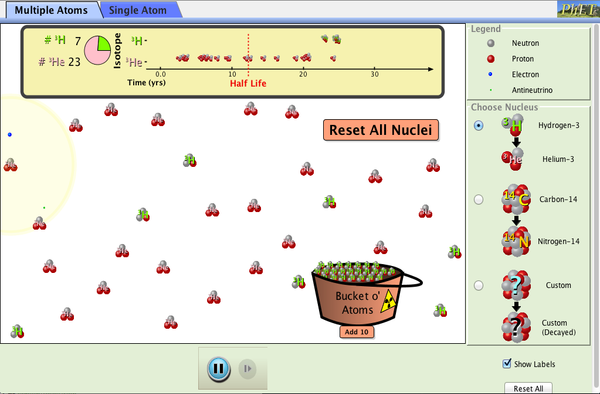
Figure 14.1:Beta decay of a single nucleus and of a sample, with the emitted electron and antineutrino shown. The conservation laws catalogued later in this chapter can be read directly off the products: charge, baryon number, and electron lepton number each balance, event by event.
Interactive simulation: Beta Decay
Reading Feynman Diagrams
Every interaction catalogued in Table 14.1 — one particle scattering off another, one particle decaying into several — can be drawn as a Feynman diagram, a bookkeeping and visualization tool introduced by Richard Feynman in the late 1940s as part of the machinery that made precise calculations in quantum electrodynamics tractable (work for which Feynman shared the 1965 Nobel Prize with Julian Schwinger and Sin-Itiro Tomonaga). A Feynman diagram is not a literal picture of particle trajectories in space, the way a cloud-chamber photograph is; it is closer to a schematic circuit diagram, read according to a small set of fixed conventions:
The vertical axis is time, increasing upward (some texts instead run time left to right; the convention adopted here matches the light-cone diagrams of Chapter 2). The horizontal axis is space, drawn schematically and not to scale.
A straight line represents a fermion (a matter particle), with an arrow indicating the direction of particle flow. A particle’s arrow points forward in time, in the direction the line is actually traversed; an antiparticle is drawn as its particle’s line traversed backward — the arrow points backward in time even though, like everything else in the diagram, the antiparticle itself only ever moves forward in time.
A wavy or dashed internal line represents the exchanged boson that mediates the interaction — a photon, gluon, or /, depending on which force is at work.
A vertex, where lines meet, represents a single interaction. Every exactly-conserved quantity introduced in this chapter — electric charge above all — must balance at each individual vertex, not merely for the diagram as a whole, since a vertex is the fundamental, irreducible unit of interaction the Standard Model actually specifies.
The internal boson line is called virtual: unlike an external line (an actual incoming or outgoing particle, which must satisfy the energy–momentum relation of Chapter 3 for its own rest mass), a virtual particle is an internal quantum-mechanical contribution and need not satisfy that relation (it is not an independently observable particle). The often-used language of “borrowing” energy from the energy–time uncertainty principle (Chapter 7) is only a heuristic; energy and momentum remain conserved at every vertex. The finite range associated with exchange of a massive boson can be estimated from its Compton wavelength, : the massive and () confine the weak interaction to a range of only — matching the table’s entry to within the precision it is normally quoted. The photon is massless and mediates an infinite-range force. The residual strong force between nucleons is instead finite-ranged, dominated at ordinary nuclear distances by exchange of massive mesons such as pions; the gluons themselves are confined and do not produce a freely propagating long-range force between nucleons.
Figure 14.2 shows two of the simplest possible diagrams, one for each of two very different interactions.
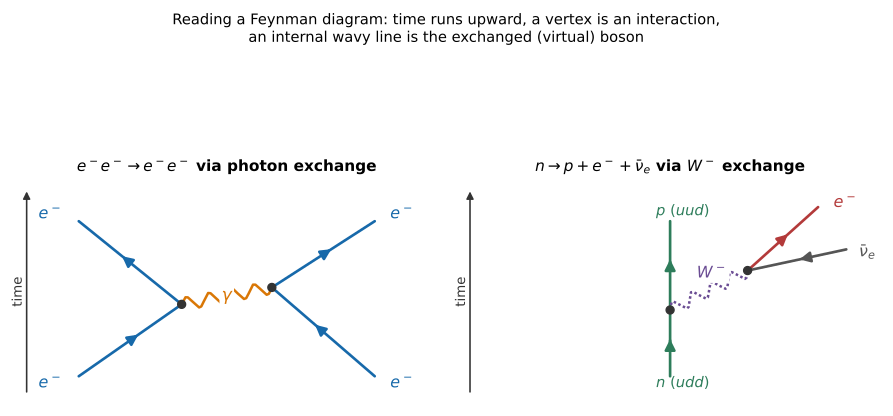
Figure 14.2:Left: two electrons scatter by exchanging a virtual photon — the same photon whose particle nature was established in Chapter 6, here playing the role of the electromagnetic force carrier at the vertex level. Right: a neutron decays to a proton by emitting a virtual , which itself decays to an electron and an electron antineutrino; the antineutrino’s arrow points backward in time, marking it as an antiparticle. Original schematic by the author.
The left-hand diagram is the quantum-field-theoretic picture underlying ordinary Coulomb repulsion: two electrons never touch, but exchange a virtual photon at a single vertex on each of their two lines, each vertex conserving charge trivially (an electron’s charge is unchanged by absorbing or emitting an uncharged photon). The right-hand diagram redraws the beta-decay process already introduced above, but at the level of an individual quark rather than the nucleon as a whole: it is really the neutron’s down quark that emits the virtual and converts directly to an up quark, turning into , while the neutron’s other two quarks look on as unaffected spectators. This is also the precise reason the weak interaction, uniquely among the four, can change a quark’s flavor at all. At a photon or gluon vertex, the boson emitted or absorbed carries zero electric charge, so charge conservation alone forces the quark’s charge — and hence its flavor family — to be exactly the same before and after; a quark () simply cannot become a quark () at such a vertex without violating charge conservation right there at the vertex. The boson is the only carrier with nonzero electric charge (), and is exactly the charge difference between an up-type and a down-type quark in the same generation (), so only a vertex has the right charge budget to convert one into the other.
Worked Example: Reading a Feynman Diagram
Verify, vertex by vertex, that the beta-decay diagram in Figure 14.2 conserves charge, baryon number, and lepton number at each vertex individually, not merely for the overall reaction already checked earlier in this chapter.
First vertex (shown schematically at the nucleon level as ): charge before is 0 (the neutron); charge after is . Balanced. Baryon number before is +1 (); after, and (the is a boson, carrying no baryon number), so . Balanced. At the underlying quark vertex this is , with the neutron’s other two quarks acting as spectators.
Second vertex (): charge before is (the ); charge after is . Balanced. Lepton number () before is 0 (the carries none); after, and , summing to 0. Balanced.
Every conservation law holds separately at each vertex, which is both a check on the diagram and the deeper reason the overall reaction conserves these quantities in the first place: a multi-vertex process can only conserve a quantity globally if every individual vertex conserves it, since nothing is allowed to leak in or out of an internal line that connects two vertices back to back.
14.2Accelerators, Leptons, and Quarks
Particle Accelerators and Detectors
None of the particle content, forces, or conservation laws catalogued in this chapter were read directly off nature; they were inferred, often at great technical and financial cost, from what came out of high-energy collisions. A particle accelerator uses electric fields to increase a charged particle’s kinetic energy, typically bending its path into a circle with magnetic fields (a synchrotron, of exactly the type used at the Bevatron introduced in Chapter 3) so that the same beam can be accelerated repeatedly on each pass rather than only once, as in a straight-line (linear) accelerator. That beam is then steered into a collision — either against a stationary target (fixed-target) or head-on against a second, oppositely circulating beam (a collider) — and the CM-frame threshold-energy analysis of Chapter 3 governs, in either case, exactly how much beam energy is needed to produce a given final state.
What comes out of the collision is reconstructed by a detector, typically built in concentric layers immediately surrounding the collision point: an inner tracking layer, threaded by a magnetic field, records the curved paths of charged particles, whose momentum is read off from the radius of curvature via — the same relation used to test directly in Chapter 3; beyond that, a calorimeter stops most particles outright and measures their energy from the size of the resulting shower of secondary particles; and an outermost layer specifically identifies muons, since a muon, carrying no strong-interaction charge and losing energy only slowly, is typically the only charged particle able to punch all the way through the calorimeter’s absorbing material. Combining the tracking, calorimetry, and timing information from every layer, for millions of collisions per second, is how a modern detector reconstructs which particles were actually produced in each individual event — the only way any of the particles, decay modes, and conservation laws in this chapter were ever actually established.
The largest such machine ever built is the Large Hadron Collider (LHC), operated by CERN outside Geneva: a 27-kilometer circular tunnel in which two counter-circulating proton beams are accelerated to several each () before colliding head-on at four points around the ring, each instrumented with a detector of exactly the layered design just described. Two of those detectors, ATLAS and CMS, are shown mid-construction in Figure 14.3; it was data from detectors of this kind, sifted from many billions of recorded collisions, that produced the statistically decisive evidence for the Higgs boson announced in 2012 and discussed further below.
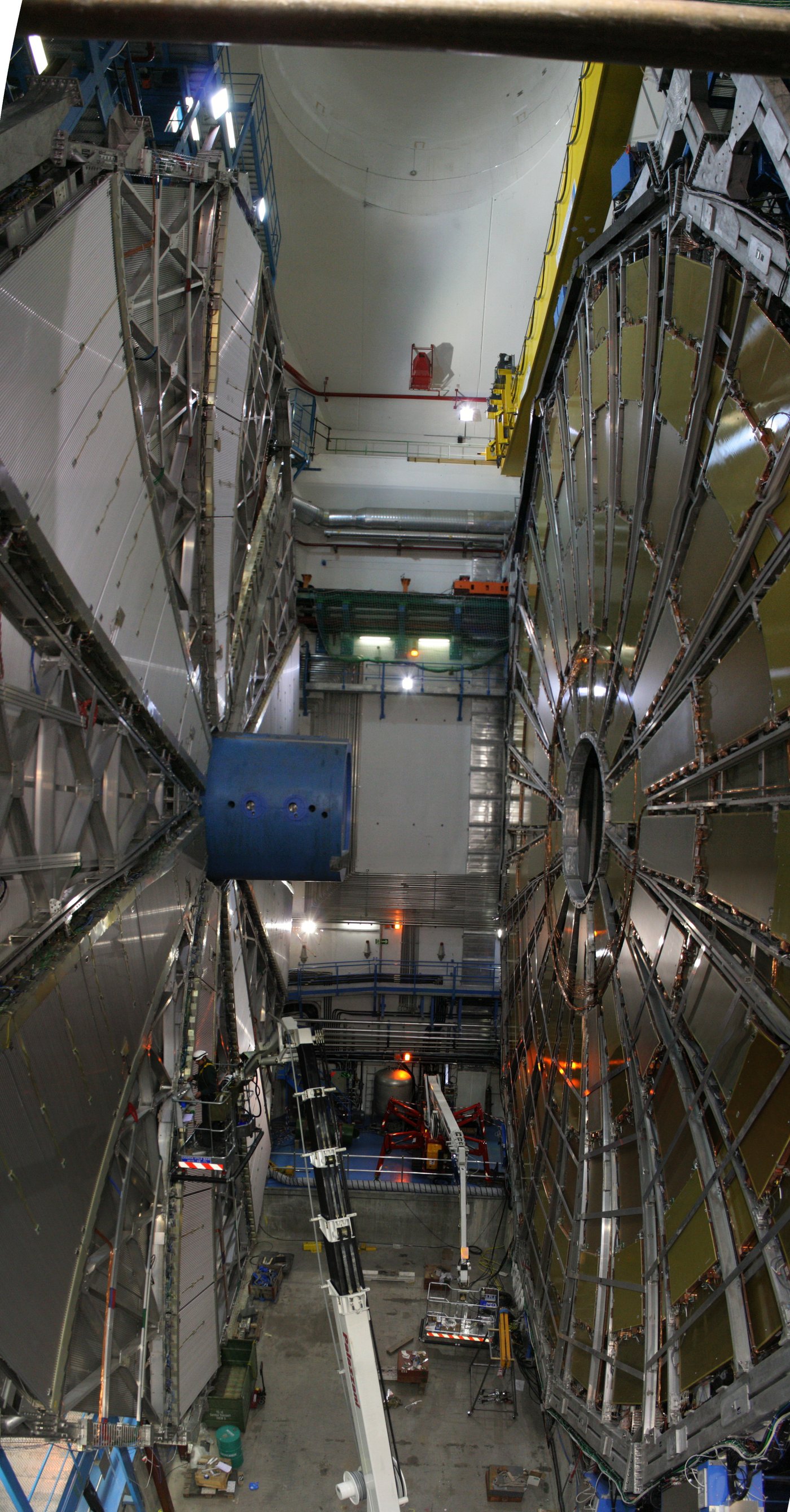
Figure 14.3:The ATLAS detector at CERN, photographed during construction in February 2007; the detector’s wheel-shaped toroid magnets, used to bend and measure the momentum of outgoing muons, are visible at either side. Photograph by Sindre Skrede, 2007; released into the public domain via Wikimedia Commons.
Not every particle produced in a collision leaves a readily visible signal. A neutrino — carrying no electric charge and feeling only the weak interaction — usually passes through even a large, modern detector’s tracking, calorimetry, and muon layers essentially undisturbed, exactly as it passes through the Earth itself. A small fraction do undergo a weak interaction in detector material, and those interactions provide direct event-by-event neutrino detections in dedicated neutrino experiments. In a collider detector, however, an escaping neutrino is usually inferred from missing transverse momentum, much as Pauli inferred the neutrino’s existence from the continuous beta-decay energy spectrum (Chapter 13), but applied now to momentum: because the incoming beams have negligible net transverse momentum, any transverse momentum imbalance among everything the detector does see may have been carried away by one or more unseen particles. Detector resolution and unobserved beam remnants can also contribute to the imbalance, so missing transverse momentum is evidence rather than an exact identification by itself.
Worked Example: Inferring a Missing Neutrino from Momentum Conservation
Suppose a collision event at a detector produces several visible particles (tracked and measured by the calorimeter) whose momentum components transverse to the beam sum to and . Since the incoming beams carry zero net transverse momentum by construction, conservation of momentum requires the missing transverse momentum, carried by one or more undetected particles (a neutrino, most often), to be exactly the negative of the visible sum:
with magnitude . A sizable “missing transverse momentum” of exactly this kind, event after event, was part of the experimental signature used to identify -boson production and decay ( or ) in the collider experiments of the 1980s, and remains a routine tool today for tagging any collision producing a neutrino (or, in searches for physics beyond the Standard Model, any other weakly-interacting particle that would likewise escape undetected — including, potentially, a dark-matter particle of the kind discussed in Open Questions below).
Worked Example: Threshold Energy for Pion Production
The fixed-target threshold method of Chapter 3’s worked example on antiproton production applies to any particle-creation reaction, not only that one. Consider a proton beam striking a stationary proton target and producing a neutral pion, , with . Following exactly the same method, with in place of the antiproton reaction’s :
Expanding the left side and solving for the beam proton’s total energy ,
so the threshold kinetic energy is
This is dramatically less demanding than the threshold found for antiproton production in Chapter 3, consistent with pion physics having been accessible to the very first generation of proton accelerators in the late 1940s and early 1950s, well before the antiproton search motivated the Bevatron. Reaching successively higher thresholds like these — hundreds of for pions, several for antiprotons and strange particles, hundreds of for the Higgs boson, and -scale collision energies for direct searches beyond the Standard Model — is the entire history of why particle accelerators have grown, generation after generation, from tabletop devices to the 27-kilometer LHC.
Leptons and Quarks
The Standard Model’s fundamental matter fermions fall into two families, leptons and quarks, each organized into three repeating generations of increasing mass, with the same gauge-interaction charges in corresponding generations. Their masses differ, and neutrino mixing means that lepton flavor is not an exact conserved label during propagation:
Leptons are fermions that do not feel the strong interaction. Each generation contains a charged lepton and a corresponding electrically neutral neutrino: the electron and electron neutrino (generation 1, the only stable charged lepton and the only leptons found in ordinary matter); the muon and muon neutrino (generation 2); and the tau and tau neutrino (generation 3). The charged leptons have the same gauge-interaction charges but differ in mass and decay channels. The muon, for instance, decays via the weak interaction () with a mean lifetime of about , far too short-lived to be found as a stable constituent of ordinary matter. Neutrinos have very small, nonzero masses, even though their masses are often negligible in introductory calculations.
Worked Example: Muon Decay Length in a Particle Beam
A beam of muons is produced at a particle accelerator with kinetic energy , well above the muon’s rest energy , so the relativistic machinery of Chapter 3 is required rather than a Newtonian estimate. The total energy is , so
giving a lab-frame speed . Time dilation (Chapter 2) stretches the muon’s proper mean lifetime to a lab-frame mean lifetime , so the mean distance the beam travels before decaying away is
Even with time dilation stretching the muon’s lifetime nearly fourfold, one mean decay length of reduces the beam to of its initial intensity — a distance that accelerator and neutrino-beam facilities (which create intense neutrino beams by steering a pion beam down a long “decay pipe” and collecting neutrinos from the resulting pion decays) must design around explicitly. This is exactly the same time-dilation effect responsible for cosmic-ray muons reaching Earth’s surface, applied here to a laboratory beam instead of the atmosphere.
Quarks are fermions that do feel the strong interaction, and — unlike leptons — are never observed as free, isolated particles (a phenomenon called confinement, discussed further below). The three generations are: up () and down () (generation 1, the constituents of ordinary protons and neutrons); charm () and strange () (generation 2); and top () and bottom () (generation 3). Quarks carry fractional electric charge, (, , ) or (, , ), the only known particles to do so, and additionally carry a strong-interaction charge called color (in three varieties, whimsically named red, green, and blue, with no relation to visible color), which plays a role for the strong force directly analogous to the role electric charge plays for the electromagnetic force.
For every lepton and quark there exists a corresponding antiparticle, with identical mass and spin but opposite electric charge (and, for quarks, opposite color) — the electron’s antiparticle, the positron, was introduced already in Chapter 6’s discussion of pair production, and the same particle-antiparticle structure is universal across all Standard Model fermions.
Figure 14.4 collects everything catalogued so far — three generations apiece of quarks and leptons, plus the gauge bosons of Table 14.1 and the Higgs boson introduced later in this chapter — into a single chart of the Standard Model’s complete particle content.
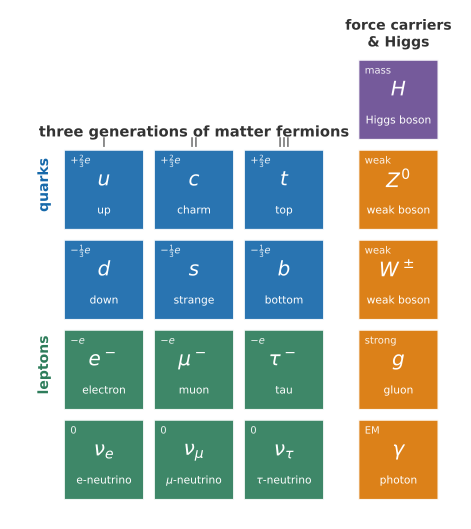
Figure 14.4:The Standard Model’s fundamental particles: three repeating generations of matter fermions (quarks and leptons), plus the force-carrying gauge bosons and the Higgs boson, neither of which come in generations. Original schematic by the author, redrawn independently of the familiar CERN/Wikipedia layout.
14.3Hadrons, Conservation Laws, and Open Questions
Hadrons and Confinement
Quarks are never seen individually; they are always found bound into composite particles called hadrons, a consequence of quark confinement: unlike the Coulomb or nuclear forces encountered so far, which weaken with distance, the strong force between two quarks does not weaken as they are pulled apart — instead, the energy stored in the strong-force field between them grows without bound, so that attempting to separate two quarks (e.g., in a high-energy collision) eventually supplies enough energy, via mass–energy equivalence, to spontaneously create a new quark-antiquark pair from the field energy itself, snapping the field into two shorter, separately confined pieces rather than yielding a single free quark. The simplest and historically most familiar hadrons occur in two configurations, both of which have net integer electric charge and (color-)neutral total color charge, consistent with confinement always producing color-neutral bound states:
Baryons: three quarks bound together (or three antiquarks, for antibaryons). The proton () and neutron () are the lightest, most familiar baryons; baryons are fermions (three half-integer spins combine to a net half-integer spin) and obey a conservation law, baryon number (discussed below).
Mesons: a quark-antiquark pair. Mesons, such as the pion (, among others), are bosons (a half-integer spin combined with a half-integer spin gives an integer net spin) and carry baryon number zero.
Quantum chromodynamics also permits color-neutral exotic hadrons, such as tetraquark states (two quarks and two antiquarks) and pentaquark states (four quarks and one antiquark), several of which have been observed. They are not needed for the ordinary baryon/meson classification used here, but they show that these are not the only possible arrangements of confined quarks.
The Confinement Potential: A Toy Model
The qualitative story above — that the strong-force field between two quarks stores energy without bound as they separate — can be made quantitative with a simple model that captures the essential physics. Unlike the Coulomb potential , which weakens with distance because electric field lines spread out to fill three-dimensional space, the gluon field between a quark and an antiquark is observed, both experimentally and in lattice-QCD calculations, to collapse into a narrow, roughly constant-cross-section flux tube, so that separating the two ends by a distance requires an energy that grows linearly,
where , the string tension, is measured to be about . Once the stored energy climbs to a few hundred — comparable to the energy needed to create a light quark-antiquark pair from the vacuum via — it becomes energetically cheaper for the field to supply that pair than to keep stretching, so the flux tube snaps into two shorter, separately confined pieces rather than yielding an isolated quark. This typically happens after the tube has stretched only about , comparable to a hadron’s own size, which is exactly why no accelerator, however powerful, can pull a free quark out of a hadron: pushing larger simply manufactures more hadrons, never a lone one.
Worked Example: Quark Content of the Meson
The meson (a kaon), like the pion above, is a quark-antiquark pair, but built from a different combination: , an up quark bound to a strange antiquark. Every antiquark carries the exact opposite electric charge of its corresponding quark, so (the antiparticle of the strange quark) carries , and
matching the kaon’s experimentally known charge of exactly. Like the pion, the is a boson with baryon number zero — but unlike the pion, it carries a nonzero strangeness: the strange antiquark carries strangeness +1 (opposite the strange quark’s , by the sign convention introduced below), while the up quark carries , giving . This one extra bookkeeping number, absent from the pion, is exactly what made kaons behave so differently from pions when both were first encountered in cosmic-ray data — the subject of the next section.
Historical Context: The Particle Zoo
The tidy classification of hadrons into baryons and mesons, each built from a handful of quark flavors, is a retrospective simplification of what was, for roughly three decades, one of the most disorienting periods in the history of physics. Cosmic rays — high-energy particles arriving from space and colliding with nuclei in the upper atmosphere — were, before particle accelerators reached comparable energies, the only available source of exotic new particles, and they did not disappoint. In 1936–1937, Carl Anderson and Seth Neddermeyer, studying cosmic-ray tracks in a cloud chamber, identified a new particle with a mass about 200 times the electron’s — initially mistaken for the meson Hideki Yukawa had predicted the previous year as the carrier of the nuclear force, but eventually recognized (it interacted far too weakly, and penetrated far too much matter, to be Yukawa’s particle) as an entirely new, heavier cousin of the electron: the muon, already met above. Yukawa’s actual meson turned up a decade later, in 1947, when Cecil Powell, Giuseppe Occhialini, and César Lattes, examining photographic emulsions exposed at high-altitude observatories, identified the pion, caught in the act of decaying into exactly the muon Anderson and Neddermeyer had already found — untangling, at a stroke, two distinct particles that had been conflated for a decade. That same year, George Rochester and Clifford Butler, also working from cosmic-ray cloud-chamber photographs, found still stranger tracks: V-shaped pairs of particle trails, produced abundantly yet decaying only slowly — the signature of what came to be called, aptly, strange particles: the kaons of the worked example above, and the lightest hyperons (baryons heavier than the proton and neutron, such as the introduced earlier in this chapter).
By the 1950s, particle accelerators had overtaken cosmic rays as the primary discovery tool, and the pace of discovery, if anything, accelerated: dozens of “elementary” hadrons were catalogued through that decade and into the next, with no organizing principle in sight — derisively called the particle zoo by physicists who had expected nature’s fundamental building blocks to be few in number, not a sprawling menagerie. Order emerged in 1961, when Murray Gell-Mann and, independently, Yuval Ne’eman noticed that plotting hadrons by electric charge against strangeness placed each family into strikingly regular geometric patterns — hexagons and triangles of eight or ten particles apiece — a scheme Gell-Mann named the eightfold way. The scheme’s predictive power was demonstrated dramatically in 1964, when a particle it predicted but which had not yet been observed, the baryon, was found at Brookhaven National Laboratory with essentially the predicted mass, charge, and strangeness. That same year, Gell-Mann and, independently, George Zweig proposed the deeper explanation for why the pattern worked at all: every hadron in the eightfold way’s patterns is simply a bound state of a small number of still more fundamental constituents, which Gell-Mann named quarks — the up, down, and strange quarks already introduced in this chapter, with the heavier charm, bottom, and top quarks discovered only later, between 1974 and 1995, as accelerators reached the correspondingly higher energies needed to produce them. What had looked, in the 1950s, like a hopeless proliferation of unrelated “elementary” particles turned out to be nothing more than the many possible ways of combining a mere handful of truly fundamental building blocks — precisely the kind of underlying simplicity the Standard Model was built to express.
Conservation Laws
Not every combination of particles satisfying energy-momentum conservation is actually observed to occur; particle reactions additionally obey several conservation laws, some familiar from earlier chapters and some new to particle physics:
Electric charge is conserved in every known interaction, without exception.
Baryon number (defined as +1 for each baryon, -1 for each antibaryon, 0 for all other particles, including mesons and leptons) is conserved in every observed reaction — this is why, for instance, the proton, the lightest baryon, is observed to be stable (or at least extremely long-lived: no proton decay has ever been observed, despite dedicated searches, placing its lifetime, if it decays at all, above 1034 years), since there is no lighter baryon for it to decay into consistent with conservation.
Lepton number, separately for each generation (, , , each +1 for the corresponding particle, -1 for its antiparticle, 0 otherwise), is conserved at the individual weak-interaction vertices used in this chapter and is an excellent approximation in most particle decays. Neutrino oscillations show that these flavor-specific numbers are not exact over long propagation distances. This is why, for example, muon decay produces both an electron antineutrino and a muon neutrino, rather than either alone, to separately conserve and at the decay vertices: the initial state has , and the combination on the right-hand side reproduces , . A flavor-changing decay such as is therefore forbidden at the ordinary tree level and is extraordinarily suppressed once neutrino masses and mixing are included.
These conservation laws function exactly as energy, momentum, and angular momentum conservation do in earlier chapters: a proposed reaction consistent with all other physics can nonetheless be immediately ruled out if it violates one of these rules, and they provide a fast, purely bookkeeping-based check on whether an observed or hypothesized particle process is allowed.
Strangeness: An (Almost) Conserved Quantum Number
The particle-zoo puzzle described above is also where strangeness enters as a genuine, book-keepable quantum number, alongside charge, baryon number, and lepton number. Strangeness is assigned by quark content: for each strange quark a particle contains, for each strange antiquark , and for every other quark flavor (a sign convention fixed historically, before quarks themselves were proposed, when strangeness was assigned directly to particles from their production and decay patterns rather than derived from a quark that had not yet been identified). The defining, and at first deeply puzzling, experimental fact about strangeness is that it is treated differently by different interactions:
The strong and electromagnetic interactions conserve strangeness exactly, in every observed reaction.
The weak interaction does not: a single tree-level charged-current vertex can change strangeness by one unit, consistent with a vertex converting an quark to an up-type quark, or vice versa (the same charge-budget argument given above for why only the weak interaction changes quark flavor at all). Higher-order weak processes can produce larger net changes, but they are strongly suppressed.
This single fact resolves Rochester and Butler’s original puzzle: strange particles were produced copiously but decayed reluctantly because associated production, the strong-interaction process that actually creates strange particles in accelerator and cosmic-ray collisions (worked through below), always creates strangeness in matched pairs summing to the initial strangeness of zero — consistent with strong-interaction conservation, and proceeding on the characteristically fast strong-interaction timescale of order . But once created, an isolated strange particle such as the has no strangeness-conserving decay available to it: there is no lighter, non-strange combination of ordinary particles it can fall apart into without changing . It can only decay via the strangeness-violating weak interaction, on the correspondingly slow weak-interaction timescale — typically , some thirteen orders of magnitude longer than a typical strong-interaction process, though still far too brief to see with the naked eye. Produced fast, decaying slow: hence “strange.”
Worked Example: Strangeness Conservation in Associated Production and Decay
Consider two reactions involving the () introduced earlier in this chapter and the meson ():
Neither the pion nor the proton on the left of the first reaction contains a strange quark (, ), so the total initial strangeness is . On the right, carries (from its ) and carries (from its ), for a total final strangeness . Strangeness is conserved — consistent with this reaction proceeding via the strong interaction, exactly the associated-production mechanism described above, with the and created together, their strangeness values canceling. (Charge and baryon number are conserved as well: : ; : .)
The second reaction, the ’s actual decay, is different: , while , a change of — forbidden for the strong or electromagnetic interaction, but allowed, one unit at a time, for the weak interaction. This is consistent with the ’s measured mean lifetime of about , squarely in the weak-interaction range, roughly 1013 times longer than the strong-interaction timescale on which the very same particle was created in the first reaction.
The Higgs Mechanism
A long-standing puzzle in the Standard Model was that the mathematical framework describing the weak and electromagnetic interactions in a unified way most naturally predicts that all fundamental particles, including the electron and quarks, should be massless — directly contradicted by experiment. The resolution, proposed independently by several theorists in 1964 (and associated most closely with the name of Peter Higgs), is that space is permeated by a nonzero background field, the Higgs field, and that fundamental particles acquire mass through their interaction with this field: a particle that couples strongly to the Higgs field behaves as though it has large inertia (large mass) as it moves through the field, while a particle that does not couple to it (the photon, for instance) remains exactly massless. Associated with the Higgs field, exactly as the electromagnetic field has an associated particle (the photon) representing its quantized excitations, is the Higgs boson, whose discovery at the Large Hadron Collider in 2012 — decades after it was first predicted, and requiring a purpose-built accelerator capable of reaching the multi-hundred-GeV collision energies needed to produce it directly — provided direct experimental confirmation of the mechanism and completed the last missing piece of the Standard Model’s particle content.
The strength of a given particle’s coupling to the Higgs field is not itself predicted by the mechanism — it is a separate, measured number for every fermion and for the / bosons — but the pattern it produces is a striking, directly testable success: the more strongly a particle couples, the larger its mass, and the Standard Model’s heaviest fermion, the top quark (, almost the mass of an entire gold nucleus packed into one point particle), has the largest known Yukawa coupling, of order one. The electron, some times lighter, couples correspondingly more weakly. The photon’s exact masslessness is, in this same language, simply the statement that the photon has no mass-generating coupling to the Higgs field — a consequence of the specific way electroweak symmetry breaking mixes the underlying gauge bosons of the unified electroweak theory into the photon and the / observed today, with only the latter three acquiring mass from the mechanism.
Open Questions
As the final chapter of this book, it is worth being explicit that the Standard Model, for all its precision and predictive success — every particle in its minimal particle content has now been found, and many of its predictions for their properties agree with experiment to several decimal places — is not a complete “theory of everything.” Several major open questions define the current frontier of particle physics and cosmology, worth naming even though, unlike everything else in this book, none has yet been resolved:
Dark matter. Galaxies and clusters of galaxies rotate and move as though they contain roughly five times more gravitating mass than is visible in stars, gas, and dust combined — a discrepancy first noted from galaxy rotation curves and since confirmed by multiple independent lines of evidence (gravitational lensing, the large-scale structure of the universe, the cosmic microwave background). No known Standard Model particle has the right properties — electrically neutral, stable or extremely long-lived, interacting only very weakly with ordinary matter — to account for it, and despite decades of dedicated direct-detection experiments, no dark-matter particle has yet been observed in the laboratory.
Matter–antimatter asymmetry. Chapter 6 and this chapter both treat particles and antiparticles as, in most respects, perfectly symmetric, yet the observable universe is made overwhelmingly of matter, with no evidence anywhere of large antimatter regions — even though the Big Bang, run forward through known physics, should have produced matter and antimatter in almost exactly equal amounts, which would then have mutually annihilated into pure radiation and left nothing behind to form galaxies, stars, or the reader of this sentence. Explaining the tiny observed excess of matter over antimatter (baryogenesis) requires physics that violates matter–antimatter symmetry more thoroughly than the Standard Model’s confirmed interactions currently account for.
Neutrino mass. The Standard Model outlined in this chapter, in its original form, predicted neutrinos to be exactly massless, like the photon. Neutrino oscillation experiments — a neutrino produced in one flavor (say ) measured, some distance later, with a nonzero probability of being detected as a different flavor ( or ) — demonstrated conclusively, beginning in the late 1990s, that neutrinos have a small but nonzero mass: a firmly established experimental fact with no settled place in the version of the Standard Model presented in this chapter, and one of the clearest concrete signs that the model, though successful, is not the final word.
Unification. The electromagnetic and weak interactions are already understood as two facets of a single underlying “electroweak” interaction, unified at sufficiently high energy — a success this chapter’s Higgs mechanism is part of. Many physicists suspect the strong interaction unifies with the electroweak interaction at a still higher energy (grand unification), and that gravity itself — entirely absent from the Standard Model, and still described only by Einstein’s classical general relativity — must eventually be brought into a single quantum-mechanical framework together with the other three forces. Such a “theory of everything” remains, despite decades of effort (string theory and loop quantum gravity among the leading proposals), unconfirmed by any experiment.
These are not signs of failure so much as an honest map of where the frontier currently sits: the Standard Model surveyed in this chapter is, by a wide margin, the most thoroughly tested theory in the history of physics, and every one of these open questions is being actively pursued — at facilities from the LHC to underground dark-matter detectors to neutrino observatories — by the direct descendants of the same experimental methods, particle accelerators, colliders, and increasingly sophisticated layered detectors, introduced earlier in this chapter.
If you want the shortest reading of this chapter’s ending, it is this: the Standard Model is extraordinarily precise, but it still does not explain dark matter, the matter-antimatter asymmetry, neutrino masses, or how gravity joins the quantum forces.
14.4Summary
Particles are classified by spin as fermions (half-integer spin, obey the exclusion principle; matter is built from these) or bosons (integer spin, no exclusion restriction; forces are mediated by these).
Four fundamental interactions — strong, electromagnetic, weak, and gravitational — are distinguished by relative strength, range, and mediating gauge boson (gluon, photon, , and the hypothesized graviton, respectively).
Matter fermions are leptons (no strong interaction; electron, muon, tau and their neutrinos, across three generations) and quarks (feel the strong interaction, carry fractional charge and color, never observed free due to confinement).
Quarks bind into color-neutral hadrons, most familiarly baryons (three quarks, e.g. proton , neutron ) and mesons (quark-antiquark pairs); exotic tetraquark and pentaquark states are also observed.
Conservation laws — electric charge, baryon number, and (at elementary vertices, to an excellent approximation) lepton number — determine which proposed particle reactions are physically allowed. Strangeness is a further, only-approximately-conserved quantity: exactly conserved by the strong and electromagnetic interactions, but changeable by one unit at a tree-level charged-current weak vertex, which is why strange particles are produced quickly (via the strong interaction) but decay slowly (via the weak). Higher-order weak processes can change it by more than one unit, but are strongly suppressed.
The Higgs field, and its associated Higgs boson (discovered 2012), is the mechanism by which most fundamental Standard Model particles acquire mass.
A Feynman diagram depicts a particle interaction as fermion lines (particle arrows forward in time, antiparticle arrows reversed) meeting at vertices, connected by internal, virtual boson lines; every exactly-conserved quantity must balance at each individual vertex, and only a charged-current vertex directly changes a quark’s flavor, since it alone carries enough charge to balance an up-type/down-type quark transition.
Particle accelerators (linear or, more commonly, synchrotron-based) collide beams either against a fixed target or head-on in a collider, and layered detectors — tracking, calorimetry, and muon identification — reconstruct what each collision produced; the Large Hadron Collider at CERN is the largest such machine yet built.
The particle zoo of hadrons discovered via cosmic rays and early accelerators (muon, 1936; pion and strange particles, 1947) was organized by the eightfold way (Gell-Mann and Ne’eman, 1961) and explained by the quark model (Gell-Mann and Zweig, 1964).
Gravity is negligible for individual particles: the ratio of the gravitational to the electromagnetic force between two protons is only , because mass (unlike charge) is always attractive and accumulates without limit, while ordinary bulk matter is nearly charge-neutral.
The Standard Model remains incomplete: dark matter, the matter–antimatter asymmetry, nonzero neutrino mass, and the search for a unified theory including gravity are among the major open questions at the current frontier of particle physics.
14.5Problems
Solution to Exercise 14.1 #
Particles with integer spin are bosons, while particles with half-integer spin are fermions. Thus the photon () and pion () are bosons, whereas the electron () and proton () are fermions. Therefore, photons and pions obey Bose statistics, while electrons and protons obey Fermi--Dirac statistics.
Solution to Exercise 14.2 #
Adding the constituent-quark charges gives
Therefore, the baryon has charge 0, in agreement with the neutral charge of the .
Solution to Exercise 14.3 #
For (a), the initial proton has , while has ; baryon number and lepton number fail, so it is forbidden. For (b), both sides have , because has and has ; it is allowed. For (c), charge is conserved, but the initial state has and the final state has , so it is forbidden at the ordinary tree level (neutrino mixing permits an immeasurably small higher-order rate). For (d), both sides have , , and , so it is allowed if sufficient kinetic energy is supplied.
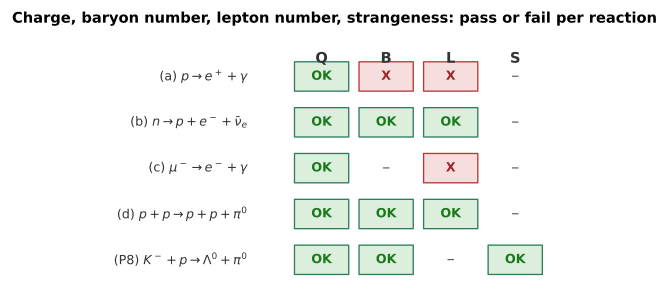
Figure 14.5:Reading conservation laws as a pass/fail table: (a) fails on two counts, (c) fails on lepton number alone, and (b), (d), and Problem 8’s reaction pass everything asked of them.
Therefore, (b) and (d) conserve all listed quantum numbers, whereas (a) violates and and (c) violates muon lepton number in the ordinary flavor-conserving approximation.
Solution to Exercise 14.4 #
For a proton, . For a neutron,
Therefore, quark charges give the observed proton charge and neutron charge 0.
Solution to Exercise 14.5 #
Initially, has and . In , the final electron has and , while the photon has both numbers zero. The proposed final state therefore changes both generation numbers and is forbidden at the ordinary tree level. In the observed decay, supplies and supplies , so each total is restored at the decay vertices. Neutrino masses and mixing make technically possible beyond this approximation, but its predicted rate is so tiny that it has not been observed. Thus the neutrinos are required for the ordinary, flavor-conserving muon decay.
Solution to Exercise 14.6 #
Separating colored quarks stores increasing energy in the strong-force field between them. Before an isolated quark can emerge, the stored energy is sufficient to create a quark--antiquark pair, which forms new color-neutral hadrons instead. By contrast, the electromagnetic force between charges decreases approximately as , so separating charges requires progressively less additional force. Therefore, quark confinement produces only color-neutral particles, whereas electric charges can be isolated.
Solution to Exercise 14.7 #
An anti-up quark has charge , and an quark has charge , so
The quark has strangeness , so has . The antiparticle has the opposite values, and .
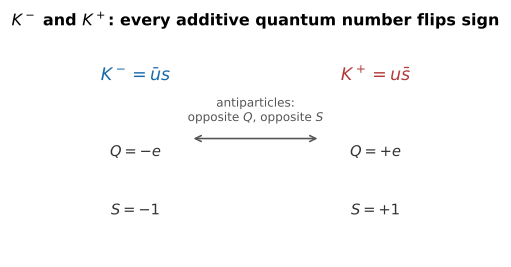
Figure 14.6:Every additive quantum number a particle carries — not just charge — reverses sign for its antiparticle; and show this for both and at once.
Therefore, is the antiparticle of because antiparticles have opposite additive quantum numbers, including charge and strangeness.
Solution to Exercise 14.8 #
Initially has , , and . Finally has , , and , the bottom row of Figure 14.5. Therefore, charge, baryon number, and strangeness are all conserved, so the reaction can proceed through the strong interaction.
Solution to Exercise 14.9 #
Draw an incoming line ending at a vertex that emits an outgoing line and a virtual line; the ends at a second vertex in outgoing and lines. At the first vertex, and . At the second, and . All unmentioned generation numbers are zero on both sides.
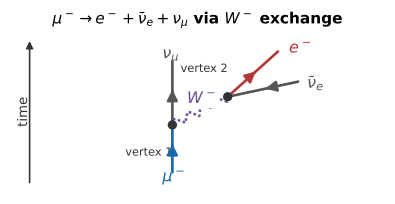
Figure 14.7:Drawn in the same style as Figure 14.2: the converts to at vertex 1 while emitting a virtual , which decays to at vertex 2 — charge and each generation’s lepton number balance separately at both vertices.
Therefore, each vertex separately conserves charge and the electron and muon lepton numbers.
Solution to Exercise 14.10 #
Convert the total energy to . Then
The mean lab lifetime is , so
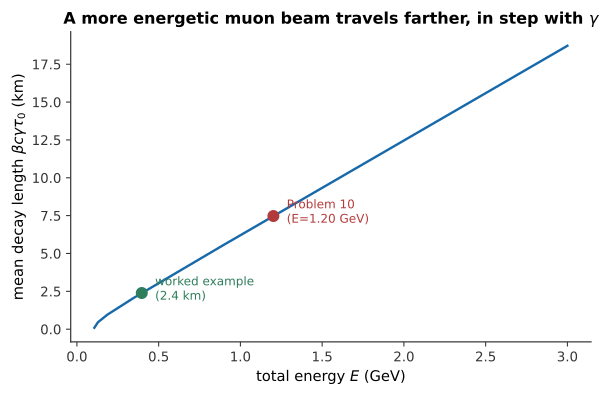
Figure 14.8:Both beams sit on the same curve; this problem’s higher energy gives a larger and a correspondingly longer mean decay length.
Therefore, this beam has , , and a mean decay length of , longer than because its Lorentz factor is larger.
Solution to Exercise 14.11 #
For two identical particles, the force ratio is . For electrons,
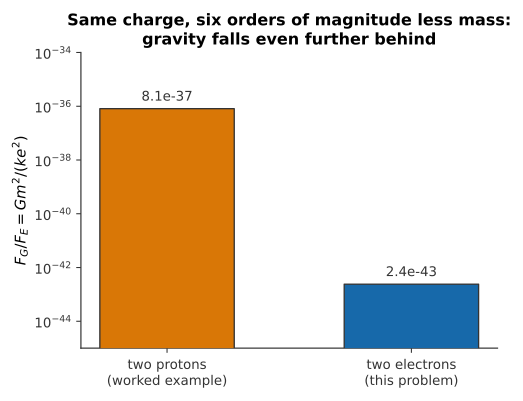
Figure 14.9:Same formula, same charge magnitude, but enters squared: the electron ratio is smaller by roughly .
Therefore, gravity between two electrons is only about of their electrical repulsion; the ratio is far smaller than for protons because it scales as while the charge magnitude is unchanged.