Learning Objectives
By the end of this chapter, you should be able to:
Derive and apply the relativity of simultaneity from Einstein’s postulates, and describe an operational procedure for synchronizing clocks within a single frame.
Derive and apply time dilation, including the concept of proper time.
Derive and apply length contraction, including the concept of proper length.
Use the Lorentz transformation to relate the space and time coordinates of an event in two inertial frames.
Apply the relativistic velocity-addition formula, show that it never yields a result exceeding , and use it to explain the Fizeau drag coefficient of Chapter 1.
Construct and interpret simple spacetime diagrams, including the light cone and its role in cause and effect.
Explain the resolution of the twin paradox in terms of the asymmetry between inertial and non-inertial motion.
Derive and apply the relativistic Doppler effect.
Explain why magnetism can be understood as a relativistic consequence of length contraction acting on electric fields.
Introduction
Chapter 1 established that Einstein’s two postulates — the equivalence of all inertial frames, and the invariance of the speed of light — are incompatible with the Galilean transformation. This chapter works out what does follow from the postulates: a new set of rules relating space and time measurements between observers in relative motion, called the Lorentz transformation. Its consequences are strange by the standards of everyday experience — moving clocks run slow, moving objects are measured as shortened, and two events that are simultaneous for one observer need not be simultaneous for another — but they are not arbitrary. Each follows directly, and only, from insisting that every inertial observer measures the same speed for light.
Throughout, an event is something that happens at a definite place and a definite time — a flashbulb going off, a particle passing a marker — specified by four coordinates in a given reference frame. Two different inertial observers, in relative motion, will in general assign different coordinates to the same event; the question this chapter answers is exactly how those coordinate sets are related.
2.1Simultaneity, Time Dilation, and Length Contraction
The Relativity of Simultaneity
Consider a train car moving at constant velocity relative to the ground, with a light source at its exact center. When the source flashes, light travels outward in all directions at speed — in every inertial frame, by the second postulate.
To an observer sitting at the center of the car, the light reaches the front and back walls simultaneously, since both walls are equidistant from the source and light travels at the same speed in both directions in the car’s own frame.
To an observer standing on the ground watching the car go by, the situation is different. In the ground frame, light still travels at speed in both directions — but the back wall of the car is moving toward the point where the backward-going light was emitted, while the front wall is moving away from the point where the forward-going light was emitted. So light reaches the back wall first. The two flashes, simultaneous in the car’s frame, are not simultaneous in the ground frame.
This is not a measurement error or a signal-delay artifact to be corrected for — it is a genuine disagreement about which events are simultaneous, forced on us by the requirement that both observers measure the same speed for the same light pulses. Simultaneity is relative to the observer’s frame of motion, not an absolute, frame-independent relation between events. This single fact is the seed from which time dilation and length contraction both grow.
The basic geometry is shown in Figure 2.1. The two flashes are simultaneous in the train frame, but the moving observer travels toward the front flash and away from the rear flash.
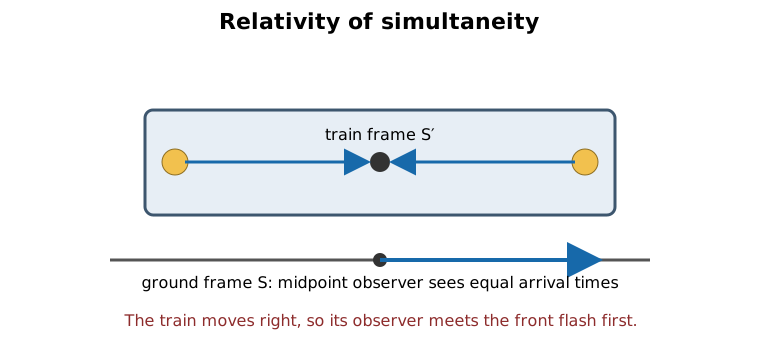
Figure 2.1:Simultaneity depends on the observer’s frame. The diagram is schematic: the ground observer is at the midpoint, while the train observer moves toward the front flash. Original schematic by the author.
An Operational Procedure for Synchronizing Clocks
The train example shows that simultaneity depends on the observer’s frame, but it is worth being explicit about how an observer within a single frame decides that two clocks, at different locations, are synchronized in the first place — otherwise “simultaneous in the car’s frame” is just as vague a phrase as “simultaneous” was before Einstein.
Here is one way to do it, entirely within a single inertial frame . An observer, Amy, sits at a fixed location with a clock. At some time (her own clock reading), she sends a light pulse toward a distant mirror a known distance away. The pulse reflects and returns to her at time . Because light travels at the same speed in both directions (postulate 2), the pulse must have reached the mirror at the midpoint time,
Amy can use this fact to synchronize a second clock, placed at the mirror’s location: she instructs whoever is stationed there to set their clock to read at the moment the light pulse arrives. Any two clocks synchronized this way — by “radar,” bouncing a light signal and splitting the round-trip time evenly — will agree with each other and with any other pair of clocks in the same frame synchronized by the same method. (An equivalent, more homely method: synchronize two clocks side by side, then separate them by moving them apart very slowly; since relativistic effects on a moving clock’s rate are of order , they can be made as small as desired by transporting the clocks slowly enough.)
This procedure defines, unambiguously, a notion of “simultaneous” within a single inertial frame — but it is frame-dependent by construction, because it relies on the frame in which the observer doing the synchronizing is at rest. An observer in a second frame , moving relative to , will synchronize clocks by the identical procedure applied within , and — as the train example already showed — the two resulting sets of “simultaneous” clocks will not agree with each other. Both sets of clocks are perfectly well synchronized, each within its own frame; there is simply no frame-independent fact about which distant events are simultaneous with a given event here and now.
Time Dilation
Consider a light clock: two mirrors facing each other, separated by a distance , with a single light pulse bouncing between them. In the frame where the clock is at rest, one “tick” — one round trip — takes
This time, measured in the frame where the clock does not move, is called the proper time between the two events (pulse leaves the bottom mirror; pulse returns to the bottom mirror) — the time measured by a clock present at both events, at the same location.
Now view the same clock from a frame in which it moves at speed perpendicular to the line joining the mirrors. In this frame, between emission and return the light pulse must travel not just up and down but also sideways with the clock, tracing a diagonal path. Since light still travels at speed in this frame (postulate 2), and the diagonal path is longer than , the round trip must take longer as measured here. Writing for the round-trip time in this frame, the pulse travels a horizontal distance while covering the diagonal distance , and by the Pythagorean theorem applied to each mirror-to-mirror leg,
Substituting and solving for gives
where the Lorentz factor
is greater than or equal to 1 for any , and grows without bound as . This is time dilation: a clock moving at speed relative to an observer is measured by that observer to run slow, ticking out of the observer’s own time for every of proper time it displays. The effect is symmetric — each of two observers in relative motion sees the other’s clock as running slow, since each is equally entitled to regard themselves as at rest. Although derived here for a light clock, time dilation applies to time itself, and hence to every physical process — mechanical clocks, radioactive decay rates, biological aging — since two different physical clocks, built differently, must stay in agreement in every frame or their disagreement could be used to detect absolute motion, contradicting postulate 1.
The two clocks of that argument run side by side in Figure 2.2: one at rest in the laboratory, one gliding past at a speed you set, with the moving pulse’s zigzag path drawn in. Nothing in the simulation makes the moving clock tick slowly by fiat. Both pulses travel at ; the moving one simply has a longer path to cover between reflections, and the two tick counts drift apart by exactly the factor computed above.
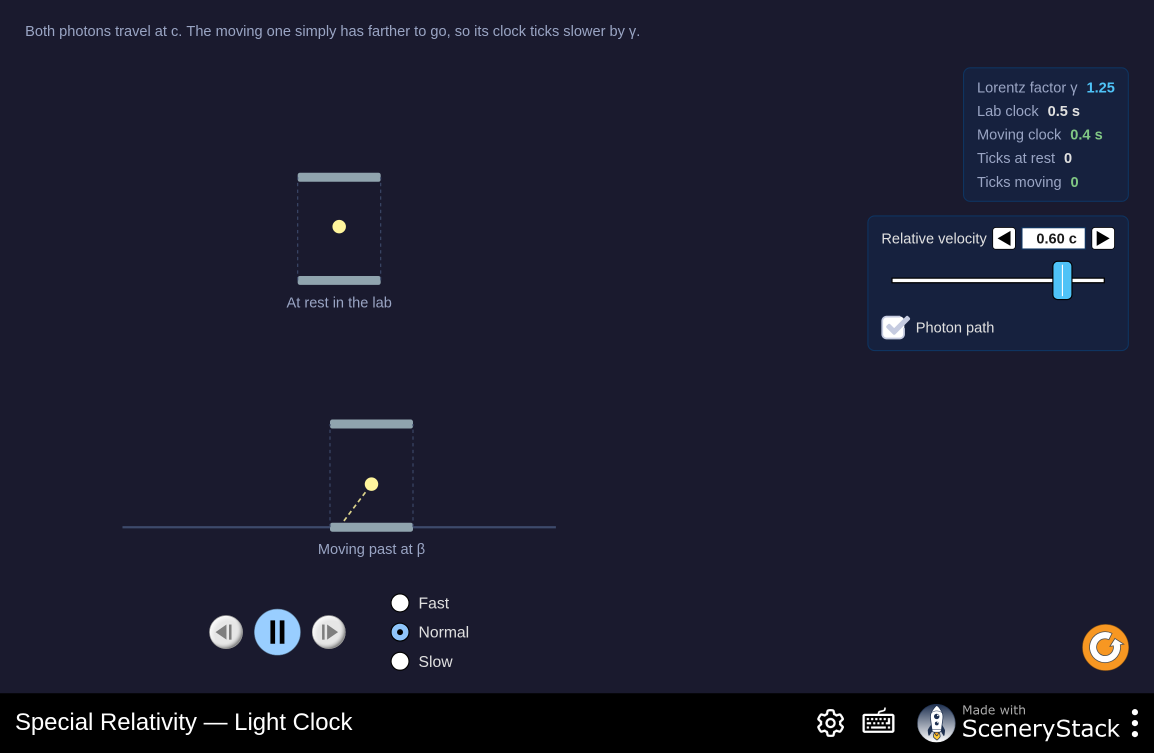
Figure 2.2:A light clock at rest beside an identical one moving at , with the diagonal light path and both tick counts displayed. The other screens of this simulation return in the sections that follow — an interactive Minkowski diagram, the ladder-and-barn paradox (an application of length contraction), the twin paradox, and the relativistic Doppler effect, each one screen further along.
Interactive simulation: Special Relativity
Time dilation is not a hypothesis awaiting confirmation; it is routinely observed. Muons created by cosmic rays in the upper atmosphere have a mean lifetime, at rest, of about — long enough, at nearly the speed of light, to travel only a few hundred meters before decaying, far short of the several kilometers to Earth’s surface. Yet large numbers of these muons are detected at sea level. In Earth’s frame, the muons’ internal “clock” — the process governing decay — runs slow by the factor , extending their mean range by that same factor, which is exactly what is observed. (This effect was confirmed with precision in a classic 1941 experiment by Bruno Rossi and David Hall, comparing muon flux measured at the top of Mount Washington in New Hampshire to the flux at a lower elevation.)
The Twin Paradox
Time dilation invites an apparent paradox that is worth confronting directly. Suppose Alice stays on Earth while her twin Bob boards a spaceship, accelerates to a large fraction of , travels to a distant star, turns around, and returns to Earth. From Alice’s perspective, Bob’s clock runs slow throughout the trip (by the factor ), so Bob should be younger than Alice when he returns. But motion is relative — can’t Bob equally well claim that he was at rest the whole time, and that it was Alice, receding and then approaching, whose clock ran slow? If so, each twin should conclude the other has aged less, which is a genuine contradiction: when they are reunited at the same place, they can directly compare clocks, and only one answer can be correct.
The resolution is that the situation is not symmetric between the twins, and the asymmetry is exactly the thing time dilation was derived for: proper time is measured by a clock that is present at both endpoint events, without changing inertial frames in between. Alice never leaves a single inertial frame. Bob does not: he must decelerate, reverse course, and re-accelerate at the turnaround point (and again to land back on Earth), and no inertial frame is present at all three key moments of his trip — departure, turnaround, and return — the way Alice’s single frame is present at both departure and return. Time dilation, as derived above, compares proper time in one frame to elapsed time in a single other inertial frame; it does not directly apply to a clock that switches frames partway through. When the trip is analyzed correctly — by computing the proper time elapsed along each twin’s actual worldline in a single, fixed inertial frame (say, Earth’s) — Bob’s path necessarily accumulates less proper time than Alice’s straight, inertial path between the same two events, essentially because his path involves a nonzero, non-inertial detour that always makes his elapsed proper time work out to be shorter, not the same. Bob really is younger when he returns, and both twins, correctly accounting for Bob’s acceleration, agree on this.
The physical content of the paradox’s resolution is this: there is no contradiction, because only Bob can locally detect (with an accelerometer, for instance) that he underwent a change of inertial frame. That detectable asymmetry is exactly what breaks the naive symmetry argument and picks out which twin’s elapsed time is shorter.
Length Contraction
Time dilation has a companion effect for lengths. Consider a rod of length at rest along the -axis of frame ; call the proper length — the length measured in the frame where the rod is at rest. How long is this rod as measured by an observer in frame , moving at speed relative to along the rod’s length?
To measure a moving rod’s length, an observer must record the positions of both ends at the same instant in their own frame. Consider the muon example again, now from the muon’s own rest frame, in which Earth’s atmosphere rushes past at speed . During the muon’s mean proper lifetime , a layer of atmosphere of thickness passes it. In Earth’s frame, that same layer is at rest, so its proper thickness is , where is the muon’s mean lifetime in that frame. Therefore,
or
This is length contraction: an object of proper length , measured by an observer relative to whom it moves at speed along its own length, is found to have length . Only lengths along the direction of relative motion contract; lengths perpendicular to the motion are unaffected (a consequence one can show is required for consistency between the two observers’ descriptions of, e.g., a rod passing through a ring). Note the resemblance to the Fitzgerald–Lorentz contraction of Chapter 1 — the same formula, but now derived as a necessary consequence of the postulates rather than invented to hide a null result.
Why transverse lengths cannot contract
The light-clock argument also rules out a transverse contraction. Let a light clock have mirror separation perpendicular to the relative motion. In the clock’s rest frame its proper tick time is . Suppose, temporarily, that the separation perpendicular to the motion were in a frame where the clock moves at speed . In that frame,
Using the already established time-dilation result and gives . Therefore : and , as the Lorentz transformation states directly. Only the component parallel to the relative motion contracts.
Application: Bell’s Spaceship Paradox
Length contraction raises a subtle question about rigid bodies that is worth working through carefully, since getting it wrong is a common source of confusion. Consider two identical spaceships, initially at rest a fixed distance apart in some frame , connected by a taut string of exactly that length. At (in ), both ships fire identical engines, executing identical acceleration profiles, so that at every later instant in each ship has exactly the same velocity as the other. Does the string, stretched between them, break?
The naive answer is “no”: since both ships always move identically, the distance between them, measured in , never changes from . But this overlooks what happens to the string. The string is a physical object with its own proper length, and in the frame in which it is momentarily at rest, the separation of its endpoints must grow, not stay fixed — because the string’s own rest frame changes as it accelerates, and simultaneously requiring the ships to keep the same -frame separation is a different condition from requiring their separation to stay constant as measured by the string itself. Since the ships’ separation, measured in , stays exactly while the ships (and any observer moving with them) are increasingly length-contracted relative to , the string’s own rest-frame length would have to increase to keep up — equivalently, the distance between the ships, measured in the ships’ own instantaneous rest frame, grows beyond as their common speed increases. A string of fixed material length cannot stretch to match this demand, and it snaps.
The paradox dissolves once it is clear that “the two ships have identical velocity at every instant of -time” is a statement specific to frame ; it does not mean the ships are relatively at rest, nor does it mean the string, whose integrity depends on physics internal to its own rest frame, experiences no strain. This scenario (due to John Bell, 1976, who reported that it caused genuine disagreement even among professional physicists at CERN) is a useful check on intuition: length contraction is a real, physical effect with real, physical (and sometimes destructive) consequences for extended objects undergoing acceleration, not merely a bookkeeping artifact of coordinate choices.
2.2The Lorentz Transformation and Causality
The Lorentz Transformation
Time dilation and length contraction are special cases of a general coordinate transformation between inertial frames, replacing the Galilean transformation of Chapter 1. For frame moving at velocity along the common - axis relative to frame , with origins coinciding at , the Lorentz transformation is
The inverse transformation (from back to ) has the same form with :
Two features are worth noting. First, in the limit , and the term becomes negligible, and the Lorentz transformation reduces to the Galilean transformation — special relativity does not discard Newtonian kinematics but contains it as the low-speed limit. Second, the time coordinate depends on both and : two events at different locations that are simultaneous () in frame are, in general, not simultaneous in unless they also share the same — a direct, quantitative statement of the relativity of simultaneity derived qualitatively above.
A quantity that has the same value in every inertial frame is called a Lorentz invariant. The most important one is the spacetime interval between two events,
which every inertial observer computes to be the same number, even though and individually differ between frames. This invariance can be verified directly by substituting the Lorentz transformation. The interval plays the same role for spacetime that ordinary Euclidean distance, , plays for a plane: it is unchanged by a change of coordinates (there, a rotation of axes; here, a Lorentz “boost” to a new inertial frame), even though the individual coordinate differences are not.
Worked Example: Applying the Lorentz Transformation
Two events occur in frame : event 1 at , and event 2 at . Frame moves at relative to . Find the coordinates of both events in , and verify that the interval is the same in both frames.
First, . Event 1 is at the shared origin, so trivially. For event 2,
In , the interval is (using ). In , , so — the same value, confirming invariance. Note also that : event 2 occurs before event 1 in , even though event 2 occurs after event 1 in . This is only possible because, as the next section shows, the interval between these two events is spacelike.
Light Cones and Causality
Einstein’s 1905 paper introduced the two postulates that resolved the experimental tension; a later portrait of Einstein is included in Figure 2.3.
Figure 2.3:Albert Einstein in 1921. Photograph by Underwood & Underwood; public domain via Wikimedia Commons.
The Lorentz transformation permits the order of two events to reverse between frames, as the worked example above just demonstrated — but only for certain pairs of events, and understanding which pairs is essential to understanding why relativity does not undermine cause and effect.
Classify any two events by the sign of the interval between them, :
Timelike separation, : more time separates the events than would be needed for a signal traveling at or below to get from one to the other. Equivalently, . A material particle, which travels slower than , can pass through both events, so one event can causally influence the other.
Spacelike separation, : the events are separated by more space than light could cross in the available time, . No signal, of any kind consistent with the postulates, can connect them; neither event can be the cause of the other.
Lightlike (or null) separation, : the events lie exactly on each other’s light cone, connectible only by a signal moving at precisely .
Because is Lorentz-invariant, every inertial observer agrees on which of these three categories a given pair of events falls into, even though they may disagree on and individually. This is the resolution of the apparent puzzle in the worked example above: event 2 was found to occur before event 1 in despite occurring after it in , but a direct calculation shows the interval between them, , is negative — the events are spacelike separated. Indeed, light would need to cross the separation, longer than the between the events. Because no signal could have traveled from event 1 to event 2 in the first place, no observer’s disagreement about their time-ordering creates any physical contradiction: neither event could possibly have caused the other, in any frame.
The full set of events timelike-separated from a given event and in its future is called ’s future light cone; the analogous set in the past is its past light cone. Events in ’s future light cone are exactly the events could causally influence; events in its past light cone are exactly the events that could have influenced . All observers agree on the light cone structure of any event, because it is built entirely from the invariant interval.
This structure is what protects causality in relativity. If two events are timelike separated, every inertial observer agrees on their order (the earlier one always is measured to occur first, in every frame) — only the time interval between them, not their order, is frame-dependent. Order can only reverse between frames, as in the worked example, for spacelike-separated events — and by construction, no causal signal can link spacelike-separated events anyway, since that would require traveling faster than . If it were somehow possible to send a signal faster than — a hypothetical “subspace radio” — that signal would connect two spacelike-separated events, and by the argument above there would exist a frame in which the signal is received before it is sent, an unambiguous violation of cause and effect. This is the deep reason the speed limit is not merely an engineering inconvenience but is woven into the logical structure of the theory: no particle, signal, or influence of any kind can propagate faster than without permitting effects to precede their causes in some valid inertial frame.
Velocity Addition
If a particle moves with velocity along the -axis of frame , and moves at velocity relative to , what velocity does the particle have in ? Differentiating the Lorentz transformation (or applying it to two nearby events along the particle’s path) gives the relativistic velocity-addition formula:
For , the denominator is nearly 1 and this reduces to the familiar Galilean rule . But for (light propagating in the direction), the formula gives
for any — exactly consistent with the second postulate: adding any sub-light velocity to still gives . More generally, if and , then always: no combination of sub-light velocities, added relativistically, ever reaches or exceeds .
Worked Example: Explaining the Fizeau Coefficient
Chapter 1 described Fizeau’s 1851 measurement of light’s speed in flowing water, which showed a puzzling partial drag coefficient rather than full or zero entrainment. This is now straightforward to explain, with no separate assumption about the ether at all. Let be the lab frame and the frame of the flowing water, moving at speed relative to the lab. In the water’s own rest frame, light travels at the ordinary speed for that medium, . By the velocity-addition formula, the speed measured in the lab is
Since , expand the denominator using for small :
dropping the term of order , which is negligible for the modest flow speeds (few m/s) used in the experiment. This is exactly Fizeau’s measured result, with the drag coefficient emerging directly from relativistic velocity addition applied to ordinary light propagation in a moving medium — no partial ether entrainment need be assumed at all.
2.3Doppler Effect, Spacetime Diagrams, and Magnetism
The Relativistic Doppler Effect
The classical Doppler effect — the pitch of an ambulance siren rising as it approaches and falling as it recedes — arises from the finite travel time of successive wave crests to a stationary observer. Light shows an analogous effect, but with a relativistic correction on top of it, because the source’s clock itself runs slow according to the observer, an effect with no classical counterpart at all.
It is worth being precise about what the classical effect does and does not depend on, because the difference is the whole point. Figure 2.4 is the acoustic case, with the source and the observer independently movable. Move the source toward a stationary listener at speed and the received frequency is ; leave the source alone and move the listener toward it at the same and the answer is instead. The two disagree at second order in , and they must: the air is a medium, the medium picks out a frame, and “which one is really moving” is a question sound can answer. Light has no such medium, so the formula derived below can depend on the relative velocity and on nothing else — and that constraint alone is nearly enough to fix it.
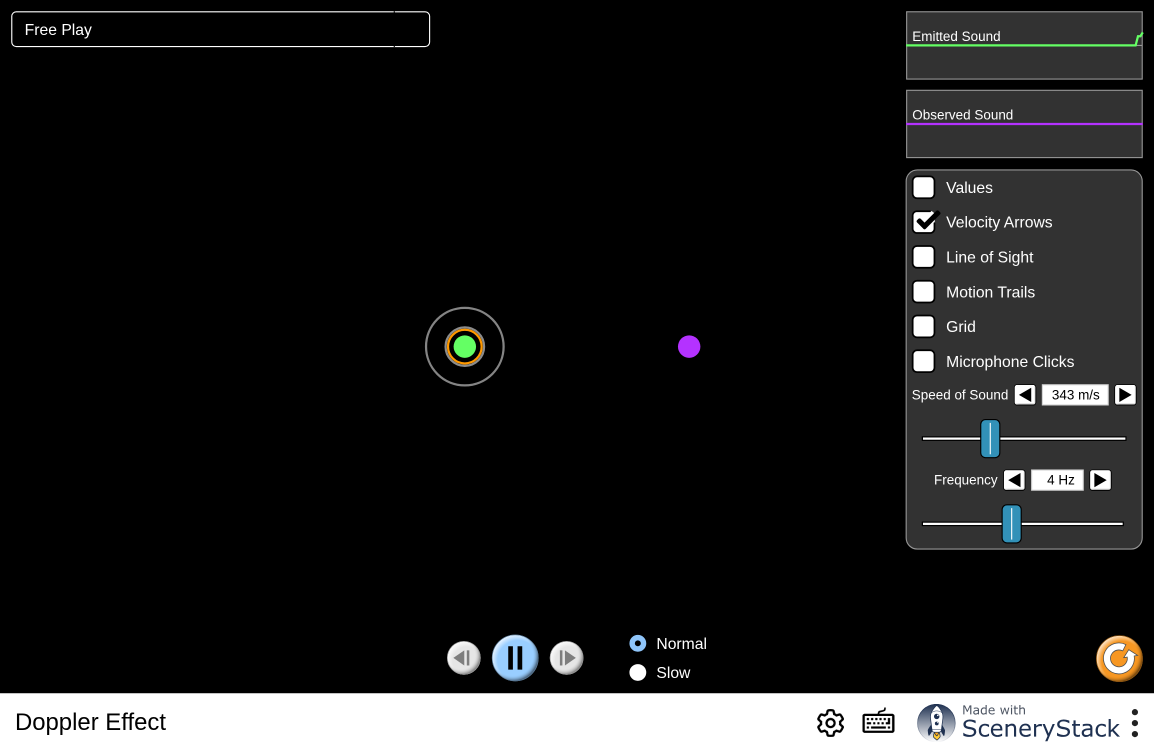
Figure 2.4:The classical Doppler effect, for sound in air. Drag the source and the observer independently and compare the shift produced by moving one against the shift produced by moving the other; the asymmetry between the two cases is the signature of a medium, and it is what disappears in the relativistic formula.
Interactive simulation: Doppler Effect
Consider a source emitting light of proper frequency (the frequency measured by an observer at rest relative to the source), receding directly away from an observer at speed . Two effects combine:
Time dilation of the source’s own clock, as measured by the observer: successive wave crests are emitted at intervals of in the observer’s frame, rather than , purely because the moving source’s clock runs slow.
Light travel time, which increases from one crest to the next because the source is receding, stretching the effective interval further by an additional factor.
Carrying out this calculation (Problem 14 outlines the steps) gives the relativistic Doppler formula for a source receding directly away from the observer:
with the source’s speed measured relative to the observer; a source approaching directly gives the same formula with , i.e.,
For , expanding to first order in recovers , the same leading-order shift familiar from the classical (sound) Doppler effect. The distinctively relativistic feature appears at second order and in a special geometric case: even a source moving perpendicular to the line of sight at the instant of emission — for which there is no classical Doppler shift at all, since the source is neither approaching nor receding — shows a purely relativistic transverse Doppler shift,
a direct consequence of time dilation alone, with no light-travel-time contribution. This effect was confirmed with high precision by Ives and Stilwell (1938), who measured the frequency of light emitted by fast-moving hydrogen atoms viewed from the side, finding exactly the shift predicted by time dilation and none of the shift a purely classical (source-frame) Doppler picture would have predicted.
The relativistic Doppler effect is not a laboratory curiosity. The cosmological redshift of light from distant galaxies is also a redshift, conventionally written , but it must be calculated using the expansion of spacetime rather than by applying this special-relativistic formula to arbitrarily distant galaxies. The same special-relativistic physics, applied to radio signals rather than light, is a correction that must be built into GPS satellite transmissions alongside the time-dilation correction already discussed.
Worked Example: Redshift from a Receding Galaxy
A distant galaxy’s hydrogen emission line, with rest-frame (proper) wavelength , is observed at . Find the galaxy’s recession speed.
Since , the frequency ratio is . Setting this equal to and squaring gives . Solving for :
so , receding.
Spacetime Diagrams
A useful way to visualize these effects is a spacetime diagram: a plot with on the horizontal axis and (rather than , so both axes share units of length) on the vertical axis, drawn in a chosen frame . A particle at rest at some fixed traces a vertical line (its worldline); a light ray traces a line at , since . An observer moving at speed in frame has a worldline tilted from vertical by an angle with .
In frame , that same moving observer’s own and axes are not perpendicular in the diagram as drawn in : the axis coincides with the observer’s own worldline, while the axis — the locus of events simultaneous with the origin in — tilts up from the -axis by the same angle that the axis tilts from the -axis. This tilted-axis picture is a direct graphical statement of the relativity of simultaneity: the set of events an -observer calls “now” is not the same as the set an -observer calls “now.” Reading distances off a spacetime diagram requires care (the Lorentz-transformed axes are not orthogonal in the Euclidean sense), but the picture makes clear that simultaneity, not merely elapsed time, is the coordinate that differs between frames.
The light cone of the previous section appears naturally on such a diagram: the two lines through any event divide the diagram into the future (above both lines), the past (below both lines), and two “elsewhere” regions (spacelike-separated from ), to either side. As a frame’s axes tilt with increasing relative speed , they close in like a pair of scissors toward — but, for any , never quite reaching — the light-cone lines themselves. This is the geometrical statement that no continuous process of acceleration can bring a massive object’s worldline from a slope less steep than to one that equals or exceeds it: velocities do not simply add in relativity, and the speed is a genuine asymptote, never attained.
The causal regions and their light-speed boundaries are shown in Figure 2.5.
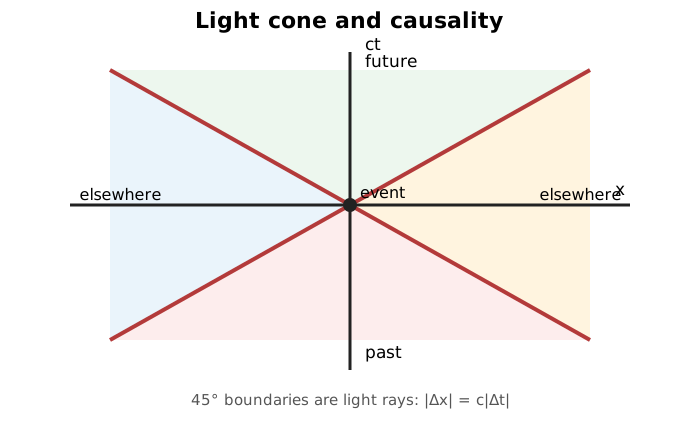
Figure 2.5:The light cone divides events into the causal future, causal past, and spacelike-separated “elsewhere.” Its boundaries are the worldlines of light in units where the horizontal coordinate is and the vertical coordinate is . Original schematic by the author.
The simulation in Figure 2.6 draws these diagrams live. Sliding the relative speed tilts the and axes toward the light cone exactly as described above, and dragging an event shows how its coordinates — and, on the other screens, the reading of a moving light clock and the ageing of the travelling twin — change between frames.
Figure 2.6:Special relativity in five screens: a moving light clock, an interactive Minkowski diagram, the ladder-and-barn paradox, the twin paradox, and the relativistic Doppler effect. Set the relative speed and watch the tilted axes close on the light-cone lines without ever reaching them.
Interactive simulation: Special Relativity
Application: Magnetism as a Relativistic Effect
It may seem that special relativity, having explained a handful of subtle high-precision optical experiments, is otherwise disconnected from everyday electromagnetism. In fact one of the most familiar phenomena in electromagnetism — magnetism itself — can be understood as a direct consequence of length contraction applied to electric charge.
Consider an idealized long wire with equal positive and negative linear charge densities moving in opposite directions along the wire, so that the wire’s net charge density is zero in the lab frame. In that frame the wire carries a current. A test charge moving parallel to the wire can therefore experience a magnetic force, even though the wire produces no net electric field outside it. In the frame in which the two charge species move at equal and opposite speeds, their density changes by the same length-contraction factor, so their charge densities still cancel. If the test charge is moving in this frame, the magnetic field accounts for its force.
Now view the same situation from a frame in which the test charge is at rest (equivalently, an observer moving alongside it). By relativistic velocity addition, the two species of charge carriers in the wire no longer move at equal speeds relative to this observer—one is sped up and the other slowed down. Because length contraction depends on speed, their charge densities are no longer equal: the wire acquires a net linear charge density in this frame and therefore an electric field. That electric field produces the same physical deflection of the test charge that the magnetic field produced in the original frame; electric and magnetic fields have mixed under the change of frame.
Both descriptions—magnetic force in one frame and electric force from a net charge density in another—refer to the same underlying physical event, and both observers must agree on the test charge’s worldline. Requiring this agreement forces the electric and magnetic fields to mix under a change of frame, consistently with the Lorentz transformation. In this setup, magnetism is the part of the electromagnetic interaction that appears when charges and the observer are in relative motion; electric and magnetic fields are not separate forces but frame-dependent components of one electromagnetic field. This unification is one of the clearest illustrations that relativity is not a remote, exotic correction confined to particle accelerators and GPS satellites, but a structural feature of the electromagnetic force that operates, imperceptibly, in every electric motor and every compass needle.
2.4Summary
Because both postulates must hold simultaneously, two events simultaneous in one inertial frame are, in general, not simultaneous in another: simultaneity is relative. Simultaneity within a single frame can be defined operationally by radar synchronization: bounce a light signal off a distant clock and assign it the round-trip midpoint time.
A clock moving at speed relative to an observer runs slow by the Lorentz factor : , where is the proper time, measured in the clock’s own rest frame. This is time dilation, confirmed directly by observations such as cosmic-ray muon decay (Rossi–Hall, 1941).
The twin paradox is resolved by recognizing that the traveling twin’s worldline is not inertial throughout the trip (it includes acceleration at turnaround), breaking the naive symmetry between the twins; the twin who departs from and returns to a single inertial frame ages more.
An object of proper length (measured in its own rest frame) has length as measured by an observer relative to whom it moves along its length. This is length contraction; only lengths along the direction of motion are affected.
Bell’s spaceship paradox shows that length contraction has real physical consequences: two spaceships accelerating identically, as measured in a common frame , maintain constant separation in , but a string connecting them experiences increasing strain and eventually breaks, because the string’s own proper length would have to grow to keep pace with the ships’ increasing length-contraction relative to .
The Lorentz transformation, , , replaces the Galilean transformation and reduces to it for . The spacetime interval is the same in every inertial frame.
Pairs of events are classified as timelike (), spacelike (), or lightlike () separated; all observers agree on this classification and on the time-order of timelike-separated events, which is what prevents faster-than-light signaling from creating causal paradoxes.
Velocities combine via , which reduces to Galilean addition at low speed, never produces a result at or above when combining sub-light speeds, and reproduces the Fizeau drag coefficient as its low-speed limit for light in a moving medium.
The relativistic Doppler effect, for direct recession/approach, combines the classical light-travel-time shift with time dilation of the source’s clock; even purely transverse motion produces a shift, , confirmed by the Ives–Stilwell experiment.
Spacetime diagrams represent these effects graphically: a moving observer’s axes of space and time are both tilted, by an equal angle, relative to a “stationary” observer’s axes, and the light cone through any event marks the boundary of what that event can causally affect or be affected by.
Magnetism can be understood as a relativistic effect: length contraction, applied unequally to the two oppositely-moving charge species in a current-carrying wire as seen from different frames, converts what looks like a purely magnetic force in one frame into a purely electric force (from a net charge density) in another.
2.5Problems
Solution to Exercise 2.1 #
Solution to Exercise 2.2 #
Solution to Exercise 2.3 #
Solution to Exercise 2.4 #
First calculate the Lorentz factor:
In Earth’s frame, the mean lifetime is
The corresponding mean travel distance is
In the muon’s rest frame, the atmosphere is length-contracted:
The ground approaches at , so the muon-frame time to the ground is
Therefore, the Earth-frame mean range is , less than , and equivalently the ground takes to arrive in the muon frame, longer than the mean proper lifetime. Quantitatively, both frames predict the same survival fraction,
Reaching the ground is therefore not typical, but is quite possible for this surviving fraction of muons.
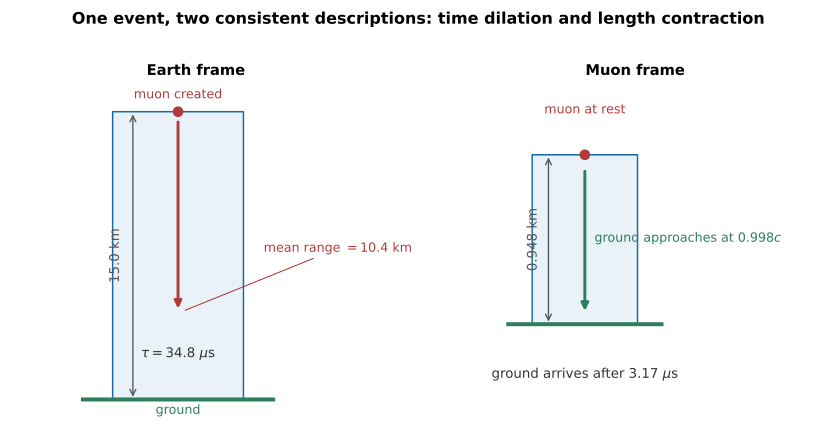
Figure 2.7:Time dilation in the Earth frame and length contraction in the muon frame describe the same physical crossing, with matching survival conclusion.
Solution to Exercise 2.5 #
Take one ship to have and the other in the Earth frame. The speed magnitude measured from the first ship is
Therefore, either ship measures the other to approach at ; ordinary addition would give , an unphysical speed that would violate Einstein’s second postulate that every inertial observer measures light at and no sublight velocity combination exceeds it.
Solution to Exercise 2.6 #
On axes with vertical and horizontal, the object at rest has for every , so its worldline is vertical and makes an angle with the vertical axis. The moving particle obeys
so its angle from vertical obeys , giving . The light pulse obeys , so and . Therefore, the requested sketch contains a vertical line at , a -from-vertical line from the origin for the massive particle, and a -from-vertical light ray from the origin.
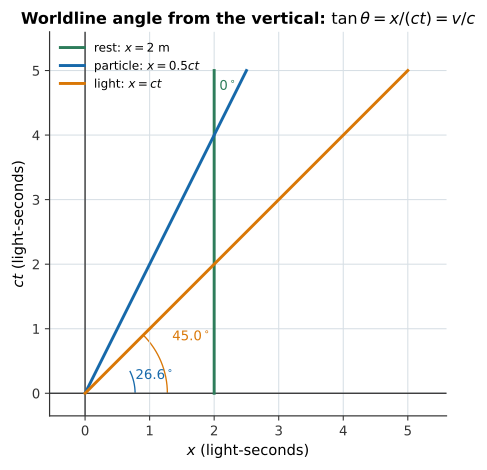
Figure 2.8:On equal and scales, a worldline’s angle from the vertical directly encodes .
Solution to Exercise 2.7 #
In Alice’s frame, each leg lasts
so Alice’s elapsed time is . At , , and Bob’s proper time is
Therefore, Alice ages while Bob ages $12.0\ \text{years}; Bob, unlike Alice, changes inertial frames at turnaround, so the apparent symmetry between their constant-velocity observations does not apply to the full trip.
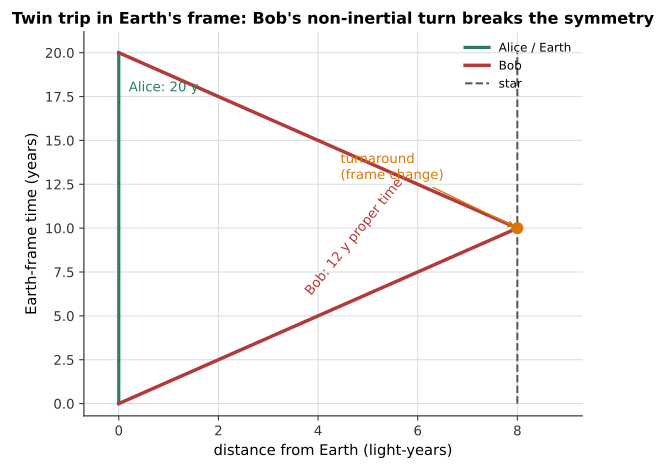
Figure 2.9:Bob’s kinked worldline identifies the turnaround—the event that makes the two twins’ complete histories physically different.
Solution to Exercise 2.8 #
The interval is
It is negative, so the separation is spacelike. Simultaneity in requires
Therefore, the events are spacelike separated and a frame moving at makes them simultaneous; their order can reverse without a causality paradox because no light-speed-or-slower signal can connect them.
Solution to Exercise 2.9 #
Solution to Exercise 2.10 #
In the lab the positive and negative linear charge densities cancel, so the wire is neutral. An observer moving alongside one species sees that species at rest but sees the other species moving at a different relativistic relative speed. Because moving charge separations along the wire are length-contracted by different factors, the two charge densities no longer have equal magnitudes in that frame, and the observer therefore measures a net charge density and an electric field. Therefore, the test charge has an electric force in that observer’s frame, while the lab observer describes the same physical acceleration using the transformed electric and magnetic fields; the two descriptions must agree because they are related by the Lorentz transformation.
Solution to Exercise 2.11 #
Solution to Exercise 2.12 #
For transverse motion, . Here
Thus
Therefore, the transverse Doppler shift is a redshift, because time dilation always makes the moving source’s clock run slow; reversing a purely transverse velocity does not change or , whereas reversing longitudinal motion changes whether successive crests are emitted closer to or farther from the observer.
Solution to Exercise 2.13 #
Although the ships keep the same separation in frame , the instantaneous rest frame of either accelerating ship changes continuously. In each such momentary rest frame, the other ship is not generally at rest at the same separation: relativity of simultaneity assigns the two ships’ simultaneous positions differently, and the other ship is seen to recede during part of the acceleration. A string that would be unstressed in a common instantaneous rest frame requires a larger proper length as the ships gain speed, while its endpoints are constrained to remain only apart in . Therefore, the string is stretched beyond its natural proper length and develops increasing tension, eventually breaking if it is not strong enough.
Solution to Exercise 2.14 #
Let be the proper interval between emitted crests. Time dilation makes the Earth-frame emission interval . During that interval a receding source moves an additional distance , adding a propagation delay , so
Using gives
Since frequency is the reciprocal of period,
Therefore, combining time dilation with the extra light-travel time produces the relativistic Doppler formula for direct recession.