Learning Objectives
By the end of this chapter, you should be able to:
Explain why the Newtonian definition of momentum, , is not conserved in all inertial frames once the Lorentz transformation replaces the Galilean transformation, and derive the corrected, relativistic definition from a symmetric elastic-collision thought experiment.
Apply the relativistic expressions for momentum, kinetic energy, and total energy.
Use the mass–energy relation and the energy–momentum invariant .
Distinguish rest mass, relativistic momentum, kinetic energy, and total energy, and apply these to problems involving massive particles and photons.
Represent energy and momentum as components of a single four-vector, and use conservation of this four-vector to analyze collisions, decays, and annihilation events.
Transform to the center-of-momentum frame of a collision and compute threshold energies for particle-production reactions.
Recognize the low-speed (Newtonian) and high-speed (ultrarelativistic) limits of the relativistic energy and momentum expressions.
Explain why the combination of momentum blowing up as and the causality argument of Chapter 2 together rule out faster-than-light material particles.
Introduction
Chapter 2 replaced the Galilean transformation with the Lorentz transformation, because only the latter is consistent with the invariance of the speed of light. But momentum and energy in Newtonian mechanics are defined and conserved using Galilean kinematics: , conserved because Newton’s third law and Galilean-invariant forces guarantee it in every Galilean frame. Once the underlying kinematics changes, the old definitions of momentum and energy no longer transform consistently between inertial frames, and a collision that conserves Newtonian momentum in one frame will not, in general, conserve it in another frame related by a Lorentz transformation. This chapter derives the corrected definitions — relativistic momentum and relativistic energy — that are conserved in every inertial frame, assembles them into a single four-component object whose conservation law captures both at once, and works out their most important consequences: mass and energy are, up to a conversion factor , the same quantity, and a whole new class of practical calculations — threshold energies for particle production — becomes possible.
3.1Relativistic Momentum
Deriving Relativistic Momentum
Rather than simply asserting the corrected formula, it is worth seeing exactly where it comes from, because the argument is a direct descendant of the light-clock argument used to derive time dilation in Chapter 2, and it makes clear that the correction is forced on us by the Lorentz transformation, not chosen for convenience.
Consider two identical particles, and , each of rest mass , in an idealized elastic scattering event. Choose the incoming and outgoing velocities so that the components are unchanged while each particle’s component reverses sign. In frame , let ’s transverse speed be . Let move at speed along the -axis relative to , and choose so that has no motion. In , let ’s transverse speed be the same . Because while for with , the transverse speed measured in is reduced by a factor of :
In , therefore has an component and a component before the bounce, while has a component . After the bounce, both components reverse sign. Writing the momentum of a particle moving at speed as , for some as-yet-undetermined function that reduces to the particle’s ordinary mass at , conservation of momentum says that the incoming and outgoing transverse momenta are equal. Since the outgoing total is the negative of the incoming total, each must be zero; hence
where and denote the total (not just transverse) speeds of and in frame . Substituting the magnitudes and , and cancelling the common factor of ,
Finally, take the limit : in this limit, ’s transverse motion vanishes entirely, so and , the particle’s ordinary rest mass. Meanwhile ’s transverse velocity component also vanishes, leaving moving purely along at the frame’s relative velocity, so . The boxed relation becomes
for arbitrary , since was the (otherwise unconstrained) relative speed of the two frames. In other words, momentum conservation across inertial frames, together with the Lorentz transformation’s effect on transverse velocities, forces the “effective mass” appearing in to be exactly — not simply , as Newtonian mechanics assumed. This is the relativistic momentum derived below; unlike the Newtonian formula, it is exactly the definition needed to make momentum conservation frame-independent, consistent with the Lorentz transformation of Chapter 2.
Relativistic Momentum
The result of the argument above is
where is the particle’s rest mass — an intrinsic, frame-independent property of the particle, equal to the mass measured by an observer at rest relative to it — and is the particle’s speed in the frame in question. For , and this reduces to the Newtonian . As , however, , so as well: a finite force acting for a finite time supplies only a finite impulse, whereas reaching the speed of light would require an unbounded impulse and work. This is the precise dynamical reason no massive object can reach or exceed , complementing the kinematic argument of Chapter 2 (relativistic velocity addition never produces from sub-light inputs).
Worked Example: Testing Against Data
The formula is not merely a theoretical nicety; it has been tested directly by measuring the momentum and speed of fast electrons and protons independently — momentum from the radius of curvature in a known magnetic field (), speed from time-of-flight over a measured distance. Measurements of this kind confirm across a wide range of speeds and rule out the Newtonian prediction at appreciable fractions of . For a proton with , for instance, , so the relativistic momentum is larger than the Newtonian formula predicts.
3.2Relativistic Energy
A parallel argument — demanding that the work-energy theorem, , hold with the relativistic force — leads to the relativistic kinetic energy
Deriving from the work-energy theorem
Start from the definition of kinetic energy as the work done accelerating a particle from rest to speed along a straight line:
using . With , differentiating with respect to gives
so , and
Substituting , , the integral becomes elementary:
which is exactly — confirming, by direct integration of the relativistic work-energy theorem, the result quoted in the main text.
It is useful to expand this for using the binomial approximation :
recovering the familiar Newtonian kinetic energy as the low-speed limit — a necessary consistency check, since Newtonian mechanics is extremely well tested at everyday speeds.
The kinetic energy expression separates naturally into two terms: , and a constant subtracted off. Einstein’s insight was to take both terms seriously as energy, not just their difference. Define the total energy
and the rest energy
Then : kinetic energy is the energy above and beyond the energy a particle possesses simply by virtue of having rest mass , even at rest (, ). This is the celebrated mass–energy equivalence: rest mass is a form of energy, convertible (in principle and, in nuclear and particle processes, routinely in practice) into other forms of energy, and vice versa. The conversion factor is enormous, which is why converting even a small amount of rest mass releases a very large amount of energy — the physical basis of the energy released in nuclear fission and fusion, examined in Chapter 13.
3.3Four-Vectors and Threshold Energies
The Energy–Momentum Four-Vector
Momentum and energy are not independent; eliminating and between and gives the energy–momentum invariant,
a relation that holds for every particle, in every inertial frame.
This is directly analogous to the invariant spacetime interval of Chapter 2, and the analogy is not superficial: just as can be assembled into a single spacetime-displacement four-vector that transforms under a Lorentz boost according to the Lorentz transformation, the quadruple can be assembled into a single energy–momentum four-vector,
which transforms from one inertial frame to another by exactly the same Lorentz transformation rule used for in Chapter 2 (with and ). Its invariant magnitude is
which is precisely the energy–momentum relation in Equation (3.14), rearranged; the rest mass plays the same role for the energy–momentum four-vector that the invariant interval plays for the spacetime-displacement four-vector — a quantity every observer computes to be the same, regardless of the frame in which and individually are measured. For a massive particle, the energy–momentum four-vector is proportional to its four-velocity. Its component ratio therefore gives the ordinary velocity, (and similarly for the other components). A slower particle has a larger ratio of to its momentum, as this expression requires.
The relation can be read geometrically as a right triangle, as shown in Figure 3.1: the total-energy term is the hypotenuse, while rest energy and momentum provide the two legs.
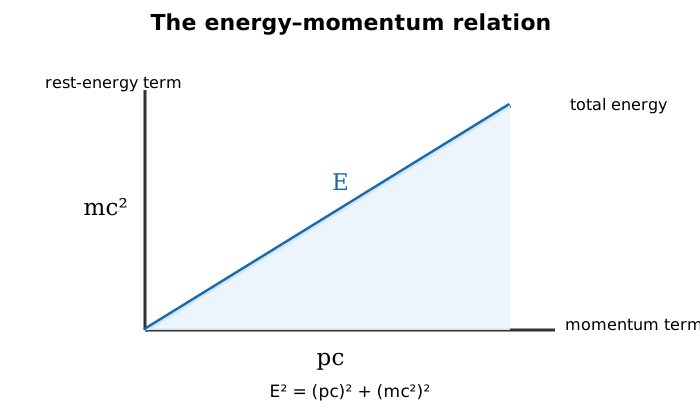
Figure 3.1:The energy–momentum relation as a right triangle: . Original schematic by the author.
Two limits of the energy–momentum relation are worth committing to memory:
Massive particle at rest (): , the rest energy alone.
Massless particle (), such as a photon: . Massless particles carry momentum and energy but no rest energy, and — consistent with the momentum argument above, which forbids a massive particle from reaching — they travel at exactly in every inertial frame.
Ultrarelativistic massive particle (, equivalently ): and . The massless relation is therefore also an excellent approximation for a sufficiently energetic massive particle.
The energy–momentum relation is often more convenient than working with and directly, particularly for high-energy particles and for photons, where speed is fixed at and carries no information about energy.
Why the Four-Vector Formalism Earns Its Keep
The payoff of packaging as a single object is that the energy–momentum four-vector is exactly conserved in every collision or decay, in every inertial frame, component by component — precisely because the underlying, separately-conserved quantities (in every frame) are energy and the three components of momentum. This means a conservation calculation can be carried out entirely by four-vector addition: add up the four-vectors of everything going into a collision, add up the four-vectors of everything coming out, and set the two sums equal, four components at a time. Because the four-vector’s magnitude, , is invariant, this magnitude can be computed in whichever frame is most convenient — often a frame in which one particle is initially at rest, or the frame in which the total three-momentum is zero (the subject of the next section) — and the resulting relation between energies and masses will hold in every other frame as well.
Electron–positron annihilation, revisited: consider an electron and a positron (each of mass ), both essentially at rest, annihilating. Charge conservation alone would permit (a single photon), but the four-vector of the initial state is (both particles at rest, energies each, zero total momentum), while any single photon’s four-vector must satisfy , i.e., have equal, nonzero energy and momentum magnitude — it cannot have zero momentum unless its energy is also zero. A single outgoing photon is therefore impossible; conservation of the energy–momentum four-vector, not merely of energy or momentum separately, forces at least two photons, emitted back-to-back so that their momenta cancel, each carrying energy . This is the same conclusion reached by separate energy and momentum arguments in Problem 3 below, but the four-vector language makes clear that both conservation laws are really a single, unified statement, and this is exactly the physical process (positron annihilation, producing two back-to-back gamma rays) exploited in medical positron-emission tomography (PET) scans to locate a radioactive tracer inside the body.
Center-of-Momentum Frame and Threshold Energies
Many practical problems in nuclear and particle physics — will one particle collision produce a new particle, or not? — are most easily solved by transforming to the center-of-momentum (CM) frame: the unique inertial frame in which the total three-momentum of a system is zero. Because is Lorentz-invariant, the total invariant mass of a system of particles,
is the same number whether computed in the lab frame or in the CM frame — but in the CM frame, where by definition, it simplifies to : the total CM-frame energy alone. This invariant determines whether a reaction is kinematically possible: by conservation of the energy-momentum four-vector, a reaction that produces a set of final-state particles with total rest mass is only possible if the available energy in the CM frame is at least — i.e., if . Other conservation laws and interaction probabilities can still forbid or suppress a reaction. The threshold condition is exactly, corresponding, for massive final-state particles, to all of them being at rest relative to the CM frame (and hence relative to each other), with no leftover kinetic energy to spare.
The CM frame is not a relativistic invention, and it is worth recovering the non-relativistic intuition before leaning on it. Figure 3.2 runs elastic and inelastic collisions in one and two dimensions, with the center of mass drawn on the screen and a momentum diagram beside it. Whatever the pucks do, that marker glides on at constant velocity — the collision cannot touch it, because the internal forces cancel in pairs — which is what makes its rest frame a natural place to do the bookkeeping. Choose the masses and velocities so that the marker stands still, and the momentum diagram shows what has been bought: two arrows equal and opposite before the collision, two arrows equal and opposite after it, however much kinetic energy was lost in between. The relativistic version below keeps that structure exactly, replacing by and the total mass by the invariant ; what changes is that is no longer the sum of the parts.
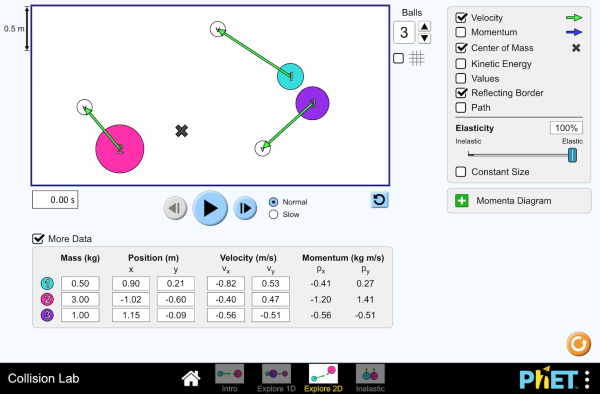
Figure 3.2:Classical collisions with the center of mass and the momentum vectors displayed. The center of mass moves at a velocity no collision can change, elastic or not, which is what makes its rest frame a natural place to do the bookkeeping — and what carries over, with in place of , to the relativistic threshold calculations of this section.
Interactive simulation: Collision Lab
Worked Example: The Threshold for Antiproton Production
In 1955, the Bevatron at Berkeley was built specifically to search for the antiproton, via the reaction
a proton beam striking a stationary proton (in a hydrogen target), producing an additional proton–antiproton pair. (Baryon number and charge are each automatically conserved by this reaction; nothing prevents it kinematically once enough energy is available.) What is the minimum, or threshold, kinetic energy the beam proton must have, in the lab frame, where the target proton is at rest?
Let be the proton (and antiproton) rest mass, for beam and target, and let be the total rest mass of the four final-state particles, all momentarily at rest in the CM frame at threshold. The invariant can be computed in the lab frame, where the target is at rest (, ) and the beam proton has energy and momentum :
Using (the beam proton’s own invariant), this simplifies to
The threshold kinetic energy is . With for the proton, this is — dramatically larger than the naive one might have guessed from simply counting the rest-mass energy of the new particle pair. The extra factor of three arises because, in the lab frame, the newly created particles must all share the same velocity as the CM frame itself (since at threshold they are at rest in the CM frame, which is itself moving relative to the lab), so a substantial fraction of the beam’s kinetic energy is unavoidably “wasted” maintaining the overall forward motion of the collision products rather than being converted into new rest mass. The Bevatron was deliberately designed to reach a beam energy of , comfortably above this threshold, and the antiproton was discovered there later that same year by Owen Chamberlain, Emilio Segrè, and collaborators.
This “wasted energy” problem is exactly why modern particle physics favors colliders, in which two beams travel toward each other and collide head-on. If the beam and target in the reaction above were replaced by two protons of equal and opposite momentum (so that the lab frame is the CM frame), the threshold condition becomes simply , i.e., per beam — six times less kinetic energy required per proton than the fixed-target case, precisely because no energy needs to be spent maintaining a net forward CM velocity.
The contrast between the two arrangements is summarized in Figure 3.3.
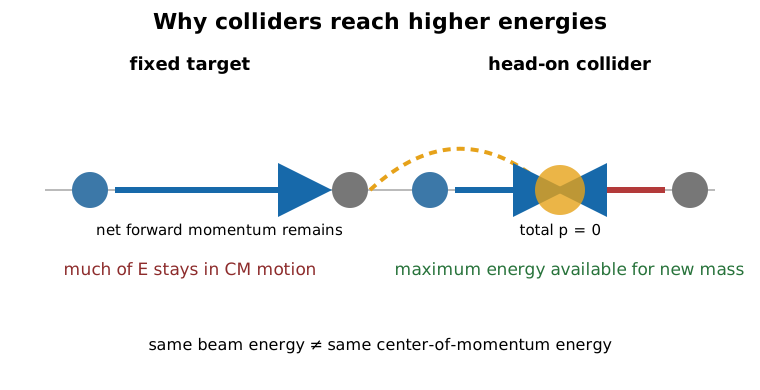
Figure 3.3:Fixed-target versus collider kinematics. In a head-on collider the center-of-momentum frame can coincide with the laboratory, so more of the beam energy is available to create rest mass. Original schematic by the author.
The historical setting of this threshold calculation is shown in Figure 3.4: the Bevatron was built in the 1950s to reach the energies needed to discover the antiproton.
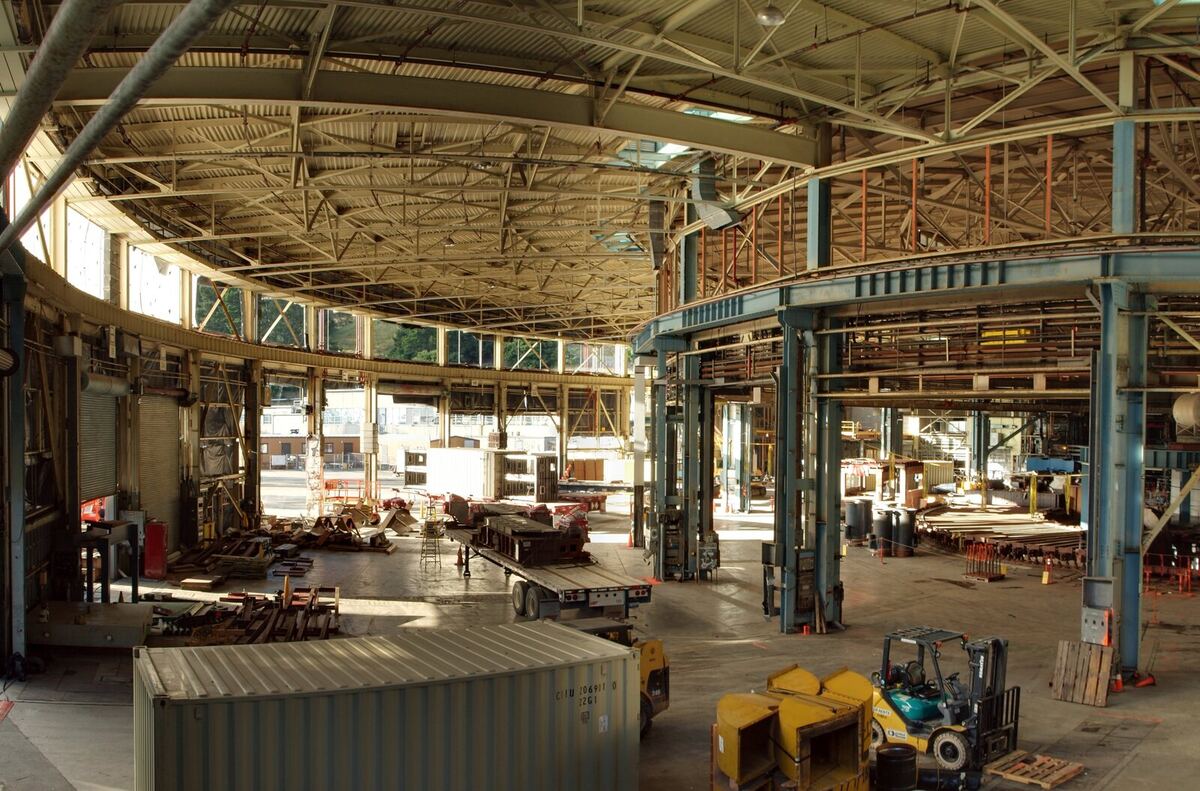
Figure 3.4:Interior of the former Bevatron building at Lawrence Berkeley National Laboratory. Photograph by Daniel Parks, 2010; CC BY 2.0 via Wikimedia Commons. The photograph shows the surviving facility structure, not the operating 1955 machine.
Aside: Why There Are No Faster-Than-Light Massive Particles
Chapter 2 argued, from causality alone, that no signal or influence can travel faster than without permitting effects to precede their causes in some valid inertial frame. This chapter’s momentum formula, , gives an independent, purely dynamical reason a massive particle in particular can never reach or exceed : as , , so accelerating a massive particle arbitrarily close to requires arbitrarily large — and, at itself, literally infinite — momentum and energy. No finite amount of work can supply this, so is a strict, unreachable asymptote for any object with , approached but never attained no matter how long or how powerfully it is accelerated.
It is sometimes asked whether a hypothetical particle might simply be born moving faster than , without ever having to accelerate through — such a hypothetical particle is called a tachyon. Formally, applying the energy–momentum relation at gives a spacelike four-momentum, so the invariant mass-squared would be negative (often described informally as an “imaginary rest mass”). This is not the rest mass of an ordinary particle, and no such particle has been observed. More importantly, a tachyon would connect spacelike-separated events (Chapter 2) — and the causality argument there shows that some inertial observer would measure any spacelike-connecting signal to travel backward in time, arriving before it was sent. Thus the mass–energy relation excludes faster-than-light motion for ordinary massive particles, while the light-cone argument gives a separate causal reason that controllable faster-than-light signals cannot exist.
Worked Example: An Electron Accelerated Through a Potential Difference
An electron (rest energy ) is accelerated from rest through a potential difference of , gaining kinetic energy .
Total energy: .
Momentum: from ,
so .
Speed: from , , and .
Note that a Newtonian calculation of the speed from would give — an unphysical result exceeding , and a sharp reminder that the Newtonian kinetic-energy formula must not be used once is comparable to or larger than .
3.4Summary
Because momentum must be conserved in every inertial frame under the Lorentz transformation, the correct definition is , not the Newtonian . This can be derived by analyzing a symmetric elastic collision in two frames related by a boost: requiring conservation of transverse momentum, together with the Lorentz-transformation rule for transverse velocities, forces a moving particle’s effective inertia to scale as .
As , , which is why no massive particle can reach the speed of light; this is confirmed directly by measurements of for fast electrons and protons, which match and rule out the Newtonian prediction of 1.
Relativistic kinetic energy is , which reduces to for .
Total energy and rest energy satisfy : mass is a form of energy (mass–energy equivalence), convertible to and from other forms of energy.
The energy–momentum invariant holds for all particles in all frames; it reduces to for a particle at rest and to for a massless particle such as a photon, which necessarily travels at .
For an ultrarelativistic massive particle with , the same invariant gives and .
Energy and momentum combine into a single energy–momentum four-vector, , which transforms like under a Lorentz boost and whose invariant magnitude is the rest mass, . Conservation of energy and momentum together is equivalent to conservation of this single four-vector.
The center-of-momentum (CM) frame is the frame in which total momentum is zero; the invariant total mass of a system, computed from , sets the threshold condition, , for whether a reaction producing a given set of final-state particles is energetically possible, and fixed-target reactions require substantially more beam kinetic energy than head-on collider reactions to reach the same threshold.
Combining the divergence of as with the causality argument of Chapter 2 rules out faster-than-light motion for ordinary massive particles and shows why controllable faster-than-light signals would create causal paradoxes.
Newtonian expressions for momentum and kinetic energy are the (equivalently ) limit of the relativistic expressions and must not be used when this condition fails.
3.5Problems
Solution to Exercise 3.1 #
Solution to Exercise 3.2 #
Solution to Exercise 3.3 #
Initially, both particles are essentially at rest, so their total energy is their combined rest energy:
If the two photons have equal energy , energy conservation gives
The initial total momentum is zero. Each photon has momentum magnitude , so two equal nonzero momentum vectors can sum to zero only if they point in opposite directions. Therefore, the annihilation produces two photons of energy each, traveling in exactly opposite directions.
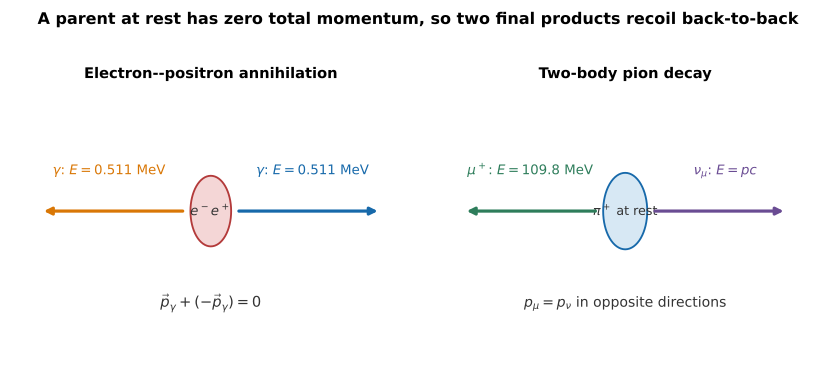
Figure 3.5:For any two-body process whose parent is at rest, momentum conservation fixes the products to have equal and opposite momenta. The right panel also previews the geometry used in the next solution.
Solution to Exercise 3.4 #
The pion is initially at rest, so its total momentum is zero. The muon and massless neutrino must therefore have equal and opposite momentum magnitude . Their energies are
Energy conservation gives
Substitute into the muon’s energy relation:
Expanding and cancelling yields
so
Therefore, the muon’s kinetic energy is .
The pion-decay panel in Figure 3.5 shows why the muon and neutrino use the same momentum magnitude in the energy calculation.
Solution to Exercise 3.5 #
Solution to Exercise 3.6 #
Mass--energy equivalence gives , so
The elapsed time is
At the stated constant rate, the lost mass would be
Its fraction of the Sun’s mass is
Therefore, the Sun loses about each second to radiation, but this amounts to only about of its present mass over 4.6 billion years and is not significant for its lifetime so far.
Solution to Exercise 3.7 #
Solution to Exercise 3.8 #
For ,
Each lump has energy . Their momenta are equal and opposite, so the total initial four-vector is
The composite is at rest, so its four-vector is ; conservation gives
Therefore, the stuck-together lump has rest mass , not ; the extra is the original kinetic energy retained as internal energy, such as heat and deformation, in the composite.
Solution to Exercise 3.9 #
At threshold, the final particles are at rest relative to one another in the CM frame, so their total rest mass is
For a stationary target, the initial invariant is
where was used. Set this equal to :
so
For equal and opposite collider beams, the lab is the CM frame, and threshold requires
per proton. The ratio is
Therefore, the fixed-target threshold is of kinetic energy, the collider threshold is per beam proton, and colliders require fourteen times less kinetic energy per incident proton because the CM has no net forward motion.
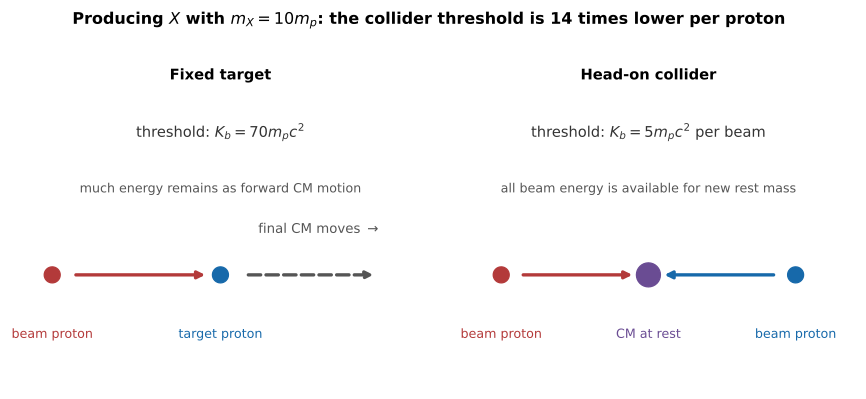
Figure 3.6:In a fixed-target experiment, much of the beam energy remains as forward centre-of-momentum motion; in a collider, that energy is available to create new rest mass.
Solution to Exercise 3.10 #
The initial photon and electron have total momentum in the photon direction, so the final particle must recoil with that momentum. The invariant mass of the one-particle final state follows from the initial four-vector:
Thus
Therefore, the final particle has momentum and rest mass . Its total energy is , as required by energy conservation.
Solution to Exercise 3.11 #
For a particle with finite nonzero energy, , so the invariant becomes
At ,
so . Such a signal connects spacelike-separated events. For a spacelike separation, a Lorentz transformation can reverse the order of emission and reception, so some inertial observer would see the signal arrive before it was sent; combining such signals between suitably moving observers permits a reply to reach the sender before the original message. Therefore, a tachyon requires negative mass squared in this formalism and would permit a causality paradox even apart from that problem.
Solution to Exercise 3.12 #
At threshold the incident proton has and the stationary target has energy , so
The beam momentum follows from its invariant:
The CM frame moves at , hence
The final four-particle system has rest energy but lab energy ; its Lorentz factor in the lab is , consistent with . Therefore, the naive counts only the new pair’s rest energy, whereas the additional of the beam kinetic energy is unavoidable kinetic energy of the entire final system moving at in the lab.
The fixed-target panel of Figure 3.6 illustrates this forward-moving final centre of mass.