Learning Objectives
By the end of this chapter, you should be able to:
Explain why late-nineteenth-century physics appeared essentially complete, and identify the handful of unresolved puzzles that undid that picture.
State the principle of relativity as it already existed in Newtonian mechanics, and explain why it does not, by itself, forbid a preferred frame for light.
State the Galilean transformation and Galilean velocity-addition rule, and explain what they predict for the speed of light.
Describe the luminiferous-ether hypothesis and the reasoning behind the Michelson–Morley experiment, and compute the fringe shift it predicted.
Explain why the null result of the Michelson–Morley experiment could not be explained away within Newtonian mechanics and a stationary ether.
Explain why the Kennedy–Thorndike experiment constrains length-only explanations of the null results and, together with independent clock tests, supports the linked space-and-time effects of Lorentz invariance.
Describe the Fizeau experiment and explain why its result was equally difficult to accommodate within a simple ether picture.
State Einstein’s two postulates of special relativity and explain why they are jointly incompatible with Galilean relativity.
Introduction
By the 1890s, many physicists believed their subject was nearly finished. Newtonian mechanics predicted the motion of planets, projectiles, and machinery with extraordinary precision; Maxwell’s equations had unified electricity, magnetism, and optics into a single theory of the electromagnetic field and correctly predicted that light is an electromagnetic wave. A famous (if perhaps apocryphal) remark attributed to physicists of the era held that all that remained was to measure constants to more decimal places.
That confidence concealed a handful of loose threads. This chapter follows one of them: Maxwell’s equations predict a definite speed for light, , but they do not say relative to what that speed is measured. Every other wave known to nineteenth-century physics — sound, water waves, waves on a string — is a disturbance in a material medium, and its speed is fixed relative to that medium, not relative to an observer. It was natural to assume light must be the same: a wave in some all-pervading substance, the luminiferous ether, with being its speed relative to the ether alone. Observers moving through the ether should then measure a different speed for light, just as a swimmer’s speed relative to the shore depends on whether they swim with or against a current. Two experiments designed to detect this effect — one that stubbornly refused to find it, and one that found something stranger still — are where this chapter begins, before turning to the radical reinterpretation Einstein proposed for both results at once.
1.1The Ether Hypothesis and Michelson–Morley
The Principle of Relativity, Before Einstein
It is worth being precise about what was, and was not, already understood before 1905. Galileo had already argued, nearly three centuries earlier, that uniform motion is undetectable from the inside. In his Dialogue Concerning the Two Chief World Systems (1632), he imagined an observer sealed below the deck of a smoothly sailing ship, with no portholes: butterflies fly about the cabin, fish swim in a bowl, drops fall from a bottle into a jar beneath it. Galileo’s point was that no mechanical experiment performed in that sealed cabin can tell you whether the ship is at rest in harbor or cruising at constant velocity across a calm sea. The butterflies do not pile up against the stern wall; the drops fall straight down into the jar exactly as they would in harbor. Only changes in the ship’s velocity — a lurch, a turn — are detectable from inside, because those involve acceleration, and acceleration is not relative in the same way.
This is the principle of relativity applied to mechanics alone: the laws of mechanics take the same form in every inertial (non-accelerating) reference frame, so no mechanical experiment, performed entirely inside a closed laboratory, can determine that laboratory’s velocity — only changes in velocity are detectable. Formally, this is exactly the content of the Galilean transformation worked out below: Newton’s second law, , keeps the same form under for any constant , because acceleration is unchanged by the transformation (, since is constant). Nothing about this principle was controversial in 1890; it was already a working assumption of every mechanic and astronomer.
What was not yet settled was whether this principle extended beyond mechanics — in particular, to light and electromagnetism. Maxwell’s equations, unlike Newton’s laws, single out a specific speed for electromagnetic waves, and by the reasoning of the Introduction above, a wave’s speed is normally measured relative to its medium, not relative to an arbitrary observer. If light truly is a disturbance in a material ether, then Maxwell’s equations should hold their simplest form only in the ether’s own rest frame, and an observer moving relative to the ether — such as anyone standing on the surface of a planet orbiting the Sun — should be able to detect that motion optically, even though no mechanical experiment inside a closed lab could reveal it. The question the rest of this chapter pursues is empirical: can such motion actually be detected?
Galilean Relativity and the Speed of Light
Newtonian mechanics is built on a specific rule for relating measurements made by observers moving relative to one another. Consider two reference frames, and , with moving at constant velocity along the -axis of , and with their origins coinciding at . The Galilean transformation relates the coordinates of an event as measured in each frame:
The last equation encodes an assumption so natural to everyday experience that it usually goes unstated: time flows identically for every observer, regardless of how they are moving. Differentiating the transformation for gives the familiar classical velocity-addition rule. If an object moves with velocity in frame , its velocity in is
This is the rule that lets you add your walking speed to a moving walkway, or a thrown ball’s speed to the speed of the train from which it is thrown. Applied to light, it makes a sharp prediction: if light travels at speed relative to the ether, and Earth moves through the ether at orbital speed , then an observer on Earth measuring light traveling in the same direction as Earth’s motion should get , and light traveling in the opposite direction should give . The effect is small — about one part in 104 — but with an interferometer sensitive enough to detect a shift in the interference pattern of order that size, it should be measurable.
The assumption hiding inside that argument is worth making explicit, because every wave known to nineteenth-century physics encouraged it. A wave is a disturbance of something, and that something fixes the frame in which the wave has its textbook speed: Figure 1.1 runs one oscillating source as a ripple on water, as a sound wave in air, and as light. On the first two screens the medium can be put on display directly — the water surface, and the individual air molecules being pushed back and forth — and it is relative to that medium that the disturbance travels at its stated speed. The ether hypothesis is the assumption that the third screen works like the first two, and that the medium there is merely one nobody had yet managed to detect.
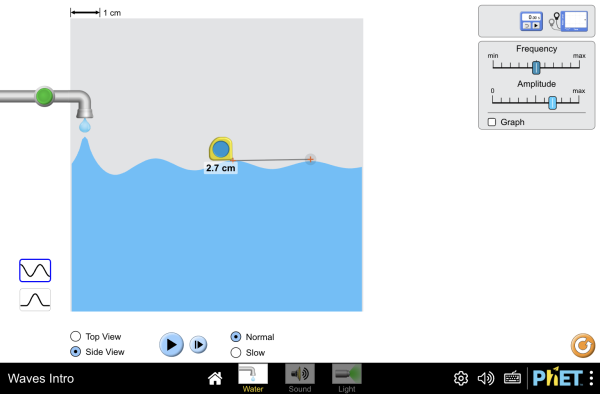
Figure 1.1:A single oscillating source seen as a water wave, a sound wave, and a light wave. For water and sound the medium can be drawn on the screen, and it sets the frame in which the wave travels at its stated speed; light was expected to be no different, and the medium it was supposed to disturb was the ether.
Interactive simulation: Waves Intro
The Michelson–Morley Experiment
Albert Michelson (and later Michelson working with Edward Morley) built exactly such an interferometer. Its principle is to split a beam of light into two perpendicular paths, reflect each off a mirror, recombine the beams, and observe the resulting interference pattern. If Earth moves through the ether, the round-trip travel time along the path parallel to that motion should differ slightly from the round-trip time along the perpendicular path, because a “cross-stream” trip and an “upstream–downstream” trip through a moving medium take different times even when the two paths have equal length — the same effect that makes a boat crossing a river directly and returning take less time than travelling the same distance upstream and back. The predicted difference is small, but the interferometer was sensitive enough to detect a shift of a small fraction of a fringe, and the apparatus was mounted on a stone slab floating on mercury so that it could be rotated smoothly to swap the roles of the two arms.
Computing the Predicted Fringe Shift
The prediction can be made quantitative. Let both interferometer arms have length , with the apparatus moving at speed through the ether, and suppose (for the moment) that one arm lies along the direction of motion and the other perpendicular to it. Light traveling down the parallel arm and back takes
since it travels at relative to the apparatus going one way (against the ether wind) and coming back. Light traveling down the perpendicular arm and back must be aimed slightly upstream (in the ether frame) to compensate for the sideways drift of the apparatus, so that its actual path through the ether is the hypotenuse of a right triangle with leg ; a short calculation (directly analogous to the light-clock argument of Chapter 2) gives
For , both expressions can be expanded with the binomial approximation, and :
Rotating the apparatus by swaps the roles of the two arms, doubling the effect, so the predicted shift in the interference pattern, measured in units of fringes (one fringe corresponding to one extra wavelength of path-length difference), is
Plugging in the actual 1887 apparatus — effective arm length (achieved by multiple reflections), sodium light , and Earth’s orbital speed — gives
comfortably above the apparatus’s sensitivity of about 0.01 fringe — roughly a factor of 37 in signal-to-noise. This is the calculation, worked in reverse from the design specifications, that told Michelson and Morley their apparatus was more than sensitive enough for the job.
The Null Result
The prediction was unambiguous: rotating the apparatus should shift the fringe pattern by an amount corresponding to Earth’s motion through the ether, roughly 0.4 fringe in the original 1887 apparatus — well above its sensitivity of about 0.01 fringe. The experiment was repeated at different times of day and during different seasons. If a stationary ether existed, Earth’s rotation and orbital motion would continually change the direction—and generally also the magnitude—of the laboratory’s velocity relative to it. A null result at one moment might therefore reflect an unfavorable orientation or an accidentally small projected velocity, but persistent null results could not. No shift of the predicted size was ever observed, in any orientation, at any time of year. The measured shift was consistent with zero and far smaller than the effect Galilean relativity plus a stationary ether required. Later, more sensitive repetitions of the experiment (through the twentieth century, using lasers and eventually rotating optical cavities) have pushed the upper bound on any such effect down by many more orders of magnitude, with the same result: none.
The beam-splitting layout that makes this comparison possible is shown in Figure 1.2.
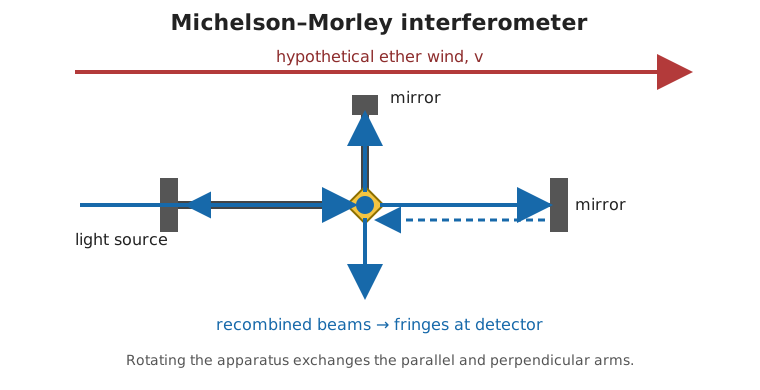
Figure 1.2:The Michelson–Morley arrangement. A beam is split into perpendicular paths and recombined; rotating the apparatus exchanges the arms that are parallel and perpendicular to the hypothesized ether wind. Original schematic by the author.
What a fraction of a fringe looks like, and how little it takes to produce one, can be checked directly in Figure 1.3. Translating one mirror by half a wavelength moves the pattern by one full fringe, so the 0.37 fringe that Michelson and Morley were hunting corresponds to an optical path difference of , and to a mirror motion of half that — small, but on this display an unmistakable movement of the whole pattern rather than a subtle change of shape. That is why the null result was so hard to argue with.
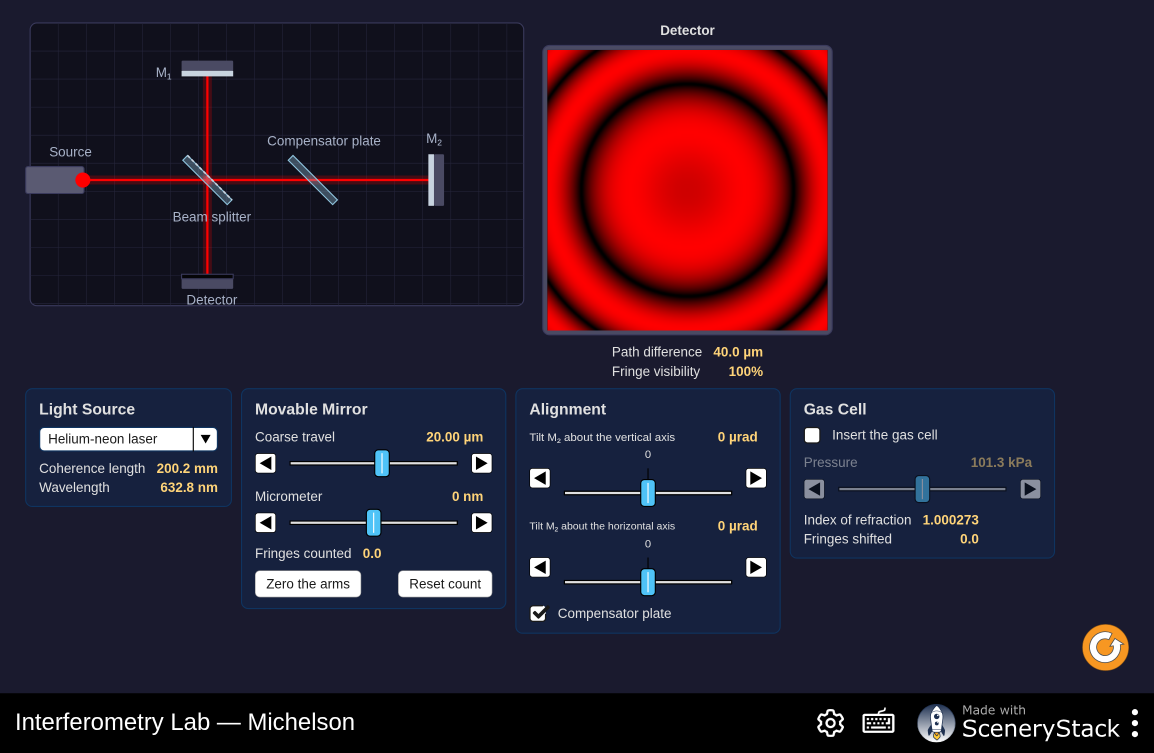
Figure 1.3:The Michelson geometry that Michelson and Morley used, with the arms under direct control. The ether wind is not modeled — no experiment has ever needed it to be — but the instrument’s response to a path-length difference between the arms is, and it is that response the 1887 apparatus was calibrated against.
Interactive simulation: Interferometry Lab
1.2Further Null Results: Kennedy–Thorndike and Fizeau
A Second Null Result: The Kennedy–Thorndike Experiment
Michelson–Morley compared equal perpendicular arms while rotating the apparatus. In 1932, Roy Kennedy and Edward Thorndike used unequal arms and searched for changes as Earth’s velocity relative to a hypothetical preferred frame varied. Their null result closed an important loophole in explanations based on length contraction alone and supported the linked transformation of lengths and clock rates required by Lorentz invariance.
Why unequal arms provide a different test
The surviving photograph in Figure 1.4 shows the scale and mechanical character of the original apparatus described above.
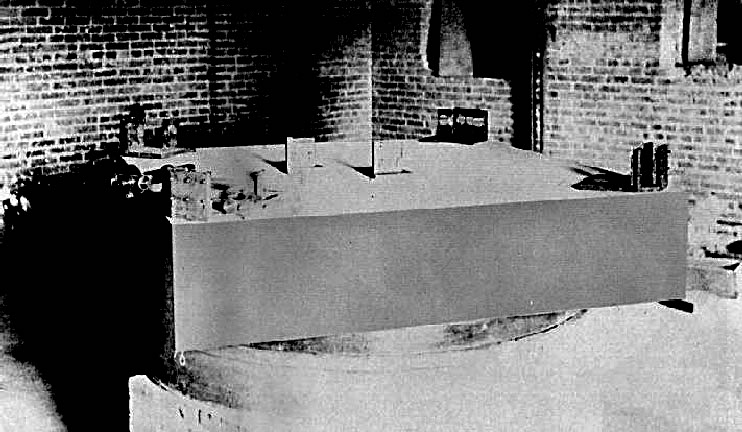
Figure 1.4:The Michelson–Morley apparatus at Case Western Reserve University, circa 1887. Photograph attributed to Case Western Reserve University; public domain via Wikimedia Commons.
One gap in the Michelson–Morley result deserves attention before moving on, because the way it was closed illustrates how tightly interlocking the eventual relativistic explanation would have to be. The Michelson–Morley experiment used two arms of equal length, and looked only for a fringe shift as the whole apparatus was rotated. This design has a subtle limitation: a length contraction (the Fitzgerald–Lorentz contraction, discussed below in “Attempts to Save the Ether”) of exactly the right amount would make for any direction of the apparatus relative to the ether, since whichever arm happens to be aligned with the direction of motion at a given moment contracts by just enough to keep equal to regardless of orientation — so rotating the equal-armed apparatus can never distinguish “no ether effects at all” from “an ether effect perfectly cancelled by length contraction alone.” It says nothing about whether the round-trip time itself depends on velocity through the ether, only about whether the two perpendicular round-trip times remain equal to each other.
Roy Kennedy and Edward Thorndike closed this gap in 1932 with a modified apparatus using two arms of substantially unequal length, . With unequal arms, length contraction alone can no longer guarantee at all times of year: even if each arm individually contracts as , the resulting difference still depends on the apparatus’s instantaneous speed through the hypothetical ether — a speed that changes over the course of a year as Earth’s orbital velocity vector changes direction (and, if the solar system itself moves through the ether, also has a component that does not average to zero). A length-contraction-only patch, with no accompanying change in the rate at which clocks run, predicts a fringe shift that slowly drifts as the year progresses. None was observed, to a precision even finer than Michelson and Morley’s original bound.
The Kennedy–Thorndike null result therefore rules out length contraction as a stand-alone patch within this class of ether models. More precisely, it constrains how lengths and the frequency of the light source transform with velocity; interpreted together with Michelson–Morley and independent clock-comparison experiments, it supports the linked length and time effects predicted by the Lorentz transformation. It does not, by itself, constitute a direct measurement of time dilation or uniquely derive the full transformation. This is a useful methodological lesson that recurs throughout physics: a single null result can usually be explained by more than one patch, and it typically takes a family of independent experiments, each closing off a different escape route, to establish a genuinely new theory.
A Complication: The Fizeau Experiment
The ether’s troubles did not begin with Michelson and Morley. Decades earlier, in 1851, Hippolyte Fizeau performed a related but distinct experiment: rather than looking for an effect of Earth’s motion through vacuum, he measured the speed of light inside a moving medium — water flowing rapidly through a pipe. Splitting a light beam so that one part traveled with the flow and the other against it, then recombining them interferometrically, Fizeau could measure how much the water’s motion changed the light’s speed compared to light in stationary water, (where is water’s refractive index).
The naive, purely mechanical expectation — light as a stream of particles, or the water fully “dragging” the ether along with it, either of which would give ordinary Galilean addition — predicts a shift of exactly , the full speed of the flowing water:
To first order in the water speed , Fizeau measured something different, and reproducibly so:
The water changes the measured speed of light, but only partially at this order — by a fraction of its own speed, not the full speed predicted by simple addition, and not zero either. Augustin-Jean Fresnel had predicted this coefficient in 1818 using an ether model in which a transparent medium partially entrained the ether. The prediction matched Fizeau’s measurement, but its physical interpretation required a specialized rule for the interaction between matter and ether.
Fizeau’s result sat alongside the Michelson–Morley null result as a second, independent puzzle: whatever the ether was doing, it was not doing anything as simple as being either fully dragged along by matter or entirely undisturbed by it. As will become clear in Chapter 2, once relativistic velocity addition replaces the Galilean rule, Fresnel’s fractional drag coefficient emerges automatically — with no separate assumption about entrainment at all — as the leading term of evaluated at . What looked like an ad hoc patch to the ether model instead emerges, to first order in , from relativistic kinematics.
Extracting the Fresnel coefficient from relativistic velocity addition
This chapter has not yet derived the relativistic velocity-addition formula — that is the work of Chapter 2 — but it is worth seeing, in advance, exactly how the “unmotivated” Fresnel coefficient falls out of it, since the calculation is short. Substitute (light’s speed in water at rest) into :
For , expand the denominator with :
where the cross term from the first factor’s times the second factor’s has been dropped as second order in . This reproduces Fizeau’s measured formula to first order in , with the fractional drag coefficient appearing automatically — not as a separate hypothesis about how much ether a medium entrains, but as the leading correction to ordinary velocity addition once the relativistic addition rule is used in place of the Galilean one. Higher-precision treatments must also account for effects such as the variation of refractive index with wavelength.
Fizeau is shown in a late-nineteenth-century portrait in Figure 1.5.
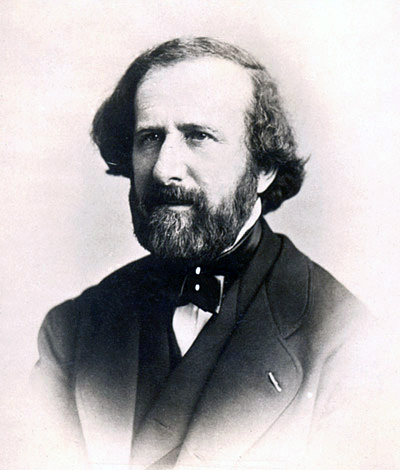
Figure 1.5:Hippolyte Fizeau (1819–1896). Photograph by Charles Reutlinger; Académie des Sciences / Smithsonian Institution Libraries; public domain via Wikimedia Commons.
The three possibilities are summarized visually in Figure 1.6: no drag, full Galilean drag, and the intermediate result actually observed.
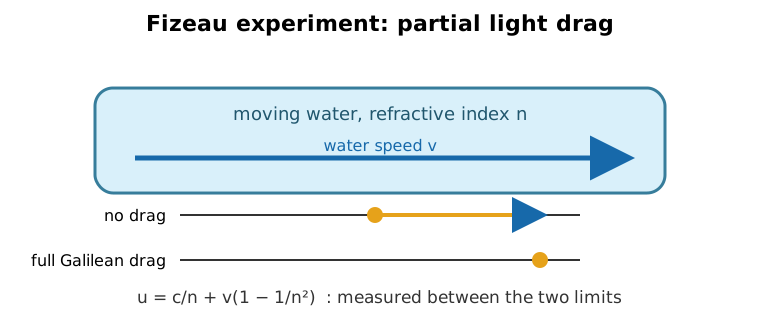
Figure 1.6:Fizeau’s moving-water result. The measured velocity is shifted by the Fresnel factor , lying between the predictions of no drag and full Galilean addition. Original schematic by the author.
1.3Toward Einstein’s Postulates
Attempts to Save the Ether
The null result did not immediately convince anyone to abandon the ether; instead, it triggered a series of increasingly strained patches:
Ether drag. Perhaps Earth drags the nearby ether along with it, so light near Earth’s surface shows no relative motion. The simplest version—complete, uniform drag—conflicts with stellar aberration, the small annual shift in the apparent position of stars (about 20.5 arcseconds, first measured by James Bradley in 1727). In the falling-rain analogy, complete local drag would make the incoming light share Earth’s sideways motion and would remove the need to tilt the telescope, contrary to observation. Historically, more elaborate drag models were proposed to recover aberration, so aberration alone did not dispose of every possible ether theory; rather, it forced those theories to become substantially more complicated.
The Fitzgerald–Lorentz contraction. George FitzGerald and, independently, Hendrik Lorentz proposed that objects moving through the ether physically contract along their direction of motion by just the factor needed to make the two arms of the interferometer take equal time, hiding the effect. Concretely, if a rod of ether-frame length oriented along the direction of motion instead has length , then recomputed with this shortened arm length equals exactly, and no fringe shift results, for any . Lorentz went further, introducing a fictitious “local time” that varied with position in exactly the combination that would, decades later, turn out to be the correct relativistic time coordinate. Taken on its own, however, this is an ad hoc fix — a contraction (and a local time) invented for the sole purpose of explaining away one null result, with the ether itself still doing the conceptual work of defining a single true rest frame. It turns out to contain a genuine piece of the truth, but only once it is derived from a deeper principle rather than posited to save a failing hypothesis, which is what Einstein did in 1905 (Chapter 2).
Emission theories. Perhaps light simply travels at speed relative to its source, with no ether needed at all — a proposal in the spirit of a bullet’s speed depending on the gun that fired it. De Sitter argued in 1913 that a simple version of this theory would badly distort observations of binary stars: light emitted while a star approached Earth would arrive faster than light emitted while it receded, potentially scrambling the apparent orbit. Such distortions are not observed, providing important evidence against simple ballistic theories. The historical argument was not conclusive by itself, because interactions with intervening matter might erase a source-dependent speed before the light reached Earth; laboratory and astronomical tests taken together provide the stronger case that light’s vacuum speed is independent of its source.
Worked Example: Estimating the Aberration Angle
The stellar-aberration bullet above asserts a value of about 20.5 arcseconds; it is worth seeing where a number of that size comes from, since the same reasoning about combining velocities recurs throughout this chapter. Consider a star directly “overhead,” so that in the Sun’s rest frame its light arrives travelling straight down (speed , along ) at a telescope. In the frame of Earth, which moves at orbital speed in some direction in the - plane perpendicular to the line of sight, ordinary (Galilean) velocity subtraction gives the light’s velocity components as measured on Earth: still along , but now also along , exactly as raindrops falling straight down acquire an apparent forward velocity component for a runner moving beneath them. The apparent direction of arrival is tilted from vertical by an angle with
Since this is a very small angle, . Converting to arcseconds (using ),
in close agreement with the historically measured value of . Because Earth’s velocity vector sweeps around in a full circle over the course of a year (always perpendicular to the instantaneous direction to a star near the pole of the ecliptic), each such star traces out a small circle of this same angular radius on the sky annually — exactly the periodic wobble Bradley detected in 1727, long before anyone suspected the ether was in trouble.
Each patch could account for the existing data but only by adding a new, unmotivated assumption, and no single patch accounted for both puzzles — the Michelson–Morley null result and the Fizeau partial-drag coefficient — without contradicting itself. What was needed was not another patch but a new starting point.
Einstein’s Postulates
In 1905, Einstein proposed to stop patching Galilean relativity and instead take the null result at face value, elevating it (together with the principle of relativity already implicit in mechanics, discussed above) to a postulate. Special relativity rests on two statements:
The principle of relativity. The laws of physics take the same form in all inertial reference frames. No experiment performed entirely within a closed laboratory can distinguish one inertial frame from another.
The constancy of the speed of light. The speed of light in vacuum has the same value in every inertial reference frame, independent of the motion of the source or the observer.
The first postulate was not new — as Galileo’s ship illustrates, it already held for Newtonian mechanics, where no mechanical experiment can detect uniform motion (this is why you cannot feel the constant-velocity phase of a smooth flight, and why the butterflies in Galileo’s cabin fly about undisturbed). Einstein’s step was to insist that this postulate apply to all of physics, electromagnetism included, so that no experiment of any kind — mechanical or optical — can distinguish inertial frames; there is no preferred, ether-defined rest frame for anything, including light. The second postulate is the one that clashes head-on with Galilean relativity: if held for light as it does for baseballs, two observers in relative motion could not both measure the same speed for the same light beam. Taken together, the postulates require that time and space themselves — not just the “aether wind” — behave differently than Galilean relativity assumes.
This is a genuinely radical move. Rather than asking “what medium is light waving in?”, Einstein asked what kinematics — what set of rules for relating space and time coordinates between observers — is consistent with light having the same speed for everyone. The answer is not the Galilean transformation but the Lorentz transformation, and working out its consequences — the relativity of simultaneity, time dilation, length contraction, and (as noted above) the Fizeau drag coefficient as a special case of velocity addition — is the subject of Chapter 2.
Einstein was not working in a vacuum: Lorentz had already written down transformation equations of essentially the same mathematical form (motivated, as noted above, by fitting the Michelson–Morley and Fizeau data rather than by a physical principle), and Henri Poincaré, in the same year, independently emphasized that the principle of relativity should be regarded as an exact law of nature rather than an approximate consequence of ether dynamics, and showed that the Lorentz transformations form a mathematical group — a property essential for consistency, since applying two velocity boosts in succession must itself be equivalent to some single valid transformation. What distinguished Einstein’s paper was not the equations themselves but their derivation: rather than reverse-engineering a transformation to fit the data, he started from the two postulates and showed that the Lorentz transformation is the unique kinematic consequence of taking them seriously, with time dilation, length contraction, and the relativity of simultaneity following as necessary theorems rather than independently adjustable assumptions.
It is worth appreciating just how much this single change in starting point accomplishes. The Michelson–Morley null result, stellar aberration, binary-star observations, and the Fizeau drag coefficient were separate empirical constraints that simple ether and emission models struggled to accommodate together. Relativistic kinematics provides a common framework for all four, without assigning light to a material medium or introducing a separate ether parameter for each result.
1.4Summary
The principle of relativity — that no mechanical experiment inside a closed laboratory can detect uniform motion — already applied to Newtonian mechanics before 1905 (Galileo’s ship). What was not settled was whether it extended to optics and electromagnetism, where Maxwell’s equations single out a specific speed naturally interpreted as a speed relative to a medium, the luminiferous ether.
The Galilean transformation and its associated velocity-addition rule, , predict that an observer moving through the ether should measure a speed of light different from , by an amount of order Earth’s orbital speed; the predicted Michelson–Morley fringe shift is fringe for the 1887 apparatus.
The Michelson–Morley interferometer was sensitive enough to detect this predicted shift but found none, at any time of year or orientation: the speed of light showed no dependence on the observer’s motion through the presumed ether.
The Kennedy–Thorndike experiment, using unequal interferometer arms, constrained length-contraction-only explanations. Together with Michelson–Morley and independent clock tests, its null result supports the linked length and time effects of Lorentz invariance.
The Fizeau experiment, measuring the speed of light in flowing water, found to first order a partial drag coefficient, — neither the full entrainment nor the zero entrainment that simple ether pictures would predict. Relativistic velocity addition produces this coefficient naturally at first order in .
Proposed rescues of the ether hypothesis faced additional constraints: stellar aberration conflicts with simple complete-drag models, binary-star observations weigh against simple emission theories, and length contraction introduced solely to hide the Michelson–Morley effect was an incomplete patch. More elaborate models could evade individual objections, but only at the cost of additional assumptions.
Einstein’s 1905 postulates take the null result at face value: the laws of physics (postulate 1) and the speed of light in particular (postulate 2) are the same in every inertial frame. Together these are incompatible with the Galilean transformation and require a new kinematics, developed in Chapter 2, which reproduces all of the results above — Michelson–Morley, aberration, binary-star timing, and the Fizeau coefficient — without any adjustable ether parameters.
1.5Problems
Solution to Exercise 1.1 #
Solution to Exercise 1.2 #
For the cross-river trip, the swimmer must devote a velocity component upstream to cancel the current. If is the shore-frame component across the river, then
Each crossing takes , so
For the upstream--downstream trip, the two shore-frame speeds are and . Thus
Their ratio is
Therefore, the upstream--downstream trip takes longer than the cross-river trip; this is precisely the classical ether prediction that the interferometer arm parallel to an ether wind has a longer round-trip light time than the perpendicular arm.
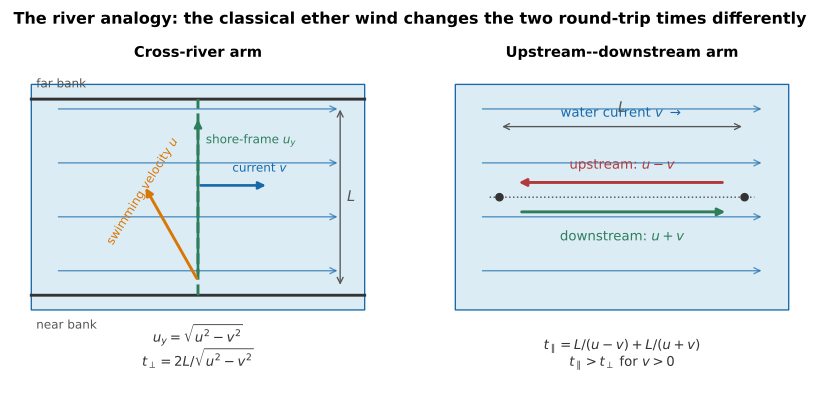
Figure 1.7:The river-current construction makes the key geometric difference explicit: holding a shore-fixed transverse path leaves a reduced crossing speed, while the parallel path has unequal upstream and downstream speeds.
Solution to Exercise 1.3 #
One null result could have occurred at an unlucky orientation, at a time when Earth’s velocity happened to have a small component relative to a hypothetical ether, or because of a temporary instrumental error. A stationary-ether model predicts that Earth’s velocity relative to the ether changes in direction and magnitude over a day and, especially, over a year as Earth orbits the Sun. Therefore, obtaining null results after rotating the apparatus and repeating the measurement at many times of year rules out those accidental explanations: the predicted signal should have changed, but it did not.
Solution to Exercise 1.4 #
In a simple emission theory, light emitted while a star moves toward Earth would initially have a larger Earth-frame speed than light emitted while it moves away. During a binary orbit, successive signals emitted at different orbital phases would therefore have different travel times across the same enormous star--Earth distance. The apparent orbital timing would be systematically advanced for some phases and delayed for others, producing a distorted or scrambled orbit. Such distance-amplified distortions are not observed, which is strong evidence against the simple ballistic model assumed in the question. Historically, this argument alone could not exclude every modified emission theory, because interaction with intervening matter might erase the source-dependent speed.
Solution to Exercise 1.5 #
Newtonian mechanics already obeyed the first postulate because experiments involving forces, masses, and accelerations have the same form in every frame moving at constant velocity: is unchanged by a Galilean transformation. Einstein’s second postulate adds the new empirical statement that every inertial observer also measures light in vacuum to have the same speed, , independent of the source’s or observer’s motion. This addition is absent from Newtonian mechanics and is incompatible with its velocity-addition rule.
Solution to Exercise 1.6 #
For the parallel arm, classical velocity addition gives
For the perpendicular arm, the light’s transverse speed is , so
For , use and :
Rotation reverses the sign of this difference, so it doubles the change in optical path:
For , , , and ,
Therefore, a stationary ether would predict about 75 fringes for this apparatus, about times the original 1887 predicted shift, before considering the much better readout precision of modern instruments.
Solution to Exercise 1.7 #
The stated upper bound is
For a fixed apparatus, . Thus, comparing this bound with the original prediction at gives
and hence
Therefore, under the deliberately incorrect ether interpretation, the residual ether speed would be below about , which is about times smaller than Earth’s orbital speed.
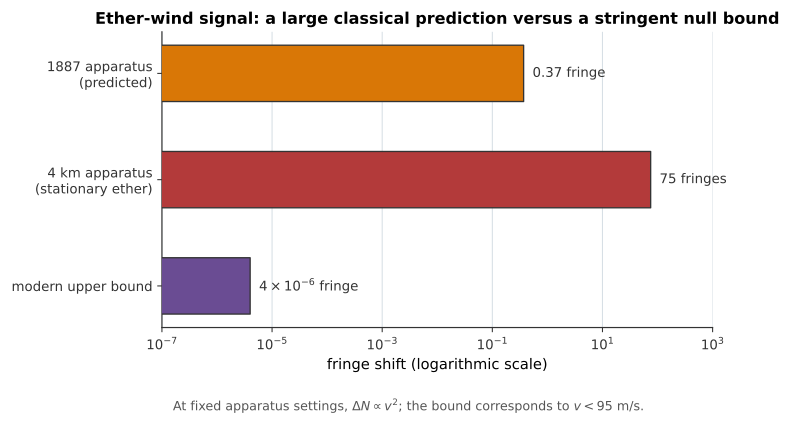
Figure 1.8:The logarithmic scale separates the large stationary-ether prediction from the tiny experimental bound; for a fixed apparatus, the signal varies as .
Solution to Exercise 1.8 #
Solution to Exercise 1.9 #
For a small aberration angle, , so the aberration angle is proportional to orbital speed. Therefore
Therefore, the astronomer on Jupiter would measure an annual aberration ellipse with angular radius about , and the ratio to Earth’s angle depends only on because the common factor cancels.
Solution to Exercise 1.10 #
Starlight behaves like the falling rain: because Earth moves sideways while the light enters the telescope, the telescope must be tilted slightly into the apparent direction from which the light arrives. Full ether drag near Earth would make the local ether, and hence the starlight’s propagation direction relative to Earth, move along with Earth. In the rain analogy, it would make the rain in the dragged region fall exactly vertically for the runner, so the umbrella would never need a forward tilt. Therefore, full ether drag predicts zero stellar aberration, whereas the observed nonzero annual aberration rules it out.
Solution to Exercise 1.11 #
With equal arms, a hypothesized length contraction can shorten whichever arm is instantaneously parallel to the ether wind by exactly the amount needed to make its longer classical light time equal to the perpendicular-arm time. After a rotation the other equal arm contracts by the same rule, so the experiment still gives no difference; an equal-arm null result therefore cannot distinguish this cancellation from no ether effect at all. With unequal arms, , the two light times retain a difference whose size depends on Earth’s speed through the ether, even if each parallel length contracts. Therefore, an annual change in the hypothetical ether speed would produce a Kennedy--Thorndike fringe drift unless time-rate changes accompany the length contraction, and the observed absence of that drift closes the loophole.
Solution to Exercise 1.12 #
A length-contraction-only theory could make the two equal Michelson--Morley arms have equal round-trip times at every orientation, so the original rotation experiment could still have produced its observed null result. However, for unequal Kennedy--Thorndike arms, that same theory leaves a velocity-dependent difference in travel time because the arms have different lengths; Earth’s changing speed relative to the ether would then create a yearly fringe drift. Therefore, the hypothetical drift would be consistent with the original equal-arm null result but would show that clock rates do not transform with the compensating time-dilation factor required by the Lorentz transformation, contradicting special relativity.