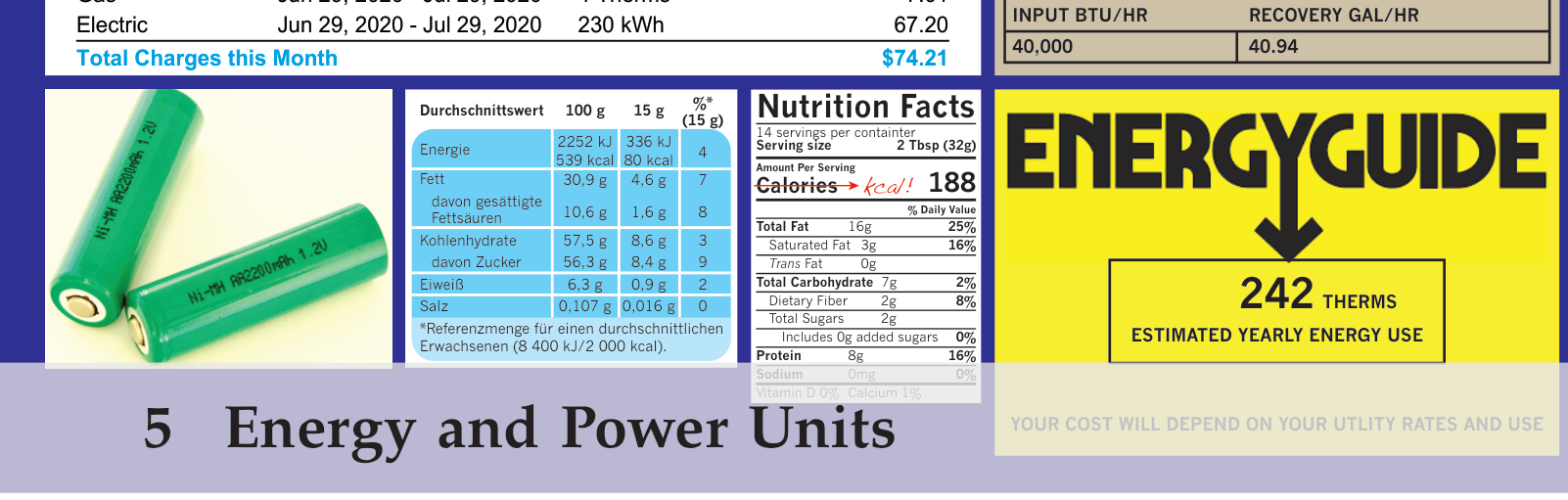
Energy units from everyday life. Clockwise from upper left: a utility bill (kWh and Therms); a hot water heater label (Btu/hr); EnergyGuide for same hot water heater (Therms); U.S. nutrition label for peanut butter (Calories; should be kcal); a German nutrition label for Nutella (kJ, kcal); and rechargeable AA batteries (2200 mAh, 1.2 V).
5. Energy and Power Units
Gas Jun 29, 2020 - Jul 29, 2020 4 Therms 7.01
This chapter provides a baseline for understanding the rest of the content in this book, so that students may learn to interpret and convert units, while building a useful intuition in the process. Sec. A.10 (p. 382) in the Appendices offers some tips on manipulating units and performing unit conversions.
Unlike most chapters, this one does not tell a single story or advance our perspective on the world. But it builds a foundation, putting us in a position to start looking at consequential matters of energy use in our society in chapters to come. Hopefully, patience will be rewarded.
5.1 Energy (J)
First, what is energy?
The SI unit of force is the Newton (N), breaking down more fundamentally to kg . The best way to remember this is via Newton’s Second Law: (force equals mass times acceleration). Mass has units of kg, and acceleration[2] is measured in meters per second squared.
Since work is force times distance, the unit for work (and thus energy) is Newtons times meters, or N m. We give this unit its own name: the
Joule (J). Thus, the application of 1 N of force across a distance of 1 m constitutes 1 J of work, requiring 1 J of energy to perform. Table 5.1 offers contextual examples (unit prefixes are on page 433).
Table 5.1:Approximate energy for familiar activities. The first freeway example is just kinetic energy; the second is the energy cost of a whole trip.
| Action | Energy |
|---|---|
| Nerf football toss | 15 J |
| Lift loaded bookbag | 100 J |
| Fast-pitch baseball | 120 J |
| Speeding bullet | 5 kJ |
| Charge cell phone | 30 kJ |
| Car on freeway (K.E.) | 675 kJ |
| human daily diet | 8 MJ |
| 1 hour freeway drive | 250 MJ |
Writing out Newtons as kg , we find that the unit of energy amounts to J N m kg . Notice that this looks like mass times velocity-squared. Box 5.1 explores how this makes a lot of sense.
We’ll encounter other ways to describe energy in this book, but any energy unit can always be cast into units of Joules, if desired. Later sections in this chapter detail alternative units whose acquaintance we must make in order to interpret energy information in our lives.
5.2 Energy Forms and Conservation
Energy manifests in a variety of forms, which we will treat in greater detail in application-specific chapters in Part III of this text. For now we just want to name them and point to related chapters and applications, as is done in Table 5.2.
Table 5.2:Energy forms. Exchange is possible between all forms. Chemical energy is represented here by Gibbs free energy.
| Energy Form | Formula | Chapter(s) | Applications |
|---|---|---|---|
| gravitational potential | 11, 16 | hydroelectric, tidal | |
| 1 | |||
| kinetic | 12, 16 | wind, ocean current | |
| photon/light | 13 | solar | |
| chemical | 8, 14 | fossil fuels, biomass | |
| thermal | 6, 16 | geothermal, heat engines | |
| electric potential | 15 | batteries, nuclear role | |
| mass (nuclear) | 15 | fission and fusion |
A bedrock principle of physics is conservation of energy, which we take to never be violated in any system, ever.[6] What this means is that energy can flow from one form to another, but it is never created or destroyed.
Example 5.2.1 traces a few familiar energy conversions, and Figure 5.1 provides an example illustration. A more encompassing narrative connecting cosmic sources to daily use is provided in Sec. D.2.2 (p. 408).
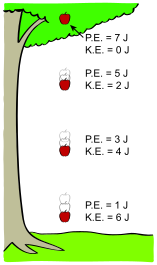
Figure 5.1:Example exchange of potential energy (P.E.) into kinetic energy (K.E.) as an apple drops from a tree. The total energy always adds to the same amount (here 7 J). The apple speeds up as it gains kinetic energy (losing potential energy). When it comes to rest on the ground, the energy will have gone into 7 J of heat (the associated temperature rise is too small to notice).
Any of the forms of energy (e.g., in Table 5.2) can convert into the other, directly or indirectly. In each conversion, 100% of the energy is accounted for. In the general case, the energy branches into multiple paths, so we do not get 100% efficiency into the channel we want. For instance, the pendulum example above will eventually bleed its energy into stirring the air (kinetic energy) and friction (heat) at the pivot point. The stirring air eventually turns to heat via internal (viscous) friction of the air.
One useful clarification is that thermal energy is really just random motions—kinetic energy—of individual atoms and molecules. So in the case of nuclear fission in Example 5.2.1, the initial kinetic energy of the nuclear fragments is already thermal in nature, but at a higher temperature (faster speeds) than the surrounding material. By bumping into surrounding atoms, the excess speed is diffused into the medium, raising its temperature while “cooling” the fragments themselves as they are slowed down.
If accounting for all the possible paths[7] of energy, we are confident that they always add up. Nothing is lost.[8] Energy is never created or destroyed in any process we study. It just sloshes from one form to another, often branching into multiple parallel avenues. The sum total will always add up to the starting amount. Sec. D.2.3 (p. 409) provides a supplement for those interested in better understanding where energy ultimately goes, and why “losing energy to heat” is not actually a loss but just another reservoir for energy.
5.3 Power (W)
Before getting to the various common units for energy, we should absorb the very important concept and units of power.
While energy is the capacity to do work, it says nothing about how quickly that work might be accomplished. Power addresses the rate at which energy is expended. Figure 5.2 provides a sense of typical power levels of familiar animals and appliances.
![Various power levels for comparison and intuition-building. Green entries correspond to metabolic power [33]. Purple entries are devices and](/EnergyAndHumanAmbitions/build/fig-5-2-a8e1dceb16d3b99236797b4160b00d3a.svg)
Figure 5.2:Various power levels for comparison and intuition-building. Green entries correspond to metabolic power [33]. Purple entries are devices and appliances. Orange entries are per-capita totals for societal (non-metabolic) energy use. Note that appliances whose job it is to create heat demand the greatest power. The “heating appliance” entry stands for things like microwave ovens, toaster ovens, space heaters, or hair dryers plugged into electrical outlets. Do not take the numbers provided as definitive or exact, as almost everything in the
figure will vary somewhat from one instance to another.
Of course, we commonly apply the usual multipliers of factors of 103 to the unit to make it more useful. Thus we have the progression W, kW, MW, GW, TW, etc. For reference, a large college campus will require several tens of MW (megawatts) for electricity. A large power plant is typically in the 1–4 GW range. See Table 5.3 for scales at which we are likely to use the various multiplying factors, and a more complete set of multipliers on page 433.
Table 5.3:Power multipliers and contexts
| Factor | Unit | Context |
|---|---|---|
| 1 | W | phones; computers |
| 103 | kW | microwave oven |
| 106 | MW | campus; community |
| 109 | GW | power plant; city |
| 1012 | TW | societal scale |
Although it won’t come up too often in this course, it is worth mentioning that the common unit of horsepower equates to 745.7 W. Thus a 100 hp car is capable of delivering about 75 kW of power.
5.4 Kilowatt-hour (kWh)
This unit causes no end of confusion, but it’s really pretty straightforward. The kilowatt-hour is a kilowatt times an hour. Thus it is power multiplied by time, which is energy (since power is energy over time).
It is straightforward to convert back to Joules, because 1 kW is 1,000 J/s and one hour is 3,600 s. So 1 kWh is 1 kW times 1 hr, which is 1,000 J/s times 3,600 s, and is therefore equal to 3,600,000 J, or 3.6 MJ. A related measure sometimes comes up: the watt-hour (Wh). In much the same vein, this is equivalent to 1 J/s for 3,600 seconds, or 3,600 J.[9]
One tendency some people have is to mix up kW and kWh.[11] Kilowatts is a unit of power, or how fast energy is being used. Think of it like a speedometer: how fast are you moving (through space or energy)? Kilowatt-hours is a multiplication of power times time, becoming an energy. It’s more like the odometer: how much have you accumulated (distance or energy)? Just like distance is rate (speed) times time, energy is rate (power) times time.
5.5 Calories (kcal)
A common unit for describing chemical and thermal processes is the calorie and its siblings.
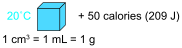

Figure 5.3:Following the definition of a calorie, adding 50 cal to one gram of water raises its temperature by .
It is usually sufficient to remember that the conversion factor between calories and Joules is about 4.2—or just 4 if performing a crude calculation.
1 cal = 4.184 J J J 1 kcal = 4,184 J kJ kJ
Two examples will help cement use of the kcal (a more useful scale in this class than the much smaller calorie).
A second example hews closely to the definition of the kcal: heating water.
Notice that we did not apply an explicit formula in Example 5.5.3. By proceeding stepwise, we attempt to keep it intuitive. We could write a
formula, but we implicitly create the formula on the fly by recognizing that the amount of energy required should scale with the mass of water and with the amount of temperature increase. Hopefully, this approach leads to a deeper understanding of the concept, while printing a formula on the page might short-circuit comprehension.
5.6 British Thermal Unit (Btu)
Why would we waste our time talking about the arcane British thermal unit (Btu)? It’s because data provided by the U.S. Energy Information Administration on global energy use is based on the Btu. More specifically, country-scale annual energy expenditures are measured in units of quadrillion Btu (see Box 5.4). Also, heating appliances in the U.S.[18] are rated in Btu/hour—a unit of power that can be converted to Watts.
We can make sense of the conversion to Joules in the following way: a pound is roughly half a kilogram and one degree Fahrenheit is approximately half a degree Celsius. So a Btu should be roughly a quarter of a kcal. Indeed, 1,055 J is close to one quarter of 4,184 J.
5.7 Therms
We will rarely encounter this unit, but include it here because natural gas utility bills[24] in the U.S. often employ Therms. Since part of the goal of this book is to empower a personal understanding of energy and how to compare different measures of energy (e.g., on a utility bill), conventions in the U.S. demand that we cover the unit here.[25]
5.8 Electrical Power
Electronic interactions are governed by charges pushing on each other. For the purposes of this course, we need only understand a few concepts. The first is voltage. Voltage is a measure of electric potential, in Volts, and can be thought of as analogous to how high something is lifted.[28] A higher voltage is like sitting higher on the shelf, and can do more work if allowed to be released.
Charge is moved around by electrical forces, and the amount of charge moved plays a role similar to that of mass in gravitational settings. The unit of charge is the Coulomb (C), and the smallest unit of charge we encounter in normal situations is from the proton C) or the electron C).
Current is the rate at which charge flows, and is usually symbolized by the letter . Imagine setting up a toll booth in a conducting wire and counting how many charges (or how much cumulative charge) pass the gate per unit time. This gives rise to the Definition 5.8.2.
Moving one Coulomb through one Volt every second would constitute one Joule of energy every second, which is the definition of one Watt. Putting the concepts of Definition 5.8.1 and Definition 5.8.2 together, we find ourselves able to define electrical power.
Finally, we are in a position to understand how much energy a battery will hold. Batteries are rated by two numbers: voltage, and charge capacity. Since current is charge per time, multiplying current and time results in just charge.[32] Therefore, charge capacity in batteries is characterized as Amp-hours (Ah) or milli-amp-hours (mAh). Since Amps times Volts is Watts (Eq. 5.2), Amp-hours times Volts is Watt-hours, a familiar unit of energy from Section 5.4.
5.9 Electron Volt (eV)
The electron-volt (eV) is the unit of choice for energy at the atomic scale. This makes it ideal for discussing individual chemical bond strengths, the energy of individual photons of light emitted from atoms, and thermal energy per atom or molecule.[34] We also use the eV for nuclear physics, but must increase the scale one million-fold and therefore speak of the mega-electron-volt, or MeV.
We have already hit all the relevant concepts for understanding the eV in Section 5.8. The main reason to have its own section is so that it appears separately in the table of contents, making it easier to find and reference. The definition follows Definition 5.8.1 closely.
The electron-volt, at J, is a tiny amount of energy. But it’s just the right level for describing energetic processes for individual atoms.
5.10 Light Energy
Light energy and its spectrum will be explored more extensively in Chapter 13, but the main concepts are covered here for completeness.
Light can be used to describe any part of the electromagnetic spectrum, from radio waves and microwaves, through infrared, visible, ultraviolet, and on to X-rays and gamma rays. Like atoms, light is “quantized” into smallest indivisible units—in this case particles called photons. An individual photon’s energy is characteristic of its wavelength, (Greek lambda), or frequency, (Greek nu).[38]
We also routinely express photon energy in electron-volts (eV) according to Definition 5.10.2.
5.11 Upshot on Units
Every chapter has an upshot, usually distilling key lessons from the chapter or offering final thoughts. Such a treatment is not necessary here, although we could reinforce the idea that energy can always be expressed in Joules, or converted into any of the units described in the chapter. Also critical is the notion that energy is conserved—only exchanging from one form to another but never truly disappearing or coming from nowhere.
Students may wish to see a master table of conversions between all the units discussed—and what a glorious table this would be! But it is intentionally left out for three reasons:
It could short-circuit your effort to learn the material;
Problems will ask you to do some of this;
This would be a fantastic opportunity for you to design and populate your own master conversion table. Then you’ll really own it.

5.12 Problems
A typical textbook may have a mass of 1 kg, and thus a weight of about 10 N. How high could the textbook be lifted (against the force of gravity) by supplying one Joule of energy?
If you look in your “energy wallet” and only have 24 J of energy available to spend, how far can you expect to slide an empty box across the floor if it takes 6 N of force to move it along?
A 50 kg crate might require 200 N to slide across a concrete floor. If we must slide it 10 m along the floor and then lift it 2 m into a truck, how much energy goes into each action, and what fraction of the total energy expenditure is each?
Come up with your own scenario (a force and a distance) that would result in 100 J of energy expenditure.
The numbers in Table 5.1 are reasonable but should not be thought of as right.[40] You can make your own table by using for lifting and for kinetic energy. For this exercise, pick three familiar activities or situations that allow you to estimate an energy scale in Joules and compute/estimate the results.
Just for fun, compute the energy associated with the mass of a tiny bit of shaving stubble having a mass of 0.01 using . Make sure you use the correct units to put the result in Joules. The speed of light, , is approximately 3 m/s.
What exchanges of energy (between what forms) happens when a hand grenade explodes and sends pieces of its casing flying away from the explosion at high velocity? You may wish to describe more than one step/exchange.
Follow the evolution of energy exchanges for a wad of clay that you throw high into the air. Describe what is happening as the clay moves upward, as it reaches its apex, as it falls back down, and finally hits the ground with a thud. Where does the initial energy you put into the clay end up?
A couch might take 100 N to slide across a floor. If someone slides the couch 4 meters and does it in 8 seconds, how much power did they expend?
If a 70 kg person (weight: 700 N) is capable of putting out energy at a rate of 500 W in short bursts, how long will it take the person to race up a flight of stairs 4 m high, considering only the vertical energy[42] required?
If asked to compute the power associated with performing a pull-up,[43] what specific information would you need to solve the problem (and what are the units of each)? Write out the math that would give the final answer.
How many kcal will it take to heat 1 liter of water (e.g., in a pot) from room temperature to boiling ? How many Joules is this?
If a microwave operates at a power of 1,600 W (1,600 J/s), how long will it take to heat 0.25 L of water from room temperature to boiling (changing temperature by if 50% of the microwave energy is absorbed by the water?
A smaller or less active person may require only 1,300 kcal per day of food intake, while a larger or more active person might demand 3,000 kcal per day. Approximately what range of power does this spread translate to, in Watts?
If a typical metabolic intake is 2,000 kcal each day, approximately how much energy does this translate to for one day, in units of kWh? Compare this to a typical American household’s electricity usage of 30 kWh in a day.
The chapter banner image (page 73) shows food labels for peanut butter and Nutella. The former indicates 188 Calories in a 32 g serving, while Nutella is 539 kcal in 100 g. To compare, we must adjust to the same serving size. Using 100 g as a sensible reference, which of the two is more energetic for the same serving size, and by how much (as a percentage)?
Based on the peanut butter label in the chapter banner image (page 73), showing 188 Cal per 32 g serving, how much mass of peanut butter would need to be consumed daily to constitute a 2,000 kcal/day diet? If a baseball has a mass of 145 g, how many baseballs of peanut butter would need to be consumed each day?
A generic $10 pizza might contain about 2,500 kcal. What is this in kWh? Electricity typically costs $0.15 per kWh,[44] so how much would a pizza’s amount of energy cost in electrical terms? Which of the two is a cheaper form of energy?
A refrigerator cycles on and off. Let’s say it consumes electrical power at a rate of 150 W when it’s on, and (essentially) 0 W when it’s off. If it spends half of its time in the on-state, what is its average power? How much energy does it consume in a 24-hour day, in kWh? At a typical electricity cost of $0.15 per kWh, about how much does it cost per year to run the refrigerator?
The chapter banner image (page 73) shows data from the author’s utility bill, indicating 230 kWh of electrical usage for a 30-day period in 2020. What does this rate of energy usage translate to, in Watts?
Heating a typical house might require something like 200 W of power for every degree Celsius difference between inside and outside temperatures. If the inside temperature is kept at and the outside temperature holds steady all day and night at , how much power is required to maintain the temperature?
If Problem 21 had resulted in 5,000 W,[45] how much energy is used in a 24-hour day, in Joules? Express in the most natural/convenient multiplier (i.e., J, kJ, MJ, GJ, etc.) depending on the scale.
If Problem 21 had resulted in 5,000 W,[46] how many kilowatt-hours (kWh) are expended in a 24-hour period? At an electricity cost of around $0.15 per kWh,[47] about how much will it cost, per day, to maintain heat?
If Problem 21 had resulted in 5,000 W,[48] how many Btu are required in a day to maintain temperature? How many Therms is this? At a typical cost of around $1.25 per Therm, about how much does it cost per day to heat the home?
If Problem 21 had resulted in 5,000 W,[49] how many gallons of liquid propane[50] would be consumed in heating the home for a day? At a cost of around $2.50 per gallon, about how much does it cost per day to heat the home?
The chapter banner image (page 73) shows data from the author’s utility bill, reflecting 230 kWh of electricity and 4 Therms of gas usage. Annoyingly, the units are different. How do the actual energies compare, if expressed in the same units?[51] How would you capture in a simple sentence the approximate comparison of energy use for each?
The chapter banner image (page 73) shows part of the hot water heater label in the author’s home, showing a rating of 40,000 Btu/hr. How much power is it capable of putting out, in Watts?
The chapter banner image (page 73) shows the energy label associated with the author’s hot water heater, estimating that it will use 242 Therms per year. If the estimated energy cost is distributed evenly across 12 months, what would the utility bill be expected to report? Based on an actual utility bill in the same image, the usage for one billing period was 4 Therms. How does actual usage compare to estimated usage, as an approximate percentage?
The chapter banner image (page 73) has two panels relating to the same hot water heater. One indicates the rate of gas usage when the heater is on (ignited, heating water) as 40,000 Btu/hr, and the other anticipates 242 Therms per year will be used. How many hours per day is the heater expected to be on (heating water) based on these numbers?
Gather up or compute conversion factors from the chapter to start your own conversion table (empty version below). Express kWh, cal, kcal, Btu, and Therms in terms of Joules.
| From | kWh | cal | kcal | Btu | Therms |
|---|---|---|---|---|---|
| To: J |
Perhaps assisted by Problem 30, create a table for conversions between kWh, kcal, Btu, and Therms in terms of one another. The table is started out below, populating the diagonal (no conversion necessary) and also providing a start that 1 Therm is 29.3 kWh.
| From | kWh | kcal | Btu | Therms |
|---|---|---|---|---|
| To: kWh | 1 | 29.3 | ||
| To: kcal | 1 | |||
| To: Btu | 1 | |||
| To: Therms | 1 |
A car headlight using light emitting diodes (LEDs) operates at about 15 W. If drawing from the car’s 12 V battery, how much current, in Amps, flows to the headlight?
Houses in the U.S. are equipped with circuit protection rated to 100 or 200 Amps, typically. If a 100 A house is operating at 80% of its rated capacity,[52] how much power is it consuming (at 120 V)? If sustained for a month, how many kWh will show up on the bill? At $0.15/kWh, what is the cost?
The chapter banner image (page 73) shows a rechargeable AA battery, operating at 1.2 V and holding 2,200 mAh of charge. How many Joules is this, and how long could it power a 1 W LED array?
If we have 6 molecules,[53] and each molecule releases 1 eV in a chemical reaction, how many kJ (per mole, as it turns out) is this reaction?
Considering the typical wavelength of light to be 0.55 , what is a typical photon energy, in Joules, and how many photons per second emerge from a 1 W light source?[54]
At what wavelength, in microns , is the corresponding photon energy in eV the same number? A deliberately wrong example to illustrate would be if a wavelength corresponded to 2.6 eV (it doesn’t’).
This definition applies to the common circumstance when the motion is aligned with the direction of force, like pushing a box across a level floor, propelling a car along the road, or lifting a weight.
Acceleration is the rate of change of velocity. Since velocity is measured in meters per second, the rate at which it changes will be meters per second per second, or , or . Some students may know that gravitational acceleration on Earth’s surface is 9.8 , which is another way to remember.
For examples like these, framed as statements and not questions, you can practice solving several types of problems by covering up one number and then solving for it using still-available information. So each statement can be seen as several examples in one!
The force needed to hold against gravity is just
The only exception is on cosmological scales and times. But across scales even as large as the Milky Way galaxy and over millions of years, we are on solid footing to consider conservation of energy to be inviolate. It is fascinating to note that conservation of energy stems from a symmetry in time itself: if the laws and constants of the Universe are the same across some span of time, then energy is conserved during such time—a concept we trace to Emmy Noether. See Sec. D.2 (p. 406) for more.
… sometimes called channels
Actually, the principle is so well established that new particles (like the neutrino) have been discovered by otherwise unaccounted energy in nuclear processes.
A Wh is one-thousandth of a kWh, not surprisingly.
Literally, kW/hr would be a sort of acceleration through energy. It’s a real thing that can happen, but it’s usually not what people mean.
… an incandescent, for instance
… maybe 30 m/s; 67 m.p.h.; 108 k.p.h.
Human metabolism is not the same as heating water, but the energy involved can still be counted in an energy unit that is defined in terms of heating water. It’s still just energy.
It would serve little purpose to perform exact math here—producing 96.85 W in this case—since the idea that someone’s daily diet is exactly 2,000.00 kcal is pretty preposterous. It will likely vary by at least 10% from day to day, and by even larger amounts from individual to individual, so that 100 W is a convenient and approximate representation.
Make sure this is clear to you; by understanding, we are installing concepts instead of formulas, which are more powerful and lasting.
… hot water heaters, furnaces, air conditioners, ovens and stoves
Recall that 1 kcal is the energy it takes to heat one kilogram of water by .
J, more precisely.
A cute and convenient way to remember this, approximately, is seconds per year.
Typical shower flow is about 2 gallons, or L, per minute.
30,000 Btu/hr is equivalent to 8,800 W, as worked out above.
See, for instance, the banner image for this chapter on page 73.
Chapter 20 will explore what might be learned from utility bills.
Propane is often used in more remote locations as a substitute for natural gas when the pipeline infrastructure for natural gas is absent.
Based on a capacity of 200 L, pulling in chilly water at and heating it to , thereby requiring 200 kg C kcal.
… making electric potential a lot like gravitational potential energy in flavor
Amperes, formally
The alternating current nature is already accommodated in this measure of voltage.
Safety regulations limit continuous use to 80% of the breaker current capacity, so that realistically the limits are 1,400 W and 1,920 W, respectively. This is why “heating appliances” in Figure 5.2 top out around 1,500 W: circuit/safety limits.
For example, 0.1 Amps (0.1 Coulombs per second) of current sustained for a duration of 100 seconds results in 10 Coulombs of charge flow.
Approaching a problem from multiple directions provides validation and also promotes greater flexibility.
Really, this is just the kinetic energy of the particle.
See Appendix B for a primer/refresher on chemistry.
Tables in chemistry books contain this type of information.
Each carbon-to-oxygen link is a double bond, meaning that two electrons participate in the link, for a total of four.
The two are related by the speed of light, , via .
A micron , or micrometer) is another way to say 10-6 m.
Every nerf toss is not 15 J; the bookbag lift depends on how heavy and how high the lift; every example would have a range of reasonable numbers.
Ignoring inefficiencies of moving legs, rounding flights, etc.
… or chin-up, lifting your entire body up to a bar using your arms
… regionally variable
⚠ it does not, exactly
⚠ it does not, exactly
… regionally variable
⚠ it does not, exactly
⚠ it does not, exactly
Hint: related to Problem 24 and the fact that a gallon of propane contains 0.915 Therms of energy.
… recommend kWh as common basis
All circuits blazing at the safety limit!
Assuming 100% efficiency