This book does not rely heavily on past knowledge of chemistry, but it is helpful to know a few basic elements that play a role in fossil fuels, biological energy, and climate change. This section could act as a refresher, or a first exposure to the fundamentals.
B.1 Moles
Chemistry deals with atoms and molecules and the interactions between them. Atoms and molecules[1] are irreducible nuggets of a substance—the minimum unit that carries the essential properties of that substance. Water, for instance, is comprised of two hydrogen atoms bonded to a single oxygen atom, which we denote as HO.
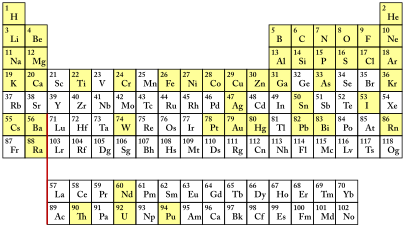
Figure B.1:Periodic Table of the Elements. This version is too small to permit names, so that only symbols are given. The more familiar elements are highlighted. Numbers represent the number of protons in the nucleus of the associated atoms.
Figure B.1 presents a stripped-down version of the periodic table. Additional exploration of more fully-featured versions is encouraged.[2]
It is natural to imagine that a first step in dealing with piles of atoms and/or molecules is being able to count them. But since individual atoms are fantastically small, the numbers can be overwhelmingly large. This is where the mole[3] comes in. A mole is just a number, and that number is called Avogadro’s number, having a value of , or 602,214,076,000,000,000,000,000, if written out.[4]
The way the mole is defined, essentially, is that 12.000000 grams of neutral carbon atoms (of the isotope having 6 protons and 6 neutrons in its nucleus) will constitute one mole of atoms. In this way, the masses of other elements—being comprised of an integer number of protons and neutrons[5]—will tend to be close to an integer number of grams.[6] For instance, a mole of hydrogen atoms is very close to 1.00 grams. A mole of helium is very nearly 4.00 grams, nitrogen 14, oxygen 16, etc.
So the concept of the mole is pretty straightforward: just a number— albeit a very large one.
B.2 Stoichiometry
Chemistry starts by counting atoms and molecules. Since molecules are comprised of integer numbers of atoms of specific types, the counting fun does not stop there. When atoms and molecules react chemically, the atoms themselves are never created or destroyed—only rearranged. This means that an accurate count of how many of each atom type are present at the start, a proper count at the end should yield exactly the same results.
Before we get into balancing chemical reactions, we need to know something about the scheme for labeling chemical compounds. A compound is an arrangement of atoms (representing pure elements) into a molecule. For instance, water is made of three atoms drawn from two elements: hydrogen and oxygen. Two atoms of hydrogen are bonded to an atom of oxygen to make a molecule of water. We denote this as HO.
Examples of a few familiar atoms and molecules are presented in Figure B.2. Each one is named at the top. Below each one appears the bond structure in the case of molecules and the chemical “formula” in all cases. Notice that hydrogen atoms always have a single bond (single
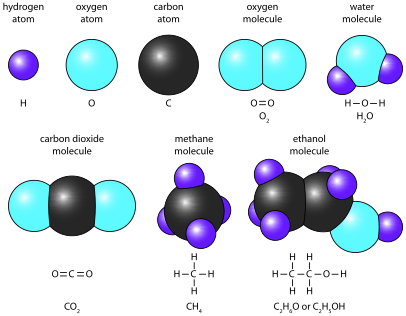
Figure B.2:Representing atoms as colored spheres for schematic purposes, we can depict the general appearance of molecules as bonded collections of atoms. Here, we have three elements—hydrogen, oxygen, and carbon—combined into familiar molecules. Oxygen in the air we breathe is self-bonded into a “diatomic” molecule. Two representations appear below each molecule: a diagram indicating bonds (including double-bonds in some cases), and the chemical formula.
electron to share), oxygen has two (wants to “borrow” two electrons to feel good about itself), and carbon tends to have four (either donating four in the case of CO, or accepting four when bonding to hydrogen). The chemical formula for each uses elemental symbols to denote the participants and subscripts to count how many are present.[9]
Now we come to a bedrock practice in chemistry called stoichiometry— which boils down to counting atoms in a reaction to make sure no atoms are missing or spontaneously appear. To get a sense of this, see Figure B.3 for two examples. The graphical version captures the physical reality, so that simply counting the number of spheres of each color on the left and right had better match. Below each graphical reaction is the associated chemical formula. Each formula contains an arrow indicating the direction of the reaction (separating “before” and “after”). Numerical factors (coefficients, or prefactors) in front of a molecule indicate how many molecules are present in the reaction. To get the total number of atoms represented, we must multiply the subscript for that atom (implicitly 1 if not present) by the prefactor.[10]
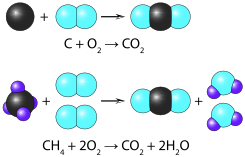
Figure B.3:Two example fossil fuel reactions (combustion) are shown here. The first is coal and the second is natural gas (methane). Both cases simply rearrange the input atoms without creating or destroying any, so that the count is the same on both sides of the arrow (which denotes the direction of the reaction). In other words, four purple hydrogens on the left in the case of methane must all appear on the right somewhere. The formula version also just counts instances of each atom/molecule, in which pre-factors (coefficients) indicate how many molecules are present.
The treatment above cast chemical reactions at the most fundamental level of individual molecules reacting. In practice, reactions involve great numbers of interacting particles, so it is often more convenient to think in moles. In fact, common practice is to look at the prefactors[13] in chemical reaction formulas as specifying the number of moles rather than the number of individual molecules. Either way, the formula looks exactly the same,[14] and it’s just a matter of interpretation.
Thinking of the chemical formulas in terms of moles makes assessment of the masses involved more intuitive. Recall that one mole of carbon atoms is exactly 12 grams, that hydrogen is 1 g, and oxygen is 16 g. That means one mole of water molecules (HO) will be 18 g (16 , one mole of carbon dioxide (CO is 44 g (12 , and one mole of ethanol HO) is 46 g (12 . We refer to this figure as the molar mass, and standard periodic tables display the molar masses for each element: the mass of one mole of the substance. The unit is typically grams per mole, or g/mol.
B.3 Chemical Energy
Atoms (elements) can bond together to make molecules (compounds). The bond—formed by outer electrons within the atoms—can be strong or weak. It takes energy[15] to pull apart bonded atoms. It stands to reason that when two atoms form a new bond, energy is released—usually as vibrations that we know as heat. In a typical reaction, some bonds are broken and other new ones formed. If the balance is that the new bonds are stronger than the broken bonds, energy will be released. Otherwise, energy will have to be put into the reaction to allow it to happen.
In the context of this book, chemical energy is typically associated with combustion (burning) a substance in the presence of oxygen. This is true for burning coal, oil, gas, biofuels, and firewood. In a chemistry class, one learns to look up the energetic properties of various compounds in tables, combining them according to the stoichiometric reaction formula to ascertain a net energy value. We’re going to take a shortcut to all that, by introducing the following approximate formula for combustion energy.
The approximate energy available from the compound HO— where the subscripts represent the number of each atom in the molecule to be burned—is:
For instance, sucrose has the formula HO, so that , , and . The denominator in the formula is just the molar mass,[16] or 342 in this case. The numerator adds to 13.1, so that the result is 3.8 kcal/g—very close to the expected value around 4 kcal/g for a carbohydrate like sugar.
The numerator of Eq. B.1 tells us that we get the most energy from each carbon atom, 30% as much from each hydrogen atom, and take a 50% hit (deduction) for each oxygen atom. Nitrogen is energetically inert and does not contribute to the numerator—while degrading the energy density by adding mass in the denominator. The negative coefficient for oxygen tells us something important. Since combustion is a process of joining oxygen to atoms in the fuel, the presence of oxygen already in the fuel means it is already partly “reacted” and has less to offer in the way of new oxygen bonds.
We can explore the sensibility of Eq. B.1 by testing it on some known
product at the end of the energy process. HO, as another commonboundary cases.CO, calculating for CO should offer no energy to us, since it’s a “waste”Since one ubiquitous end-product of combustion is
combustion product, is likewise effectively neutralized in the formula (the result is at least made to be very small). Table B.1 provides some examples of what Eq. B.1 delivers for familiar carbon-based substances. Note that oxygen content (last column) drives energy down, while hydrogen offers a boost.
Table B.1:Example approximate chemical energies. The results of the approximate formula are compared to true values (favorably). Fractional mass in carbon, hydrogen, and oxygen also appear—emphasizing the penalty for molecules already carrying oxygen.
| substance | formula | Eq. B.1 kcal/g | true kcal/g | % C | % H | % O |
|---|---|---|---|---|---|---|
| glucose | HO | 3.7 | 3.7 | 40 | 7 | 53 |
| typ. protein | HO | 4.4 | 41 | 7 | 52 | |
| coal | C | 8.3 | 7.8 | 100 | 0 | 0 |
| typ. fat | HO | 9.8 | 77 | 12 | 11 | |
| octane | H | 11.8 | 11.5 | 84 | 16 | 0 |
| methane | CH | 13.8 | 13.3 | 75 | 25 | 0 |
The resulting calculated energies are definitely in the right (expected) ranges. Notice that the “winners” have little or no oxygen as a percentage of the total molecular mass. The lower-energy entries in Table B.1 are more than half oxygen, by mass.
B.4 Ideal Gas Law
Another topic covered in chemistry classes that strongly overlaps physics is the ideal gas law. This relationship describes the interactions between pressure, volume and temperature of a gas. In chemistry class, it is learned as
where stands for pressure (in Pascals[18]), is volume (cubic meters), is the number of moles, is temperature (in Kelvin), and is called the gas constant, having the value
To get degrees in Kelvin, add 273.15 (273 among friends) to the temperature in Celsius.[19] Standard atmospheric pressure is about 105 Pa.[20]
Physicists prefer a variant of the ideal gas law that derives from the study of “statistical mechanics,” which is practically synonymous with thermodynamics and relates to the study of interactions between large ensembles of particles. The form looks pretty familiar, still:
Pressure, volume, and temperature are all unchanged, and expressed in the same units as before. Now, describes the number of particles (quite large, usually), and is called the Boltzmann constant, having a value
Notice that , the number of particles, and , the number of moles, differs simply by a factor of Avogadro’s number, . Indeed, if we multiply by , we get 8.314, and are back to .[22]
Molecules are made from a handful of atoms.
Perhaps at least identifying the highlighted elements would be worthwhile.
… the word molecule begins with mole.
Unfortunately, it can be hard to remember if it is supposed to be or . For this reason, it may be wise to forget about the 22 and just remember , or even as something that is very slightly wrong but much better than being 10 times off!
… and associated light-weight electrons equal in number to the protons
Blends of different isotopes can mess up this convenient arrangement in natural (mixed) samples, however.
A nucleon is either a proton or a neutron: the two types of particles that occupy the nucleus of an atom and are responsible for almost all of the atom’s mass.
… if such a thing were to be found/created
Two variants are shown for ethanol. The first is a no-nonsense census of the atoms, while the second pulls one of the H symbols to the end to call attention to the OH (hydroxyl) tagged onto the end of the molecule. In either case, the formula specifies 2 carbons, 6 hydrogens, and 1 oxygen, in total.
For example, 2HO has a total of 4 hydrogen atoms and 2 oxygens.
Equations are just statements of truth that we can create on our own. They are just a way to express what we know about a problem.
What if the starting point had an odd number of hydrogens on the left? We’d need to double the number of hydrogen-containing molecules on the left to produce an even number and start over.
… also called coefficients
To be explicit, if a formula is balanced for individual molecules, then it should also be balanced if doubling the “recipe,” or tripling, multiplying by 10, or even by 6 .
Recall that energy is a measure of work, or a force times a distance.
The coefficients in the denominator reflect the fact that carbon is 12 units of mass, oxygen is 16, etc.
A Pascal (Pa) is also a Newton of force per square meter, which reduces to more fundamental units of (Joules of energy per cubic meter).
And F.
1 atmosphere is 101,325 Pa.
It may be surprising, but the ideal gas law does not care what element or molecule we are considering!
The units work, too, since effectively has units of a number (of particles) per mole.
… means 200 times atmospheric pressure
The gas is not leaking out, and the cylinder does not change size—at least not significantly—as it warms.