A. Math and Equations
Depending on background, math and equations may be an intimidating “foreign language” to some students. This brief appendix aims to offer a refresher on techniques, and hopefully inspire a more peaceful relationship for students.
A.1 Relax on the Decimals
First, we can form a more natural, forgiving relationship with numbers. Like your friends, they need not be held to exacting standards: they are simply trying to tell you something useful. Remembering that is roughly 3 is far more important than committing any further decimals to memory. If a friend traced out a circle in the sand and asked how much area it had,[1] the poorly-defined and irregular boundary defies precise measurement, so why carry extra digits. Maybe just recognize that the radius is roughly one meter, so the area is about 3 square meters. Done.[2] The message here is to give yourself a break and just not over-represent the precision (number of decimals) in your answer.
Part of the reason students have a rigid relationship with numbers is because homework and test problems tend to come pre-loaded with numbers assumed to be exactly known. But the real world is seldom so generous, leaving us to forage for approximate numbers and estimations.
By being approximate in our use of numbers, we are liberated to do math in our heads more readily. Practice can make this into a life-long skill that becomes second nature. It is helpful to know some shortcuts.
Much like we have multiplication tables stamped into our heads, it is often very useful to have a few reciprocals floating around to help us do quick mental math. Some examples are given in Table A.1 that multiply to 10. Students are encouraged to add more examples to the table, filling in the gaps with their favorite numbers.
Table A.1:Reciprocals, multiplying to 10.
| Number | Reciprocal |
|---|---|
| 8 | 1.25 |
| 6.67 | 1.5 |
| 6 | 1.67 |
| 5 | 2 |
| 4 | 2.5 |
| 3 |
The values in Table A.1 are selected to multiply to 10, which is an arbitrary but convenient choice. This lets us “wrap around” the table and continue past three down to 2.5, 2, etc. and learn that the entry for 1.5 would be 6.67. To make effective use of the table, forget where the decimal point is located! Think of the reciprocal of 8 as being “1.25–like,” meaning it might be 0.125, 12.5, or some other cousin. The essential feature is 125. Likewise, the reciprocal of 2.5 is going to start with a 4.
Some students view math and numbers as dangerous, unwelcoming territory—maybe like deep water in which they might drown. But think about dolphins, who not only are not afraid to immerse themselves in deep water (numbers), but frolic and play on its surface. Numbers can be that way too: flinging them this way and that to see that a calculation makes sense in lots of different ways. Humans are not natural-born swimmers, but we can learn to be comfortable in water. Likewise, we can learn to be quantitatively comfortable and even have fun messing around. So get your floaties on and jump in!
A.2 Forget the Rules
Math, in some ways, is just an expression of truth—a logic about relationships between numbers and their manipulations. It is easy to be overwhelmed by all the rules taught to us in math classes through the years, and students[7] can lose sight of the simple and verifiable logic underneath it all. Most math mistakes come from faulty or deteriorating memorization. The good news is that we can usually do simple tests to make sure we’re getting it right. The lesson is not to memorize math! Math makes logical sense, and we can create the right rules by understanding a few core concepts. This section attempts to teach this skill.
Consider for a moment the concept of language (and see Box A.1 for fun examples). Language is riddled with rules of grammar and spelling, yet we learn to speak without needing to know what adjectives or prepositions are. We learn the rules later, after speaking is second-nature. And unlike math, the rules of language can defy logic and have many exceptions. In this sense, math is much easier and more natural. It is the language of the universe. We would likely share no words in common with an alien species[8], but we can be sure that we would agree on the integers, how they add and multiply, all the way up through calculus and other advanced mathematical concepts. We can use its innate nature to expose the rules for ourselves.
A.3 Areas and Volumes
This book, and the problems within, often assume facility in computing areas or volumes of some basic shapes. Students who have focused on memorizing formulas may see a jumble of to various powers, and some hard-to-remember numerical coefficients. For circles and spheres, how do we bring order to the mess?
A helpful trick is to turn the circle into a square, or the sphere into a cube, where our footing is more secure. Hopefully it is clear that the perimeter (length around) of a square whose side length is will be . The area will be . Units can help us, too: if m, then the perimeter should also be a length with units of meters and the area should be in square meters. It would never do to have something like describe a perimeter (wrong units) or to have the area not contain something like . The cube version has volume .
About those circles and spheres: The task is to fit a circle or sphere inside of a square or cube, so that . In other words, the diameter , where is radius) fits neatly across the side length of the square. The perimeter of the circle should be smaller than the perimeter of the square,[11], but a good deal larger than , which would represent a round trip directly across the square, through its center.[12] So the circle perimeter is between and , probably not far from . Since , the perimeter should be somewhat close to . Suspecting that shows up somewhere, the leap is not far to the perimeter being .
Likewise for the area: a circle within the square has an area smaller than that of the surrounding square , but surely larger than half the square area—maybe around three-quarters. In terms of radius, the whole square has area , and three-quarters of this is . Correct again!
Volume is a little harder to visualize, but again the sphere will have a volume smaller than that of the cube: . Maybe the sphere’s volume is about half that of the cube, so . But where would a go? It’s always a multiplier in these situations, so we can harmlessly throw in a factor to get a volume .
The point is that forgetting the exact formulas is not fatal: just back up to a more familiar setting and build out from there. For cylinders, just combine elements of circular and rectangular geometries to realize that the volume is the area of the circle times the height[13] of the cylinder. External surface area is twice the areas of the end-caps (each plus the perimeter of the circle times the height—as if rolling out the skin into a rectangle and calculating its area.
A.4 Fractions
Stressed about fractions? Do you have an intuitive sense for what half a pie ( ) would look like? A fifth of a pie ( )? Which is larger: one-third ( ) of a pie or one-quarter ( )? Do you have an immediate sense of how many quarters are in a dollar? Back to the pie: if a friend hands you two pie plates, each containing a third ( ) of a pie, do you now have less than half of a pie in total, more than half, or exactly half? If you had little trouble picturing and answering these questions, then you’re all set!
But isn’t there a lot more to fractions: rules of adding, subtracting, multiplying, and dividing? What about common denominators and all that business? The point of this section is that you can build on your natural intuition[14] to verify and construct the right rules for how the mechanics of fractions should work. You’re not in the dark!
First, representation. What does mean? Literally, we can say that we divide something (a pie, for instance) into 5 pieces (denominator) and extract 1 (numerator). Implicitly, we are multiplying the something (pie) by the fraction . Now what about something like ? We can interpret this multiple ways,[15] which we will express several ways:
Figure A.1 shows the first two options in Eq. A.1 graphically. We can either slice one pie into five slices and take three of them, or slice three pies into five equal pieces and take one. Either way, we end up with the same amount. The possibilities are endless, and it is worth concocting your own variants. The last steps in Eq. A.1 hint at one type of freedom: we could split one pie into 10 pieces and select 6. Or we could split two pies into ten pieces and take 3 of those to end up with the same amount of pie.
Let’s formulate rules about multiplication of fractions based on stuff we know (intuition). What is the rule for the general multiplication of two fractions, expressed symbolically so we can substitute any number
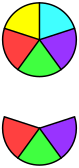
Figure A.1:Paralleling Eq. A.1, we can slice one pie into five equal pieces (left) and keep three of them (lower left); or we can split three pies into equal-area pieces (same color; sometimes split up across different pies) and take one of the resulting pieces. In both cases, the bottom row is the same amount of pie: pies.
for any symbol (placeholder) and get the right answer? In other words, what should the question marks be in the following:
(A.2)
To answer, pick a scenario you already know and back-out the answer. You know that one half of one-half is one quarter. You also know that one half of must be , or that three thirds must be a whole “one.” In math terms: 1 1 3
2 ; 2 ; 1
From these examples—and others that can be fabricated as wished or needed—it is possible to arrive at the conclusion that
(A.4)
In other words, just multiply the numerators together and multiply the denominators together, simplifying by common factors as needed.
One more framing of fractions and their relationship to multiplication and division: dividing by 8 is the same as multiplying by . Multiplying by is the same as dividing by . Multiplication and division are thus essentially the same, only having to flip the number or fraction upside-down into its reciprocal.
How can our intuition assist us in figuring out addition and subtraction of fractions? Use what you know:
1 1 3
2 ; 4
Hopefully, the first two statements in Eq. A.5 are apparent enough. The last one bounds the answer by what you already know. Since is larger than .[17] So adding must be larger than . By similar logic, since one-third is smaller than one-half,[18] their sum must be smaller than 1.
Adding fractions like and is where common denominators come in. We can add numerators only if the fractions share the same denominator. We never add denominators. We can’t replicate the middle example in Eq. A.5 by adding numerators and denominators, or we would get the nonsense answer , rather than .
So how would we ever recreate the whole common denominator scheme based on intuition? Let’s return to the case of . We have already bounded it to be between 0.75 and 1.0 (in Eq. A.5), which is already useful as a check to whatever rule we might try. Looking at the problem graphically, as in Figure A.2, we see that overlaying and naturally creates a missing gap of . How do 2 and 3 in the denominators conspire to form 6? Via multiplication, of course. Re-expressing as and as ,[19] allows us to add the numerators directly, having made the denominators the same: .
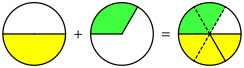
Figure A.2:Graphically, it is easy to see that similar/familiar scenarios to verify (and reinvent) the rules.
To some students, this may seem like an unnecessary and elementary review,[20] but the main point is that when in doubt, use what you already know to test your technique and verify that you are doing things right. If the rules you are trying to apply seem to work for a few different known cases, then you’re probably golden. Approaching math this way makes you the boss of the formulas, rather than the other way around.
A.5 Integer Powers
Raising a number to a power, like 43, is just a mathematical shorthand for 4 . Think of all the room we save in the case of 423!
So what are the rules for dealing with exponents when we raise the whole thing to another power, or when we multiply two exponentiated pieces together, or if we divide by (or invert) the thing? In other words, what are:
The theme of this appendix is: discover the rule through your own experimentation. Tackling in stages, what is ? We can write out 74 as 7 easily enough. If we cube this number, it’s the same as writing this set three times, all multiplied together, or , which is just 12 sevens multiplied, or 712. So we have discovered/formulated the rule:
We multiply the exponents when raising the inner exponent to an outer one.
How about ? What is the rule there? The process[21] is similar to before, expanding out to , which just looks like seven threes multiplied together, or 37. Therefore, our rule is:
We add exponents when multiplying two pieces, each having their own exponent. Note that this does not work when the bases are unequal, as you could verify yourself for .
Finally, what about inversion, or dividing by ? As a preview, a negative power is equivalent to putting the item in the denominator, so that . To see this, consider Eq. A.8 in the case where and are opposite sign but the same magnitude. For instance, following the “add the exponents rule” we get that , because anything raised to the zero power is 1.[22] The only thing we can multiply into 3 in order to get 1 is . This means that 3-4 is the same as , or more generally:
Negative exponents therefore flip the construction to the denominator, or denote a division rather than multiplication.
A.6 Fractional Powers
In the previous section, we only dealt with integer powers, so that we could write out 34 as 3 . How would we possibly write 31.7? Yet it is mathematically well defined. A calculator has no trouble.
We can get a hint from Eq. A.8. Consider, for example, 5. We know that we can just add the exponents, which in this case add to a tidy 1, meaning that the answer is just 5. Therefore we interpret 5 as the square root of 5, since multiplying it by itself yields 5. So we can re-express our familiar friend as a fractional power:
In principle, then, we could approach 31.7 by taking the tenth-root of 3 and raising it to 17th power: . More generally, in Chapter 1, we saw that we can represent any base, , raised to some arbitrary number, , as:
where we use the exponential function and its inverse function (natural log, ln), or alternatively the base-10 equivalents. If, for some reason, we lacked a calculator button, these approaches allow more fundamental ways to get at the same thing.
A.7 Scientific Notation
The single-biggest mistake students make when it comes to scientific notation is easily remedied by understanding it not as a set of rules, but for what it’s actually doing.
Most of the time, students get it right: they see and move the decimal to the right two times to get 160. A little harder is negative exponents, like . Moving the decimal point twice to the left results in the correct 0.024 answer.
The hangup can come about if the process is misconstrued as simply “counting zeros.” Ironically, a student might correctly convert 6 by adding three zeros to the 6 to get 6,000, but then mistake 103 for 10,000—thinking: start with 10 and add three zeros.
The sure-fire way is to connect to the concept of integer powers, so that 103 is simply 10 , which is unmistakably 1,000. Likewise, 10-4 is four repeated (multiplied) instances of 10-1, each one representing , or 0.1. String four together, and we have , or 0.0001. So fall back on the basics.
A.8 Equation Hunting
Students often form a counter-productive dependency on formulas. Experts focus on learning the concept expressed by an equation, since an equation is very much like a sentence that speaks some truth.[24] Once the fundamental principle is mastered, the equation or formula is automatic, and can be generated from a place of understanding—which is more permanent than memorization.
The practice is more common and natural than it might seem at first. Let’s say a person has a take-home pay of $50,000 per year. Rent is $2,000 per month, groceries and other bills come to $1,000 per month. How much is left per month for discretionary spending? Where is the formula for that problem? Of course, you wouldn’t bother hunting for a formula in this case and would instead build your own math. You essentially create your own formula on the fly. Whether you first divide the annual figure by 12 and then subtract the monthly expenses, or multiply monthly expenses by 12 before subtracting from the annual amount and then dividing by 12, the result is the same: a little more than $1,000 per month.
It is also clear in this context that it makes little sense to perform math down to the penny, since the grocery and other expenses are not going to be exactly the same each month. The lesson is that most people are expert enough in managing money that they don’t scramble to find printed formulas whenever they want to figure something out, and they are also forgiving on precision because they know from context not to take it all too literally.
This book tries to foster a more expert-like approach to the material. For instance, Def. 5.3.1 (p. 76) introduces the concept of power without explicitly saying . It just says that power is how much energy is expended in how much time. If a student internalizes that idea, then why print a formula? By doing so, a student may bypass real understanding[25] and rely on the formula as a crutch, never planting the core idea firmly in the brain. Shortcuts can end up disadvantaging students, as attractive as they may look in the moment. The student who masters the concepts will be in a far better position to deploy them in a wider variety of circumstances—including unfamiliar test questions.
A.9 Equation Manipulation
Physics instructors often joke that they teach students the “three Ohm’s Laws.” The joke is that only one is needed: . The other forms: and can be derived from the first. Rigid memorization leads some students to remember all three forms, rather than simply move things around in a way that maintains the relationship.
The rules are easy enough to generate on your own. Think of an equation as a perfectly balanced see-saw—maybe an elephant sitting on both sides. The equation is only valid if it remains balanced. You may add a chicken, but do it to both sides. You may multiply or divide the number of elephants, as long as it is done the same way to both sides. Dividing both sides of (the first) Ohm’s Law above by leads to the second form, for instance.
It’s not always so straightforward. Sometimes we have to “undo” or “invert” a mathematical function. Consider for instance a familiar problem: find the side length, , of a right triangle whose other side is and hypotenuse . We know from the Pythagorean Theorem that , so that . But we want , not . How do we “undo” the square? Take a page from Eq. A.7. We want to the power of 1, so we want to raise to whatever power will neutralize the 2 via multiplication. Looks like (square root) will do the trick. But we need to treat both sides:
In this case, the power can be said to perform the inverse function of the power . In more familiar contexts: subtraction is the inverse of addition; division is the inverse of multiplication. Less familiarly, but in similar veins: the sine is “undone” by arcsine;[27] the exponential is undone by the natural ; is undone by , etc.
If you have not done it before (or recently), mess around on a calculator, starting with a custom number you make up that is pleasing to you and recognizable.[28] Square it and then take the square root. Calculate the sine and then inverse sine (ASIN). Take the exponential and then natural log—or other way around. Get to know these things on your own terms!
A.10 Units Manipulation
In the real world, numbers often are packaged with associated units. The radius of the earth is 6,378 km. If we change the unit, we change the number, too. Earth’s radius becomes 6,378,000 m or 3,963 miles. Most generally, we aim to quantify something in nature, and the numeric value is utterly dependent on the units we choose to represent the physical reality.
Because the numbers are often meaningless without the accompanying units, we should[29] carry around the units in all manipulations. Any time we do something to the number, we need to do the same thing to the unit.
More complicated arrangements follow the same rules. For example, the force of drag[30] on an object moving at speed through a medium of density is , where is the frontal (cross-sectional) area of the object and is the dimensionless drag coefficient.[31] The dimensions of area are ; density is (mass per volume), and velocity is m/s (distance over time). The whole arrangement therefore has dimensions:
The end result matches the definition of Newtons, and can be verified by the (possibly familiar) form of Newton’s Second Law,[32] whereby we have mass in kg times acceleration in making kg .
When performing a chain of multiplications or divisions, we can carry the units around and multiply, divide, or (hopefully) cancel them as we go.
We just carried out unit conversions (in time) in Example A.10.2, when we multiplied by constructs like 60 s/1 min. The key to unit conversions is to arrange a fraction expressing the same physical thing in both the numerator and denominator, just using different units. So we’re looking for equivalent measures. Most of the time, one of them will be 1, numerically, as in the following example.
Finally, units can help guide correct usage of factors in a problem. In Example A.10.3, what if we did not know whether to divide or multiply by 1,055? The fact that we wanted to eliminate Joules told us we needed the Joules in the denominator, and so the relation 1 Btu = 1,055 J told us the 1,055 travels with Joules and must be in the denominator.
But what if we are faced with a problem whose application is not as apparent?[35] Let’s explore how this might go in a less familiar setting.
We will do one more example in an unfamiliar context, this time involving some ambiguity that your wits can help resolve.
A.11 Just the Start
It is well beyond the scope of this book to engage in an exhaustive review of math concepts. Hopefully what has been covered provides a useful foundation. The key lesson is that the knowledge and intuition students already hold in their heads can be leveraged effectively to recreate forgotten rules of math. Just remember: it all makes sense and hangs together. Creating customized simple problems[39] allows a way to make sure the math rules being applied replicate the right answer. If not, a few tests can often get things back on the right track. By doing so, students can claim greater personal ownership of the math, and have a better internal mastery of its workings.
Now that’s a quality friend!
Also notice that the circle fits within a square 2 meters on a side, so the area should be less than 4 : it hangs together.
Really .
Really it’s about 3.333.
Money examples often seem easier to mentally grasp because we deal with money all the time. To the extent that money examples are easier, it says that the math itself isn’t hard: the unfamiliar context is often what trips students up.
This is where “blurry” numbers are useful: 8 if you squint.
… teachers, too!
Except, perhaps we would learn that we inexplicably share the word “sock.”
… acknowledging that this exercise may be less intuitively obvious to non-native English speakers
The number of combinations is 4! (fourfactorial), or . It is a worthy exercise to write out all 24 combinations, not only to verify the result but to give practice in how to systematically shuffle the words in an orderly manner—inventing your own functional rules as you go. You might even stumble on why 4 is the right way to count the combinations based on your method of systematizing.
… literally cutting corners
This path would look like a line across the square, traversed twice as a there-and-back trip.
… or length, if on its side
… as expressed in the first paragraph
… all correct, and depends on context of the problem at hand
We can apply our lesson on reciprocals (see Example A.1.2) and realize that multiplying 24 by 5 is a lot like dividing it by 2, up to a decimal place. This gives us something 12–like and thus 120.
Splitting a pie into three parts will surely leave larger pieces than splitting it into more (4) parts, so ( ).
If such statements are less than intuitive, think about pie or money, where the natural context lends itself to better intuition.
… by multiplying top and bottom by the missing factor—or the “other” denominator value
… which is why it is relegated to an appendix
Note that some care must be exercised in selecting the example. For instance, picking both exponents as 2 would leave some ambiguity: is the result of 4 2 , or 22?
Think of the exponent as how many instances of a number are multiplied together in a chain, implicitly all multiplied by 1. If we have zero instances of the number, then the implicit 1 is all we have left in the multiplication. In other words, 1 is the starting point for all multiplications, just like zero is the starting point for all additions.
The frolicking dolphin tries several and revels in the reinforcement that comes from consistency.
… perhaps within some context or set of assumptions
… which in this case is not a heavy lift
It is easy to substitute numbers anywhere you wish at any time
… and the other way around, for all these examples
Something like 1.23456 would work, but make it your own!
Full disclosure: I don’t always do so, in haste. But I know they belong there and will throw them back in if I get tangled or end up suspecting a nonsense result.
This choice is intentionally unfamiliar and complicated–looking to demonstrate that units can help bring a sense of order and correctness even in alien contexts.
The drag coefficient, , is usually in the range 0.3–1.
Force equals mass times acceleration
E.g., 24 hours and 1 day describe the same time interval.
So units, handled carefully, can provide important clues as to how to get the problem right.
… or we don’t know the formula, which is no bad thing, as we then have the chance to construct it from what we know, like a real expert!
This construction means that kg and are both in the denominator together.
The units would be energy per time, or J/s, which is a power (W).
This construction means that m and are both in the denominator together.
… whose answers are already known or can be figured out