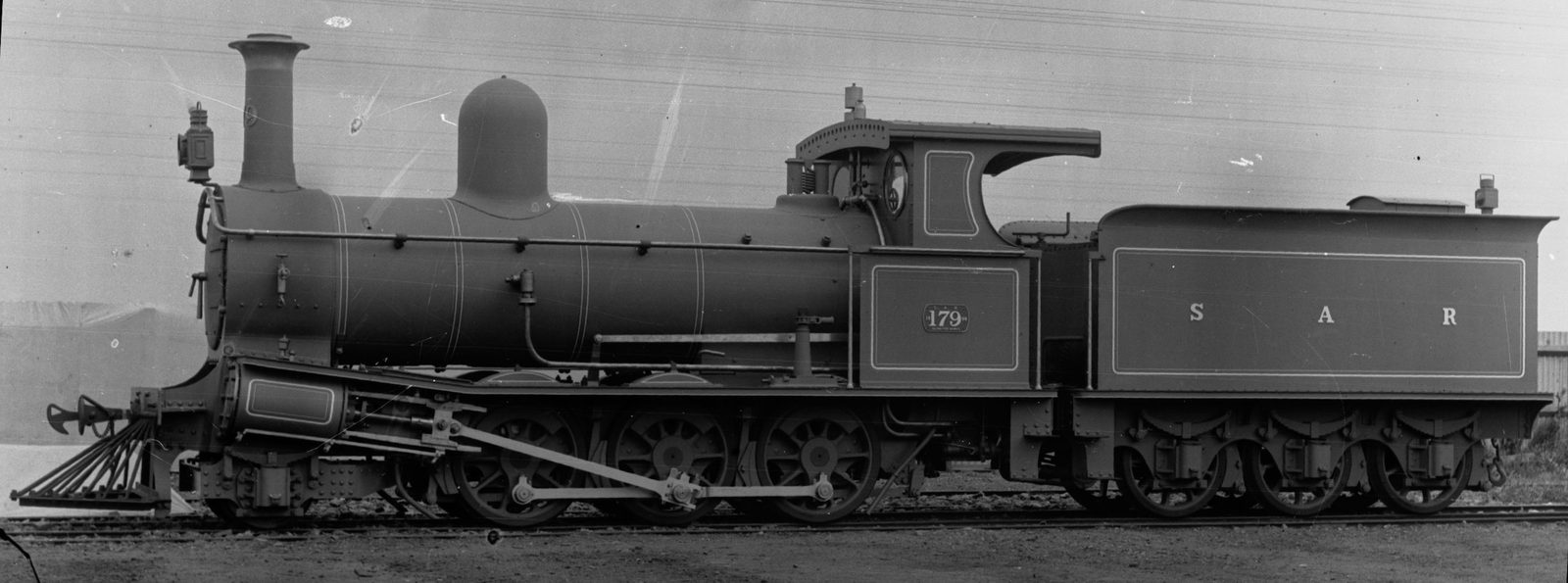
A locomotive engine as an example heat engine. Photo credit: South Australian Government Photographer.
6. Putting Thermal Energy to Work
We have already encountered thermal energy in two contexts. The first was infrared radiation (Eq. 1.8; p. 11), and the second was in the definition of the kilocalorie (Sec. 5.5; p. 78). Otherwise, heat has often been treated as a form of “waste” in a chain of energy conversion: friction, air resistance, etc. The insinuation was that heat is an unwanted byproduct of no value.
Yet 94% of the energy we use today is thermal in nature [34]: we burn a lot of stuff for energy![1] Sometimes heat is what we’re after, but how can we use it to fly airplanes, propel cars, and light up our screens? This chapter aims to clarify how heat is used, and explore limits to the efficiency at which heat can perform non-thermal work.
Like the previous chapter, this topic represents a slight detour from the book’s overall trajectory, which otherwise aims to build a steady narrative of what we can’t expect to continue doing, what options we might use to change course, and finally how to bring about such change. Nonetheless, the way we utilize thermal energy is a key piece of the story, and relates to both current and future pathways to satisfying our energy demands.
6.1 Generating Heat
Before diving in to thermal issues, let’s do a quick run-down of the various ways we can generate heat.
Table 6.1:Specific heat capacities of common materials.
| Substance | |
|---|---|
| steel | 490 |
| rock, concrete | 750–950 |
| glass | 840 |
| aluminum | 870 |
| air | 1,005 |
| plastic | 1,100–1,700 |
| wood | 1,300–2,000 |
| alcohol | 2,400 |
| flesh | 3,500 |
| water | 4,184 |
6.2 Heat Capacity
First, we’ll connect a basic thermal concept to something we already covered in Sec. 5.5 (p. 78) in the context of the calorie. The statement that it takes 1 kcal to heat 1 kilogram of HO by is in effect defining the specific heat capacity of water. In SI units, we would say that HO has a specific heat capacity of 4,184 .[2] Very few substances top water’s specific heat capacity. Most liquids, like alcohols, tend to be in the range of 2,000 . Most non-metallic solids (and even air) come in around 1,000 . Metals are in the 130–900 range—lighter metals at the top, and heavier ones at the lower end.[3] Table 6.1 provides a sample of specific heat capacities for common substances.
Knowing the specific heat capacity of a substance allows us to compute how much energy it will take to raise its temperature. A useful and approximate guideline is to treat water as 4,000 and all other stuff (air, furniture, walls) as 1,000 . Mixtures, like food, might be somewhere between, at 2,000–3,500, due to high water content. If in doubt, 1,000 is never going to be too far off. For estimation purposes, deviate from this only for high water-content[4] or for metals.[5]
To perform computations using specific heat capacity, try an intuitive approach rather than some algorithmic formula.[7] The following should just make a lot of sense to you, and can guide how to put the pieces together: it takes more energy to heat a larger mass or to raise the temperature by a larger amount. It’s all proportional. The units also offer a hint. To go from specific heat capacity in to energy in J, we need to multiply by a mass and by a temperature change.
6.3 Home Heating/Cooling
Our personal experience with thermal energy is usually most connected to heating a living space and heating water or food. Indeed, about two-thirds of the energy used in residential and commercial spaces[9] relate to thermal tasks, like heating or cooling the spaces, heating water, refrigeration, drying clothes, and cooking.
When it comes to heating (or cooling) a home, we might care about two things:
how long will it take to change its temperature by some certain amount; and
how much energy it will take to keep it at the desired temperature.
The first depends on how much stuff is in the house,[10] how much you want to impart, and how much power is available to create[11] the heat. The energy required is mass times times the catch-all 1,000 specific heat capacity. The time it takes is then the energy divided by the available power.
How much it takes to maintain temperature depends on how heat flows out of (or into) the house through the windows, walls, ceiling, floor, and air gaps. But it also depends linearly on —the difference between inside and outside temperatures—that is being maintained. A house can be characterized by its heat loss rate in units of Watts per degree Celsius.[13] This single number then indicates how much power is needed to maintain a certain between inside and outside. Box 6.1 explores an example of how to compute the heat loss rate for a house, and Example 6.3.2 applies the result to practical situations.
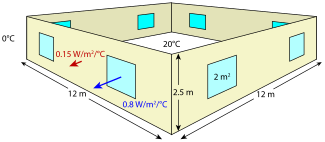
Figure 6.1:External walls and windows for the house modeled in Box 6.1. The floor and ceiling are not shown. The numbers in are U-values, and in this case represent the very best engineering practices. Most houses will have larger values by factors as high as 2–6. Don’t forget the door in a real house!
Once we understand how much power it takes to maintain a certain temperature in a house, we can anticipate the behavior of the house’s heater. Heaters are typically either on full-blast or off. Regulation is achieved by turning the heat on and off—usually controlled by a thermostat. Given the rating of a heater,[17] it is then straightforward to anticipate the duty cycle: the percentage of time it has to be on to produce an average output meeting the power requirement for some particular .
In a sensible world, heaters are characterized by W (or kW). In the U.S., the measure for many appliances is Btu/hr. Since 1 Btu is 1,055 J and one hour is 3,600 s, one Btu/hr equates to 0.293 W.[18] A whole house heater—sometimes in the form of a furnace—might be rated at 30,000 Btu/hr (about 10 kW), in which case the three outcomes in Example 6.3.2 would require the heater to be on about 15%, 30%, or 60% of the time[19] to maintain in the three houses.
It is also possible to assess how much the foregoing heater could maintain in the three houses. It should stand to reason that a house requiring 100 and having a 10,000 W heater can support a as high as .[20] Thus, the three houses from Example 6.3.2 could support values of , and if equipped with a 10 kW Btu/hr) heater. The snug house does not need such a powerful heater installed. The poorly built house can maintain a differential at full-blast, which means that if the temperature drops below F) outside, it will not be able to keep the inside as high as . So a house in a cold climate should either be built to better thermal standards, or will require a bigger heater—costing more to heat the home.[21]
Cooling a home (or refrigerator interior, or whatever) is also a thermal process, but in this case involves removing thermal energy from the cooler environment. Removing heat is harder to do, as witnessed by the length of human history that has utilized heating sources—starting with fire—compared to the relatively short amount of time when we have been able to produce cooling on demand.[22] Section 6.5 will get into how this is even possible, in principle. For now, just be aware that the rating on air conditioners uses the same units as heaters: how much thermal energy can be moved (out of the cooler environment) per unit time. In SI units, we know this as the Watt. In the U.S., it’s Btu/hr.
6.4 Heat Engines
Now we get to the part where thermal energy can be used to do something other than just provide direct heat to a home. It may seem odd to always characterize burning fuel as a purely thermal action, since what transpires within the cylinder of a gasoline-burning internal combustion engine seems like more of a little explosion than just the generation of heat. This is not wrong, but neither is it the whole story. The process still begins as a fundamentally thermal event. When the fuel-air mixture ignites, the temperature in the cylinder increases dramatically. To appreciate what happens as an immediate consequence, we turn to the ideal gas law:
and are pressure, volume, and temperature (in , and Kelvin). is the number of atoms or molecules, and is the Boltzmann constant, which we will see again in Sec. 13.2 (p. 209). The temperature rise upon ignition is fast enough that the cylinder volume does not have time to change.[23] Eq. 6.1 then tells us that the pressure must also spike when temperature does, all else being held constant. The increase in pressure then pushes the piston away, increasing the cylinder volume and performing work.[24] But it all starts thermally, via a sharp increase in temperature.
In the most general terms, thermal energy tries to flow from hot to cold—out of a pot of hot soup; or into a cold drink from the surrounding air; or into your feet from hot sand. Some part of this flow can manifest as physical work, at which point the system can be said to be acting as a heat engine.
Table 6.2:Schemes for electricity generation. Most are thermal in nature, and nearly all employ a turbine and generator. Data for 2018 from Table 8.2a of [34].
| Source | % elec. therm. turb./ in U.S. gen. |
|---|---|
| Nat. Gas | 35.3 ✓ ✓ |
| Coal | 27.3 ✓ ✓ |
| Nuclear | 19.2 ✓ ✓ |
| Hydroelec. | 7.0 ✓ |
| Wind | 6.6 ✓ |
| Solar PV | 2.2 |
| Biomass | 1.5 ✓ ✓ |
| Oil | 0.6 ✓ ✓ |
| Geotherm. | 0.4 ✓ ✓ |
| Sol. Therm. | 0.09 ✓ ✓ |
The last example deserves its own graphic, as important as this process is in our lives: almost all of our electricity generation—from all the fossil fuels and even from nuclear fission—follows this arrangement. Figure 6.2 illustrates the basic scheme. Table 6.2 indicates that 98% of our electricity involves turning a turbine on a shaft connected to a generator, and 84% involves a thermal process as the motive agent for the turbine—most often in the form of steam.
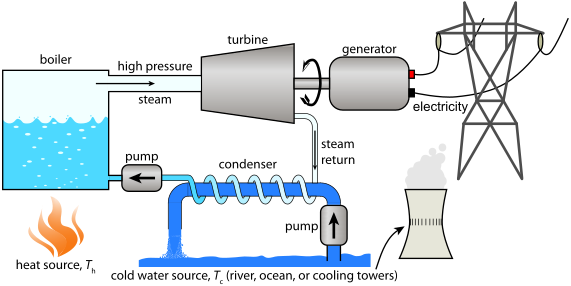
Figure 6.2:Generic power plant scheme, in which some source of heat at generates steam that flows toward the condenser—where the steam cools and reverts to liquid water, by virtue of thermal contact to a cool source at provided by a body of water or evaporative cooling towers. Along the way, the rushing steam turns a turbine connected to a generator, exporting electricity. This basic arrangement is employed for most power plants using fossil fuels, nuclear, solar thermal, or geothermal sources of heat.
6.4.1 Entropy and Efficiency Limits
A deep and powerful piece of physics intervenes to limit how much useful work may be extracted out of a flow of heat from a hot source at temperature to a cold source at temperature . That piece is entropy. You don’t need to fully grasp the deep and subtle concept of entropy in order to follow the development in this chapter and understand the role entropy plays in limiting heat engine efficiency. All the same, it is a stimulating topic that we’ll dip a toe into for some appreciation.
This definition may be an obscure disappointment to those expecting entropy to be defined as a measure of disorder.[26] Consider a gas maintained at constant pressure, volume, and temperature—thus fixing the total energy in the gas. The atoms/molecules comprising the gas can arrange into a staggeringly large number of configurations: any number of positions, velocities, rotational speeds and axis orientations, or vibrational states of each molecule, for instance—all while keeping the same overall energy.
4:0 (1)
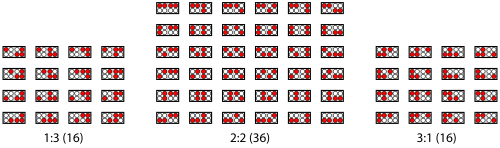
Figure 6.3:A box containing 4 atoms or molecules of one type (white) and 4 of another type (red) has many more configurations available (number in parentheses) when species are equally distributed so that left and right sides both have two of each. Entropy is related to the number of ways a system can distribute itself (at the same energy level), acting to favor disordered mixing over (improbable) orderly
The First Law of Thermodynamics is one we already encountered as conservation of energy:
Now we are ready for the Second Law.
It is entropy that governs which way heat flows (hot to cold, if left alone) and in a deep sense defines the “arrow of time.”
These two laws of thermodynamics, plus a way to quantify entropy changes that we will see shortly, are all we need to figure out the maximum efficiency a heat engine can achieve in delivering work. If we draw an amount of heat, from a hot bath[30] at temperature , and allow part of this energy to be “exported” as useful work, , then we must have the remainder flow as heat into the cold bath at temperature . Figure 6.4 offers a schematic of the process. The First Law of Thermodynamics[31] requires that , or that all of the extracted heat from the hot bath is represented in the external work and flow to the cold bath: nothing is lost.
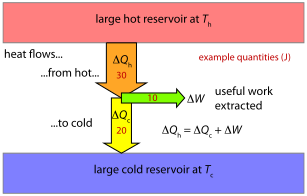
Figure 6.4:Heat engine energy balance. Heat flowing from the hot bath to the cold bath can perform useful work, , in the process—subject to conservation of energy , where is a heat flow. Entropy constraints limit how large can be. Arrow widths are proportional to energy, and red numbers are example energy amounts, for use in the text.
So where does entropy come in? Extracting heat from the hot bath in the amount results in an entropy change in the hot bath according to Definition 6.4.5.
Table 6.3:Thermodynamic symbols.
| Symbol | Describes (units) |
|---|---|
| temperature (K) | |
| temp. change (K, | |
| thermal energy (J) | |
| mechanical work (J) | |
| entropy change (J/K) | |
| efficiency | |
| entropy ratio |
So the extraction of energy from the hot bath results in a decrease of entropy in the hot bath of according to . Meanwhile, of entropy is added to the cold bath according to . The Second Law of Thermodynamics enforces that the total change in entropy may not be negative (it can’t decrease). In equation form (symbol definitions in Table 6.3):[32]
where we have subtracted since it was a deduction of entropy, while is an addition. We therefore require that
Now we are in a position to ask what fraction of can be diverted to useful work within the constraints of the Second Law. We express this as an efficiency,[33] denoted by the Greek epsilon:
The second step applies conservation of energy: .
We can add a step to Eq. 6.5 to express it in terms of entropy changes:
where we have re-expressed each as an equivalent withdrawal/deposit of entropy. Now we can divide both numerator and denominator by to be left with
where we create (eta) to represent the ratio of entropies: , which we know from Eq. 6.4 cannot be smaller than one:[34]
Looking at Eq. 6.7, if we want the highest possible efficiency in extracting work from a flow of heat, we want the numerator to be as large as possible. To achieve this, we want to subtract as little as possible from . If were allowed to be very large, then the numerator would be reduced. So we want the smallest possible value for , which we know from Eq. 6.8 happens when . We therefore derive the maximum physically allowable efficiency of a heat engine as
where we have designated as the temperature difference between hot and cold baths. A major takeaway is that efficiency improves as gets bigger, and becomes vanishingly small for small values of .
If the cold bath is fixed,[36] the maximum possible efficiency improves as the temperature of the hot source goes up. Conversely, for a given , the efficiency improves as the cold temperature decreases and thus increases.
Real heat engines like power plants (Figure 6.2) or automobile engines tend to only get about halfway to the theoretical efficiency due to myriad practical challenges. A typical efficiency for an electrical power plant is 30–40%, while cars are typically in the 15–25% range. In contrast, combustion temperatures around 700– suggest a maximum theoretical efficiency around 60%.
6.5 Heat Pumps
We can flip a heat engine around and call it a heat pump. In this case, we apply some external work to drive a heat flow opposite its natural direction—like pushing heat uphill. This is how a refrigerator[38] works, for instance. Figure 6.5 sets the stage.
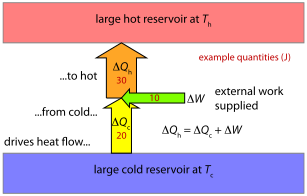
Figure 6.5:Heat pump energy balance. The application of work ; from an electrical source, for instance) can drive heat to flow— counterintuitively—from a cold reservoir (like the interior of a freezer) to a hotter environment. Example pairs might include freezer-interior room-air; cooledinside summer-outside; winter-outside warmed-inside. We still must satisfy conservation of energy , where is a heat flow. Entropy constraints limit how large can be for a given input. Arrow widths are proportional to energy, and red numbers are example energy amounts, for use in the text.
A very similar chain of logic can be applied to this configuration, invoking the Second Law to guarantee no entropy decrease. We define the efficiency according to the application and what we care about, giving rise to two different figures of merit.
The derivation goes similarly to the one above, but now we require that the entropy added to the hot bath must not be smaller than the entropy removed from the cold bath so that the total change in entropy is not negative.[41] In this case, the maximum allowed efficiencies for cooling and heating via heat pumps are:
and
These look a lot like Eq. 6.9, but turned upside down. The maximum efficiencies can be larger than unity![42]
In the case of heating, it is worth comparing the output of a heat pump to the application of direct heat. Let’s revisit the scenarios explored in Section 6.3.
Engineering realities will prevent operating right up to the thermodynamic limit, but we might at least expect to be able to accomplish the 6,000 W goal of Example 6.5.3 for under 2,000 W. Thus the heat pump has shaved a factor of three (or more) off the energy required to provide heat inside. Heat pumps are very special.
As Eq. 6.10 and Eq. 6.11 imply, heat pumps are most efficient when is small. Thus a refrigerator in a hot garage must not only work harder to maintain a large , it does so less efficiently—making it a double-whammy. For home heating, heat pumps offer the most gain in milder climates where is not so brutal.
6.5.1 Consumer Metrics: COP, EER, HSPF
When shopping for heat pumps or air conditioners (or freezers/refrigerators), products are specified by the coefficient of performance (COP) or energy efficiency ratio (EER) or heating seasonal performance factor (HSPF), as in Figure 6.6. How do these relate to our and values? The first one is easy.
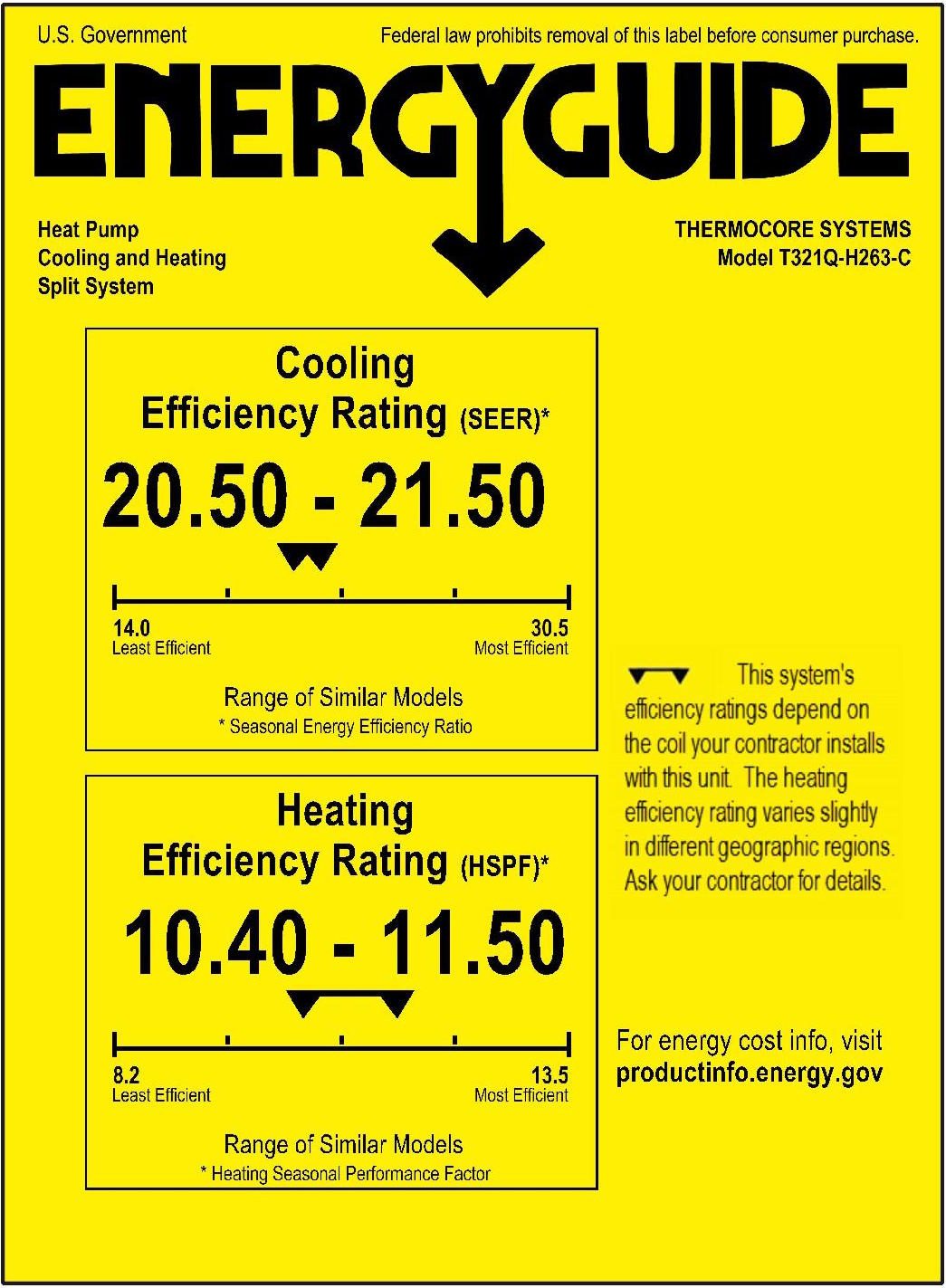
Figure 6.6:Typical heat pump energy label in the U.S., showing an EER around 21 and a HSPF around 11. From U.S. DoE.
The EER is different, and perhaps a little odd. EER is defined as the amount of heat moved , in Btu, per work input , in watt-hours (Wh). What?! Sometimes the world is just loopy. But we can manage this. If handed an EER (Btu/Wh), we can convert it to our same/same numerator/denominator units by converting both numerator and denominator to the same units. We could convert Btu to Wh in the numerator and be done, or convert Wh to Btu in the denominator and be done, or we could convert both numerator and denominator to Joules[50] to get there. For illustrative purposes, we’ll pick the last approach. To get from Btu to Joules, we multiply (the numerator) by 1,055. To get from Wh to Joules, we multiply the denominator (or divide the EER construct) by 3,600.[51] The net effect is highlighted in the following definition.
Because the theoretical maximum efficiency depends on —according to Eq. 6.10 and Eq. 6.11—and therefore can fluctuate as outdoor temperatures change, a seasonal average is often employed, called the SEER (seasonal EER). In a similar vein, the HSPF measures the same thing as the COP, but in units of EER[52] and averaged over the heating season.
Typical COP values for heat pumps range from about 2.5–4.5.[53] This means an energy savings by a factor of 2.5 to 4.5 for heating a house via heat pump vs. direct electrical heating. Quite a bargain. An air conditioner EER rating is typically in the range 10–20, corresponding to 3–6 in terms of —similar to the range for heat pumps in heating
mode.[54] Houses equipped with electric heat pumps can typically be run for both cooling and heating applications, making them a versatile and efficient solution for moving thermal energy in or out of a house.
Heat pumps leveraging the moderate-temperature ground just below the surface as the external thermal bath are called “geothermal” heat pumps, but have nothing to do with geothermal energy (as a source). Compared to heat pumps accessing more extreme outside air temperatures, geothermal heat pumps benefit from a smaller , and thus operate at higher efficiency.
6.6 Upshot on Thermal Energy
Sometimes we just want heat. Cooking, home heating, and materials processing all need direct heat. Burning fossil fuels, firewood, biofuels, extracting geothermal energy, or simply letting the sun warm our houses all directly utilize thermal energy. Specific heat capacity tells us how much thermal energy is needed to change something’s temperature, using 1,000 as a rough guess if lacking more specific information.[55] We also saw how to estimate home heating demand using a metric of heat loss rate, such as 200 .
But it turns out that we use heat for much more than this. 84% of our electricity is produced by heat engines, using heat flow to drive a turbine to turn a generator. The maximum efficiency a heat engine can achieve is set by limits on entropy and amounts to , although in practice we tend to be a factor of two or more short of the thermodynamic limit.[56] In any case, thermal energy plays a giant role in how we run our society.
Heat pumps are like heat engines in reverse: driving a flow of thermal energy against the natural hot-to-cold direction by putting in work. Any refrigeration or cooling system is likely to use this approach.[57] Because heat pumps only need to move thermal energy, each Joule they move can require a small fraction of a Joule to accomplish, making them extremely clever and efficient devices.
6.7 Problems
How many Joules does it take to heat your body up by if your (water-dominated) mass has a specific heat capacity of 3,500 ?
How long will it take a space heater to heat the air[58] in an empty room by if the room has a floor area of 10 and a height of 2.5 m and the space heater is rated at 1,500 W? Air has a density[59]
of 1.25 . Express your answer as an approximate number in minutes.
When you put clothes on in the morning in a cool house at , you warm them up to something intermediate between your skin temperature and the ambient environment.[60] If your clothes have a mass of 2 kg, how much energy must be deposited into the clothes? If you are emitting power at 100 W, how long will this take?
You score this massive 1 kg burrito but decide to put it in the refrigerator to eat later. It comes out at , and you want to heat it in the microwave up to before eating it. If the microwave puts energy into the burrito at a rate of 700 W.[61] How long should you run the microwave for a high-water-content burrito having an effective specific heat capacity of 3,000 ?
Let’s say you come home from a winter vacation to find your house at and you want to heat it to . Let’s say the house contains: 500 kg of air;[62] 1,000 kg of furniture, books, and other possessions; plus walls and ceiling and floor that amount to 6,000 kg of effective[63] mass. Using the catch-all specific heat capacity for all of this stuff, how much energy will it take, and how long to heat it up at a rate of 10 kW? Express in useful, intuitive units, and feel free to round, since it’s an estimate, anyway.
In a house achieving a heat loss rate of 200 equipped only with two 1,500 W space heaters, what is the coldest it can get outside if the house is to maintain an internal temperature of ?
In a house achieving a heat loss rate of 200 equipped a 5,000 W heater, what will the internal temperature be if the outside temperature is and the heater is running 100% of the time?
In a super-tight house achieving 100 equipped with a 5,000 W heater, what percentage of the time will the heater need to run in order to keep the internal temperature at if the temperature outside is at the freezing point?[64]
How much will it cost per day to keep a house at inside when the external temperature is steady at using direct electric heating[65] if the house is rated at 150 and electricity costs $0.15/kWh?
Provide at least one example not listed in the text in which heat flows into some other form of energy.[66] In the text, we mentioned hot air over a car, wind, internal combustion, and a steam turbine plant.
What is the only form of significant electricity production in the U.S. that does not involve a spinning shaft?
If a can of soda (350 mL; treat as water) cools from to , how much energy is extracted, and how much is the entropy (in J/K) in the can reduced using the average temperature and the
What would the maximum thermodynamic efficiency be of some heat engine operating between your skin temperature and the ambient environment cooler than your skin?
We can think of wind in the atmosphere as a giant heat engine[67] operating between the 288 K surface and the top of the troposphere[68] at 230 K. What is the maximum efficiency this heat engine could achieve in converting solar heating into airflow?
Since the sun drives energy processes on Earth, we could explore the maximum possible thermodynamic efficiency of a process operating between the surface temperature of the sun (5,800 K) and Earth’s surface temperature (288 K). What is this maximum efficiency?[69]
A heat engine pulls 100 J out of a hot bath at 800 K, and transfers 80 J of heat into the cold bath at 300 K. What efficiency does this heat engine achieve in producing useful work, and how does it compare to the theoretical maximum?
Human efficiency[70] is in the neighborhood of 25%, meaning that in order to do 100 J of external work, we need to eat 400 J of energy content. To investigate whether human energy is working as a heat engine, figure out what the cold temperature, , would have to be to achieve this efficiency, thermodynamically.[71] Do you conclude that our biochemistry operates as a heat engine, or no?[72]
A 350 mL can of soda[73] at is placed into a refrigerator having an EER rating of 10.0. How much energy will you have to spend to remove the thermal energy from the soda and bring it to a frosty ?
If a refrigerator works at half of its theoretical limit, how much more energy does it take to maintain an internal temperature of in a garage vs. a house interior? Two things are going on here: even at the same efficiency, the cooling energy scales as , but the efficiency also changes for a double-whammy.
Changing from direct electrical heating to a heat pump operating with a COP of 3 means spending one-third the energy for a certain thermal benefit. If a house averages 30 kWh/day in heating cost through the year using direct electrical heating at a cost of $0.15/kWh, how long will it take to recuperate a $5,000 installation cost of a new heat pump?
The exceptions are wind, hydroelectricity, and solar.
For temperature changes, it is always possible to interchange per-degrees-Celsius and per-Kelvin because the two are only different by a constant offset, so that any change in temperature is the same measure in both.
The pattern here is that substances like water or alcohols containing light atoms like hydrogen have higher heat capacities than substances like metals containing heavier atoms.
… go as high as 4,000 in this case
… 500 for heavier metals like steel; although light metals like aluminum are not far from 1,000
Notice that the water demands far more energy to heat, even though it is half the mass.
Although, this would be a good opportunity for a student to make up their own formula, driving home the concept and the fact that equations simply capture a concept. Also, the choice of symbols is arbitrary, which the experience would reinforce.
… assuming 1,000
… in the form of natural gas, electricity, and fuel oil
… including walls, furniture, air
… or to remove, if cooling
Only 300 kg is in the form of air: most of the mass to be heated is in the walls, floor, and ceiling.
… or equivalently, Watts per degree Kelvin
… outer walls, ceiling-tounconditioned attic, floor-to-crawl-space
… not “thermally woke"
The rating is effectively the power delivered when operating at full capacity.
1,055 J in 3,600 s is 0.293 J/s.
These are duty cycles.
First, this is a ridiculously high number! Second, rather than rely on an equation, or memory about whether the 100 and 10,000 W should be divided or multiplied, try to internalize the meaning of each, or at least use the units as a guide. Then, the appropriate math manipulation becomes more obvious.
Other possible options are to tolerate a lower internal temperature or move some-place warmer.
In fact, we’ve had the word “warmth” for a long time, but have not even gotten around to inventing the word “coolth” yet.
The moving piston allows the volume to change, but on slower timescales.
Work is measured as pressure times the change in volume. Pressure is force per unit area, so the units work out to force times distance, as they should given the definition of work.
E.g., at constant temperature, pressure, volume.
Entropy is indeed related to disorder, in that there are many more ways to configure matches in a mess than there are ways to neatly stack them.
It is far beyond the scope of this book to detail the counting scheme, but it is perhaps important to appreciate that energy levels are discrete—or quantized—which prevents an infinite number of possible energy combinations.
It is, however, possible to see lowered entropy in one place if balanced by an increase elsewhere: life organizes matter, but at the expense of increased entropy in the wider universe.
… provided that the system boundary is drawn large enough that no energy escapes
By “bath,” we mean a large reservoir at a constant temperature that is large enough not to appreciably change its temperature upon extraction of some amount of thermal energy, .
… conservation of energy
Remember: treat equations as sentences expressing important concepts in precise ways—not merely as algorithmic machines to memorize for plugging in while solving problems. What does it say?
This definition of efficiency captures what we care about: what fraction of the extracted heat can be turned into useful work.
If , then we know that .
300 K is a convenient and reasonable temperature for “normal” environments, corresponding to or F.
This is a common situation, as is usually set by the ambient temperature of the air or of a body of water.
… or a freezer, or air conditioner
… freezer, refrigerator, air conditioner
… home heating via heat pump
Note that in either K or .
Note that in either K or .
Following the example numbers in Figure 6.5, we would say that , defined as , is 2.0, and is 3.0.
150 times .
… e.g., four space heaters each expend-ing 1,500 W
We are solving for , and consider the energy moved in one second in order to go from W to J.
This corresponds to maintaining the hotter environment at , for instance in the context of heating a house.
… or any other energy unit of choice
1 watt-hour (Wh) is 1 J/s times 3,600 s.
… Btu/Wh
… mapping to HSPF from –15
EER and HSPF numbers are “inflated” by a factor of compared to COP due to the unfortunate choice of units for EER and HSPF.
Or we frequently use water’s value at 4,184 , connected to the definition of a kcal.
Typical efficiencies are 20% for cars and 35% for power plants—compared to 60% theoretical.
A notable exception is evaporative cooling.
We only consider the air for this problem, and ignore other objects—including walls and furniture—that would add substantially to the time required in real life.
Use density to get at the mass of air.
The inside surface of the clothing will be near skin temperature, and the outside will be near ambient temperature.
ⓘ Note that a microwave oven might be rated for 1,500 W, but not all the energy ends up in the burrito, so we pick 700 W to be realistic.
… appropriate for a 150 footprint
ⓘ We only count half-thickness of exterior walls since they are not heated to the interior temperature all the way to the outside.
Hint: compute the average power that would be needed in this case.
… no heat pump: just straight energy deposition at 100% efficiency
Think about motion deriving from or caused by heat or thermal release.
And it really is!
ⓘ Atmospheric wind and weather are confined to the lowest layer of the atmosphere, called the troposphere, extending to about 12 km high.
We would not expect any solar-derived process to exceed this limit in the Earth environment.
… in terms of converting food energy into useful work
ⓘ The hot temperature, , would be internal body temperature of .
Hint: do our bodies have regular access to temperatures this cold?
Treat as water, and recall that the density of water is one gram per milliliter.