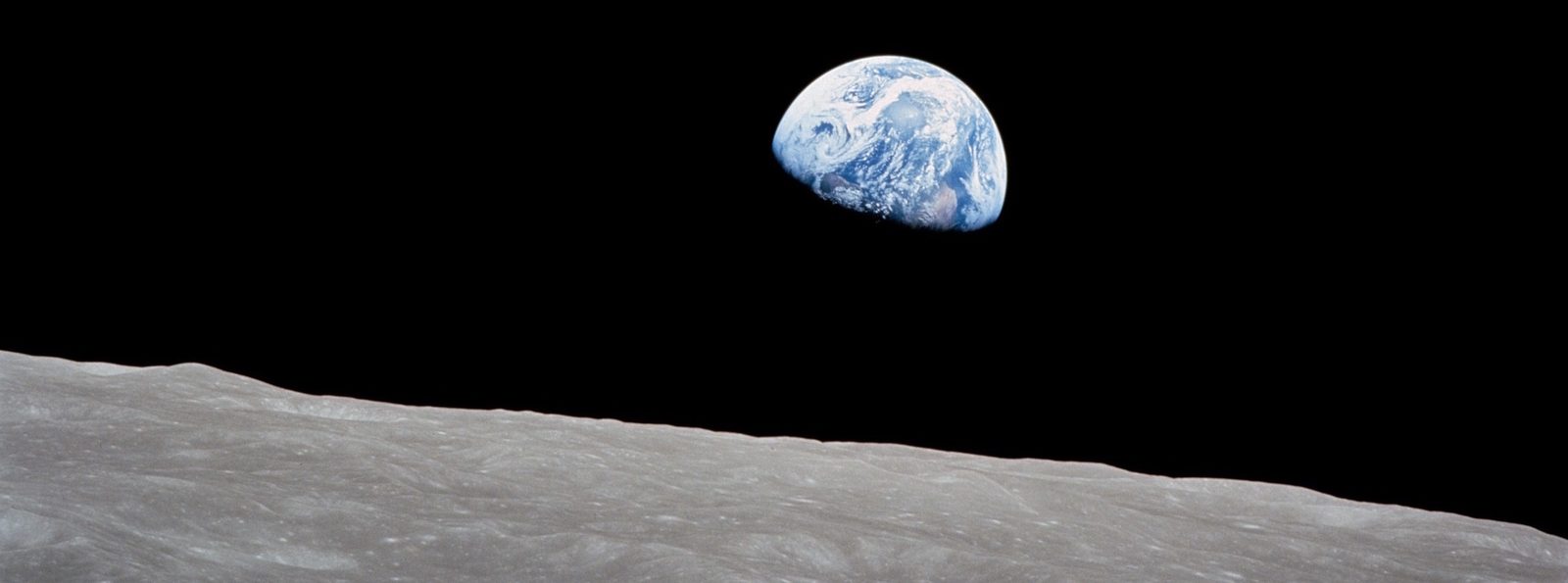
Photo credit: NASA/Bill Anders from Apollo 8 [22].
4. Space Colonization
This textbook assesses the challenges and limitations imposed upon us by living on a finite planet having finite resources. If harboring expectations that we will break out into a space-faring existence as a way to mitigate our earthly challenges, then it becomes harder for us to respond earnestly to information about where things are headed on Earth. This chapter is placed where it is to “close the exit” so that the content in the rest of the book might become more relevant and worth the investment to learn. Some of the sections in this chapter offer more of an author’s perspective than might be typical for a textbook. Some may disagree with the case that is made, but consider that the burden of proof for a way of life unfathomably beyond our current means should perhaps fall to the enthusiasts.[1]
4.1 Scale of Space
In the span of two hours, we can sit through a movie and “participate” in interstellar travel without getting tired. Let’s step out of the entertainment (fiction) industry and come to terms with the physical scale of the real space environment.
Describing an analogous scale model of the solar system, galaxy, and universe—as we will do momentarily—is a fraught exercise, because in order to arrive at physical scales for which we have solid intuition (driving distance in a day?) we end up with inconceivably small (invisible) specks representing familiar objects like the earth. By the time we make Earth the size of something we can hold and admire, the scales become too big for easy comprehension. Figures 4.1 and 4.2 demonstrate how awkward or impossible correctly-scaled graphics are in a textbook.

Figure 4.1:Earth and Moon (far right) to scale. On this scale, the sun would be larger than the page and about 400 pages away. Mars would be 160 to 1,100 pages away. Since 1972, humans have not traveled beyond the black outline of the earth in this figure (600 km).

Figure 4.2:Proving the point that textbooks are not conducive to correctly-scaled graphics of objects in space, by the time the Earth-Sun distance spans the page, Earth (on far right) is too small to be visible in print, at less than 1% the diameter of the orange sun at far left. The Earth–Moon distance is about the width of the arrow shaft pointing to Earth. Humans have never traveled more than the arrow shaft’s width from Earth, and have not even gone 0.2% that far in about 50 years! Mars, on average, is farther from Earth than is the sun.
Let us first lay out some basic ratios that can help build suitable mental models at whatever scale we choose.
Table 4.1:Progression of scale factors.
| Step | Factor |
|---|---|
| Earth diameter | (start) |
| Moon distance | |
| Sun distance | |
| Neptune distance | |
| Nearest Star | |
| Milky Way Center | |
| Andromeda Galaxy | |
| Universe Edge |
We will construct a model using the set of scale relations in Definition 4.1.1, starting local on a comfortable scale.
We’ll make Earth the size of a grain of sand (about 1 mm diameter). The moon is a smaller speck (dust?) and the diameter of its orbit would span the separation of your eyes. On this scale, the sun is 100 mm in diameter (a grapefruit) and about 12 meters away (40 feet). Mars could be anywhere from 4.5 meters (15 feet) to 30 meters (100 feet) away. Reflect
Table 4.2:Symbols, relative sizes, and distances in the solar system and to the nearest star. An AU is an Astronomical Unit, which is the average Earth–Sun distance of about 150 million kilometers. The fact that both the sun and moon are 240 of their radii away from Earth is why they appear to be a similar size on the sky, leading to “just so” eclipses.
| Body | Symbol | Approx. Radius | Distance (AU) | Alt. Distance |
|---|---|---|---|---|
| Earth | km | — | ||
| 1 | 1 | |||
| Moon | ||||
| 400 | ||||
| Sun | 1 | |||
| 1 | ||||
| Mars | \mars | 0.4–2.7 | ||
| 1 | ||||
| Jupiter | 4–6 | |||
| Neptune | ||||
| Proxima Centauri | — | 270,000 | 4.2 light years |
for a second that humans have never ventured farther from Earth than the moon, at 3 cm (just over an inch) in this scale.[7] Mars is outlandishly farther. Neptune is about four-tenths of a kilometer away (on campus at this scale), and the next star is over 3,000 km (roughly San Diego to Atlanta). So we’ve already busted our easy intuitive reckoning and we haven’t even gotten past the first star. Furthermore, this was starting with the earth as a tiny grain of sand. We’ve only ever traveled twofinger-widths away from Earth on this scale,[8] and the next star is like going on a giant trip across the country. For apples-to-apples, compare how long it takes to walk a distance of two-finger-widths (3 cm) to the time it would take to walk across the U.S. The former feat of traveling to the moon was super-hard; the latter is comparatively impossible.
Let’s relax the scale slightly, making the sun a chickpea (garbanzo bean). Earth is now the diameter of a human hair (easy to lose), and one meter from the sun. The moon is essentially invisible and a freckle’s-width away from the earth. The next star is now 300 km away (a 3-hour drive at freeway speed), while the Milky Way center is 1.5 million kilometers away. Oops. This is more than four times the actual Earth–Moon distance. We busted our scale again without even getting out of the galaxy.
So we reset and make the sun a grain of sand. Now the earth is 10 cm away and the next star is 30 km.[11] Think about space this way: the swarm of stars within a galaxy are like grains of sand tens of kilometers apart. On this scale, solar systems are bedroom-sized, composed of a brightly growing grain of sand in the middle and a few specks of dust (planets) sprinkled about the room.[12] It gets even emptier in the vast tracts between the stars. The Milky Way extent on this scale is still much larger than the actual Earth, comparable to the size of the lunar orbit.
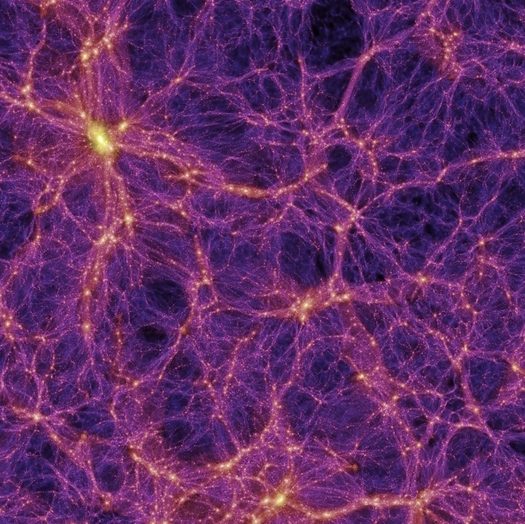
Figure 4.3:Galaxies are actually distributed in a frothy foam-like pattern crudely lining the edges of vast bubbles (voids; appearing as dark regions in the image). This structure forms as a natural consequence of gravity as galaxies pull on each other and coalesce into groups, leaving emptiness between. This graphic shows the bubble edges and filaments where galaxies collect. The larger galaxies are bright dots in this view—almost like cities along a 3-dimensional web of highways through the vast emptiness. From the Millennium Simulation [25].
Given the vastness of space, it is negligent to think of space travel as a “solution” to our present set of challenges on Earth—challenges that operate on a much shorter timescale than it would take to muster any meaningful space presence. Moreover, space travel is enormously expensive energetically and economically (see Table 4.3). As we find ourselves competing for dwindling one-time resources later this century, space travel will have a hard time getting priority, except in the context of escapist entertainment.[13]
Table 4.3:Approximate/estimated costs, adjusted for inflation (M = million; B = billion). [26–29]
| Effort | Cost |
|---|---|
| Apollo Program | $288B |
| Space Shuttle Launch | $450M |
| Single Seat to ISS | $90M |
| Human Mars Mission | $500B |
4.2 The Wrong Narrative
Humans are not shy about congratulating themselves on accomplishments, and yes, we have done rather remarkable things. An attractive and common sentiment casts our narrative in evolutionary terms: fish crawled out of the ocean, birds took to the air, and humans are making the next logical step to space—continuing the legacy of escaping the bondage of water, land, and finally Earth. It is a compelling tale, and we have indeed learned to escape Earth’s gravitational pull and set foot on another body.
But let’s not get ahead of ourselves. Just because we can point to a few special example accomplishments does not mean that such examples presage a new normal. A person can climb Mt. Everest, but it is not ever likely to become a commonplace activity. We can build a supersonic passenger airplane for trans-atlantic flight, but it does not mean it will be viable to sustain.[14] One can set up a backyard obstacle course for squirrels and generate viral videos, but the amusing demonstration does not signal a “new normal” in backyard design. We need to separate the possible from the practical. The moon landings might then be viewed as a nifty stunt—a demonstration of capability—rather than a path to our future. We encountered similar arguments in Chapter 2 in relation to decoupling: just because it can happen in certain domains of the economy does not mean that the entire economy can decouple and “defy gravity.”
The attractive evolutionary argument misses two critical facets of reality. When fish crawled out of the sea, they escaped predation (as the first animals on land) and found new food sources free of competition. That’s a win-win: less dangerous, more sustenance.[15] Likewise, when birds took flight (or we could discuss insects, which beat the birds to it), it was a similar story: evade ground-based predators who could not fly, and access a whole new menu of food—another win-win.
Going to space could easily be cast as a lose-lose. It’s an extremely hostile environment offering no protection or safe haven,[16] and there’s nothing to eat.[17] Think about it: where would you go to grab a bite in our solar system at present, outside of Earth? And a solar system is an absolute oasis compared to the vast interstellar void. The two factors that jointly
promoted evolution onto land and into the air will not operate to “evolve” us into space. It’s a much tougher prospect. Yes, it could be possible to grow food on a spacecraft or in a pressurized habitat, but then we are no longer following the evolutionary meme of stumbling onto a good deal.
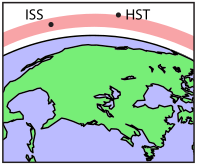
Figure 4.4:The pink band indicates the farthest humans have been from the surface of the earth for the last years. The Hubble Space Telescope (HST) orbits at the top of this band at 600 km altitude, and the International Space Station in the middle at 400 km. Beyond the thin black line outlining the globe, Earth’s atmosphere is too tenuous to support life.
4.3 A Host of Difficulties
If undeterred by the vast emptiness, hostile conditions, or lack of human-supporting resources in space, then maybe it’s because you believe human ingenuity can overcome these challenges. And this is correct to a degree. We have walked on one other solar system body.[18] We have had individuals spend a year or so in earth orbit. Either these represent first baby steps to a space future, or just rare feats that we can pull off at great effort/expense. How can we tell the difference?
One way to probe the demonstration vs. way-of-the-future question is to list capabilities we have not yet demonstrated in space that would be important for a space livelihood, including:
Growing food used for sustenance;
Surviving long periods outside of Earth’s magnetic protection from cosmic rays;[19]
Generating or collecting propulsive fuel away from Earth’s surface;
Long-term health of muscles and bones for periods longer than a year in low gravity environments;
Resource extraction for in-situ construction materials;
Closed-system sustainable ecosystem maintenance;
Anything close to terraforming (see below).
It would be easier to believe in the possibility of space colonization if we first saw examples of colonization of the ocean floor.[20] Such an environment carries many similar challenges: native environment unbreathable; large pressure differential; sealed-off self-sustaining environment. But an ocean dwelling has several major advantages over space, in that food is scuttling/swimming just outside the habitat; safety/air is a short distance away (meters); ease of access (swim/scuba vs. rocket); and all the resources on Earth to facilitate the construction/operation (e.g., Home Depot not far away).
Building a habitat on the ocean floor would be vastly easier than trying to do so in space. It would be even easier on land, of course. But we have not yet successfully built and operated a closed ecosystem on land! A few artificial “biosphere” efforts have been attempted, but met with failure [31]. If it is not easy to succeed on the surface of the earth, how can we fantasize about getting it right in the remote hostility of space, lacking easy access to manufactured resources?
On the subject of terraforming, consider this perspective. Earth right now has a problem of excess CO as a result of fossil fuel combustion (the subject of Chapter 9). The problem has flummoxed our economic and political systems, so that not only do we seem to be powerless to revert to pre-industrial CO levels, but even arresting the annual increase in emissions appears to be beyond our means. Pre-industrial levels of CO measured 280 parts per million (ppm) of the atmosphere, which we will treat as the normal level. Today’s levels exceed 400 ppm, so that the modification is a little more than 100 ppm, or 0.01% of our atmosphere.[21] Meanwhile, Mars’ atmosphere is 95% CO. So we might say that Earth has a 100 ppm problem, but Mars has essentially a million part-per-million problem. On Earth, we are completely stymied by a 100 ppm CO increase while enjoying access to all the resources available to us on the planet. Look at all the infrastructure available on this developed world and still we have not been able to reverse or even stop the CO increase. How could we possibly see transformation of Mars’ atmosphere into habitable form as realistic, when Mars has zero infrastructure to support such an undertaking? We must be careful about proclaiming notions to be impossible, but we can be justified in labeling them as outrageously impractical, to the point of becoming a distraction to discuss. Figure 4.5 further illustrates the giant gap between tolerable conditions and actual atmospheres on offer in the solar system.
We also should recall the lesson from Chapter 1 about exponential growth, and how the addition of another habitat had essentially no effect on the overall outcome, aside from delaying by one short doubling time. Therefore, even if it is somehow misguided to discount colonization of another solar system body, who cares? We still do not avoid the primary challenge facing humanity as growth slams into limitations in a finite world (or even finite solar system, if it comes to that).
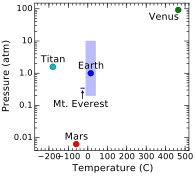
Figure 4.5:Rocky-body atmospheres in the solar system, showing average temperature (Celsius) and pressure (atmospheres). The range of “comfort” for Earth is shown as a blue rectangle going from to and 0.2 atm (where the atmosphere would need to be 100% oxygen) to (arbitrarily) 10 atm. Not only are the other bodies far outside our comfort range, the compositions are noxious, and lack oxygen. Bear in mind that a change of even a few degrees— as in climate change—is a big deal. Even Mt. Everest, where humans can survive for only a few hours with supplemental oxygen is substantially more hospitable than Mars.
4.4 Exploration’s Role
It is easy to understand why people might latch onto the idea that we will likely leverage our exploration of space into ultimate colonization. Much as early explorers of our planet opened pathways for colonization of “new worlds,” the parallels in exploring literal new worlds like planets are obvious.[22] In short, it is a familiar story, and therefore an easy “sell” to primed, undoubting minds. Plus, we’re captivated by the novelty and challenge space colonization represents—as attested by a vibrant entertainment industry devoted to stories of eventual life in space. But not all exploration leads to settlement, and entertainment is not truth.
Humans have explored (a small portion of) the crushing deep ocean, scaled Earth’s highest and wholly inhospitable peaks, and visited the harsh ice cap at the north pole. In such instances, we had zero intention of establishing permanent residence in those locations. They represented places to test our toughness and also learn about new environments. We do not view these sorts of explorations as mistakes just because they did not pave the way for inhabitation. Rather, we speak fondly of such excursions as feathers in our collective cap: feats that make us proud as a species. Space might be viewed in a similar way: superlative in terms of challenge and wonderment, reflecting positively on our curiosity, drive, ingenuity, and teamwork. We also derive benefits[23] in the way of technological advancement propelled by our quest to explore, and in furthering our scientific understanding of nature.
So even if space does not fulfill the fantasy of continued human expansion across the cosmos, it is in our nature to at least explore it. We would do well to put space exploration in the category of conquering Mt. Everest rather than that of Europeans stumbling upon the West Indies (one is as imminently uninhabitable as the other is inhabitable). Let us not make the mistake of applying the wrong narrative to space.
Many positive things might be said about space exploration, and hopefully we continue poking into our outer environment indefinitely. Yet hoping that such exploration is a pathway to human colonization of space is probably wrong and almost certainly counterproductive at present, given the short timescale on which human expansion is likely to collide with Earth’s limits.
If, in the fullness of time, we do see a path toward practical space colonization, then fine. But given the extreme challenge and cost— both energetically and economically, and for what could only be a tiny footprint in the near term—it seems vastly more prudent to take care of our relationship with Planet Earth first, and then think about space colonization in due time, if it ever makes sense. Otherwise, not only do we spend precious resources unwisely, but (even worse) our mindset is tainted by unrealistic dreams that diminish the importance of confronting the real challenge right here on the ground. We need to have our heads in the real game. Perhaps twenty øne piløts said it best in the song Stressed Out:
We used to play pretend, give each other different names We would build a rocket ship and then we’d fly it far away Used to dream of outer space but now they’re laughing at our face Saying, “Wake up, you need to make money.” Yeah.
Space colonization might be treated as a pretend fantasy for the moment. We would be better off waking up to face real here-and-now challenges. In some sense, perhaps the only way to achieve the dream of migration to space—should that be in the cards at all—is to first pretend that it is impossible and turn attention to the pressing matters on Earth. Otherwise we risk failing at both efforts.
4.5 Upshot: Putting Earth First
The author might even go so far as to label a focus on space colonization in the face of more pressing challenges as disgracefully irresponsible. Diverting attention in this probably-futile[26] effort could lead to greater total suffering if it means not only mis-allocation of resources but perhaps
more importantly lulling people into a sense that space represents a viable escape hatch. Let’s not get distracted!
The fact that we do not have a collective global agreement on priorities or the role that space will (or will not) play in our future only highlights the fact that humanity is not operating from a master plan[27] that has been well thought out. We’re simply “winging it,” and as a result potentially wasting our efforts on dead-end ambitions. Just because some people are enthusiastic about a space future does not mean that it can or will happen.
It is true that we cannot know for sure what the future holds, but perhaps that is all the more reason to play it safe and not foolishly pursue a high-risk fantasy.[28] From this point on, the book will turn to issues more tangibly relevant to life and success on Planet Earth.
4.6 Problems
If the sun were the size of a basketball, how large would Earth be, and how far away? How large would the moon be, and how far from Earth, at this scale?
Find objects whose sizes approximately match the scales found in Problem 1 and place them in your environment at the scaled/appropriate distances. Submit a personalized/unique picture of your arrangement.
How far would the nearest star be at the scale from Problem 1, and how big is this in relation to familiar objects?
Find an Earth globe and an object about one-fourth its size to represent the moon, then place at the appropriate distance apart. Report on how far this is. Take a personalized/unique picture to document, and take some time appreciating how big Earth would look from the moon.
Highway 6563 in New Mexico has signs along a roughly 30 km stretch of road corresponding to the solar system scale from the Sun to Neptune. On this scale, how large would Earth, Sun, and Jupiter be, in diameter? Express in convenient units appropriate to the scale.
Using the setup in Problem 5, how fast would you have to travel on the road to match the speed of light, for which it takes 500 seconds to go from Earth to the sun? Express in familiar/convenient units.
Note that the size of the moon in Figure 4.1 is about the same size as the sun in Figure 4.2. Explain how this is related to the fact that they appear to be about the same size in our sky. Hint: imagine putting your eye at the earth location in each figure and looking at the other body.
Use Table 4.1 to accumulate (multiplicatively combine) scale factors and ask: which is a bigger ratio: the distance to the nearest star compared to the diameter of Earth, or the distance to the edge of the universe compared to that to the nearest star? Compared to the large numbers we are dealing with, is one much smaller or much bigger than the other, or are they roughly the same?
It may be tempting to compare Earth to a life-sustaining oasis in the desert—maybe spanning 100 m. But this is a pretty misleading view. One way to demonstrate this is to consider that in a real desert, the next oasis might be a perilous 100 km journey away. Using the ratio of distance to size (diameter of planet or oasis), how close would another Earth have to be (and compare your answer to other solar system scales) to hold the analogy?[29] How long would it take to drive this distance? Do we have another oasis or potential oasis within this distance?
Another way to cast Problem 9 is to imagine that the actual distance between Earth and a comparable oasis is more like the distance between stars.[30] In this case, how far would the next oasis be in the desert if we again compare the 100 m scale of the oasis to the diameter of the Earth?[31] How long would it take to drive between oases at freeway speeds (cast in the most informative/intuitive units)?
On the eighth bullet of Box 4.3 (the one that asks you to pause), imagine someone from the year 2020 traveling back 50 years and explaining that we have not been to the moon since 1972, and that Americans get to space on Russian rockets. How believable do you think they would be, and what assumptions might be made to reconcile the shock?
Prior to exposure to this material, what would you honestly have said in response to: How far have humans been from the planet in the last 45 years;
a) 600 km (about Earth radius; low earth orbit) b) 6,000 km (roughly Earth radius) c) 36,000 km (about 6 ; around geosynchronous orbit) d) 385,000 km (approximate distance to the moon) e) beyond the distance to the moon
Explain what led you to think so (whether correct or not).
List at least three space achievements that impress you personally, even if they do not bear directly on colonization aims.
In the enumerated list beginning on page 63, which item is most surprising to you as not-yet accomplished, and why?
List three substantive challenges that prevented successful long-term operation of the artificial biosphere project [31].
Since Figure 4.5 spans the range of atmospheres found in our solar system, we can imagine how likely it would be that a random planet might happen to be livable for humans.[32] Imagine throwing a dart at the diagram to get a random instance. How likely are we to hit the comfort zone of Earth, by your estimation?
Come up with three examples (not repeating items in the text) of feats that are technically possible, but not common or practical.
For some perspective, imagine you were able to drive your car up a ramp to an altitude characteristic of low-earth orbit (about 320 km, or 200 miles). It takes about 5 J of energy[33] to win the fight against gravity. Meanwhile, each gallon of gasoline can do about 25 J of useful work. How many gallons would it take to climb to orbital height in a car? Roughly how many miles per gallon is this (just counting vertical miles)?
In Problem 18, we ignored the energy required to provide the substantial orbital speed km/s, but will not need), which essentially doubles the total energy.[34] How much gasoline will it now take, and how massive is the fuel if gasoline is 3 kg per gallon, compared to the 1,500 kg mass of the car?
To quote Carl Sagan, extraordinary claims require extraordinary evidence.
The Oort cloud marks the outer influence of the sun, gravitationally.
… Proxima Centauri
That’s 6,000 times the distance to the closest star.
… the Andromeda galaxy
For this, picture a grain of sand sitting on the bridge of your nose representing the earth, and a speck of dust in front of one eye as the moon.
The last time we went this far was 1972.
It does not happen to be aimed toward the nearest star, however.
It only had 17 km/s left.
… a long day’s walk
Even a solar system, which is a sort of local oasis within the galaxy, is mostly empty space.
… which is great stuff as long as it does not dangerously distort our perceptions of reality
Evolution works on exploiting advantages, favoring wins and letting the “lose” situations be out-competed.
Earth is the safe haven.
Amusingly, consider that no cheeseburgers have ever smacked into a space capsule.
The last Apollo landing was in 1972.
The ISS (space station) remains within Earth’s protection.
Even just 10 meters under the surface!
While the increase from 280 to 400 is about 50%, as a fraction of Earth’s total atmosphere, the ppm change is 100 divided by one million (from definition of ppm), or 0.01%.
Reaching the Americas involved a leap across a span of (life-supporting) ocean about twice the size of Europe. Reaching Mars involves a leap across inhospitable space 5,000 times the diameter of Earth— not very similar at all.
… among them a deeper appreciation for the rare and precious Earth
True, never is a long time. The notion that we may never colonize space may seem preposterous to you now. Check back at the end of the book. The odds favor a more boring slog, grappling with our place in nature.
Staffed research stations are not the same as human settlements, in the case of Antarctica.
… at least on relevant time scales
Prospects for a plan are discussed in Chapter 19.
Tempted as we may be by the e-mail offer from the displaced Nigerian prince to help move his millions of dollars to a safe account, most of us know better than to bite. The promise of wealth can lead the gullible to ruin.
In other words, oasis size is to distance between oases as Earth’s diameter is to how far?
… since Earth is the only livable “oasis” in our own solar system
In other words, Earth diameter is to interstellar distances as a 100 m oasis is to how far?
… just in terms of temperature and pressure; ignoring composition and a host of other considerations!
We’ll encounter gravitational potential energy later, but this quantity is computed as with kg.
The same amount of energy to climb against gravity must go into accelerating to speed (kinetic energy).