This version of the book—available for free in digital form at https://
This book makes extensive use of margin space for notes,[1] citations, figures, tables, and captions. Hopefully, the utilization of margins leads to a smooth reading experience, preventing parenthetical, contextual information from interrupting the flow of primary text.
References to figures and tables, glossary items, chapters and sections, definitions, boxes, equations, etc. appear as blue text, also including page numbers when pointing outside the chapter. Such instances are hyperlinked within the electronic PDF document[2] for easier internal navigation.
The electronic version of this book is far easier to use once figuring out how to navigate “back” within the PDF viewer,[3] so that a link—or even several in a row—may be clicked/tapped, followed by a painless return to the starting point that may be hundreds of pages away. It is therefore strongly recommended[4] that you figure out how to navigate using your viewing platform. For instance, viewing the document in Adobe Acrobat on a Mac, the back and forward functions are accomplished with cursor/arrow keys as -and -. In Mac Preview, -[ and -] go back and forward. Some mouses—especially those for gaming—have additional buttons that map to forward/backward navigation.
Call-out boxes indicate places where a student might enhance their understanding by engaging in personal exploration. An information symbol ( ⓘ ) in the margin is occasionally used—mostly in Problems sections—to denote supplemental content that build useful contextual links to the real world but may otherwise obscure what the problem seeks. A caution symbol ( ⚠ ) appears when an argument is being put forth that is likely faulty or nuanced. Students should be careful to avoid literal acceptance of these points and work to understand the subtleties of the argument.
This made-to-print version[5] contains a Changes and Corrections section that lists any modifications since the original release—the relevant dates being provided on page ii. Within the text, a red square marks the location of a change, corresponding to an entry describing the change in the list starting on page 367. In the electronic version, both the square and the page reference in the corrections list are hyperlinked
to facilitate navigation. Corrections and other feedback can be left at https://
A number of the examples (set apart in yellow boxes) are not posed in the form of a traditional question, but rather appear as a statement that captures a quantitative instance of the concept at hand. From this, students can construct multiple different questions that omit one piece of information and then solve for it using the remaining numbers. In this way, the example becomes a versatile guide to understanding. Note also the convention that is used to indicate “quantitatively very close to,” while represents a less precise numerical value that might be read “in the neighborhood of,” or “roughly.”
After the primary presentation of material, an Epilogue attempts to put the tone of the textbook in context as it relates to the challenges ahead.
A dedicated Image Attributions section details attributions and permissions for graphics not generated by the author. Blue tags[6] at the end of figure captions point to entries in this section.
Appendices include supplemental information on math, chemistry, worthy tangents, and a partial answer key for problems. The answer key is constructed to discourage shortcuts. Rather than give direct numerical answers, for instance, it often provides a range within which the answer is expected to lie. In this sense, it acts more like an intuition transplant, guiding more likely correct analysis in a manner closer to the way an expert operates.[7] This approach allows students to at least catch any glaring errors in approach, like dividing rather than multiplying, for instance.
The Bibliography at the end applies to the whole book. Tags contain a green reference number.[8] Each reference indicates the page or pages on which the reference is cited. Many of the entries contain URLs or DOIs to online resources.
A Notation section after the bibliography provides an overview of physical constants and symbols used in the text, unit pre-factors, and a table of Greek letters.
A Glossary provides a collection of important terms encountered in the text. Glossary words in the text appear in blue[9] type, and the corresponding entries often refer to other glossary items. Additionally, page numbers[10] where entries appear in the text are provided to facilitate finding other instances.
Finally, a full alphabetical Index appears at the end to facilitate finding information in the text.
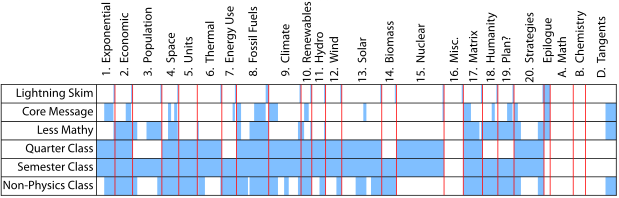
The graphic below reflects all chapters by page count,[11] suggesting a few different ways to approach this book. Just reading the “Upshot” for each chapter, and possibly the first few introductory paragraphs for each will convey a decent overview of the book’s contents. The
core message can also be picked out based on the guide below. The book has a definite quantitative slant, so it will not be possible to avoid math-laden sections completely, but the guide can help find the less numerically intense sections. Finally, different class formats might take various routes through the material, as suggested below.
Acknowledgments
I thank Brian Siana, David Crossley, and Barath Raghavan for extensive review and substantive suggestions on elements of the text. Allegra Swift offered tremendous help on permissions and open access publishing.
The first draft of this book was written in late 2019 and early 2020 for use in the Physics 12 general-education course on Energy and the Environment at UC San Diego in Winter quarter 2020. Students were presented with one chapter at a time in PDF form, lacking margin notes, having fewer figures and tables, and containing untested content. As part of weekly assignments, students were to read each chapter and offer substantive feedback on: confusing elements; missing content that would be interesting to include; ideas for additional graphics or tables; anything that seemed wrong or of questionable veracity; a critique of problems (for clarity, value, level of difficulty); and any typographical errors or wording suggestions. The voluminous feedback that resulted has been extremely valuable in shaping the current iteration of the book, so that each student in the class deserves acknowledgment here for hard work and keen insights.
In alphabetical order: J. Abaya, B. Arce, M. Beltran, D. Bothe, P. Buljat, T. Chung, J. Cordero, B. Espinoza Diaz, G. Fu, J. Funes, C. Goodale, T. Huang, K. Ito, A. Jhaveri, D. Kim, S. Mahlman, J. Mckinley, J. Murgo, H. Musa, J. Nam, J. Ngo, K. Nguyen, H. Ordonez, G. Osuna, C. Peach, H. Potts, P. Puno, E. Ramos, J. Song, A. Strube, D. Sun, N. Teuton, E. Tian, Q. C. Tu, Z. Tuazon, J. Wen, Z. Xu, A. Yoshinaga, S. Zweifler.
Numbered notes point to a specific location in the text.
A link to the electronic document is in the first paragraph, above.
… much like the “back” button in a web browser
⚠ Learn how to navigate “back” in your PDF viewer to make hyperlinks within the document more attractive.
… two-sided margin format
… hyperlinked in the PDF file
Experts often have a pretty good sense of the answer even before a detailed analysis, which serves as a way to identify possible mistakes and force a closer look.
… hyperlinked to bibliographic entry in the PDF file; “back” navigation useful
… hyperlinked in the PDF file, made more convenient by “back” navigation
… also hyperlinked in the PDF file
… and in some cases singles out individual sections by size and position within the chapter