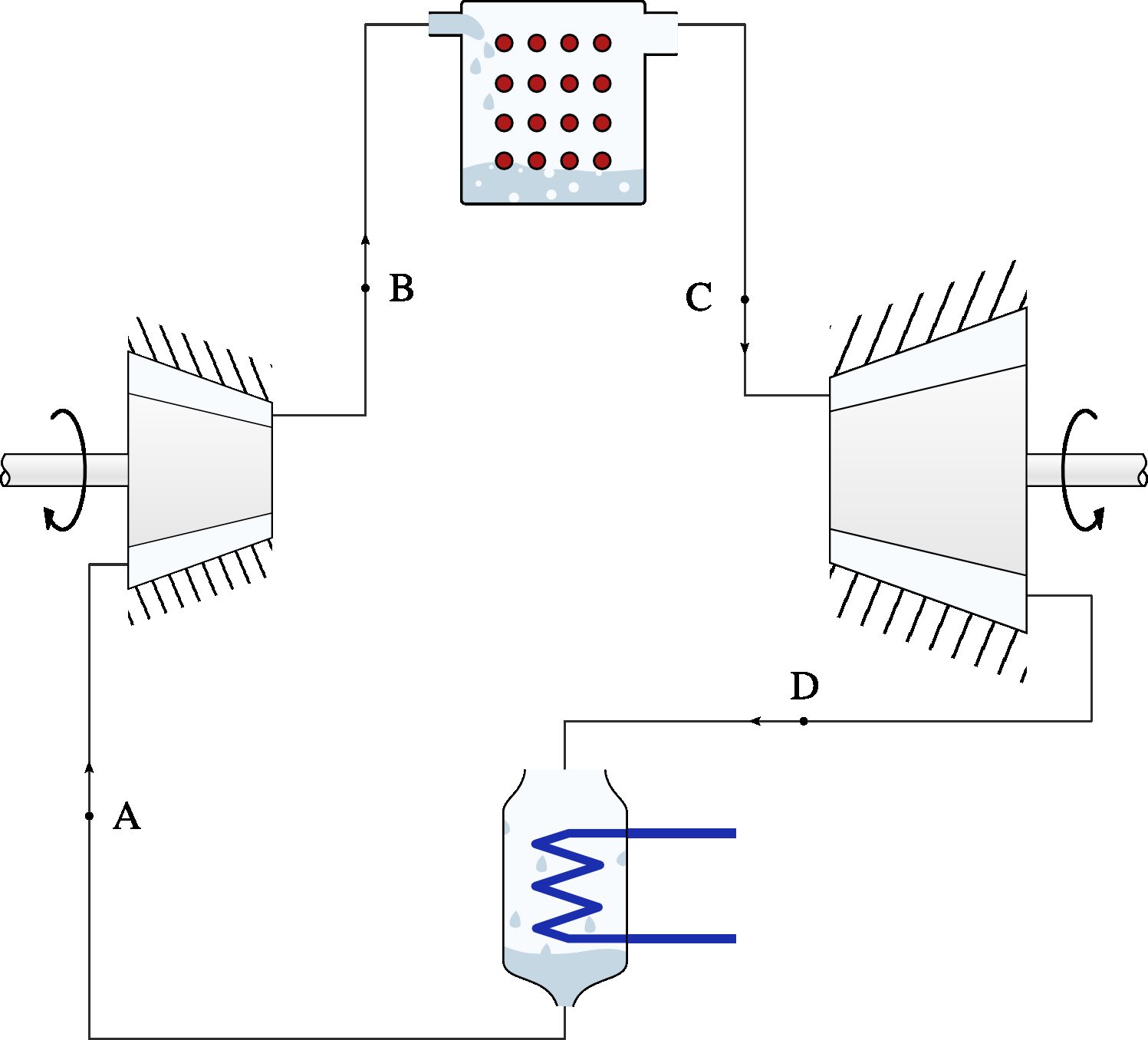
In chapter 6 (thermodynamic cycles), we studied the nature of different cycles for converting heat and work. We now aim to study, explain, and quantify their very limits. Chapter 7 (the second law) aims to answer two questions:
• Why do all heat engines always have an efficiency less than 100%?
• How can the efficiency of a heat machine be maximized?
The second law of thermodynamics is expressed as follows:
Heat spontaneously moves only towards a lower temperature.
This statement can be made more specific: heat can transfer to a higher temperature only when energy is supplied.
We will see that this simple observation has multiple, profound consequences for engineers. In particular, it determines the maximum efficiency of all engines and refrigeration machines!
The statement above seems so obvious that it is almost offending. Two remarks are necessary here.
• The second law can be stated in multiple ways. It is more striking to talk about “increase in entropy” than the spontaneous behavior of heat; yet these different statements, which we will gradually address, are all equivalent.
• The apparent manifest evidence of the postulate – of course no one has ever seen, at room temperature, a cup of hot tea spontaneously heat up, or a cold drink spontaneously cool down – crumbles as soon as one studies phenomena at the microscopic level.
Indeed, if temperature is only the level of agitation of particles, then there is a priori nothing preventing it from locally increasing even if the ambient temperature is lower. It took half a century of arduous work by thermodynamicists to provide a satisfactory answer to this (curious students will learn of Maxwell’s demon to their delight). The application of probabilities to thermodynamics, and in particular the work of Ludwig
Boltzmann (§8.5.3), would reconcile it with the Newtonian mechanistic view of the world during the 20th century. This is not a trivial problem.
In our study and from our engineering point of view, we will accept the above postulate as obvious, without seeking to justify it or explain it.
The zeroth law of thermodynamics states that if two bodies are in thermal equilibrium with a third, then all three are in equilibrium with each other. The third law states that the entropy (a property that we will study in the next chapter) of a crystal at zero temperature is zero. Neither of these laws is of any importance to the engineer.
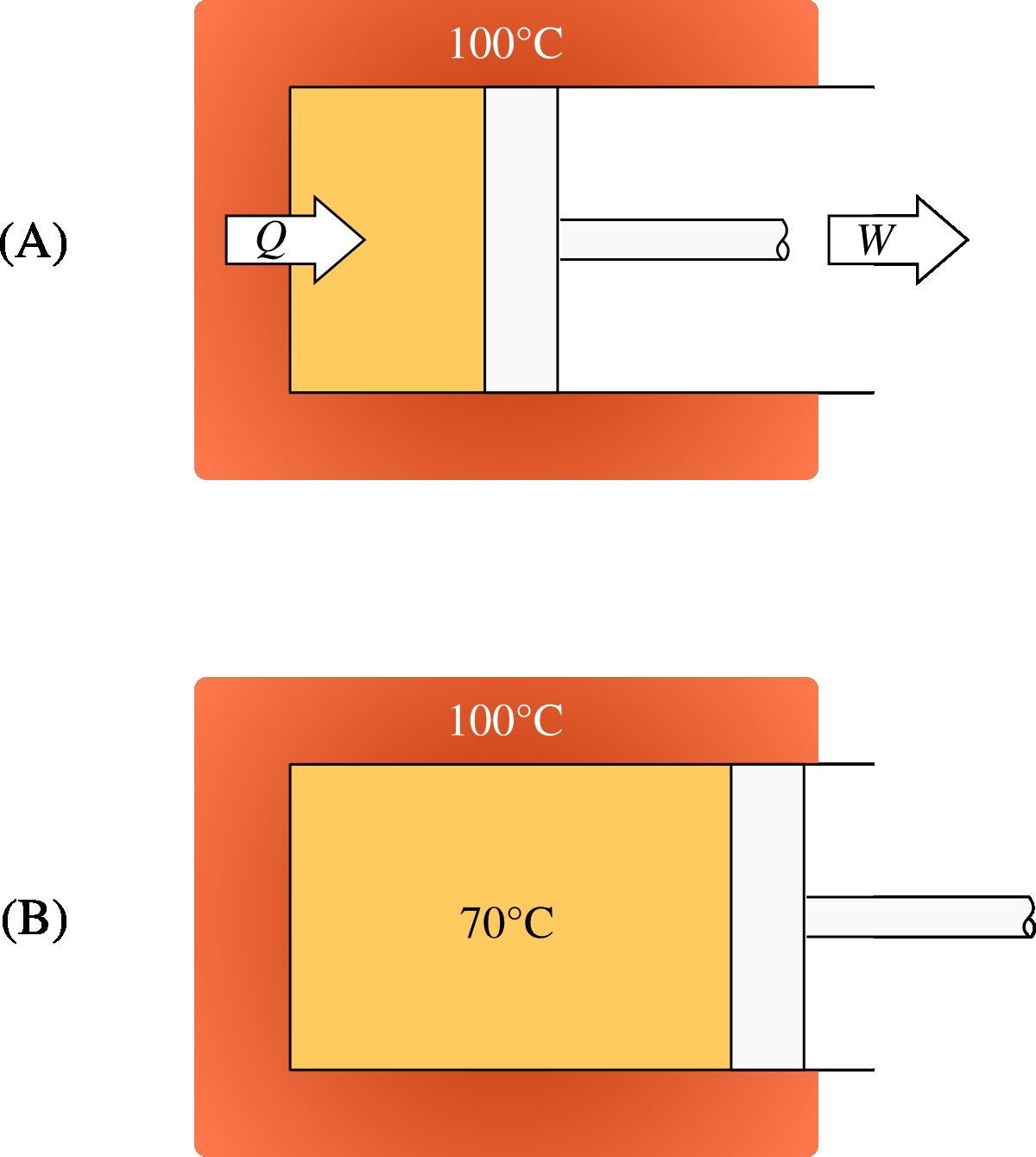
Let’s imagine that we want to generate work by taking heat from a “hot” object, that is, at a high temperature: for example, 100∘C(212∘F), as shown in figure 7.1. We connect a cylinder filled with a fluid to this object, and let the fluid push on a piston as it receives heat.
Figure 7.1:Production of work with heat from a body at 100∘C. The heat transfer allows work to be done, but also causes an increase in the fluid’s temperature.
Diagram CC-0 Olivier Cleynen
Once it has done some work (at B in figure 7.1), the fluid has increased in volume. If we want to continue converting heat into work and do not want the engine to “inflate” indefinitely, we need to cool this gas to return it to its initial volume.
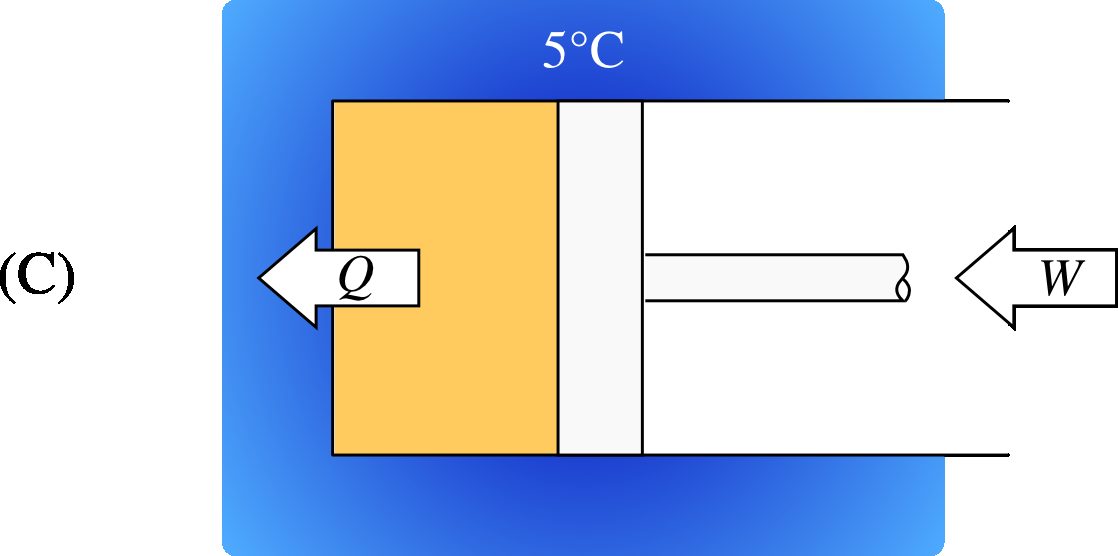
Unfortunately, the only way to extract heat from the gas is to put it in contact with a “cooler” body, as shown in figure 7.2. In particular, it is impossible to return the accumulated heat in the gas to the “hot” body – for that to happen, the gas temperature would need to be higher than this body. This accumulated energy is therefore irretrievably lost.
Figure 7.2:The inevitable cooling of the engine. The only way to return the fluid to its initial state (A) in the experiment in figure 7.1 is by extracting heat from it, which can only be done with a “heat sink” at a lower temperature. The heat and work transfers here are smaller than on the outward journey, but both are non-zero.
Diagram CC-0 Olivier Cleynen
Thus, for an engine to operate continuously, it must, in addition to a high-temperature source from which to capture heat, have a “sink” at low temperature to reject the heat that it can no longer make use of.
This reasoning applies in the same way to refrigerators, air conditioners, and heat pumps, which are designed to absorb heat at a low temperature. Once the heat has been absorbed into the low-temperature fluid, the only way to reject it at a higher temperature is to increase the temperature of the fluid. This requires a non-zero compression work. Thus, for a refrigerator to operate continuously, it must receive energy in the form of work.
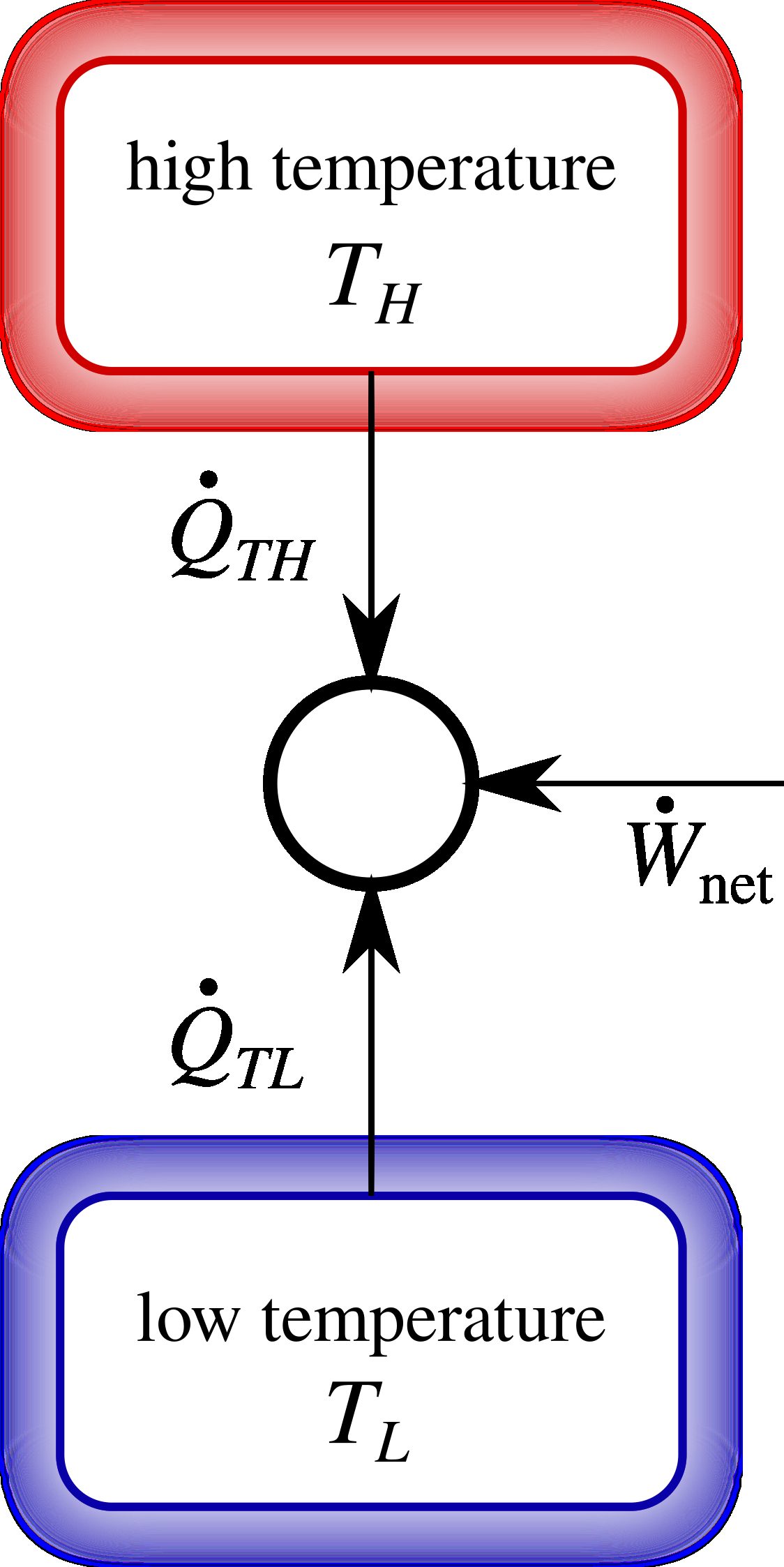
In order to study heat and work transformations more rigorously, we will use the following notation to describe thermal machines:
• TH and TL will represent the high and low temperatures respectively;
• We will always callQ˙TH the power in the form of heat transferred at high temperature, andQ˙TL its equivalent at low temperature (each can be positive or negative).
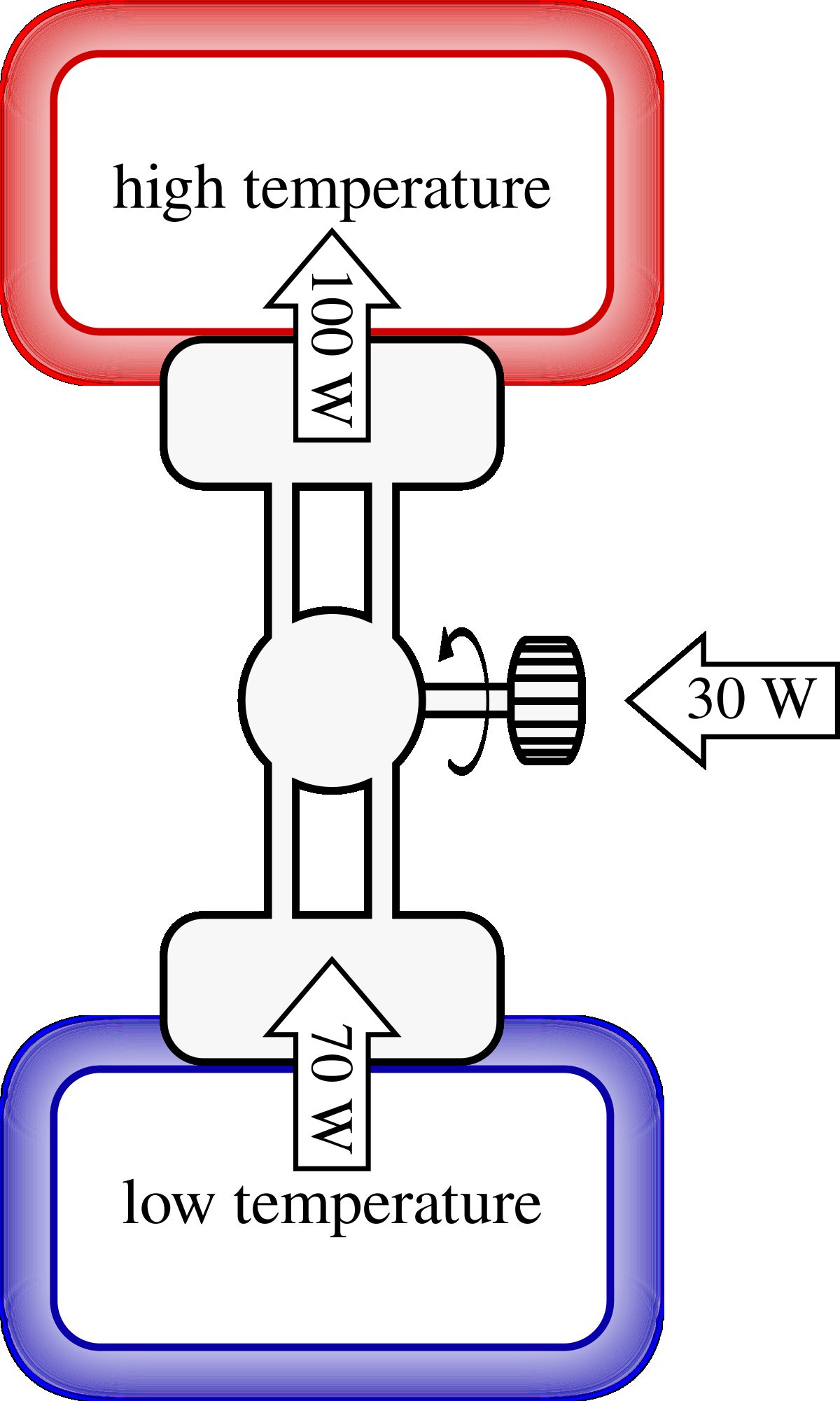
Thus, the thermal machine in its most general representation looks like figure 7.3.
Regardless of the operation mode and efficiency of the machine, it cannot create or destroy energy (§1.1.2); and we will always have:
Figure 7.3:A thermal machine transforming work and heat in its most general representation.
Diagram CC-0 Olivier Cleynen
The second law has particular consequences for each of the two main types of thermal machines:
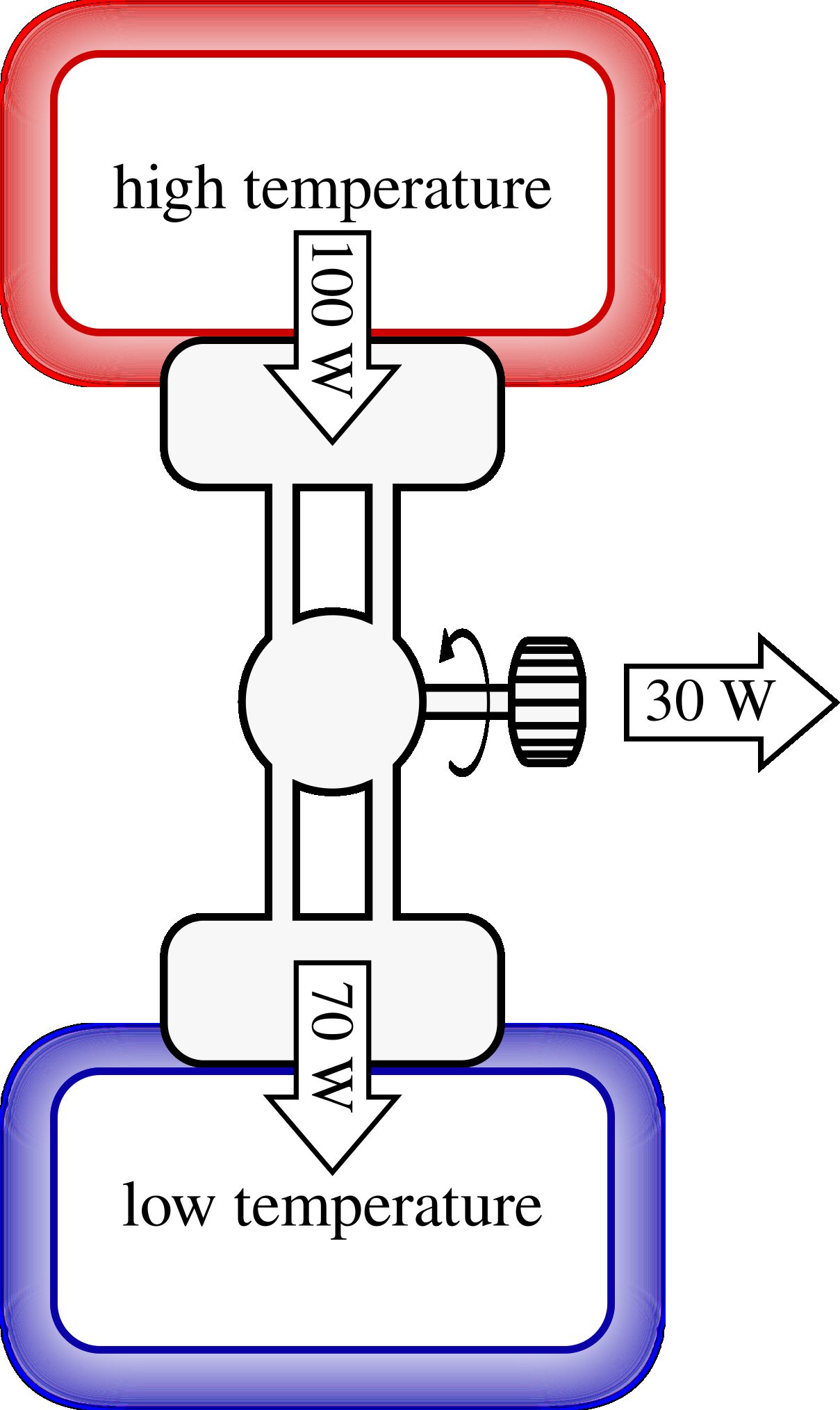
An engine takes heat from a high-temperature source (Q˙TH>0) and produces work (W˙net<0, figure 7.4). We have just seen that if we want to carry out this transformation continuously, we have no choice but to reject heat into a low-temperature reservoir (Q˙TL<0).
Figure 7.4:An example of energy transfers to a thermal engine.
Diagram CC-0 Olivier Cleynen
In power plants, the two temperature zones are easily identifiable: the steam takes heat from the core of the plant (nuclear reactor, gas boiler, or coal boiler) and releases heat through the large cooling chimneys.
Automotive and aeronautical engines, on the other hand, must discharge the air that serves as their working fluid because of the combustion products that prevent its reuse. For this reason, cooling takes place in the atmosphere, outside the engine casing. Their “cooling zone” is not easily distinguishable.
Applied to the engine, the second law states that no engine can continuously convert heat into work from a single heat source. Every engine rejects heat at a lower temperature, so continuous operation requires two reservoirs at different temperatures.
Purists will express this corollary, called the Kelvin-Planck corollary, with the following inequality:
A refrigerator, an air conditioner, or a heat pump operates in the opposite way to engines. These machines extract heat from a low-temperature source (Q˙TL>0) to reject it into a reservoir at a higher temperature (Q˙TH<0, figure 7.5). An inevitable consequence is that they must receive work for this (W˙net>0).
Figure 7.5:An example of energy transfers in a refrigerator, air conditioner, or heat pump in operation.
Diagram CC-0 Olivier Cleynen
Applied to a refrigerator, the second law states that any machine that transfers heat to a higher-temperature body receives work.
Purists will enjoy translating this corollary, called the Clausius corollary, as follows:
At the beginning of the 19th century, a young Parisian Polytechnique engineer named Sadi Carnot became interested in the operation of thermal engines, which were booming at the time. Carnot sought to predict the maximum amount of work that can be generated from a given amount of coal.
Carnot’s approach is interesting in that he completely abstracted the technological aspect to investigate the underlying principles of engine operation. This is even more challenging because at that time, engines operated by vaporizing and condensing steam, and the concepts of a cycle or of energy conservation were not yet established. This abstraction and the clarity of his writing established his only work, Reflections on the Motive Power of Fire and on Machines Fitted to Develop that Power, 1824 [4], in the history of physics.
Carnot died shortly after his publication and before his work could be recognized; his conception of heat was fundamentally incorrect;[1] yet the theoretical engine he described, an essential passage for engineering students, serves as a reference in the design offices of all engine manufacturers today.
Carnot sought the theoretical engine whose efficiency would be the maximum possible. He imagined a unique way to transform heat into work and work into heat. His machine can operate in both directions: as an engine or as a refrigerator.
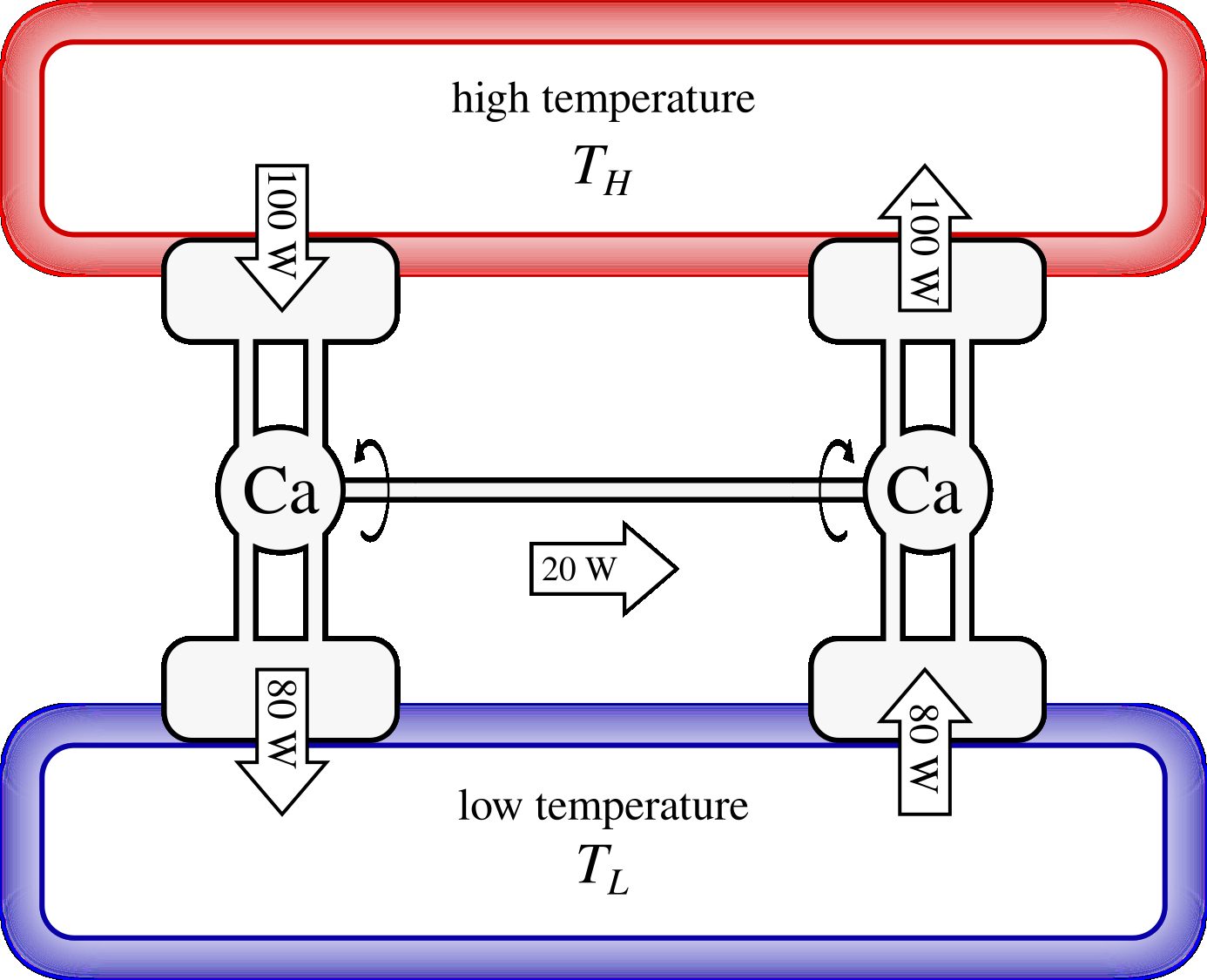
In thermodynamic terms, the machine he conceptualized is not only bidirectional, meaning that the direction of fluid flow can be changed to change its function (like many domestic heat pump / ac systems on the market today), but it is also reversible: by reversing its operation, all heat flows become exactly opposite. In this way, if Carnot’s refrigerator is powered by Carnot’s engine, then the flows will be exactly compensated, as depicted in figure 7.6.
Figure 7.6:Two Carnot machines, an engine (left) and a refrigerator (right). The first powers the second, and since they are reversible (in the thermodynamic sense of the word), the heat flows are balanced.
Diagram CC-0 Olivier Cleynen
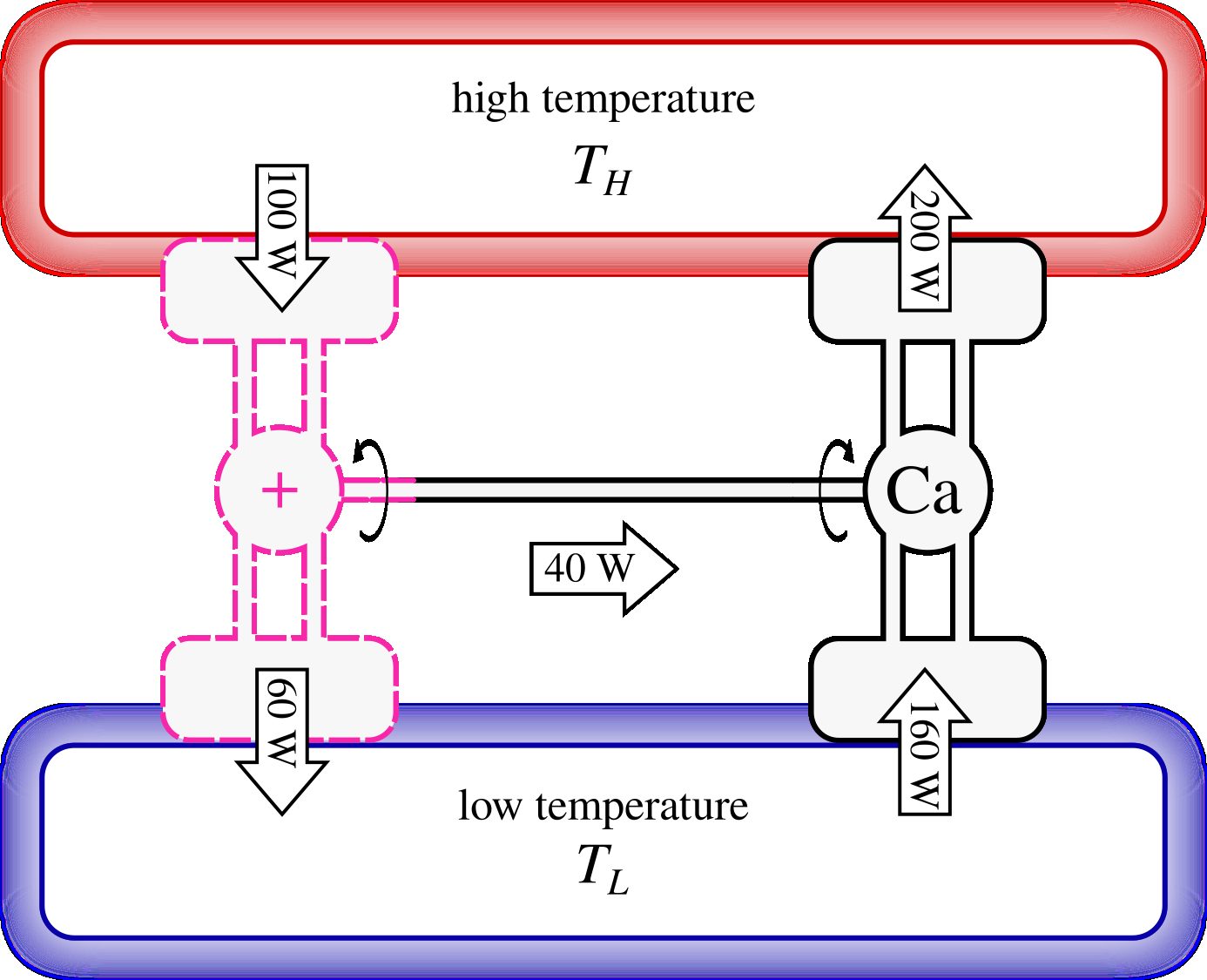
Why would such a machine be the most efficient one that can be designed? It can be proven by contradiction that an engine with higher efficiency than a reversible engine cannot exist (figure 7.7). The work supplied by this hypothetical machine could be used to power a reversible refrigerator. These two machines together would then receive no net work, but would still create a heat flow from the cold reservoir to the hot reservoir. According to Carnot, and based on the second law whose validity we have accepted, this is impossible: such a machine cannot exist.
Figure 7.7:Proof by contradiction that the best possible engine is reversible. A hypothetical engine (on the left) with higher efficiency than a reversible refrigerator (on the right) could simply power the latter. Thus, we would obtain a spontaneous net heat flow (here of 100W) from the cold source to the hot source, without a net input of work: according to the second law, this is impossible.
Diagram CC-0 Olivier Cleynen
This method of reasoning by combining hypothetical and theoretical machines, even if it can be initially confusing, is an excellent way to approach the theory of heat machines. The student is strongly encouraged to experiment in this way, for example by answering the following questions:
• Why does the best possible refrigerator operate reversibly?
• Why can’t we improve the efficiency of an engine by redirecting its heat rejection towards the hot source by use of a reversible heat pump?
We have now seen that the maximum efficiency of a machine is reached when its operation is reversible. From this observation, Carnot reasoned as follows:
All thermal machines operate by the expansion and contraction of a substance alternately subjected to two temperatures;
For them to be reversible, namely, to ensure they can be carried out in the reverse direction, all heat transfers must be done with infinitesimal temperature differences: these processes will then be isothermal;
For them to be reversible, the phases where the substance changes temperature (in order to move from one heat reservoir to another) must occur without heat transfer: these processes will then be adiabatic.
In order to allow each process to be run backwards, they must all be reversible (infinitely slow).
The essentials are here. Carnot outlined a theoretical thermodynamic cycle which consists of two isothermal and two adiabatic processes. He did not need to quantify any transfer; and did not yet concern himself with any technological detail. However, it is certain that the thermodynamic cycle that he described is the most efficient –the least inefficient!– that can be realized.
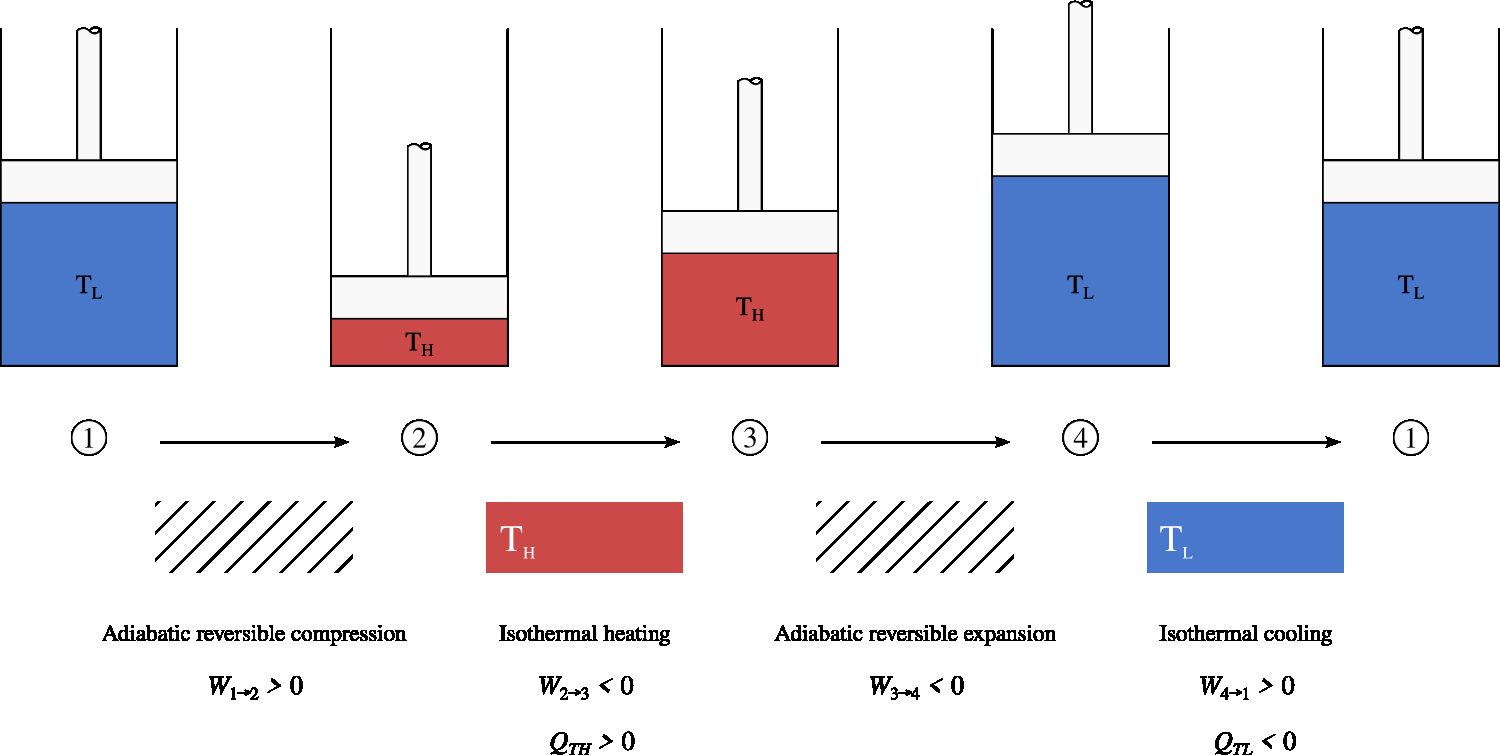
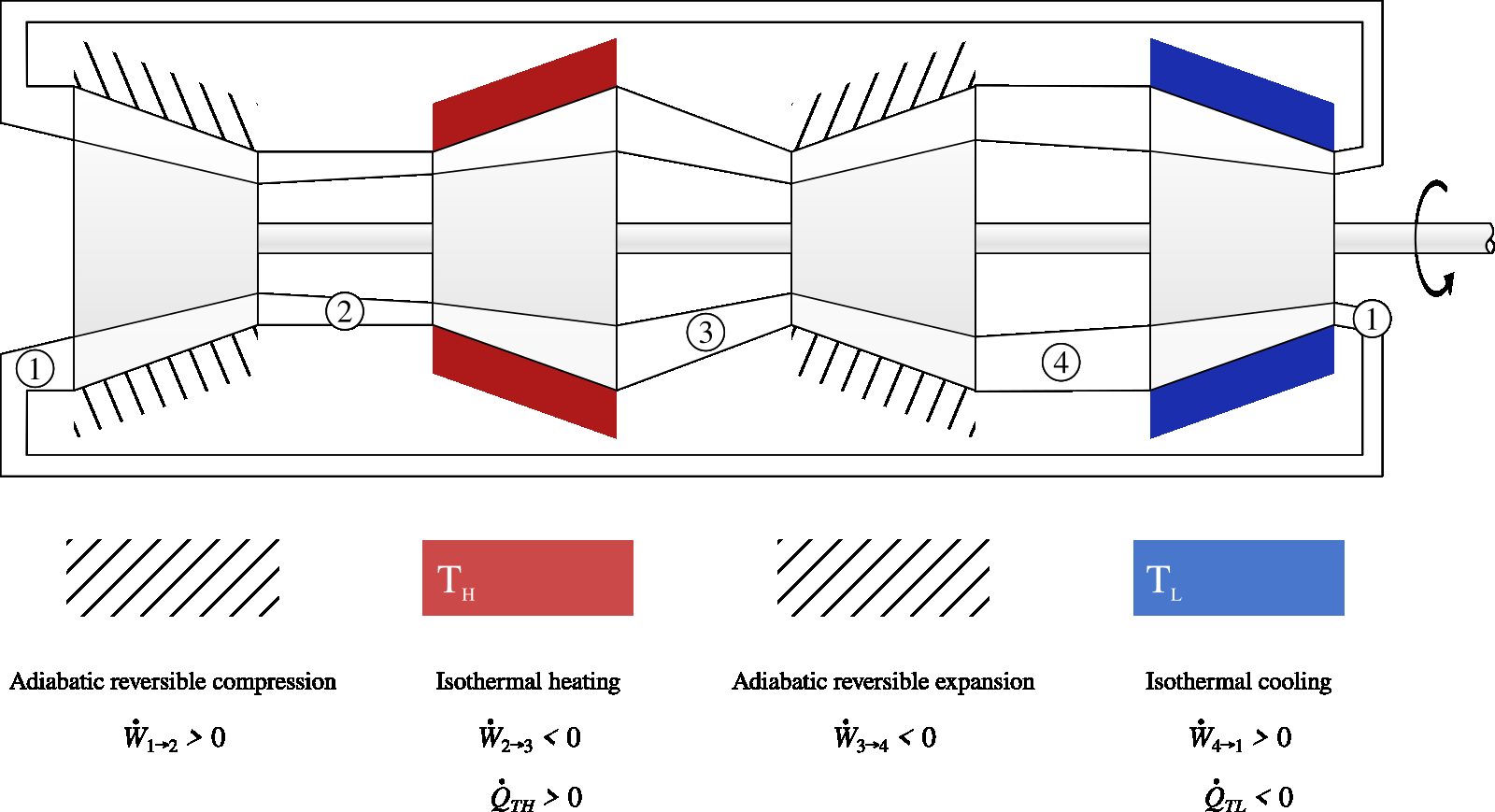
We can describe the Carnot cycle with a fixed amount of mass maintained inside a cylinder undergoing four processes (figure 7.8). It commutes between temperatures TH (“hot” source at high temperature) and TL (“cold” source at low temperature), in order to produce net work:
Reversible adiabatic compression from 1 to 2
In this stage, we aim to raise the temperature of the fluid to a high level without adding any heat to it.
The cycle starts at 1, when the fluid is in the cylinder at the low temperature TL. In order to raise it to a high temperature (thus enabling a reversible heat transfer in the following phase 2→3), the fluid is reversibly adiabatically compressed (§4.4.5 & §5.4.5). The fluid’s temperature increases from TL to TH.
This phase requires work input(W1→2>0).
Isothermal heating from 2 to 3 In this stage, we aim to absorb a quantity QTH of heat from the high-temperature source.
At 2, the fluid has been compressed in the piston at temperature TH. The cylinder is brought into contact with the hot source (temperature TH) and heat is supplied with an infinitesimal temperature difference: this is an isothermal expansion (§4.4.4 & §5.4.4). The fluid’s temperature remains constant at TH.
This phase generates work output (W2→3<0).
Reversible adiabatic expansion from 3 to 4 In this stage, we aim to decrease the temperature of the fluid to that of the cold source (TL).
At 3, the fluid is still at temperature TH. The cylinder is then thermally isolated and the fluid is expanded in order to have the fluid do work and reduce its temperature without heat transfer: this is a reversible adiabatic expansion. The piston continues its slow retreat, and the fluid’s temperature decreases down to TL.
This phase generates work output (W3→4<0).
Isothermal cooling from 4 to 1 In this final stage,
we aim to reject a quantity QTL of heat into the low-temperature sink.
At 4, the fluid is at low temperature TL. In order to bring it back to its initial volume, heat must be removed. We proceed with an isothermal cooling: the piston is gradually advanced, and the fluid’s temperature is kept constant at TL.
This phase requires work input (W4→1>0).
This quantity of work Wnet represents the maximum that can be obtained from a quantity of heat QTH between two given temperatures TL and TH.
Diagram CC-0 Olivier Cleynen
Figure 7.8:The four stages of the Carnot engine, executed with a fixed mass quantity by separating them in time. The cycle is such that when the stages are performed in reverse order (1→4→3→2→1), the transfers are exactly opposite.
Diagram CC-0 Olivier Cleynen
Figure 7.9:The four stages of the Carnot engine, executed with a constant mass flow by separating them in space. Here too, the cycle is such that when the flow direction is reversed (becoming 1→4→3→2→1), the transfers are exactly opposite.
Diagram CC-by-sa Olivier Cleynen
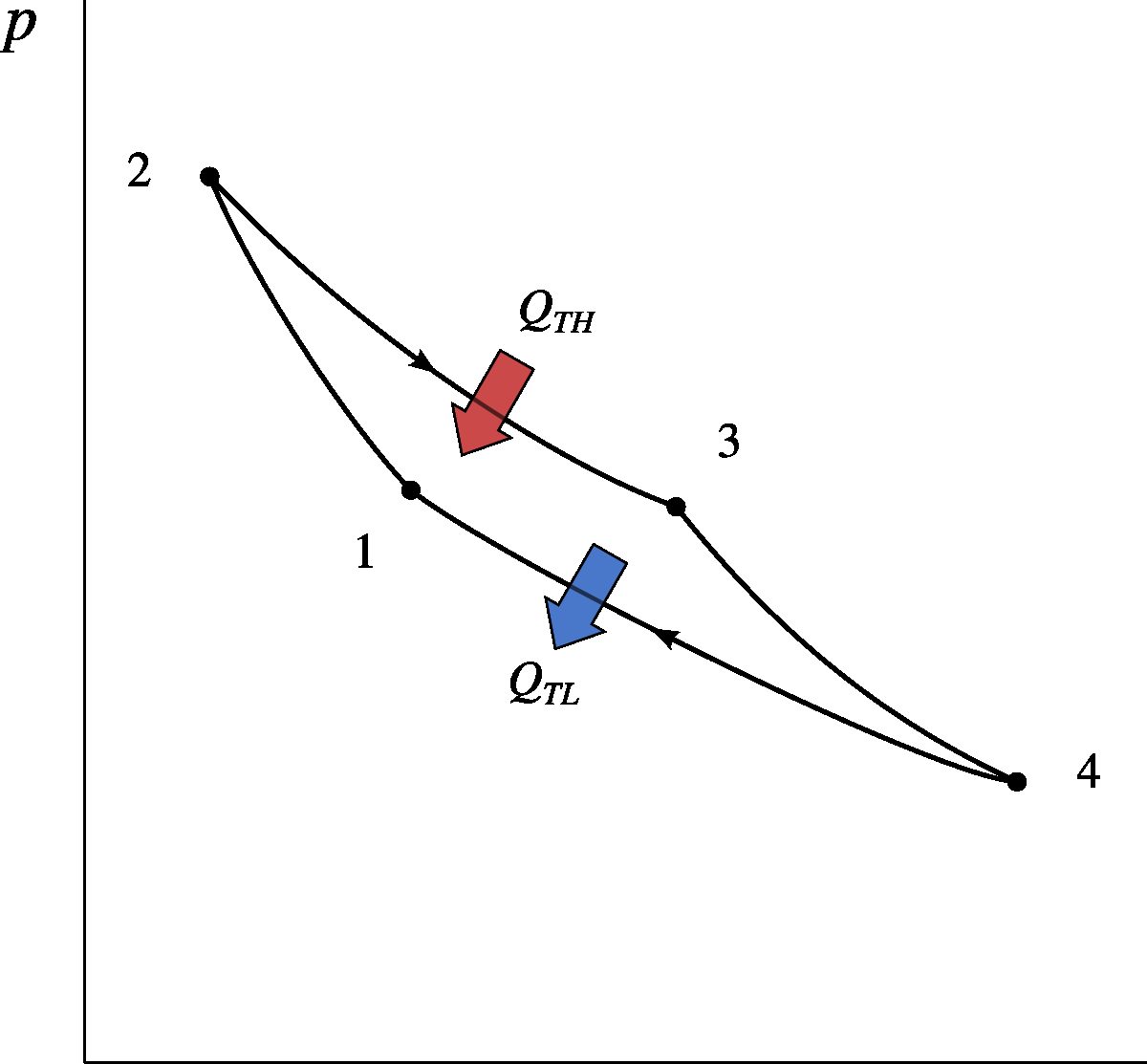
The Carnot engine cycle can be plotted on a pressure-volume diagram (for example in figure 7.10 with a perfect gas). It can be observed that the compression phases occur at lower pressure and volume than the expansion phases: the cycle is work-producing. Since all processes are reversible, the area enclosed in the path 1-2-3-4-1 represents the net work quantity Wnet produced.
Figure 7.10:Pressure-volume diagram of the Carnot engine performed with a perfect gas. The processes 2→3 and 4→1 are done at TH and TL, respectively.
Diagram CC-0 Olivier Cleynen
The perceptive student will have observed that in order for all these phases to be reversible, the piston movement must be infinitely slow, and thus the fluid completes the cycle in an infinite amount of time. The Carnot engine therefore reaches maximum efficiency with infinitely low power.
Piston engines are often classified according to their mode of operation. Two-stroke engines perform one expansion per crankshaft revolution (every two piston movements); whereas four-stroke engines (figure 6.14) perform one expansion every two revolutions. The distinction lies in the mode of exhaust gas removal and its replacement with fresh air (see §6.4 p. 163).
The transposition of the Carnot engine to reality, where eventually the fluid will need to be drained or transferred to a separate cylinder for cooling, can be done with either two or four strokes at the engineer’s discretion. Thus, the Carnot cycle, although it is indeed made up of four stages, cannot be specifically associated with either of these two modes of operation.
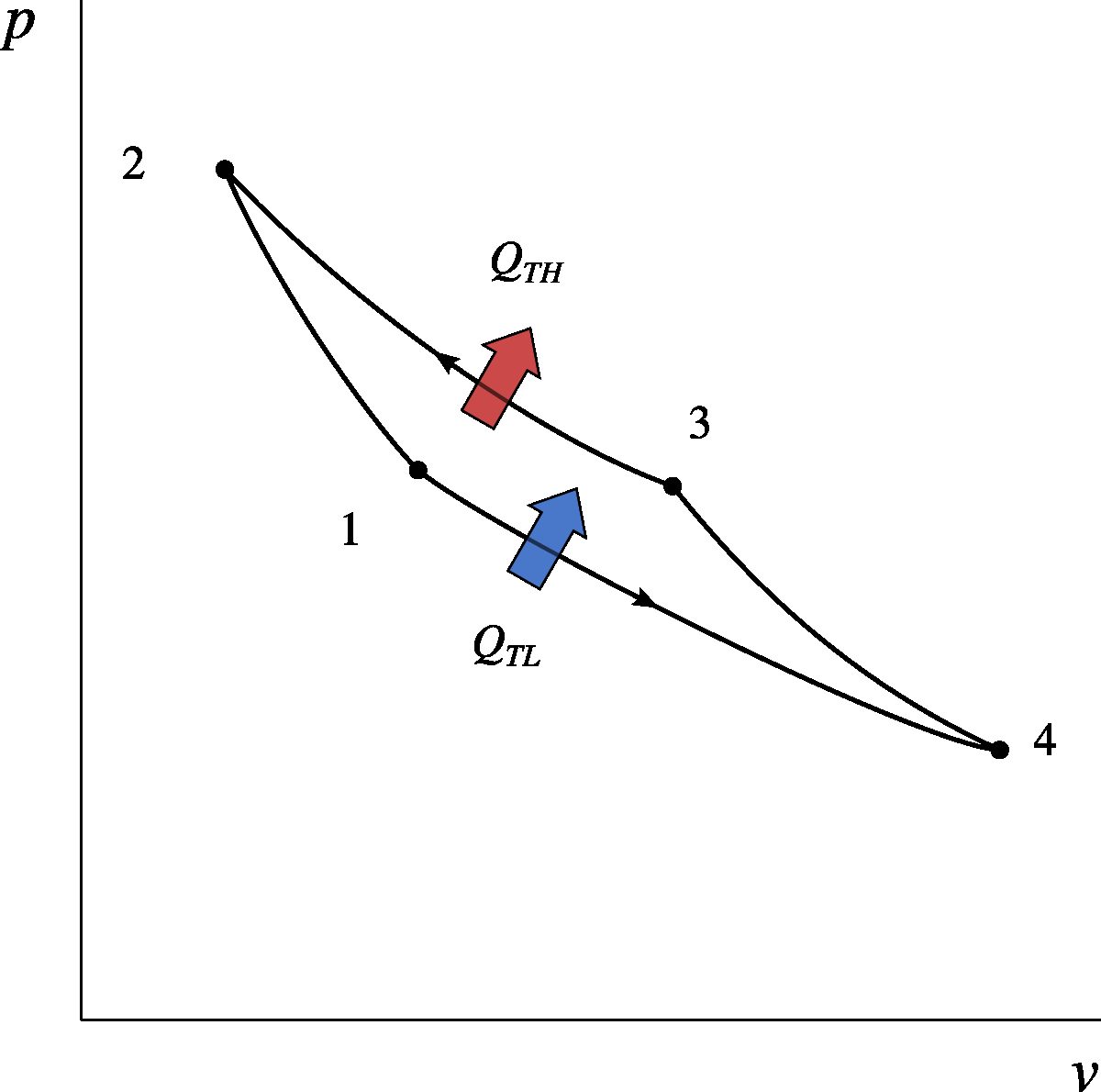
By reversing the operating direction of the engine described above, we create a refrigerator, air conditioner, or heat pump of the same efficiency. The fluid then passes through the same states, but by following the reverse path (1-4-3-2-1) as shown in figure 7.11. The heat QTL>0 is captured from the cold source, the work Wnet>0 is received by the machine, and the heat QTH<0 is rejected by the machine towards the high-temperature source.
This cycle allows obtaining the maximum efficiency (the “least bad” efficiency, since it is not infinite) of an air conditioning system or a heat pump operating between two given temperatures TH and TL.
Figure 7.11:Pressure-volume diagram for a reversed Carnot cycle, namely, in refrigeration mode (refrigerator or heat pump), with a perfect gas.
Kelvin defines a temperature scale, called absolute temperature. Within a Carnot engine, the ratio of the maximum temperature TH and minimum temperature TL is defined to be equal to the ratio of the heat transfer rates, that is:
by definition, in a Carnot engine, whereQ˙TH is the heat transfer rate absorbed or rejected at high temperature (Q˙TL, at low temperature), and where the temperatures are absolute (measured in K).
This equation 7/4 is a definition. Therefore, we can determine the temperature of a body without needing to use a specific fluid. Kelvin calibrates his scale such that 0∘C=273.15K.
The rest of this section §7.4 details the path that led to this definition. It is intended for curious readers, and can be safely skimmed by busy students or engineers.
In order to quantify a property in physics (for example, quantify “mass” or “color”), three things must have been defined:
A zero point which defines what corresponds to zero property (zero mass, zero pressure, etc.);
A standard which serves as a reference gauge (for example, an object of one pound mass, one meter length);
A scale which allows us to define the property between the zero point and the standard (for example, what is “twice as much” or “half as much” mass, light, etc.).
At the beginning of the 19th century, the two temperature scales that we use today in everyday life, those of the Swedish Anders Celsius and the German Daniel Gabriel Fahrenheit, were already in use. How are these scales defined from a physical point of view?
• The zero point is rather easy to define (it is the point where bodies are completely frozen, unable to supply heat) but neither Fahrenheit nor Celsius could accurately locate it with certainty;
• The standards of Celsius and Fahrenheit differ significantly. Celsius chose the freezing point of pure water, Fahrenheit of saltwater, at atmospheric pressure, and each assigned it the relative “zero” graduation.
• However, the scales of Celsius and Fahrenheit are strictly identical. In fact, to measure temperatures around their standards, both scientists measured the contraction and expansion of a liquid in a tube. Between his relative zero point and the boiling point of water at atmospheric pressure, Celsius drew 100 graduations; Fahrenheit, 212 graduations. As always, the history of thermodynamics is full of trivia: Celsius initially used a reversed scale, going from 100 at freezing to 0 at boiling! As for Fahrenheit, he likely chose 212 graduations in order to easily realign with his first graduation, calibrated on the freezing point of pure water (32) and the temperature of the human body (96), standards that were quite difficult to reproduce. We must not let ourselves be distracted: in a physical sense, these are only graduations and not a scale, which was already determined by using a liquid thermometer.
The main problem with these two scales is that the temperature is well defined only in the range of existence of liquid thermometers. Whatever fluid is used (mercury, alcohol, water), it always ends up freezing or boiling at some point; and the graduations then no longer provide useful information. For example, Celsius could not define or even describe what allows recognizing a temperature of 1200∘C.
In addition to this, neither scale is intuitive in the negative range. If one were to admit, for example, that 40∘C could be “twice as much temperature” as 20∘C, then what temperature would be twice as much as −10∘C? This amounts to asking the question: can we write 20∘C40∘C and is it equal to 40∘C80∘C? As an inquisitive Scot would soon explain, the modern answer to this question is no.
Scottish physicist and engineer William Thomson understood these limitations very well. He proposed a temperature scale that does not depend on the behavior of a fluid in a tube.
Thomson took a keen interest in the Carnot cycle and reasoned as follows: the only characteristic that gives maximum efficiency to the Carnot engine is the fact that it is reversible. In other words, all machines based on this cycle and operating between two given temperatures will have the same efficiency — regardless of their fuel, displacement, configuration, or power. One could therefore use the efficiency of a Carnot engine as a measure of temperature.
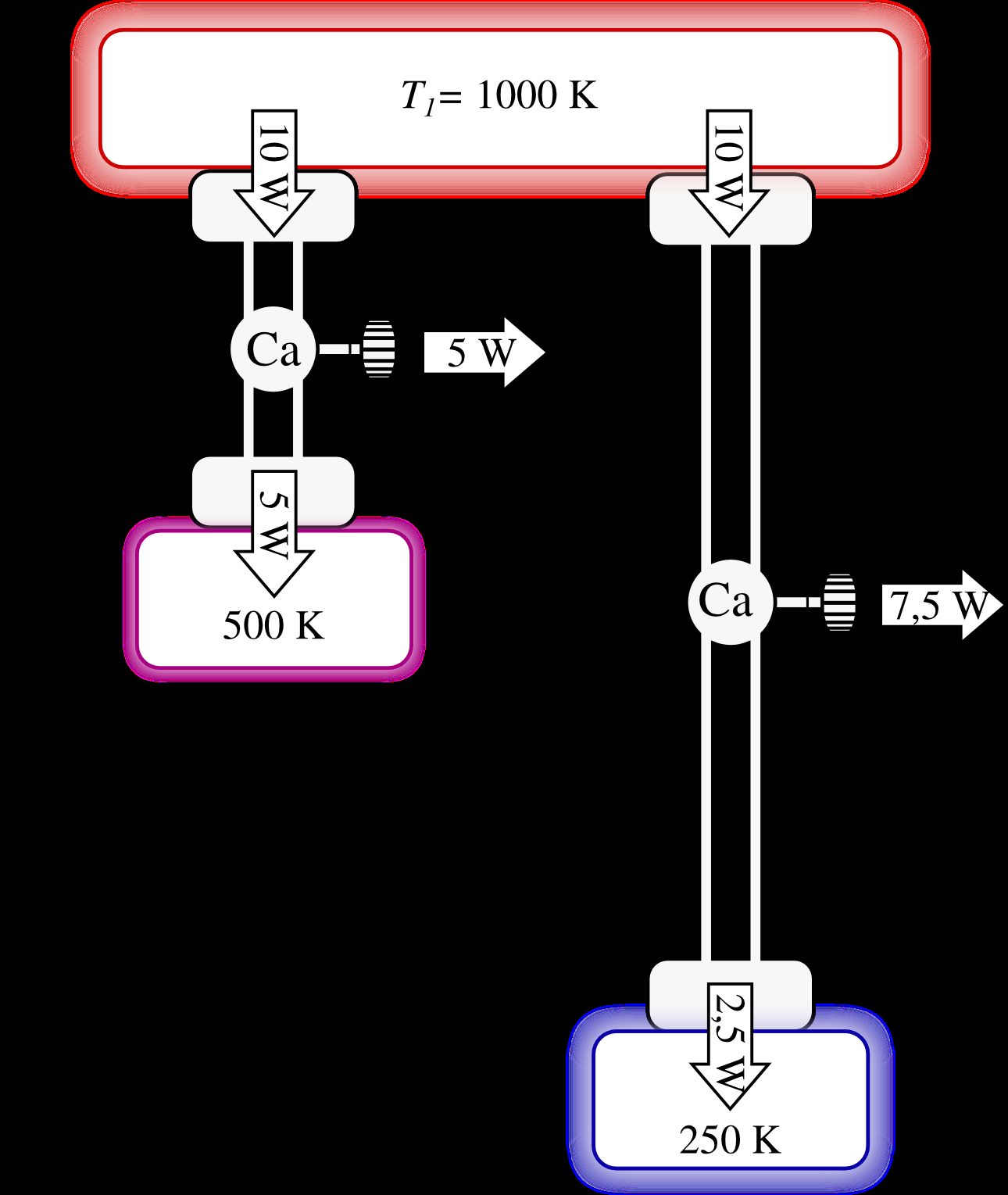
Thomson’s proposition is as follows: consider a body at a temperature T1 (for example, a thousand units, as shown in figure 7.12). A Carnot engine is attached to it, which will supply work and reject heat at a lower temperature T2. This temperature T2 is half of T1 if the engine rejects half of the heat it receives; it is one-fourth when it rejects one fourth, and so on. In mathematical terms, Thomson proposed:[2]
in a Carnot engine (actually, for any machine performing a reversible transformation), whereQ˙TH is the heat transfer rate absorbed or rejected at high temperature (Q˙TL, at low temperature), and where the temperatures are absolute (measured in K).
Figure 7.12:Experiment illustrating the absolute temperature scale proposed by William Thomson. A Carnot engine operating between 1000K and 500K rejects
5001000=50% of the heat it receives. If the low temperature is four times lower, this rejection is four times lower ( 2501000 ) than the heat received. Diagram CC-0 Olivier Cleynen
By manipulating equations 7/4 and 7/1, we can reformulate Kelvin’s definition: a Carnot engine operating between reservoirs separated by one degree and supplied with one unit of heat defines the hot-source temperature as the inverse of the work it produces.
The temperatures in this scale, called the absolute temperature scale or thermodynamic temperature scale, are always positive and vary from zero to infinity.
7.4.5 Absolute zero and synchronization of scales¶
Thomson therefore had a scale — a method of defining a temperature as “twice as high”.
The zero of this scale corresponds well to the zero temperature point, since with the experiment in figure 7.12 one then has an “abyss” of zero temperature that allows gases to be infinitely expanded down to zero temperature (thus converting all the internal energy of a fluid into work).
There remained the choice of a standard. Thomson returned to Celsius’s thermometer and took the same reference point (the freezing point of pure water at atmospheric pressure). Observing that the contraction and expansion of fluids remain proportional to the change in their absolute temperature, he assigned a value to this reference point that allows maintaining the same thermometric scale as Celsius. For this, the temperatures 100∘C and 0∘C, which are known to allow a maximum efficiency of 26.8%, must correspond to temperatures in K spaced by 100 units. The calculation is simple – the student is encouraged to reproduce it – and Thomson obtained the relation:
William Thomson, already embarked on a stunning scientific career, was thirty years old when he published his temperature scale in 1854. In 1892, he was ennobled as First Baron Kelvin (he even ought to write The Right Honourable First Lord Kelvin of Largs, of the Order of Merit, the Royal Victorian Order, and of Her Majesty’s Most Honourable Privy Council!); it is under this name that he is known today. The Kelvin unit (K) was officially assigned to absolute temperature in 1948.
Kelvin’s work thus definitively separated the concept of temperature from real or imaginary fluids as previously done with the boiling point of water or the volume of perfect gases (§1.4.1 & §4.1.1); from here on it would be linked to a specific and quantitative physical experience.
In the previous chapter (§6.3.2), we saw that the efficiency of an engine was the ratio between the work produced (useful transfer,W˙net) and the heat received (energy expenditure,Q˙in). We had transformed this expression into another that was perhaps less demonstrative:
for a reversible thermal engine, and where the temperatures are absolute (K).
This expression 7/6 is so remarkable that we must pause for a moment.
The answer to the question Carnot was asking, “what is the maximum amount of work, in theory, that can be obtained from the combustion of a given amount of coal?” is here – and it is astonishing: it depends only on the high and low temperatures of the engine!
Two important remarks are necessary here.
• First, this efficiency is not 100%. Yet, we are discussing machines here without friction or leaks, and with infinitely slow movements. By contrast, if we can ignore all practicalities, nothing is there to prevent an electric motor or an alternator from reaching an efficiency of 100%.
Therefore, even before addressing the inevitable technological difficulties associated with designing a real-world machine, the engine designer is limited by the fundamental nature of heat in what he or she can obtain from their machine. In the following chapters, we will address the irreversibilities observed in real engines, which will further reduce the efficiency calculated above.
• Secondly, this equation is a strong argument for increasing the combustion temperature in engines.
In practice, the low temperature TL is limited by the ambient air temperature. The only remaining parameter to increase the efficiency of an ideal engine is the temperature TH. This relationship explains the surprising efforts made by engine designers to use high temperatures (and correspondingly, high pressures), even though real engines are far from reversible.
In summary, we can answer Carnot’s question as follows: heat loss from the engine (wasted energy) is fundamentally inevitable. The losses are minimized, but not avoided, when the temperature at which the coal is burned is high, and the ambient temperature is low.
We saw in §6.3.3 that the efficiency of a refrigerator is the comparison between the heat extracted from the cold source (useful transfer,Q˙in) and the work input (energy expenditure,W˙net). We had expressed this efficiency with the obscure expression:
for a reversible refrigerator, where temperatures are absolute (K).
The same remarks as above apply here: firstly, the efficiency of a refrigerator or an air conditioner never reaches infinity (an infinite cop refrigerator would operate without any work input). Secondly, this efficiency reduces when the refrigeration temperature TL is reduced. In other words, when cooling an object with an ideal refrigerator, selecting a lower temperature is more expensive, not merely because more heat needs to be extracted from the object, but also because the efficiency of the extraction decreases.
We saw in §6.3.4 that the efficiency (or Coefficient of Performance, cop) of a heat pump is defined as the ratio of the heat supplied at high temperature to the work input (6/8). We had then transformed this definition with the expression:
for a reversible heat pump, where temperatures are absolute (K).
As with a refrigerator, the cop of a heat pump cannot be infinite: it is bounded by the extreme temperatures reached in the cycle. The higher the temperature at which heat Qout is delivered, the lower the efficiency that can be achieved.
The properties of water are tabulated in Steam Tables 1, 2, and 3 (see Appendix A1 p. 305)
Air is considered an ideal gas.
cv(air)=718Jkg−1K−1Rair=287Jkg−1K−1
cp(air)=1005Jkg−1K−1γair=1.4
We assume that for a reversible adiabatic process (without heat transfer and infinitely slow), the properties of air are linked according to the following three relationships:
We also assume that during a reversible isothermal process (at constant temperature and infinitely slow) of an ideal gas, the work done in an open or closed system is:
Finally, we assume that the efficiencies of thermal machines based on a Carnot cycle are expressed as a function of the absolute temperatures as follows:
Carnot figured out the second law correctly, but not the first law: he still used Antoine Lavoisier’s caloric theory, which was to be dismantled by James Prescott Joule twenty years later.
In fact, the records are again not that simple. Thomson initially proposed (in 1848 [9]) a scale in which Q˙TLQ˙TH is proportional to the difference of temperatures; making it a logarithmic scale from our current perspective. He revised this with the help of James Prescott Joule to arrive at proposition 7/4 six years later [14].