We immediately tackle one of the most difficult concepts in all of physics: energy.
We observe that in all phenomena, during all the transformations that we can observe in the universe, there exists a quantity that does not vary. This quantity is a measure for an abstract property (energy comes from the Greek ἐνέργεια or energeia, meaning “activity”, “operation”) that can take on multiple forms.
We have learned to quantify the amount of energy present in any arbitrary volume, and we strive to control its transformation from one form to another. For example, the electrical energy stored in a battery can be transformed into work in an electric motor, which can be used to operate an elevator, which can lift a load. During all these processes, the total amount of energy remains the same (figure 1.1), a fact that allows us, for example, to quantify the minimum size of battery required to lift a given load.
Figure 1.1:The chemical energy stored in the fuel that has been burned is exactly equal to the energy rejected by the exhaust pipe, plus the energy dissipated by friction, plus the kinetic energy of the moving car. All this energy is transformed into heat, but never destroyed, once the car is stopped (whichever the means!).
Photo CC-by-sa by Tommi Nummelin (cropped)
Thus, energy is primarily a concept that we use to describe the transformations we observe in the world: we could say that it is “what does not change when things change.” For the engineer, it represents above all the ability of one body to set another in motion, in a unified way (for example, with a displacement) or in a disordered way (for example, with chaotic excitation).
One can also state that “the energy of the universe is constant”, or “energy is always conserved”: it can neither be created nor destroyed. In other words, when an object receives a joule of energy, it can either store it or deliver it back to the surroundings; but in no case can it destroy it.
There are only two important laws in thermodynamics; the second one (to which we devote chapters 7 and 8) also deals with the nature of energy. Their implications are enormous and they are the result of deep and laborious intellectual work, spanning several centuries. There is no proof or demonstration of their truth, but all our observations and experiments corroborate them, so they are now universally accepted.
We will express the first law quantitatively in two different ways, one for a closed system (in chapter 2, equation 2/2) and the other for an open system (in chapter 3, equation 3/15).
The different forms of energy that we usually identify have been revealed one by one throughout the history of physics.
Kinetic energy is possessed by a body due to its velocity (see §1.2 below). It is the easiest form of energy to identify. It has long been called vis viva (“living force”).
Potential energy is stored due to the interaction between two objects linked by a conservative force.[1] On a macroscopic scale, its most palpable form is the potential energy of altitude, resulting from the work done on a mass against its weight (it is this work that makes climbing stairs more tiring than going down, for example). By compressing a spring, potential energy of compression is stored, which can be recovered by letting it expand again.
Chemical energy is a combination of potential energy and kinetic energy between atoms. Human metabolism, as well as the combustion of hydrocarbons with atmospheric oxygen used in almost all our vehicles, are both based on chemical energy transfers.
In the 20th century, it was discovered that mass, at the sub-atomic level, was also a form of energy (hence the famous E=mc2 relates mass and energy). Radiant (electromagnetic) energy is also identifiable at the sub-atomic level. These forms of energy are not relevant in this book.
In thermodynamics, we will focus on three forms of energy, identifiable at the macroscopic scale:
Internal energy denoted U, a concept that we use to group together all of the kinetic and potential energy of all of the molecules of a body. It represents the total amount of mechanical energy stored at the microscopic level within an object;
Heat denoted Q, which is a transfer of the kinetic energy of molecules in a chaotic manner from one body to another;
Work denoted W, which is a transfer of energy in a coherent manner from one body to another.
In general, the thermodynamic engineer wishes to capture heat from bodies that s/he wants to cool, or supply work to bodies that s/he wants to move. We will therefore study these transfers in detail.
Other units are often used, such as the horsepower. One horsepower is approximately the power that a strong horse can deliver as work in full effort (the story in §5.5 p. 141 reveals the name of the creator of this unit). Note that several definitions for horsepower exist (see Appendix A5 p. 317); here we refer to the din 66036 standard used in the automotive industry:
We will denote power by placing a dot above the symbol for energy; thus we writeE˙ as a power (for example, mechanical) delivering an amount of energy E every second.
In everyday language, the term “power” is used to quantify the maximum useful power of a system. For example, when we say that a car has “100 horsepower”, it means the car has an engine capable of providing it with a power ofW˙mech.=100hp for a few moments—but for this, the engine receives aboutQ˙combustion=300hp in the form of heat. Furthermore, on the road, the average mechanical power supplied by the engine probably does not exceed 20hp.
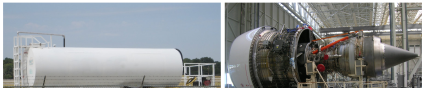
Figure 1.2:A trailer, with zero power (Q˙=0W) but capable of delivering a lot of energy. The combustion of 20t of kerosene releases about Q=800GJ as heat; A Trent 900 turbofan engine, with very high power (able to supplyW˙=14MW to a commercial aircraft) but devoid of energy (0J).
Turbofan engine photo derived from a photo CC-0 by Commons User:Dr Brains Trailer photo derived from a photo CC-by by Thomas R Machnitzki
In many thermodynamic applications, it is interesting to quantify energy transfers independently of the amount of mass inside the machine. For example, if we want to compare the operation of the engines of a motorcycle and of a truck, it will be wise to divide each of the energy transfers (during compression, combustion, expansion) by the quantity of air in the cylinders, to eliminate the scale effects. To this end, we use quantities called specific (sometimes called mass-specific); and we denote them in lowercase.
Specific energy (sometimes called mass-specific energy) is measured in joules per kilogram (Jkg−1):
where e is the specific energy (Jkg−1), E is the energy (J),
and m is the mass of the system under consideration (kg).
Specific power (sometimes also called mass-specific power) has the same units as specific energy: we divide watts (joules per second) by a mass flow rate (kilos per second).
where e is the specific power (Jkg−1), E˙ is the power (W), and m˙ is the mass flow rate through the system (kgs−1).
It should be noted that in practice, the adjectives “specific” or “mass-specific” are often simply omitted, and that the lowercase notation is not systematically used in scientific literature.
In thermodynamics, we are mainly interested in the changes in the energy of fluids within machines. The kinetic energy of gases varies negligibly in piston/cylinder engines, but it plays a major role in jet engines, as we will see in chapter 10 (air-based power cycles).
The expression for potential energy due to altitude should also not cause any concern for the student:
where g is the gravitational acceleration (usually 9.81ms−2), and z is the altitude relative to the reference point (m, see Appendix A5 p. 317 for other units).
We will show that in machines, the change of the potential energy of the air due to altitude is always negligible, and that this is often also true for water. Kinetic energy and potential energy due to altitude are often combined into a single term, called mechanical energy:
Work is a transfer of energy. An object does work (and thus loses energy) when it exerts a force over a displacement. In mechanics, this work is quantified using vectors:
where W is the work (J), F is the vector representing the force (of magnitude F in N), and l is the vector representing the displacement (of magnitude l in m).
In thermodynamics, we will use this equation 1/10 to quantify the work done by fluids. In order to do this, we will rewrite it by adding three particularities:
• We will measure the displacement as the change in length of the object that does the work;
• We will only consider cases where the vectors F and l are collinear;
• We will take into account the fact that F can vary as a function of l.
With these three constraints, equation 1/10 becomes:
Since dl is measured from the length of the object performing the work, dl will be negative when W is positive (work is then done to the object, causing its length to decrease). Finally, since F is always collinear with dl in our case, we can write:
where WA→B is the work done between two points A and B (J), F is the force (N), and dl is the infinitesimal change in the length of the considered object (m).
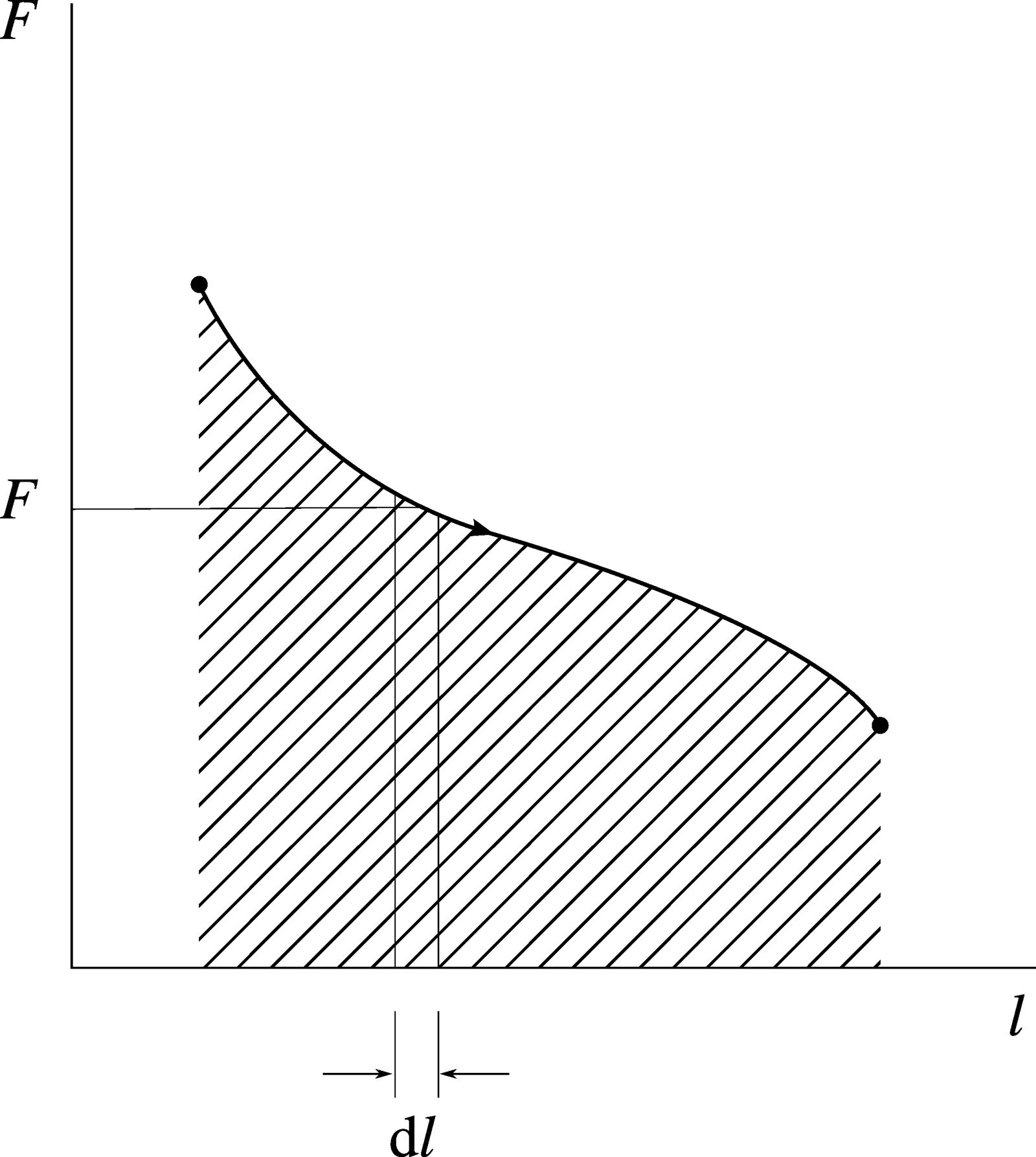
On a diagram representing the force as a function of distance, this work WA→B is represented by the area under the curve from A to B (figure 1.3). The shape of the curve, in other words, the relationship F(l) between F and l during the process, will determine the quantity WA→B.
Figure 1.3:On a force-distance diagram, the work done by an object can be visualized by the area under the curve. In the case shown here, the object’s length l increases, and the work will be negative (done by the object).
For now, we define temperature as a body’s potential for supplying or receiving heat.
The temperature of a body is a quantity that indicates its level of internal excitation. The higher the kinetic energy of its molecules, with different speeds and directions, the higher its temperature will be.
When the molecules making up a body are perfectly stationary relative to each other, the body has no internal vibration: this state defines zero temperature. In contrast, the temperature scale is open towards infinity. There is no defined maximum temperature point.
We cannot simply measure the “mean kinetic energy of the molecules” of a body, and as a result, it is very difficult to rigorously define a temperature scale (for example, what it means for a temperature to be “twice as large”). We will revisit the concept of temperature itself in chapter 4 (the ideal gas) and define it fully in chapter 7 (the second law). In the meantime, we will accept the definition given above.
Temperature is measured in kelvins (K), on a scale created for the needs of thermodynamics and rather immodestly referred to as absolute.
Students will likely be familiar with at least one of two temperature scales:
• the Celsius scale (∘C). Simply subtracting 273.15 units from an absolute temperature (in kelvins) gives a temperature in degrees Celsius:
Both of those scales precede the Kelvin scale, and they were cleverly redefined and synchronized with it in 1848 (we will have the opportunity to study this clever manipulation in chapter 7, see §7.4 p. 191). Purists will note that the absolute unit is named kelvin and not “degree Kelvin”. Some indicative temperatures are listed in table 1.1.
Table 1.1:Examples of temperatures. Values with an asterisk are converted approximately.
kelvins
degrees Celsius
0
-273.15
Absolute zero (by definition)
10-10
-273.1499999999
Lowest temperature ever reached (only a few particles)
4.22
-268.93
Helium boiling at atmospheric pressure
44
-229
Average temperature of the surface of Pluto*
184
-89.4
Lowest recorded atmospheric temperature on Earth*
273.15
0
Water melting at atmospheric pressure
327
54
Highest recorded atmospheric temperature on Earth*
373.15
100
Water boiling at atmospheric pressure
400
127
Nose of a Concorde in cruise flight*
483
200
Ordinary household oven*
485
210
Autoignition of diesel fuel*
753
480
Leading edges of a Lockheed SR-71 Blackbird in cruise*
1100
830
Wood fire*
1900
1600
Space Shuttle heat shield on atmospheric re-entry*
When two bodies of different temperatures are brought into contact, their temperatures tend to equalize during a spontaneous transfer of energy. We call this form of energy heat.
Heat, written Q, is a form of energy (measured in joules). On a macroscopic scale, it is a transfer of energy in chaotic form. It can be caused in several ways, the most relevant for the engineer being:
• loss of internal energy of a body, by coming into contact with a lower temperature body;
• friction;
• disappearance of mass in a nuclear reaction;
• transformation of potential energy between atoms, by chemical reaction
(especially the combustion of hydrocarbons with atmospheric oxygen).
Just like we denote heat as Q(J), we denote specific heat as q(Jkg−1).
The concept of heat is very difficult to understand. It was long believed to be a fluid (the caloric) of very low density, capable of permeating all materials.
This theory was abandoned in the mid-19th century, when it was shown that heat is not conserved, that is, it has the ability to disappear or appear.
For example, an engine in operation receives heat (through combustion) but releases less than it received. It transforms part of it into work, which we can then use to propel a vehicle.
On a microscopic scale, in other words, when we consider the movement of individual particles, the concepts of temperature and heat are even more difficult to define (Richard Feynman [30, 35] explores this beautifully). However, this is beyond the scope of this book.
When the same amount of heat is supplied to two different bodies, their temperature can increase in different ways – for example, it takes less heat to raise the temperature of a kilogram of steel than a kilogram of aluminum. This tendency of a body’s temperature to increase is called its thermal capacity (or heat capacity).
The specific thermal capacity of a body is defined as the amount of heat required to raise the temperature of one kilogram of the substance by one kelvin:
where c is the specific thermal capacity of the substance (Jkg−1K−1), δq is a (specific) infinitesimal quantity of heat (Jkg−1), δQ is an infinitesimal quantity of heat (J), m is the mass (kg),
and dT is an infinitesimal change in temperature (K or ∘C).
In this equation 1/16, the infinitesimal transfer of heat is denoted by the symbol δ, while the infinitesimal change in temperature is denoted by the symbol d. This distinction is harmless and is detailed in Appendix A4 p. 316.
The specific thermal capacity of solids is generally invariant. However, for fluids, which we use extensively in machines, it is not so simple:
• By working a gas (namely, by allowing it to push on a movable wall), we significantly increase its specific thermal capacity. We will quantify this phenomenon in chapter 4 (the ideal gas).
• The specific thermal capacity of liquids and vapors becomes infinite (!) during boiling, which takes place over a particular range of properties. Outside of this range, the capacity becomes finite again, but it varies with temperature. We will describe these behaviors in chapter 5 (liquids and vapors).
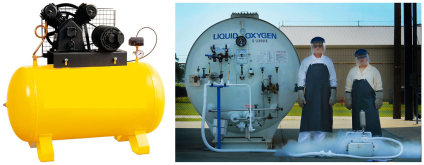
We conclude this chapter by revisiting some common language terms, as they are understood in thermodynamics. Hot — For us, “hot” is not a property of objects: instead of “this object is hot”, we say that its temperature is high. Instead of “this object is heating up/cooling down” we say that its temperature is increasing or decreasing. In everyday language, phrases like “it is hot” or “heat wave” also refer to temperature. To heat — For us, “to heat up” means to supply heat. We can “heat up” an object while its temperature drops. We can also raise the temperature of an object without supplying heat (figure 1.4). Cold — For us, the sensation of “cold” denotes a low temperature. We do not consider “cold” to be something that can be manufactured or measured. Instead, we would say that we are transferring heat away from an object (for example, a refrigerator extracts heat from a warm food item). Fire — Fire is the term given to the emission of light (electromagnetic radiation) from a gas at high temperatures. In thermodynamics, “fire” does not have any special properties. For us, it is the same heat whether it is generated by the combustion of wood or kerosene, by friction in a brake, or by a nuclear reaction. Ultimately, the only thing that matters is the temperature at which it is transmitted!
Figure 1.4:Left: when air is compressed in a compressor, air gives heat away through the sides and the fins of the cylinders; and yet, its temperature increases. Right: by contrast, when liquid oxygen is expanded in a vane, liquid oxygen receives heat from the atmosphere (as evidenced by the condensation and frost from atmospheric air on the piping); in spite of this, its temperature drops.
Compressor photo CC-by-sa Fábio Teixeira
Liquid oxygen photo public domain Jensen Stidham / USAF
We simply note that we humans are ourselves very poor thermometers: since the human body attempts to maintain a constant temperature, our sensations of “hot” or “cold” are intrinsically linked to heat transfer.
Even though this vocabulary probably puts us among the unsociable scientists relegated to the end of the table, it equips us better to face what’s next, because in the next chapter, we will be dealing with closed systems.
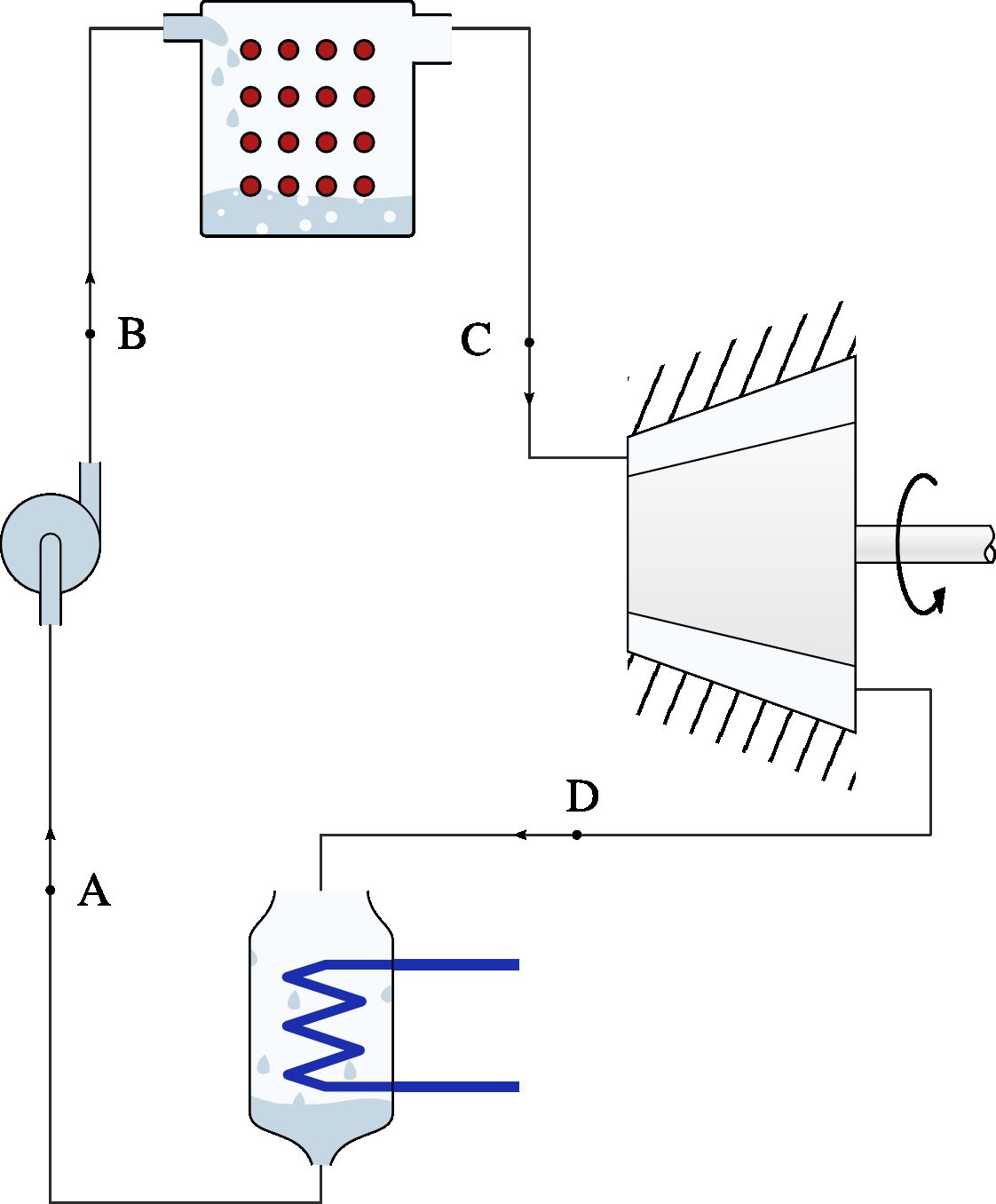
Figure 1.8:Simplified diagram of the water circuit inside a steam power plant. The water follows a complete cycle through four processes. This circuit, called the Rankine cycle, is studied in more detail in chapter 9 (steam power cycles) (section 9.4.2 p. 252).
From A to B the liquid water is compressed in the pump. It receives a specific work wA→B=+50kJkg−1, with no heat transfer.
From B to C the water is heated in the boiler, where it exits as steam. It receives a specific heat qB→C=+450kJkg−1, without receiving any work.
From C to D the water expands in the turbine, where it delivers a specific work wC→D=−194kJkg−1, without receiving or giving heat.
From D to A the water is cooled in a condenser, with no work transfer. It returns to its original state and properties before returning to the pump to be compressed again.
The water flow rate circulating in the plant is 15kgs−1.
What is the specific power rejected in the form of heat in the condenser?
What is the power (in watts) rejected by the condenser?
What is the power (in watts) generated by the turbine in the form of work?
What is the efficiency ηplant of the power plant, that is, the ratio between its net power and the power it receives as heat?
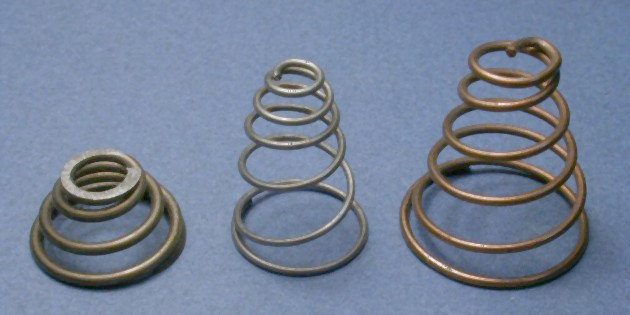
Figure 1.9:Conical springs, whose stiffness increases exponentially when compressed. We will see in chapter 2 (closed systems) that when fluids are compressed and expanded slowly, they behave similarly to spring C, which has a conical geometry like those shown here.
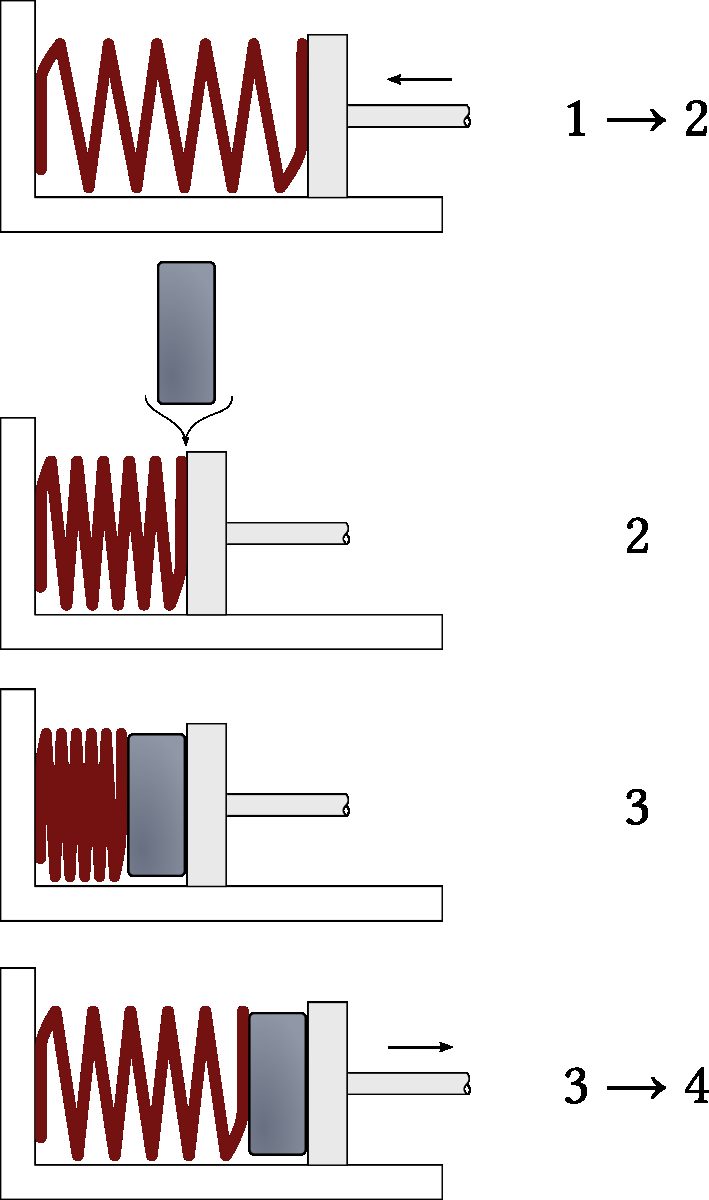
Figure 1.10:Experiment conducted with a powerful spring. The piston compresses the spring from 1 to 2, then the spring pushes back the piston from 3 to 4. On the return path, the force exerted by the spring is greater.
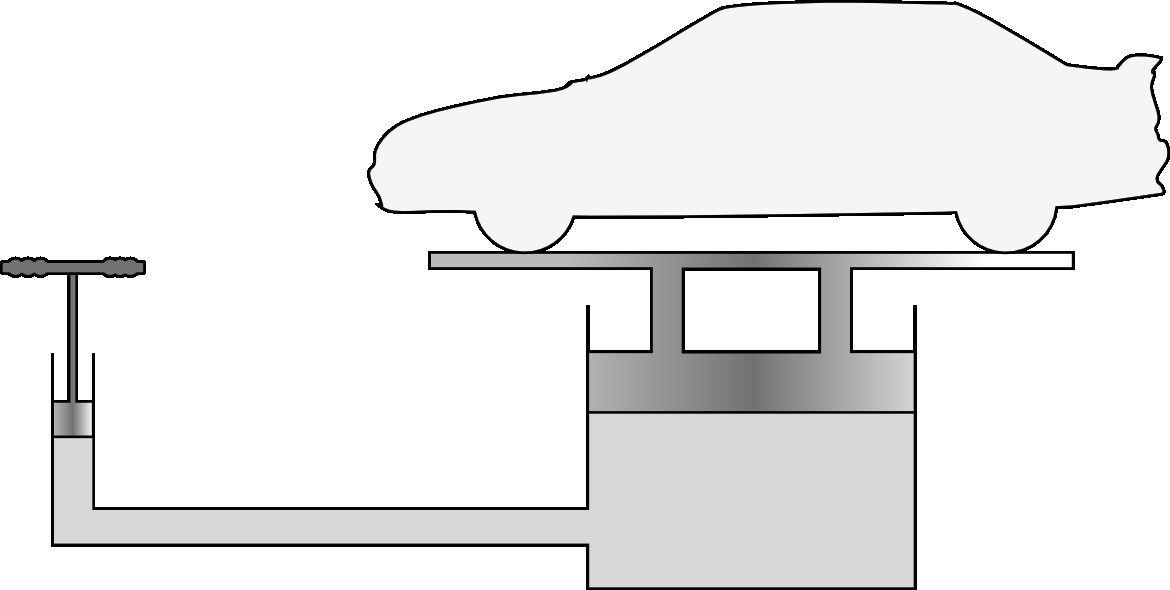
Figure 1.11:Schematic diagram of a hydraulic jack.
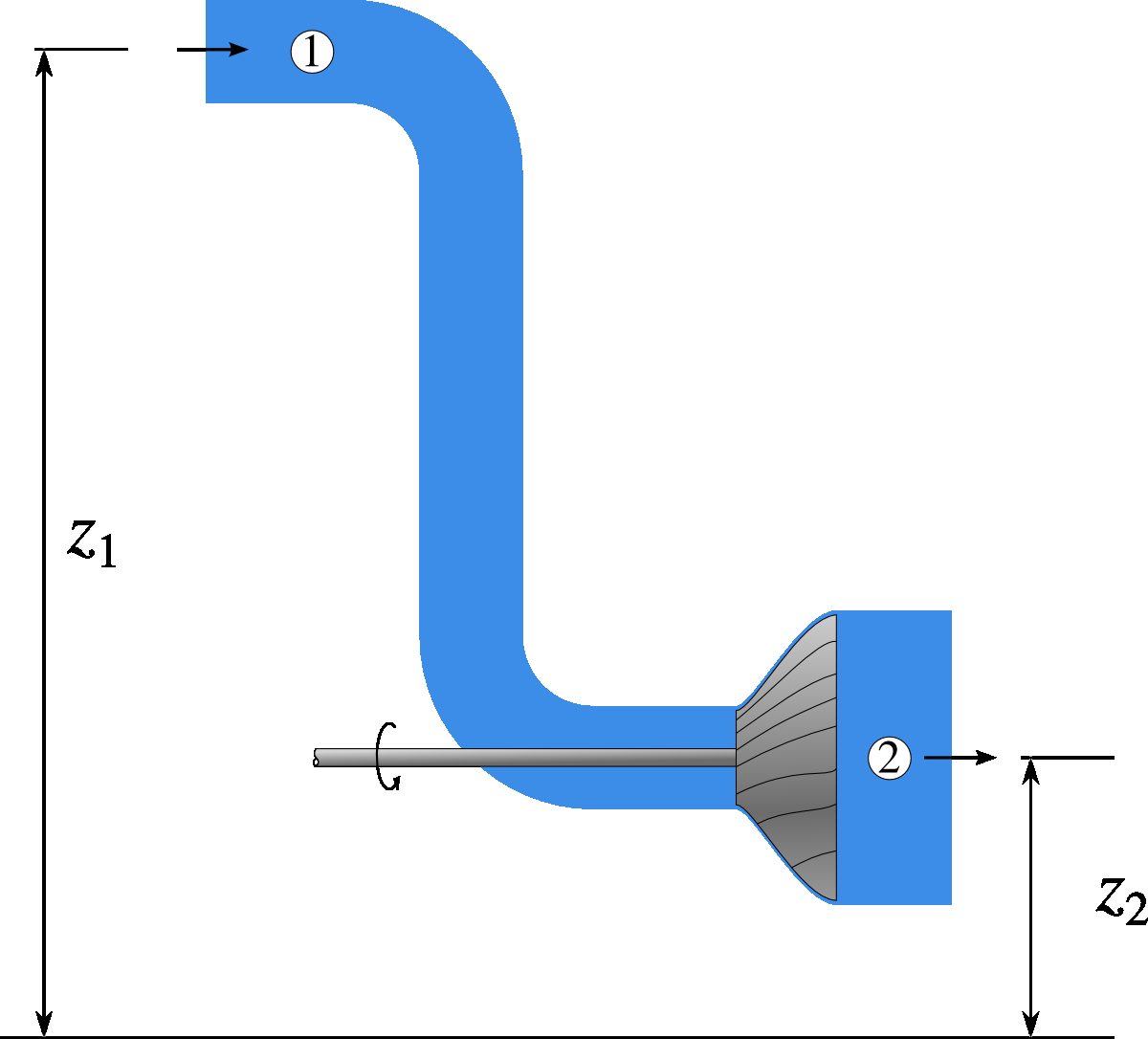
Figure 1.12:Schematic diagram of a water turbine. Water enters at the top left, rotates the turbine blades, is heated by internal friction, and exits at the bottom right of the machine.
What is the specific mechanical power received or supplied by the water as it passes through the power plant?
What is the specific power provided as heat by internal friction?
What is the power (in watts) released in the form of work by the turbine?
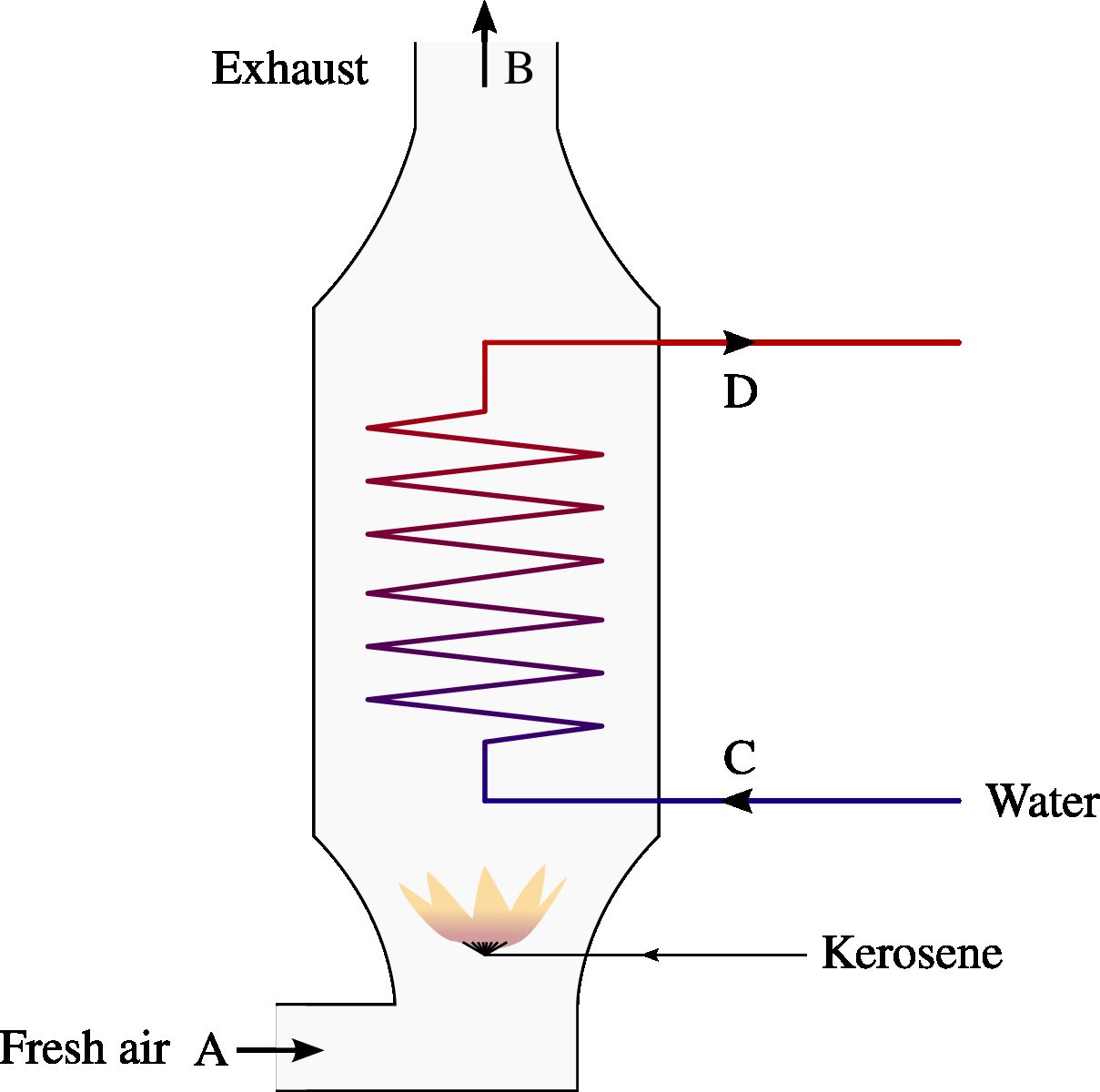
Figure 1.13:Schematic diagram of a boiler used for heating a building. The water (C → D) enters from the right and is heated by the air (A → B) mixed with kerosene.
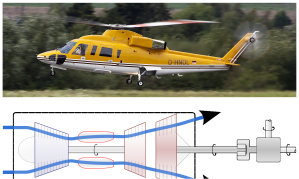
Figure 1.14:A Sikorsky S-76B helicopter, equipped with two P&WC pt-6b turboshaft engines, each with 980hp. The airflow through the engines is shown in a schematic diagram. We will study these engines in more detail in chapter 10 (air-based power cycles).
A force is called conservative when it remains the same in one direction as in the other. For example, gravity is conservative (it is the same whether going up or down) but friction is not (it always opposes the motion).