Problem 11.1. Principal planes for a thick lens.
In this problem the transfer matrix for a thick lens is derived. By finding the positions of the principal planes, you will derive that the transfer matrix has the same form as for a thin lens when object, image and focal distances are measured with respect to principal planes.
The transfer matrices which you should use are those for refraction through a spherical interface between two media with refractive indices , to the left and right of the interface, respectively, and with radius of curvature :
where , and the matrix for propagation through a medium with refractive index over a distance .
Consider a thick lens made of a glass of refractive index with thickness . For paraxial rays, the thickness can be identified with the distance between the vertices and of the surfaces of the lens.
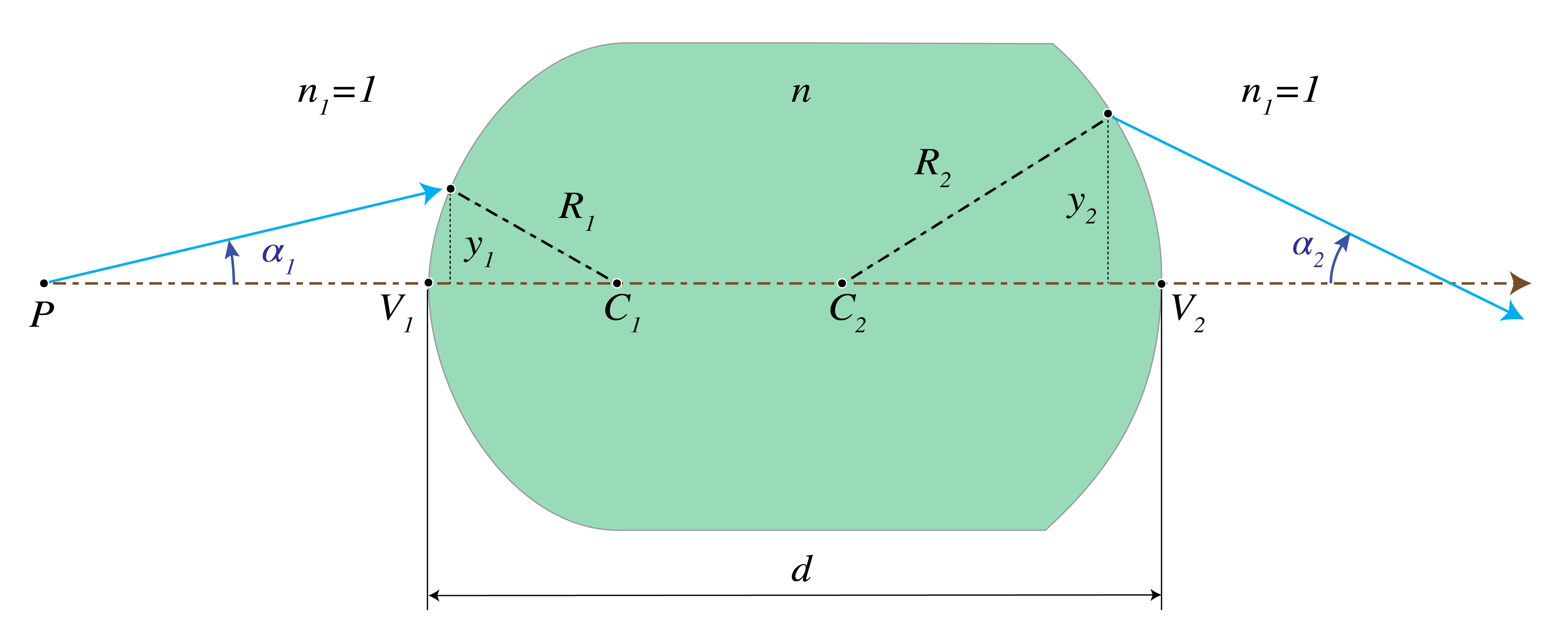
Figure 1:Thick lens geometry showing the two curved surfaces with vertices V₁ and V₂ separated by thickness d. The lens has refractive index n and is surrounded by air, with radii of curvature R₁ and R₂ for the left and right surfaces respectively.
(a) Derive that the transfer matrix between the surfaces through the two vertices of the thick lens is given by:
where and
(b) Show that for the transfer matrix is identical to that for a thin lens given by Eq. (25).
The thick-lens section of this chapter defines the primary and secondary principal planes. Let be the signed distance from the first principal plane to vertex , and the signed distance from vertex to the second principal plane , as shown in Figure 2. Thus when is left of , and when is right of .
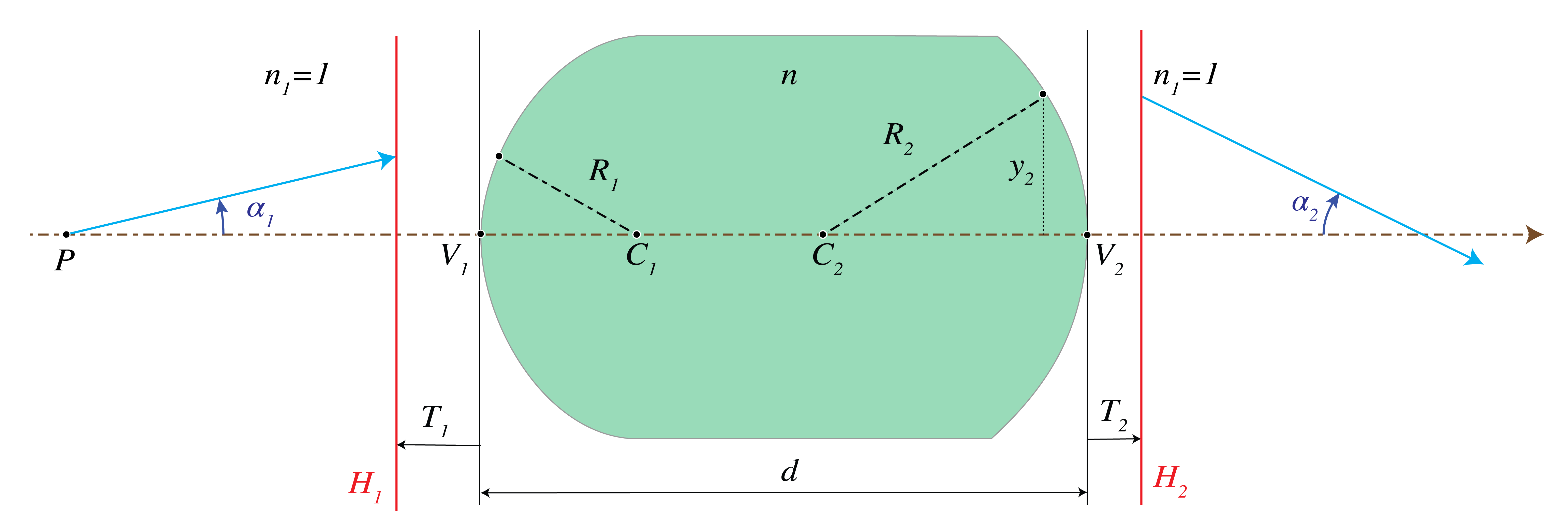
Figure 2:Thick lens with principal planes.
The transformation of a ray from the primary principal plane to the secondary principal plane is:
where
(c) By using the following abbreviation for the matrix Eq. (2):
derive that:
(d) The principal planes are conjugate (i.e. they are images of each other) with unit magnification. Derive from this fact that the locations of the principal planes are given by:
With the solutions for and the system matrix between the principal planes becomes:
which has the same shape as the transfer matrix for a thin lens.
(e) Show that the signed image focal coordinate measured from is and the signed object focal coordinate measured from is . For a positive lens in air, both focal distances have magnitude .