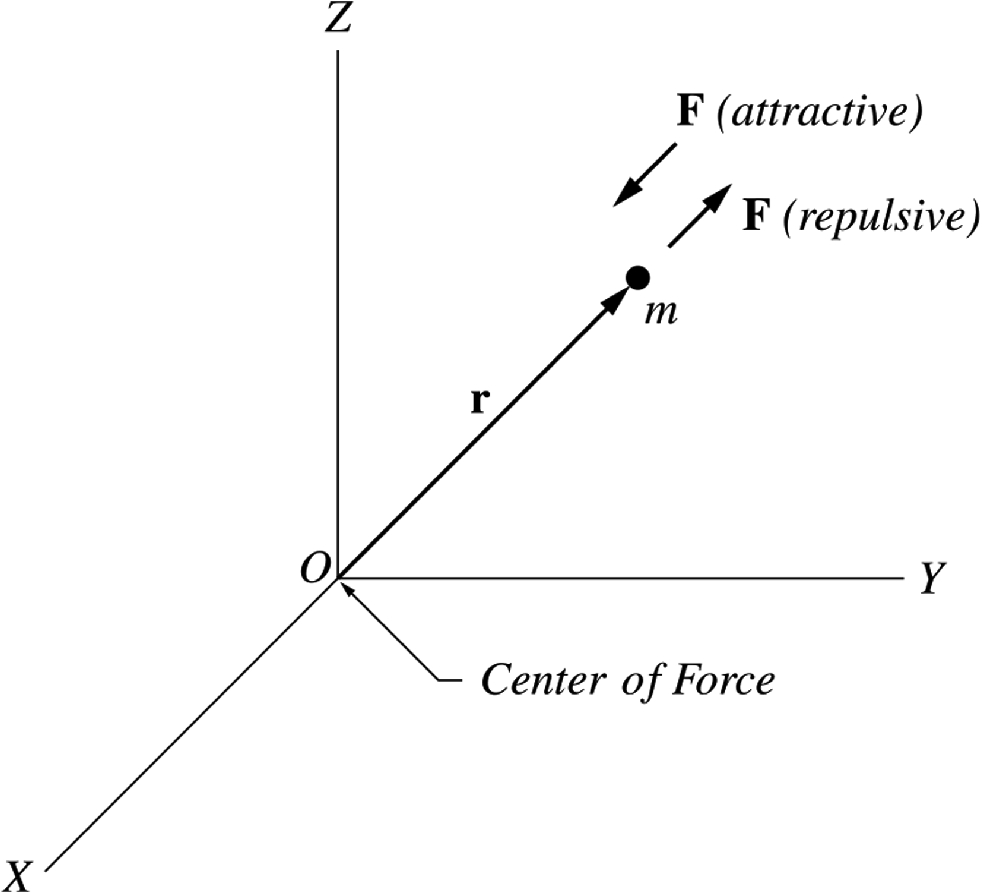
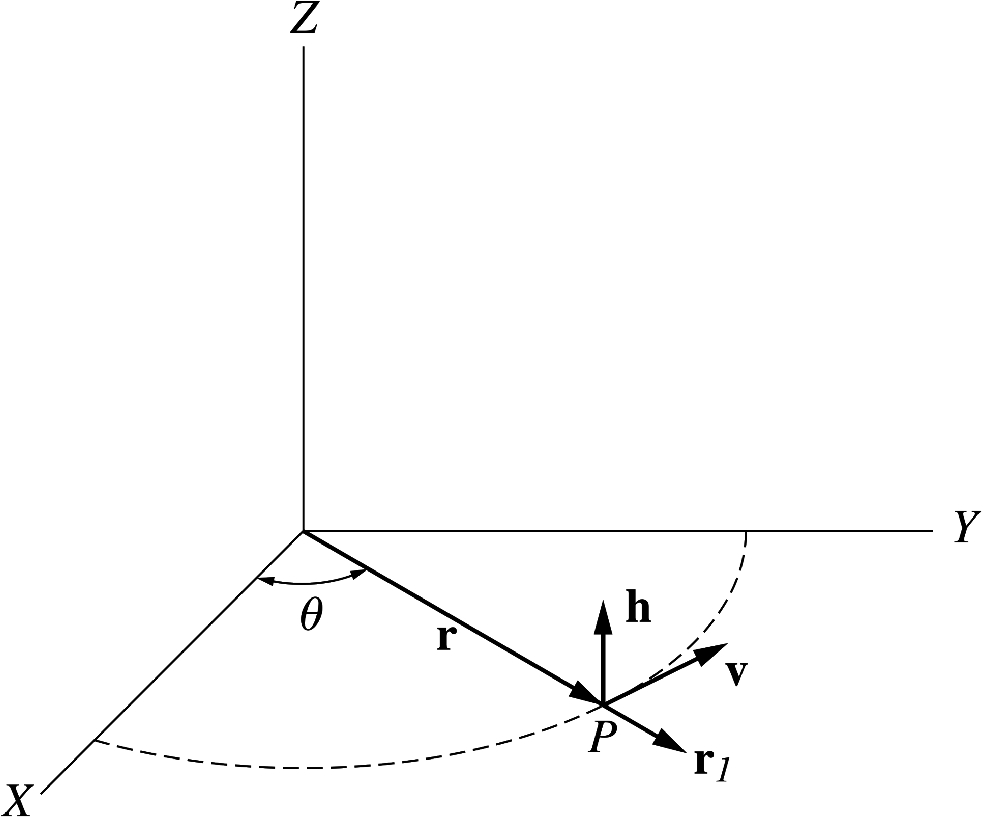
A force is said to be central under two conditions. First, the direction of the force must always be toward or away from a fixed point (see Fig. Figure 1). This point is known as the center of the force. Second, the magnitude of the force should only be proportional to the distance r between the particle and the center of the force. The central force may be written as
where r1 is a unit vector in the direction of r. Therefore, if f(r)<0, then the central force is an attractive force since it is directed toward the center of the force O (as shown in Fig. Figure 1) and if f(r)>0, the force is repulsively directed away from O.
where h is a constant vector. Therefore, r and v always lie in the same plane where h is perpendicular to that plane for every value of t. As a result, the path of the particle takes place in a plane. 2.The angular momentum of the particle is conserved. From Eq. 9.2, we have
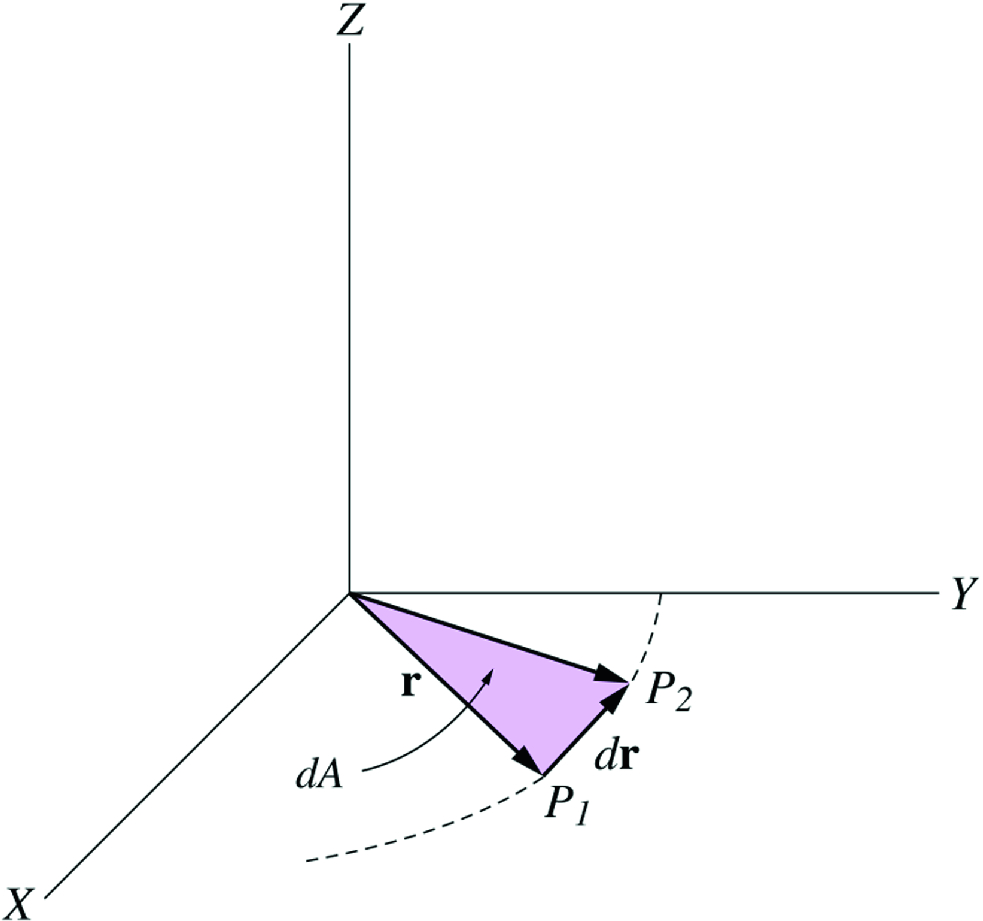
Thus, the angular momentum is equal to a constant at all times (conserved). 3.The position vector r of the particle with respect to the center of force sweeps out equal areas in equal times or in other words, the areal velocity is constant. To show that, consider the plane of motion to be the x–y plane. During an infinitesimally small time interval dt, the radius vector r sweeps out an area equal to dA. From Fig. Figure 2, this area is equal to half of the area of a parallelogram with sides r and dr. That is,
Figure 2:During an infinitesimally small time interval dt, the radius vector r sweeps out an area equal to dA
9.1.2 Equations of Motion in a Central Force Field
The most convenient coordinate system to describe the motion of a particle, under the influence of a central force, is the polar coordinate system. This convenience lies in the fact that the central force is in the r-direction. In Sect. 2.6, it has been shown that the acceleration of a particle in a plane, in terms of its polar coordinates, is given by
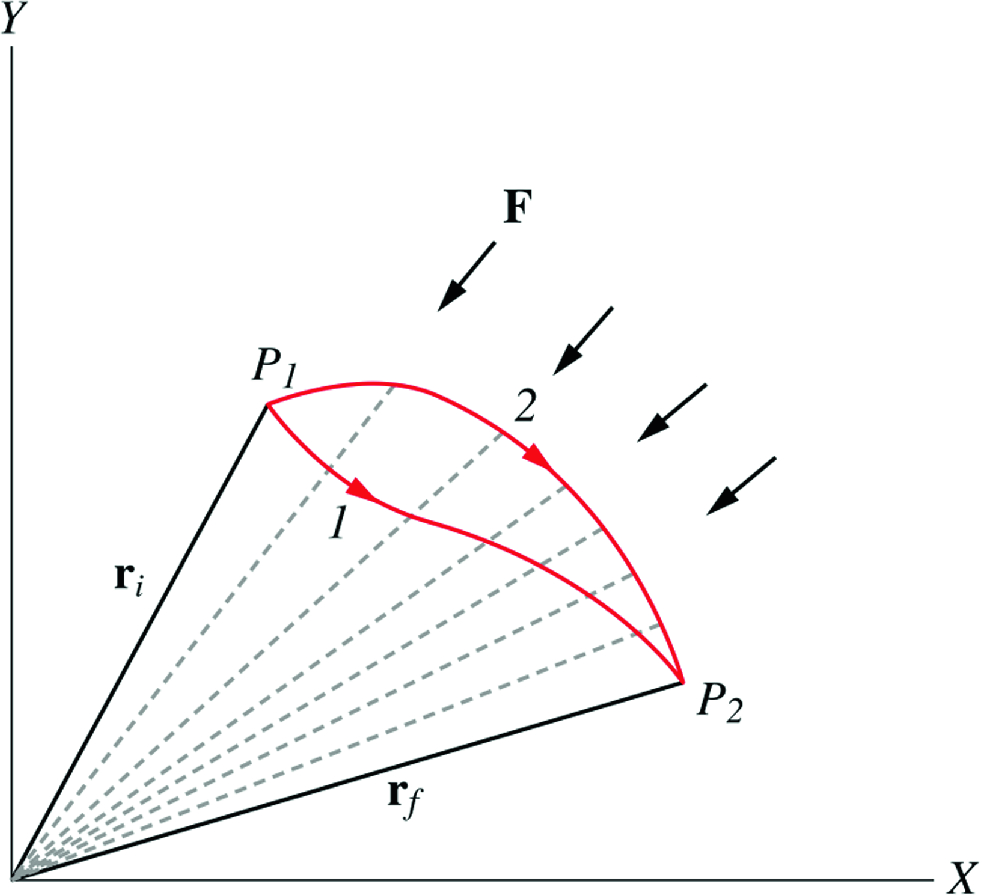
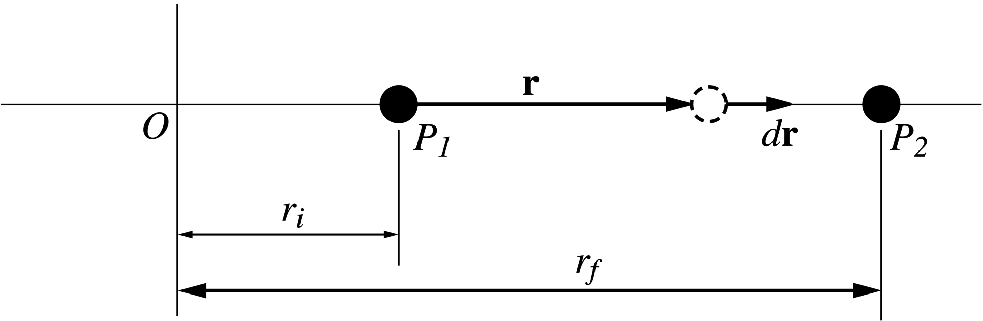
Consider a particle moving from point P1 to P2 (see Fig. Figure 3) while a central force that has its center at the origin acts on it. The path of the particle may be considered as a combination of radial and curved segments. The central force is always acting in the direction of the radial segments and is perpendicular to the displacement along any of the curved segments. Thus, the work done by the central force along any curved segment is zero and the total work done in moving the particle along any path is equal to the work done along a radial line from ri to rf (see Fig. Figure 4). That is, the work done by a central force is independent of path. It depends only on the initial and final positions of the particle.
Figure 3:A particle moving from point P1 to P2, while a central force that has its center at the origin acts on it
Figure 4:The central force is always acting in the direction of the radial segments and is perpendicular to the displacement along any of the curved segments. Therefore, the total work done in moving the particle along any path is equal to the work done along a radial line from ri to rf
From this, we conclude that the central force is a conservative force. You may also prove that ∇×F=0. Hence, there exists a potential energy and the work done by the gravitational force may be written as
In 1687, Isaac Newton made a remarkable discovery. Newton stated that the force that holds planets in their orbit is the same force that makes an apple fall from a tree. Newton’s law of gravity states that every particle in the universe attracts every other particle with a force that is directly proportional to the product of the masses of the particles and inversely proportional to the square of the distance between them. The magnitude of this gravitational force is given by
where m1 and m2 are the masses of the particles, r is the distance between them, and G is the universal gravitational constant. G has the same value if the particles (or objects) are located anywhere in the universe and it is given by
The gravitational force is effective when one or both the masses are very large. This is because G is a very small number. Note that, the gravitational force is not a contact force; it is a field force that can act through any medium. The direction of the gravitational force is along the line joining the two particles.
Therefore, the gravitational force is a central force since its magnitude is proportional only to the distance between the two particles (where one of the particles can be considered as the center of force), and its direction is along the line joining them (toward the center of force).
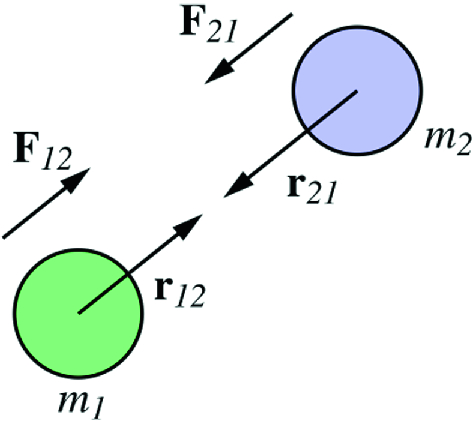
Figure 5:Two particles of masses m1 and m2. Each particle exerts a gravitational force on the other
Figure Figure 5 shows two particles of masses m1 and m2. Each particle exerts a gravitational force on the other. Let the gravitational force exerted on m2 by m1 to be F21, and that exerted on m1 by m2 to be F12. From Newton’s third law of action and reaction, we have
where r12 is a unit vector that is directed along the line joining the two particles (directed from m1 to m2) and r21 is a unit vector directed from m2 to m1. The negative sign indicates that the force is attractive. That is, the force exerted on m1 by m2 will move m1 in the direction opposite of r21, i.e., toward m2. Where the force exerted on m2 by m1 will move m2 opposite to r12 (toward m1). If particle P of mass of mP interacts with a system of particles, the resultant gravitational force FP exerted on particle P due to all particles in the system is the vector sum of the individual forces that each particle in the system exerts on particle P:
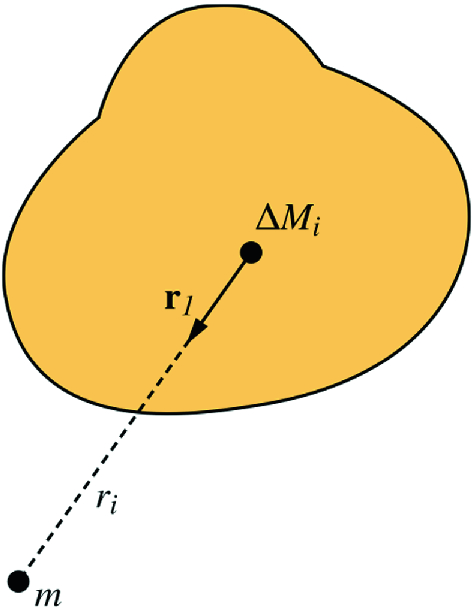
where riP is a unit vector directed from the ith particle in the system toward the particle P and FPi is the force exerted on particle P by the ith particle. If particle P of mass m interacts with an extended body of mass M, the resultant gravitational force FP exerted on particle P is the vector sum of the individual forces dF exerted on particle P due to each mass element dM in the object, but in this case, the sum is replaced by an integral
where r1 is a unit vector directed from the mass element dM to the particle as shown in Fig. Figure 6. The force of gravity gives planets and other heavy celestial bodies their spherical shape. That is because as the mass of the body becomes larger the force of gravity becomes stronger and all particles from all sides are attracted evenly toward the center. As a result, the body tends to have a spherical shape.
Figure 6:A particle P of mass m interacting with an extended body of mass M
9.2.1 The Gravitational Force Between a Particle and a Uniform Spherical Shell
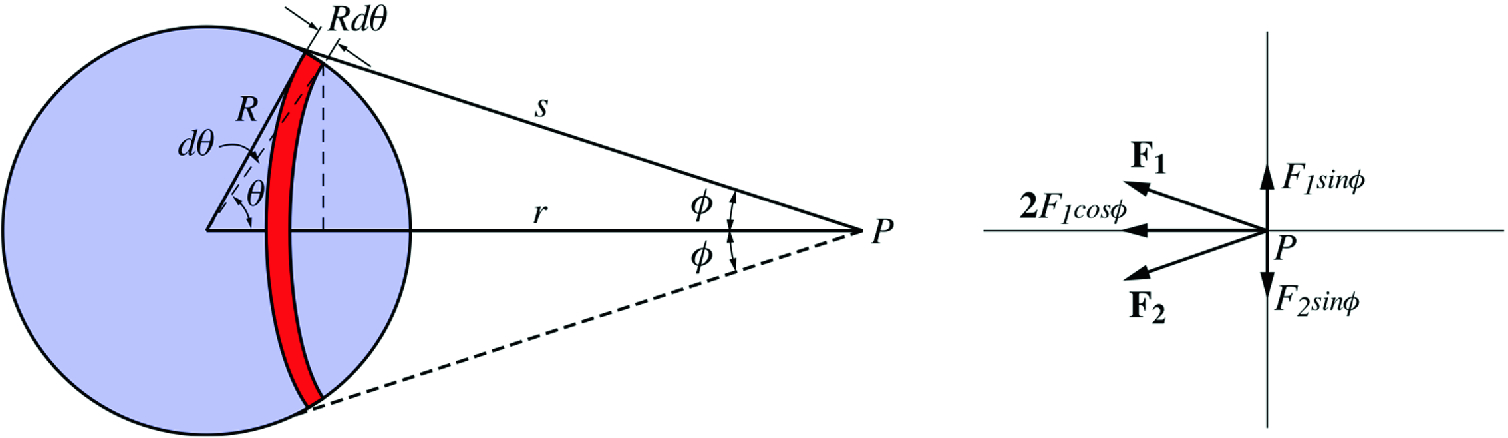
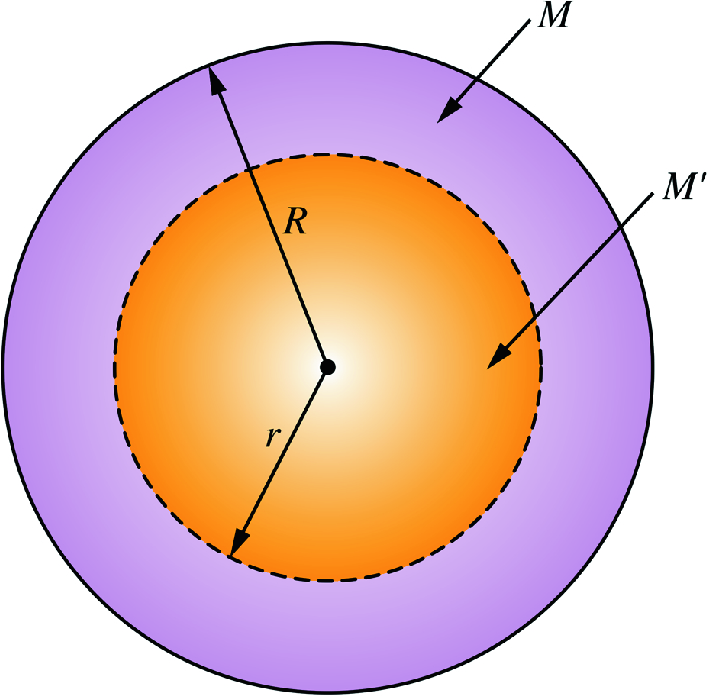
Case I: A Particle outside the Shell Consider a particle of mass m located outside a uniform spherical shell at point P as in Fig. Figure 7. Imagine this shell to be made of a large number of thin rings each of outer thickness Rdθ and inner thickness l. The ring is so thin (since dθ is used) that every particle in the ring is at a distance s from P Furthermore, each particle in the ring exerts a gravitational force on the particle at P.
Figure 7:Because F1 and F2 are equal in magnitude, then their y components cancel each other out and their x components add up
From the symmetry of the ring, if a particle (1) on the upper side exerts a gravitational force F1 on m, there is always another particle (2) at the opposite side of the ring exerting another force (F2) on the particle. Because F1 and F2 are equal in magnitude, then their y components cancel each other out and their x components add up (see Fig. Figure 7). Thus, the resultant force exerted on m due to all particles of the sphere is the sum of the x components of their forces. Therefore the resultant force on m is along the x direction (toward the center of the shell). The gravitational force exerted on m by a thin ring of mass dM is
To integrate over all rings, θ will change from θ=0 to π. From Eq. 9.15, we have at θ=0,s=r−R since (r≥R), and at θ=π,s=r+R. Also, we have from Eq. 9.15
That is, the spherical shell behaves as a particle of mass M located at its center.
Case II: A Particle inside the Shell If a particle is inside a uniform spherical shell, the derivation of the gravitational force exerted on the particle by the spherical shell is the same as if the particle were outside the shell, except that the lower integration limit is different. At θ=0,s=R−r since r<R. Thus, we have
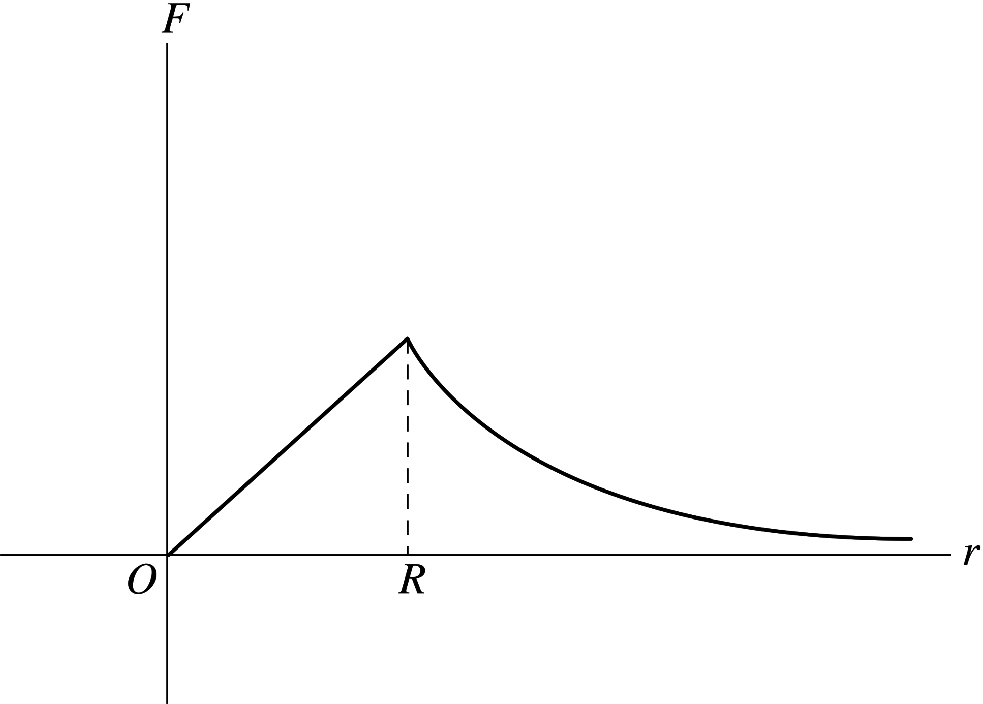
where r<R. That is, if the particle is inside the shell, the gravitational force exerted on it by the shell is zero. However, objects outside the shell may still exerts forces on the particle. In summary, we have
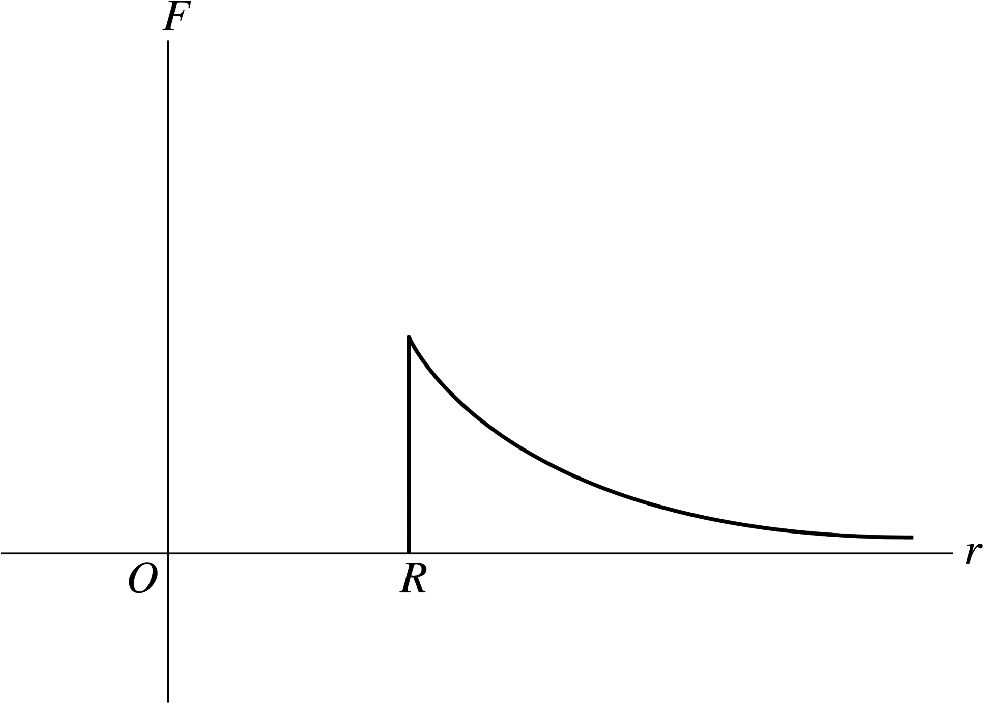
Figure Figure 8 shows the force exerted on a particle as a function of its location.
Figure 8:The force exerted on a particle as a function of its r
9.2.2 The Gravitational Force between a Particle and a Uniform Solid Sphere
Case I: A Particle outside the Sphere Consider a particle of mass m located outside a uniform solid sphere. The sphere may be considered to be made of a series of concentric spherical shells. The force exerted on the particle by each shell is given by
The mass of each shell is dM=ρdV=ρ4πa2da. Where ρ is the volume density of the sphere and a is the distance from the shell to the center of the sphere and da is the thickness of the shell, Hence,
Thus, the solid sphere behaves as a particle of mass M located at the center of the sphere.
Figure 9:If a particle of mass m is located inside a uniform solid sphere of mass M, then the gravitational force exerted on the particle is due only to the part of the sphere of radius r<R and of mass of M
Case II: A Particle inside the Sphere If a particle of mass m is located inside a uniform solid sphere of mass M, then the gravitational force exerted on the particle is due only to the part of the sphere of radius r<R and of mass of M (see Fig. Figure 9). The remaining part of the sphere is a spherical shell which exerts no force on the particle since the particle is located inside it. From Eq. 9.18, the gravitational force exerted on the particle due to a sphere of radius r and mass M1 is given by
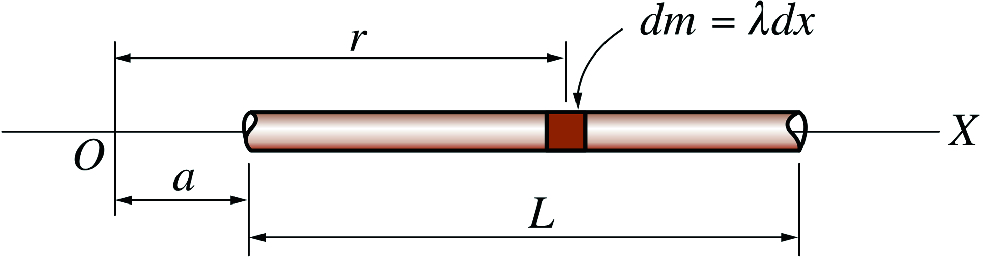
That is, the rod can be considered as a particle of mass M that is at a distance a from m.
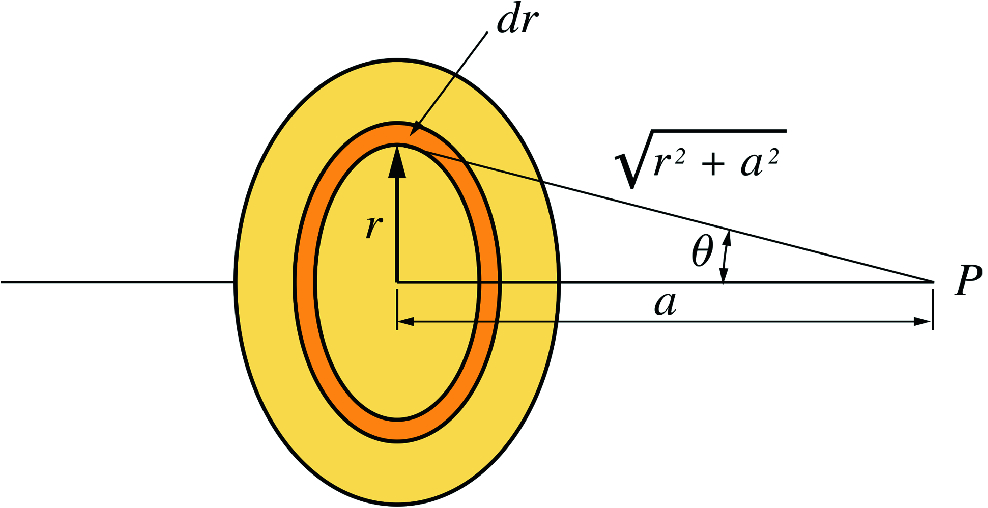
Figure 12:The gravitational force exerted on a particle of mass m that is at a distance a from the center of a uniform solid disk of radius R and mass M
Let us divide the disk into thin concentric rings of radius r and thickness dr. By symmetry, the resultant force on the particle is directed along the axis of the ring, since the y-components of the forces exerted by all particles of the ring will cancel out, where their x-components will add up. That is,
In Chap. 4, we’ve seen that the weight of an object is defined as the gravitational force exerted on the object by the earth (or any other astronomical object) and it is directed toward the center of the earth. The weight of an object is given by w=mg, where g is the free-falling acceleration and its value near the earth’s surface is 9.8 m/s2. The exact form of the gravitational force between any two objects was given earlier in this chapter by Newton’s law of gravity In the case of an earth–particle system, the gravitational force that each one exerts on the other is
where ME is the mass of the earth and m is the mass of the particle that is at a distance r from the center of the earth. Note that, it is assumed that the earth is a perfect sphere of uniform mass distribution, and therefore behaves as a particle. In reality, the earth is not a perfect sphere but rather an ellipsoid. Furthermore, the earth’s density is not uniform since it varies with the radius of earth.
The earth’s density also varies at the earth’s surface from one region to another. In addition, if the earth’s rotation is included, then the resultant force on an object will be its weight plus the centripetal force exerted on the object due to the rotation. However, these variations are often neglected. From the definition of weight, we have
As you can see the free-falling acceleration does not depend on the mass of the object as was predicted before. If the object is falling near the earth’s surface, then distance r in Eq. 9.21 can be replaced by RE which is the radius of the earth and we have
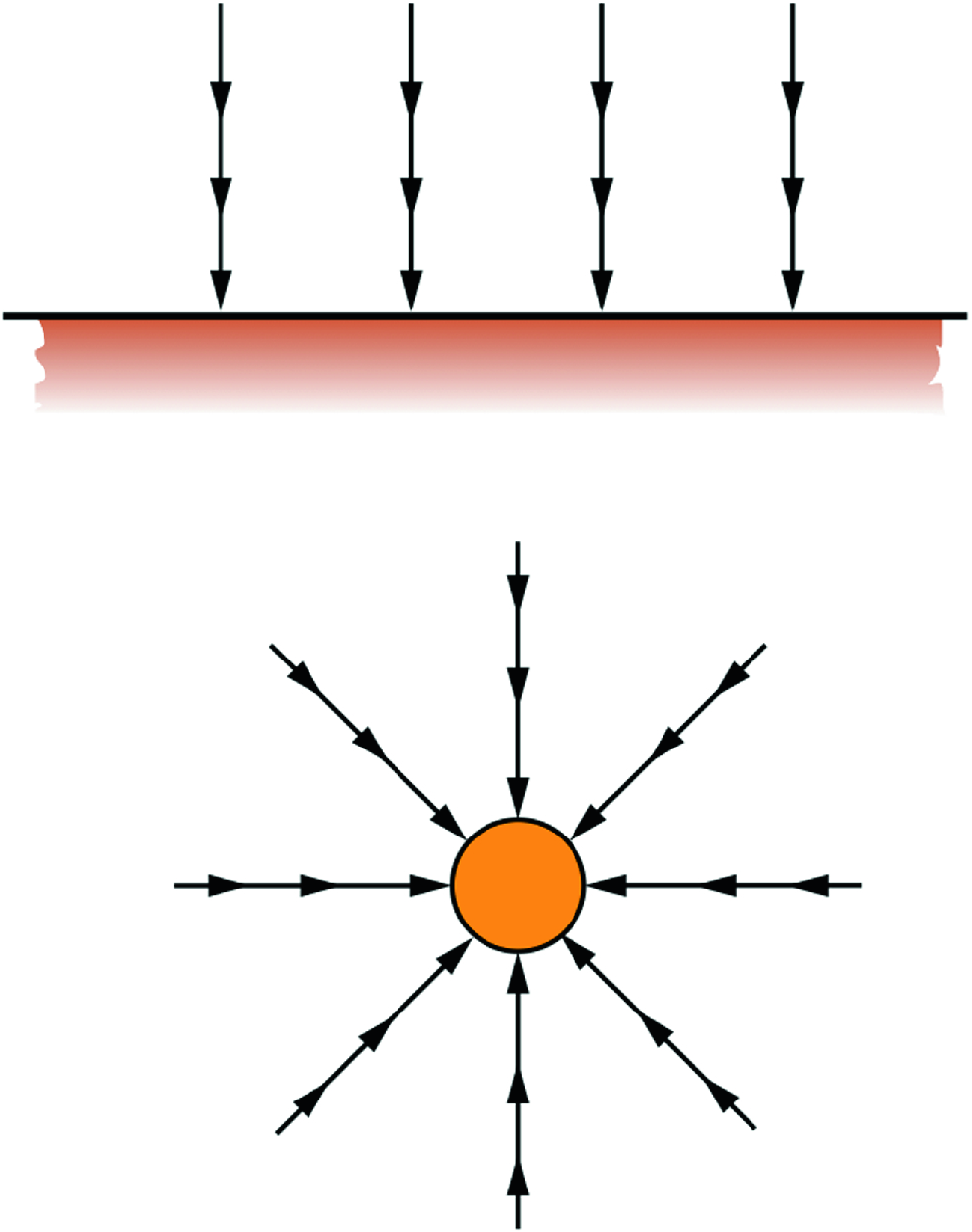
As mentioned previously, the gravitational force is a field force that can act through empty space, i.e., physical contact between objects is not necessary for such a force to act. An alternative way in describing the gravitational attraction is by introducing the concept of the gravitational field. Suppose a test particle of mass m0 is placed at different points from another mass M(which represents the center of the gravitational force). At each point, the test particle will experience a gravitational force that depends on its distance from M and is given by
where r1 is a unit vector that points radially outwards. Therefore, M may be considered as producing a gravitational field in the space around it. This field can be sensed by the force that the test particle experience when placed in the vicinity of M. The gravitational field produced by M at any point in space is thus given by
That is, the gravitational field at a point is defined as the gravitational force per unit mass at that point. A map of the field can be drawn showing the gravitational field at any point in space. Figure Figure 14 shows the gravitational field vectors near the earth’s surface and at large distances from the earth. Note that, the gravitational field is an example of a static field since the field at any point is constant with time.
Figure 14:The gravitational field vectors near the earth’s surface and at large distances from the earth
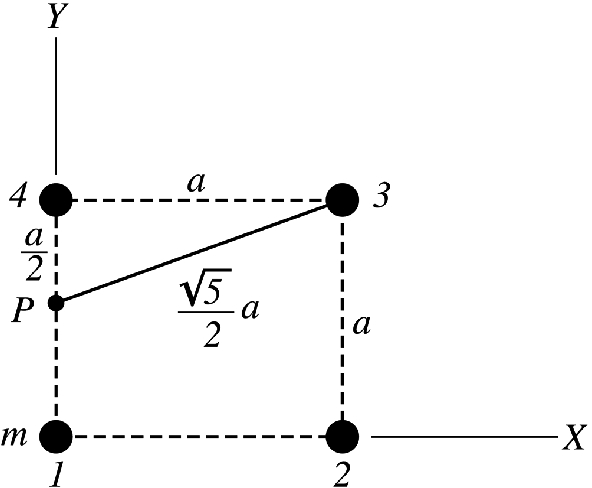
Figure 15:Finding the magnitude and direction of the gravitational field at P
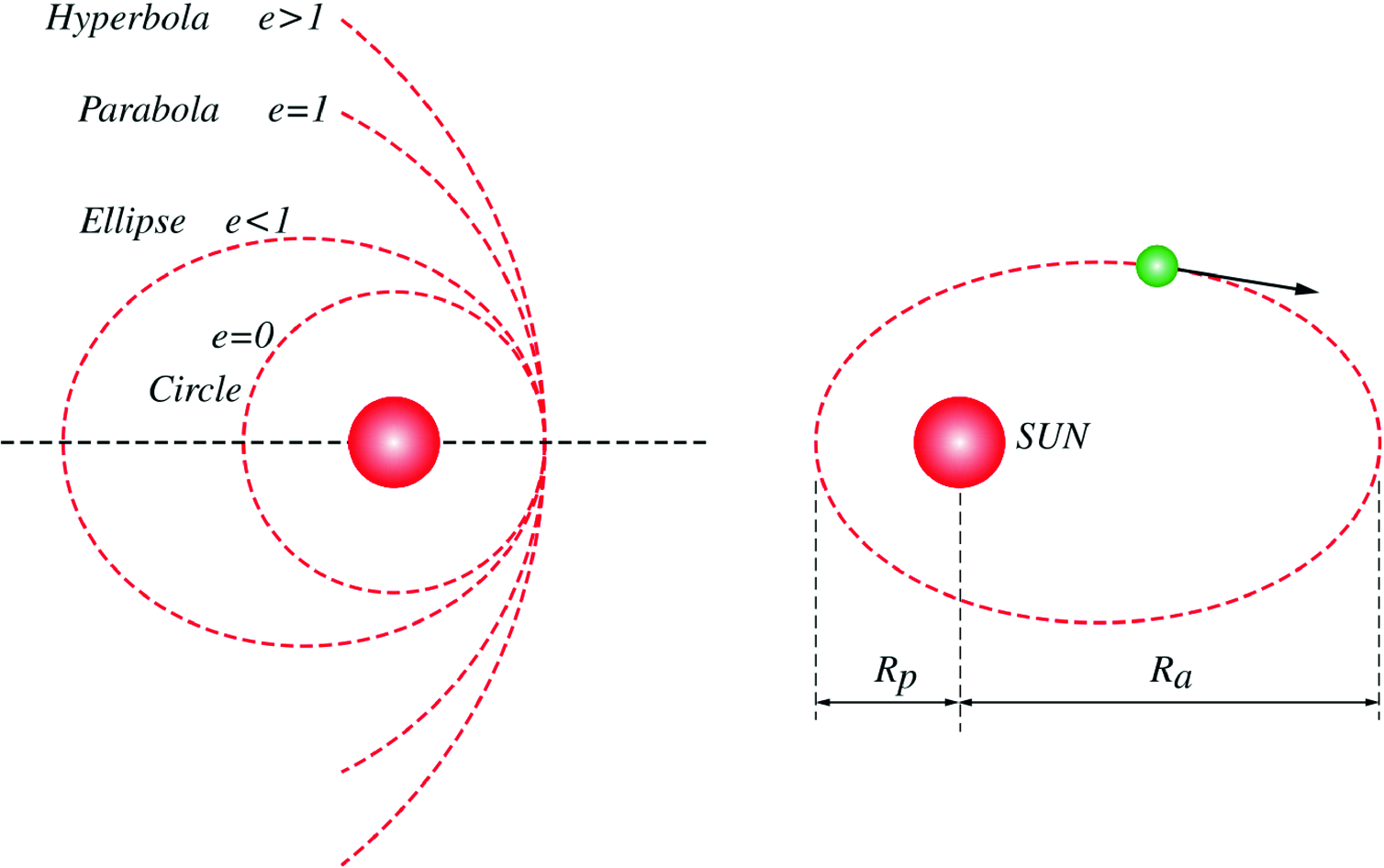
Conic sections are produced if a double right circular cone intersects with a plane. It may be a circle, a parabola, an ellipse, or a hyperbola.
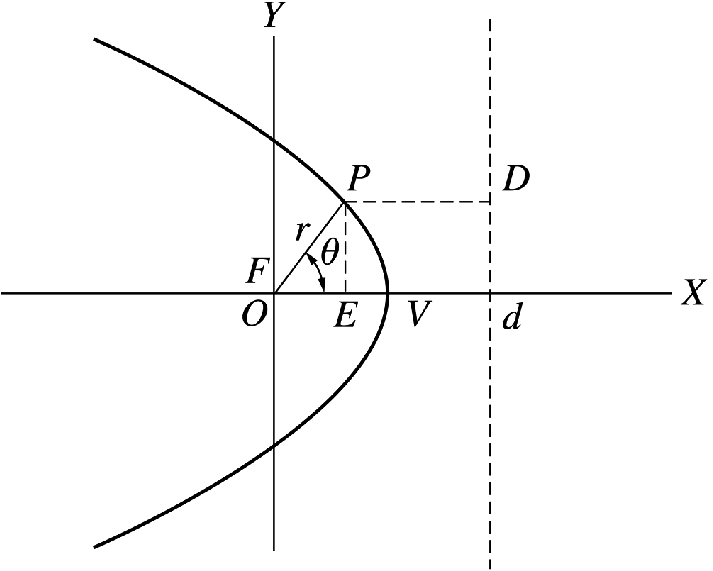
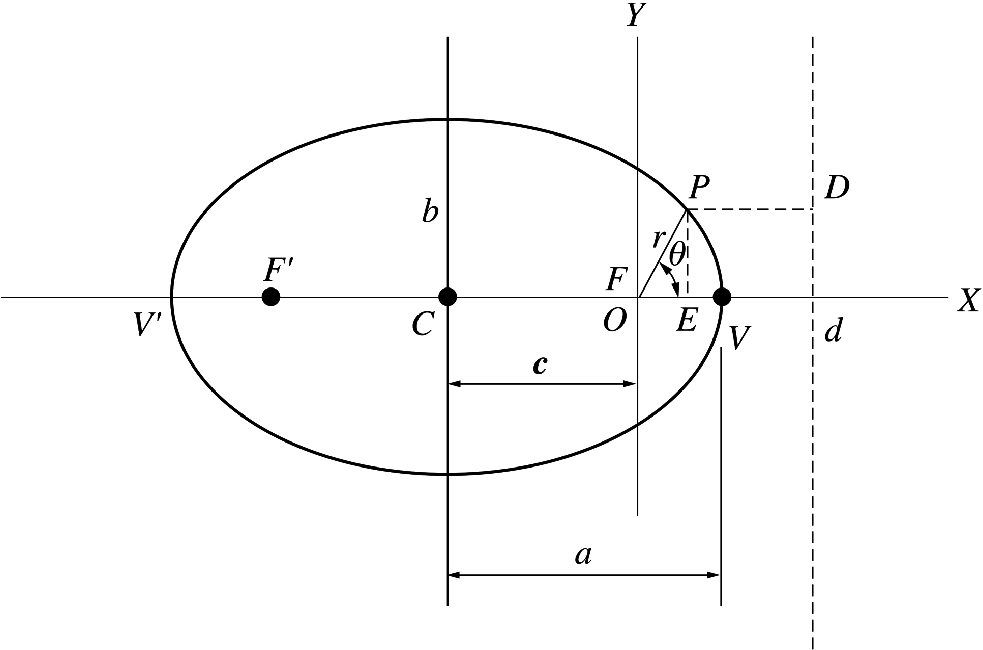
Figure 16:A conic section has the property that the ratio e (called the eccentricity) of the distance between any point on the curve (for example point P) and another point called the focus (F) to the distance between P and a line called the directrix is equal to a constant
A conic section has the property that the ratio e (called the eccentricity) of the distance between any point on the curve (for example point P) and another point called the focus (F) to the distance between P and a line called the directrix is equal to a constant (see Fig. Figure 16). This constant differs from one conic section to another. Consider Fig. Figure 16 where the focus F is at the origin O of the x and y coordinate system and the directrix is at x=d. Since the distance between P and F is
Since from Fig. Figure 17, we have c<a, i.e., the distance between the foci is less than that between the vertices, then e<1. Furthermore, you can prove that c=a2−b2 or b=a1−e2 where b is the length of the semiminor axis of the ellipse.
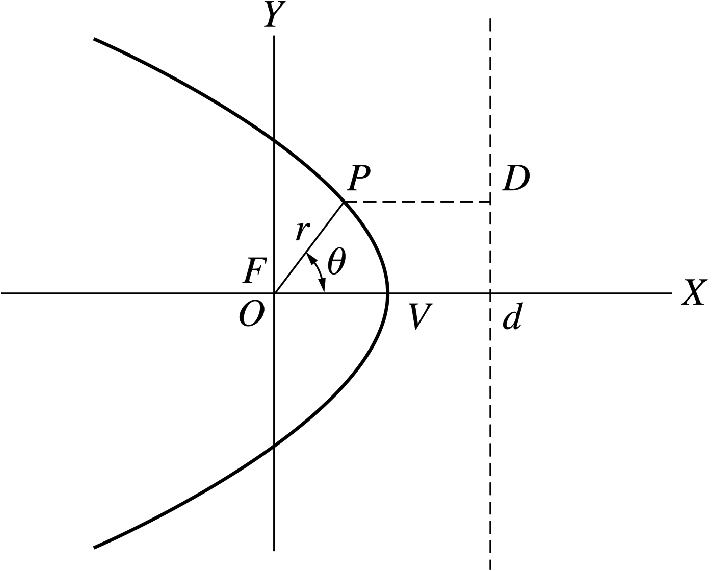
(Polar Equation of a Parabola) As θ approaches π,r becomes infinite and hence a→∞ (see Fig. Figure 18).
Figure 18:In a parabola, as θ approaches π,r becomes infinite and hence a→∞
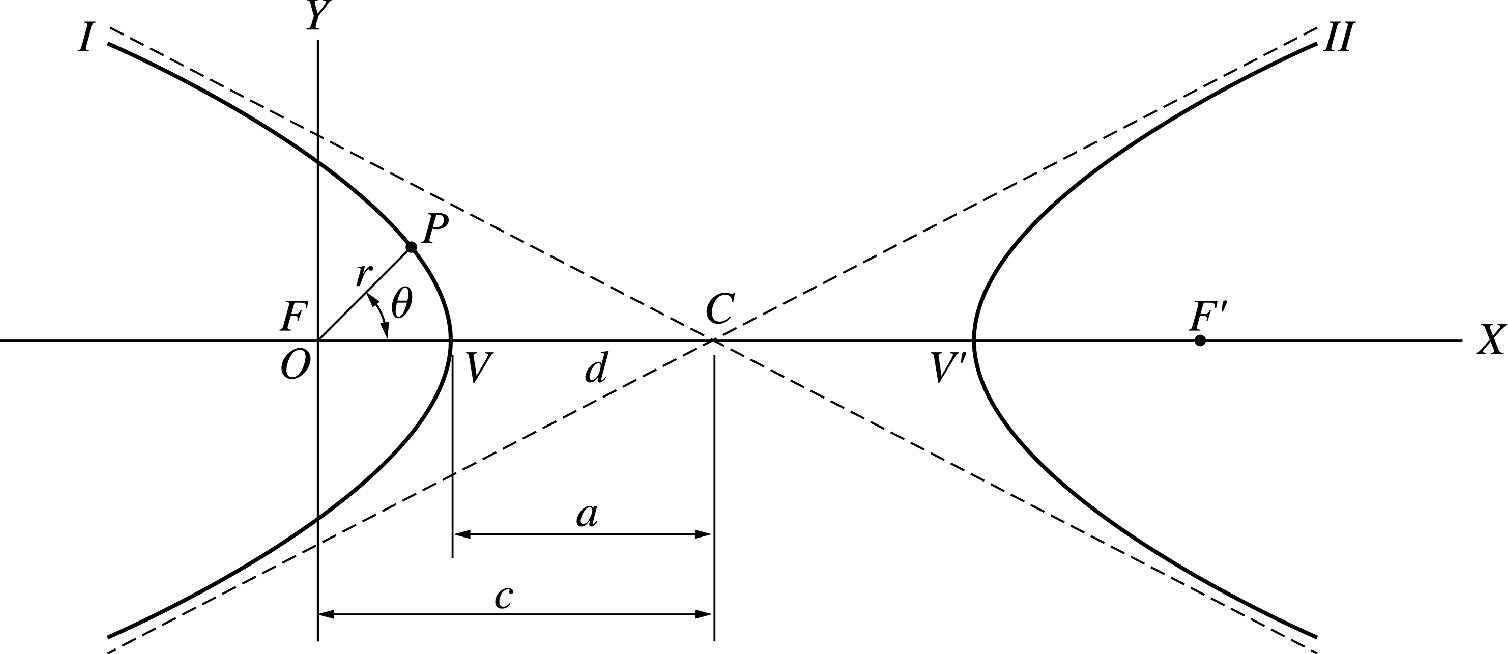
Hyperbola: e>1 The hyperbola has two branches as shown in Fig. Figure 19. For the gravitational force, only the first branch (I) represents a possible motion of the particle since GM/h2 must be positive. The polar equation of a hyperbola is given by
The path of a particle in any central force field can be found by solving the equation of motion (d2u/dθ2+u=−1/(mh2u2)f(1/u) (Eq. 9.9) if the form of the force is known. In the case of a gravitational force, we have
where C and ϕ are integration constants. ϕ is known as the phase angle and it can be chosen to be ϕ=0 if the x-axis is chosen such that at θ=0,r is a minimum. That gives
Thus, the path of the particle under the influence of the gravitational force field is a conic with ed=h2/GM and d=1/C and e=h2C/GM. If a planet is moving in elliptical orbit about the sun, then the maximum and minimum distances of the planet from the sun (OV and OV′) are called the aphelion and perihelion respectively If a satellite is moving about a planet in an elliptical orbit, the maximum and minimum distances of the satellite from the planet are called the apogee and perigee respectively.
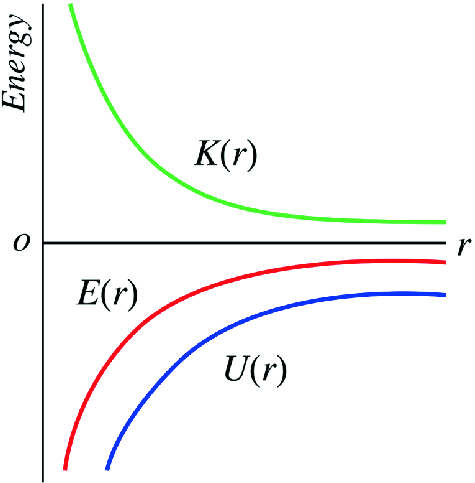
Consider a particle of mass m moving under the influence of a larger particle of mass M(M≫m). By using Eq. 9.10 (△U=Uf−Ui=−∫rirff(r)dr) and noting that f(r)=−GMm/r2, the change in the gravitational potential energy of the system as m moves from ri to rf in the field of M is
That is, as the particle of mass m moves toward or away from M, the potential energy of the system decreases and increases respectively Note that, the lighter particle (m) gains most of the kinetic energy as the potential energy changes. By choosing the reference point at infinity (ri=∞) then Ui=0 and taking rf=r gives
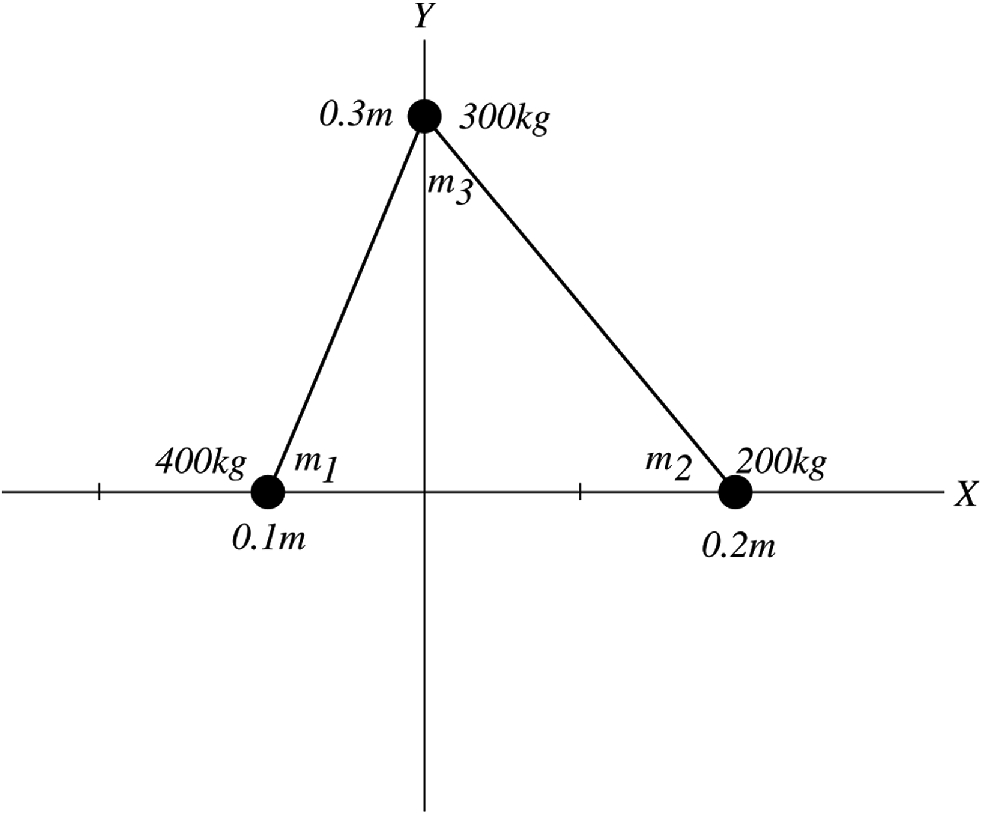
For more than two-particle systems, there is more than one gravitational force (one for each pair of particles). Hence, there is more than one potential energy The total potential energy is the sum of the potential energies of each pair. For example if there are three particles, the total potential energy is
Thus the trajectory of the particle is an ellipse if e<1, that is if E<0. Therefore, if the potential energy of the particle is greater than its kinetic energy the particle’s path is an ellipse since it does not have enough energy to reach infinity. The trajectory of the particle is a parabola if e=1 and hence if E=0. In that case, the kinetic energy of the particle is equal to its potential energy and thus it can reach infinity with zero kinetic energy. Finally, the trajectory of the particle is a hyperbola if e>1 and therefore if E>0. That is, if the kinetic energy of the particle is greater than its potential energy, then it will reach infinity with positive kinetic energyElliptical Orbit E<0Parabolic Orbit E=0Hyperbolic Orbit E>0
After analyzing the astronomical data of the Danish astronomer Tycho Brahe, the German astronomer Johannes Kepler formulated his three laws of planetary motion.
From the first property of a central force, we have r×v=h=constant, where h is a constant vector perpendicular to the x–y plane (see Fig. Figure 22). Since r=rr1 and v=dr/dt=drr1/dt=rdr1/dt+(dr/dt)r1 we have
The radius vector drawn from the sun to the planet sweeps out equal areas in equal periods of time.
This was proved in Sect. 9.1 as a property of a central force, where we’ve seen that for any central force, the position vector r of the particle from the center of force O sweeps out equal areas in equal times. That is,
The square of the period of revolution of any planet about the sun is proportional to the cube of the semimajor axis of its orbit.
The area of an ellipse is given by A=πab, where a and b are the semimajor and semiminor axis of the ellipse, respectively. From Kepler’s second law, the areal velocity is a constant given by
Also, we’ve seen that the eccentricity for the gravitational force is given by e=h2C/GM or e=h2C/GMS in the case of the planet–sun system. Since ed=a(1−e2), we have
This proves Kepler’s third law. Note that, Kepler’s laws apply also for satellites. In such cases, the mass of the sun in the previous equations is replaced by the earth or any other planet about which the satellite revolves.
The orbits of most planets in our solar system are almost circular. Next, we will find the total energy of a body of mass m moving in a circular orbit about a massive body of mass M that is assumed to be fixed (at rest) in an inertial frame of reference. From that energy, we will find the eccentricity and prove that the orbit is circular. The potential energy of such system is
The escape speed vesc is the speed required for an object to escape from the influence of the gravitational field of an astronomical object or system. Suppose an object of mass m is projected from the surface of a planet of mass M. The minimum speed for the object to escape the gravitational field of the planet is that in which the object has zero total mechanical energy at infinity. From conservation of energy, we have
where R is the radius of the planet. If the object’s initial speed is greater than the escape speed from that planet, then the object will still have some kinetic energy at infinity. Table.9.2 shows planetary data escape speeds
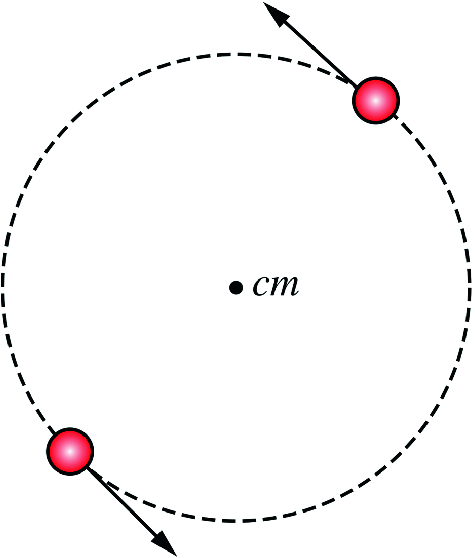
Figure 24:Two stars of equal mass M revolve about their center of mass with a speed v
The gravitational force that one star exerts on the other is