Energy is a very important concept that is heavily used in everyday life. Everything around us, including ourselves, needs energy to function. For example, electricity provides home appliances with the energy they require, food gives us energy to survive, and the sun provides earth with the energy needed for the existence of life!
Experiments show that energy is a scalar quantity related to the state of an object. Energy may exist in various forms: mechanical, chemical, gravitational, electromagnetic, nuclear, and thermal. Furthermore, energy cannot be created or destroyed; it can only be transformed from one form to another. In other words, if energy were to be exchanged between objects inside a system, then the total amount of energy (the sum of all forms of energy) in the system will remain constant.
A transformation of energy occurs due to the action of a force known as work or due to heat exchange between objects (or between an object and its environment). If energy is transferred due to work then it may be defined as the capacity of doing work. This book is concerned with mechanical energy which involves kinetic energy (associated with the object’s motion) and potential energy (associated with the position of the object in space).
Work may have many meanings. Sometimes, work is said to be done when a muscular activity is performed. Work may also refer to mental activity (mental work). In physics, the definition of work is different. Work is said to be done if a force is applied to an object while it is moving, i.e., if there is no resulting displacement, no work is done. Suppose that a person holds a heavy box for sometime and then starts to feel tired. The reason he/she feels tired is because chemical energy in his/her body is converted into internal microscopic motions of the muscles. Since the energy is not transferred to the box being carried (the box did not move), the work done on the box is equal to zero.
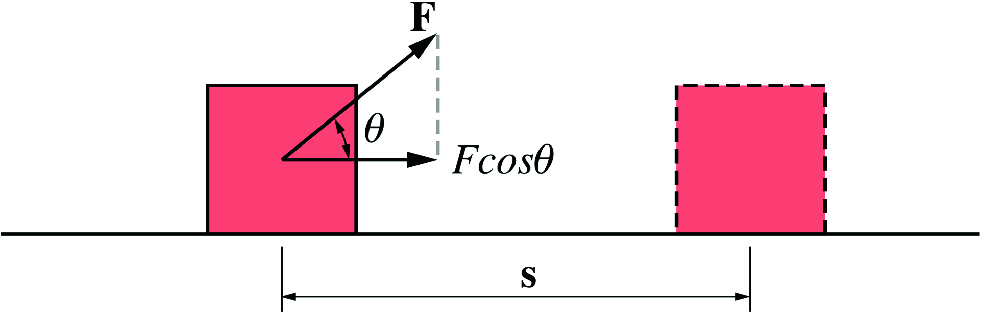
Consider an object exposed to a constant force F (see Fig. Figure 1). If the object is displaced through a displacement s, then the work done on the object is a scalar quantity defined as
where θ is the smaller angle between F and s. The component of F in the direction of s(Fcosθ) is the only effective component that produces motion. The work done represents energy transferred to or from the object via that force. If (θ=0), the work done on the object is positive, i.e. energy is transferred to the object. If (θ=180o), the work done is negative, i.e., energy is transferred from the object. The SI unit of work is Newton meter (N.m) also named as the Joule.
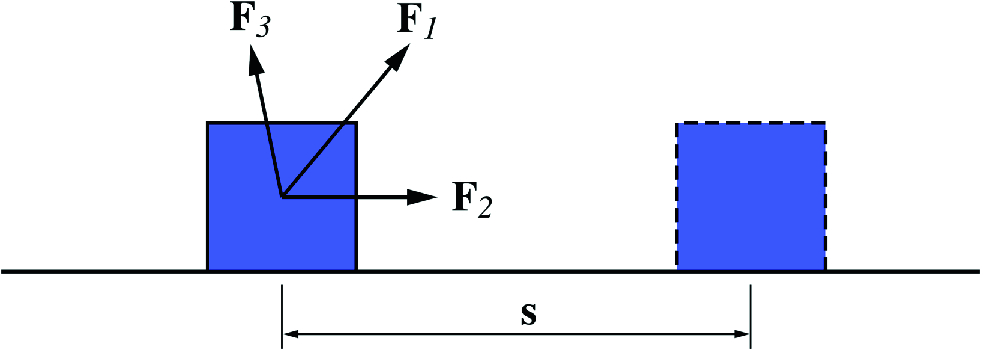
Consider an object exposed to several forces as in Fig. Figure 2. The work done by all of these forces is the sum of the individual amounts of work done by each force:
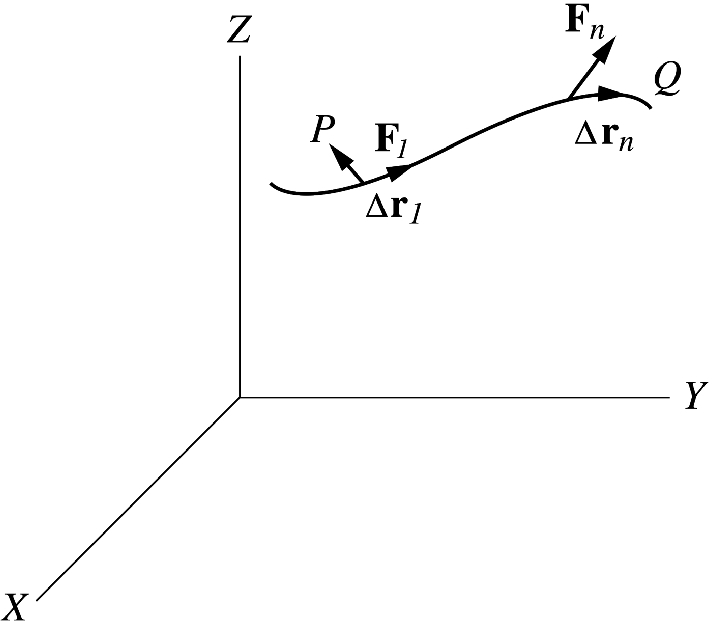
Previously, the work done in the special case of a force that is constant in both magnitude and direction was discussed. The object there moved along a straight line. In many situations, the force may vary in magnitude or in direction or in both, and the object may move along a curved path. To find the work done in this case, consider a particle moving along the curved path shown in Fig. Figure 3. While it is moving, a force F that varies in both magnitude and direction with the position of the particle acts on it. Let us divide the path into a large number n of very small displacements where each is tangent to the path. For each displacement, the force can be approximated to be constant in both magnitude and direction. The total work done as the particle moves from P to Q is the sum of the individual amounts of work done along each displacement, that is
As mentioned in Sect. 1.10.1, this integral is called the line integral. Each component of F(Fx,FyorFz) may be a function of x, y, and z, and the curve can be determined by its equations that relates x, y, and z to each other. The component form of the above equation is
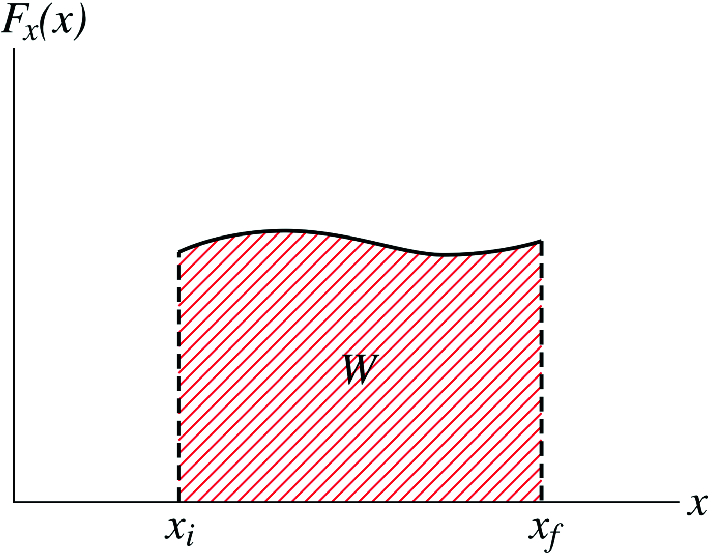
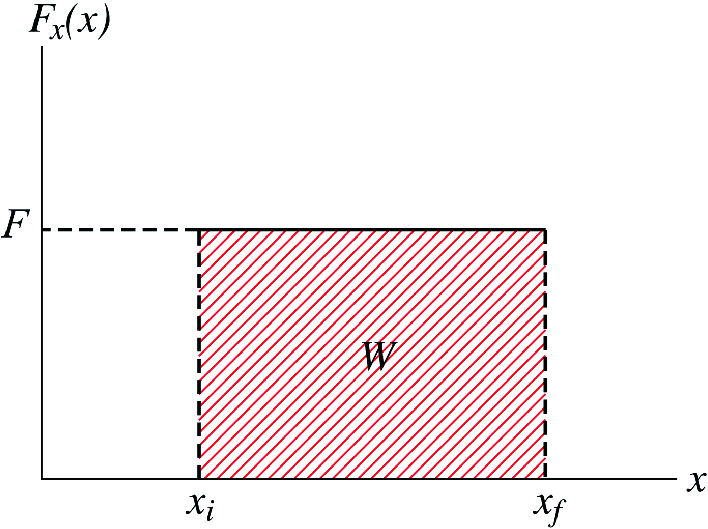
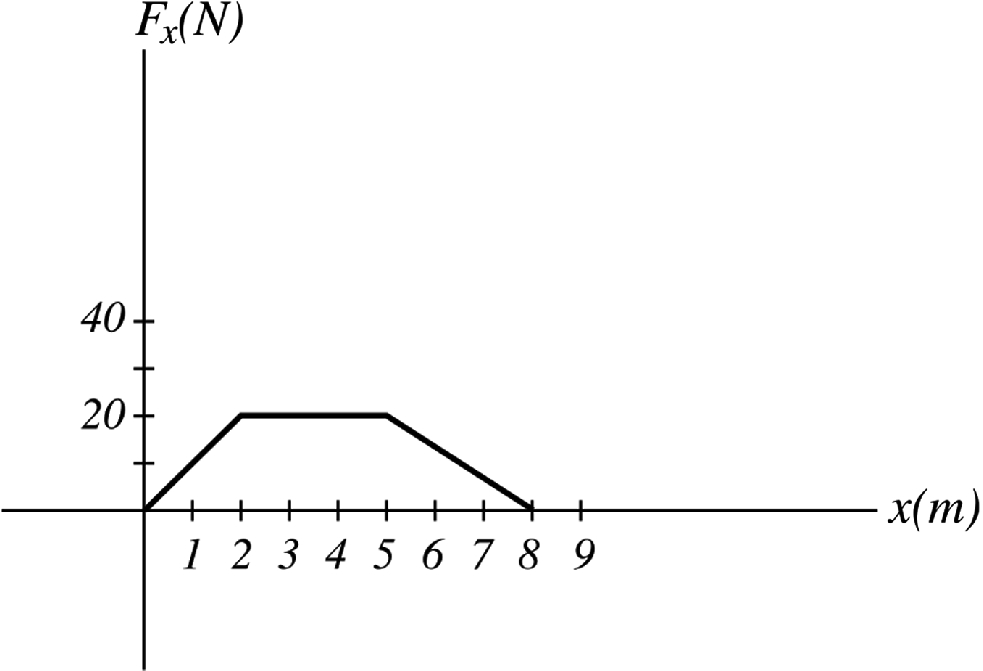
Now consider the case in which the particle moves along a straight line (for example the positive x-axis) and in which the force acting on the particle has a constant direction along the x-axis and a magnitude that varies with x. Equation 4.1 is then reduced to
The work is then equal to the rectangular area shown in Fig. Figure 5.
Figure 3:A particle moving along a curved path. While itõs moving, a force F that varies in both magnitude and direction with the position of the particle acts on it
Figure 4:The area under the curve represents the work
Figure 5:The work is equal to the rectangular area
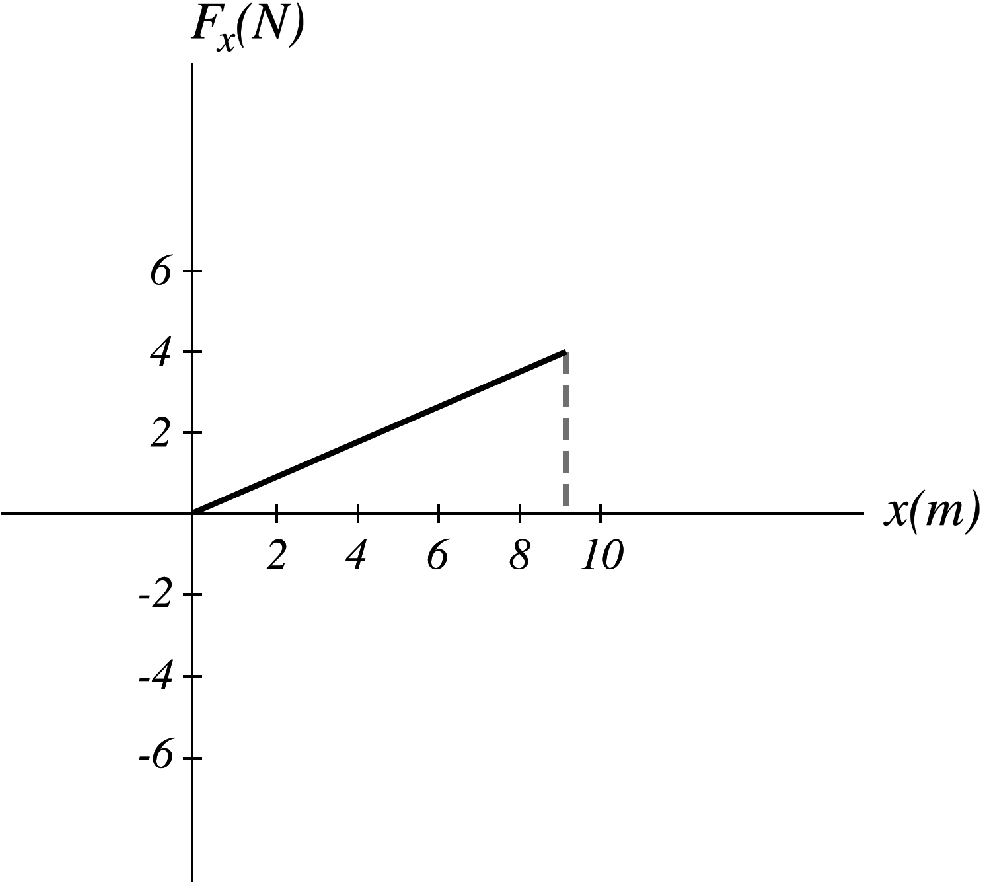
Figure 6:A force acting on a particle is a function of position
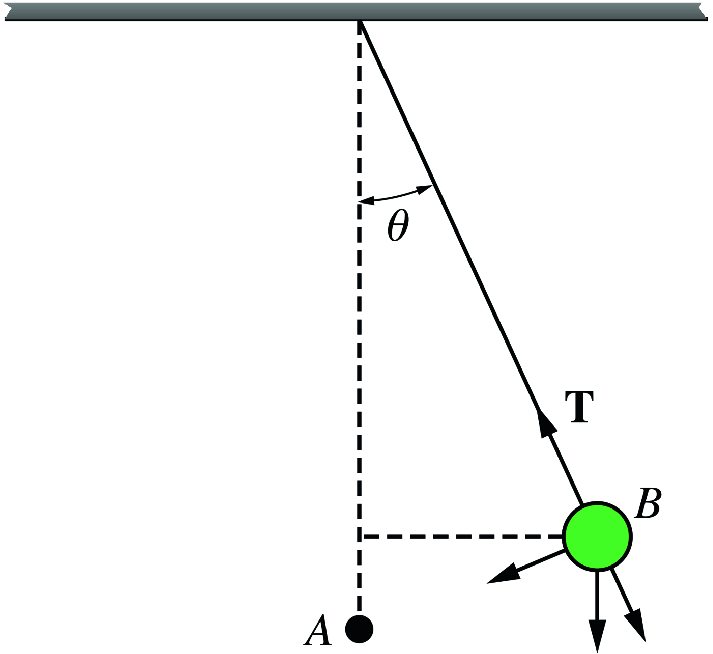
Figure 7:A ball suspended by a light rope and displaced a small distance from the position of equilibrium
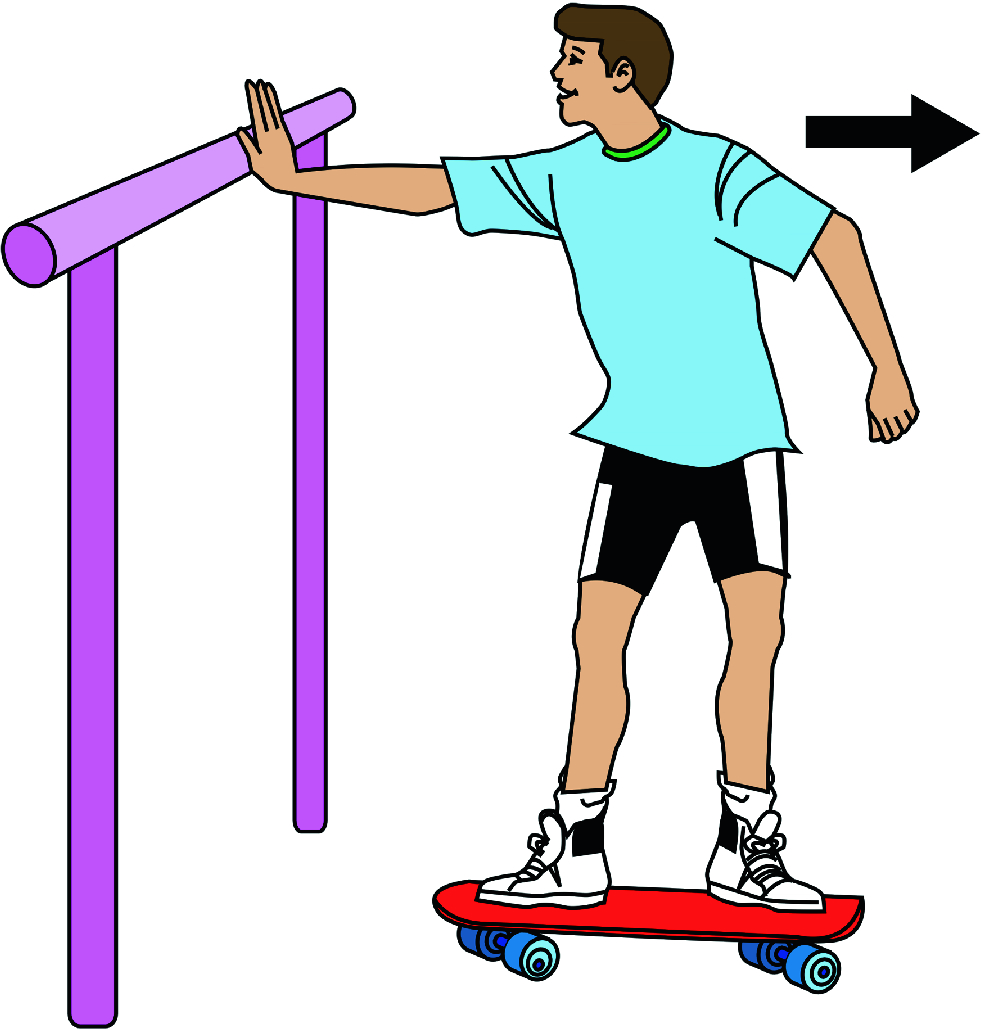
Figure 8:The center of mass of the system (man+skateboard) moves and the work-energy theorem can be applied to that point
4.3 Kinetic Energy (KE) and the Work–Energy Theorem
Consider a particle that is exposed to a net field force and is moving along a curve in space. Suppose that the particle is at P at ti and at Q at tf and that its velocity at P and Q is vi and vf, respectively. The net work done on the particle as it moves from P to Q is then given by
The quantity 21mv2 is the energy associated with the motion of the particle called the kinetic energy (KE). Thus, if a particle of constant mass m is moving with a speed v, its KE is a scalar quantity defined as
It also can be written as K=21m(v⋅v). Hence, the total work done by the net force in displacing the particle is equal to the change in the KE of the particle
Similar to work, the SI unit of kinetic energy is the Joul. Note that the work–energy theorem is applied only if the object is treated as a particle (all of its parts move in exactly the same way). As an example of how the theorem is applied only for particle-like objects consider a man standing on a skateboard on a horizontal surface (see Fig. Figure 8). If the man pushes the bar then that would move him backwards along with his skateboard. This motion is due to the reaction force F exerted on him by the bar. The work done by n or w is equal to zero since each force is perpendicular to the displacement. Because the point of application of F did not move it follows that the work done by that force is zero. Thus, from the work–energy theorem the man should not move. The question is why did he move?
The fact here is that it is incorrect to treat the man as a particle, since different parts of his body move in different ways as he pushes the bar. Therefore, the work–energy theorem does not hold. The man must be treated as a system of particles. In Chap. 6, we will see that the motion of a system of particles can be represented by the motion of its center of mass. The center of mass behaves as if all of the mass of the object (or system) is concentrated there and as if the net external force is applied there. In the case of the skateboarder, the center of mass of the system (man + skateboard) moves and the work–energy theorem can be applied to that point.
The work–energy theorem is an alternative method for describing motion without using Newton’s laws. It is especially useful in problems involving a varying force. Note that the work and the kinetic energy are not invariant quantities; they have different values when measured in different inertial frames of reference. However, from the principle of invariance, the equation Wnet=△K still holds for any inertial frame.
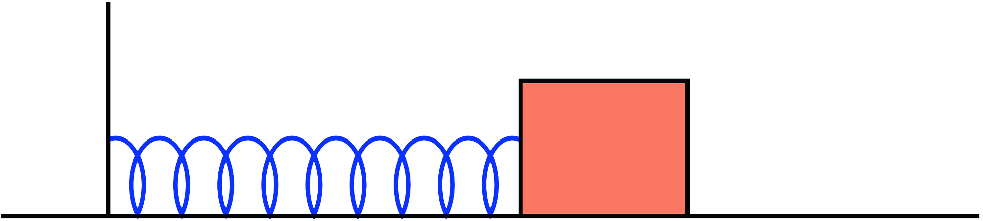
Figure 9:A block attached to a light spring on a frictionless surface
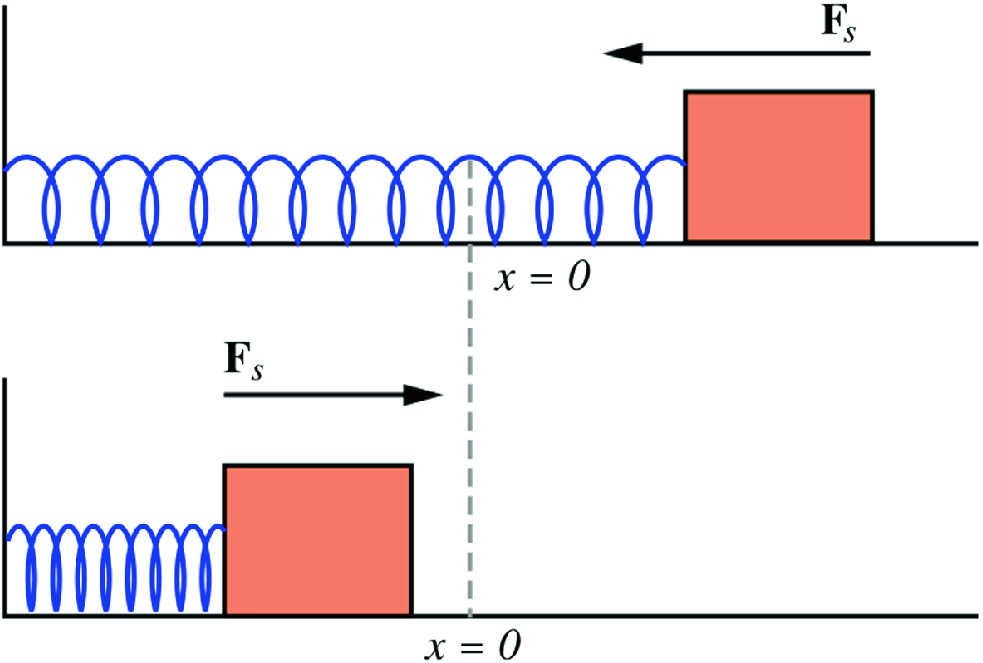
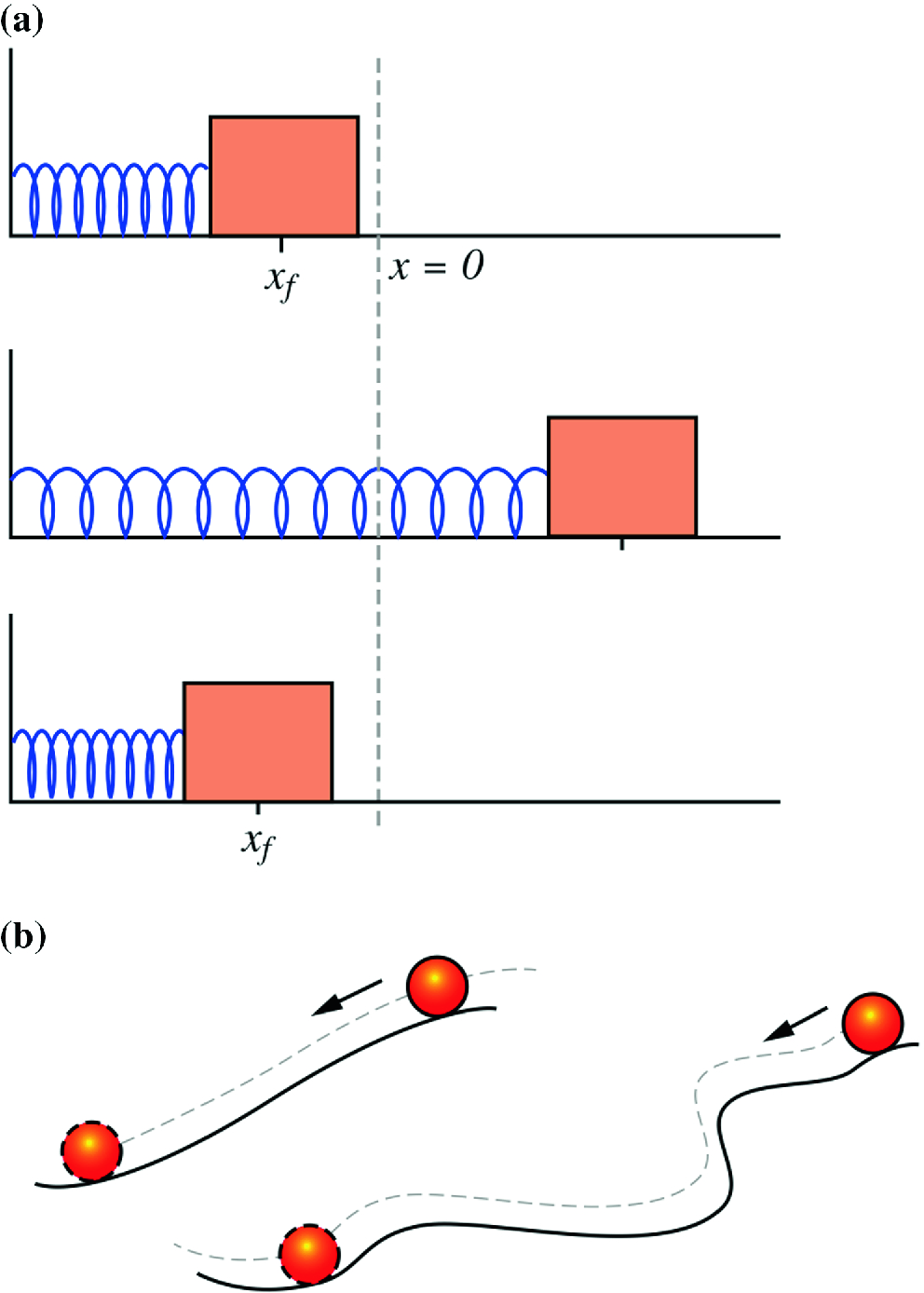
Consider a block attached to a light spring fixed at the other end on a frictionless horizontal surface as in Fig. Figure 9. Suppose an external force Fext is applied to the block by either stretching or compressing it through a small displacement from its equilibrium (relaxed) position taken at x=0. The spring will then exert a restoring force Fs on the block that opposes the applied force and restores the block to its equilibrium position. For many kinds of springs and in the case of small displacements, the spring force varies linearly with the displacement x of the block (or any other object) from its equilibrium position (x=0). That is
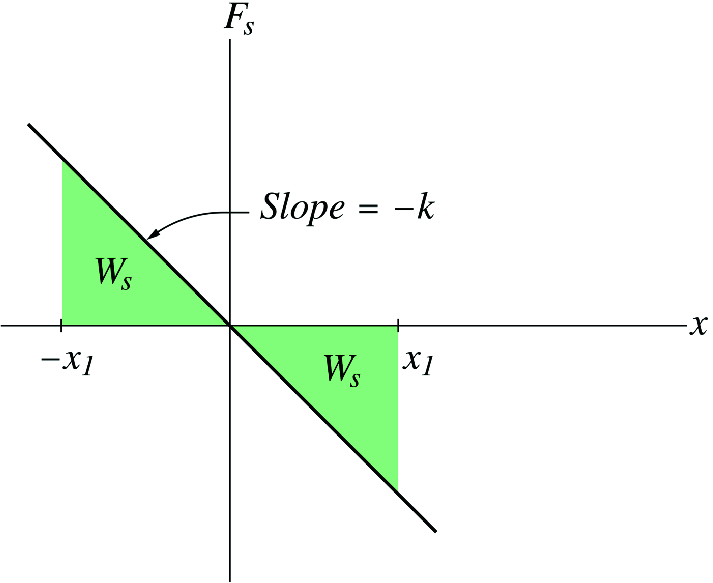
where k is a constant called the force or spring constant. k measures the stiffness of the spring. The stiffer the spring the larger is k. This equation is known as Hook’s law. The minus sign indicates that the spring force is always acting in a direction opposing the displacement. The work done by the spring force in moving the block from an initial position xi to a final position xf is:
Figure Figure 10 shows a plot of Fs versus x for the mass–spring system.
Figure 10:A plot of Fs versus x for the mass-spring system
Figure 11:A 2 kg block attached to a light spring of force constant 300 N/m on a horizontal smooth surface
4.3.2 Work Done by the Gravitational Force (Weight)
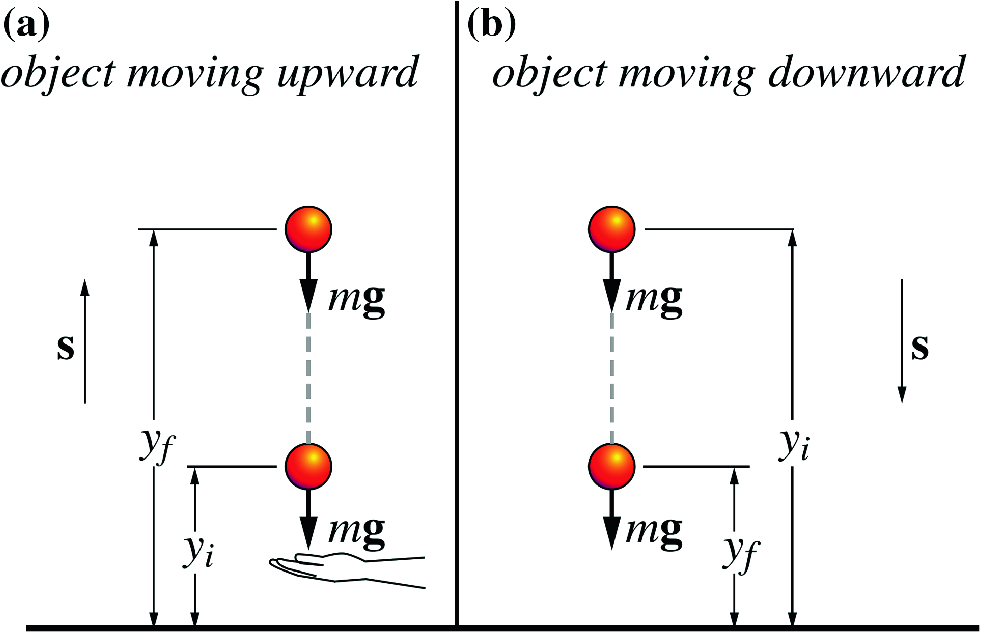
If a particle-like object of mass m is moving vertically upward or downward near the surface of the earth where g is assumed to be constant (see Fig. Figure 12), and if air resistance is neglected, then the only force that does work on the object is the gravitational force mg. By taking the y-axis along the line of motion (positive upwards) with y=0 at the earth’s surface, the work done by the gravitational force is
Note that unlike the spring force the reference point yi may be chosen anywhere. If the object moved downwards from yi=y to yf=0, the work done by the gravitational force is
This result is the same as if the object has followed a straight vertical path. Therefore, the work done by the gravitational force depends only on the initial and final positions of the object.
Figure 12:By taking y=0 at the hand level, in the work done by gravity a is −mgyf and in b is +mgyi
Figure 13:a The total work done by the spring force on the block is zero since xi=xf. b Along any path the work done by the gravitational force is the same since the initial and final positions are the same
Power is a quantity that defines how much work is done over a period of time, i.e., power is the time rate of doing work, or more generally, it is the time rate of energy transfer. If an external force F does work W on an object for a time interval △t, then the average power during that time is
In nature, there are two kinds of forces: conservative and nonconservative forces. A conservative force is a force that conserves the energy of a system when acting upon it. The action of this force results in changing the kinetic energy of any object in the system. This change will be stored in the system in the form of potential energy. For every conservative force, there is a certain potential energy that is associated with it. Such potential energy can be retransformed into kinetic energy Thus, the total energy of the system would not be dissipated, instead it would be conserved. A force that does not act in this way is said to be a nonconservative force. Properties of a conservative force are given as follows:
The net work done by a conservative force on a particle moving from one point to another is independent of the path taken by the particle;
The net work done by a conservative force in moving a particle through any closed path is equal to zero.
A force not meeting these conditions is a nonconservative force. As mentioned in Sect. 1.10.2, property 2 of a conservative force can be obtained from property 1 (if A is a vector field and the line integral of A between any two points is independent of path, then ∮CA⋅r=0). That is, these two properties are equivalent. Examples of conservative forces in mechanics are the gravitational and spring forces. To show this let us go back to Sects. 4.3.1 Work Done by a Spring Force and 4.3.2 Work Done by the Gravitational Force (Weight), where the work done by the gravitational force or the spring force was calculated. We have seen that the work done in each case depends only on the initial and final positions of the object. Therefore, the work done by any of these forces is independent of the path joining the initial and final positions. Furthermore, if (xi=xf) in the case of the spring or (yi=yf) in the case of the gravitational force the net work done is zero. Hence, these forces are conservative.
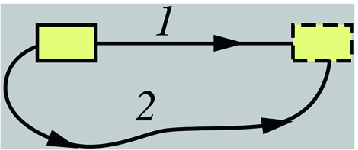
The force of friction is an example of a nonconservative force. To show that, consider a block sliding on a rough surface. Figure Figure 14 shows two possible paths connecting two points. The longer the path the more interaction between the block and the surface and the more the force of friction will act and do work on the block. Thus, the work depends on the path taken between the two points and therefore the frictional force is a nonconservative force.
Figure 14:The longer the path the more interaction between the block and the surface and the more the force of friction will act and do work on the block
For a system consisting of two or more objects, the potential energy U of the system is the energy associated with the configuration of the system. That is, the potential energy is the energy associated with the position of objects in the system relative to each other. If the configuration of the system is changed, then the potential energy of the system also changes. Such energy is defined only in terms of a conservative force because if such a force acts on a system then it can transform the kinetic energy of any object in the system into potential energy of the system and vice versa. The potential energy means that the system has potential to do work.
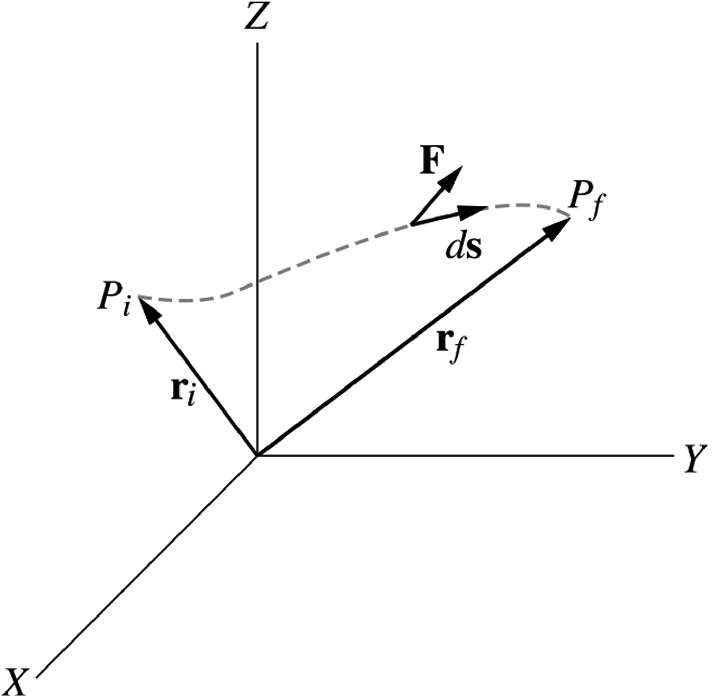
In Sect. 1.10.2 it has been proven that the line integral in Eq. (1.2) is independent of the path joining the points P and Q if and only if A=∇ϕ, or equivalently ∇×A=0. Where ϕ(x,y,z) is some scalar that has continuous partial derivatives. Therefore, for a conservative force field F(x,y,z), there always exist a scalar field U=U(x,y,z) (called the potential energy) such that
where U=U(x,y,z). Because only the change in the potential energy is significant, it does not matter where the reference point (U) is chosen. This is because if Ui is changed Uf will be also changed but △U will remain constant.
Figure 15:The total work done by a conservative force in moving a particle from Pi to Pf
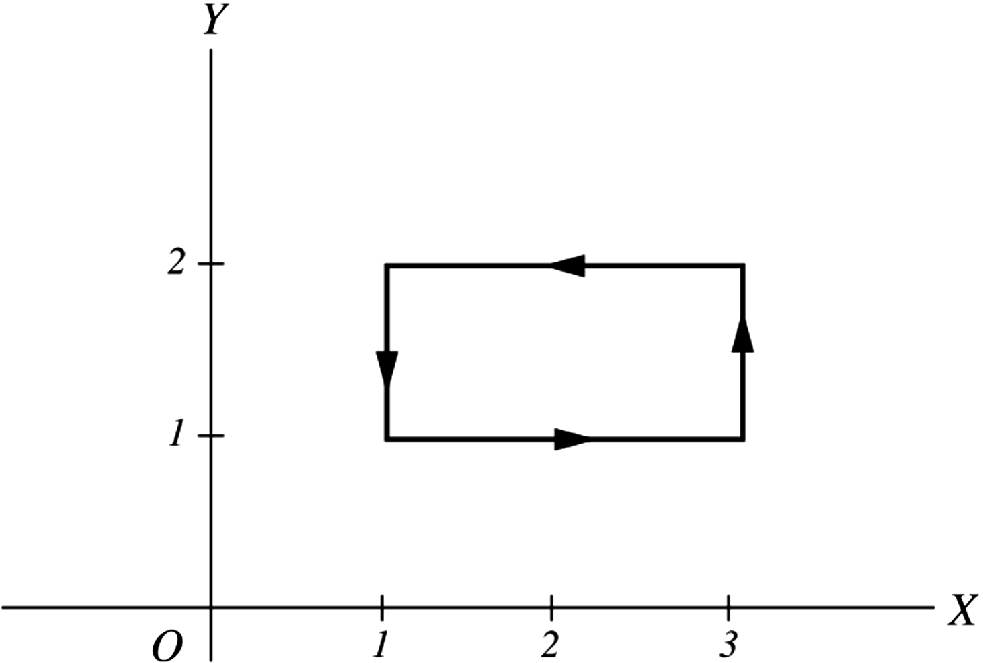
Figure 16:The work done in moving the particle along a closed path
The force of gravity near the surface of the earth can be found from the gravitational potential energy In general we have F=−∇U here, since the motion is in one direction we have
The total mechanical energy of a system is defined as the sum of all of the kinetic energies of the objects within the system plus all of the potential energies of the system.
Now, consider an isolated system in which there are no external forces acting on it, or the net external force is zero. The only forces acting on the system will be the internal forces within the system. These forces may be conservative or nonconservative. If only internal conservative forces exist, then the work done by any of these forces on an object in the system will transform its kinetic energy into potential energy (associated with that force), or vice versa. The internal conservative force can also transform one form of potential energy into another. The work done by such a force on an object in the system is
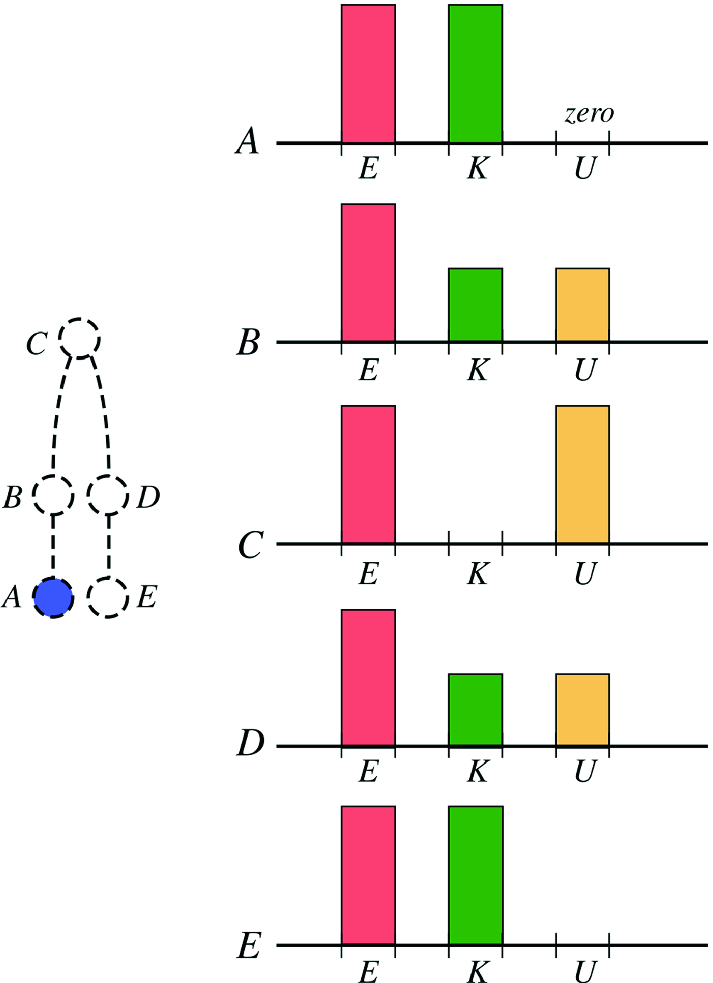
From the previous discussion, we conclude that for an isolated system in which only conservative forces act, the total mechanical energy of the system remains constant (conserved). Figure Figure 17 shows the changes of energy of a ball thrown upwards. Now suppose that the system is not isolated and that the external forces acting on the system are conservative. The change in the kinetic energy of the system is then equal to the work done on the system by an internal conservative force plus the amount of kinetic energy changed due to an external conservative force, that is,
Therefore, the total mechanical energy of the system remains constant under both external and internal conservative forces. If external nonconservative forces act on the system, or if there is heat transfer, or if internal nonconservative forces act, then the total mechanical energy may change and is no longer conserved.
Figure 17:Changes in the kinetic and potential energies of a ball thrown vertically upwards
4.5.1 Changes of the Mechanical Energy of a System due to External Nonconservative Forces
External nonconservative forces may act on a system if it is not isolated. Consider a system that is not isolated in which only internal conservative forces act. The change in the kinetic energy of the system is then equal to the work done on the system by an internal conservative force plus the amount of kinetic energy changed due to an external nonconservative force. This can be expressed as
This implies that the total mechanical energy has changed by an amount of △Kext. Not that the work done by a nonconservative force cannot be calculated generally but the change in the kinetic energy can be observed.
Friction is a nonconservative force as seen in Sect. 4.2 Work. If this force is applied externally to a system in which only internal conservative forces act, it will decrease (dissipate) the kinetic energy of the system by transforming it into thermal energy The change in the mechanical energy of the system is
The work done by friction or any other nonconservative force cannot be calculated. In other words, the work done by friction is not simply −fks, where s is the displacement of the object in the system. The reason behind not being able to calculate the work done by friction is that at a microscopic level the frictional force is not a single force that acts at one point. Rather, it is a combination of forces acting at different points in the object. However, the loss in kinetic energy of the object can be calculated as shown below: Consider a block sliding on a rough surface. Let’s choose the block only to be our system. From the equation of motion, we have
This quantity represents the magnitude of the loss in the kinetic energy of the block due to friction. This loss of energy appears as thermal energy of the block and of the surface on which it slides.
4.5.3 Changes in Mechanical Energy due to Internal Nonconservative Forces
In solving problems you are free to choose the system. If we considered the block plus the surface as our system, then friction will be an internal nonconservative force and we may write
where △Kin,nc is the change in the kinetic energy of the system due to an internal nonconservative force. Another example of a nonconservative force is the force that you exert on your body by your muscles. This force transfers the chemical energy of your body into kinetic energy In Sect. (4.1.5), we have seen that the motion of the skateboarder can be explained using the concept of the center of mass. Another way to explain the motion of the skateboarder is that the internal chemical energy of the man is transformed into kinetic energy, and we may write
Since △U=0 in his case. An additional example of nonconservative forces is the forces that different parts in an object exert on each other when the object is deformed. These forces transform the kinetic energy of the object into internal energy. In all cases, even though energy can transfer from one object to another or to the environment, the total amount of energy in the universe is constant. That is, energy gained by a system is lost by another system. In other words, energy cannot be created or destroyed it can only be transformed from one form to another and the total energy of an isolated system is conserved (constant). This statement is known as the law of conservation of energy The law of conservation of energy is also valid in relativity and quantum mechanics.
4.5.4 Changes in Mechanical Energy due to All Forces
Consider a system in which there are both internal and external conservative and nonconservative forces acting on it. In this case, the change in the total mechanical energy of the system can be written as
Expanding on the definition of power, power is the rate of energy transfer due to a force. If △E is the amount of energy transferred in an amount of time △t, the average power is
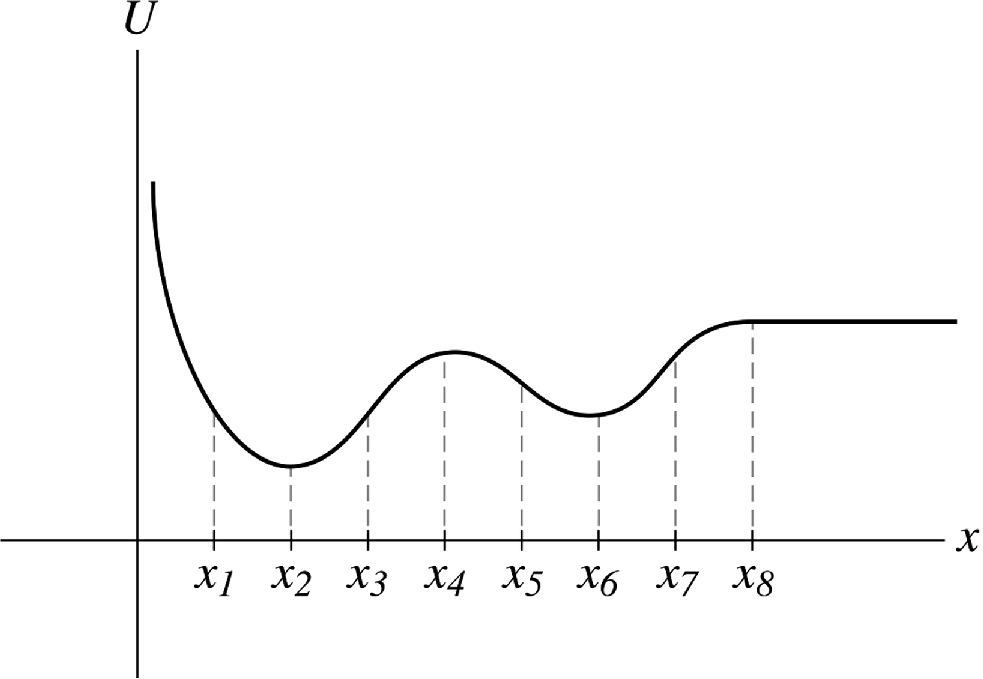
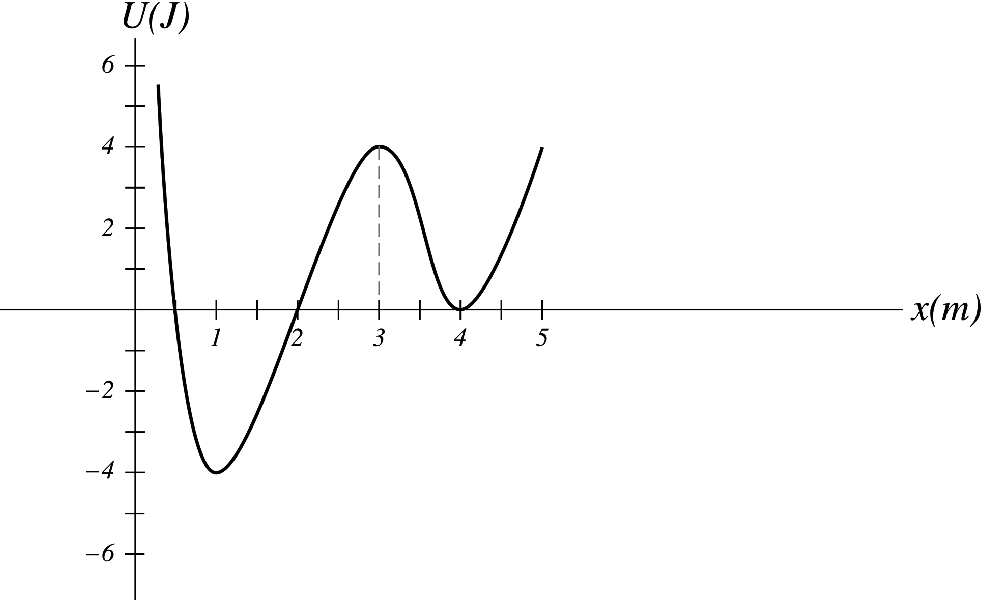
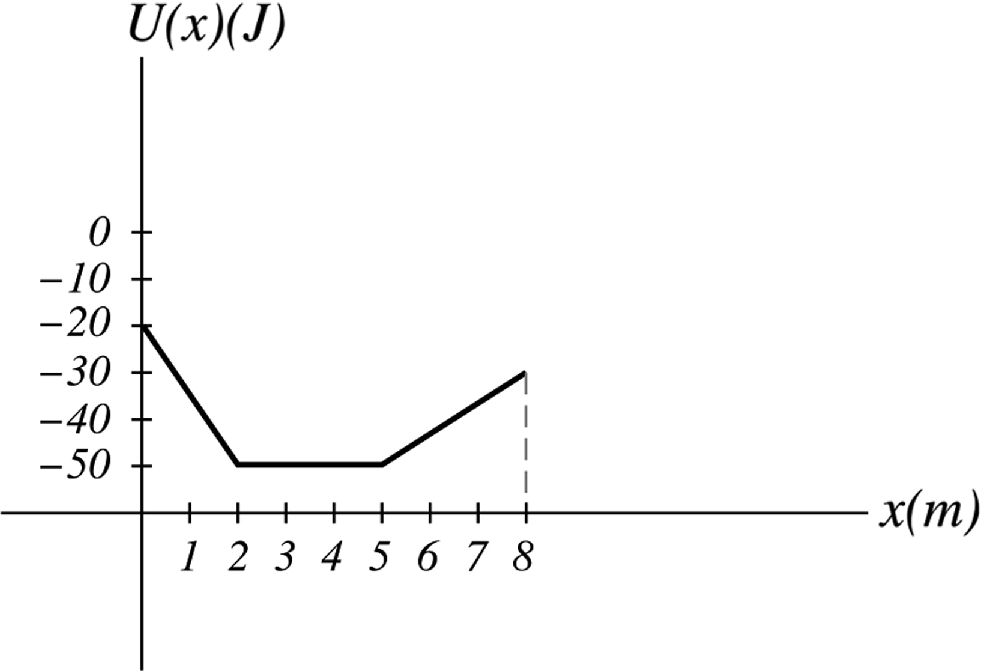
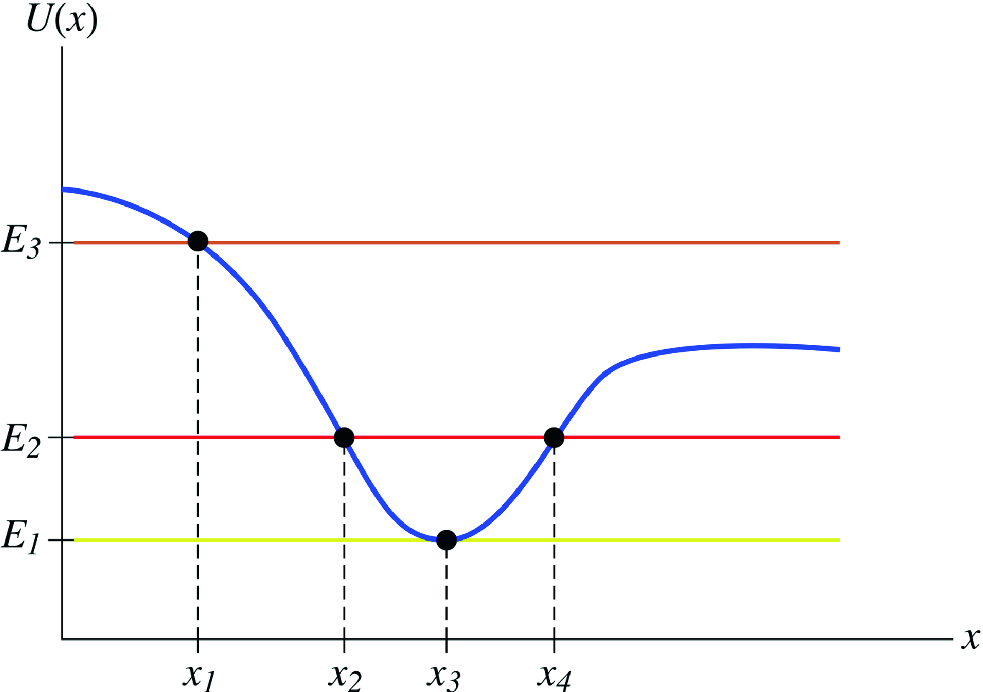
Consider a particle that is a part of an isolated system where only internal conservative forces act. Suppose this particle is moving along the x-axis while a conservative force that depends only on the position of the particle acts on it. For simplicity, we will assume that is the only force acting on the system and that it does work only on that particle. The potential energy of the system as a function of the particle’s position (x) is shown in Fig. Figure 26. At any point F(x) is given by
That is, it is the negative of the slope of the curve at that point. Because this force is conservative it follows that the total mechanical energy of the system is conserved. Therefore the kinetic energy of the particle as a function of position is given by
If at an equilibrium point d2U(x)/dx2>0, then U(x) is a minimum at that point. The point is then said to be a position of stable equilibrium, i.e., any minimum on the U(x) curve is a position of stable equilibrium. Another method to find the position of stable equilibrium is to find the sign of F(x) at each side of the point. As an example, consider the point x2.
This point is a position of stable equilibrium since if the particle is displaced slightly to the right of x2 then dU(x) / dx is positive which leads to F(x) being negative and the particle will accelerate back towards x2. On the other hand, if the particle is displaced slightly to the left of x2, then dU(x) / dx is negative and thus F(x) is positive and the particle will also accelerates back to x2. Therefore, because F(x) tends to restore the particle back to that position when the particle is displaced in either direction, it is called a position of stable equilibrium. x6 is also a position of stable equilibrium.
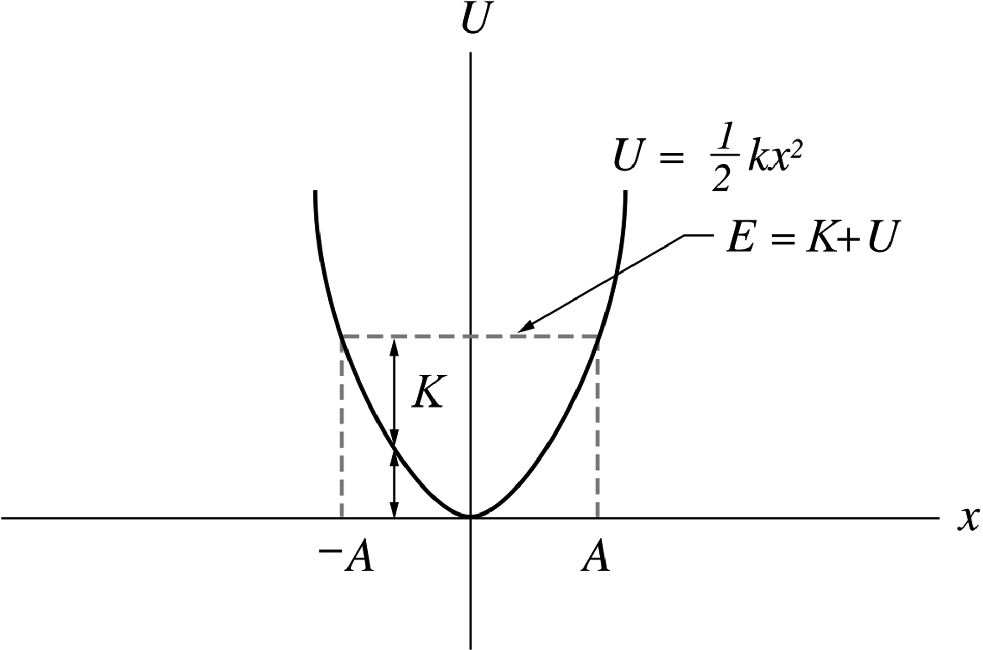
If at an equilibrium point d2U(x)/dx2<0, then U(x) is maximum at that point, and the point is called a position of unstable equilibrium. In Fig. Figure 26, x4 is a position of unstable equilibrium since if the particle is slightly displaced to the right of x4,F(x) is positive and the particle will accelerate away from x4. If the particle is displaced to the left of x4,F(x) is negative and the particle will also accelerate away from that position. Therefore, because F(x) tends to repel the particle away from that position, it is called a position of unstable equilibrium. In general this force tends to move the particle towards the minimum value of U(x). Figure Figure 27 shows the potential energy of a mass–spring system as a function of x.
Figure 27:The potential energy of a mass-spring system as a function of x
Any point in a region where U(x) is constant and F(x)=0 is called a position of neutral equilibrium. x8 is a position of neutral equilibrium. If the particle is slightly displaced to the right or left of x8, no restoring or repelling forces will act on the particle and it will remain stationary The position of the particle as a function of time can be obtained from