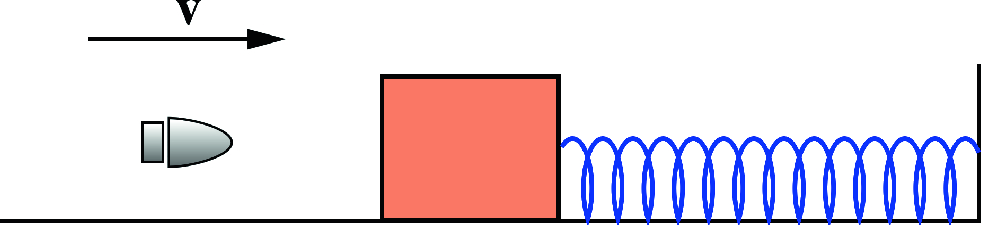
When two billiard balls collide, in which direction would they travel after the collision? If a meteorite hits the earth, why does the earth remain in its orbit? When two cars collide with each other, why is one of the cars more damaged than the other? We will find that to answer such questions, new concepts must be introduced.
Consider the situation where two bodies collide with each other. During the collision, each body exerts a force on the other. This force is called an impulsive force, because it acts for a short period of time compared to the whole motion of the objects, and its value is usually large. To solve collision problems by using Newton’s second law, it is required to know the exact form of the impulsive forces. Because these forces are complex functions of the collision time, it is difficult to find their exact form and would make it difficult to use Newton’s second law to solve such problems. Thus, new concepts known as momentum and impulse were introduced. These concepts enable us to analyze problems that involve collisions, as well as many other problems.
The law of conservation of momentum is especially used in analyzing collisions and is applied immediately before and immediately after the collision. Therefore, it is not necessary to know the exact form of the impulsive forces, which makes the problem easy to analyze. Next, we will discuss and verify the concepts of momentum and impulse, and the law of conservation of momentum. The linear momentum (or quantity of motion as was called by Newton) of a particle of mass m is a vector quantity defined as
where v is the velocity of the particle. A fast moving car has more momentum than a slow moving car of the same mass. Another example is that a bowling ball has more momentum than a basketball moving at the same speed. The SI unit of linear momentum is kg⋅m/s. In terms of components, we may write px=mvx,py=mvy, and pz=mvz. Newton’s second law can be expressed in terms of momentum for a particle-like object of constant mass as
That is, the rate of change of the linear momentum of an object is equal to the resultant force acting on the object and is in the same direction as that force.
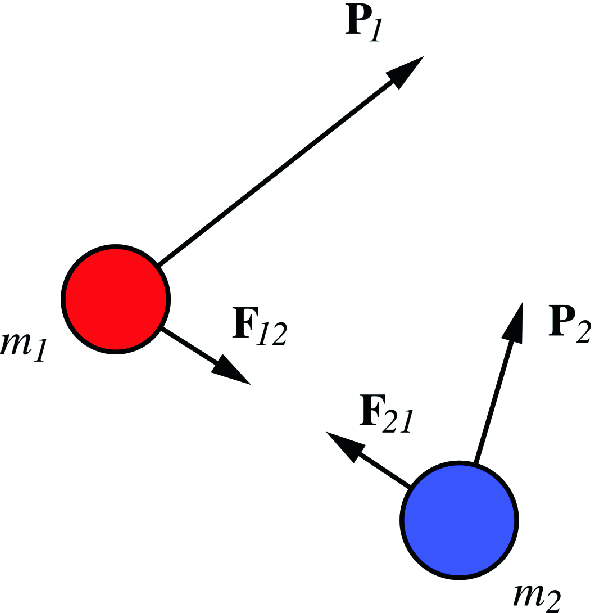
The law of conservation of linear momentum states that if the net external force acting on a system equals zero (isolated) and if there is no mass exchange with the surroundings of the system (closed), then the total linear momentum of the system remains constant. To show that, consider an isolated system consisting of two particles where the only forces that act in the system are internal forces (see Figure 1). The total linear momentum of the system at any particular time is given by
If the net force exerted on particle 2 by particle 1 is F21, then from Newton’s third law, the net force exerted on particle 1 by particle 2 is F12, That is
That is, the linear momentum of each particle may change, but the total linear momentum of the system is the same at all times. This statement is known as the law of conservation of linear momentum: If the net external force on a system is zero, the total linear momentum of the system remains unchanged (constant). In terms of components, we have pix=pfx,piy=pfy, and piz=pfz. In solving problems involving collisions, pi and pf refers to the total momentum of the system immediately before and immediately after the collision, respectively. For a two-particle system, we have
From the principle of invariance, the law of conservation of momentum is valid with respect to any inertial frame of reference. Furthermore, as the law of conservation of energy, the law of conservation of momentum is valid in relativity and quantum mechanics.
Impulse is a quantity that defines how a certain force acting on a particle changes the linear momentum of that particle. Now, consider a time-dependent force acting on a particle. From Newton’s second law (F=dp/dt), we have
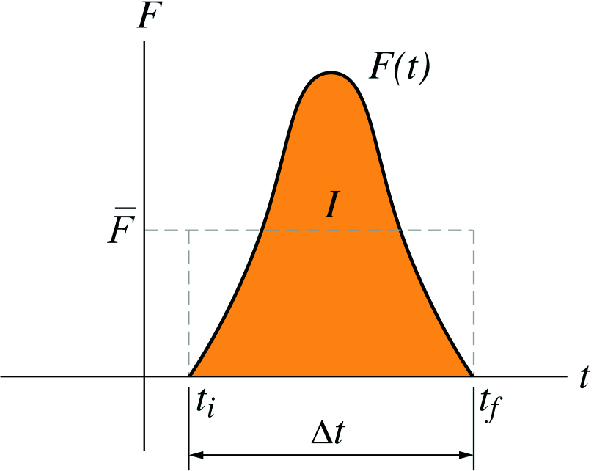
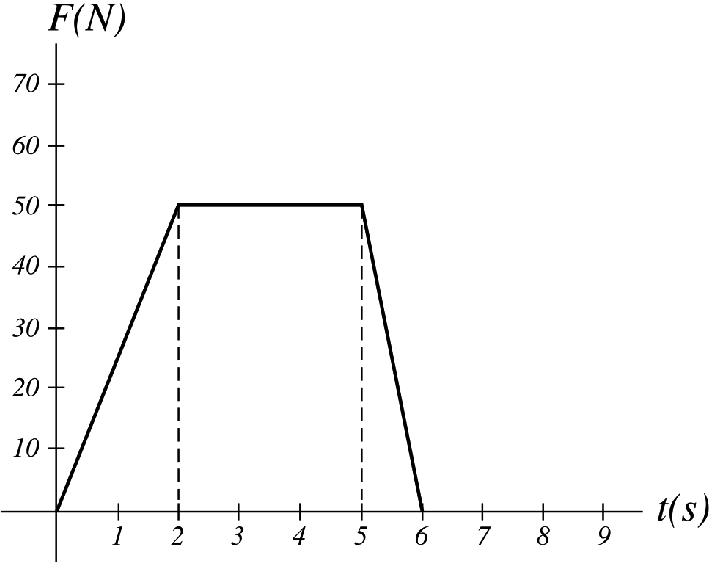
Which is known as the impulse–momentum theorem. In component form, we have Ix=△px,Iy=△py, and Iz=△pz. That is, the impulse of a force that acts on a particle during a time interval is equal to the change in the momentum of the particle during that interval. The direction of the impulse is in the same direction as the change of momentum. If F has a constant direction, the variation of its magnitude with time may be of the form as shown in Fig. 5.2. The average of F is given by
That is, F is a constant force that gives the same impulse as F. In the case of a collision between two bodies, the variation of the impulsive force that each body exerts on the other during the collision time takes the form as shown in Figure 2.
Figure 2:One example of the variation of F over time
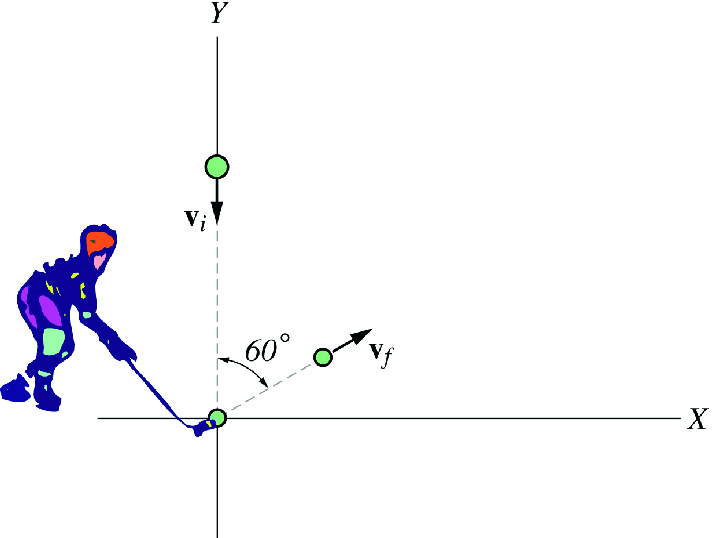
As discussed previously, when two bodies collide, they exert large forces on one another (during the time of the collision) called impulsive forces. These forces are very large such that any other forces (e.g., friction or gravity) present during the short time of the collision can be neglected. This approximation is known as the impulse approximation. For example, if a golf ball was hit by a golf club, the change in the momentum of the ball can be assumed to be only due to the impulsive force exerted on it by the club. The change in its momentum due to any other force present during the collision can be neglected. That is, the force in the expression I =△p=F△t can be assumed to be the impulsive force only. The neglected forces present during the collision time are external to the two-body system, whereas the impulsive forces are internal. The two-body system can therefore be considered to be isolated during the short time of the collision (which is in the order of a few milliseconds). Hence, the total linear momentum of the system is conserved during the collision, which enables us to apply the law of conservation of momentum immediately before and immediately after the collision. In general, for any type of collision, the total linear momentum is conserved during the time of the collision. That is, pi=pf, where pi and pf are the momenta immediately before and after the collision. In the next sections, we will define various types of two- body collisions, depending on whether or not the kinetic energy of the system is conserved.
Figure 3:A hockey player changing the momentum of the puck
An elastic collision is one in which the total kinetic energy, as well as momentum, of the two-colliding-body system is conserved. These collisions exist when the impulsive force exerted by one body on the other is conservative. Such force converts the kinetic energy of the body into elastic potential energy when the two bodies are in contact. It then reconverts the elastic potential energy into kinetic energy when there is no more contact. After collision, each body may have a different velocity and therefore a different kinetic energy. However, the total energy as well as the total momentum of the system is constant during the time of the collision. An example of such collisions is those between billiard balls.
An inelastic collision is one in which the total kinetic energy of the two-colliding-body system is not conserved, although momentum is conserved. In such a collision, some of the kinetic energy of the system is lost due to deformation and appear as internal or thermal energy. In other words, the (internal) impulsive forces are not conservative. Therefore, the kinetic energy of the system before the collision is less than that after the collision. If the two colliding objects stick together, the collision is said to be perfectly inelastic. There are some types of collisions in which the total kinetic energy after the collision occurs is greater than that before it occurs. This type of collision is called an explosive collision.
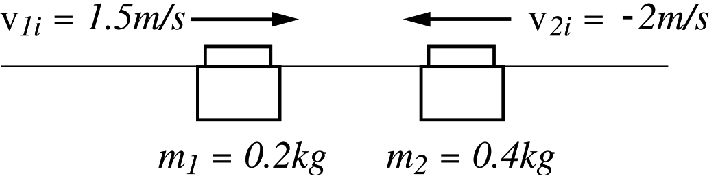
Figure 4:Two particles of masses m1 and m2 experiencing an elastic head-on collision
When a collision takes place in one dimension, it is referred to as a head-on collision. Consider two particles of masses m1 and m2 experiencing an elastic head-on collision as in Figure 4. Applying the law of conservation of energy and the law of conservation of linear momentum gives
If m1=m2, it follows from Eqs. (43) and (44) that v1f=v2i and v2f=v1i. In other words, if the particles have equal masses they exchange velocities.
If m2 is stationary (v2i=0), then from Eqs. (43) and (44), we have
In that case m2 is called the target and m1 is called the projectile. Furthermore, if m1≫m2, then from Eqs. (45) and (46), we find that v1f≈v1i and v2f≈2v1i. While if m2≫m1, then from Eqs. (45) and (46), we see that v1f≈−v1i, and v2f≈v2i=0.
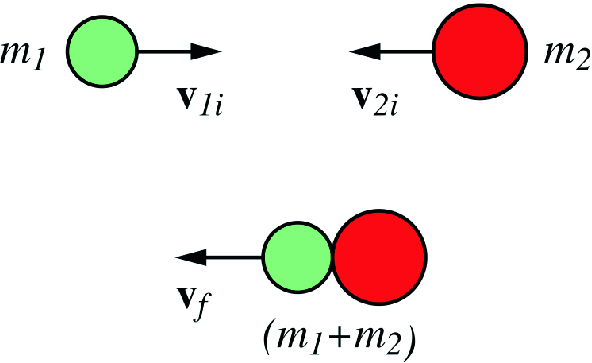
Figure 5:A one dimensional (head-on) perfectly inelastic collision between two particles of mass m1 and m2
Figure 5 shows a one-dimensional (head-on) perfectly inelastic collision between two particles of mass m1 and m2. Here, the kinetic energy of the system is not conserved, but the law of conservation of linear momentum still holds
where v1i and v2i are velocities before the collision. v1f and v2f are velocities after the collision. ∣v1i−v2i∣ is called the relative speed of approach and ∣v2f−v1f∣ is the relative speed of recession.
If e=1 the collision is perfectly elastic. If e<1 the collision is inelastic. If e=0 the collision is perfectly inelastic (the two bodies stick together).
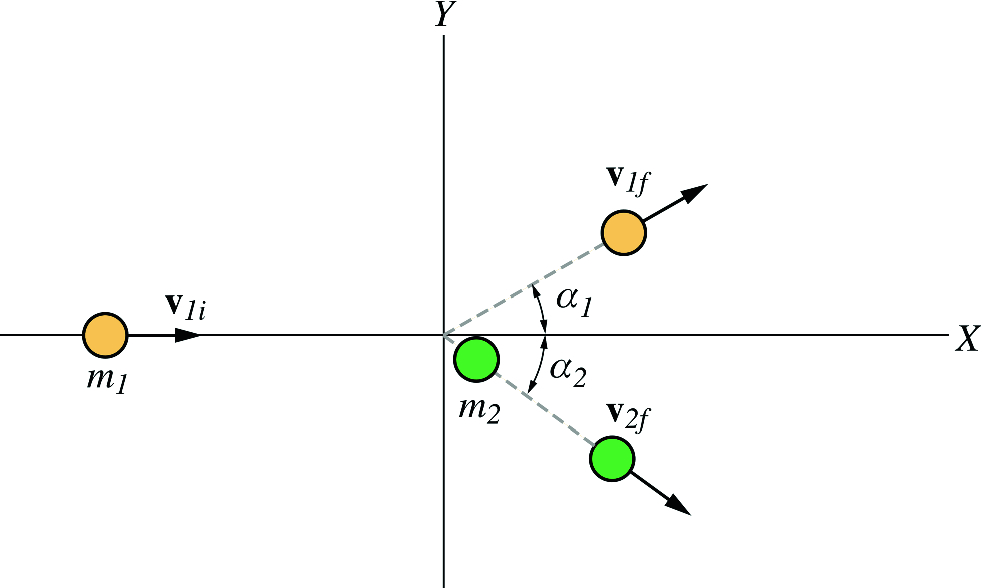
When a collision takes place in space, the total linear momentum is conserved along each of the x−,y-, and z-directions. That is, pix=pfx,piy=pfy, and piz=pfz. Here, we will analyze a two-dimensional elastic collision between two particles where one particle is moving and the other is at rest as shown in Figure 8. This type of collision is known as a glancing collision. Since the collision is elastic, it follows that the total linear momentum as well as the kinetic energy of the system are conserved. Applying these laws immediately before and immediately after the collision, we have pix=pfx and piy=pfy or
Therefore, we have three equations and seven unknown quantities. By knowing any four of these quantities, the three equations for the three variables can be solved.
Figure 8:A two dimensional elastic collision between two particles where one particle is moving and the other is at rest
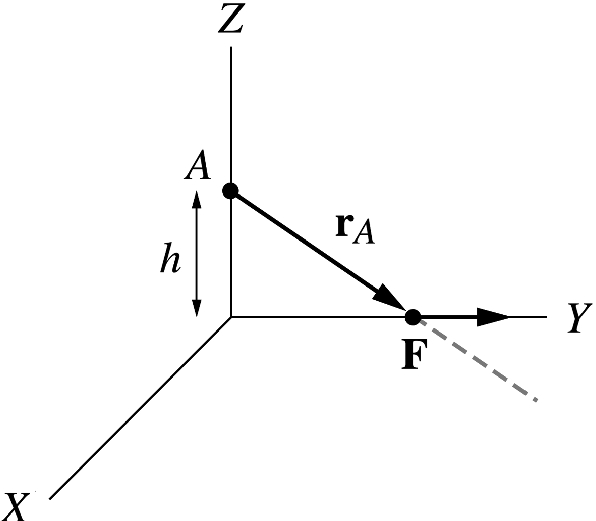
Consider a force F acting on a particle that has a position vector r with respect to some origin O that is in an inertial frame. The torque is a vector quantity that measures the tendency of that force to rotate the particle about O and is defined as
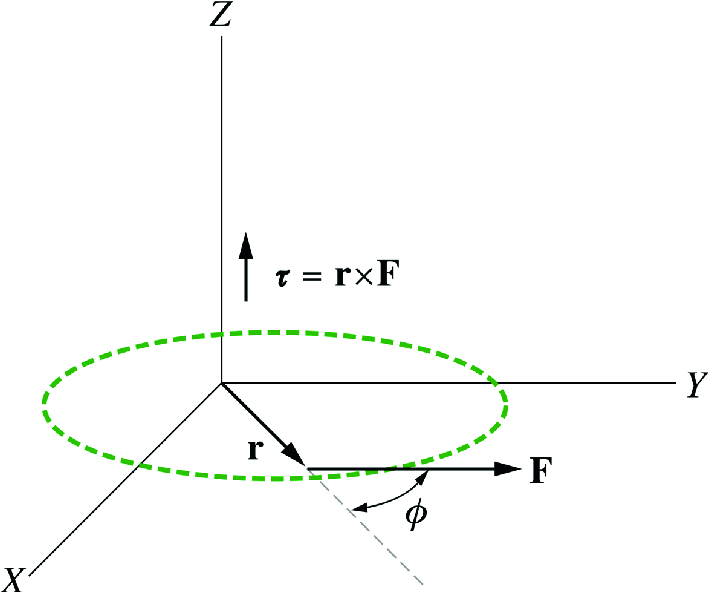
The direction of τ is perpendicular to the plane formed by r and F and its sense is given by the right-hand rule or of advance of a right-handed screw rotating from r to F. From the vector product definition, this quantity has a magnitude given by
where ϕ is the smaller angle between r and F,τ is positive if the force tends to rotate the particle counterclockwise and negative if it tends to rotate it clockwise. If ϕ=0 or 180∘, the force is radial and thus it has no rotating tendency. In component form, we may write
Let us consider a particle in the x–y plane exposed to a force that lies in that plane (see Figure 11). The resulting torque is then perpendicular to the x–y plane parallel to the z-axis. τ can also be written as
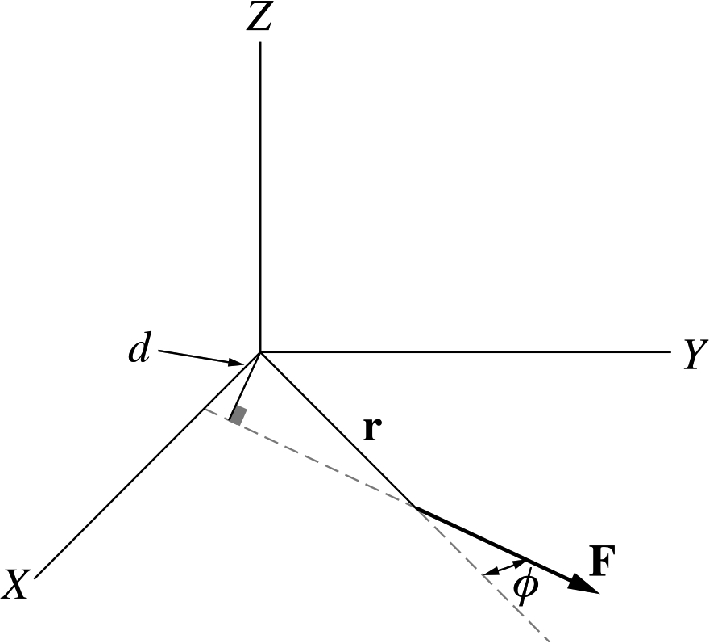
where d=rsinϕ is called the moment arm of F where it represents the perpendicular distance from the axis of rotation to the line of action of F as shown in Figure 12. Note that because τ depends on r, it follows that τ depends on the choice of the origin O. The force F can be resolved into two components Ft=Fsinϕ and Fr=Fcosϕ. Since the line of action of Fr passes through O, it has no rotating effect. Hence, Ft is the only component of F that causes rotation. The SI unit of torque is the Newton-metre (N m). This unit is the same unit of work, but they are different quantities and the torque should never be expressed in joules.
Figure 11:A particle in the x-y plane exposed to a force that lies in that plane. The resulting torque is then perpendicular to the x-y plane parallel to the -axis
Figure 12:is called the moment arm of and it represents the perpendicular distance from the axis of rotation to the line of action of
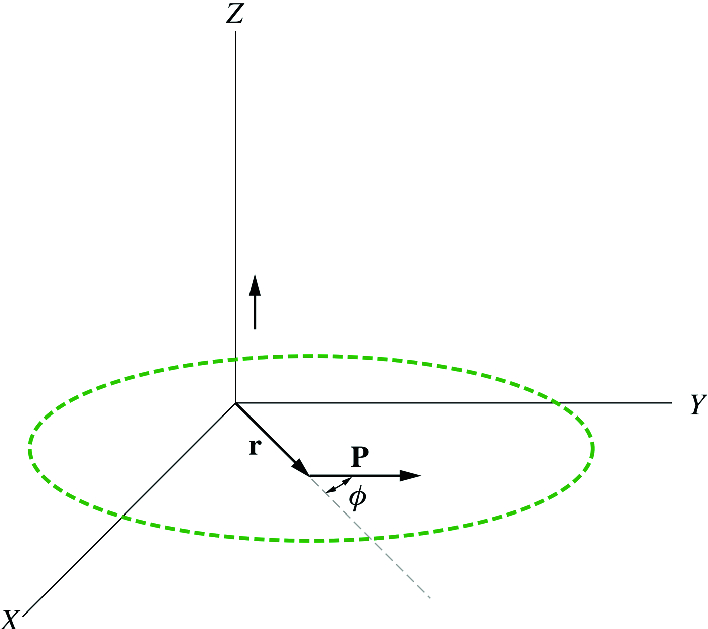
where r is the position vector of the particle relative to an origin O that is in an inertial frame. Therefore, as τ,L also depends on the choice of the origin. Suppose the particle moves in the x–y plane (see Figure 13). The direction of L is then perpendicular to the plane containing r and p and its sense is found by the right-hand rule. The magnitude of L is given by
where ϕ is the smaller angle between r and p. This quantity is the rotational analog of linear momentum in translational motion. If ϕ=0 or 180∘ the particle will move along a line passing through O and its angular momentum is zero. The SI unit of angular momentum is kg.m2/s. In terms of rectangular components, we have
Figure 13:If the particle is moving in the x-y plane, then the direction of is perpendicular to the plane containing and and is found by the right-hand rule
This implies that the torque acting on a particle is equal to the time rate of change of the angular momentum for that particle. This equation is valid only if τ and L are evaluated with respect to the same origin or any other fixed point in an inertial frame. If several forces act on the particle, Eq. (128) can be written as
where Στ is the net torque on the particle. This is the rotational analog of Newton’s second law in linear form, which states that the net force acting on a particle is equal to the time rate of change of its linear momentum. In component form, we have Στx=dLx/dt,Στy=dLy/dt and Στz=dLz/dt.
The law of conservation of angular momentum is a fundamental law of physics and it holds in relativity and quantum mechanics. Thus, for an isolated system, the linear momentum and angular momentum are conserved.