6. System of Particles Salma Alrasheed
King Abdullah University of Science and Technology
6.1 System of Particles ¶ In the previous chapters, objects that can be treated as particles were only considered. We have seen that this is possible only if all parts of the object move in exactly the same way. An object that does not meet this condition must be treated as a system of particles. Next, we will see that the complex motion of this object or system of particles can be represented by the motion of a point located at the center of mass of the system. The center of mass moves as if all of the mass of the object is concentrated there and as if the net external force acting on the system is applied there (at the center of mass). As well as representing an object by a particle, the concept of the center of mass is used to analyze the motion of many systems such as a system of two colliding blocks (particle-like objects) and the system of two colliding subatomic particles such as the neutron with the nucleus.
6.2 Discrete and Continuous System of Particles ¶ 6.2.1 Discrete System of Particles ¶ A discrete system of particles is a system in which particles are separated from each other.
6.2.2 Continuous System of Particles ¶ A continuous system of particles is a system where the separation of particles is very small such that it approaches zero. An extended object is a continuous system of particles. Now, consider the skateboarder example mentioned in Sect. 4.3 Kinetic Energy (KE) and the Work–Energy Theorem + + +
6.3 The Center of Mass of a System of Particles ¶ For a system of particles of total mass M the acceleration of its center of mass is given by
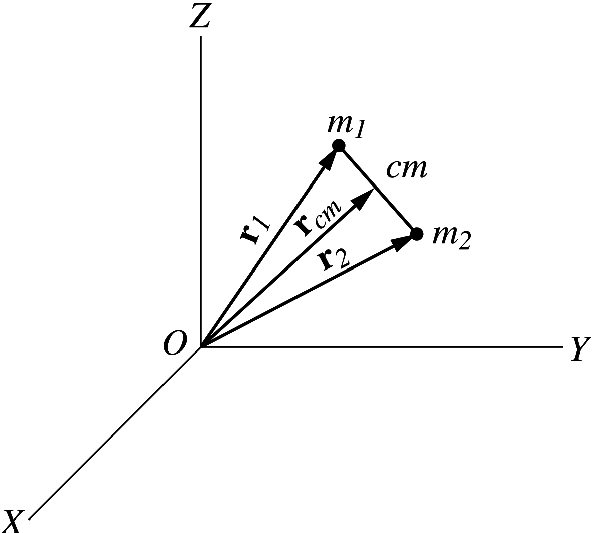
a = F M \mathbf {a}=\frac{\mathbf {F}}{M} a = M F 6.3.1 Two Particle System ¶ Consider two particles of masses m 1 m_{1} m 1 m 2 m_{2} m 2 r 1 \mathbf {r}_{1} r 1 r 2 \mathbf {r}_{2} r 2 Figure 1
r c m = m 1 r 1 + m 2 r 2 m 1 + m 2 \mathbf {r}_{cm}=\frac{m_{1}\mathbf {r}_{1}+m_{2}\mathbf {r}_{2}}{m_{1}+m_{2}} r c m = m 1 + m 2 m 1 r 1 + m 2 r 2 The x , y and z components of the center of mass is
x c m = m 1 x 1 + m 2 x 2 m 1 + m 2 x_{cm}=\frac{m_{1}x_{1}+m_{2}x_{2}}{m_{1}+m_{2}} x c m = m 1 + m 2 m 1 x 1 + m 2 x 2 y c m = m 1 y 1 + m 2 y 2 m 1 + m 2 y_{cm}=\frac{m_{1}y_{1}+m_{2}y_{2}}{m_{1}+m_{2}} y c m = m 1 + m 2 m 1 y 1 + m 2 y 2 and
z c m = m 1 z 1 + m 2 z 2 m 1 + m 2 z_{cm}=\frac{m_{1}z_{1}+m_{2}z_{2}}{m_{1}+m_{2}} z c m = m 1 + m 2 m 1 z 1 + m 2 z 2 Figure 1: Two particles of masses m 1 m_{1} m 1 m 2 m_{2} m 2 r 1 \mathbf {r}_{1} r 1 r 2 \mathbf {r}_{2} r 2
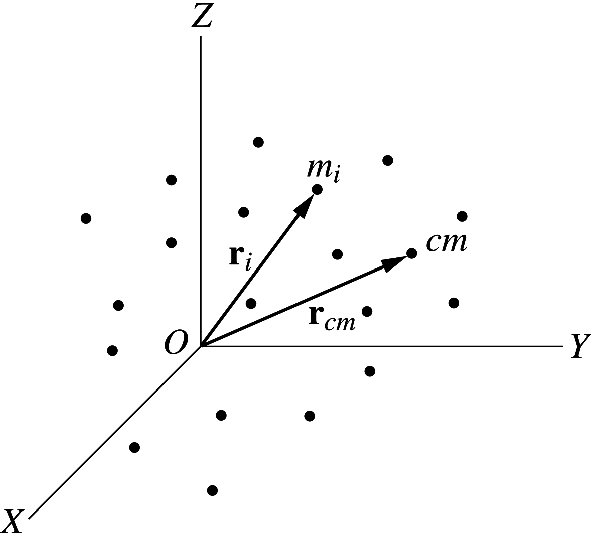
Figure 2: A discrete system of particles consisting of n particles
6.3.2 Discrete System of Particles ¶ Consider a discrete system of particles consisting of n particles (see Fig. Figure 2
r c m = m 1 r 1 + m 2 r 2 + m 3 r 3 . + ⋯ ⋅ ⋅ ⋅ ⋅ ⋯ ⋅ ⋅ m n r n m 1 + m 2 + m 3 + ⋯ + m n = Σ i = 1 n m i r i M \mathbf {r}_{cm}=\frac{m_{1}\mathbf {r}_{1}+m_{2}\mathbf {r}_{2}+m_{3}\mathbf {r}_{3}.+\cdots \cdot \cdot \cdot \cdot \cdots \cdot \cdot m_{n}\mathbf {r}_{n}}{m_{1}+m_{2}+m_{3}+\cdots +m_{n}}=\frac{\varSigma _{i=1}^{n} m_{i}\mathbf {r}_{i}}{M} r c m = m 1 + m 2 + m 3 + ⋯ + m n m 1 r 1 + m 2 r 2 + m 3 r 3 . + ⋯ ⋅ ⋅ ⋅ ⋅ ⋯ ⋅ ⋅ m n r n = M Σ i = 1 n m i r i where r i \mathbf {r}_{i} r i M = ∑ i = 1 n m i M=\displaystyle \sum _{i=1}^{n}m_{i} M = i = 1 ∑ n m i r i \mathrm {r}_{i} r i
r i = x i i + y i j + z i k \mathbf {r}_{i}=x_{i}\mathbf {i}+y_{i}\mathbf {j}+z_{i}\mathbf {k} r i = x i i + y i j + z i k The x , y and z components of the center of mass vector are
x c m = ∑ i = 1 n m i x i M x_{cm}=\frac{\sum _{i=1}^{n}m_{i}x_{i}}{M} x c m = M ∑ i = 1 n m i x i y c m = ∑ i = 1 n m i y i M y_{cm}=\frac{\sum _{i=1}^{n}m_{i}y_{i}}{M} y c m = M ∑ i = 1 n m i y i and
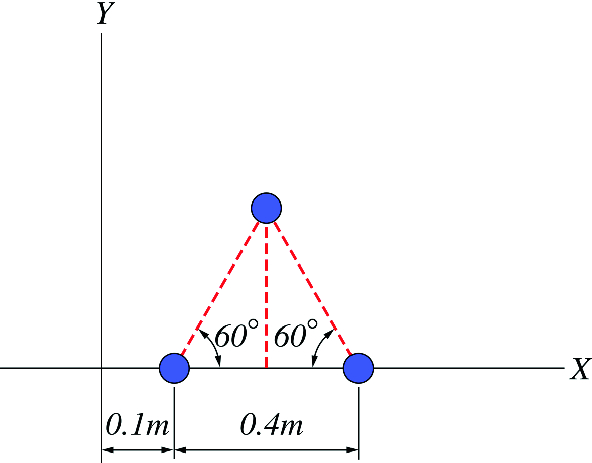
z c m = ∑ i = 1 n m i z i M z_{cm}=\frac{\sum _{i=1}^{n}m_{i}z_{i}}{M} z c m = M ∑ i = 1 n m i z i Figure 3: The center of mass of a system in the x-y plane
A system of particles consists of three masses m A = 0.5 m_{A}=0.5 m A = 0.5 m B = 2 m_{B}=2 m B = 2 m C = 5 m_{C}=5 m C = 5 P A ( − 3 , 1 , 2 ) \mathrm {P}_{\mathrm {A}}(-3,1,2) P A ( − 3 , 1 , 2 ) P B ( 0 , 1 , 2 ) \mathrm {P}_{\mathrm {B}}(0,1,2) P B ( 0 , 1 , 2 ) P C ( − 1 , 3 , 0 ) \mathrm {P}_{\mathrm {C}}(-1,3,0) P C ( − 1 , 3 , 0 )
The position vector of each particle is
r A = ( − 3 i + j + 2 k ) m \mathbf {r}_{A}=(-3\mathbf {i}+\mathbf {j}+2\mathbf {k})\,\mathrm {m} r A = ( − 3 i + j + 2 k ) m r B = ( j + 2 k ) m \mathbf {r}_{B}=(\mathbf {j}+2\mathbf {k})\,\mathrm {m} r B = ( j + 2 k ) m and
r C = ( − i + 3 j ) m \mathbf {r}_{C}=(-\mathbf {i}+3\mathbf {j})\,\mathrm {m} r C = ( − i + 3 j ) m The center of mass of the system is
r c m = ∑ i = 1 n m i r i ∑ i = 1 n m i = ( 0.5 k g ) ( ( − 3 i + j + 2 k ) m ) + ( 2 k g ) ( ( j + 2 k ) m ) + ( 5 k g ) ( ( − i + 3 j ) m ) ( 7.5 k g ) \displaystyle \mathbf {r}_{cm}=\frac{\sum _{i=1}^{n}m_{i}\mathbf {r}_{i}}{\sum _{i=1}^{n}m_{i}}=\frac{(0.5\,\mathrm {k}\mathrm {g})((-3\mathbf {i}+\mathbf {j}+2\mathbf {k})\,\mathrm {m})+(2\,\mathrm {k}\mathrm {g})((\mathbf {j}+2\mathbf {k})\,\mathrm {m})+(5\,\mathrm {k}\mathrm {g})((-\mathbf {i}+3\mathbf {j})\,\mathrm {m})}{(7.5\,\mathrm {k}\mathrm {g})} r c m = ∑ i = 1 n m i ∑ i = 1 n m i r i = ( 7.5 kg ) ( 0.5 kg ) (( − 3 i + j + 2 k ) m ) + ( 2 kg ) (( j + 2 k ) m ) + ( 5 kg ) (( − i + 3 j ) m ) That gives
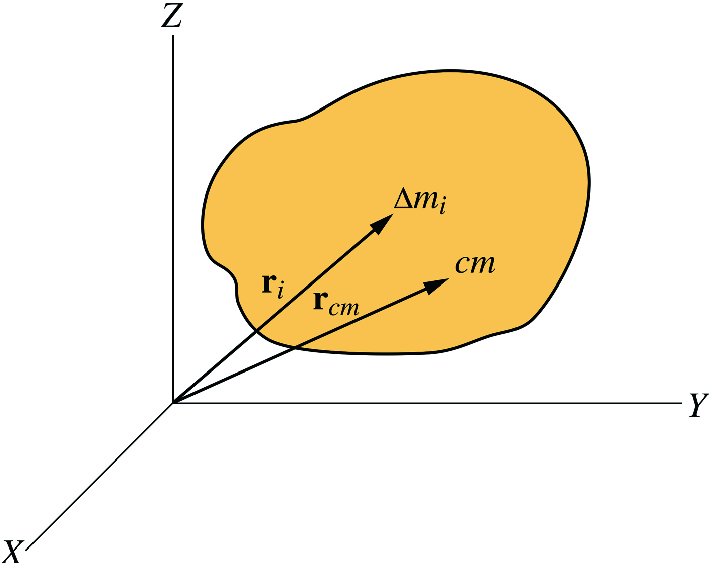
r c m = ( − 0.87 i + 2.3 j + 0.7 k ) m . \mathbf {r}_{cm}=(-0.87\mathbf {i}+2.3\mathbf {j}+0.7\mathbf {k})\,\mathrm {m}. r c m = ( − 0.87 i + 2.3 j + 0.7 k ) m . 6.3.3 Continuous System of Particles (Extended Object) ¶ A continuous system of particles is a system consisting of a large number of particles separated by very small distances. Consider an extended object of mass M divided into small volume elements each of mass △ m i \triangle m_{i} △ m i r i \mathrm {r}_{i} r i Figure 4
r c m ≈ ∑ i = 1 n r i △ m i M \mathbf {r}_{cm}\approx \frac{\sum _{i=1}^{n}\mathbf {r}_{i}\triangle m_{i}}{M} r c m ≈ M ∑ i = 1 n r i △ m i For a very large number of particles where n → ∞ n\rightarrow \infty n → ∞ △ m i → 0 \triangle m_{i}\rightarrow 0 △ m i → 0
r c m = lim △ m i ∑ i = 1 n r i △ m i M = 1 M ∫ r d m \mathbf {r}_{cm}=\lim _{\triangle m_{\mathrm {i}}}\frac{\sum _{i=1}^{n}\mathbf {r}_{i}\triangle m_{i}}{M}=\frac{1}{M}\int \mathbf {r}dm r c m = △ m i lim M ∑ i = 1 n r i △ m i = M 1 ∫ r d m Since r = x i + y j + z k \mathbf {r}=x\mathbf {i}+y\mathbf {j}+z\mathbf {k} r = x i + y j + z k x , y and z components of the center of mass are given by
x c m = 1 M ∫ x d m x_{cm}=\frac{1}{M}\int xdm x c m = M 1 ∫ x d m y c m = 1 M ∫ y d m y_{cm}=\frac{1}{M}\int ydm y c m = M 1 ∫ y d m and
z c m = 1 M ∫ z d m z_{cm}=\frac{1}{M}\int zdm z c m = M 1 ∫ z d m Figure 4: An extended object of mass M divided into small volume elements each of mass △ m i \triangle m_{i} △ m i r I \mathrm {r}_{I} r I
6.3.4 Elastic and Rigid Bodies ¶ A body is called an elastic (deformable) body if the separation between its particles changes when a force is applied to it. This change or deformation is sometimes so small that it can be neglected. A body that behaves in this way is called a rigid body. A rigid body can be defined as a body in which the separation between its particles remain constant with time despite the applied force, i.e., the body has a constant size and shape. Therefore, the center of mass of a rigid object remains fixed at the same location at all times. In this book, only rigid bodies are discussed. In solving problems, it is common to use the volume density ρ \rho ρ
ρ = d m d V \rho =\frac{dm}{dV} ρ = d V d m Therefore, the total mass of a rigid object is
M = ∫ ρ d V M=\int \rho dV M = ∫ ρ d V The center of mass of a rigid object can thus be written as
r c m = 1 M ∫ r d m = ∫ ρ r d V ∫ ρ d V \mathbf {r}_{cm}=\frac{1}{M}\int \mathbf {r}dm=\frac{\int \rho \mathbf {r}dV}{\int \rho dV} r c m = M 1 ∫ r d m = ∫ ρ d V ∫ ρ r d V ρ \rho ρ ρ \rho ρ
ρ = d m d V = T o t a 1 M a s s T o t a 1 V o l u m e = constant \displaystyle \rho =\frac{dm}{dV}=\frac{\mathrm {T}\mathrm {o}\mathrm {t}\mathrm {a}1\mathrm {M}\mathrm {a}\mathrm {s}\mathrm {s}}{\mathrm {T}\mathrm {o}\mathrm {t}\mathrm {a}1\mathrm {V}\mathrm {o}\mathrm {l}\mathrm {u}\mathrm {m}\mathrm {e}}=\text {constant} ρ = d V d m = Tota 1 Volume Tota 1 Mass = constant If the continuous distribution of particles occupies a surface, then the surface density σ \sigma σ
σ = d m d A (mass per unit area) \displaystyle \sigma =\frac{dm}{dA} \; \text {(mass\,per\,unit\, area)} σ = d A d m (mass per unit area) σ = T o t a 1 M a s s T o t a 1 A r e a = constant (homogeneous body) \displaystyle \sigma =\frac{\mathrm {T}\mathrm {o}\mathrm {t}\mathrm {a}1\mathrm {M}\mathrm {a}\mathrm {s}\mathrm {s}}{\mathrm {T}\mathrm {o}\mathrm {t}\mathrm {a}1\mathrm {A}\mathrm {r}\mathrm {e}\mathrm {a}}=\text {constant} \; \text {(homogeneous body)} σ = Tota 1 Area Tota 1 Mass = constant (homogeneous body) If the particles occupy a curve or a line, the linear density λ \lambda λ
λ = d m d l (mass per unit length) \displaystyle \lambda =\frac{dm}{dl} \; \text {(mass\,per\,unit\, length)} λ = d l d m (mass per unit length) λ = T o t a 1 M a s s T o t a 1 L e n g t h = constant (homogeneous body) \displaystyle \lambda =\frac{\mathrm {T}\mathrm {o}\mathrm {t}\mathrm {a}1\mathrm {M}\mathrm {a}\mathrm {s}\mathrm {s}}{\mathrm {T}\mathrm {o}\mathrm {t}\mathrm {a}1\mathrm {L}\mathrm {e}\mathrm {n}\mathrm {g}\mathrm {t}\mathrm {h}}= \text {constant (homogeneous body)} λ = Tota 1 Length Tota 1 Mass = constant (homogeneous body) The center of mass of any homogeneous symmetric object is at its geometrical center and it is not necessarily located within the object.
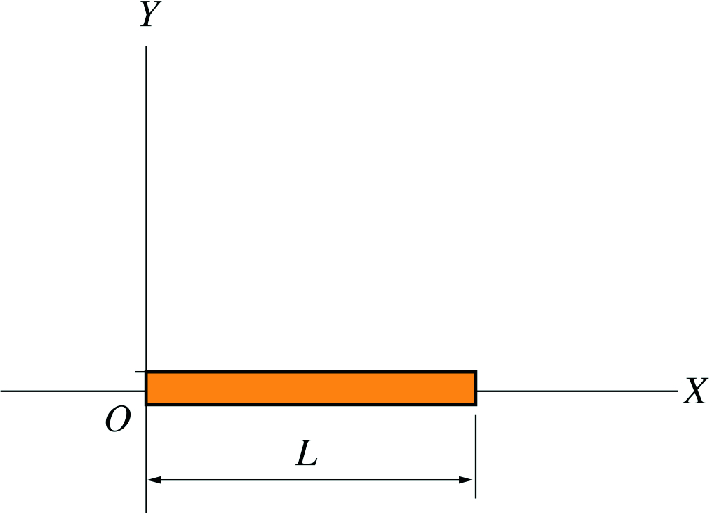
A thin rod of length L = 2 m L=2\,\mathrm {m} L = 2 m x according to the expression λ ( x ) = ( 2 x − 1 ) k g / m \lambda (x)=(2x-1)\,\mathrm {k}\mathrm {g}/\mathrm {m} λ ( x ) = ( 2 x − 1 ) kg / m Figure 5
x c m = 1 M ∫ x d m = ∫ 0 L x λ ( x ) d x ∫ 0 L λ ( x ) d x = ∫ 0 L ( 2 x 2 − x ) d x ∫ 0 L ( 2 x − 1 ) d x x_{cm}=\frac{1}{M}\int xdm=\frac{\int _{0}^{L}x\lambda (x)dx}{\int _{0}^{L}\lambda (x)dx}=\frac{\int _{0}^{L}(2x^{2}-x)dx}{\int _{0}^{L}(2x-1)dx} x c m = M 1 ∫ x d m = ∫ 0 L λ ( x ) d x ∫ 0 L x λ ( x ) d x = ∫ 0 L ( 2 x − 1 ) d x ∫ 0 L ( 2 x 2 − x ) d x = ( ( 2 / 3 ) x 3 − x 2 / 2 ) ∣ x = 0 L ( x 2 − x ) ∣ x = 0 L = L ( ( 2 / 3 ) L − 1 / 2 ) ( L − 1 ) =\frac{((2/3)x^{3}-x^{2}/2)|_{x=0}^{L}}{(x^{2}-x)|_{x=0}^{L}}=\frac{L((2/3)L-1/2)}{(L-1)} = ( x 2 − x ) ∣ x = 0 L (( 2/3 ) x 3 − x 2 /2 ) ∣ x = 0 L = ( L − 1 ) L (( 2/3 ) L − 1/2 ) Substituting L = 2 m L=2\,\mathrm {m} L = 2 m x c m = 1.7 m . x_{cm}=1.7\,\mathrm {m}. x c m = 1.7 m .
Figure 5: A thin rod of length L = 2 m L=2 \; \mathrm {m} L = 2 m x
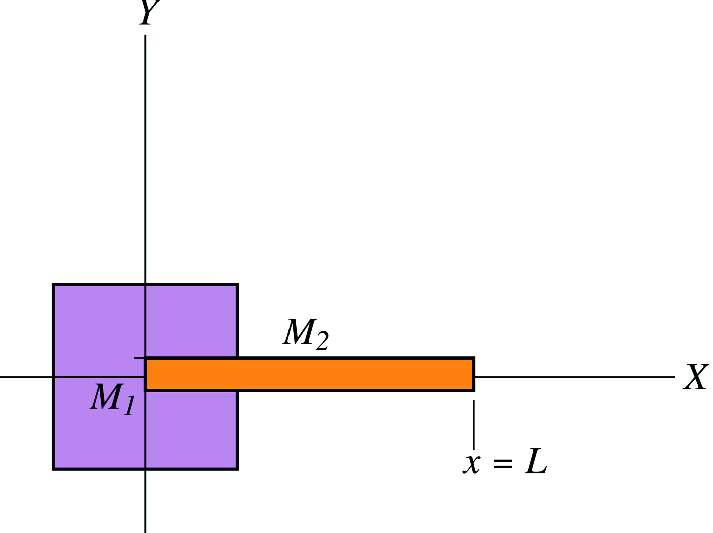
Figure 6: A uniform square sheet suspended by a uniform rod where they both lie in the same plane
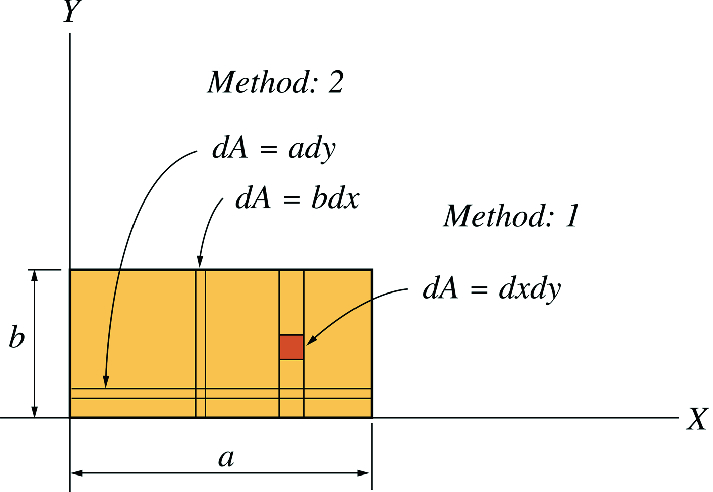
Figure 7: The center of mass of a rectangular plate
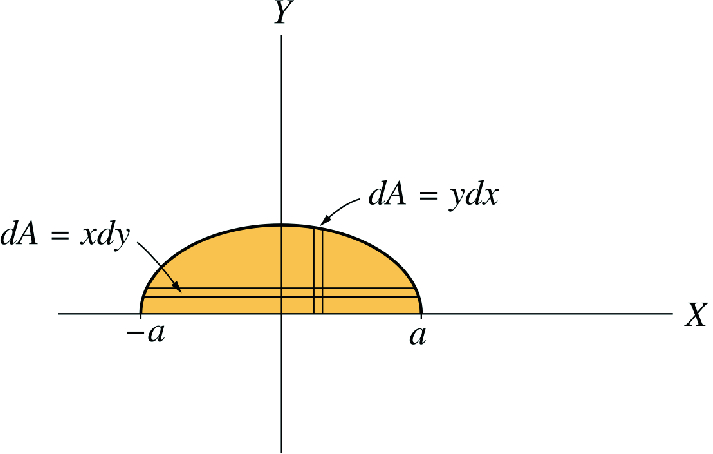
Figure 8: The center of mass of half an ellipse
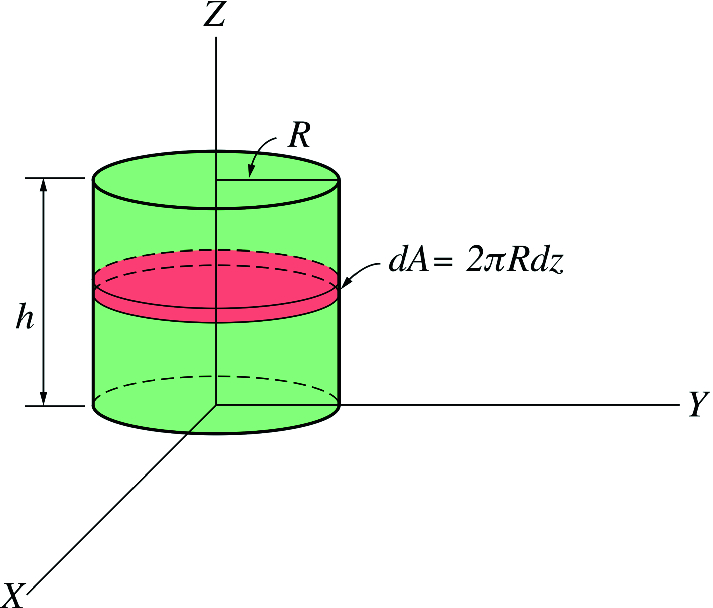
Figure 9: The center of mass of a cylindrical shell
A boy standing on a smooth ice surface wants to fetch a container that is at a distance of 10 m \mathrm {m} m m \mathrm {m} m
Figure 10: A boy pulling a container on a smooth surface
By taking the midpoint between the boy and the container as the origin (see Fig. Figure 10
x c m = Σ i m i x i Σ i m i = ( 70 k g ) ( 5 m ) + ( 40 k g ) ( − 5 m ) ( 110 k g ) = 1.36 m x_{cm}=\frac{\varSigma _{i}m_{i}x_{i}}{\varSigma _{i}m_{i}}=\frac{(70\,\mathrm {k}\mathrm {g})(5\,\mathrm {m})+(40\,\mathrm {k}\mathrm {g})(-5\,\mathrm {m})}{(110\,\mathrm {k}\mathrm {g})}=1.36\,\mathrm {m} x c m = Σ i m i Σ i m i x i = ( 110 kg ) ( 70 kg ) ( 5 m ) + ( 40 kg ) ( − 5 m ) = 1.36 m Because the surface may be assumed to be frictionless, the resultant external force on the system is zero and therefore the center of mass must remain stationary at all times. Hence, if the boy has moved a distance of 2 m \mathrm {m} m − 3 m -3\,\mathrm {m} − 3 m
( 1.36 m ) = ( 70 k g ) x c + ( 40 k g ) ( − 3 m ) ( 110 k g ) (1.36\,\mathrm {m})=\frac{(70\,\mathrm {k}\mathrm {g})x_{c}+(40\,\mathrm {k}\mathrm {g})(-3\,\mathrm {m})}{(110\,\mathrm {k}\mathrm {g})} ( 1.36 m ) = ( 110 kg ) ( 70 kg ) x c + ( 40 kg ) ( − 3 m ) That gives x c = 3.86 m x_{c}=3.86\,\mathrm {m} x c = 3.86 m ( 5 m ) − ( 3.86 m ) = 1.14 m . (5\,\mathrm {m})-(3.86\,\mathrm {m})=1.14\,\mathrm {m}. ( 5 m ) − ( 3.86 m ) = 1.14 m .
A boy is standing at the rear of a boat as shown in Fig. Figure 11 5 m 5\,\mathrm {m} 5 m
Figure 11: A boy walking on a small boat
By neglecting air and water resistance, the net external force on the ( b o y + (\mathrm {b}\mathrm {o}\mathrm {y}+ ( boy + m \mathrm {m} m
x c m = ∑ i = 1 n m i x i M = m 1 x 1 + m 2 x 2 m 1 + m 2 = ( 45 k g ) ( 0 ) + ( 80 k g ) ( 2.5 m ) ( 125 k g ) = 1.6 m \begin{aligned} x_{cm}&=\frac{\sum _{i=1}^{n}m_{i}x_{i}}{M}=\frac{m_{1}x_{1}+m_{2}x_{2}}{m_{1}+m_{2}}\\&=\frac{(45\,\mathrm {k}\mathrm {g})(0)+(80\,\mathrm {k}\mathrm {g})(2.5\,\mathrm {m})}{(125\,\mathrm {k}\mathrm {g})}=1.6\,\mathrm {m} \end{aligned} x c m = M ∑ i = 1 n m i x i = m 1 + m 2 m 1 x 1 + m 2 x 2 = ( 125 kg ) ( 45 kg ) ( 0 ) + ( 80 kg ) ( 2.5 m ) = 1.6 m If the boy moves a distance of 1 m \mathrm {m} m
( 1.6 m ) = ( 45 k g ) ( 1 m ) + ( 80 k g ) x b ( 125 k g ) (1.6\,\mathrm {m})=\frac{(45\,\mathrm {k}\mathrm {g})(1\,\mathrm {m})+(80\,\mathrm {k}\mathrm {g})x_{b}}{(125\,\mathrm {k}\mathrm {g})} ( 1.6 m ) = ( 125 kg ) ( 45 kg ) ( 1 m ) + ( 80 kg ) x b That gives x b = 1.94 m x_{b}=1.94\,\mathrm {m} x b = 1.94 m ( 1.94 m ) − ( 2.5 m ) = − 0.56 m . (1.94\,\mathrm {m})-(2.5\,\mathrm {m})=-0.56\,\mathrm {m}. ( 1.94 m ) − ( 2.5 m ) = − 0.56 m .
6.3.5 Velocity of the Center of Mass ¶ The velocity of the center of mass of a system of particles that has a constant mass M is
v c m = d r c m d t = 1 M d d t ( ∑ i = 1 n m i r i ) = 1 M ∑ i = 1 n m i r ˙ i \mathbf {v}_{cm}=\frac{d\mathbf {r}_{cm}}{dt}=\frac{1}{M}\frac{d}{dt}\bigg (\sum _{i=1}^{n}m_{i}\mathbf {r}_{i}\bigg )=\frac{1}{M}\sum _{i=1}^{n}m_{i}\dot{\mathbf {r}}_{i} v c m = d t d r c m = M 1 d t d ( i = 1 ∑ n m i r i ) = M 1 i = 1 ∑ n m i r ˙ i where r ˙ i = d r i / d t \dot{\mathbf {r}}_{i}=d\mathbf {r}_{i}/dt r ˙ i = d r i / d t
v c m = ∑ i = 1 n m i v i M \begin{aligned} \displaystyle \mathbf {v}_{cm}=\sum _{i=1}^{n}\frac{m_i{{\mathbf {v}}i}}{M} \end{aligned} v c m = i = 1 ∑ n M m i v i where v i \mathbf {v}_{i} v i
a c m = d v c m d t = 1 M d d t ( ∑ i = 1 n m i v i ) = 1 M ∑ i = 1 n m i r ¨ i \mathbf {a}_{cm}=\frac{d\mathbf {v}_{cm}}{dt}=\frac{1}{M}\frac{d}{dt}\bigg (\sum _{i=1}^{n}m_{i}\mathbf {v}_{i}\bigg )=\frac{1}{M}\sum _{i=1}^{n}m_{i}\ddot{\mathbf {r}}_{i} a c m = d t d v c m = M 1 d t d ( i = 1 ∑ n m i v i ) = M 1 i = 1 ∑ n m i r ¨ i a c m = 1 M ∑ i = 1 n m i a i \begin{aligned} \displaystyle \mathbf {a}_{cm}=\frac{1}{M}\sum _{i=1}^{n}m_{i}\mathbf {a}_{i} \end{aligned} a c m = M 1 i = 1 ∑ n m i a i where a i \mathbf {a}_{i} a i
6.3.6 Momentum of a System of Particles ¶ The total linear momentum of a system of particles is the vector sum of the linear momenta of the individual particles:
∑ i = 1 n m i v i = ∑ i = 1 n p i = p t o t \begin{aligned} \displaystyle \sum _{i=1}^{n}m_{i}\mathbf {v}_{i}=\sum _{i=1}^{n}\mathbf {p}_{i}=\mathbf {p}_{tot} \end{aligned} i = 1 ∑ n m i v i = i = 1 ∑ n p i = p t o t By using Eq. (56)
p t o t = M v c m \begin{aligned} \mathbf {p}_{tot}=M\mathbf {v}_{cm} \end{aligned} p t o t = M v c m Two particles of masses m 1 = 1 m_{1}=1 m 1 = 1 m 2 = 2 m_{2}=2 m 2 = 2 r 1 = ( 2 t i − 4 j ) m \mathbf {r}_{1}=(2t\mathbf {i}-4\mathbf {j})\,\mathrm {m} r 1 = ( 2 t i − 4 j ) m r 2 = ( 5 t i − 2 t j ) m \mathbf {r}_{2}=(5t\mathbf {i}-2t\mathbf {j})\,\mathrm {m} r 2 = ( 5 t i − 2 t j ) m t is time. Determine the velocity and linear momentum of the center of mass of the two- particle system at any time and at t = 1 s . t=1\,\mathrm {s}. t = 1 s .
r c m = ∑ i m i r i ∑ i m i = ( 1 k g ) ( 2 t i − 4 j ) + ( 2 k g ) ( 5 t i − 2 t j ) ( 3 k g ) \mathbf {r}_{cm}=\frac{\sum _{i}m_{i}\mathbf {r}_{i}}{\sum _{i}m_{i}}=\frac{(1\,\mathrm {k}\mathrm {g})(2t\mathbf {i}-4\mathbf {j})+(2\,\mathrm {k}\mathrm {g})(5t\mathbf {i}-2t\mathbf {j})}{(3\,\mathrm {k}\mathrm {g})} r c m = ∑ i m i ∑ i m i r i = ( 3 kg ) ( 1 kg ) ( 2 t i − 4 j ) + ( 2 kg ) ( 5 t i − 2 t j ) That gives
r c m = ( 4 t i − 4 3 ( t + 1 ) j ) m \mathbf {r}_{cm}=\left( 4t\mathbf {i}-\frac{4}{3}(t+1)\mathbf {j}\right) \,\mathrm {m} r c m = ( 4 t i − 3 4 ( t + 1 ) j ) m v c m = d r c m d t = ( 4 i − 4 3 j ) m / s \mathbf {v}_{cm}=\frac{d\mathbf {r}_{cm}}{dt}=\left( 4\mathbf {i}-\frac{4}{3}\mathbf {j}\right) \,\mathrm {m}/\mathrm {s} v c m = d t d r c m = ( 4 i − 3 4 j ) m / s The total linear momentum is
p t o t = M v c m = ( 3 k g ) ( 4 i − 4 3 j ) = ( 12 i − 4 j ) k g . m / s \mathbf {p}_{tot}=M\mathbf {v}_{cm}=(3\mathrm {k}\mathrm {g})\left( 4\mathbf {i}-\frac{4}{3}\mathbf {j}\right) =(12\mathbf {i}-4\mathbf {j})\,\mathrm {k}\mathrm {g}.\mathrm {m}/\mathrm {s} p t o t = M v c m = ( 3 kg ) ( 4 i − 3 4 j ) = ( 12 i − 4 j ) kg . m / s at t = 1 s t=1\mathrm {s} t = 1 s
r c m = ( 4 i − 8 3 j ) m \mathbf {r}_{cm}=(4\mathbf {i}-\frac{8}{3}\mathbf {j})\,\mathrm {m} r c m = ( 4 i − 3 8 j ) m v c m = ( 4 i − 4 3 j ) m / s \mathbf {v}_{cm}=(4\mathbf {i}-\frac{4}{3}\mathbf {j})\,\mathrm {m}/\mathrm {s} v c m = ( 4 i − 3 4 j ) m / s and
p t o t = ( 12 i − 4 j ) k g . m / s \mathbf {p}_{tot}=(12\mathbf {i}-4\mathbf {j})\,\mathrm {k}\mathrm {g}.\mathrm {m}/\mathrm {s} p t o t = ( 12 i − 4 j ) kg . m / s 6.3.7 Motion of a System of Particles ¶ From Newton’s second law Eq. (58)
a c m = 1 M ∑ i = 1 n F i \begin{aligned} \displaystyle \mathbf {a}_{cm}=\frac{1}{M}\sum _{i=1}^{n}\mathbf {F}_{i} \end{aligned} a c m = M 1 i = 1 ∑ n F i where F i \mathbf {F}_{i} F i F i \mathbf {F}_{i} F i
F i = F i ( e x t ) + ∑ j f i j \begin{aligned} \displaystyle \mathbf {F}_{i}=\mathbf {F}_{i(ext)}+\sum _{j}\mathbf {f}_{ij} \end{aligned} F i = F i ( e x t ) + j ∑ f ij Where F i ( e x t ) \mathbf {F}_{i(ext)} F i ( e x t ) f i j \mathbf {f}_{ij} f ij f i i = 0 \mathbf {f}_{ii}=0 f ii = 0 (69) (68)
a c m = 1 M ( ∑ i F i ( e x t ) + ∑ i ∑ j f i j ) \begin{aligned} \displaystyle \mathbf {a}_{cm}=\frac{1}{M}\bigg (\sum _{i}\mathbf {F}_{i(ext)}+\sum _{i}\sum _{j}\mathbf {f}_{ij}\bigg ) \end{aligned} a c m = M 1 ( i ∑ F i ( e x t ) + i ∑ j ∑ f ij ) Now, from Newton’s third law we have
f i j = − f j i \mathbf {f}_{ij}=-\mathbf {f}_{ji} f ij = − f ji Therefore, the second term in Eq. (70)
F n e t = ∑ i F i ( e x t ) = M a c m \mathbf {F}_{net}=\sum _{i}\mathbf {F}_{i(ext)}=M\mathbf {a}_{cm} F n e t = i ∑ F i ( e x t ) = M a c m where F n e t \mathbf {F}_{net} F n e t
F n e t = ∑ F e x t = M a c m \mathbf {F}_{net}=\sum \mathbf {F}_{ext}=M\mathbf {a}_{cm} F n e t = ∑ F e x t = M a c m By differentiating Eq. (60)
M a c m = d p t o t d t M\mathbf {a}_{cm}=\frac{d\mathbf {p}_{tot}}{dt} M a c m = d t d p t o t thus
∑ F e x t = d p t o t d t \sum \mathbf {F}_{ext}=\frac{d\mathbf {p}_{tot}}{dt} ∑ F e x t = d t d p t o t Thus, the net external force acting on a system of particles is equal to the time rate of change of the total linear momentum of the system.
6.3.8 Conservation of Momentum ¶ For an isolated system of particles, we have
∑ F e x t = 0 \sum \mathbf {F}_{ext}=0 ∑ F e x t = 0 Thus
d p t o t d t = 0 \frac{d\mathbf {p}_{tot}}{dt}=0 d t d p t o t = 0 and
p t o t = M v c m = constant \mathbf {p}_{tot}=M\mathbf {v}_{cm}=\text {constant} p t o t = M v c m = constant Which is the law of conservation of linear momentum for a system of particles.
6.3.9 Angular Momentum of a System of Particles ¶ The angular momentum L \mathbf {L} L
L = L 1 + L 2 + L 3 + + L n = ∑ i = 1 n L i = ∑ i = 1 n ( r i × p i ) = ∑ i = 1 n m i ( r i × v i ) \mathbf {L}=\mathbf {L}_{1}+\mathbf {L}_{2}+\mathbf {L}_{3}+\ +\mathbf {L}_{n}=\sum _{i=1}^{n}\mathbf {L}_{i}=\sum _{i=1}^{n}(\mathbf {r}_{i}\times \mathbf {p}_{i})=\sum _{i=1}^{n}m_{i}(\mathbf {r}_{i}\times \mathbf {v}_{i}) L = L 1 + L 2 + L 3 + + L n = i = 1 ∑ n L i = i = 1 ∑ n ( r i × p i ) = i = 1 ∑ n m i ( r i × v i ) 6.3.10 The Total Torque on a System ¶ The total torque acting on a particle in a system is the sum of torques associated with the internal forces and of torques associated with external forces. Using Eq. (69)
τ i = r i × F i = r i × ( F i e x t + ∑ j f i j ) = r i × F i e x t + ∑ j r i × f i j \boldsymbol{\tau _{i}}=\mathbf {r}_{i}\times \mathbf {F}_{i}=\mathbf {r}_{i}\times \left( \mathbf {F}_{iext}+\sum _{j}\mathbf {f}_{ij}\right) =\mathbf {r}_{i}\times \mathbf {F}_{iext}+\sum _{j}\mathbf {r}_{i}\times \mathbf {f}_{ij} τ i = r i × F i = r i × ( F i e x t + j ∑ f ij ) = r i × F i e x t + j ∑ r i × f ij Summing over i \mathrm {i} i
∑ i τ i = ∑ i r i × F i = ∑ i r i × F i e x t + ∑ i ∑ j r i × f i j \begin{aligned} \displaystyle \sum _{i}\boldsymbol{\tau _{i}}=\sum _{i}\mathbf {r}_{i}\times \mathbf {F}_{i}=\sum _{i}\mathbf {r}_{i}\times \mathbf {F}_{iext}+\sum _{i}\sum _{j}\mathbf {r}_{i}\times \mathbf {f}_{ij} \end{aligned} i ∑ τ i = i ∑ r i × F i = i ∑ r i × F i e x t + i ∑ j ∑ r i × f ij By using Newton’s third law of action and reaction, the double sum in Eq. (81)
r i × f i j + r j × f j i = ( r i − r j ) × f i j \mathbf {r}_{i}\times \mathbf {f}_{ij}+\mathbf {r}_{j}\times \mathbf {f}_{ji}=(\mathbf {r}_{i}-\mathbf {r}_{j})\times \mathbf {f}_{ij} r i × f ij + r j × f ji = ( r i − r j ) × f ij Now, suppose that the internal forces between the two particles lie along the line joining the particles (i.e., the vectors f i j \mathbf {f}_{ij} f ij ( r i − r j ) (\mathbf {r}_{i}-\mathbf {r}_{j}) ( r i − r j ) (81)
τ n e t = ∑ i τ i = ∑ i r i × F i = ∑ i r i × F i e x t \boldsymbol{\tau _{net}}=\sum _{i}\boldsymbol{\tau _{i}}=\sum _{i}\mathbf {r}_{i}\times \mathbf {F}_{i}=\sum _{i}\mathbf {r}_{i}\times \mathbf {F}_{iext} τ net = i ∑ τ i = i ∑ r i × F i = i ∑ r i × F i e x t Therefore, the total torque on the system about the origin is only the torque associated with external forces
τ n e t = ∑ τ e x t = ∑ i = 1 n r i × F i ( e x t ) \begin{aligned} \displaystyle \boldsymbol{\tau _{net}}=\sum \boldsymbol{\tau _{ext}}=\sum _{i=1}^{n}\mathbf {r}_{i}\times \mathbf {F}_{i(ext)} \end{aligned} τ net = ∑ τ ext = i = 1 ∑ n r i × F i ( e x t ) 6.3.11 The Angular Momentum and the Total External Torque ¶ The angular momentum of the individual particles may change with time. This will change the total angular momentum of the system
d L d t = ∑ i = 1 n d L i d t \frac{d\mathbf {L}}{dt}=\sum _{i=1}^{n}\frac{d\mathbf {L}_{i}}{dt} d t d L = i = 1 ∑ n d t d L i Eq. (84)
τ n e t = ∑ τ e x t = ∑ i = 1 n r i × F i ( e x t ) = d d t { ∑ i = 1 n m i ( r i × v i ) } = d d t { ∑ i = 1 n L i } = d L d t \displaystyle \boldsymbol{\tau _{net}}=\sum \boldsymbol{\tau _{ext}}=\sum _{i=1}^{n}\mathbf {r}_{i}\times \mathbf {F}_{i(ext)}=\frac{d}{dt} \bigg \{\sum _{i=1}^{n}m_{i}(\mathbf {r}_{i}\times \mathbf {v}_{i}) \bigg \}=\frac{d}{dt}\bigg \{\sum _{i=1}^{n}\mathbf {L}_{i} \bigg \}=\frac{d\mathbf {L}}{dt} τ net = ∑ τ ext = i = 1 ∑ n r i × F i ( e x t ) = d t d { i = 1 ∑ n m i ( r i × v i ) } = d t d { i = 1 ∑ n L i } = d t d L i.e., the net external torque about some origin exerted on a system of particles is equal to the time rate of change of the total angular momentum of the system.
6.3.12 Conservation of Angular Momentum ¶ If
∑ τ e x t = 0 \sum \boldsymbol{\tau _{ext}}=\mathbf {0} ∑ τ ext = 0 L = ∑ i = 1 n m i ( r i × v i ) = constant \displaystyle \mathbf {L}=\sum _{i=1}^{n}m_{i}(\mathbf {r}_{i}\times \mathbf {v}_{i})=\text {constant} L = i = 1 ∑ n m i ( r i × v i ) = constant or
L i = L f \mathbf {L}_{i}=\mathbf {L}_{f} L i = L f Hence, if the resultant external torque acting on a system is zero, the total angular momentum remains constant.
6.3.13 Kinetic Energy of a System of Particles ¶ The total kinetic energy of a system of particles is the sum of the kinetic energies of the individual particles
K = 1 2 ∑ i = 1 n m i v i 2 K=\frac{1}{2}\sum _{i=1}^{n}m_{i}v_{i}^{2} K = 2 1 i = 1 ∑ n m i v i 2 6.3.14 Work ¶ Since the total force acting on the ith particle is given by
F i = F i ( e x t ) + ∑ j f i j \mathbf {F}_{i}=\mathbf {F}_{i(ext)}+\sum _{j}\mathbf {f}_{ij} F i = F i ( e x t ) + j ∑ f ij then the total work done on such particle is given by
W 12 = ∑ i ∫ 1 2 F i ⋅ d s i W_{12}=\sum _{i}\int _{1}^{2}\mathbf {F}_{i}\cdot d\mathbf {s}_{i} W 12 = i ∑ ∫ 1 2 F i ⋅ d s i 6.3.15 Work–Energy Theorem ¶ The total work done in moving a system from one state to another is
W 12 = ∑ i ∫ 1 2 F i ⋅ d s i = ∑ i ∫ 1 2 F i ⋅ d s i d t d t = ∑ i ∫ 1 2 F i ⋅ v i d t W_{12}=\sum _{i}\int _{1}^{2}\mathbf {F}_{i}\cdot d\mathbf {s}_{i}=\sum _{i}\int _{1}^{2}\mathbf {F}_{i} \cdot \frac{d\mathbf {s}_{i}}{dt}dt=\sum _{i}\int _{1}^{2}\mathbf {F}_{i}\cdot \mathbf {v}_{i}dt W 12 = i ∑ ∫ 1 2 F i ⋅ d s i = i ∑ ∫ 1 2 F i ⋅ d t d s i d t = i ∑ ∫ 1 2 F i ⋅ v i d t = ∑ i ∫ 1 2 v i ⋅ F i d t = ∑ i ∫ 1 2 v i ⋅ d d t ( m i v i ) d t =\sum _{i}\int _{1}^{2}\mathbf {v}_{i}\cdot \mathbf {F}_{i}dt=\sum _{i}\int _{1}^{2}\mathbf {v}_{i}\cdot \frac{d}{dt}(m_i \mathbf {v}_i)dt = i ∑ ∫ 1 2 v i ⋅ F i d t = i ∑ ∫ 1 2 v i ⋅ d t d ( m i v i ) d t Since
v i d d t ( m i v i ) = 1 2 d d t ( m i ( v i ⋅ v i ) ) = 1 2 d d t ( m i v i 2 ) \mathbf {v}_{i}\frac{d}{dt}(m_{i}\mathbf {v}_{i})=\frac{1}{2}\frac{d}{dt}(m_{i}(\mathbf {v}_{i}\cdot \mathbf {v}_{i}))=\frac{1}{2}\frac{d}{dt}(m_{i}v_{i}^{2}) v i d t d ( m i v i ) = 2 1 d t d ( m i ( v i ⋅ v i )) = 2 1 d t d ( m i v i 2 ) it follows that
W 12 = 1 2 ∑ i ∫ 1 2 d d t ( m i v i 2 ) d t = 1 2 ∑ i ( m i v i 2 ) ∣ 1 2 = K 2 − K 1 W_{12}=\frac{1}{2}\sum _{i}\int _{1}^{2}\frac{d}{dt}(m_{i}v_{i}^{2})dt=\frac{1}{2}\sum _{i} \big (m_{i}v_{i}^{2} \big )|_{1}^{2}=K_{2}-K_{1} W 12 = 2 1 i ∑ ∫ 1 2 d t d ( m i v i 2 ) d t = 2 1 i ∑ ( m i v i 2 ) ∣ 1 2 = K 2 − K 1 where 1 2 ∑ i m i v i 2 \displaystyle \frac{1}{2}\sum _{i}m_{i}v_{i}^{2} 2 1 i ∑ m i v i 2
6.3.16 Potential Energy and Conservation of Energy of a System of Particles ¶ Consider a system of particles in which the external and internal forces acting on the system are conservative. First, let us calculate the work done by the internal conservative forces. Suppose that f i j \mathbf {f}_{ij} f ij f j i \mathbf {f}_{ji} f ji f i j \mathbf {f}_{ij} f ij f j i \mathbf {f}_{ji} f ji f i j = − f j i \mathbf {f}_{ij}=-\mathbf {f}_{ji} f ij = − f ji
f i j = − ∇ i U i j \mathbf {f}_{ij}=-\nabla _{i}U_{ij} f ij = − ∇ i U ij and
f j i = − ∇ j U i j \mathbf {f}_{ji}=-\nabla _{j}U_{ij} f ji = − ∇ j U ij From the law of action and reaction,U i j U_{ij} U ij
U i j = U i j ( ∣ r i − r j ∣ ) = U j i ( ∣ r i − r j ∣ ) U_{ij}=U_{ij}(|\mathbf {r}_{i}-\mathbf {r}_{j}|)=U_{ji}(|\mathbf {r}_{i}-\mathbf {r}_{j}|) U ij = U ij ( ∣ r i − r j ∣ ) = U ji ( ∣ r i − r j ∣ ) or
U i j ( r i j ) = U j i ( r j i ) U_{ij}(r_{ij})=U_{ji}(r_{ji}) U ij ( r ij ) = U ji ( r ji ) where ∣ r i − r j ∣ = r i j = r j i |\mathbf {r}_{i}-\mathbf {r}_{j}|=r_{ij}=r_{ji} ∣ r i − r j ∣ = r ij = r ji d r i d\mathbf {r}_{i} d r i d r j d\mathbf {r}_{j} d r j
f i j ⋅ d r i + f j i ⋅ d r j = − ∇ i U i j ⋅ d r i − ∇ j U i j ⋅ d r j \mathbf {f}_{ij}\cdot d\mathbf {r}_{i}+\mathbf {f}_{ji}\cdot d\mathbf {r}_{j}=-\nabla _{i}U_{ij}\cdot d\mathbf {r}_{i}-\nabla _{j}U_{ij}\cdot d\mathbf {r}_{j} f ij ⋅ d r i + f ji ⋅ d r j = − ∇ i U ij ⋅ d r i − ∇ j U ij ⋅ d r j = − [ ∂ U i j ∂ x i d x i + ∂ U i j ∂ y i d y i + ∂ U i j ∂ z i d z i + ∂ U i j ∂ x j d x j + ⋯ ⋯ ⋯ ] = − d U i j =-\bigg [\frac{\partial U_{ij}}{\partial x_{i}}dx_{i}+\frac{\partial U_{ij}}{\partial y_{i}}dy_{i}+\frac{\partial U_{ij}}{\partial z_{i}}dz_{i}+\frac{\partial U_{ij}}{\partial x_{j}}dx_{j}+\cdots \cdots \cdots \bigg ]=-dU_{ij} = − [ ∂ x i ∂ U ij d x i + ∂ y i ∂ U ij d y i + ∂ z i ∂ U ij d z i + ∂ x j ∂ U ij d x j + ⋯⋯⋯ ] = − d U ij Hence, the total work done by the internal conservative forces in moving the system from stage 1 to stage 2 is
W 12 ( i n , c ) = ∑ i ∑ j ∫ 1 2 f i j ⋅ d r i = − 1 2 ∑ i ∑ j ∫ 1 2 d U i j = − 1 2 ∑ i ∑ j U i j ∣ 1 2 = U 1 ( i n t ) − U 2 ( i n t ) = − △ U ( i n t ) \begin{aligned} W_{12(in, c)}&=\displaystyle \sum _{i}\sum _{j}\int _{1}^{2}\mathbf {f}_{ij}\cdot d\mathbf {r}_{i}=-\frac{1}{2}\sum _{i}\sum _{j}\int _{1}^{2}dU_{ij}\\&=-\frac{1}{2}\sum _{i}\sum _{j}U_{ij} |_{1}^{2}=U_{1(\mathrm {i}\mathrm {n}\mathrm {t})}-U_{2(\mathrm {i}\mathrm {n}\mathrm {t})}=-\triangle U_{(\mathrm {i}\mathrm {n}\mathrm {t})} \end{aligned} W 12 ( in , c ) = i ∑ j ∑ ∫ 1 2 f ij ⋅ d r i = − 2 1 i ∑ j ∑ ∫ 1 2 d U ij = − 2 1 i ∑ j ∑ U ij ∣ 1 2 = U 1 ( int ) − U 2 ( int ) = − △ U ( int ) The factor 1/2 occurs since each term in the summation appears twice. Now, consider the total work done by the external conservative forces
W 12 ( e x t , c ) = ∑ i ∫ 1 2 F i ( e x t ) . d s i = − ∑ i ∫ 1 2 ∇ i U i ⋅ d s i = − ∑ i U i ∣ 1 2 = U 1 ( e x t ) − U 2 ( e x t ) W_{12(ext, c)}=\displaystyle \sum _{i}\int _{1}^{2}\mathbf {F}_{i(ext)} . d\mathbf {s}_{i}=-\sum _{i}\int _{1}^{2}\nabla _{i}U_{i}\cdot d\mathbf {s}_{i} =-\sum _{i}U_{i} |_{1}^{2}=U_{1(ext)}-U_{2(ext)} W 12 ( e x t , c ) = i ∑ ∫ 1 2 F i ( e x t ) . d s i = − i ∑ ∫ 1 2 ∇ i U i ⋅ d s i = − i ∑ U i ∣ 1 2 = U 1 ( e x t ) − U 2 ( e x t ) To show that energy is conserved when both the external and internal forces are conservative, we may define a total potential of the system as
U = ∑ i U i + 1 2 ∑ i ∑ j U i j U=\sum _{i}U_{i}+\frac{1}{2}\sum _{i}\sum _{j}U_{ij} U = i ∑ U i + 2 1 i ∑ j ∑ U ij From the work–energy theorem, the work done by the total force F i \mathrm {F}_{i} F i
W 12 = ∑ i ∫ 1 2 F i ⋅ d r i = K 2 − K 1 W_{12}=\sum _{i}\int _{1}^{2}\mathbf {F}_{i}\cdot d\mathbf {r}_{i}=K_{2}-K_{1} W 12 = i ∑ ∫ 1 2 F i ⋅ d r i = K 2 − K 1 and since
W 12 = W 12 ( i n , c ) + W 12 ( e x t , c ) W_{12}=W_{12(in, c)}+W_{12(ext, c)} W 12 = W 12 ( in , c ) + W 12 ( e x t , c ) From this, we conclude that for a system of particles in which the internal and external forces are conservative, the total mechanical energy of the system is conserved
U 1 ( i n t ) − U 2 ( i n t ) + U 1 ( e x t ) − U 2 ( e x t ) = K 2 − K 1 U_{1(\mathrm {i}\mathrm {n}\mathrm {t})}-U_{2(\mathrm {i}\mathrm {n}\mathrm {t})}+U_{1(ext)}-U_{2(ext)}=K_{2}-K_{1} U 1 ( int ) − U 2 ( int ) + U 1 ( e x t ) − U 2 ( e x t ) = K 2 − K 1 or
U 1 − U 2 = K 2 − K 1 U_{1}-U_{2}=K_{2}-K_{1} U 1 − U 2 = K 2 − K 1 or
△ K = − △ U \triangle K=-\triangle U △ K = − △ U Thus
△ K + △ U = 0 \triangle K+\triangle U=0 △ K + △ U = 0 6.3.17 Impulse ¶ In Sect. 6.3.7 Motion of a System of Particles
F n e t = d p t o t d t \mathbf {F}_{net}=\frac{d\mathbf {p}_{tot}}{dt} F n e t = d t d p t o t The total linear impulse on the system as the system goes from one state to another is defined as
I = ∫ t 1 t 2 F n e t d t = ∫ t 1 t 2 d p t o t d t d t = p t o t 2 − p t o t 1 \mathbf {I}=\int _{t_{1}}^{t_{2}}\mathbf {F}_{net}dt=\int _{t_{1}}^{t_{2}}\frac{d\mathbf {p}_{tot}}{dt}dt=\mathbf {p}_{tot2}-\mathbf {p}_{tot1} I = ∫ t 1 t 2 F n e t d t = ∫ t 1 t 2 d t d p t o t d t = p t o t 2 − p t o t 1 That is, the total linear impulse on the system is equal to the change in the total momentum of the system.
6.4 Motion Relative to the Center of Mass ¶ The motion of a system of particles is sometimes described relative to the center of mass of the system. This method is used in some problems to simplify the analysis and add a particular symmetry to it.
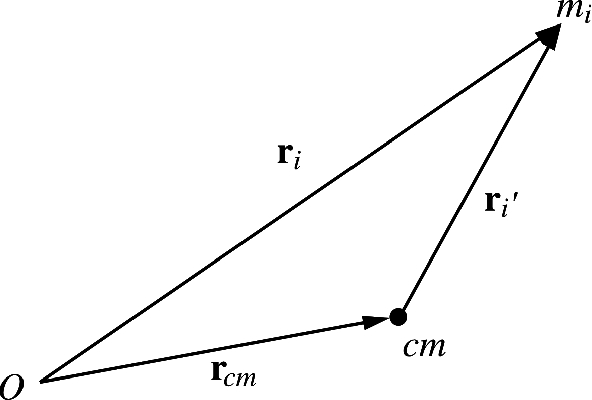
Figure 12: The position vector ( r i ′ ) (\mathbf {r}_{i}') ( r i ′ )
6.4.1 The Total Linear Momentum of a System of Particles Relative to the Center of Mass ¶ The position vector of the center of mass of the system with respect to an origin in an inertial frame of reference (for example, the lab frame) is given by
r c m = Σ i n m i r i M \begin{aligned} \displaystyle \mathbf {r}_{cm}=\frac{\varSigma _{i}^{n} m_{i}\mathbf {r}_{i}}{M} \end{aligned} r c m = M Σ i n m i r i From Fig. Figure 12 ( r i ′ ) (\mathbf {r}_{i}') ( r i ′ )
r i ′ = r i − r c m \mathbf {r}_{i}'=\mathbf {r}_{i}-\mathbf {r}_{cm} r i ′ = r i − r c m or
r i = r i ′ + r c m \begin{aligned} \mathbf {r}_{i}=\mathbf {r}_{i}'+\mathbf {r}_{cm} \end{aligned} r i = r i ′ + r c m Where r i \mathbf {r}_{i} r i (117) (115)
r c m = 1 M ∑ i = 1 n m i ( r i ′ + r c m ) = 1 M ∑ i = 1 n m i r i ′ + ∑ i = 1 n m i M r c m \mathbf {r}_{cm}=\frac{1}{M}\sum _{i=1}^{n}m_{i}(\mathbf {r}_{i}'+\mathbf {r}_{cm})=\frac{1}{M}\sum _{i=1}^{n}m_{i}\mathbf {r}_{i}'+\frac{\sum _{i=1}^{n}m_{i}}{M}\mathbf {r}_{cm} r c m = M 1 i = 1 ∑ n m i ( r i ′ + r c m ) = M 1 i = 1 ∑ n m i r i ′ + M ∑ i = 1 n m i r c m = 1 M ∑ i = 1 n m i r i ′ + r c m =\frac{1}{M}\sum _{i=1}^{n}m_{i}\mathbf {r}_{i}'+\mathbf {r}_{cm} = M 1 i = 1 ∑ n m i r i ′ + r c m therefore
1 M ∑ i = 1 n m i r i ′ = r c m − r c m = 0 \frac{1}{M}\sum _{i=1}^{n}m_{i}\mathbf {r}_{i}'=\mathbf {r}_{cm}-\mathbf {r}_{cm}=0 M 1 i = 1 ∑ n m i r i ′ = r c m − r c m = 0 That gives
∑ i = 1 n m i r i ′ = 0 \begin{aligned} \displaystyle \sum _{i=1}^{n}m_{i}\mathbf {r}_{i}'=\mathbf {0} \end{aligned} i = 1 ∑ n m i r i ′ = 0 Differentiating Eq. (121) t gives
∑ i = 1 n m v i ′ = 0 \begin{aligned} \displaystyle \sum _{i=1}^{n}m{{\mathbf {v}_{i}'=}}\mathbf {0} \end{aligned} i = 1 ∑ n m v i ′ = 0 or
∑ i = 1 n p i ′ = 0 \sum _{i=1}^{n}\mathbf {p}_{i}'=\mathbf {0} i = 1 ∑ n p i ′ = 0 or
p ′ = 0 \mathbf {p}'=\mathbf {0} p ′ = 0 That is, the total linear momentum of the system is zero when observed from the center of mass frame.
6.4.2 The Total Angular Momentum About the Center of Mass ¶ By differentiating Eq. (117)
v i = v i ′ + v c m \begin{aligned} \mathbf {v}_{i^{=}}\mathbf {v}_{i}'+\mathbf {v}_{cm} \end{aligned} v i = v i ′ + v c m where v i \mathbf {v}_{i} v i v i ′ \mathbf {v}_{i}' v i ′ O \mathrm {O} O v c m \mathbf {v}_{cm} v c m O \mathrm {O} O
L = ∑ i m i ( r i × v i ) = ∑ i m i { ( r i ′ + r c m ) × ( v i ′ + v c m ) } \mathbf {L}=\sum _{i}m_{i}(\mathbf {r}_{i}\times \mathbf {v}_{i})=\sum _{i}m_{i}\{(\mathbf {r}_{i}'+\mathbf {r}_{cm})\times (\mathbf {v}_{i}'+\mathbf {v}_{cm})\} L = i ∑ m i ( r i × v i ) = i ∑ m i {( r i ′ + r c m ) × ( v i ′ + v c m )} = ∑ i m i ( r i ′ × v i ′ ) + ∑ i m i ( r i ′ × v c m ) + ∑ i m i ( r c m × v i ′ ) + ∑ i m i ( r c m × v c m ) =\displaystyle \sum _{i}m_{i}(\mathbf {r}_{i}'\times \mathbf {v}_{i}')+\sum _{i}m_{i}(\mathbf {r}_{i}'\times \mathbf {v}_{cm})+\sum _{i}m_{i}(\mathbf {r}_{cm}\times \mathbf {v}_{i}')+\sum _{i}m_{i}(\mathbf {r}_{cm}\times \mathbf {v}_{cm}) = i ∑ m i ( r i ′ × v i ′ ) + i ∑ m i ( r i ′ × v c m ) + i ∑ m i ( r c m × v i ′ ) + i ∑ m i ( r c m × v c m ) The second and third terms are zero followed from Eqs. (121) (122) ( ∑ i m i r i ′ ) × v c m = 0 \left( \displaystyle \sum _{i}m_{i}\mathbf {r}_{i}'\right) \times \mathbf {v}_{cm}=\mathbf {0} ( i ∑ m i r i ′ ) × v c m = 0 r c m × ( ∑ i m i v i ′ ) = 0 \displaystyle \mathbf {r}_{cm}\times \left( \sum _{i}m_{i}\mathbf {v}_{i}'\right) =\mathbf {0} r c m × ( i ∑ m i v i ′ ) = 0
L = ∑ i m i ( r i ′ × v i ′ ) + ∑ i m i ( r c m × v c m ) \mathrm {L}=\sum _{i}m_{i}(\mathbf {r}_{i}'\times \mathbf {v}_{i}')+\sum _{i}m_{i}(\mathbf {r}_{cm}\times \mathbf {v}_{cm}) L = i ∑ m i ( r i ′ × v i ′ ) + i ∑ m i ( r c m × v c m ) Thus, the total angular momentum of the system of particles about an origin O \mathrm {O} O L ′ \mathbf {L}' L ′
L ′ = ∑ i m i ( r i ′ × v i ′ ) = ∑ i m i ( r i × v i ) − M ( r c m × v c m ) \begin{aligned} \displaystyle \mathbf {L}'=\sum _{i}m_{i}(\mathbf {r}_{i}'\times \mathbf {v}_{i}')=\sum _{i}m_{i}(\mathbf {r}_{i}\times \mathbf {v}_{i})-M(\mathbf {r}_{cm}\times \mathbf {v}_{cm}) \end{aligned} L ′ = i ∑ m i ( r i ′ × v i ′ ) = i ∑ m i ( r i × v i ) − M ( r c m × v c m ) 6.4.3 The Total Kinetic Energy of a System of Particles About the Center of Mass ¶ The total kinetic energy of a system of particles relative to an origin in an inertial frame of reference is given by
K = 1 2 ∑ i m i v i 2 = 1 2 ∑ i m i ( v i ⋅ v i ) K=\frac{1}{2}\sum _{i}m_{i}v_{i}^{2}=\frac{1}{2}\sum _{i}m_{i}(\mathbf {v}_{i}\cdot \mathbf {v}_{i}) K = 2 1 i ∑ m i v i 2 = 2 1 i ∑ m i ( v i ⋅ v i ) From Eq. (125)
K = 1 2 ∑ i m i ( ( v i ′ + v c m ) ⋅ ( v i ′ + v c m ) ) K=\frac{1}{2}\sum _{i}m_{i}((\mathbf {v}_{i}'+\mathbf {v}_{cm})\cdot (\mathbf {v}_{i}'+\mathbf {v}_{cm})) K = 2 1 i ∑ m i (( v i ′ + v c m ) ⋅ ( v i ′ + v c m )) = 1 2 ∑ i m i ( v i ′ ⋅ v i ′ ) + ∑ i m i ( v i ′ ⋅ v c m ) + 1 2 ∑ i m i ( v c m ⋅ v c m ) =\frac{1}{2}\sum _{i}m_{i}(\mathbf {v}_{i}'\cdot \mathbf {v}_{i}')+\sum _{i}m_{i}(\mathbf {v}_{i}'\cdot \mathbf {v}_{cm})+\frac{1}{2}\sum _{i}m_{i}(\mathbf {v}_{cm}\cdot \mathbf {v}_{cm}) = 2 1 i ∑ m i ( v i ′ ⋅ v i ′ ) + i ∑ m i ( v i ′ ⋅ v c m ) + 2 1 i ∑ m i ( v c m ⋅ v c m ) = 1 2 ∑ i m i v i ′ 2 + v c m ⋅ ( ∑ i m i v i ′ ) + 1 2 ( ∑ i m i ) v c m 2 =\frac{1}{2}\sum _{i}m_{i}v_{i}^{\prime 2}+\mathbf {v}_{cm}\cdot \bigg (\sum _{i}m_{i}\mathbf {v}_{i}'\bigg )+\frac{1}{2}\bigg (\sum _{i}m_{i}\bigg )v_{cm}^{2} = 2 1 i ∑ m i v i ′2 + v c m ⋅ ( i ∑ m i v i ′ ) + 2 1 ( i ∑ m i ) v c m 2 From Eq. (122)
K = 1 2 ∑ i m i v i ′ 2 + 1 2 M v c m 2 K=\frac{1}{2}\sum _{i}m_{i}v_{i}^{\prime 2}+\frac{1}{2}Mv_{cm}^{2} K = 2 1 i ∑ m i v i ′2 + 2 1 M v c m 2 That is the total kinetic energy of a system of particles about an origin is equal to the kinetic energy of the system with respect to the center of mass plus the kinetic energy of the center of mass relative to the origin O. Therefore, the total kinetic energy of the system with respect to the center of mass is
K ′ = 1 2 ∑ i m i v i ′ 2 = 1 2 ∑ i m i v i 2 − 1 2 M v c m 2 K'=\frac{1}{2}\sum _{i}m_{i}v_{i}^{\prime 2}=\frac{1}{2}\sum _{i}m_{i}v_{i}^{2}-\frac{1}{2}Mv_{cm}^{2} K ′ = 2 1 i ∑ m i v i ′2 = 2 1 i ∑ m i v i 2 − 2 1 M v c m 2 6.4.4 Total Torque on a System of Particles About the Center of Mass of the System ¶ The total torque acting on a system of particles about the center of mass is (from theorem (5.6.1)) equal to the time rate of change of the angular momentum of the system about the center of mass. That is,
τ ′ = d L ′ d t \boldsymbol{\tau '}=\frac{d\mathbf {L}'}{dt} τ ′ = d t d L ′ Two particles of masses m 1 = 1 m_{1}=1 m 1 = 1 m 2 = 2 m_{2}=2 m 2 = 2 r 1 = ( t 2 i − 2 t j ) m \mathbf {r}_{1}=(t^{2}\mathbf {i}-2t\mathbf {j})\,\mathrm {m} r 1 = ( t 2 i − 2 t j ) m r 2 = ( 3 t i + j ) m \mathbf {r}_{2}=(3t\mathbf {i}+\mathbf {j})\,\mathrm {m} r 2 = ( 3 t i + j ) m t is time. Find: (a) the total angular momentum of the system; the total external torque acting on the system; and the total kinetic energy of the system all relative to the origin at any time; (b) repeat (a) relative to the center of mass.
(a)
v 1 = d r 1 d t = ( 2 t i − 2 j ) m / s \mathbf {v}_{1}=\frac{d\mathbf {r}_{1}}{dt}=(2t\mathbf {i}-2\mathbf {j})\,\mathrm {m}/\mathrm {s} v 1 = d t d r 1 = ( 2 t i − 2 j ) m / s v 2 = d r 2 d t = ( 3 i ) m / s \mathbf {v}_{2}=\frac{d\mathbf {r}_{2}}{dt}=(3\mathbf {i})\,\mathrm {m}/\mathrm {s} v 2 = d t d r 2 = ( 3 i ) m / s The total angular momentum of the system relative to the origin is
L = ∑ i m i ( r i × v i ) = ( 1 ) [ ( t 2 i − 2 t j ) × ( 2 t i − 2 j ) ] + ( 2 ) [ ( 3 t i + j ) × ( 3 ) i ] \displaystyle \mathbf {L}=\sum _{i}m_{i}(\mathbf {r}_{i}\times \mathbf {v}_{i})=(1)[(t^{2}\mathbf {i}-2t\mathbf {j})\times (2t\mathbf {i}-2\mathbf {j})] +(2)[(3t\mathbf {i}+\mathbf {j})\times (3)\mathbf {i}] L = i ∑ m i ( r i × v i ) = ( 1 ) [( t 2 i − 2 t j ) × ( 2 t i − 2 j )] + ( 2 ) [( 3 t i + j ) × ( 3 ) i ] that gives
L = ( ( 2 t 2 − 6 ) k ) k g . m 2 / s \mathbf {L}=((2t^{2}-6)\mathbf {k})\,\mathrm {kg}.\mathrm {m}^{2}/\mathrm {s} L = (( 2 t 2 − 6 ) k ) kg . m 2 / s The total kinetic energy of the system relative to O \mathrm {O} O
K = 1 2 ∑ i = 1 n m i v i 2 = 1 2 ( m 1 v 1 2 + m 2 v 2 2 ) = 1 2 [ ( 1 ) ( 4 t 2 + 4 ) + ( 2 ) ( 9 ) ] = ( 2 t 2 + 11 ) J K=\displaystyle \frac{1}{2}\sum _{i=1}^{n}m_{i}v_{i}^{2}=\frac{1}{2}(m_{1}v_{1}^{2}+m_{2}v_{2}^{2})=\frac{1}{2}[(1)(4t^{2}+4)+(2)(9)]=(2t^{2}+11) \; \mathrm {J} K = 2 1 i = 1 ∑ n m i v i 2 = 2 1 ( m 1 v 1 2 + m 2 v 2 2 ) = 2 1 [( 1 ) ( 4 t 2 + 4 ) + ( 2 ) ( 9 )] = ( 2 t 2 + 11 ) J The net external torque about the origin is
∑ τ e x t = d L d t = ( ( 4 t ) k ) N.m \displaystyle \sum \boldsymbol{\tau _{ext}}=\frac{d\mathbf {L}}{dt}=((4t)\mathbf {k})\,\text {N.m} ∑ τ ext = d t d L = (( 4 t ) k ) N.m (b) To find the total angular momentum relative to the center of mass let’s find first the total angular momentum of the center of mass relative to the origin
r c m = ∑ i m i r i ∑ i m i = ( 1 ) ( t 2 i − 2 t j ) + ( 2 ) ( 3 t i + j ) ( 3 ) \mathbf {r}_{cm}=\frac{\sum _{i}m_{i}\mathbf {r}_{i}}{\sum _{i}m_{i}}=\frac{(1)(t^{2}\mathbf {i}-2t\mathbf {j})+(2)(3t\mathbf {i}+\mathbf {j})}{(3)} r c m = ∑ i m i ∑ i m i r i = ( 3 ) ( 1 ) ( t 2 i − 2 t j ) + ( 2 ) ( 3 t i + j ) = ( ( t 2 3 + 2 t ) i + ( 2 3 − 2 3 t ) j ) m =\bigg (\bigg (\frac{t^{2}}{3}+2t\bigg )\mathbf {i}+\bigg (\frac{2}{3}-\frac{2}{3}t\bigg )\mathbf {j}\bigg )\,\mathrm {m} = ( ( 3 t 2 + 2 t ) i + ( 3 2 − 3 2 t ) j ) m The velocity of the center of mass is
v c m = ( ( 2 3 t + 2 ) i − ( 2 3 ) j ) m / s \mathbf {v}_{cm}=\bigg (\bigg (\frac{2}{3}t+2\bigg )\mathbf {i}-\bigg (\frac{2}{3}\bigg )\mathbf {j}\bigg )\,\mathrm {m}/\mathrm {s} v c m = ( ( 3 2 t + 2 ) i − ( 3 2 ) j ) m / s and the total angular momentum of the center of mass relative to O \mathrm {O} O
L c m = M ( r c m × v c m ) = ( 3 ) [ ( ( t 2 3 + 2 t ) i + ( 2 3 − 2 3 t ) j ) × ( ( 2 3 t + 2 ) i − ( 2 3 ) j ) ] \displaystyle \mathbf {L}_{cm}=M(\mathbf {r}_{cm}\times \mathbf {v}_{cm})=(3)\bigg [\bigg (\bigg (\frac{t^{2}}{3}+2t\bigg )\mathbf {i}+\bigg (\frac{2}{3}-\frac{2}{3}t\bigg )\mathbf {j}\bigg )\times \bigg (\bigg (\frac{2}{3}t+2\bigg )\mathbf {i}-\bigg (\frac{2}{3}\bigg )\mathbf {j}\bigg )\bigg ] L c m = M ( r c m × v c m ) = ( 3 ) [ ( ( 3 t 2 + 2 t ) i + ( 3 2 − 3 2 t ) j ) × ( ( 3 2 t + 2 ) i − ( 3 2 ) j ) ] = ( − ( 2 3 t 2 + 4 3 t + 4 ) k ) k g . m 2 / s =\bigg (-\bigg (\frac{2}{3}t^{2}+\frac{4}{3}t+4\bigg )\mathbf {k}\bigg )\,\mathrm {k}\mathrm {g}.\mathrm {m}^{2}/\mathrm {s} = ( − ( 3 2 t 2 + 3 4 t + 4 ) k ) kg . m 2 / s From Eq. (129)
L ′ = ∑ i m i ( r i ′ × v i ′ ) = ∑ i m i ( r i × v i ) − M ( r c m × v c m ) \mathbf {L}'=\sum _{i}m_{i}(\mathbf {r}_{i}'\times \mathbf {v}_{i}')=\sum _{i}m_{i}(\mathbf {r}_{i}\times \mathbf {v}_{i})-M(\mathbf {r}_{cm}\times \mathbf {v}_{cm}) L ′ = i ∑ m i ( r i ′ × v i ′ ) = i ∑ m i ( r i × v i ) − M ( r c m × v c m ) = ( 2 t 2 − 6 ) k + ( 2 t 2 3 + 4 3 t + 4 ) k = ( ( 8 3 t 2 + 4 3 t − 2 ) k ) k g . m 2 / s =(2t^{2}-6)\displaystyle \mathbf {k}+\bigg (\frac{2t^{2}}{3}+\frac{4}{3}t+4\bigg )\mathbf {k}=\bigg (\bigg (\frac{8}{3}t^{2}+\frac{4}{3}t-2\bigg )\mathbf {k}\bigg )\,\mathrm {kg}.\mathrm {m}^{2}/\mathrm {s} = ( 2 t 2 − 6 ) k + ( 3 2 t 2 + 3 4 t + 4 ) k = ( ( 3 8 t 2 + 3 4 t − 2 ) k ) kg . m 2 / s The net external torque about the center of mass is
τ ′ = d L ′ d t = ( ( 16 3 t + 4 3 ) k ) N . m \displaystyle \boldsymbol{\tau '}=\frac{d\mathbf {L}'}{dt}=\bigg (\bigg (\frac{16}{3}t+\frac{4}{3}\bigg )\mathbf {k}\bigg )\,\mathrm {N.m} τ ′ = d t d L ′ = ( ( 3 16 t + 3 4 ) k ) N.m
The total kinetic energy of the system relative to the center of mass is
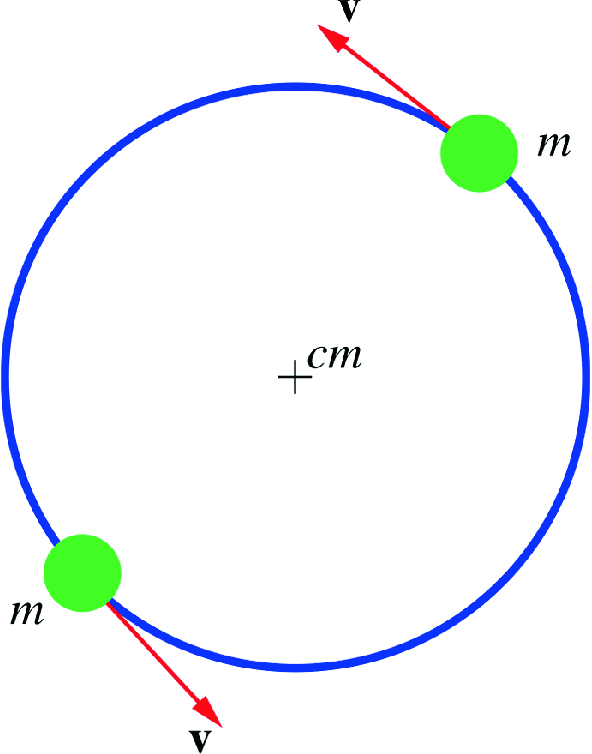
K ′ = 1 2 ∑ i m i v i ′ 2 = ∑ i m i v i 2 − 1 2 M v c m 2 K'=\frac{1}{2}\sum _{i}m_{i}v_{i}^{\prime 2}=\sum _{i}m_{i}v_{i}^{2}-\frac{1}{2}Mv_{cm}^{2} K ′ = 2 1 i ∑ m i v i ′2 = i ∑ m i v i 2 − 2 1 M v c m 2 = ( 2 t 2 + 11 ) − 1 2 ( 3 ) [ ( 2 3 t + 2 ) 2 + 4 9 ] = ( 4 t 2 3 − 2 t − 13 3 ) J =(2t^{2}+11)-\frac{1}{2}(3)\bigg [\bigg (\frac{2}{3}t+ 2\bigg )^{2}+\frac{4}{9}\bigg ]=\bigg (\frac{4t^{2}}{3}-2t-\frac{13}{3}\bigg ) \; \mathrm {J} = ( 2 t 2 + 11 ) − 2 1 ( 3 ) [ ( 3 2 t + 2 ) 2 + 9 4 ] = ( 3 4 t 2 − 2 t − 3 13 ) J Figure 13: Two particles rotating about their center of mass
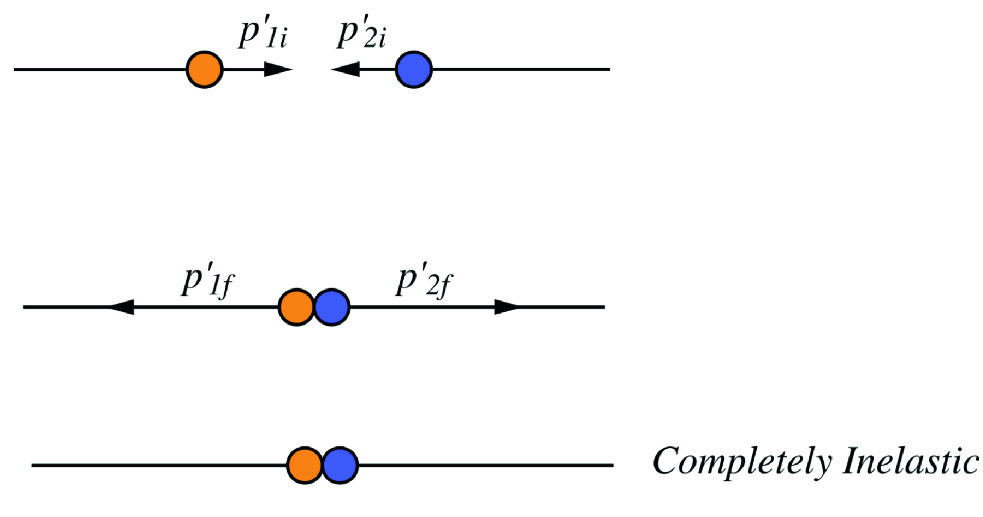
6.4.5 Collisions and the Center of Mass Frame of Reference ¶ In problems involving collisions, it is useful to use an inertial frame of reference that is attached to the center of mass to analyze the collision. This method is most commonly used in analyzing collisions between subatomic particles or atoms. In section (6.4.1), we proved that the total linear momentum of a system when observed from the center of mass frame is equal to zero.
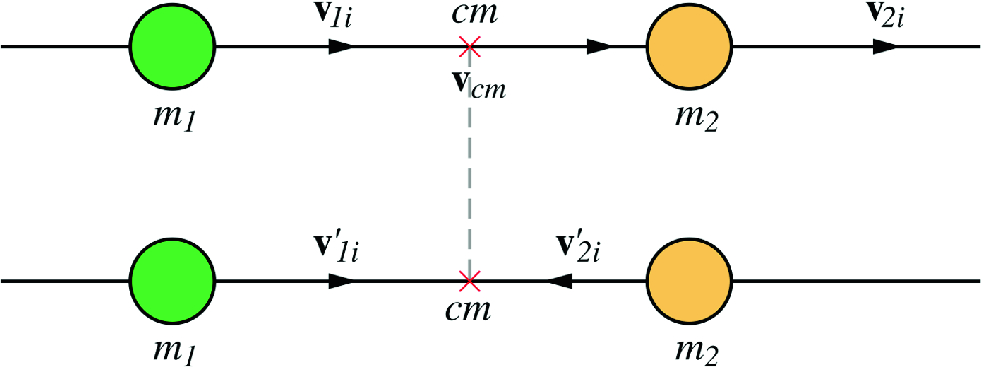
p i ′ = p f ′ = 0 \begin{aligned} \mathbf {p}_{i}'=\mathbf {p}_{f}'=\mathbf {0} \end{aligned} p i ′ = p f ′ = 0 Now consider a system consisting of two bodies undergoing a one-dimensional collision (see Fig. Figure 14 (153)
p 1 i ′ = − p 2 i ′ p_{1i}'=-p_{2i}' p 1 i ′ = − p 2 i ′ and
p 1 f ′ = − p 2 f ′ p_{1f}'=-p_{2f}' p 1 f ′ = − p 2 f ′ That is, when viewed from the center of mass frame the two objects approach each other with equal and opposite momenta and move away from each other with an equal and opposite momenta. Therefore, the center of mass frame simplifies the analysis since it exhibits a particular symmetry to the problem (see Fig. Figure 15
Figure 14: Consider a system consisting of two bodies undergoing a one-dimensional collision
Figure 15: The center of mass frame analysis of a collision
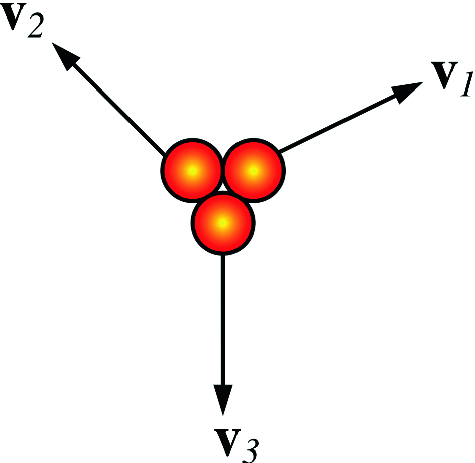
Figure 16: A rocket is projected vertically upward and explodes into three fragments of equal mass when it reaches the top of its flight at an altitude of 40 m \mathrm {m} m
A rocket is projected vertically upward and explodes into three fragments of equal mass when it reaches the top of its flight at an altitude of 40 m \mathrm {m} m Figure 16 s \mathrm {s} s
When the rocket reaches the top its velocity immediately before explosion is zero. Since v 1 , v 2 \mathbf {v}_{1},\mathbf {v}_{2} v 1 , v 2 v 3 \mathbf {v}_{3} v 3
m 1 v 1 + m 2 v 2 + m 3 v 3 = 0 m_{1}\mathbf {v}_{1}+m_{2}\mathbf {v}_{2}+m_{3}\mathbf {v}_{3}=\mathbf {0} m 1 v 1 + m 2 v 2 + m 3 v 3 = 0 Since m 1 = m 2 = m 3 m_{1}=m_{2}=m_{3} m 1 = m 2 = m 3 v 1 + v 2 + v 3 = 0 v_{1}+v_{2}+v_{3}=0 v 1 + v 2 + v 3 = 0 t ′ t' t ′ − v 3 / 2 -v_{3}/2 − v 3 /2
h = v 3 t + g t 2 2 h=v_{3}t+\frac{gt^{2}}{2} h = v 3 t + 2 g t 2 and
h = − v 3 t ′ 2 + g t ′ 2 2 h=\frac{-v_{3}t'}{2}+\frac{gt'2}{2} h = 2 − v 3 t ′ + 2 g t ′ 2 That gives
v 3 = g ( t ′ 2 − t 2 ) 2 t + t ′ v_3=\frac{g(t^{\prime 2}-t^{2})}{2t+t'} v 3 = 2 t + t ′ g ( t ′2 − t 2 ) and
h = g t t ′ ( t + 2 t ′ ) 2 ( 2 t + t ′ ) h=\frac{gtt'(t+2t')}{2(2t+t')} h = 2 ( 2 t + t ′ ) g t t ′ ( t + 2 t ′ ) Substituting the values of h and t ′ t' t ′
29.4 t 2 + 160 t + 63.6 = 0 29.4t^{2}+160t+63.6=0 29.4 t 2 + 160 t + 63.6 = 0
Thus,t = 2.3 s . t=2.3\,\mathrm {s}. t = 2.3 s .
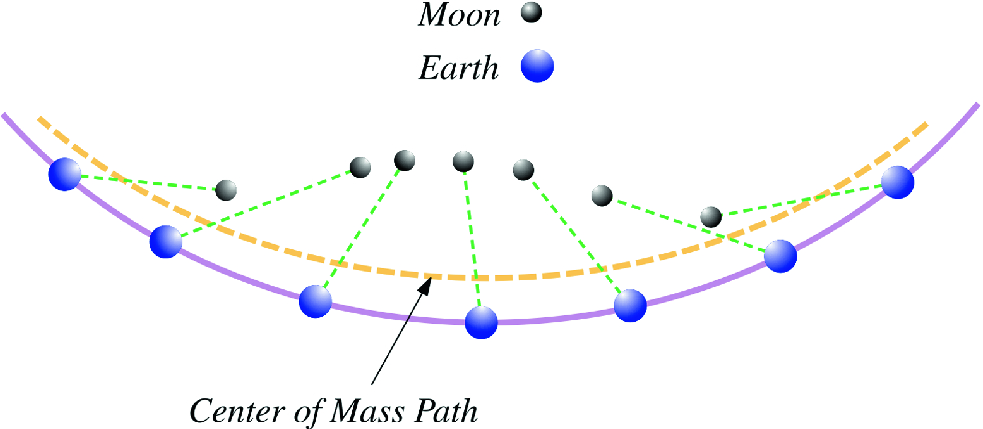
Figure 18: The center of mass of the Earth-Moon system moves as a single planet of mass ( M E + M M ) (M_{E}+M_{M}) ( M E + M M )
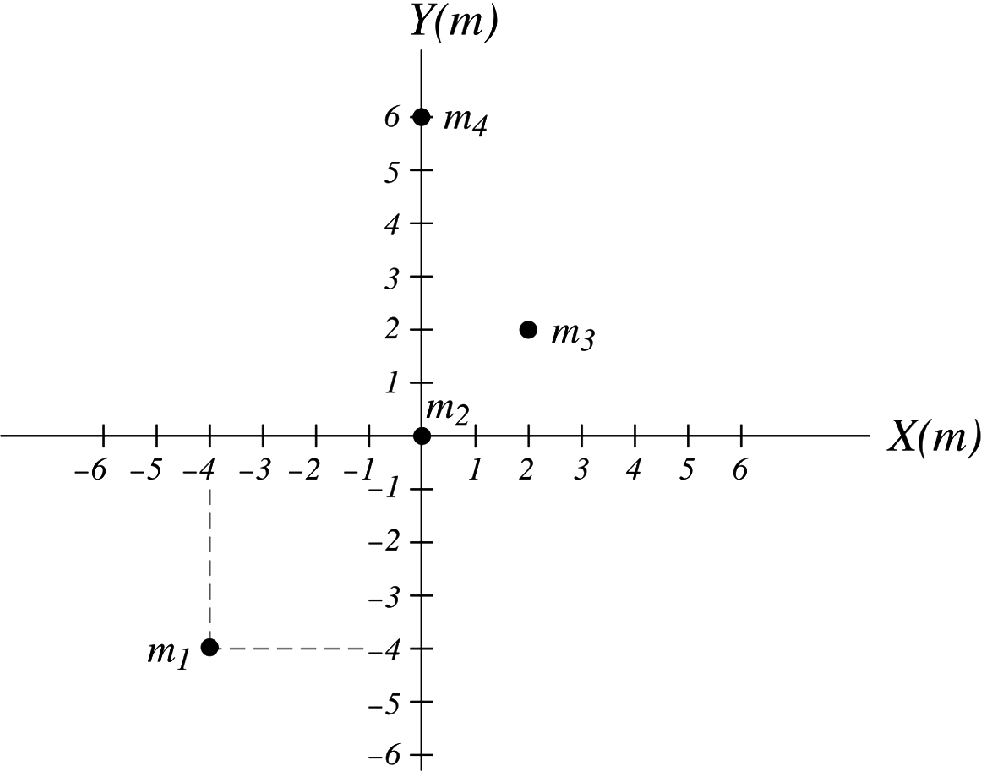
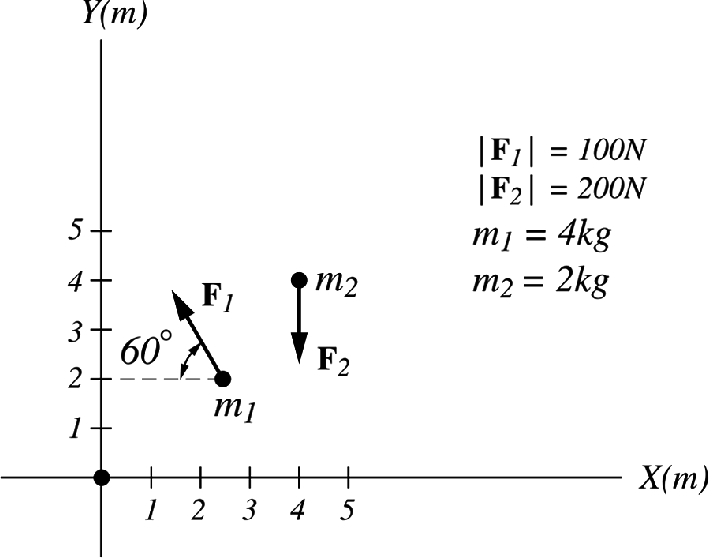
Figure 20: A system of particles in x-y plane
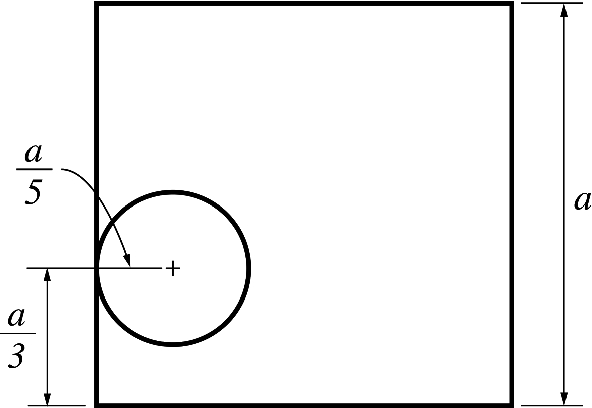
Figure 21: A homogenous sheet with a hole
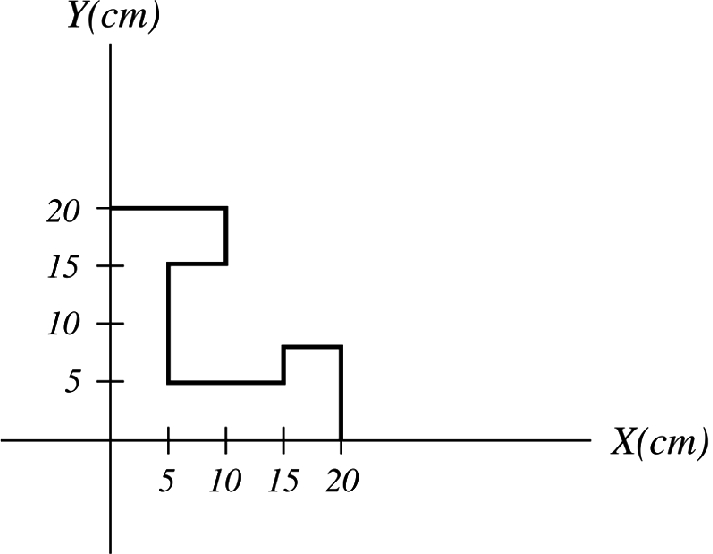
Figure 22: A homogenous sheet in the x-y plane
Problems ¶ A projectile of mass 15 kg is fired from the ground with an initial velocity of 12 m / s \mathrm {m}/\mathrm {s} m / s 4 5 o 45^{\mathrm {o}} 4 5 o m / s \mathrm {m}/\mathrm {s} m / s 3 0 o 30^{\mathrm {o}} 3 0 o
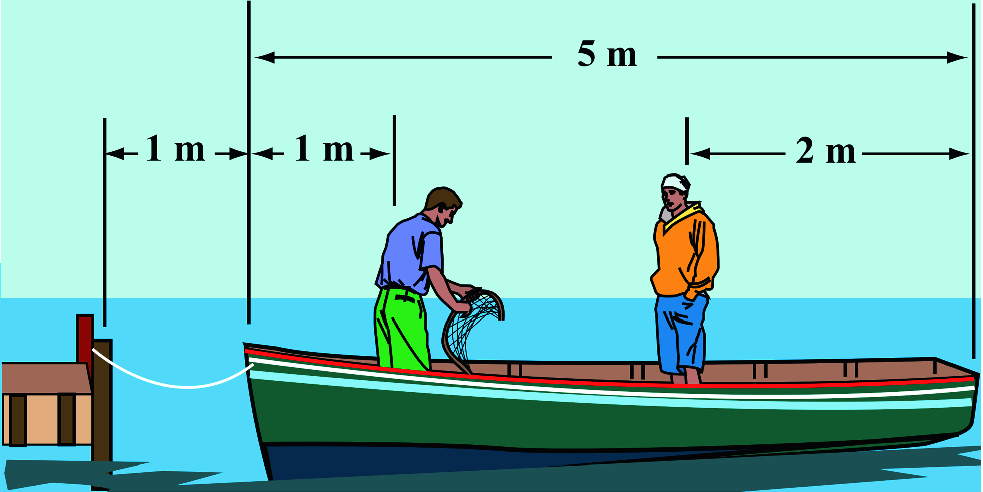
Two boys of masses 45 and 40 kg are standing on a boat of mass 150 kg and length 5 m \mathrm {m} m Figure 24
Two particles of masses m 1 = 1 m_{1}=1 m 1 = 1 m 2 = 2 m_{2}=2 m 2 = 2 v 1 = 2 i − 3 j + k \mathbf {v}_{1}=2\mathbf {i}-3\mathbf {j}+\mathbf {k} v 1 = 2 i − 3 j + k v 2 = 7 i + j − 2 k \mathbf {v}_{2}=7\mathbf {i}+\mathbf {j}-2\mathbf {k} v 2 = 7 i + j − 2 k ( − 1 , 1 , 2 ) (-1,1,2) ( − 1 , 1 , 2 )
Figure 23: The acceleration of the center of mass of two masses acted upon by different forces
Figure 24: By neglecting friction between the boat and water, the center of mass can be used to find the distance moved by the boat