Photo Credit: Rudy and Peter Skitterians.
14. Biological Energy
The renewable energy options discussed thus far have been rather different from the chemically-stored thermal energy provided by fossil fuels. These sources—hydroelectricity, wind, and solar—are good at making electricity, but are intermittent to various degrees and are not directly suitable for transportation, except via bulky batteries.
Biologically-based energy is more similar to fossil fuels in that it is a form of chemical energy burned to create thermal energy. We will focus on two major forms: solid biomass and liquid biofuels. The latter is well-suited to transportation: one of the few renewable energies that can make this claim. In some cases, the same plant can produce either food or bio-energy—depending on whether it is eaten by another biological form or by a machine.
Ultimately, biologically-based energy is a form of solar energy, creating chemical storage by means of photosynthesis. Fossil fuels are also an ancient form of biofuel, deriving from photosynthetic energy captured millions of years ago. So sunlight is the actual energy source, and photosynthesis is the mechanism by which the energy is stored in chemical form.
14.1 Photosynthesis
This textbook will not focus on the complex mechanisms responsible for photosynthesis, but rather will describe the net result and efficiency. Photosynthesis involves the absorption of individual solar photons that ultimately facilitate the movement of electrons in order to change bonding structures, forming sugars, cellulose, and other materials used to construct a plant. The fundamental chemical reaction is depicted in
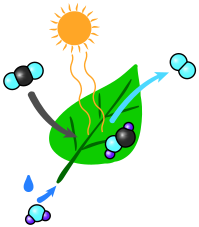
Figure 14.1:Cartoon version of photosynthesis, providing a graphical representation of Eq. 14.1. Water, CO, and sunlight are inputs. The leaf “exhales” oxygen and keeps sugar (only part of the final sugar molecule is pictured here).
Figure 14.1 and represented as a formula in Eq. 14.1, in which the product is a basic unit of a larger sugar molecule, like glucose HO.
In sentence form: energy from light transforms carbon dioxide and water into a building block of sugar and releases oxygen back to the air.
In terms of efficiency, plants tend to convert sunlight into stored chemical energy at a rate of 0.01–6%. The range is rather large due to limitations in water and nutrients. A well-watered and fertilized corn field might reach 1.5% efficiency. Algae tend to top the charts at 5–6%. Dry climates might have ample sunlight, but too little water for efficient use of the available light. Box 14.2 provides an example of how one might estimate what fraction of incident solar energy is turned into chemical storage by a potato plant.
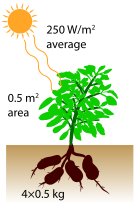
Figure 14.2:The potato plant in Box 14.2.
14.2 Biomass
Biological mass, or biomass, has long been utilized to supplement our energy needs, via controlled use of fire starting hundreds of thousands of years ago. Burning wood or other plant matter, and in some places dried animal feces[6] counts as utilization of biomass. Wood provides about 4 kcal of energy per gram when burned, or about 16 MJ/kg—much like proteins or carbohydrates[7] in our diet. Burning of biomass is most typically used for heating and cooking within individual homes.
In the U.S. in 2018, 2.36 qBtu of the 101.25 qBtu total came from burning wood, and an additional 0.5 qBtu came from incinerating waste products [34]. Thus about 2.8% (0.1 TW) of U.S. energy comes from biomass. Out of the 11.41 qBtu of all renewables in 2018, biomass accounted for 25% of the U.S. renewable budget.[9]
Globally, biomass use is estimated to be more important, at 6%,[10] constituting more than a third of global renewable resources (Fig. 7.8; p. 114). The high use of biomass in the wider world is a reflection on the difference between developed countries like the U.S. and developing countries that are more likely to rely on more primitive forms of energy like firewood and animal dung. Since most biomass around the world is burned for individual use, emissions controls are essentially non-existent, resulting in high levels of pollution—smoke and harmful chemicals that would be scrubbed out of a power plant’s exhaust.[11]
14.3 Biofuels
Biofuels deserve their own category because the origins and end uses are different enough to warrant distinction. While the biomass sources from Section 14.2 tend to be in solid form, biofuels—as treated here—are liquid. Liquid fuels are instantly a big deal because they have the energy density and versatility to be used in transportation applications. An airplane can’t very well fly on firewood, hydroelectricity, solar, wind, ocean currents, geothermal, or nuclear energy.[13] matter. Biofuels therefore occupy a special place in the pantheon of renewable resources as the most obvious viable replacement for petroleum—the dominant fossil fuel responsible for 92%[14] of transportation in the U.S.
In the U.S. in 2018, 2.28 qBtu (2.3%; 0.08 TW) came from biofuels [34], which is very similar to the amount from biomass (wood, waste). Out of the 11.41 qBtu of all renewables, biofuels account for 20% of the U.S. renewable budget (Table 10.3; p. 177).
Most prominently, ethanol is the chief biofuel, accounting for about 80% of the total. It is an alcohol that can be produced by fermenting the photosynthetically-produced sugars in the plant and then distilling the result.[15] Structurally, ethanol is very similar to ethane except that the terminating hydrogen on one end of the chain is replaced by a hydroxyl group (OH; shown in Figure 14.3).
Though it is not necessary to fully understand the chemistry,[17] combustion of ethanol—for comparison to the fossil fuel reactions in Eq. 8.1 (p. 126)—goes according to
In other words, ethanol combines with oxygen via combustion (burning) producing carbon dioxide and water, also releasing energy. It is almost like the photosynthesis reaction (Eq. 14.1) in reverse.

Figure 14.3:Ethanol is similar to ethane, but replacing the hydrogen at the end with hydroxyl (OH).
The energy density works out to 7.1 kcal/g, which is considerably lower than octane (representing gasoline) at 11.5 kcal/g (Table 8.2; p. 126). In terms of CO production, the reaction generates 88 g of CO for each 46 g of ethanol, coming to 1.9 g/g—which is lower than the 3.09 factor for octane. In terms of CO energy intensity, ethanol produces 64 g of CO for every 1 MJ of energy: exactly the same as petroleum (Table 8.2). Generally speaking, biofuels—and other forms of biomass—are often considered to be carbon-neutral,[18] as the carbon released upon burning was taken in from the atmosphere in the process of photosynthesis, making it a cycle.
Most of the ethanol in the U.S. is blended into gasoline into E10, E15, or E85 products meaning 10%, 15%, or 85% ethanol. Not all vehicles are equipped to handle the more corrosive ethanol, and those that are (“flex-fuel” vehicles) might expect lower energy performance due to the fact that ethanol has lower energy density than gasoline.
Both the lower energy density and lower carbon mass per input fuel mass can be attributed to the oxygen atom hosted by the ethanol molecule.[19] Ethanol can derive from a number of plants. In the U.S., corn is the most common feedstock. Brazil uses sugar cane, which requires tropical climates.
14.3.1 EROEI
Before going further, we introduce a crucial metric for evaluating the merit of any energy source: the EROEI.
By and large, energy does not come for free. Oil has to be actively drilled; hydroelectricity requires construction of a dam; solar panels are fabricated in an industrial process requiring energy input. So the question is: how much energy do we get out compared to the amount we had to put in? If we extract less energy than we invest, we lose net energy and probably should not bother.[20] If we only get a little more out, we still may question the investment.
Early oil wells were shallow and under pressure, producing “gushers” that exceeded 100:1 in EROEI. To understand what this means, imagine using oil as the energy source for the original exploration, building the equipment, running the drill, and collecting/storing the product. An EROEI of 100:1 means that for every barrel of oil that goes into the process, 100 barrels come out. That’s a good deal. A high EROEI means nearly “free” energy: low effort for high reward.
As we progress to more challenging oil resources,[21] the EROEI drops— now around 10–15:1 for conventional oil and as low as 3:1 for tar sands [95]. Table 14.1 provides one set of EROEI estimates for various sources. Note that estimates vary due to difficulties in proper accounting of all energy inputs, so don’t take these numbers literally—just as approximate guides.
Table 14.1:EROEI estimates for various sources [96]. For example, Wind has an estimated EROEI of 20:1. See Table 7.1 (p. 111) for a refresher on how much energy we get from various sources. Canada and Venezuela tend to have heavy oil deposits.
| Source | EROEI Est. | Source | EROEI Est. |
|---|---|---|---|
| Hydroelectric | 40+ | Solar PV | 6 |
| Wind | 20 | Soy Biodiesel | 5.5 |
| Coal | 18 | Nuclear Fission | 5 |
| Oil | 16 | Tar Sands | 3–5 |
| Sugar Cane Ethanol | 9 | Heavy Oil (Can., Ven.) | 4 |
| Natural Gas | 7 | Corn Ethanol | 1.4 |
If life were a video game, we would look at Table 14.1, decide that hydroelectric and wind are “the best,” cursor over to them and “plus” those two up until we’re getting all our energy from these low-energy-investment sources. But of course the world is constrained, placing real limits to what is possible. We saw in Chapter 11 and Chapter 12 that hydroelectricity and wind cannot be expected to provide more than a few terawatts, leaving a large shortfall. Meanwhile, solar has the largest raw potential. In other words, it is useful to appreciate the EROEI of various resources, but EROEI is not the sole determining factor of what is practical. A low EROEI can be tolerable if abundance makes up for it.
For resources whose energy investment is mostly up-front, before production begins, the resulting EROEI depends critically on how long the resource will provide energy. After all, the energy return gets larger the longer the facility can operate, while the investment part may be essentially done and unchanging. It can be difficult to predict how long a resource will last, which is part of why EROEI estimates are just that: approximate guidelines.
In a self-supporting sense[23] the net energy is for an EROEI of :1. In other words, an EROEI of 1.25:1 only “really” produces 0.25 units of exportable energy for every one unit invested, if that one invested unit comes from the 1.25 units extracted in a closed system. In this case, for every one unit netted,[24] 4 units went in and 5 came out–only 1 of the 5 free and clear.
Low EROEI cuts into the effective available resource, demanding investment of precious energy. As conventional resources are exhausted, forcing us to lower-EROEI deposits, even if we keep up with energy demand in absolute terms,[25] the net energy available will decline as a greater fraction of the harvest must go back into extraction.
Note that many of the entries in Table 14.1 have low numbers, translating to a tough life in which a substantial fraction of the total energy resource is dedicated to continued energy procurement. Biological forms of energy are not superstars in this regard.
Table 14.2:Summary: EROEI of biofuels.
| Source | EROEI |
|---|---|
| sugar cane ethanol | 0.8–10 |
| soy bean biodiesel | 5.5 |
| biodiesel | 1.3 |
| corn ethanol | 0.8–1.6 |
| algae-derived | 0.13–0.71 |
14.3.2 EROEI of Biofuels
Various estimates exist for the EROEI for different biofuels. Unfortunately for the U.S., the corn ethanol industry is estimated to have an EROEI of anywhere from 0.8:1 to 1.6:1. The former would mean it’s a net loss of energy, and that we would have more energy available if we did not spend any of it trying to get ethanol from corn. Biodiesel (a non-ethanol biofuel produced from vegetable oils or animal fat) is estimated to have an EROEI of 1.3:1 [98]. Sugar cane may be anywhere from 0.8:1 to 10:1 [99] (see Table 14.2).
To explore an example of how this all plays out, let’s say that corn ethanol provides an EROEI of 1.2:1—in the middle of the estimated range. This means that in order to get 1.2 units of energy out, one unit has to go in. Or for every 6 units out, 5 go in. If we use that same resource as the energy input—in other words, we use corn ethanol as the energy input to grow, harvest, distill, and distribute corn ethanol—then we get to “keep” one unit for external use out of every 6 units produced. For the U.S. to replace its 37 qBtu/yr oil habit with corn ethanol, it would take six times this much, or 220 qBtu J) of corn ethanol production each year. If the growing season is 5 months, the solar input is 250 on average, and the corn field is 1.5% efficient at turning sunlight into chemical energy, then each square meter of corn-land produces J of energy[28] and we would therefore need about 5 of land for corn. This is an area 2,200 km on a side (Figure 14.4)! The U.S. does not possess this much arable land (estimated at about 30% of this). About 4 of land in the U.S. is currently used for corn production, which is 8% of what would be needed. And of course we must still feed ourselves. In 2018, 31% of U.S. corn production went into ethanol. We would somehow need to ramp corn ethanol production up by a factor of 40 to derive our current liquid fuels from corn in a self-sufficient way. Don’t expect to see this fantasy materialize.
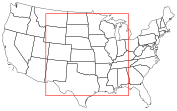
Figure 14.4:Area of corn growth needed to displace U.S. petroleum demand if at EROEI of 1.2:1. This is far larger than agriculturally productive land in the U.S.
A fundamental reason why the EROEI for biofuels tends to be low is that processing the material into ethanol requires a fair amount of energy input in the form of heat. Burning biomass, by contrast, does not have this requirement. Also, burned biomass is often gathered from untended (natural) environments that required little deliberate energy input on the parts of humans. Therefore, low EROEI is more a problem for biofuels than biomass.
14.4 Upshot for Biomass and Biofuels
Wood has always provided a source of heat for people, and will continue to do so. Its use occupied a much higher fraction of energy resources hundreds of years ago before being supplanted by fossil fuels. Still, several percent of U.S. energy comes from wood (and over 5% globally). Wood represents a renewable resource that can often be locally obtained, and will likely continue steady use,[31] potentially assuming a greater fraction again if overall energy expenditure declines.
Biofuels are special due to their liquid nature, as a potential replacement for oil to drive transportation. Because photosynthesis is not terribly efficient, and the EROEI of biofuels tends to be on the low side, the amount of land needed to replace petroleum is anywhere from daunting to prohibitive. This is even before addressing the crunch an extensive expansion would place on water resources or food supply, or the degradation of arable land that may result from depleting nutrients in the soil. Algae may represent another approach, but so far the process appears to be well below break-even in terms of EROEI (from 0.13–0.71:1 [100]). It is difficult to see a meaningful path forward for wholesale replacement of liquid fuels using biological resources.
A final perspective is that the total biological scale on the planet is estimated to be 100 TW (Table 10.2; p. 175), which is not outrageously more[32] than the current 18 TW scale of the human endeavor. Can we really imagine commandeering 20% of all life on Earth to serve our energy needs? It would actually need to be substantially more than this, given EROEI limits. It may be that Earth does not possess enough biology to offer a substitute for our current fossil fuel appetite—even if we tried to use it all.
We conclude by listing some pros and cons for biologically-derived energy, beginning with the advantageous aspects:
Biofuels offer a possible liquid fuel substitute to support transportation needs;
Biological energy relies on dependable solar input, replenished as harvested stocks grow back;
Biofuels represent a form of storage of solar energy, mitigating intermittency;
Methods for growing and harvesting crops are well established;
Burning biomass is low-tech and likely to remain part of our energy portfolio.
And the less savory aspects:
It is difficult to scale biological energy to meaningful multi-terawatt levels;
Heavy reliance on biological energy co-opts earth’s biology and displaces natural habitat;
Cultivating biofuels competes with food production for water and land resources;
Low EROEI for biofuels reduces net energy available;
Smoke and other pollutants from burning biomass can be problematic.
14.5 Problems
A large tree might have a trunk 0.5 m in diameter and be 40 m tall. Even though it branches out many times, pretend all the wood fits into a cylinder maintaining this 0.5 m diameter for the full height of the tree. Wood floats,[33] so let’s say it has a density around 800 . How many kilograms of CO did this tree pull out of the atmosphere to get its carbon, if we treat the tree’s mass as 50% carbon?
Using the geometry and density of the tree in Problem 1, if the resulting wood has an energy density similar to carbohydrates (4 kcal/g), and the tree spent 50 years accumulating this bulk while receiving an average of 250 of solar input over 5 months each year in a leafy area averaging 200 to receive sunlight, what is the net photosynthetic efficiency of the tree?
The U.S. gets 2.4 qBtu per year of energy from burning biomass (mostly firewood). At an energy density of 4 kcal per gram, and a population of 330 million, how many 5 kg logs per year does this translate to per person?
How many logs of firewood per day (whose parameters are specified in Problem 3) would you need to burn to provide 5,000 W of heating to a house?
Replicate the conclusion of Box 14.3 by assuming one-quarter of the 2 trillion tons (5 kg) of mass is combustible at 4kcal/g. How long—in years—would this amount of energy last if burning at 18 TW?
Given the energy densities of ethanol vs. octane (gasoline), how many liters of ethanol does it take to replace one liter of gasoline, if the densities are 789 g/L for ethanol and 703 g/L for octane?
If 50 kJ of energy are spent to extract 1 MJ of energy content in the form of coal, what is the EROEI?
Re-express an EROEI of 1.5:1 in terms of how many total units of energy must be produced in order to extract one unit of net energy in a self-supporting operation.
Imagine that the extraction of a low-EROEI biofuel is performed using energy derived from that biofuel alone—in other words, a self-contained operation not using any other (external) form of energy. We can think of the situation thusly: for each hectare of land producing fuel for external use, some additional land must be dedicated to raising the energy used to perform the extraction operation—like an overhead. If the EROEI is 1.5:1,[34] how much total land area would need to be devoted to the endeavor for every hectare (or any area unit you wish) that contributes to net production? See Problem 8 for a related scenario.
It takes a certain energy investment to fabricate a solar panel. Referring to Table 14.1, figure out how many years of the panel’s output energy it takes to “pay off” the investment if the EROEI estimate assumed operation for 30 years.
Our modern food industry has an EROEI of 0.1:1. In pre-industrial settings, when energy investment for food production was in the form of muscle power (animal and human), why would a 0.1:1 EROEI for food have been untenable? Next, describe the conditions for an exact break-even food EROEI of 1:1. What would this mean in terms of where effort/energy goes? What would this leave for building shelters, cathedrals, or esthetic pursuits?
Parallel the development in the text for the land required for corn ethanol if it is self-sufficient[35] in the case for EROEI of 1.5:1—near the optimistic end of the range. How much larger is this than the area now devoted to corn, and how does it compare to total arable land in the U.S.?
Using the setup for Problem 12, how large would the required corn area be in terms of the side length of a square in units of kilometers. Draw this to approximate scale on a crude representation of the contiguous U.S. And this is at the optimistic end.
What fraction of the earth’s 100 TW biological budget (all life on the planet) do you think is justifiable to use in service of human energy needs? Explain your reasoning. What does this become in TW, and how does it compare to our 18 TW current appetite?
… dry wood, for instance
… which we combust when burning wood
Recall 4,184 J per kcal.
… summer, averaging day/night and weather
… such as cow dung
Fats and hydrocarbons like fossil fuels are 2–3 times more energy dense.
… assuming a wood stove or other efficient device to prevent most heat from just escaping through the chimney
… while 23% was hydro; 22% was wind; 20% were biofuels, 8% was solar, and 2% was geothermal; see Table 10.3 (p. 177)
… down considerably from in 1950
Note that CO is common to both, and is not scrubbed out of power plant exhaust, comprising the bulk of the emissions.
About a quarter of the biomass is “dry” combustible material, at about 4 kcal/g.
Another 5% is from biofuels, usually blended into gasoline.
… also how “moonshine” alcohol is made 16: … H: the second in the alkane sequence of methane, ethane, propane, butane, …, octane, etc.
Appendix B provides some background on chemical reactions and associated energy.
In practice, fossil fuels are used in the cultivating of biofuels, so it’s not a perfectly clean, closed cycle in present form.
In some cases, it may still make sense to pursue EROEI resources if the resulting form is otherwise hard to obtain, like food energy. As another example, we might use coal to process biofuels, in effect converting a less useful solid to a more useful liquid, even if losing energy in the process. But such desperate measures will not be favored if alternatives exist.
… deep water, fracking, tar sands
… because the delivered energy is 20 times the input energy
… if the energy extracted is then used as the input to extract more
… multiplying the 0.25 net by 4
… e.g., same number of barrels of oil produced each year
… a form of energy
… or at least subsidizing the energy
150 days times 86,400 seconds per day times 250 times 0.015 gives Joules per square meter produced.
… where corn is grown
… compromised by low EROEI if using fossil-fuel inputs to run production
… subject to availability in the face of deforestation
… compared to solar or wind budgets, for instance, which are 5,000 times and 50 times our demand–not just 5 times as is the case for all biology
ⓘ Water has a density of 1,000 .
You can always multiply both sides by the same factor to make both sides integers, if this is easier to understand.
… i.e., relying on its own energy to re-invest in its extraction