We begin our study of organic chemistry with the alkanes, compounds containing only two elements, carbon and hydrogen, and having only single bonds. There are several other kinds of hydrocarbons, distinguished by the types of bonding between carbon atoms and by the properties that result from that bonding. In Chapter 13 "Unsaturated and Aromatic Hydrocarbons" we will examine hydrocarbons with double bonds, with triple bonds, and with a special kind of bonding called aromaticity. Then in Chapter 14 "Organic Compounds of Oxygen" we will study some compounds considered to be derived from hydrocarbons by replacing one or more hydrogen atoms with an oxygen-containing group. Chapter 15 "Organic Acids and Bases and Some of Their Derivatives" focuses on organic acids and bases, after which we will be ready to look at the chemistry of life itself---biochemistry---in the remaining five chapters.
12.1 Organic Chemistry
Scientists of the 18th and early 19th centuries studied compounds obtained from plants and animals and labeled them organic because they were isolated from “organized” (living) systems. Compounds isolated from nonliving systems, such as rocks and ores, the atmosphere, and the oceans, were labeled inorganic. For many years, scientists thought organic compounds could be made by only living organisms because they possessed a vital force found only in living systems. The vital force theory began to decline in 1828, when the German chemist Friedrich Wöhler synthesized urea from inorganic starting materials. He reacted silver cyanate (AgOCN) and ammonium chloride (NH4Cl), expecting to get ammonium cyanate (NH4OCN). What he expected is described by the following equation.
AgOCN + NH4Cl → AgCl + NH4OCN
Instead, he found the product to be urea (NH2CONH2), a well-known organic material readily isolated from urine. This result led to a series of experiments in which a wide variety of organic compounds were made from inorganic starting materials. The vital force theory gradually went away as chemists learned that they could make many organic compounds in the laboratory.
Today organic chemistry[1] is the study of the chemistry of the carbon compounds, and inorganic chemistry[2] is the study of the chemistry of all other elements. It may seem strange that we divide chemistry into two branches---one that considers compounds of only one element and one that covers the 100-plus remaining elements. However, this division seems more reasonable when we consider that of tens of millions of compounds that have been characterized, the overwhelming majority are carbon compounds.
Carbon is unique among the other elements in that its atoms can form stable covalent bonds with each other and with atoms of other elements in a multitude of variations. The resulting molecules can contain from one to millions of carbon atoms. In Chapter 12 "Organic Chemistry: Alkanes and Halogenated Hydrocarbons" through Chapter 15 "Organic Acids and Bases and Some of Their Derivatives", we survey organic chemistry by dividing its compounds into families based on functional groups. (For general information about organic functional groups, see Chapter 4 "Covalent Bonding and Simple Molecular Compounds", Section 4.6 "Introduction to Organic Chemistry".) We begin with the simplest members of a family and then move on to molecules that are organic in the original sense---that is, they are made by and found in living organisms. These complex molecules (all containing carbon) determine the forms and functions of living systems and are the subject of biochemistry, a topic presented in Chapter 16 "Carbohydrates" through Chapter 20 "Energy Metabolism".
Organic compounds, like inorganic compounds, obey all the natural laws. Often there is no clear distinction in the chemical or physical properties among organic and inorganic molecules. Nevertheless, it is useful to compare typical members of each class, as in Table 12.1 "General Contrasting Properties and Examples of Organic and Inorganic Compounds". (Keep in mind, however, that there are exceptions to every category in this table.) To further illustrate typical differences among organic and inorganic compounds, Table 12.1 "General Contrasting Properties and Examples of Organic and Inorganic Compounds" also lists properties of the inorganic compound sodium chloride (common table salt, NaCl) and the organic compound hexane (C6H14), a solvent that is used to extract soybean oil from soybeans (among other uses). Many compounds can be classified as organic or inorganic by the presence or absence of certain typical properties, as illustrated in Table 12.1 "General Contrasting Properties and Examples of Organic and Inorganic Compounds".
Table 12.1 General Contrasting Properties and Examples of Organic and Inorganic Compounds
Organic | Hexane | Inorganic | NaCl | |
|---|---|---|---|---|
low melting points | −95°C | high melting points | 801°C | |
low boiling points | 69°C | high boiling points | 1,413°C | |
low solubility in water; high solubility in nonpolar solvents | insoluble in water; soluble in gasoline | greater solubility in water; low solubility in nonpolar solvents | soluble in water; insoluble in gasoline | |
flammable | highly flammable | nonflammable | nonflammable | |
aqueous solutions do not conduct electricity | nonconductive | aqueous solutions conduct electricity | conductive in aqueous solution | |
exhibit covalent bonding | covalent bonds | exhibit ionic bonding | ionic bonds |
Concept Review Exercises
Classify each compound as organic or inorganic.
C3H8O
CaCl2
Cr(NH3)3Cl3
C30H48O3N
Which compound is likely organic and which is likely inorganic?
a flammable compound that boils at 80°C and is insoluble in water
a compound that does not burn, melts at 630°C, and is soluble in water
Answers
organic
inorganic
inorganic
organic
organic
inorganic
Exercises
Classify each compound as organic or inorganic.
C6H10
CoCl2
C12H22O11
Classify each compound as organic or inorganic.
CH3NH2
NaNH2
Cu(NH3)6Cl2
Which member of each pair has a higher melting point?
CH3OH and NaOH
CH3Cl and KCl
Which member of each pair has a higher melting point?
C2H6 and CoCl2
CH4 and LiH
Answers
organic
inorganic
organic
NaOH
KCl
12.2 Structures and Names of Alkanes
We began our study of organic chemistry in Chapter 4 "Covalent Bonding and Simple Molecular Compounds" with the hydrocarbons[3], the simplest organic compounds, which are composed of carbon and hydrogen atoms only. As we noted, there are several different kinds of hydrocarbons. They are distinguished by the types of bonding between carbon atoms and the properties that result from that bonding. Hydrocarbons with only carbon-to-carbon single bonds (C--C) and existing as a continuous chain of carbon atoms also bonded to hydrogen atoms are called alkanes (or saturated hydrocarbons)[4]. Saturated, in this case, means that each carbon atom is bonded to four other atoms (hydrogen or carbon)---the most possible; there are no double or triple bonds in the molecules.
We introduced the three simplest alkanes---methane (CH4), ethane (C2H6), and propane (C3H8)---in Chapter 4 "Covalent Bonding and Simple Molecular Compounds", Section 4.6 "Introduction to Organic Chemistry". They are shown again in Figure 12.1 "The Three Simplest Alkanes". The flat representations shown do not accurately portray bond angles or molecular geometry. Methane has a tetrahedral shape that chemists often portray with wedges indicating bonds coming out toward you and dashed lines indicating bonds that go back away from you. (For more information about the shape of molecules, see Chapter 4 "Covalent Bonding and Simple Molecular Compounds", Section 4.5 "Characteristics of Molecules".) An ordinary solid line indicates a bond in the plane of the page.
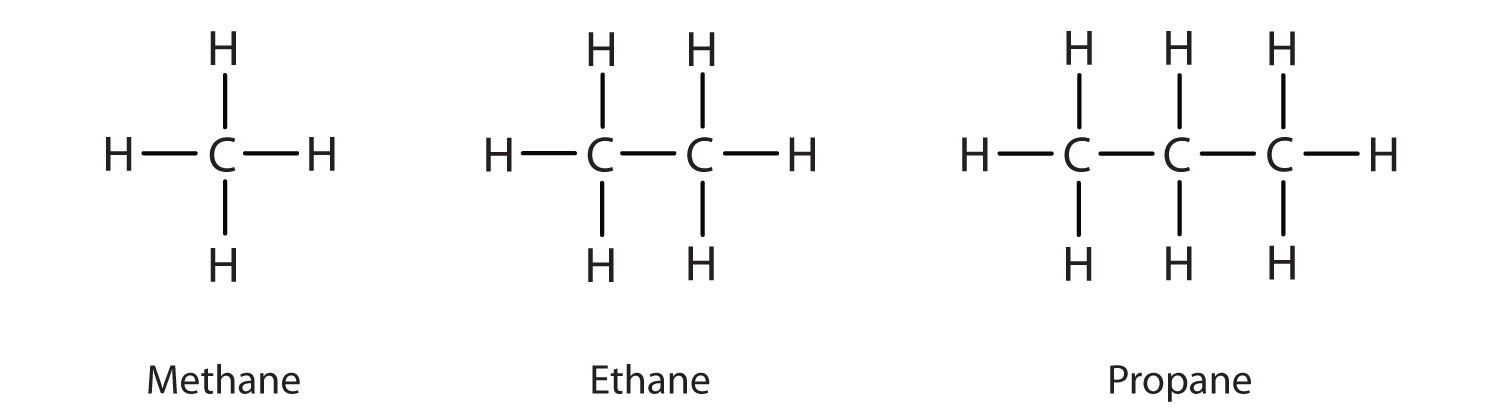
Figure 12.1 The Three Simplest Alkanes
Recall from Chapter 4 "Covalent Bonding and Simple Molecular Compounds", Section 4.5 "Characteristics of Molecules" that the VSEPR theory correctly predicts a tetrahedral shape for the methane molecule (Figure 12.2 "The Tetrahedral Methane Molecule").

Figure 12.2 The Tetrahedral Methane Molecule
Methane (CH4), ethane (C2H6), and propane (C3H8) are the beginning of a series of compounds in which any two members in a sequence differ by one carbon atom and two hydrogen atoms---namely, a CH2 unit. The first 10 members of this series are given in Table 12.2 "The First 10 Straight-Chain Alkanes".
Table 12.2 The First 10 Straight-Chain Alkanes
Name | Molecular Formula (CnH2 n +\ 2) | Condensed Structural Formula | Number of Possible Isomers |
|---|---|---|---|
methane | CH4 | CH4 | — |
ethane | C2H6 | CH3CH3 | — |
propane | C3H8 | CH3CH2CH3 | — |
butane | C4H10 | CH3CH2CH2CH3 | 2 |
pentane | C5H12 | CH3CH2CH2CH2CH3 | 3 |
hexane | C6H14 | CH3CH2CH2CH2CH2CH3 | 5 |
heptane | C7H16 | CH3CH2CH2CH2CH2CH2CH3 | 9 |
octane | C8H18 | CH3CH2CH2CH2CH2CH2CH2CH3 | 18 |
nonane | C9H20 | CH3CH2CH2CH2CH2CH2CH2CH2CH3 | 35 |
decane | C10H22 | CH3CH2CH2CH2CH2CH2CH2CH2CH2CH3 | 75 |
Consider the series in Figure 12.3 "Members of a Homologous Series". The sequence starts with C3H8, and a CH2 unit is added in each step moving up the series. Any family of compounds in which adjacent members differ from each other by a definite factor (here a CH2 group) is called a homologous series[5]. The members of such a series, called homologs, have properties that vary in a regular and predictable manner. The principle of homology gives organization to organic chemistry in much the same way that the periodic table gives organization to inorganic chemistry. Instead of a bewildering array of individual carbon compounds, we can study a few members of a homologous series and from them deduce some of the properties of other compounds in the series.
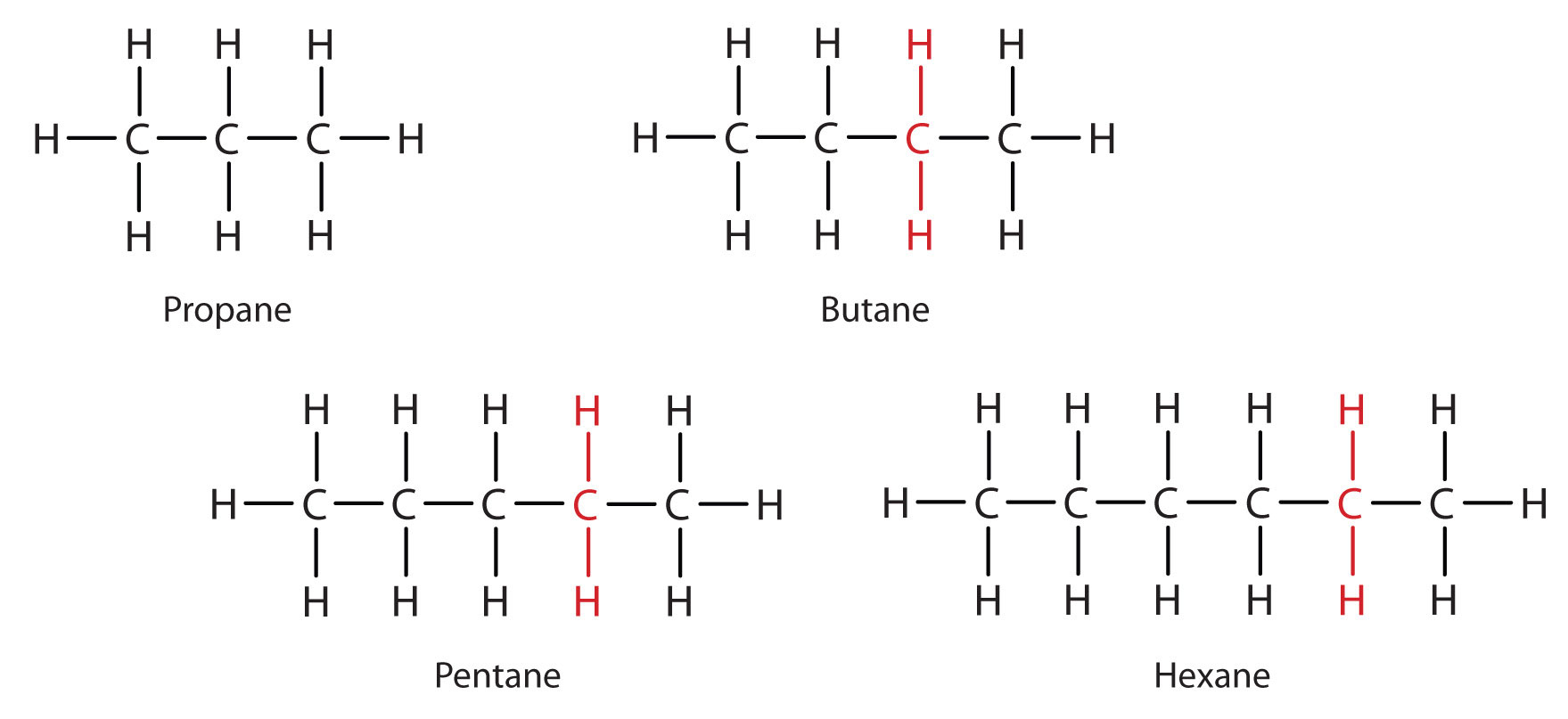
Figure 12.3 Members of a Homologous Series
Each succeeding formula incorporates one carbon atom and two hydrogen atoms more than the previous formula.
The principle of homology allows us to write a general formula for alkanes: CnH2 n +\ 2. Using this formula, we can write a molecular formula for any alkane with a given number of carbon atoms. For example, an alkane with eight carbon atoms has the molecular formula C8H(2\ ×\ 8)\ +\ 2 = C8H18.
Concept Review Exercises
In the homologous series of alkanes, what is the molecular formula for the member just above C8H18?
Use the general formula for alkanes to write the molecular formula of the alkane with 12 carbon atoms.
Answers
C9H20
C12H26
Exercises
What compounds contain fewer carbon atoms than C3H8 and are its homologs?
What compounds contain five to eight carbon atoms and are homologs of C4H10?
Answer
CH4 and C2H6
12.3 Branched-Chain Alkanes
We can write the structure of butane (C4H10) by stringing four carbon atoms in a row,
--C--C--C--C--
and then adding enough hydrogen atoms to give each carbon atom four bonds:

The compound butane has this structure, but there is another way to put 4 carbon atoms and 10 hydrogen atoms together. Place 3 of the carbon atoms in a row and then branch the fourth one off the middle carbon atom:

Now we add enough hydrogen atoms to give each carbon four bonds.
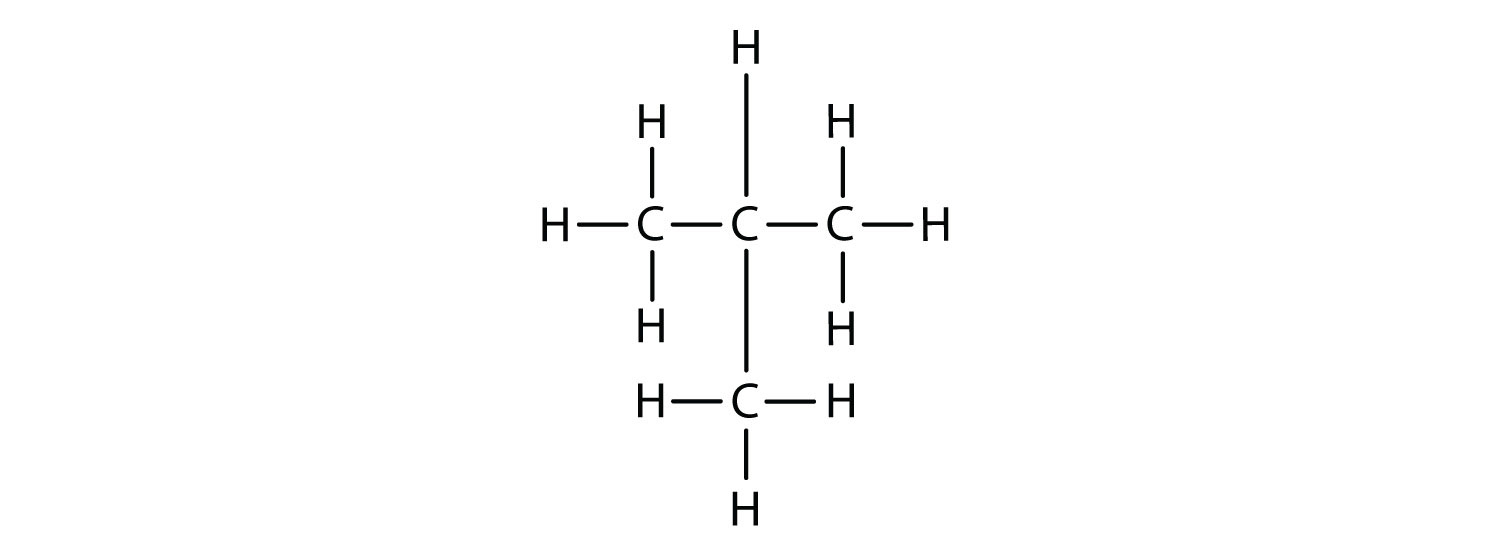
There is a hydrocarbon that corresponds to this structure, which means that two different compounds have the same molecular formula: C4H10. The two compounds have different properties---for example, one boils at −0.5°C; the other at −11.7°C. Different compounds having the same molecular formula are called isomers[6]. The compound with this branched chain is called isobutane (Figure 12.4 "Butane and Isobutane").
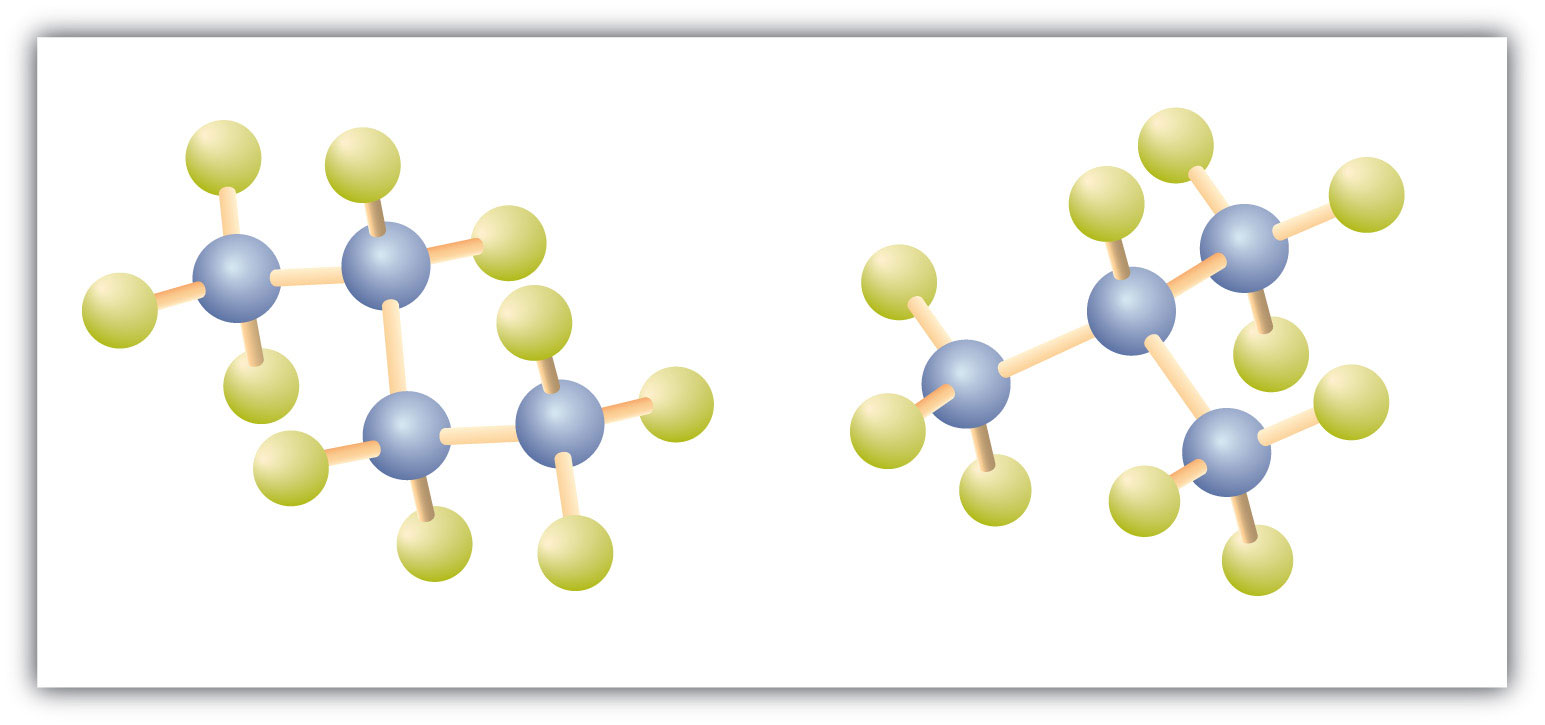
Figure 12.4 Butane and Isobutane
The ball-and-stick models of these two compounds show them to be isomers; both have the molecular formula C4H10.
Notice that C4H10 is depicted with a bent chain in Figure 12.4 "Butane and Isobutane". The four-carbon chain may be bent in various ways because the groups can rotate freely about the C--C bonds. However, this rotation does not change the identity of the compound. It is important to realize that bending a chain does not change the identity of the compound; all of the following represent the same compound:
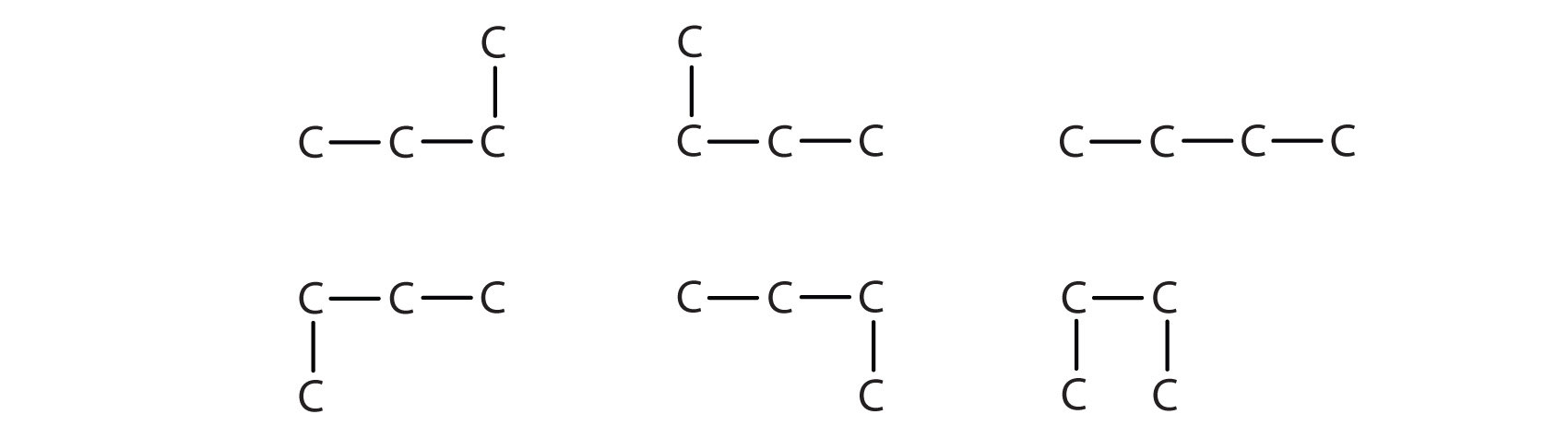
The formula of isobutane shows a continuous chain of three carbon atoms only, with the fourth attached as a branch off the middle carbon atom of the continuous chain.
Unlike C4H10, the compounds methane (CH4), ethane (C2H6), and propane (C3H8) do not exist in isomeric forms because there is only one way to arrange the atoms in each formula so that each carbon atom has four bonds.
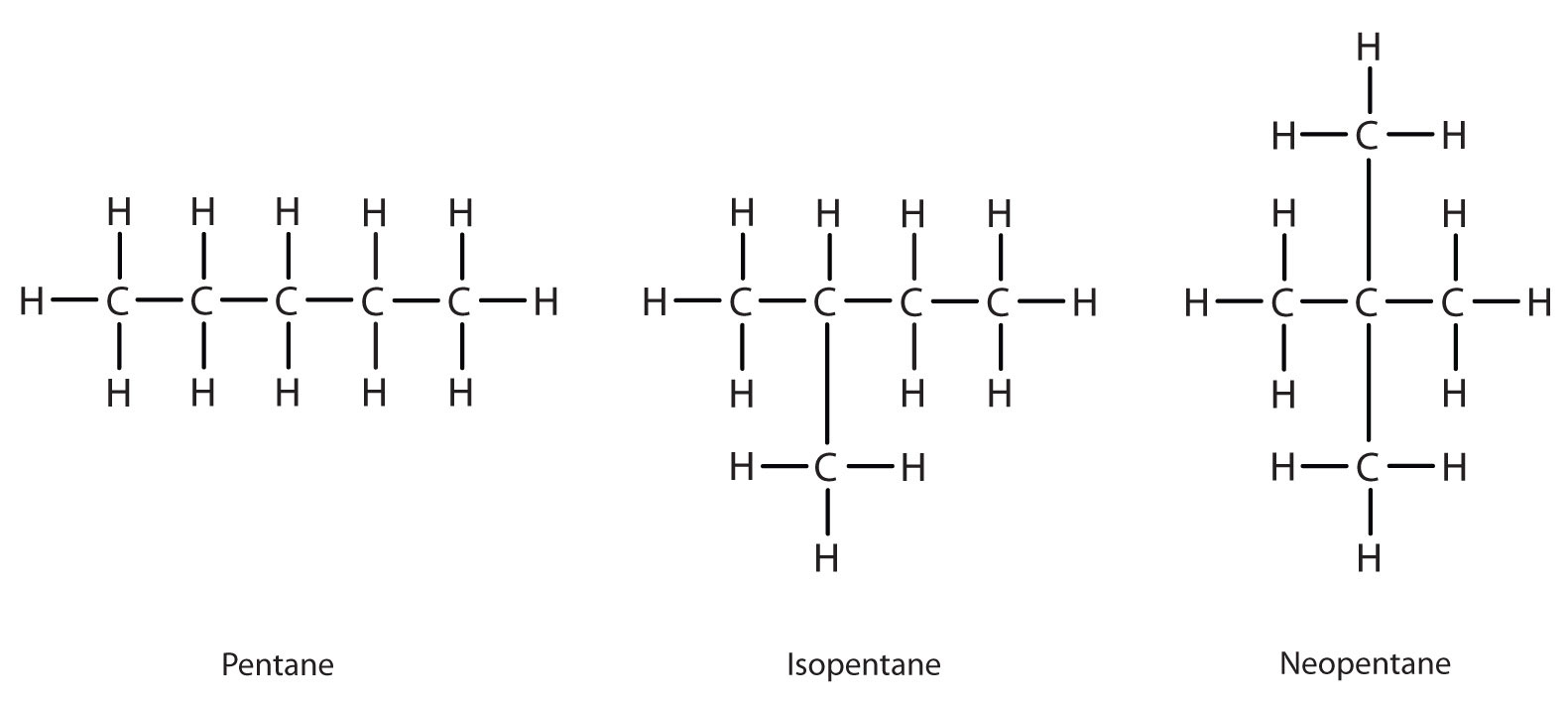
Next beyond C4H10 in the homologous series is pentane. Each compound has the same molecular formula: C5H12. (Table 12.2 "The First 10 Straight-Chain Alkanes" has a column identifying the number of possible isomers for the first 10 straight-chain alkanes.) The compound at the far left is pentane because it has all five carbon atoms in a continuous chain. The compound in the middle is isopentane; like isobutane, it has one CH3 branch off the second carbon atom of the continuous chain. The compound at the far right, discovered after the other two, was named neopentane (from the Greek neos, meaning “new”). Although all three have the same molecular formula, they have different properties, including boiling points: pentane, 36.1°C; isopentane, 27.7°C; and neopentane, 9.5°C.
Concept Review Exercises
In alkanes, can there be a two-carbon branch off the second carbon atom of a four-carbon chain? Explain.
A student is asked to write structural formulas for two different hydrocarbons having the molecular formula C5H12. She writes one formula with all five carbon atoms in a horizontal line and the other with four carbon atoms in a line, with a CH3 group extending down from the first attached to the third carbon atom. Do these structural formulas represent different molecular formulas? Explain why or why not.
Answers
No; the branch would make the longest continuous chain of five carbon atoms.
No; both are five-carbon continuous chains.
Exercises
Briefly identify the important distinctions between a straight-chain alkane and a branched-chain alkane.
How are butane and isobutane related? How do they differ?
Name each compound.
Write the structural formula for each compound.
hexane
octane
Indicate whether the structures in each set represent the same compound or isomers.
CH3CH2CH2CH3 and

CH3CH2CH2CH2CH3 and



Answers
Straight-chain alkanes and branched-chain alkanes have different properties as well as different structures.
pentane
heptane
no
yes
12.4 Condensed Structural and Line-Angle Formulas
We use several kinds of formulas to describe organic compounds. A molecular formula shows only the kinds and numbers of atoms in a molecule. For example, the molecular formula C4H10 tells us there are 4 carbon atoms and 10 hydrogen atoms in a molecule, but it doesn’t distinguish between butane and isobutane. A structural formula[7] shows all the carbon and hydrogen atoms and the bonds attaching them. Thus, structural formulas identify the specific isomers by showing the order of attachment of the various atoms.
Unfortunately, structural formulas are difficult to type/write and take up a lot of space. Chemists often use condensed structural formulas[8] to alleviate these problems. The condensed formulas show hydrogen atoms right next to the carbon atoms to which they are attached, as illustrated for butane:

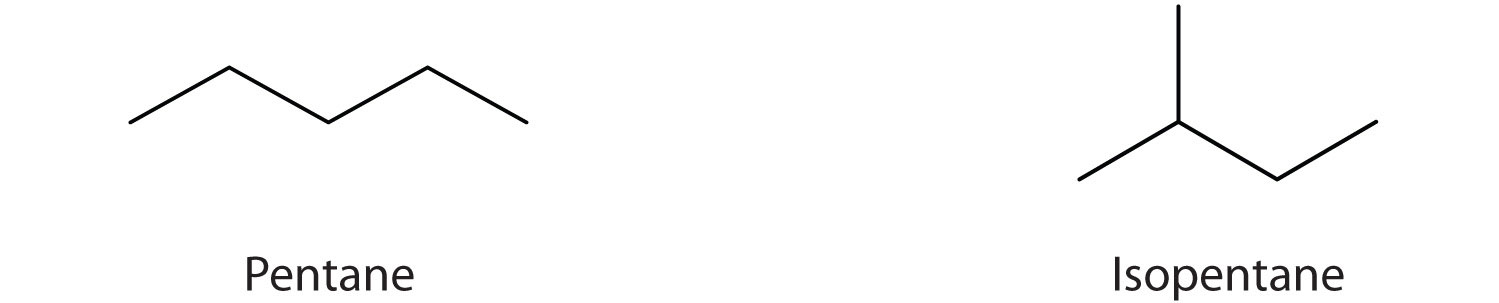
The ultimate condensed formula is a line-angle formula[9], in which carbon atoms are implied at the corners and ends of lines, and each carbon atom is understood to be attached to enough hydrogen atoms to give each carbon atom four bonds. For example, we can represent pentane (CH3CH2CH2CH2CH3) and isopentane [(CH3)2CHCH2CH3] as follows:
Exercises
Write the condensed structural formula for each structural formula.
A condensed structural formula for isohexane can be written as (CH3)2CHCH2CH2CH3. Draw the line-angle formula for isohexane.
Draw a line-angle formula for the compound CH3CH2CH(CH3)CH2CH2CH3.
Give the structural formula for the compound represented by this line-angle formula:




Answers
CH3CH3
CH3CH2CH3
CH3CH2CH2CH2CH3

12.5 IUPAC Nomenclature
As noted in Table 12.2 "The First 10 Straight-Chain Alkanes", the number of isomers increases rapidly as the number of carbon atoms increases. There are 3 pentanes, 5 hexanes, 9 heptanes, and 18 octanes. It would be difficult to assign unique individual names that we could remember. A systematic way of naming hydrocarbons and other organic compounds has been devised by the International Union of Pure and Applied Chemistry (IUPAC). These rules, used worldwide, are known as the IUPAC System of Nomenclature[10]. (Some of the names we used earlier, such as isobutane, isopentane, and neopentane, do not follow these rules and are called common names.) A stem name (Table 12.3 "Stems That Indicate the Number of Carbon Atoms in Organic Molecules") indicates the number of carbon atoms in the longest continuous chain (LCC). Atoms or groups attached to this carbon chain, called substituents, are then named, with their positions indicated by numbers. For now, we will consider only those substituents called alkyl groups.
Table 12.3 Stems That Indicate the Number of Carbon Atoms in Organic Molecules
Stem | Number |
|---|---|
meth- | 1 |
eth- | 2 |
prop- | 3 |
but- | 4 |
pent- | 5 |
hex- | 6 |
hept- | 7 |
oct- | 8 |
non- | 9 |
dec- | 10 |
An alkyl group[11] is a group of atoms that results when one hydrogen atom is removed from an alkane. The group is named by replacing the -ane suffix of the parent hydrocarbon with -yl. For example, the CH3 group derived from methane (CH4) results from subtracting one hydrogen atom and is called a methyl group.
The alkyl groups we will use most frequently are listed in Table 12.4 "Common Alkyl Groups". Alkyl groups are not independent molecules; they are parts of molecules that we consider as a unit to name compounds systematically.
Table 12.4 Common Alkyl Groups
Parent Alkane | Parent Alkane | Alkyl Group | Alkyl Group | Condensed Structural Formula |
|---|---|---|---|---|
methane | 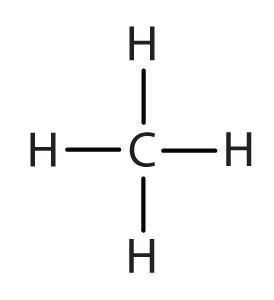 | methyl | 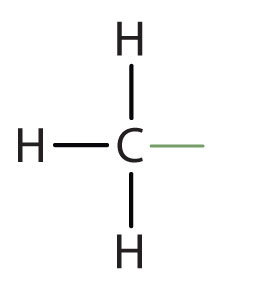 | CH3-- |
ethane | 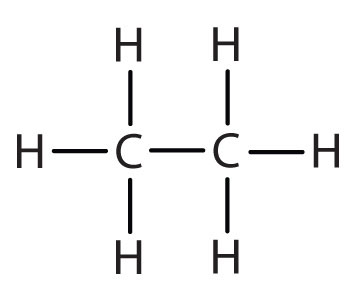 | ethyl | 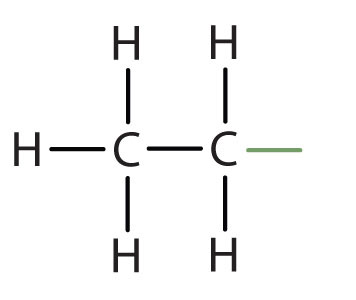 | CH3CH2-- |
propane | 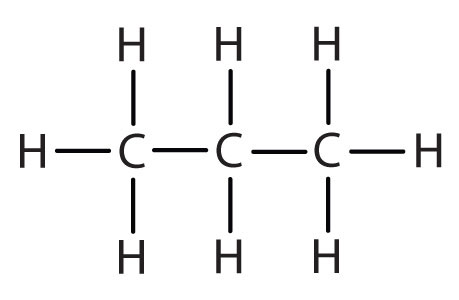 | propyl | 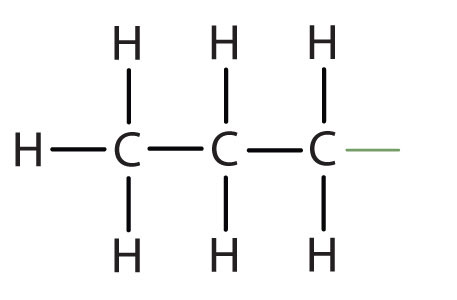 | CH3CH2CH2-- |
isopropyl | 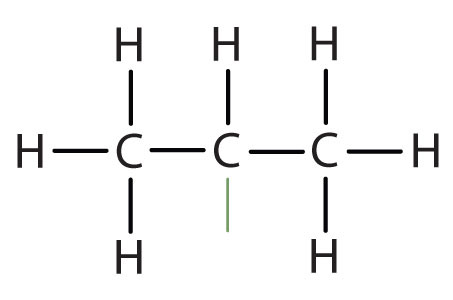 | (CH3)2CH-- | ||
butane | 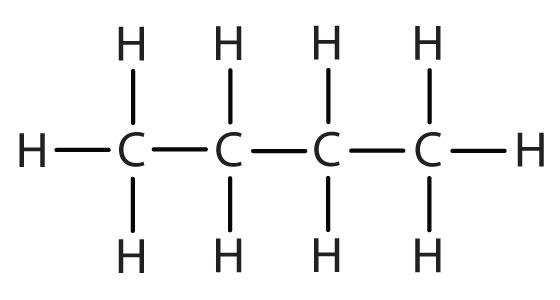 | butyl* | 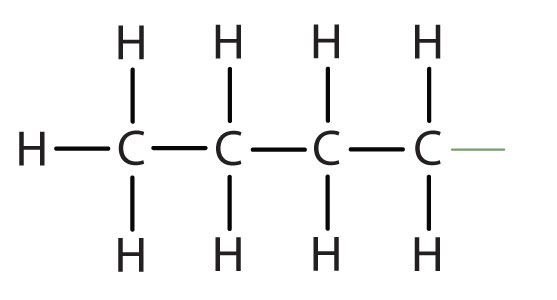 | CH3CH2CH2CH2-- |
*There are four butyl groups, two derived from butane and two from isobutane. We will introduce the other three where appropriate. | *There are four butyl groups, two derived from butane and two from isobutane. We will introduce the other three where appropriate. | *There are four butyl groups, two derived from butane and two from isobutane. We will introduce the other three where appropriate. | *There are four butyl groups, two derived from butane and two from isobutane. We will introduce the other three where appropriate. | *There are four butyl groups, two derived from butane and two from isobutane. We will introduce the other three where appropriate. |
Simplified IUPAC rules for naming alkanes are as follows (demonstrated in Example 12.1).
1. Name alkanes according to the LCC of carbon atoms in the molecule (rather than the total number of carbon atoms). This LCC, considered the parent chain, determines the base name, to which we add the suffix -ane to indicate that the molecule is an alkane.
2. If the hydrocarbon is branched, number the carbon atoms of the LCC. Numbers are assigned in the direction that gives the lowest numbers to the carbon atoms with attached substituents. Hyphens are used to separate numbers from the names of substituents; commas separate numbers from each other. (The LCC need not be written in a straight line; for example, the LCC in the following has five carbon atoms.)

3. Place the names of the substituent groups in alphabetical order before the name of the parent compound. If the same alkyl group appears more than once, the numbers of all the carbon atoms to which it is attached are expressed. If the same group appears more than once on the same carbon atom, the number of that carbon atom is repeated as many times as the group appears. Moreover, the number of identical groups is indicated by the Greek prefixes di-, tri-, tetra-, and so on. These prefixes are not considered in determining the alphabetical order of the substituents. For example, ethyl is listed before dimethyl; the di- is simply ignored. The last alkyl group named is prefixed to the name of the parent alkane to form one word.
When these rules are followed, every unique compound receives its own exclusive name. The rules enable us to not only name a compound from a given structure but also draw a structure from a given name. The best way to learn how to use the IUPAC system is to put it to work, not just memorize the rules. It’s easier than it looks.
Example 1
Name each compound.



Solution
The LCC has five carbon atoms, and so the parent compound is pentane (rule 1). There is a methyl group (rule 2) attached to the second carbon atom of the pentane chain. The name is therefore 2-methylpentane.
The LCC has six carbon atoms, so the parent compound is hexane (rule 1). Methyl groups (rule 2) are attached to the second and fifth carbon atoms. The name is 2,5-dimethylhexane.
The LCC has eight carbon atoms, so the parent compound is octane (rule 1). There are methyl and ethyl groups (rule 2), both attached to the fourth carbon atom (counting from the right gives this carbon atom a lower number; rule 3). The correct name is thus 4-ethyl-4-methyloctane.
Skill-Building Exercise
Name each compound.



Example 2
Draw the structure for each compound.
2,3-dimethylbutane
4-ethyl-2-methylheptane
Solution
In drawing structures, always start with the parent chain.
The parent chain is butane, indicating four carbon atoms in the LCC.

Then add the groups at their proper positions. You can number the parent chain from either direction as long as you are consistent; just don’t change directions before the structure is done. The name indicates two methyl (CH3) groups, one on the second carbon atom and one on the third.

Finally, fill in all the hydrogen atoms, keeping in mind that each carbon atom must have four bonds.

The parent chain is heptane in this case, indicating seven carbon atoms in the LCC.
--C--C--C--C--C--C--C--
Adding the groups at their proper positions gives

Filling in all the hydrogen atoms gives the following condensed structural formulas:
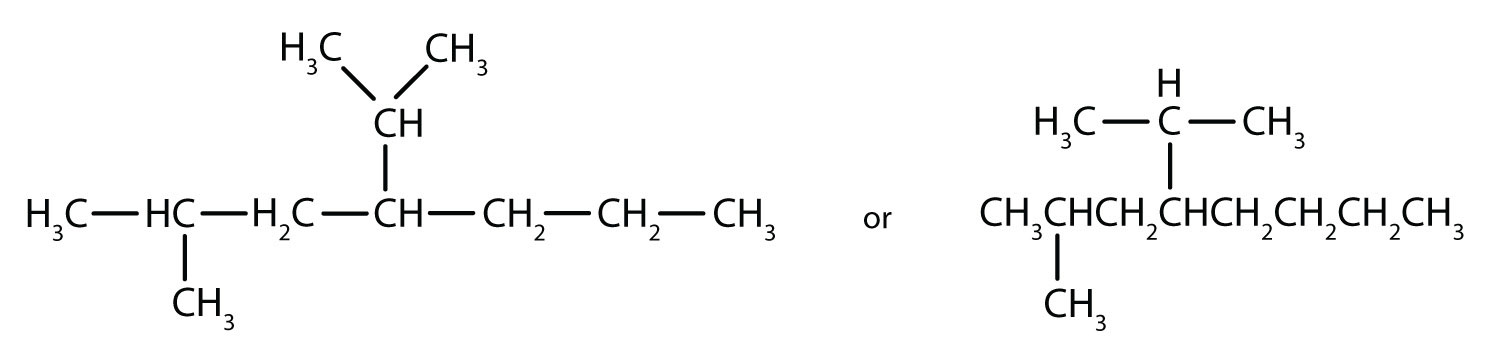
Note that the bonds (dashes) can be shown or not; sometimes they are needed for spacing.
Skill-Building Exercise
Draw the structure for each compound.
4-ethyloctane
3-ethyl-2-methylpentane
3,3,5-trimethylheptane
Concept Review Exercises
What is a CH3 group called when it is attached to a chain of carbon atoms---a substituent or a functional group?
Which type of name uses numbers to locate substituents---common names or IUPAC names?
Answers
substituent
IUPAC names
Exercises
Briefly identify the important distinctions between an alkane and an alkyl group.
How many carbon atoms are present in each molecule?
2-methylbutane
3-ethylpentane
How many carbon atoms are present in each molecule?
2,3-dimethylbutane
3-ethyl-2-methylheptane
Draw the structure for each compound.
3-methylpentane
2,2,5-trimethylhexane
4-ethyl-3-methyloctane
Draw the structure for each compound.
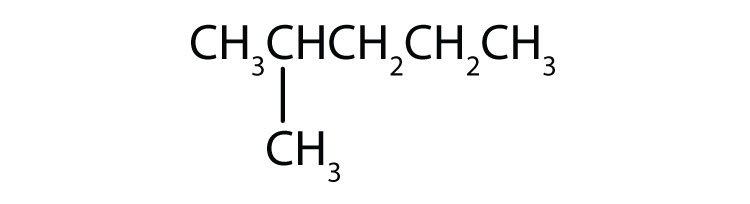
2-methylpentane
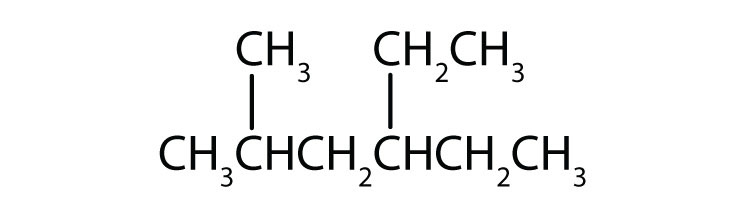
4-ethyl-2-methylhexane
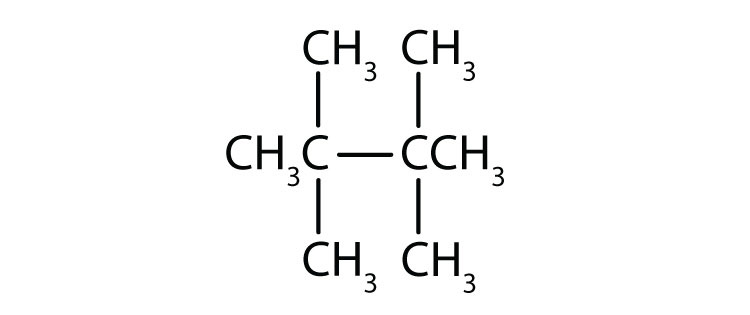
2,2,3,3-tetramethylbutane
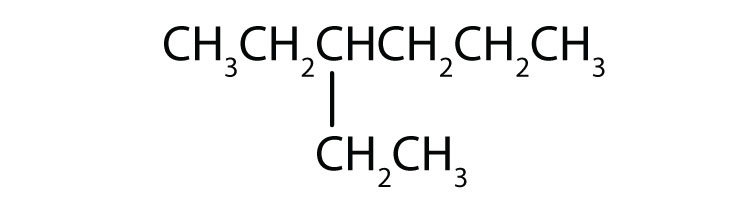
Name each compound according to the IUPAC system.
Name each compound according to the IUPAC system.
What is a substituent? How is the location of a substituent indicated in the IUPAC system?
Briefly identify the important distinctions between a common name and an IUPAC name.
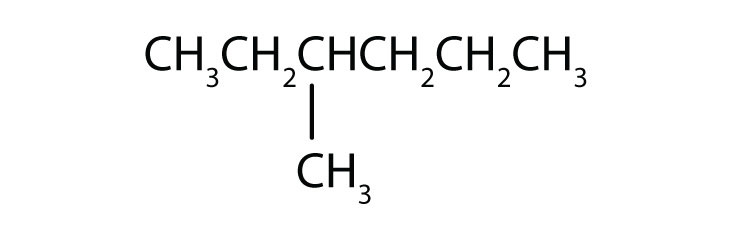
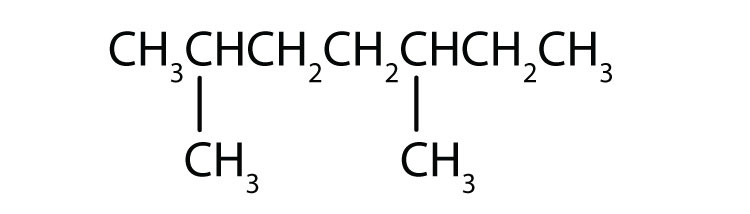
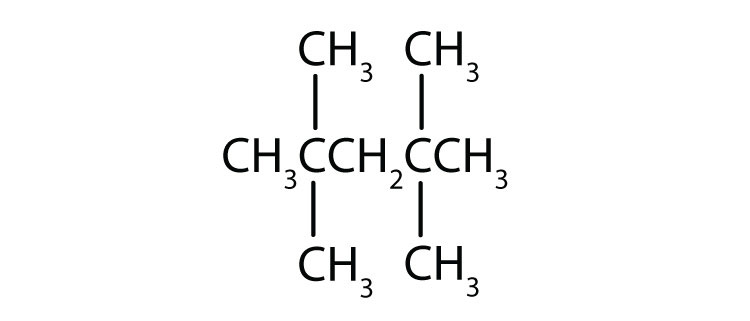
Answers
An alkane is a molecule; an alkyl group is not an independent molecule but rather a part of a molecule that we consider as a unit.
6
10
2,2,4,4-tetramethylpentane
3-ethylhexane
Common names are widely used but not very systematic; IUPAC names identify a parent compound and name other groups as substituents.
12.6 Physical Properties of Alkanes
Because alkanes have relatively predictable physical properties and undergo relatively few chemical reactions other than combustion, they serve as a basis of comparison for the properties of many other organic compound families. Let’s consider their physical properties first.
Table 12.5 "Physical Properties of Some Alkanes" describes some of the properties of some of the first 10 straight-chain alkanes. Because alkane molecules are nonpolar, they are insoluble in water, which is a polar solvent, but are soluble in nonpolar and slightly polar solvents. (For more information about solubility, see Chapter 9 "Solutions", Section 9.2 "Concentration".) Consequently, alkanes themselves are commonly used as solvents for organic substances of low polarity, such as fats, oils, and waxes. Nearly all alkanes have densities less than 1.0 g/mL and are therefore less dense than water (the density of H2O is 1.00 g/mL at 20°C). These properties explain why oil and grease do not mix with water but rather float on its surface.
Table 12.5 Physical Properties of Some Alkanes
Molecular Name | Formula | Melting Point (°C) | Boiling Point (°C) | Density (20°C)* | Physical State (at 20°C) |
|---|---|---|---|---|---|
methane | CH4 | --182 | --164 | 0.668 g/L | gas |
ethane | C2H6 | --183 | --89 | 1.265 g/L | gas |
propane | C3H8 | --190 | --42 | 1.867 g/L | gas |
butane | C4H10 | --138 | --1 | 2.493 g/L | gas |
pentane | C5H12 | --130 | 36 | 0.626 g/mL | liquid |
hexane | C6H14 | --95 | 69 | 0.659 g/mL | liquid |
octane | C8H18 | --57 | 125 | 0.703 g/mL | liquid |
decane | C10H22 | --30 | 174 | 0.730 g mL | liquid |
*Note the change in units going from gases (grams per liter) to liquids (grams per milliliter). Gas densities are at 1 atm pressure. | *Note the change in units going from gases (grams per liter) to liquids (grams per milliliter). Gas densities are at 1 atm pressure. | *Note the change in units going from gases (grams per liter) to liquids (grams per milliliter). Gas densities are at 1 atm pressure. | *Note the change in units going from gases (grams per liter) to liquids (grams per milliliter). Gas densities are at 1 atm pressure. | *Note the change in units going from gases (grams per liter) to liquids (grams per milliliter). Gas densities are at 1 atm pressure. | *Note the change in units going from gases (grams per liter) to liquids (grams per milliliter). Gas densities are at 1 atm pressure. |
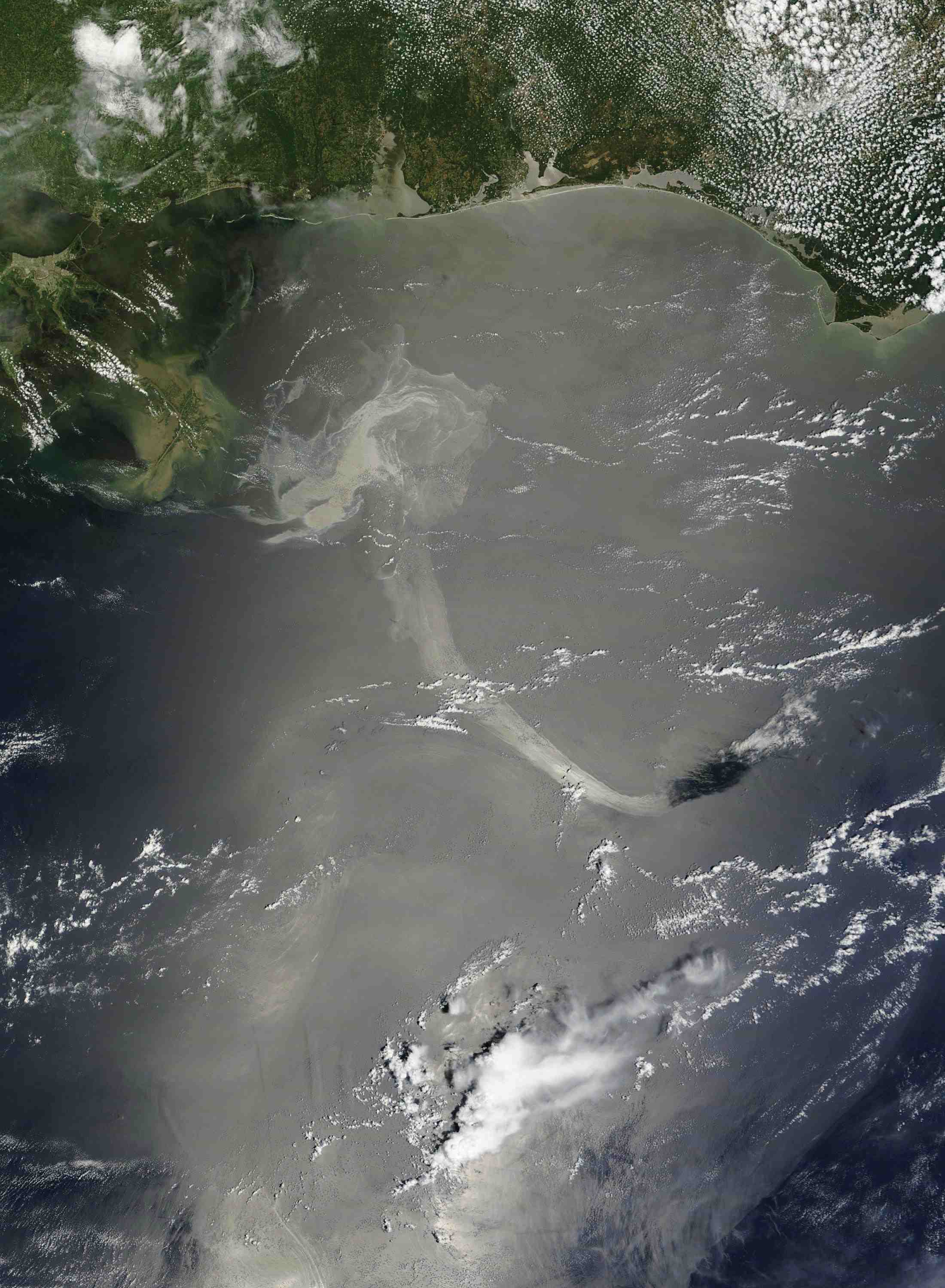
Figure 12.5 Oil Spills
Crude oil coats the water’s surface in the Gulf of Mexico after the Deepwater Horizon oil rig sank following an explosion. The leak was a mile below the surface, making it difficult to estimate the size of the spill. One liter of oil can create a slick 2.5 hectares (6.3 acres) in size. This and similar spills provide a reminder that hydrocarbons and water don’t mix.
Credit: NASA Goddard / MODIS Rapid Response Team; Public domain. Source.
As shown in Table 12.5 "Physical Properties of Some Alkanes", the boiling points of the straight-chain alkanes increase with increasing molar mass. This general rule holds true for the straight-chain homologs of all organic compound families. Larger molecules have greater surface areas and consequently interact more strongly; more energy is therefore required to separate them. For a given molar mass, the boiling points of alkanes are relatively low because these nonpolar molecules have only weak dispersion forces to hold them together in the liquid state.
Concept Review Exercises
Without referring to a table, predict which has a higher boiling point---hexane or octane. Explain.
If 25 mL of hexane were added to 100 mL of water in a beaker, which of the following would you expect to happen? Explain.
Hexane would dissolve in water.
Hexane would not dissolve in water and would float on top.
Hexane would not dissolve in water and would sink to the bottom of the container.
Answers
octane because of its greater molar mass
b; hexane is insoluble in water and less dense than water.
Exercises
Without referring to a table or other reference, predict which member of each pair has the higher boiling point.
pentane or butane
heptane or nonane
For which member of each pair is hexane a good solvent?
pentane or water
sodium chloride or soybean oil
Answer
pentane
nonane
12.7 Chemical Properties of Alkanes
Alkane molecules are nonpolar and therefore generally do not react with ionic compounds such as most laboratory acids, bases, oxidizing agents, or reducing agents. Consider butane as an example:
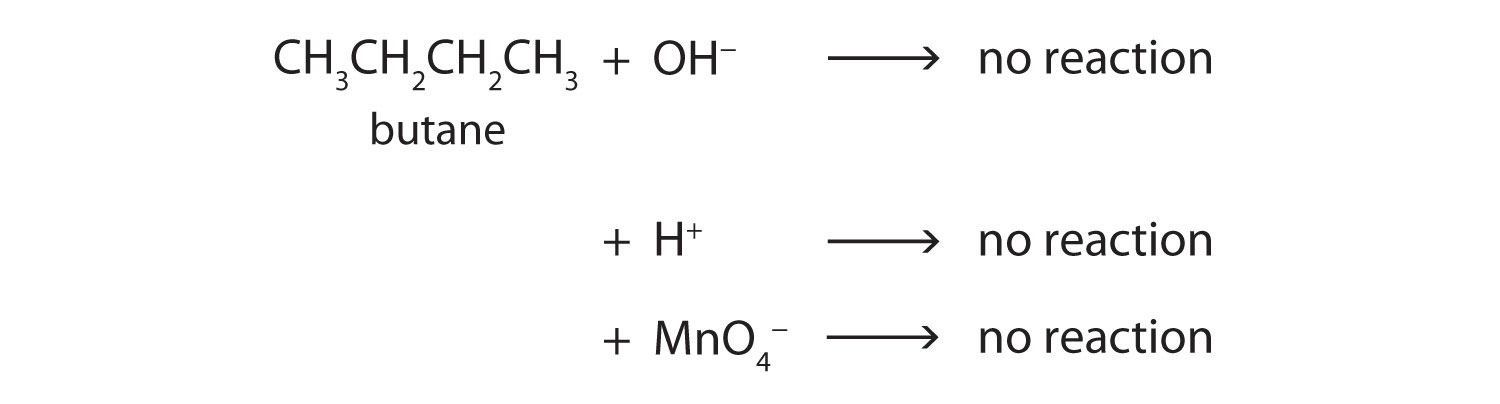
Neither positive ions nor negative ions are attracted to a nonpolar molecule. In fact, the alkanes undergo so few reactions that they are sometimes called paraffins, from the Latin parum affinis, meaning “little affinity.”
Two important reactions that the alkanes do undergo are combustion and halogenation. Nothing happens when alkanes are merely mixed with oxygen (O2) at room temperature, but when a flame or spark provides the activation energy, a highly exothermic combustion reaction[12] proceeds vigorously. For methane (CH4), the reaction is as follows:
CH4 + 2O2 → CO2 + 2H2O + heat
If the reactants are adequately mixed and there is sufficient oxygen, the only products are carbon dioxide (CO2), water (H2O), and heat---heat for cooking foods, heating homes, and drying clothes. Because conditions are rarely ideal, however, other products are frequently formed. When the oxygen supply is limited, carbon monoxide (CO) is a by-product:
2CH4 + 3O2 → 2CO + 4H2O
This reaction is responsible for dozens of deaths each year from unventilated or improperly adjusted gas heaters. (Similar reactions with similar results occur with kerosene heaters.)
Alkanes also react with the halogens chlorine (Cl2) and bromine (Br2) in the presence of ultraviolet light or at high temperatures to yield chlorinated and brominated alkanes. For example, chlorine reacts with excess methane (CH4) to give methyl chloride (CH3Cl).
CH4 + Cl2 → CH3Cl + HCl
With more chlorine, a mixture of products is obtained: CH3Cl, CH2Cl2, CHCl3, and CCl4.
Fluorine (F2), the lightest halogen, combines explosively with most hydrocarbons. Iodine (I2) is relatively unreactive. Fluorinated and iodinated alkanes are produced by indirect methods. We will discuss the names and uses of halogenated hydrocarbons in Section 12.8 "Halogenated Hydrocarbons".
Concept Review Exercises
Why are alkanes sometimes called paraffins?
Which halogen reacts most readily with alkanes? Which reacts least readily?
Answers
Alkanes do not react with many common chemicals. They are sometimes called paraffins, from the Latin parum affinis, meaning “little affinity.”
most readily: F2; least readily: I2
Exercises
Why do alkanes usually not react with ionic compounds such as most laboratory acids, bases, oxidizing agents, or reducing agents?
Write an equation for the complete combustion of methane (CH4, the main component of natural gas).
What is the most important reaction of alkanes?
Name some substances other than oxygen that react readily with alkanes.
Answers
Alkanes are nonpolar; they do not attract ions.
combustion
12.8 Halogenated Hydrocarbons
Many organic compounds are closely related to the alkanes. As we noted in Section 12.7 "Chemical Properties of Alkanes", alkanes react with halogens to produce halogenated hydrocarbons, the simplest of which have a single halogen atom substituted for a hydrogen atom of the alkane. Even more closely related are the cycloalkanes, compounds in which the carbon atoms are joined in a ring, or cyclic fashion.
The reactions of alkanes with halogens produce halogenated hydrocarbons[13], compounds in which one or more hydrogen atoms of a hydrocarbon have been replaced by halogen atoms:

The replacement of only one hydrogen atom gives an alkyl halide (or haloalkane)[14]. The common names of alkyl halides consist of two parts: the name of the alkyl group plus the stem of the name of the halogen, with the ending -ide. The IUPAC system uses the name of the parent alkane with a prefix indicating the halogen substituents, preceded by a number indicating the substituent’s location. The prefixes are fluoro-, chloro-, bromo-, and iodo-. Thus CH3CH2Cl has the common name ethyl chloride and the IUPAC name chloroethane. Alkyl halides with simple alkyl groups (one to four carbon atoms) are often called by common names. Those with a larger number of carbon atoms are usually given IUPAC names.
Example 3
Give the common and IUPAC names for each compound.
CH3CH2CH2Br
(CH3)2CHCl
Solution
The alkyl group (CH3CH2CH2--) is a propyl group, and the halogen is bromine (Br). The common name is therefore propyl bromide. For the IUPAC name, the prefix for bromine (bromo) is combined with the name for a three-carbon chain (propane), preceded by a number identifying the carbon atom to which the Br atom is attached, so the IUPAC name is 1-bromopropane.
The alkyl group [(CH3)2CH--] has three carbon atoms, with a chlorine (Cl) atom attached to the middle carbon atom. The alkyl group is therefore isopropyl, and the common name of the compound is isopropyl chloride. For the IUPAC name, the Cl atom (prefix chloro-) attached to the middle (second) carbon atom of a propane chain results in 2-chloropropane.
Skill-Building Exercise
Give common and IUPAC names for each compound.
CH3CH2I
CH3CH2CH2CH2F
Example 4
Give the IUPAC name for each compound.


Solution
The parent alkane has five carbon atoms in the longest continuous chain; it is pentane. A bromo (Br) group is attached to the second carbon atom of the chain. The IUPAC name is 2-bromopentane.
The parent alkane is hexane. Methyl (CH3) and bromo (Br) groups are attached to the second and fourth carbon atoms, respectively. Listing the substituents in alphabetical order gives the name 4-bromo-2-methylhexane.
Skill-Building Exercise
Give the IUPAC name for each compound.


A wide variety of interesting and often useful compounds have one or more halogen atoms per molecule. For example, methane (CH4) can react with chlorine (Cl2), replacing one, two, three, or all four hydrogen atoms with Cl atoms. Several halogenated products derived from methane and ethane (CH3CH3) are listed in Table 12.6 "Some Halogenated Hydrocarbons", along with some of their uses.
Table 12.6 Some Halogenated Hydrocarbons
Formula | Common Name | IUPAC Name | Some Important Uses |
|---|---|---|---|
Derived from CH4 | Derived from CH4 | Derived from CH4 | Derived from CH4 |
CH3Cl | methyl chloride | chloromethane | refrigerant; the manufacture of silicones, methyl cellulose, and synthetic rubber |
CH2Cl2 | methylene chloride | dichloromethane | laboratory and industrial solvent |
CHCl3 | chloroform | trichloromethane | industrial solvent |
CCl4 | carbon tetrachloride | tetrachloromethane | dry-cleaning solvent and fire extinguishers (but no longer recommended for use) |
CBrF3 | halon-1301 | bromotrifluoromethane | fire extinguisher systems |
CCl3F | chlorofluorocarbon-11 (CFC-11) | trichlorofluoromethane | foaming plastics |
CCl2F2 | chlorofluorocarbon-12 (CFC-12) | dichlorodifluoromethane | refrigerant |
Derived from CH3CH3 | Derived from CH3CH3 | Derived from CH3CH3 | Derived from CH3CH3 |
CH3CH2Cl | ethyl chloride | chloroethane | local anesthetic |
ClCH2CH2Cl | ethylene dichloride | 1,2-dichloroethane | solvent for rubber |
CCl3CH3 | methylchloroform | 1,1,1-trichloroethane | solvent for cleaning computer chips and molds for shaping plastics |
Concept Review Exercises
What is the IUPAC name for the HFC that has the formula CH2FCF3? (Hint: you must use a number to indicate the location of each substituent F atom.)
What is the IUPAC name for the HCFC that has the formula CHCl2CF3?
Answers
1,1,1,2-tetrafluoroethane
1,1,1-trifluoro-2,2-dichloroethane
Exercises
Write the condensed structural formula for each compound.
methyl chloride
chloroform
Write the condensed structural formula for each compound.
ethyl bromide
carbon tetrachloride
Write the condensed structural formulas for the two isomers that have the molecular formula C3H7Br. Give the common name and the IUPAC name of each.
Write the condensed structural formulas for the four isomers that have the molecular formula C4H9Br. Give the IUPAC name of each.
What is a CFC? How are CFCs involved in the destruction of the ozone layer?
Explain why each compound is less destructive to the ozone layer than are CFCs.
fluorocarbons
HCFCs
Answers
CH3Cl
CHCl3
CH3CH2CH2Br, propyl bromide, 1-bromopropane; CH3CHBrCH3, isopropyl bromide, 2-bromopropane
compounds containing Cl, F, and C; by releasing Cl atoms in the stratosphere
12.9 Cycloalkanes
The hydrocarbons we have encountered so far have been composed of molecules with open-ended chains of carbon atoms. When a chain contains three or more carbon atoms, the atoms can join to form ring or cyclic structures. The simplest of these cyclic hydrocarbons[15] has the formula C3H6. Each carbon atom has two hydrogen atoms attached (Figure 12.6 "Ball-and-Spring Model of Cyclopropane") and is called cyclopropane.
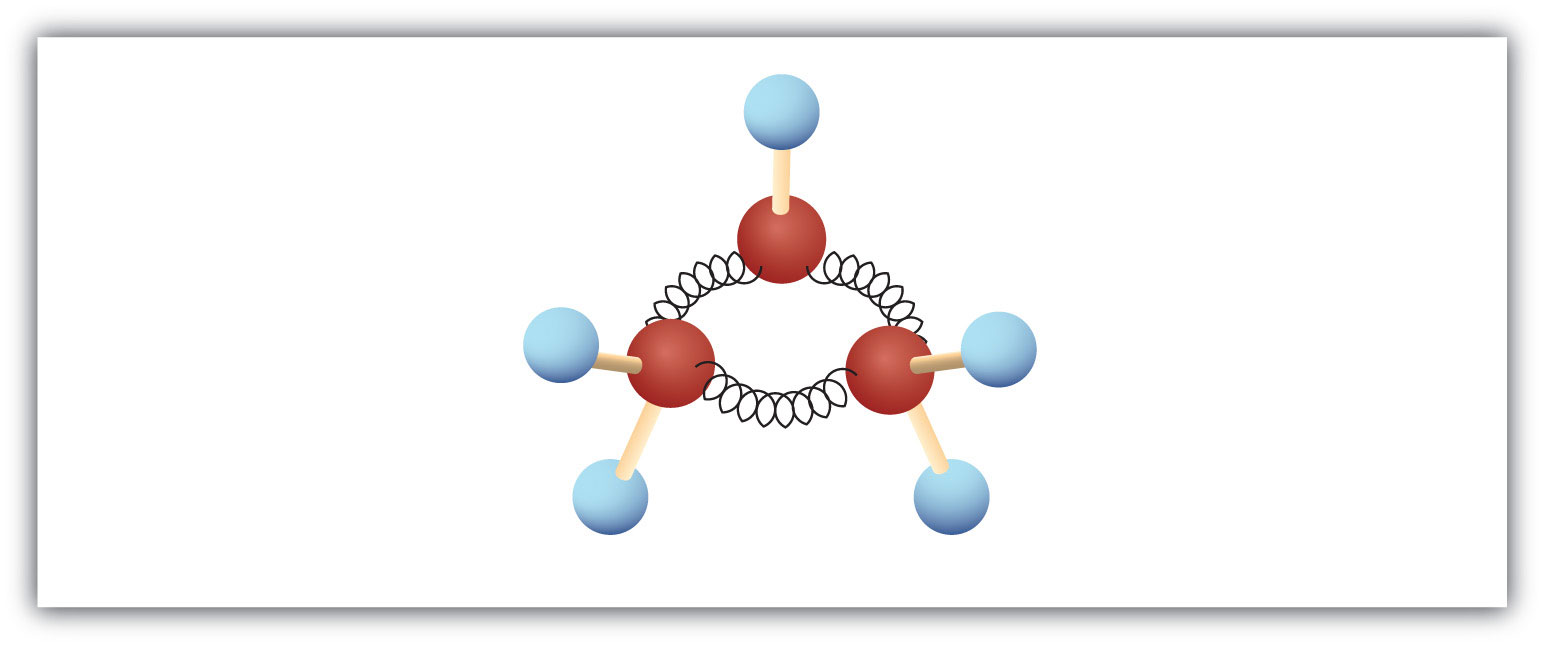
Figure 12.6 Ball-and-Spring Model of Cyclopropane
The springs are bent to join the carbon atoms.
The cycloalkanes[16]---cyclic hydrocarbons with only single bonds---are named by adding the prefix cyclo- to the name of the open-chain compound having the same number of carbon atoms as there are in the ring. Thus the name for the cyclic compound C4H8 is cyclobutane. The carbon atoms in cyclic compounds can be represented by line-angle formulas that result in regular geometric figures. Keep in mind, however, that each corner of the geometric figure represents a carbon atom plus as many hydrogen atoms as needed to give each carbon atom four bonds.
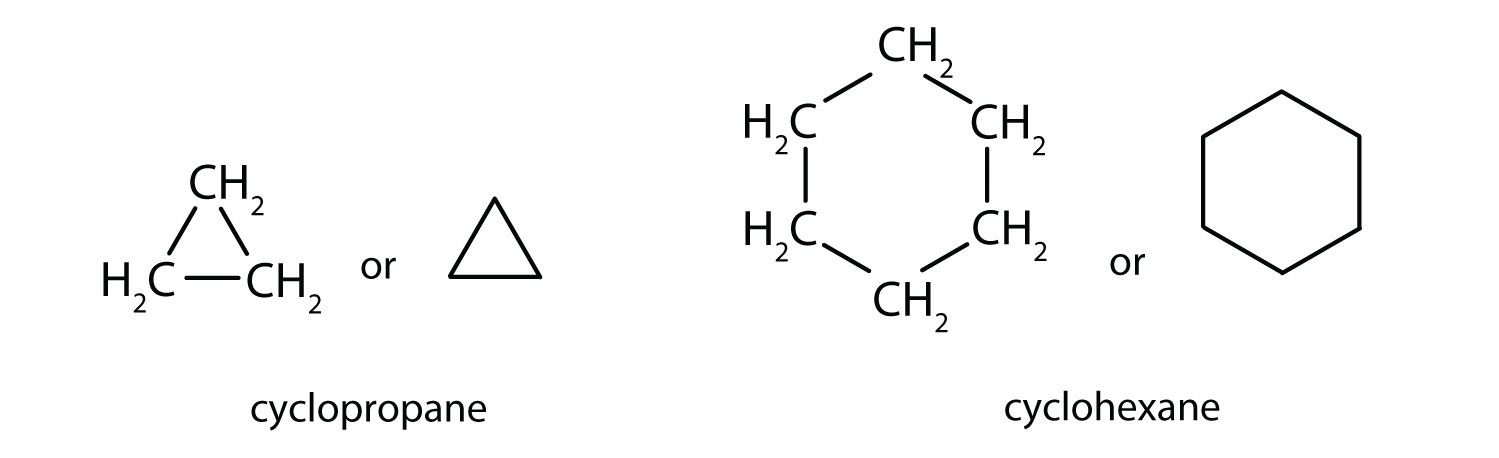
Some cyclic compounds have substituent groups attached. Example 5 interprets the name of a cycloalkane with a single substituent group.
Example 5
Draw the structure for each compound.
cyclopentane
methylcyclobutane
Solution
The name cyclopentane indicates a cyclic (cyclo) alkane with five (pent-) carbon atoms. It can be represented as a pentagon.

The name methylcyclobutane indicates a cyclic alkane with four (but-) carbon atoms in the cyclic part. It can be represented as a square with a CH3 group attached.

Skill-Building Exercise
Draw the structure for each compound.
cycloheptane
ethylcyclohexane
The properties of cyclic hydrocarbons are generally quite similar to those of the corresponding open-chain compounds. So cycloalkanes (with the exception of cyclopropane, which has a highly strained ring) act very much like noncyclic alkanes. Cyclic structures containing five or six carbon atoms, such as cyclopentane and cyclohexane, are particularly stable. We will see in Chapter 16 "Carbohydrates" that some carbohydrates (sugars) form five- or six-membered rings in solution.
Concept Review Exercises
What is the molecular formula of cyclooctane?
What is the IUPAC name for this compound?

Answers
C8H16
ethylcyclopropane
Exercises
Draw the structure for each compound.
ethylcyclobutane
propylcyclopropane
Draw the structure for each compound.
methylcyclohexane
butylcyclobutane
Cycloalkyl groups can be derived from cycloalkanes in the same way that alkyl groups are derived from alkanes. These groups are named as cyclopropyl, cyclobutyl, and so on. Name each cycloalkyl halide.
Halogenated cycloalkanes can be named by the IUPAC system. As with alkyl derivatives, monosubstituted derivatives need no number to indicate the position of the halogen. To name disubstituted derivatives, the carbon atoms are numbered starting at the position of one substituent (C1) and proceeding to the second substituted atom by the shortest route. Name each compound.



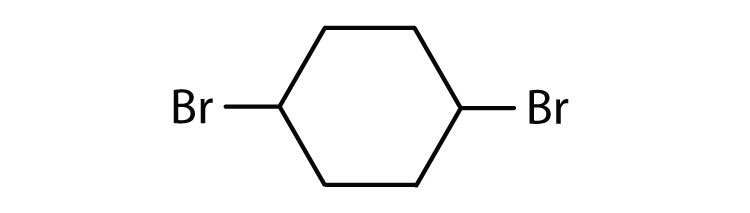
Answers
cyclopentyl bromide
cyclohexyl chloride


12.10 End-of-Chapter Material
Additional Exercises
You find an unlabeled jar containing a solid that melts at 48°C. It ignites readily and burns readily. The substance is insoluble in water and floats on the surface. Is the substance likely to be organic or inorganic?
Give the molecular formulas for methylcyclopentane, 2-methylpentane, and cyclohexane. Which are isomers?
What is wrong with each name? (Hint: first write the structure as if it were correct.) Give the correct name for each compound.
2-dimethylpropane
2,3,3-trimethylbutane
2,4-diethylpentane
3,4-dimethyl-5-propylhexane
What is the danger in swallowing a liquid alkane?
Distinguish between lighter and heavier liquid alkanes in terms of their effects on the skin.
Following is the line formula for an alkane. Draw its structure and give its name.

Write equations for the complete combustion of each compound.
propane (a bottled gas fuel)
octane (a typical hydrocarbon in gasoline).
The density of a gasoline sample is 0.690 g/mL. On the basis of the complete combustion of octane, calculate the amount in grams of carbon dioxide (CO2) and water (H2O) formed per gallon (3.78 L) of the gasoline when used in an automobile.
Draw the structures for the five isomeric hexanes (C6H14). Name each by the IUPAC system.
Indicate whether the structures in each set represent the same compound or isomers.
Consider the line-angle formulas shown here and answer the questions.
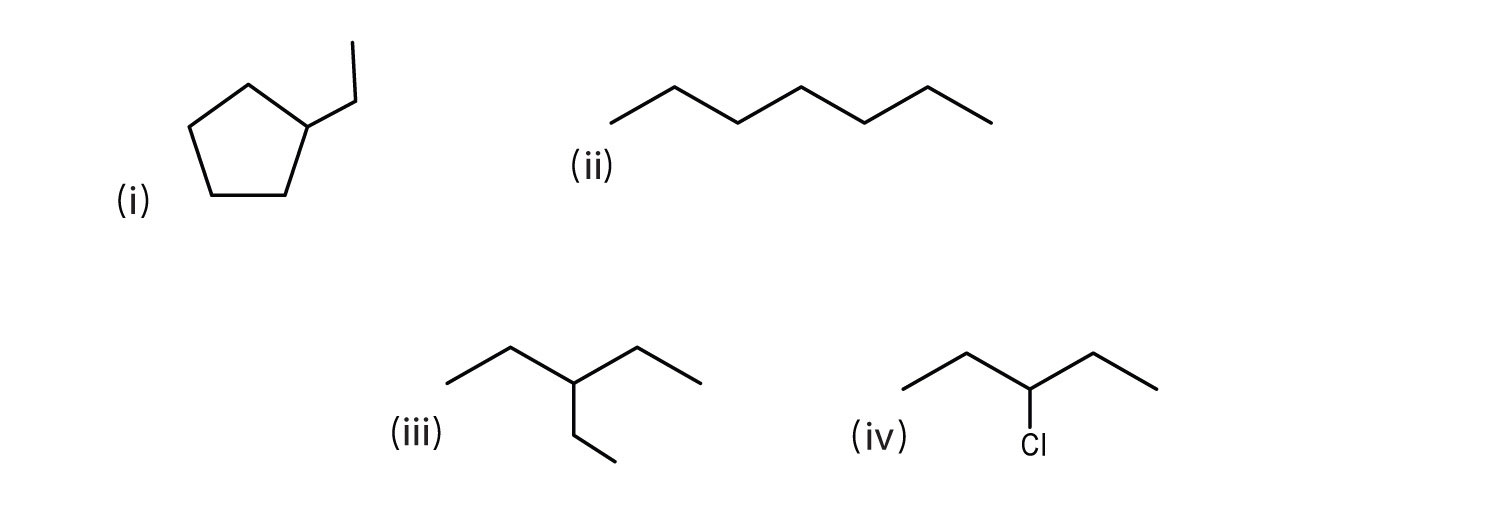
Which pair of formulas represents isomers? Draw each structure.
Which formula represents an alkyl halide? Name the compound and write its condensed structural formula.
Which formula represents a cyclic alkane? Name the compound and draw its structure.
What is the molecular formula of the compound represented by (i)?



Answers
organic
Two numbers are needed to indicate two substituents; 2,2-dimethylpropane.
The lowest possible numbers were not used; 2,2,3-trimethylbutane.
An ethyl substituent is not possible on the second carbon atom; 3,5-dimethylheptane.
A propyl substituent is not possible on the fifth carbon atom; 3,4,5-trimethyloctane.
Lighter alkanes wash away protective skin oils; heavier alkanes form a protective layer.
C3H8 + 5O2 → 3CO2 + 4H2O
2C8H18 + 25O2 → 16CO2 + 18H2O
CH3CH2CH2CH2CH2CH3; hexane




ii and iii; CH3CH2CH2CH2CH2CH2CH3 and

iv; 3-chloropentane; CH3CH2CHClCH2CH3
i; ethylcyclopentane;

C7H14
The study of the chemistry of carbon compounds.
The study of the chemistry of all other elements.
The simplest organic compound, composed of carbon and hydrogen atoms only.
A hydrocarbon with only carbon-to-carbon single bonds and existing as a continuous chain of carbon atoms also bonded to hydrogen atoms
Any family of compounds in which adjacent members differ from each other by a definite factor.
Compounds having the same molecular formula but different structural formulas and properties.
A chemical formula that shows how the atoms of a molecule are attached to one another.
An organic chemical formula that shows the hydrogen atoms (or other atoms or groups) right next to the carbon atoms to which they are attached.
An organic chemical formula in which carbon atoms are implied at the corners and ends of lines. Each carbon atom is understood to be attached to enough hydrogen atoms to give each carbon atom four bonds.
A systematic way of naming chemical substances so that each has a unique name.
A hydrocarbon group derived from an alkane by removal of a hydrogen atom.
A chemical reaction in which a substance combines with molecular oxygen to make oxygen-containing compounds of other elements in the reaction.
A hydrocarbon in which one or more hydrogen atoms have been replaced by a halogen atom.
A compound resulting from the replacement of a hydrogen atom of an alkane with a halogen atom.
A hydrocarbon with a ring of carbon atoms.
A cyclic hydrocarbon with only single bonds.