
Easter Island stands as a testament to humans’ ability to do really dumb things, like cutting every tree on the island. Who cut down the last one? Photo by Sophie Hurel.
18. Human Factors
Energy has occupied center-stage in this book because it is the physical currency of activity. Fossil fuel availability permitted the Industrial Revolution and all that came with it. Human civilization has never before faced the prospect of such a crucial global resource either disappearing or being abandoned due to other ills (e.g., climate change).
Despite the mixed suitabilities of alternative energy sources presented in Chapter 17, some physically viable avenues are open to us. In other words, physics itself does not preclude development of an energy landscape consisting primarily of solar, wind, and hydroelectric power, plus a few small contributions from a variety of other sources. Life may be different; less air travel or transportation in general, as one possibility. The enormous solar potential combined with decent storage technologies could conceivably maintain our 18 TW appetite without fossil fuels. Or we could scale back and not expect to live in such a profligate manner, viewing our current ways and expectations in the broader human experience as anomalous, temporary, and not important to preserve.
In any case, the barriers are not completely due to physical constraints— though we must heed limits where they exist. A practical concern is the expense of a non-fossil energy infrastructure: both in energy and financial terms. It is possible that the prosperity required to afford such a dream is physically unavailable.[1] Another limitation involves people and how they work collectively, which is the focus of this chapter.
18.1 Personality
Discussion of personality may seem out of place in a physics-based textbook. But how we react to a looming crisis—both individually
or collectively—becomes a central question. Physics and nature are indifferent to the choices we make, and whether or not these choices serve our long-term interests. Success or failure therefore depends more on our attitudes and reactions to physical reality than it does on physics itself. While this section addresses how personality preferences might influence human reaction to crisis, it is by no means the only determining factor. Education, socio-economic status, financial interests, and many other attributes can play a role. Yet underneath it all, we are humans, and possess various traits that influence our reactions.
A common fallacy is that a collection of people, possessing access to the same set of facts,[2] will respond similarly. Having only occupied one person’s head, each of us cannot easily comprehend the reactions another might have to a situation. A variety of metrics have been devised to characterize different personalities and preferences, which play a role in shaping reactions. The Big–5 and Myers–Briggs are among the most well known. The former provides a scale for each of five traits:
Openness: creative and curious vs. careful and regimented
Conscientiousness: degree of organization and efficiency
Extraversion: socially energetic vs. preference for quiet or alone
Agreeableness: engaging and sympathetic vs. aloof or cranky
Neuroticism: easily rattled vs. confident and stable
The Myers–Briggs scheme[3] has four categories that are usually represented as binary (either/or) labels, but in truth also exist on a continuum as do the Big–5 traits. Each category in Myers–Briggs acquires a one-letter label, in the end generating 16 possibilities.[4] The categories are:
I/E: Introvert vs. Extravert: are parties draining or energizing?
N/S: iNtuiting vs. Sensing: preference for abstract vs. concrete direct-sensory information
T/F: Thinking vs. Feeling: preference for intellectual/logical or emotional reasoning
J/P: Judging[5] vs. Perceiving: decisiveness vs. keeping options open
If you have never taken a Myers-Briggs type test, the following three citations include links to online tests [114–116]. These sites, and many others, offer descriptions of the types. For instance, here is a link[6] to a description of the INTJ type from [114]. Other types are linked from that page.
Many scientists find themselves in the INTX camps.[7] Technically speaking, the last category (J/P) reflects whether a person relies more heavily on the N/S axis (if P) or the T/F axis (if J). In the case of INTP, abstraction/theory is valued over logic, and the reverse for INTJ. Figure 18.1 provides an indication of the frequency of each type.[8]
A survey of visitors to the author’s Do the Math website, which presents a quantitative look at energy and resource use much in the same spirit as
![Frequency of Myers-Briggs types from one collection of data, as percentages [117]. Areas are proportioned accordingly. Don’t take the number](/EnergyAndHumanAmbitions/build/fig-18-1-0f73dc84eae2a56fb5aeec97b91f0f8a.svg)
Figure 18.1:Frequency of Myers–Briggs types from one collection of data, as percentages [117]. Areas are proportioned accordingly. Don’t take the numbers literally: they are not as precisely determined as decimals indicate, but visually at least this representation gives a decent sense for distribution. Note how significant it is when a two-thirds majority of interest-selected individuals piles into the small INTJ and INTP boxes at upper right, as described in the text.
this text, found that a staggering 44% of about 1,000 survey respondents shared the same INTJ type as the author, despite INTJs constituting only about 2% of the population. The over-representation of INTJ is thus about a factor of 20, and beyond question a statistically significant result (see Figure 18.2). The adjacent INTP cohort accounted for an additional 21% of visitors, despite being about 3% of the population. Thus about two-thirds of the site visitors represented 5% of the population for more than a factor-of-ten anomaly. While the Myers–Briggs scheme is not free of criticism (see Box 18.1), the result from Do the Math is pretty convincing that the Myers–Briggs scheme is measuring something relevant. Had the site asked for astrological sign, we can be pretty sure that representation would have been essentially uniform: no statistical anomalies. Myers–Briggs is evidently telling us something.
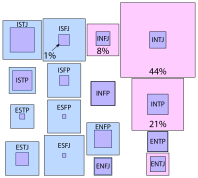
Figure 18.2:Stunning Myers–Briggs personality disparity between Do the Math readership and the general population. Areas of blue boxes represent frequency of types in the general population, as a variant of Figure 18.1. Pink areas reflect the readership of Do the Math, and overlaps appear purple. Visible pink means over-representation on the site, and visible blue indicates underrepresentation. 73% of the readership occupies the top right corner of the personality types, even though these three boxes only capture 7% of the population. A result this extreme, involving over 1,000 respondents, is absurdly far from random. Percentages are shown in the three most overwhelmingly over-represented boxes, plus a 1% box for reference. What if objection to the Myers–Briggs framework correlated strongly with Myers–Briggs type?
The most important aspect of personality that bears on our energy/resource challenges, and a key reason for covering the topic at all in this book, is that the Myers–Briggs “S” types constitute 73% of the population, yet are most resistant to the argument that unprecedented disruptive changes are on the horizon. S-types place more value on direct sensory input than on abstraction. Things directly experienced—seen with their own eyes, heard by their own ears, personally touched, smelled or tasted—carry much greater weight than “theory.” Presented with warnings about climate change, a hard-over S-type [118] might hold up a snowball (as Senator Inhofe famously did in front of Congress in 2015) to demonstrate—in their mind—how preposterous this global warming talk is. When warned about potential hardships following fossil fuel availability, an S-type may look out the metaphorical window and sense that everything seems to be fine.
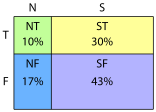
Figure 18.3:Distribution of N/S and T/F traits among the population.
18.1.1 Consequences and Coping
The S-type asymmetry[10] in human populations may confer an overall adaptive advantage. In stable times, recent history and apparent conditions provide reliable guidance to the likely future. It is understandable, therefore, that humankind would have difficulty adapting early to an upcoming reversal of fortunes, or even acknowledging its possibility. The prevailing narrative of growth and progress are so firmly rooted in society that the mere suggestion of a more primitive future[11] is discordant enough to be rejected by cultural antibodies—alien enough to resist comprehension, as if spoken in a foreign language.
The growth narrative’s firm grip is easy to understand: Earth has always been large enough to accommodate human cravings, for countless generations. Yet 8 billion people competing for finite resources[12] at an unprecedented rate, climate change, deforestation, fisheries collapse, species loss, and a host of other crises signal that the prevailing narrative may simply be wrong[13] (Figure 18.4).
Timely, effective mitigation is possible only by seriously entertaining a radically new paradigm before widespread disruption becomes unmistakably evident. Is it possible to implant a wholly different narrative

Figure 18.4:The growth narrative is… wrong. Sung to the tune of a clock chime striking three; inspired by Dr. Cox in S1:E9 of Scrubs.
about the long-term relationship of humans to this planet, or is it cooked in to human nature[14] that we fail this challenge?
One aspect of this dilemma is a pattern of unwillingness to accept personal responsibility for our predicament. Our own habits and expectations place demands on planetary resources that lead to global-scale challenges larger than we have ever faced. People have a tendency to blame others for their plights. In this complex world, it is never difficult to identify some other contributor to our problems: capitalists, socialists, liberals, conservatives, environmentalists, illegal immigrants, other religions, other powerful countries. What fraction of the blame might we assign to ourselves, and is it honest/accurate? In the end, we as humans must accept responsibility for the conditions we—and our expectations—create.
The human penchant for blaming and even demonizing “others” might lead to resource wars in the face of hardships imposed by limited resource availability. Such a path is lamentable on many levels, not least of which is that precious resources and energy would be channeled toward destructive acts rather than using them to build a better future. Are humans capable of mounting a transformative effort of global cooperation on a scale even greater than that of, say, World War II if we are not fighting an enemy other than ourselves and our own resource demands? Can we identify a precedent in which human societies have done so in the past at a large/relevant scale?
The first step in avoiding these pitfalls is awareness of the roles that human personality and psychology play in these problems, as this section has attempted to point out. One thing that became evident to the author on the basis of the Do the Math survey was that like seems to attract like: the communication style of the blog was a magnet for those of the same or adjacent types. But the message had startlingly little grip on the S crowd—especially the population-dominant xSFx types (second column in Figure 18.2). Perhaps a concerted effort to recruit all personality types to communicate important messages will better reach a broader audience, in terms that are more resonant with recipients.
One other coping mechanism is simple: time. The world a child is born into is by definition “normal” to the child. Future generations who do not grow up spoiled by abundant fossil fuel energy will not fight for a bygone lifestyle, and will simply adapt to the world as they find it—where the S–types shine. One way or another, nature will settle on a solution, and humans will be part of that solution, whatever its form. Ideally, we can guide ourselves into a mutually agreeable coexistence.
18.2 Policy vs. Individual Action
From where does power[15] stem? Monarchs of old claimed divine provenance as a source of power. Authoritarians might use a combination of personality and strong military backing. Some countries put on a show of democracy, while exercising power to thwart rivals and control the legal apparatus—resulting in sham elections.
In a functioning democracy, power is meant to come from the people. Votes send ineffective or crooked politicians packing, replacing them with folks promising to be faithful servants to the people and to the country’s constitution. If democracy works as planned, then how far can a politician be from the sentiment of the people[16] and still get elected (or re-elected)? Since presumably politicians cannot afford to stray far from the views of their constituents, are democratic politicians leaders or followers?
What would happen in a functioning democracy if the government told people what to eat, how many kids to have, or what temperature to set in homes? If people are not already willing to make the changes on their own,[17] how can a democratic government impose “responsible” choices when those choices involve unwanted sacrifice in some form? If democratically-elected politicians are constrained to only offer “better,” more personally attractive choices, a democratic world may no longer have the flexibility necessary to address our fundamental challenges.
So if democratic governments turn out to be ineffective at promoting substantive change involving reduction, what can be done if indeed that’s the necessary course of action? Citizens are free to take charge of their own choices, for the greater good. Yet, individual action as a response to our predicament often provokes criticism and debate. The argument is that only policy has the teeth to bring about effective change. If person A uses less of a resource, it just leaves person B free to use more of it.
But consider that voting is also an individual action. One person’s vote seldom makes any measurable difference: it is a tiny drop in the bucket. Yet, if everyone[18] concluded that the individual action of voting was wasted and meaningless, the result would be disastrous: gross underrepresentation and distortion of the will of the people.
We understand in the context of voting that individual action leads to collective representation, and tend to practice this right even though policy does not demand that we do so. We see it as part of a civic responsibility—as the right way to participate in our society. Our system can tolerate a certain fraction of individuals who won’t donate time to their civic responsibility, but things fall apart if we have too many such people.[19] Next time someone challenges your individual efforts to improve the world in some way, labeling them as meaningless, ask them to be consistent with their espoused principles and please refrain from
voting in the future, lest they be labeled hypocrites. Often such objections are rooted in defense: they want stuff, and your giving something up is a threat to their perceived moral “right” to have it. The sense of sanctimony and righteousness of the individual making sacrifices—even if not intentional—can be very offputting.
One other aspect of individual action is that it could influence others to follow, thus amplifying the individual’s effect. This approach is perhaps most effective if others see benefits for themselves, and are not made to feel bad for not already being “woke” to the right side of the practice.
18.3 The Energy Trap
If we unwisely mount a response only after we find ourselves in fossil fuel decline—as crisis responders, not proactive mitigators—we could find ourselves in an energy trap: a crash program to build a new energy infrastructure requires up-front energy, for decades. If energy is already in short supply, additional precious energy must be diverted to the project, making peoples’ lives seem even harder/worse.[20] A democracy will have a hard time navigating this decades-long sacrifice.
Let’s flesh this concept out a bit more. In the financial world, money can be borrowed on the promise of paying it back.[21] In this way, something is created from nothing, essentially. Modern monetary systems are based on fiat currency, rather than being tied to physical gold or silver. This means money can be “willed” into existence by the financial system. Energy does not work that way. To build a hydroelectric dam, solar panels, wind turbines, or a nuclear plant, all the energy must be available up front. Nature offers no financing!
Recall from Sec. 14.3.1 (p. 241) that the EROEI, or energy returned on energy invested, describes the ratio of output energy over the lifetime of the resource to the input energy needed to secure it in the first place. For many cases, like a hydroelectric dam, nuclear plant, wind turbine, or solar panel, most of the energy input happens before any energy is delivered. In other cases, like biofuels, the investment may be more drawn out and seem more like an efficiency. In the context of the energy trap, we will focus on the input as an up-front investment.
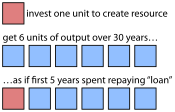
Figure 18.5:Energy “payback” time for 30 year resource with EROEI of 6:1.
As another example, development of a resource that will last 40 years and whose EROEI is 10:1 will require 4 years of its energy output ahead of time[23] to bring it to fruition.
Imagine now that we find ourselves having reduced access to oil,[28] driving prices up and making peoples’ lives harder. Now the government announces a 16 year plan to divert 25% of energy into making a new infrastructure in an effort to reduce dependence on fossil fuels. That is a huge additional sacrifice on an already short-supply commodity. Voters are likely to respond by tossing out the responsible[29] politicians, installing others who promise to kill the program and restore relief on a short timescale. Election cycles are short compared to the amount of time needed to dedicate to this sort of major initiative, making meaningful infrastructure development a difficult prospect in a democracy. And this is before addressing the likely contentious fights about what the new infrastructure should be, out of the table of imperfect[30] options.
Now it is perhaps more apparent why this is called an energy trap: short-term political and economic interests forestall a proactive major investment in new energy, and by the time energy shortages make the crisis apparent, the necessary energy is even harder to attain. Short-term focus is what makes it a trap.[31]
One wonders how democracies will fare in the face of declining resources. The combination of capitalism and democracy have been ideal during the growth phase of our world: efficiently optimizing allocation of resources according to popular demand. But how do either work in a decline scenario, when the future is not “bigger” than today, and may involve sacrifice? We simply do not yet know. This is a giant unauthorized experiment that is not operating from a script. Chapter 19 will return to this notion.
18.4 Fermi Paradox Explained?
Having discussed some of the top-level challenges facing our technological society, it is too tempting to speculate on how universal our trajectory might be. We do so in the context of the Fermi Paradox [119], which asks: if the universe produces a reasonably high probability of intelligent life developing, why have we seen no credible evidence[32] of advanced civilizations? Yes, this is a bit of a tangent,[33] but it could be interpreted as a relevant data point in the likelihood that we maintain an advanced civilization for a long duration.
The setup to the question is a “big if.” The usual approach to estimating the number of intelligent species in our galaxy[34] is via the Drake Equation [120]. The equation is simple, just multiplying the number of stars by a chain of probabilities: that the star has planets at all; that one of the star’s planets is “habitable;” that the environment is benign and that life has had enough time to develop; and finally that the life develops into an intelligent form, capable of communicating. Also factored in is the likelihood that any such species would endeavor to reach out, and how long their civilization lasts in that state so that we might overlap[35] in time. For the Milky Way galaxy, 100 billion stars—almost all of which we now know are likely to have planets—gives a huge start so that even if the chance of intelligent life arising is one in a million, we’re left with quite a margin.
But maybe our trajectory is pretty typical. By the time an intelligent species arises, the many millions or billions of years of life leading up to that event may ubiquitously lead to deposits of fossil fuels.[36] The first species smart enough to utilize the planet’s fossil fuels does so with reckless abandon. Because evolution does not skip steps, we should not expect to find a species wise enough to refrain from rapid fossil fuel use emerging before a species who is just smart enough to use them, but not smart enough not to. So the “intelligent” species short-circuits the battery[37] in a blaze of glory that may even involve baby-step excursions into space before either climate change or other resource/planetary limitations removes the fossil fuel source that made it all possible. Lacking wisdom and foresight, solid plans are not in place to handle the withdrawal, which does not go well and leaves the species in a crippled lower-tech state. Rebuilding from the ashes is then much less likely to explode without that one-time elixir that made it all possible the first time.[38] A simple, and possibly quite satisfying life may await, but it may not involve traveling or communicating across space for others to learn of our existence.
This notion is, of course, highly speculative and of little practical value. Except it may allow us to think “bigger” than ourselves and ponder whether it is surprising that we might fail to achieve a Star Trek future. It is at least somewhat relevant to note that the universe we peer into does not have an evident intergalactic intelligent presence. Perhaps the combination of evolution and fossil fuels makes our path—including a possible decline to follow—a very natural and expected outcome, leaving the universe a quiet place.
18.5 Upshot on Humanity
We face unprecedented pressures on resources and on our environment, as human population and standard of living both surge on a finite planet. Nature will not allow this trend to continue indefinitely. While much of this book has pointed out limitations of one form of energy or the other, we should be clear that physics does not preclude a satisfying route to the future that operates within planetary limits. It would appear that the real barrier is human limitations in accepting physical constraints. Failure (as a whole) to:
process abstract information;
anticipate situations that have never yet arisen;
make individual sacrifices[39] for the greater good, even if not mandated;
recognize that awaiting a clear-and-present crisis may leave us unable to mount a timely response;
acknowledge that our loneliness in the universe might constitute evidence that intelligent species don’t routinely “make it.”
Of course, individuals in a society may not share all of these shortcomings. But if these failings are collectively prevalent, the more cognizant individuals have too little sway.
Can we collectively overcome these limitations? Can we use the gift of intelligence[40] to bypass built-in limitations? Only by being well aware of the barriers do we have any meaningful chance of managing them. This chapter aimed to at least raise awareness so that readers can begin to think about the role that human nature plays in the challenges ahead.
18.6 Problems
If each of the four axes in the Myers–Briggs type happened to be equally[41] likely—that is, 50% chance of being I and 50% chance of E, etc., and uncorrelated, then how probable would you expect each of the 16 types to be, in percent?
Approximate probabilities for the four different axes in the Myers– Briggs type appear as follows:[42]
Axis % Share % Share I/E I: 51 E: 49 S/N S: 73 N: 27 F/T F: 60 T: 40 J/P J: 54 P: 46 If we imagine that the four axes do not correlate with each other,[43] we could approximate the fraction of the population that is ESFP as , or approximately 10%.[44] What would you expect the most abundant personality type to be, and what percentage of the population would be this type? What is the rarest, and what percentage would you expect in this type? How do the results compare to the probabilities in Figure 18.1?
Reproduce the numbers in Figure 18.3 from the percentages in Figure 18.1. The visual width of each of the four columns in Figure 18.1 also speaks to this.
In reference to box sizes in Figure 18.2, answer the following questions:
a) Which three types are vastly over-represented[45] in the survey? b) Which three types turn out to be almost perfectly represented? c) Which column is most poorly represented (what common letters in four associated types)?
d) Which two types are most vastly under-represented, and by roughly what factor,[46] based on area of the squares?
e) What relationship do you notice between the types in comparing the two most over-represented types and the two most under-represented types?
f) How would you explain to a fellow student who disparages the Myers–Briggs scheme as little better than astrology what this figure/result means in terms of far-from-random outcomes and predictiveness?
Imagining for a moment that the distribution of human personality types is adaptive[47] in an evolutionary sense, we might try to understand the asymmetry between “S–types” and “N–types.” When trying to plot a course for the future, what advantages does each type bring, and what disadvantages? Another way to frame the question is: how can the contributions of each help things go right, and how might each one contribute to wrong decisions?
How might you propose getting people of all personality types on board with a collective campaign to fight a credible future threat that may involve sacrifice and the recognition that our own habits are part of the problem?
Let’s say you have decided to reduce your footprint[48] in some way. You run into someone who challenges your choice, pointing out that your effort is so small in the grand scheme of things that it cannot make a credible difference, and others will just use more—offsetting your sacrifice. Do you believe that is correct? If not, what argument would you offer in support of your decision?
Let’s say that the U.S. were willing to divert a one-time investment of 10 qBtu out of its 100 qBtu annual energy budget toward building a new energy infrastructure having a 10:1 EROEI and a 40 year lifetime. How many qBtu will the new resource produce in its lifetime, and now much per year? How many years before the amount of energy put in is returned by the output?
If some country or the entire world committed to a one-decade program to replace fossil fuels with solar photovoltaics at an EROEI of 6:1 (Table 14.1; p. 242) based on a 36 year panel lifetime expectation, what fraction of that region’ energy would have to be poured into this effort?
Imagine that we hit energy decline as a result of less energy available each year in traditional fossil forms, experiencing 5% less energy each year[50] A new renewable energy infrastructure effort will require up-front energy, reducing the available energy even further.[51] Imagine yourself as a politician wanting to get elected after such a program has been started, and you think you can get elected by pledging to kill the program. What is your pitch to the voters to get elected?
The Milky Way has about 100 billion stars . If 50% of stars have planetary systems, 10% of those have a rocky planet in the habitable zone, 10% of those are in benign[52] environments, 0.1% manage to produce life of some form, and 0.1% of those result in intelligent life, how many instances of intelligent life might we expect to emerge in our galaxy?
What would it take, in your view, to overcome the collective human failings summarized in Section 18.5? How do we crack this predicament?
If it were easy to conjure wealth, energy, and material goods, why would any person or country be poor?
… itself a perplexing challenge in an ecosystem of polarized information flow
Myers–Briggs often triggers a reaction among knowledgeable individuals that it is an invalid, or debunked personality measure. If you are one of those, please reserve judgment until seeing how it is framed, and accompanying data.
… ignoring the inconclusive “X” label that can take the place of any letter when someone is not strongly to one side or the other in a category
… not meaning judgmental
… can also access from citation link
Experimentalists are more likely to be J and theorists are more likely to be P.
Keep in mind that real people can blend attributes and do not always fall cleanly into a given “box,” so the 16 tidy categories is somewhat artificial.
This irony can also plague successful governance: people take for granted clean air, water, and food ensured by invisible, effective government. This quiet success creates complacent room for anti-government sentiments, potentially culminating in its failure.
… nearly 3 to 1
… fewer resources and possessions, no space colonies, closer to nature
Recall that Chapters 1 and 2 made a compelling case.
Wait, Watt? For once, we are not talking about Joules per second.
If 73% of the people are S-type personalities, then our policies will lean toward satisfying that contingent.
… and in fact, already changing habits on their own accord
… or even a large majority
The technical term for these people is: jerks.
Amid consternation over energy short-falls and likely high prices, pulling more energy away from people will not be popular.
… with interest
Any EROEI estimate must assume some resource lifetime in order to compute the amount of energy delivered.
… from a resource that is already producing energy
… or a combination of resources having similar EROEI and lifetime
… leaving nothing for societal needs
Even a 10% diversion will “hurt” and be unwelcomed.
… as the most plausible example; the first to peak
… in the true sense of the word
See Chapter 17, for instance.
Is this a human limitation?
… in the form of communications or alien visits
Normally, this kind of tangent might go in a box, but it is big enough to be awkward in that format, thus a whole section.
… or the whole universe, if thinking more broadly
The notion of “overlap” is complicated here by the 100,000 light-year scale of the galaxy, so that by the time a signal arrives at Earth, the civilization may be long gone already.
… buried remnants of life
Also, easily accessed surface metal deposits have long disappeared, bringing into question whether a Bronze Age would be possible to replicate.
For how many generations in a row are humans capable of leaving tempting global resources “on the shelf,” while being perfectly capable of exploiting them?
Are we smart enough to recognize and mitigate our shortcomings?
⚠ they are not, in reality
You can recreate this table by adding numbers in Figure 18.1.
⚠ in practice, they do
Actual frequency is 8.5%, which is close but not exact.
… i.e., far more respondents than is consistent with the general population frequency of Figure 18.1
Form a rough guess on ratio of areas.
… emerging to best serve collective survival interests
E.g., allow a larger indoor temperature range as it gets colder/warmer outside; eating less meat; conserving water via shower habits
… a steep decline
… maybe by another 10% for a 40-year plan at EROEI of 10:1 and a 40-year lifetime resource
… stable star without flares and cosmic rays