Identical particles
Learning objectives
After this chapter, you should be able to:
explain why exchanging identical particles cannot create a new observable configuration;
construct symmetric boson and antisymmetric fermion states;
apply the Pauli exclusion principle;
show that the permutation operator’s eigenvalues force every species into a bosonic or a fermionic sector;
build two-particle Slater determinants;
distinguish exchange effects from ordinary forces, including the direct and exchange energies behind Hund’s rule;
use occupation-number notation; and
connect quantum statistics to atomic structure and to degeneracy pressure in many-body and astrophysical systems.
11.1 Indistinguishability is physical
Every measurement discussed so far has involved distinguishable degrees of freedom: two separately labeled spins, or a single particle at a definite location. Real matter is built from many particles of the same species, and every electron in the universe has exactly the same mass, charge, and spin. This chapter asks what changes when the objects being described are fundamentally identical—not merely similar, but interchangeable in principle—and shows that the answer is not a new force or interaction. It is a restriction on which states of several particles are allowed to occur at all.
For two distinguishable particles, a product wavefunction can assign to particle 1 and to particle 2:
For identical particles, the labels 1 and 2 are bookkeeping devices, not measurable properties. Exchanging them cannot change any probability:
In three spatial dimensions, consistency permits two fundamental exchange rules:
Particles with integer spin are bosons; particles with half-integer spin are fermions. This spin–statistics connection is a result of relativistic quantum field theory and is taken as an empirical rule in nonrelativistic mechanics.
Concept check 11.1
Is an antisymmetric wavefunction itself an observable negative probability?
Answer
No. Exchange changes an amplitude’s sign. Probabilities remain nonnegative, but the sign changes interference with the exchanged amplitude.
The permutation operator
The fact that only the squared magnitude of is constrained suggests introducing a definite operator for exchange itself, rather than reasoning about probabilities alone. Define the permutation operator by its action on any two-particle wavefunction,
Relabeling which coordinate is read first and which second is applied twice by , and doing so must return the original function unchanged:
Exchanging labels also cannot change the inner product of any two wavefunctions built the same way, so is unitary; combined with , this makes it Hermitian as well (). An eigenvalue of must then satisfy , so : exchange has exactly two possible eigenvalues, and the mathematics permits no others.
For identical particles, the Hamiltonian cannot contain any term that treats “particle 1” differently from “particle 2,” since the two share every intrinsic property and enter every interaction symmetrically. Consequently
so energy eigenstates can always be chosen to be simultaneous eigenstates of . Nature realizes only one of the two eigenvalues for a given species—+1 for every observed boson, -1 for every observed fermion, never a mixture and never an intermediate value. This is the substance behind equation (3): it is less an independent postulate about wavefunctions than a statement of which permutation eigenvalue a given kind of particle occupies, a choice forced to be one of only two possibilities by the operator argument just given.
Concept check 11.2
Why does for identical particles, and what does it let us conclude about energy eigenstates?
Answer
The Hamiltonian of identical particles cannot contain any term that treats “particle 1” differently from “particle 2,” since the two share every intrinsic property. Because and commute, energy eigenstates can be chosen to also be eigenstates of , with eigenvalue +1 (bosons) or -1 (fermions). A given species is always found with one eigenvalue, never a mixture.
11.2 Symmetrized two-particle states
If one particle occupies and the other , with orthonormal one-particle states, the allowed states are
The first is bosonic and the second fermionic. Neither factors into a state for particle 1 and a state for particle 2. Exchange symmetry creates correlations even without an interaction potential. Both combinations still live inside the same two-particle tensor-product space built for distinguishable spins in Chapter 5; what is new is that, once the particles are identical, an unsymmetrized product such as alone is no longer a physically allowed state, because it implicitly—and wrongly—asserts which particle is in which state.
If , the antisymmetric expression vanishes. Two identical fermions cannot occupy the same complete one-particle state:
Any number of bosons may occupy one state. This difference produces radically different collective behavior: it is ultimately why bosonic and fermionic matter organize into such different phases at low temperature, a theme this chapter returns to in Section 11.6.
Example 11.1: position detection
For orbitals and , the joint detection density is
The last term is an exchange-interference term. For fermions, the density vanishes at when the internal spin states are also identical. This “exchange hole” does not require a repulsive force. The same cross term reappears, with the opposite role, once energies rather than mere detection probabilities are computed in Section 11.3: there it becomes the exchange integral responsible for Hund’s rule.
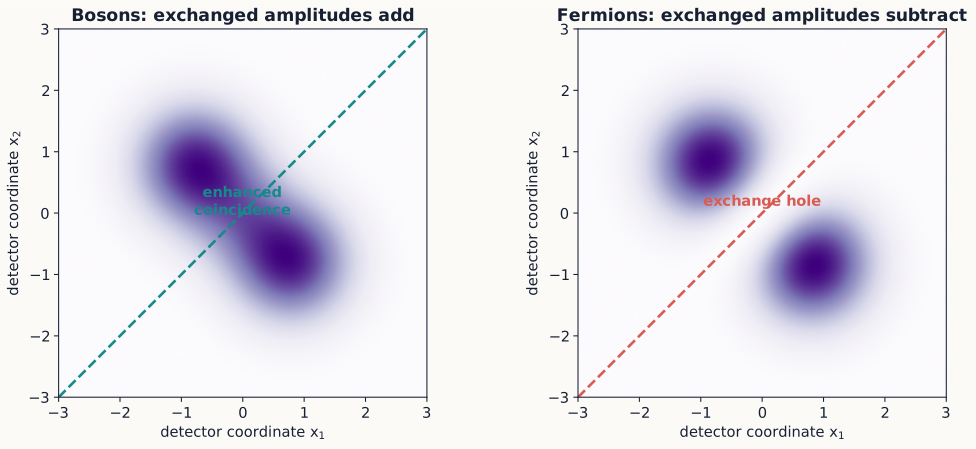
Figure 1:Direct and exchanged alternatives are physically indistinguishable, so their amplitudes interfere. The plus sign enhances coincidence for bosons; the minus sign forces the fermionic density to zero when the complete one-particle states coincide.
Concept check 11.3
Does an exchange hole prove that two fermions repel through a new force?
Answer
No. It can occur even for a Hamiltonian with no interaction between the particles. It is a correlation required by antisymmetry.
11.3 Spin and spatial symmetry
The complete state—including space and spin—must have the required exchange symmetry. For two electrons it must be antisymmetric. This requirement multiplies rather than adds the constraints on the two factors: it is the product of the spatial part and the spin part, together, that must change sign under exchange, so a symmetric spatial factor demands an antisymmetric spin factor, and an antisymmetric spatial factor demands a symmetric spin factor.
The singlet spin state is antisymmetric:
It must be multiplied by a symmetric spatial wavefunction. The three triplet spin states are symmetric and must be paired with antisymmetric spatial wavefunctions.
Example 11.2: two electrons in a well
In the lowest-energy configuration, both electrons can occupy the same spatial orbital only if their spin state is the singlet. The spatial product is symmetric, and symmetric space times antisymmetric spin is antisymmetric overall.
If the spin state is a triplet, the spatial part must be antisymmetric, so one electron must occupy a higher orbital:
Exclusion therefore affects energy even when the Hamiltonian contains no spin-dependent term.
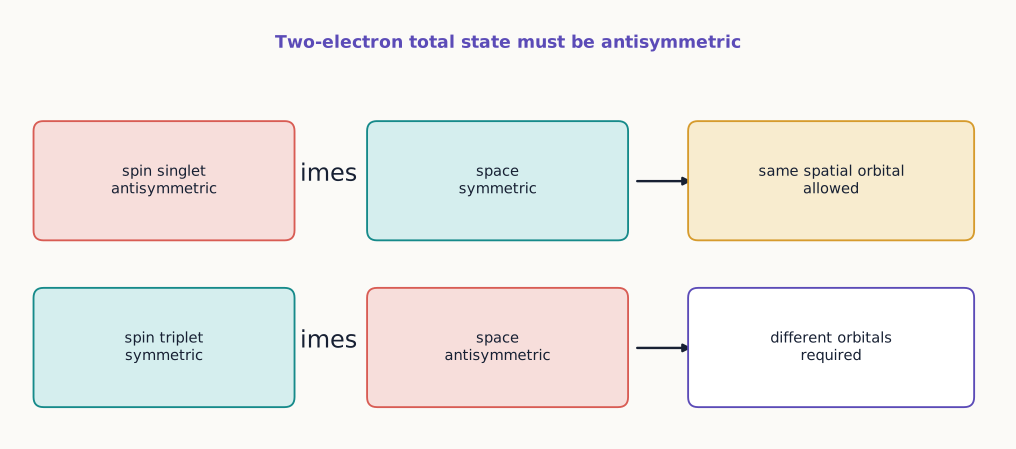
Figure 2:Only the symmetry of the complete two-electron state is fixed. Spin and space therefore compensate: the singlet permits shared spatial occupation, whereas the triplet forces an antisymmetric spatial factor with an exchange hole.
Concept check 11.4
Can two electrons occupy the same spatial orbital?
Answer
Yes, if their combined spin state is antisymmetric—the singlet. They do not occupy the same complete spin-orbital.
Direct and exchange energies
Example 11.2 already shows that the singlet and triplet configurations differ in spatial symmetry before any interaction between the electrons is even switched on. Once the electrons repel one another through a Coulomb interaction , this symmetry difference feeds directly into the energy. Evaluating in the symmetric or antisymmetric spatial pair state of equation (7) splits the result into a piece that would be present even for distinguishable particles and a piece that survives only because of exchange:
Here is the direct (Coulomb) integral—the ordinary electrostatic repulsion between two classical-looking charge distributions and —and is the exchange integral, built from the same cross term already encountered in Example 11.1, now weighted by the interaction rather than left as a bare interference term in a detection probability. The sign belongs to the symmetric spatial state, paired with the antisymmetric spin singlet; the sign belongs to the antisymmetric spatial state, paired with a symmetric spin triplet.
For a repulsive Coulomb interaction, is typically positive. The triplet configuration then lies lower in energy than the singlet configuration built from the same pair of orbitals, even though the Hamiltonian contains no spin-dependent term at all: the triplet’s antisymmetric spatial wavefunction already keeps the two electrons farther apart on average—the exchange hole of Example 11.1—which lowers their mutual repulsion. This is the microscopic origin of Hund’s first rule: for a given electron configuration, the term with the largest total spin usually has the lowest energy, because parallel spins force the spatial wavefunction to keep electrons apart and reduce their Coulomb repulsion. No new force is required, and none was invented—only the antisymmetry postulate together with an ordinary repulsive interaction.
Concept check 11.5
Using , explain why the triplet configuration of two electrons in different orbitals is usually lower in energy than the singlet configuration built from the same orbitals.
Answer
The triplet’s symmetric spin state forces an antisymmetric spatial wavefunction, which already vanishes when the two electrons coincide—the exchange hole. This keeps the electrons farther apart on average and lowers their mutual Coulomb repulsion, giving the triplet energy , with typically, below the singlet’s . No spin-dependent force is needed, only antisymmetry combined with ordinary repulsion.
11.4 Slater determinants
For identical fermions in orthonormal one-particle spin-orbitals , an antisymmetric state is
Exchanging two particle labels swaps two rows and changes the sign. If two spin-orbitals are identical, two columns coincide and the determinant is zero. Both antisymmetry and exclusion are built into this one object.
A single Slater determinant is often a useful starting approximation for many-electron atoms and molecules. General correlated fermion states require superpositions of determinants.
11.5 Occupation-number notation
When particle labels carry no physical meaning, it is often clearer to state how many particles occupy each one-particle mode:
For fermions, or 1. For bosons, . Creation and annihilation operators change occupations. For a bosonic mode,
with . Fermionic operators instead anticommute:
The relation is exclusion in operator form.
For each mode, the number operator
counts how many particles occupy mode , since in either case. Summing over all modes gives the total-number operator . Section 11.1 argued that “particle 1” and “particle 2” are not physically meaningful labels; occupation-number notation makes that argument precise by never introducing such labels at all. It is , not any single-particle identity, that is the well-defined observable.
11.6 Consequences for matter
Electrons fill atomic orbitals subject to exclusion. Including spin, an orbital specified by holds at most two electrons, with opposite spin labels. Shell structure and the periodic table emerge from this filling together with Coulomb interactions and energy splittings. Within a given subshell, the exchange energy of Section 11.3 further determines how electrons distribute among degenerate orbitals: Hund’s rule predicts that electrons first occupy separate orbitals with parallel spins, maximizing the (typically positive) exchange energy , before any orbital is doubly occupied.
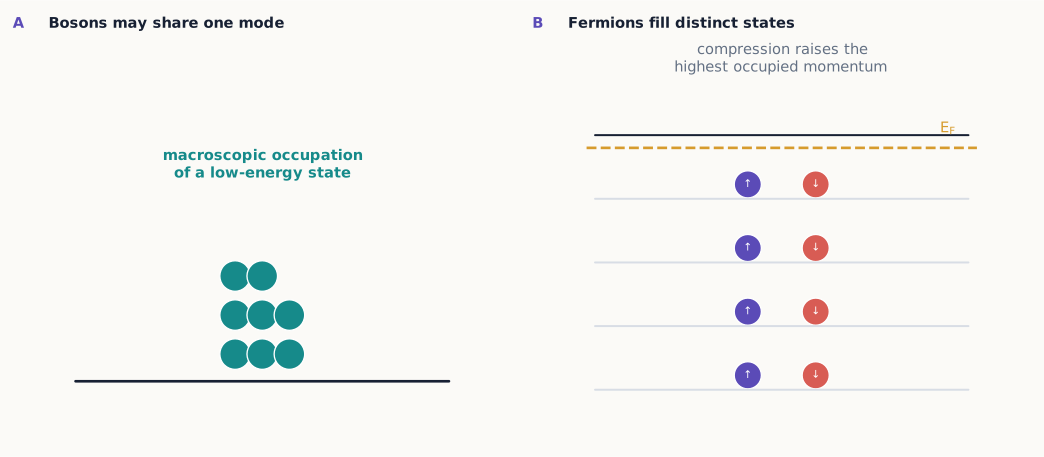
Figure 3:Bosonic occupations can become arbitrarily large in one mode. Exclusion makes fermions occupy a ladder of distinct states, creating a nonzero Fermi energy—and therefore pressure—even at zero temperature.
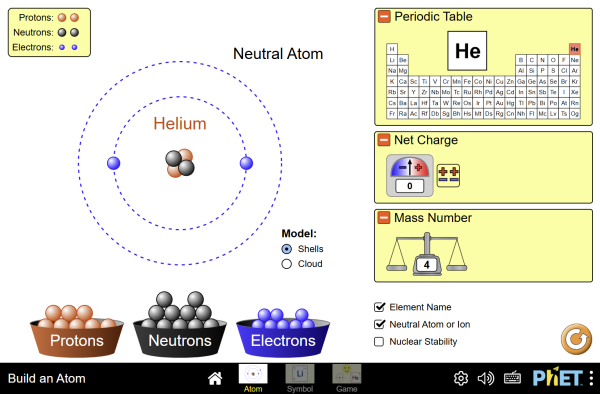
Figure 4:Add electrons one at a time and watch them fill shells subject to exclusion, building up the periodic table’s structure orbital by orbital. Try filling a subshell with parallel spins before doubling any orbital, and check the result against Hund’s rule above.
Interactive simulation: Build an Atom
In a macroscopic fermion system, low-energy states fill up to a Fermi energy. Compression forces particles into higher momentum states even at zero temperature, producing degeneracy pressure. For bosons, many particles can accumulate in one mode, enabling coherent phenomena such as Bose–Einstein condensation.
These are statistical effects rooted in state-space symmetry. They are not optional corrections applied only when particles collide; they constrain the allowed state from the start.
Example 11.3: degeneracy pressure holds up dying stars
Consider spin- fermions of mass confined to volume at essentially zero temperature. Exclusion forces them to fill distinct momentum states, two spin orientations per momentum value, up to a Fermi momentum fixed by counting the occupied states:
The corresponding Fermi energy is
Crucially, depends only on the density , not on the temperature: exclusion alone forces most particles into states of substantial kinetic energy, and compressing the gas into a smaller volume raises that energy further. The resulting outward degeneracy pressure exists even at , unlike the pressure of an ordinary classical gas.
For the electron gas inside a white dwarf, a representative density is , giving and from equation (19)—already a sizable fraction of the electron rest energy . Electron degeneracy pressure, not thermal pressure, is what balances gravity in a white dwarf. Because the electrons are only mildly nonrelativistic at best, a fully relativistic treatment becomes necessary near the Chandrasekhar mass limit ( solar masses), beyond which electron degeneracy pressure can no longer support the star; further collapse can produce a neutron star, supported in turn by neutron degeneracy pressure at far higher density. None of this requires any interaction beyond exclusion applied to a very dense, very cold Fermi gas.
Concept check 11.6
Does the degeneracy pressure of Example 11.3 require a nonzero temperature?
Answer
No. Equation (19) depends only on the particle density, not on temperature. Exclusion alone forces fermions into high-momentum states even at ; an ordinary classical gas, by contrast, would exert zero pressure at zero temperature.
Distinguishable in practice
Two particles of the same species may behave approximately distinguishably when their wave packets remain well separated and no experiment recombines them. Then exchange terms are negligibly small. As wavefunctions overlap, particle-by-particle labels cease to support correct predictions and the symmetrized description becomes essential.
Summary
Identical-particle labels are not observable, so exchange constrains the joint state.
Boson states are symmetric and fermion states antisymmetric.
Antisymmetry implies Pauli exclusion and exchange correlations.
The permutation operator’s eigenvalues are restricted to ; since for identical particles, a given species occupies one eigenvalue exclusively, fixing it as a boson or a fermion.
For electrons, spatial and spin symmetries combine to give an antisymmetric complete state.
Direct and exchange energies split singlet and triplet configurations oppositely, and the sign of the exchange integral underlies Hund’s rule.
Slater determinants enforce fermionic antisymmetry for many particles.
Occupation numbers replace unphysical particle labels and lead naturally to creation, annihilation, and number operators.
Exclusion alone produces a temperature-independent degeneracy pressure that stabilizes white dwarfs and neutron stars against gravitational collapse.
Exercises
Normalize the symmetric and antisymmetric states when and are orthogonal.
Apply the exchange operator twice and explain why its eigenvalues must be .
Show that the antisymmetric two-particle spatial wavefunction vanishes when .
Construct all allowed two-electron states when only one spatial orbital is available.
For two spatial orbitals , list the singlet and triplet possibilities and their required spatial symmetries.
Verify that a two-particle Slater determinant changes sign under exchange.
Explain why a determinant vanishes if two occupied spin-orbitals coincide.
Write occupation-number states corresponding to two bosons in three modes and to two fermions in three modes.
Derive from the fermionic anticommutation rule.
Two noninteracting fermions occupy a one-dimensional infinite well. Compare the lowest total energies for a spin singlet and a spin triplet.
Explain when two identical particles can be treated approximately as distinguishable and how that approximation could fail.
Distinguish exchange correlation, Coulomb repulsion, and entanglement in a two-electron state.
Show directly from that , and use this to show that its eigenvalues must be .
For , where is the same one-particle Hamiltonian for both particles, show explicitly that .
Using the cross term identified in Example 11.1, explain why it enters the two-particle detection density with a plus sign for the symmetric (bosonic) spatial state and a minus sign for the antisymmetric (fermionic) spatial state, and connect this sign difference to the exchange integral in equation (12).
Rank the singlet and triplet configurations of two electrons in orbitals from lowest to highest energy, assuming , and state which configuration Hund’s rule predicts for the corresponding real atomic ground state.
Show that follows from the fermionic or bosonic operator algebra, and explain why is a meaningful observable even though no individual particle carries a meaningful label.
Estimate the electron Fermi energy of a white dwarf with electron number density using equation (19), and compare your result with the electron rest energy .
Explain why increasing the density of a fermion gas increases its degeneracy pressure even at , while increasing the pressure of an ordinary classical gas at fixed density requires raising its temperature.
For three identical fermions distributed among four available spin-orbitals, how many distinct Slater determinant states can be formed?
Using the exchange-hole picture of Example 11.1, explain why two identical fermions with the same spin state are never found at exactly the same location, while two identical fermions with opposite spin states can be.
A student claims that antisymmetrization matters only for computing energies, and that the positions of noninteracting identical fermions are otherwise statistically independent. Use Example 11.1 to show that this claim is false even with no interaction present.
In helium, the ground configuration admits only a spin singlet, but the excited configuration admits both a singlet and a triplet term, with the triplet lying lower in energy (orthohelium below parahelium). Explain both halves of this statement using the results of Section 11.3.
In the Slater determinant of equation (13), exclusion is enforced by two columns coinciding, not two rows. Explain what each row and each column of the determinant represents, and why it is specifically the column structure, and not the row structure, that encodes the Pauli principle.