States and probability amplitudes
Learning objectives
After this chapter, you should be able to:
represent a spin- state using kets and column matrices;
expand a state in any orthonormal basis;
normalize a state and apply the Born rule;
calculate selected routes through sequential analyzers;
distinguish relative phase from overall phase;
translate among the , , and spin bases;
distinguish a coherent pure state from a classical mixture;
in the optional extension, construct spinors for an arbitrary analyzer direction; and
add amplitudes for coherent alternatives and probabilities for exclusive recorded routes.
The subsections labeled “optional extension” provide compact matrix machinery for readers ready to go further; the core conceptual path does not depend on them.
2.1 States are vectors
Chapter 1 ended with a wish list: whatever mathematical object represents a spin state, it needs two mutually exclusive outcomes for every analyzer direction, a way to represent a preparation that is certain for one of them, continuous families of other preparations, and phase information that can produce interference. An ordinary table of probabilities cannot do all of this at once, because it has no room for phase. Complex vectors can, and this chapter makes that idea precise.
The notation , read “ket,” simply names a vector in that complex vector space. There is no more mystery in the symbol than in writing for an arrow in ordinary space—it is just a label, chosen to remind us that we are working with a state rather than an ordinary number.
The preparation called is represented by the ket , and the preparation by . These two state vectors form an orthonormal basis for the spin state space: every other spin- preparation can be built from them by superposition, in exact analogy to how two perpendicular unit vectors span a plane. Any pure spin state can therefore be written
where and are complex numbers. Think of and as coordinates: they fix how much of and how much of go into building , in the same way that the numbers 3 and 4 fix an arrow once we agree on - and -axes. They are not themselves probabilities—Section 2.3 will show exactly how probabilities are built from them.
It is often convenient to write as a column of numbers. Choosing the representation
gives . The symbol means “is represented, in the chosen basis, by.” A ket is an abstract vector; a column matrix is only its representation once a basis has been chosen.
This distinction is the same one made for an ordinary geometric vector. The arrow in space is not identical to the list of three numbers used to represent it: rotating the coordinate axes changes the numbers but not the arrow itself. In exactly the same way, a spin ket does not change when we rewrite it in the basis instead of the basis—only its column of numbers changes.
Superposition is a physical principle
Because states are vectors, any nonzero linear combination of two allowed states can be normalized to represent an allowed state. This is the superposition principle, and it says something stronger than “the atom is secretly in one state or the other.” In
the complex coefficients preserve phase information that can affect a later measurement. Compare this with a classical mixture, in which a fraction of atoms is separately prepared in and the rest in . That mixture and the superposition above generally make different predictions, even though both give the same probabilities for a measurement. The section on pure states and mixtures makes this comparison explicit.
2.2 Bras and inner products
A ket by itself cannot yet produce a number we could compare to laboratory data—it is a direction in an abstract space, not a prediction. To extract predictions, we pair every ket with a companion object called a bra, written . A bra combines with a ket to its right to produce a single complex number, called the inner product. This pairing is what lets us ask “how much of outcome is contained in state ?” and get back a definite amplitude. The bra corresponding to is its Hermitian conjugate,
The basis is orthonormal, meaning each basis ket has unit length and the two are perpendicular in the sense of the inner product:
Using these two facts, pairing with gives
A physical pure state is normalized, meaning . If a nonzero vector is not already normalized, we can always rescale it into a valid physical state by dividing by its length:
Example 2.1: normalization
Normalize . Applying equation (9) term by term, the first coefficient contributes and the second contributes , so the squared norm is , hence
Algebra check
If , what are and ?
Answer
Conjugating the coefficients gives . Orthonormality then gives .
Inner-product habits
Three small algebraic rules prevent most early errors. First, swapping the order of an inner product conjugates it:
Second, a bra acts linearly on a ket to its right:
Third, the inner product is conjugate-linear in its first slot. If a ket is combined first and then converted into a bra, its coefficients are conjugated:
For example, if , then . Once a bra has already been written as a row, ordinary row–column multiplication is linear in the entries of that row. Keeping these two statements separate prevents the common error of forgetting conjugation when forming the bra.
Complex numbers as amplitude geometry
Complex numbers enter quantum mechanics because an amplitude needs to carry both a magnitude and a phase at once, and a single real number cannot do that. In polar form,
Multiplying two amplitudes multiplies their magnitudes and adds their phases. Adding two amplitudes is ordinary geometric addition in the complex plane—and this is the key fact that makes interference possible. Because vectors in a plane can point in opposite directions, two nonzero amplitudes can add to zero. For example,
even though the squared magnitude of each term separately is . This possibility—two nonzero contributions canceling exactly—is the algebraic core of destructive interference.
For arbitrary amplitudes and , expanding directly gives
The final term is the interference term. It depends on the relative phase between and , and it can be positive, negative, or zero. If the two alternatives are instead recorded separately, or their relative phase is randomized by the apparatus, this cross term averages to zero and only remains—the ordinary rule for adding probabilities of mutually exclusive events.
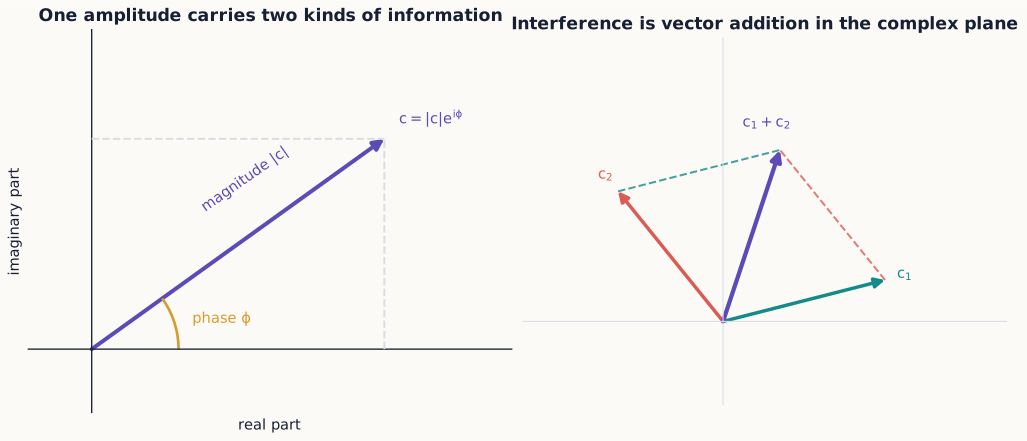
Figure 1:A complex amplitude is a two-dimensional arrow: its length is the magnitude and its direction is the phase. Coherent alternatives interfere because these arrows add before the squared magnitude is taken.
2.3 The Born rule
We now have the machinery to turn a state into an actual prediction. The amplitude for obtaining from is —simply the coefficient of in the expansion of . The probability of that outcome is the squared magnitude of that amplitude:
This rule for turning an amplitude into a probability is the Born rule, and it is one of the central postulates of quantum mechanics. Notice that the order matters in the amplitude: the bra labels the possible measurement outcome, and the ket labels the prepared state.
Because the basis spans the state space, the two overlaps recover the whole ket:
Comparing this with equation (4) shows that and are precisely the amplitudes and . Chapter 3 will package this basis expansion into an identity operator after operators have been introduced.
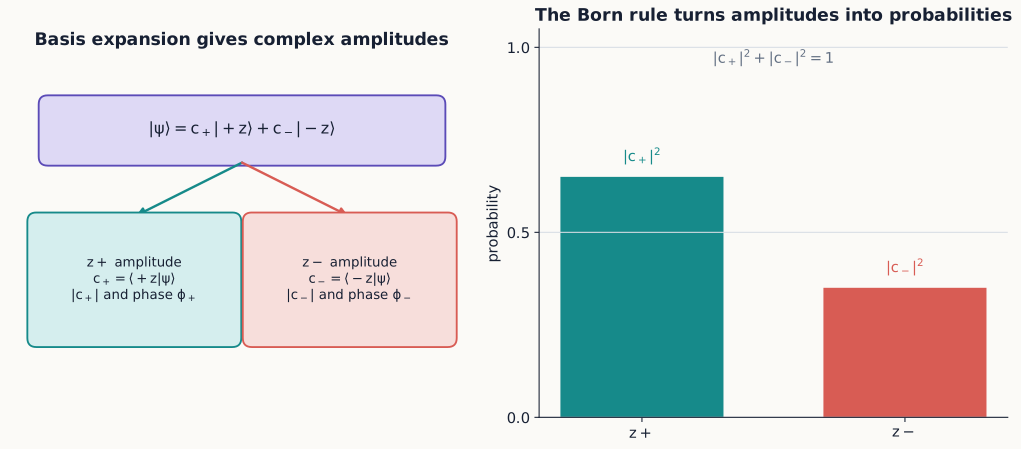
Figure 2:Expansion in a measurement basis produces complex amplitudes; the Born rule turns their squared magnitudes into normalized outcome probabilities. Each amplitude can carry a phase even though the probability bars cannot show it.
A probability calculation in four steps
For any ideal spin measurement, the same workflow applies:
Write the prepared ket and the outcome ket in a common basis.
Hermitian-conjugate the outcome ket to make the bra.
Form the amplitude .
Take its squared magnitude, and check that all exclusive outcome probabilities sum to one.
The amplitude computed in step 3 is generally complex, and there is no requirement that it lie between zero and one—only its squared magnitude in step 4 is a probability. Keeping the amplitude, rather than squaring it immediately, is essential whenever the alternative will later be recombined with another one.
Concept check 2.1
After computing , a student reports a probability of . What should the student report instead?
Answer
The amplitude may be complex, but the probability is its squared magnitude: .
2.4 Changing the question means changing the basis
Every measurement so far has used the basis, but nothing forces that choice—an analyzer built along or asks a different physical question, and it needs its own basis kets. The 50–50 result alone fixes the magnitudes of the two -basis coefficients but not their relative phases. The formulas below therefore contain two ingredients: equal magnitudes demanded by the experiment, and a standard phase convention that ties the labels and to perpendicular directions in physical space. Chapter 3 will recover the same kets as eigenvectors of the spin-component matrices. With that convention, the basis is
And the basis is
Example 2.2: a relative phase becomes a definite result
Prepare
and ask for the probability of . From equation (21),
Therefore
so and . The state is exactly , written in the basis. This deliberately simple example exposes the important algebra: the in the ket becomes in the bra, and . A missed complex conjugation would destroy the certainty that defines the state.
Let’s check that this reproduces the known result. Applying the Born rule to a input,
exactly as observed in Chapter 1. To express any state in the basis instead of the basis, project it onto the two -basis kets:
It is important to see what has and has not changed here. No physical state has changed—the atom’s preparation is exactly what it was. Only the coordinates used to describe that state have changed, in the same way that rewriting an arrow’s components in a rotated coordinate frame does not move the arrow.
Optional extension: basis-change matrices
The inner-product method above is the core skill. Readers who want a compact matrix version can organize all the overlaps into one basis-change matrix.
The same calculation can be organized as a single matrix multiplication, which is often more convenient for bookkeeping. If is the column representing in the basis, its -basis column is
Each row of this matrix is one of the -basis bras, written out in coordinates. A matrix is called unitary when ; this condition guarantees that lengths and inner products are preserved. The change-of-basis matrix is unitary, so a properly normalized state stays normalized after the change of basis. Chapter 3 will develop operators and unitary matrices systematically. Reading the entries here as inner products also makes clear that a basis change is not a physical Stern–Gerlach measurement—no outcome has been selected, and the abstract ket itself has not been disturbed in any way.
Quick calculation: carrying out the matrix multiplication
It is worth performing this multiplication by hand once, so that equation (27) reads as an ordinary matrix–vector product—row dotted into column, exactly as in the vector review of Section 2.1—rather than as an unfamiliar piece of bra–ket bookkeeping. Take , so . Multiplying,
The top entry comes from dotting the row into the column , giving ; the bottom entry comes from dotting into , giving ; each is then scaled by the collected from the two prefactors. As a check, normalization must survive the change of basis:
confirming directly, by arithmetic rather than by appeal to unitarity alone, that the -basis column is a properly normalized state.
Example 2.3: probabilities in another basis
For
the amplitude is
Therefore and . The same state has unequal probabilities, and . Probabilities belong to a state–measurement pair, not to the state alone.
2.5 Sequential measurements with amplitudes
We can now redo the analyzer chains of Chapter 1 using the vector formalism, and see that it reproduces the same answers by a more systematic route. If is prepared, is selected, and is finally detected, the probability for that selected route is
The two factors multiply because the first measurement prepares , and it is that state, not the original , which enters the second stage. It would be incorrect to replace this product with : the intervening selected measurement genuinely changes the state, and the calculation must reflect that.
Example 2.4: a three-stage analyzer problem
A beam enters . The output is retained and sent into . What fraction of the original beam emerges as ?
The route probability is
Using the basis kets,
Both squared magnitudes are , so one quarter of the original beam reaches the detector. Notice that the second amplitude is complex even though its probability is simple.
2.6 Relative and overall phase
Not every phase in a ket matters physically, and it is important to know which ones do. Multiplying an entire ket by an overall phase does not change any probability at all:
Since , the kets and represent exactly the same physical state, for any choice of .
A relative phase—one that appears on only one term of a superposition, not on the whole ket—is entirely different, and it does change interference. Compare
Concept check 2.2
Do and differ only by an overall phase?
Answer
No. If , matching the coefficient requires , while matching the coefficient requires . They are orthogonal states, not two representations of the same state.
Both and give 50–50 probabilities in the basis—the two states look identical if all we ever do is measure . Yet a relative sign is all that separates them, and an measurement distinguishes them perfectly. This is the essential fact about relative phase: it can be completely invisible to one choice of measurement and yet fully visible to another.
More generally, consider the family of states
parameterized by a single relative phase . Its probability is
Concept check 2.3
A normalized ket has . Is the state determined uniquely?
Answer
No. It has the form . Different relative phases give different predictions in other bases.
Every member of this family has exactly the same statistics—a 50–50 split, regardless of . Rotating the final analyzer to is what converts the otherwise hidden relative phase into a visible count rate. Interference, seen this way, is not some extra phenomenon bolted onto the vector formalism; it is simply what ordinary basis projection does to complex coefficients once more than one term is present.
2.7 A complete coherent path calculation
We can now close the experimental loop opened in Chapter 1. Consider an ideal device that splits into coherent and paths and then implements the inverse routing operation, returning both paths to the same spatial and motional state. With no uncontrolled path-dependent phase, the amplitude for each final outcome is the sum of the two indistinguishable route amplitudes:
The two route amplitudes are each , so
For the other exit,
The mathematics describes the ideal apparatus specified above; merely writing a sum over intermediate states would not prove that an arbitrary physical beam splitter preserves coherence or recombines every other degree of freedom.
Concept check 2.4
Both route amplitudes in equation (41) have squared magnitude . Why is the final probability zero rather than ?
Answer
The routes are indistinguishable and must be added as complex amplitudes. Their relative minus sign makes the sum zero. Adding the two route probabilities would describe a different apparatus—one that records or decoheres the intermediate alternatives.
The cancellation is valid only because the intermediate result was never recorded. If it is recorded, the two complete routes become exclusive, and we add their probabilities:
The same route magnitudes produce certainty or a 50–50 split depending on whether the intermediate alternatives remain coherent.
Concept check 2.5
Does changing the phase convention of change the interference prediction?
Answer
No. A phase assigned to the intermediate basis ket appears once in a ket overlap and once with the opposite sign in the corresponding bra overlap. It cancels from each complete route amplitude. Observable interference depends on physical relative phases introduced by transformations, not on basis notation.
A controllable phase
Suppose one path adds a phase before recombination, perhaps because it travels a slightly longer distance. Repeating the calculation,
so that
At , the original preparation is recovered. At , the two exits exchange roles and occurs with certainty. In between, a continuously adjustable phase controls discrete detector outcomes through continuously changing ensemble frequencies.
The calculation supplies a reusable rule:
identify each complete, indistinguishable route to one final record;
multiply amplitudes along each route;
include every transformation phase;
add the route amplitudes; and
square the magnitude only after the coherent sum is complete.
If a record distinguishes routes, group together only routes that remain indistinguishable to that record, and add probabilities between the resulting exclusive groups.
2.8 The Bloch-sphere coordinates
After normalizing a state and discarding its irrelevant overall phase, every pure spin- state can be written in the standard form
with and . Because only two real parameters remain once normalization and overall phase are fixed, the angles locate a point on an ordinary sphere—the Bloch sphere—and every possible pure spin state corresponds to exactly one point on it. The half-angle is essential here, not optional. The angles label a direction on the Bloch sphere; they should not be confused with a history of physical rotation undergone by the atom. Chapter 4 will show that when a representative spinor is physically rotated through , its ket acquires a minus sign. The corresponding physical ray is unchanged because the sign is an overall phase, though it can be observed relative to another coherent amplitude.
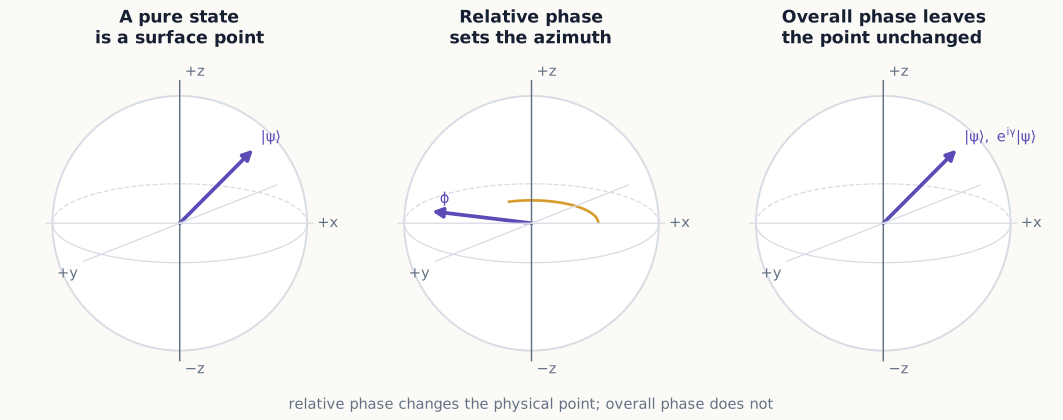
Figure 3:The Bloch sphere represents physical pure states rather than individual ket representatives. Polar angle fixes the relative magnitudes, azimuth fixes the relative phase, and overall phase has no coordinate because it leaves the physical state unchanged.
For a measurement along a unit vector making angle with , equation (45) gives
This spin- rule resembles Malus’s law for polarized light, but with one important difference: it uses half the geometric angle on the Bloch sphere, not the angle itself.
For two arbitrary pure states, let their Bloch angles be and . Substituting equation (45) for both kets gives the amplitude
Taking its squared magnitude and using the half-angle identities produces
The expression in square brackets after the 1 is exactly , where is the ordinary angle between the two analyzer directions. Therefore
This completes the derivation, promised in Chapter 1, of the empirical angle rule from state vectors. Notice a geometric subtlety worth pausing on: orthogonal directions in ordinary space () do not correspond to orthogonal kets. They give an overlap probability of , not zero. The state that is orthogonal to is , represented by the antipodal, oppositely pointing point on the Bloch sphere.
Example 2.5: recover Bloch angles from a ket
Consider
Comparison with equation (45) gives , so . The relative phase is , so one convenient choice is . The state therefore lies from and points toward negative .
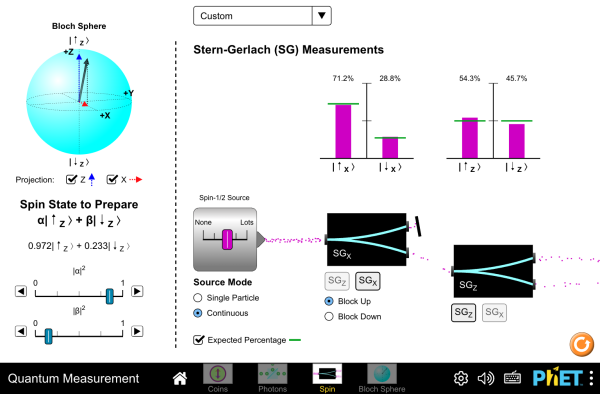
Figure 4:Prepare a spin- state and read its coordinates directly off the sphere, or drag the state vector and watch the ket in equation (45) update to match. Reproduce Example 2.5 by dragging to and checking the phase the sphere reports.
Interactive simulation: Quantum Measurement: Bloch Sphere
2.9 Pure states and mixtures
Section 2.1 promised that a coherent superposition and a classical mixture are not the same thing, even when they agree on some measurements. We can now make that comparison precise. A pure state assigns one ket to every member of an ideally prepared ensemble. Compare the coherent state with a different preparation: flip a fair classical coin, and produce on heads and on tails. Both preparations give identical statistics,
An measurement, however, tells the two apart immediately. The coherent state gives with certainty, by construction. For the coin-toss ensemble, half of the atoms began in and half in ; each of those subensembles independently gives 50–50 results, so the combined statistics also remain 50–50.
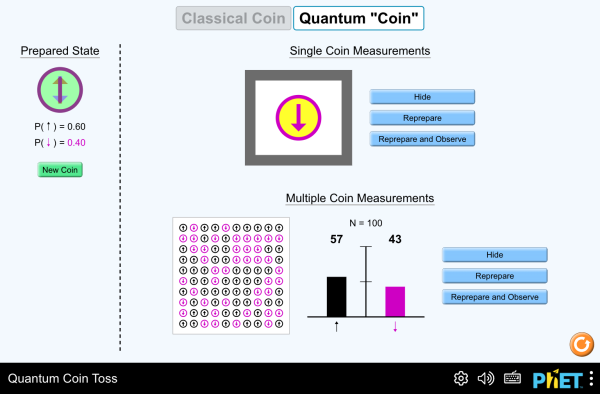
Figure 5:Compare a classical biased coin with a quantum “coin” prepared in superposition. Both can be tuned to land heads half the time, yet only the quantum coin has a measurement basis—an analog of the analyzer above—in which the 50–50 outcome disappears entirely.
Interactive simulation: Quantum Coin Toss
No single ket can represent that classical mixture—there is simply no linear combination of and that reproduces its statistics in every basis. The core operational lesson is therefore: identical probabilities for one measurement do not prove that two preparations are the same quantum state.
2.10 Optional extension: spinors for an arbitrary direction
The core chapter is complete. This optional extension packages an arbitrary analyzer orientation into a pair of spinors and a basis-change matrix.
The Bloch-sphere coordinates do more than just label a state—they also give us the eigenstates of an analyzer built along any direction we like. For an analyzer oriented along
a convenient phase convention gives its two outcome states as
A direct calculation shows that each ket has unit norm and that , so together they form a valid orthonormal basis, exactly as , , and did. The overall phase of either ket is conventional: multiplying or by its own overall phase changes its coordinates but no outcome probability. The relative phase written inside each ket, by contrast, is not a matter of convention once the -basis convention has already been fixed.
Checking special cases first
Before applying equation (55) to an unfamiliar direction, it is a good habit to check that it reproduces the three directions already known, since a mistake in a general formula often shows up as soon as you specialize it. Setting (pointing along ) gives , exactly as it should, since the formula’s -dependent term is multiplied by . Setting (pointing along ) gives , matching equation (20). Setting (pointing along ) gives , matching equation (21). With these three checks passed, the formula can be trusted for a direction that is not simply one of the six coordinate poles.
Example 2.6: an analyzer not in a coordinate plane
Let and . Then
A input gives
The same result follows from the real-space angle rule: . Notice that the azimuth does not affect a input, because rotating the analyzer around leaves its angle from the preparation axis unchanged. It does affect inputs that carry their own transverse phase information.
The column matrix whose two columns are the two spinors above,
is unitary, and it converts coordinates between the analyzer basis and the basis. Its columns describe how the new basis vectors look in old coordinates, while performs the reverse change, from old coordinates to new. Keeping those two directions of conversion straight prevents a common basis-change error.
Summary
A ket is an abstract state vector; its column depends on the chosen basis.
Inner products produce amplitudes, and squared magnitudes produce probabilities.
An orthonormal basis supplies expansion amplitudes through inner products.
Overall phase is unobservable, while relative phase controls interference.
Every pure spin- state corresponds to a point on the Bloch sphere.
A selected intermediate result resets the state used in subsequent amplitudes, while unobserved coherent alternatives must be added at the amplitude level.
A coherent superposition and a classical mixture can agree in one basis and disagree in another.
In the optional extension, arbitrary analyzer directions correspond to orthonormal spinors whose half-angle coordinates form a unitary basis-change matrix.
Coherent routes are multiplied along each route and added across indistinguishable alternatives before the Born rule is applied.
Exercises
Exercises 1–7 establish the core notation and probability skills, 8–14 consolidate basis changes, phases, and mixtures, and 15–21 are extensions on arbitrary directions and coherent paths. Complete the first group before moving to the more algebraic problems.
Normalize and find the probabilities of and .
Verify directly that the two states in equation (20) are normalized and orthogonal.
Write and in the basis.
Calculate all four quantities . Interpret the result as a sequence of analyzers.
For the state in Example 2.3, calculate and . Explain why the relative phase matters here although it did not affect the probabilities.
Show that equation (45) is normalized. Identify the Bloch-sphere angles for the six states , , and .
Give two normalized kets that have identical probabilities but are orthogonal to one another.
Prove that replacing both basis kets by phase-shifted basis kets changes the column coordinates but not any measurement probability.
Use equation (27) to express in the basis. Check the norm before and after the transformation.
A beam enters ; the output is retained and sent to . Calculate the probability for every complete detected route from the original beam.
Derive equation (38) and find without doing a second inner-product calculation.
Find the Bloch angles for the normalized ket . What spin direction does it represent?
Without using density operators, show that a coherent preparation gives with certainty while a 50–50 classical mixture of and gives . State where probabilities, rather than amplitudes, must be added in the mixture calculation.
Construct two physically different ensembles that give identical statistics. Specify one additional analyzer orientation that distinguishes them, and calculate the predicted probabilities.
Verify the normalization and orthogonality of the two spinors in equation (55).
Write for and . Identify it as one of the six coordinate-axis states, up to overall phase.
Verify by direct matrix multiplication that for equation (59).
Starting from equation (17), let and for real nonnegative and . Find the largest and smallest possible total probabilities as varies.
Reproduce equations (40) and (41) with the basis inserted instead of the basis. Track every factor of .
A phase shifter adds to the route of the recombiner. Predict both final probabilities for , , and .
A path marker leaves the route unchanged but correlates the route with a distinguishable marker state. Explain, without yet using composite state notation, why equations (44) no longer describe full-visibility fringes.
Selected exercise guidance
Use these answers only after making a complete attempt.
Exercise 1
The norm is 5, so the normalized ket is . The probabilities are and .
Exercise 5
The imaginary relative coefficient aligns constructively with and destructively with .
Exercise 12
and . The Bloch vector is : it lies from toward .
Exercise 20
For , . For the pair is , and for it is .