The properties of solutions are very similar to the properties of their respective pure solvents. This makes sense because the majority of the solution is the solvent. However, some of the properties of solutions differ from pure solvents in measurable and predictable ways. The differences are proportional to the fraction that the solute particles occupy in the solution. These properties are called colligative properties (A property of solutions related to the fraction that the solute particles occupy in the solution, not their identity.); the word colligative comes from the Greek word meaning “related to the number,” implying that these properties are related to the number of solute particles, not their identities.
Before we introduce the first colligative property, we need to introduce a new concentration unit. The mole fraction (The ratio of the number of moles of a component to the total number of moles in a system.) of the ith component in a solution, χi, is the number of moles of that component divided by the total number of moles in the sample:
(χ is the lowercase Greek letter chi.) The mole fraction is always a number between 0 and 1 (inclusive) and has no units; it is just a number.
Solution to Exercise 1 #
We need to determine the number of moles of each substance, add them together to get the total number of moles, and then divide to determine the mole fraction of C10H8. The number of moles of C10H8 is as follows:
The number of moles of C6H6 is as follows:
The total number of moles is
Now we can calculate the mole fraction of C10H8:
The mole fraction is a number between 0 and 1 and is unitless.
Solution to Exercise 2 #
0.275
A useful thing to note is that the sum of the mole fractions of all substances in a mixture equals 1. Thus the mole fraction of C6H6 in Example 15 could be calculated by evaluating the definition of mole fraction a second time, or—because there are only two substances in this particular mixture—we can subtract the mole fraction of the C10H8 from 1 to get the mole fraction of C6H6.
Now that this new concentration unit has been introduced, the first colligative property can be considered. As was mentioned in Chapter 10 "Solids and Liquids", all pure liquids have a characteristic vapor pressure in equilibrium with the liquid phase, the partial pressure of which is dependent on temperature. Solutions, however, have a lower vapor pressure than the pure solvent has, and the amount of lowering is dependent on the fraction of solute particles, as long as the solute itself does not have a significant vapor pressure (the term nonvolatile is used to describe such solutes). This colligative property is called vapor pressure depression (The decrease of a solution’s vapor pressure because of the presence of a solute.) (or lowering). The actual vapor pressure of the solution can be calculated as follows:
where Psoln is the vapor pressure of the solution, χsolv is the mole fraction of the solvent particles, and is the vapor pressure of the pure solvent at that temperature (which is data that must be provided). This equation is known as Raoult’s law (The mathematical formula for calculating the vapor pressure of a solution.) (the approximate pronunciation is rah-OOLT). Vapor pressure depression is rationalized by presuming that solute particles take positions at the surface in place of solvent particles, so not as many solvent particles can evaporate.
Solution to Exercise 3 #
This is the same solution that was in Example 15, but here we need the mole fraction of C6H6. The number of moles of C10H8 is as follows:
The number of moles of C6H6 is as follows:
So the total number of moles is
Now we can calculate the mole fraction of C6H6:
(The mole fraction of C10H8 calculated in Example 15 plus the mole fraction of C6H6 equals 1, which is mathematically required by the definition of mole fraction.) Now we can use Raoult’s law to determine the vapor pressure in equilibrium with the solution:
The solution has a lower vapor pressure than the pure solvent.
Solution to Exercise 4 #
24.1 torr
Two colligative properties are related to solution concentration as expressed in molality. As a review, recall the definition of molality:
Because the vapor pressure of a solution with a nonvolatile solute is depressed compared to that of the pure solvent, it requires a higher temperature for the solution’s vapor pressure to reach 1.00 atm (760 torr). Recall that this is the definition of the normal boiling point: the temperature at which the vapor pressure of the liquid equals 1.00 atm. As such, the normal boiling point of the solution is higher than that of the pure solvent. This property is called boiling point elevation (The increase of a solution’s boiling point because of the presence of solute.).
The change in boiling point (ΔTb) is easily calculated:
where m is the molality of the solution and Kb is called the boiling point elevation constant (The constant that relates the molality concentration of a solution and its boiling point change.), which is a characteristic of the solvent. Several boiling point elevation constants (as well as boiling point temperatures) are listed in Table 11.3 "Boiling Point Data for Various Liquids".
Table 1:Boiling Point Data for Various Liquids
| Liquid | Boiling Point (°C) | Kb (°C/m) |
|---|---|---|
| HC2H3O2 | 117.90 | 3.07 |
| C6H6 | 80.10 | 2.53 |
| CCl4 | 76.8 | 4.95 |
| H2O | 100.00 | 0.512 |
Remember that what is initially calculated is the change in boiling point temperature, not the new boiling point temperature. Once the change in boiling point temperature is calculated, it must be added to the boiling point of the pure solvent—because boiling points are always elevated—to get the boiling point of the solution.
Solution to Exercise 5 #
Using the equation for the boiling point elevation,
Note how the molality units have canceled. However, we are not finished. We have calculated the change in the boiling point temperature, not the final boiling point temperature. If the boiling point goes up by 12.4°C, we need to add this to the normal boiling point of CCl4 to get the new boiling point of the solution:
The boiling point of the solution is predicted to be 89.2°C.
Solution to Exercise 6 #
103.6°C
The boiling point of a solution is higher than the boiling point of the pure solvent, but the opposite occurs with the freezing point. The freezing point of a solution is lower than the freezing point of the pure solvent. Think of this by assuming that solute particles interfere with solvent particles coming together to make a solid, so it takes a lower temperature to get the solvent particles to solidify. This is called freezing point depression (The decrease of a solution’s freezing point because of the presence of solute.).
The equation to calculate the change in the freezing point for a solution is similar to the equation for the boiling point elevation:
where m is the molality of the solution and Kf is called the freezing point depression constant (The constant that relates the molality concentration of a solution and its freezing point change.), which is also a characteristic of the solvent. Several freezing point depression constants (as well as freezing point temperatures) are listed in Table 11.4 "Freezing Point Data for Various Liquids".
Table 2:Freezing Point Data for Various Liquids
| Liquid | Freezing Point (°C) | Kf (°C/m) |
|---|---|---|
| HC2H3O2 | 16.60 | 3.90 |
| C6H6 | 5.51 | 4.90 |
| C6H12 | 6.4 | 20.2 |
| C10H8 | 80.2 | 6.8 |
| H2O | 0.00 | 1.86 |
Remember that this equation calculates the change in the freezing point, not the new freezing point. What is calculated needs to be subtracted from the normal freezing point of the solvent because freezing points always go down.
Solution to Exercise 7 #
We use the equation to calculate the change in the freezing point and then subtract this number from the normal freezing point of C6H6 to get the freezing point of the solution:
Now we subtract this number from the normal freezing point of C6H6, which is 5.51°C:
The freezing point of the solution is −3.16°C.
Solution to Exercise 8 #
59.5°C
Freezing point depression is one colligative property we use in everyday life. Many antifreezes used in automobile radiators use solutions that have a lower freezing point than normal so that automobile engines can operate at subfreezing temperatures. We also take advantage of freezing point depression when we sprinkle various compounds on ice to thaw it in the winter for safety (Figure 11.2 "Salt and Safety"). The compounds make solutions that have a lower freezing point, so rather than forming slippery ice, any ice is liquefied and runs off, leaving a safer pavement behind.
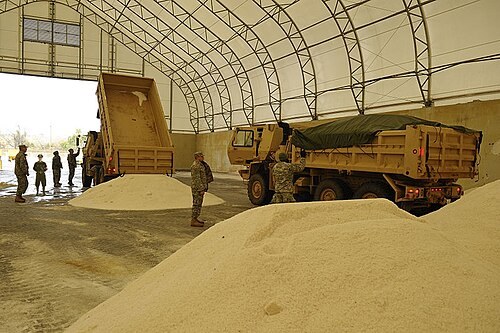
Figure 11.2:Salt and Safety. Trucks stand in a road-salt storage facility. Salt spread on icy roads dissolves in water and lowers the freezing point of the resulting solution.
Credits: RoadSaltTrucks — James LeWorm, CC BY-SA 4.0. Images resized for the web.
Before we introduce the final colligative property, we need to present a new concept. A semipermeable membrane (A thin membrane that will pass certain small molecules but not others.) is a thin membrane that will pass certain small molecules but not others. A thin sheet of cellophane, for example, acts as a semipermeable membrane.
Consider the system in Figure 11.3 "Osmosis"a. A semipermeable membrane separates two solutions having the different concentrations marked. Curiously, this situation is not stable; there is a tendency for water molecules to move from the dilute side (on the left) to the concentrated side (on the right) until the concentrations are equalized, as in Figure 11.3 "Osmosis"b. This tendency is called osmosis (The tendency of solvent molecules to pass through a semipermeable membrane due to concentration differences.). In osmosis, the solute remains in its original side of the system; only solvent molecules move through the semipermeable membrane. In the end, the two sides of the system will have different volumes. Because a column of liquid exerts a pressure, there is a pressure difference Π on the two sides of the system that is proportional to the height of the taller column. This pressure difference is called the osmotic pressure (The tendency of a solution to pass solvent through a semipermeable membrane due to concentration differences.), which is a colligative property.
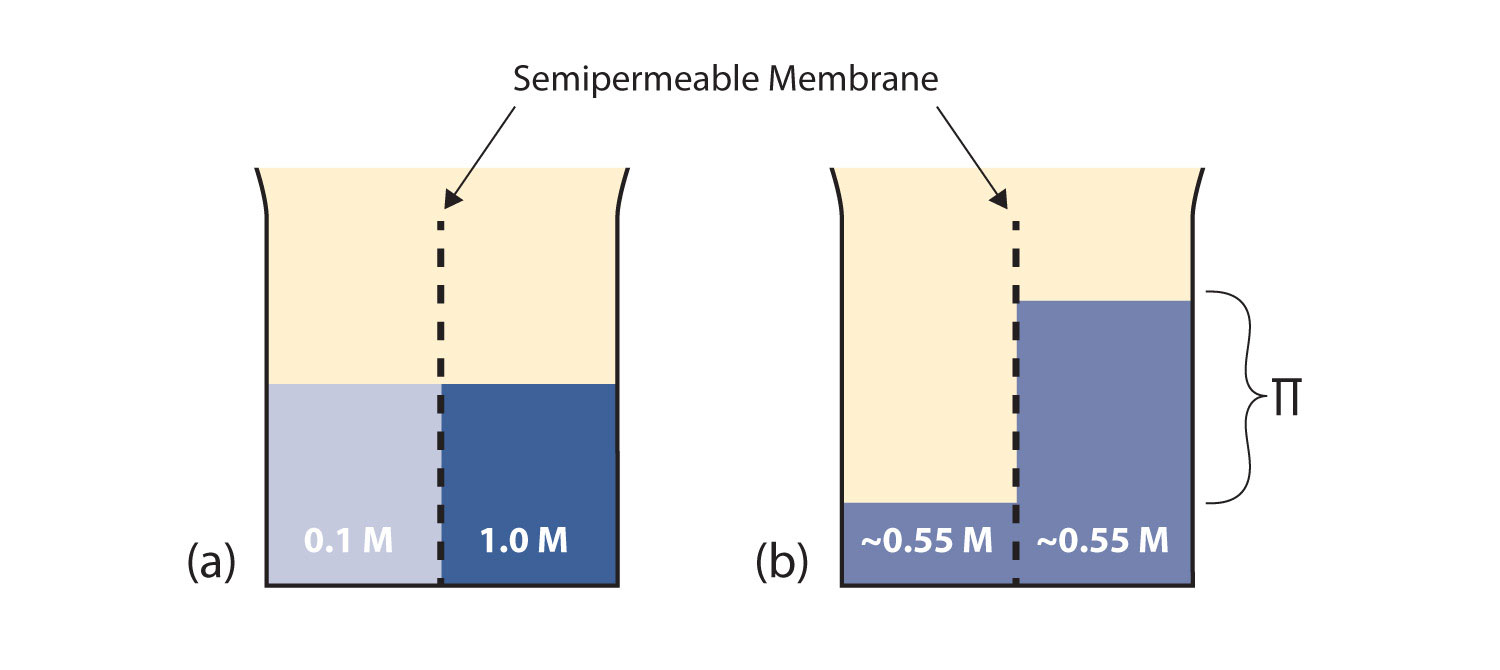
Figure 1:Osmosis. (a) Two solutions of differing concentrations are placed on either side of a semipermeable membrane. (b) When osmosis occurs, solvent molecules selectively pass through the membrane from the dilute solution to the concentrated solution, diluting it until the two concentrations are the same. The pressure exerted by the different height of the solution on the right is called the osmotic pressure.
The osmotic pressure of a solution is easy to calculate:
where Π is the osmotic pressure of a solution, M is the molarity of the solution, R is the ideal gas law constant, and T is the absolute temperature. This equation is reminiscent of the ideal gas law we considered in Chapter 6 "Gases".
Solution to Exercise 9 #
First we need to convert our temperature to kelvins:
Now we can substitute into the equation for osmotic pressure, recalling the value for R:
The units may not make sense until we realize that molarity is defined as moles per liter:
Now we see that the moles, liters, and kelvins cancel, leaving atmospheres, which is a unit of pressure. Solving,
This is a substantial pressure! It is the equivalent of a column of water 84 m tall.
Solution to Exercise 10 #
1.40 atm
Osmotic pressure is important in biological systems because cell walls are semipermeable membranes. In particular, when a person is receiving intravenous (IV) fluids, the osmotic pressure of the fluid needs to be approximately the same as blood serum; otherwise bad things can happen. Figure 11.4 "Osmotic Pressure and Red Blood Cells" shows three red blood cells: Figure 11.4 "Osmotic Pressure and Red Blood Cells"a shows a healthy red blood cell. Figure 11.4 "Osmotic Pressure and Red Blood Cells"b shows a red blood cell that has been exposed to a lower concentration than normal blood serum (a so-called hypotonic solution); the cell has plumped up as solvent moves into the cell to dilute the solutes inside. Figure 11.4 "Osmotic Pressure and Red Blood Cells"c shows a red blood cell exposed to a higher concentration than normal blood serum (hypertonic); water leaves the red blood cell, so it collapses onto itself. Only when the solutions inside and outside the cell are the same (isotonic) will the red blood cell be able to do its job.
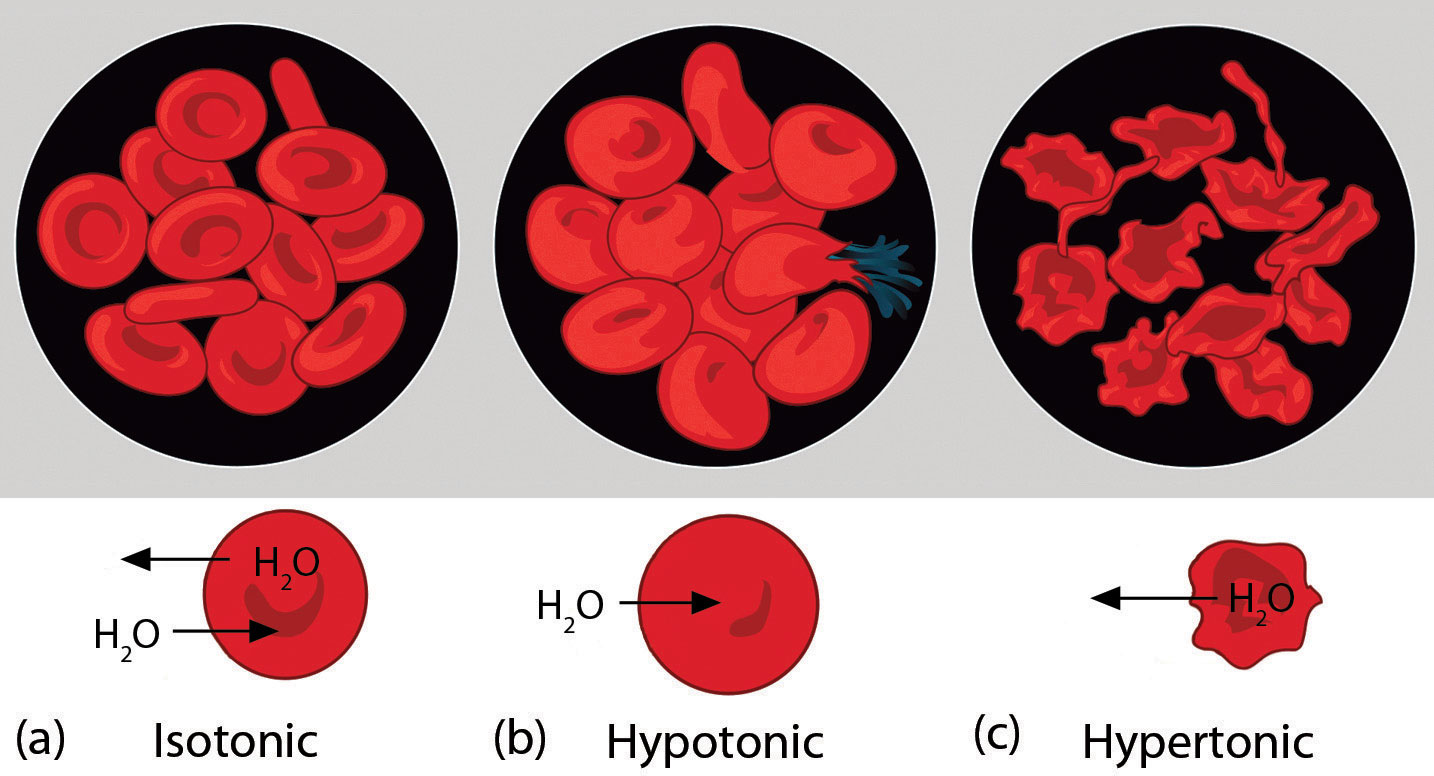
Figure 2:Osmotic Pressure and Red Blood Cells. (a) This is what a normal red blood cell looks like. (b) When a red blood cell is exposed to a hypotonic solution, solvent goes through the cell membrane and dilutes the inside of the cell. (c) When a red blood cell is exposed to a hypertonic solution, solvent goes from the cell to the surrounding solution, diluting the hypertonic solution and collapsing the cell. Neither of these last two cases is desirable, so IV solutions must be isotonic with blood serum to not cause deleterious effects.
Osmotic pressure is also the reason you should not drink seawater if you’re stranded in a lifeboat on an ocean; seawater has a higher osmotic pressure than most of the fluids in your body. You can drink the water, but ingesting it will pull water out of your cells as osmosis works to dilute the seawater. Ironically, your cells will die of thirst, and you will also die. (It is OK to drink the water if you are stranded on a body of freshwater, at least from an osmotic pressure perspective.) Osmotic pressure is also thought to be important—in addition to capillary action—in getting water to the tops of tall trees.
Exercises
Solution to Exercise 11 #
boiling point elevation, freezing point depression, vapor pressure depression
Solution to Exercise 13 #
mole fraction C6H6: 0.469; mole fraction C6H5CH3: 0.531
Solution to Exercise 15 #
mole fraction NaCl: 0.157; mole fraction H2O: 0.843
Solution to Exercise 17 #
65.8 torr
Solution to Exercise 19 #
27.26 torr
Solution to Exercise 21 #
100.71°C
Solution to Exercise 23 #
92.9°C
Solution to Exercise 25 #
−5.65°C
Solution to Exercise 27 #
−18.3°C
Solution to Exercise 29 #
33.9 atm
Solution to Exercise 31 #
0.0409 M