Rather than qualitative terms (Section 11.1 "Some Definitions"), we need quantitative ways to express the amount of solute in a solution; that is, we need specific units of concentration. In this section, we will introduce several common and useful units of concentration.
Molarity (The number of moles of solute divided by the number of liters of solution.) (M) is defined as the number of moles of solute divided by the number of liters of solution:
which can be simplified as
As with any mathematical equation, if you know any two quantities, you can calculate the third, unknown, quantity.
For example, suppose you have 0.500 L of solution that has 0.24 mol of NaOH dissolved in it. The concentration of the solution can be calculated as follows:
The concentration of the solution is 0.48 M, which is spoken as “zero point forty-eight molarity” or “zero point forty-eight molar.” If the quantity of the solute is given in mass units, you must convert mass units to mole units before using the definition of molarity to calculate concentration. For example, what is the molar concentration of a solution of 22.4 g of HCl dissolved in 1.56 L? First, convert the mass of solute to moles using the molar mass of HCl (36.5 g/mol):
Now we can use the definition of molarity to determine a concentration:
Solution to Exercise 1 #
To use the definition of molarity, both quantities must be converted to the proper units. First, convert the volume units from milliliters to liters:
Now we convert the amount of solute to moles, using the molar mass of NaOH, which is 40.0 g/mol:
Now we can use the definition of molarity to determine the molar concentration:
Solution to Exercise 2 #
1.57 M
The definition of molarity can be used to determine the amount of solute or the volume of solution, if the other information is given. Example 4 illustrates this situation.
Solution to Exercise 3 #
We know the volume and the molarity; we can use the definition of molarity to mathematically solve for the amount in moles. Substituting the quantities into the definition of molarity:
We multiply the 0.108 L over to the other side of the equation and multiply the units together; “molarity × liters” equals moles, according to the definition of molarity. So
Solution to Exercise 4 #
0.324 mol
If you need to determine volume, remember the rule that the unknown quantity must be by itself and in the numerator to determine the correct answer. Thus rearrangement of the definition of molarity is required.
Solution to Exercise 5 #
Solution to Exercise 6 #
1.53 L
A similar unit of concentration is molality (The number of moles of solute per kilogram of solvent.) (m), which is defined as the number of moles of solute per kilogram of solvent, not per liter of solution:
Mathematical manipulation of molality is the same as with molarity.
Another way to specify an amount is percentage composition by mass (Ratio of mass of solute to the total mass of a sample times 100.) (or mass percentage, % m/m). It is defined as follows:
It is not uncommon to see this unit used on commercial products (Figure 11.1 "Concentration in Commercial Applications").
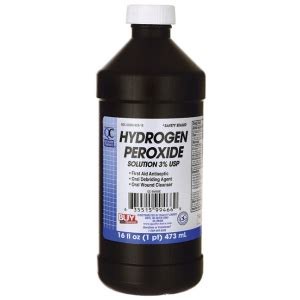
Figure 11.1:Concentration in Commercial Applications. A commercial hydrogen peroxide bottle states a concentration of 3%. Concentration labels specify how much solute is present in a solution; the convention used for a percentage should always be checked.
Credits: Hydrogen Peroxide Bottle — ThatOneEli, CC BY-SA 4.0. Images resized for the web.
Solution to Exercise 7 #
Using the definition of mass percentage, we have
Solution to Exercise 8 #
3.01%
Related concentration units are parts per thousand (ppth) (Ratio of mass of solute to total mass of sample times 1,000.), parts per million (ppm) (Ratio of mass of solute to total mass of sample times 1,000,000.), and parts per billion (ppb) (Ratio of mass of solute to total mass of sample times 1,000,000,000.). Parts per thousand is defined as follows:
There are similar definitions for parts per million and parts per billion:
Each unit is used for progressively lower and lower concentrations. The two masses must be expressed in the same unit of mass, so conversions may be necessary.
Solution to Exercise 9 #
Use the definition of parts per thousand to determine the concentration. Substituting
Solution to Exercise 10 #
1.58 ppm
As with molarity and molality, algebraic rearrangements may be necessary to answer certain questions.
Solution to Exercise 11 #
Solution to Exercise 12 #
1.16 g
For ionic solutions, we need to differentiate between the concentration of the salt versus the concentration of each individual ion. Because the ions in ionic compounds go their own way when a compound is dissolved in a solution, the resulting concentration of the ion may be different from the concentration of the complete salt. For example, if 1 M NaCl were prepared, the solution could also be described as a solution of 1 M Na+(aq) and 1 M Cl−(aq) because there is one Na+ ion and one Cl− ion per formula unit of the salt. However, if the solution were 1 M CaCl2, there are two Cl−(aq) ions for every formula unit dissolved, so the concentration of Cl−(aq) would be 2 M, not 1 M.
In addition, the total ion concentration is the sum of the individual ion concentrations. Thus for the 1 M NaCl, the total ion concentration is 2 M; for the 1 M CaCl2, the total ion concentration is 3 M.
Exercises
Solution to Exercise 13 #
Molarity is moles per liter, whereas molality is moles per kilogram of solvent.
Solution to Exercise 15 #
0.457 M
Solution to Exercise 17 #
0.0844 mol
Solution to Exercise 19 #
1.59 L
Solution to Exercise 21 #
0.376 L
Solution to Exercise 23 #
Mg2+ = 0.66 M; NO3− = 1.32 M; total: 1.98 M
Solution to Exercise 25 #
0.277 M