Often, a worker will need to change the concentration of a solution by changing the amount of solvent. Dilution (The addition of solvent, which decreases the concentration of the solute in the solution.) is the addition of solvent, which decreases the concentration of the solute in the solution. Concentration (The removal of solvent, which increases the concentration of the solute in the solution.) is the removal of solvent, which increases the concentration of the solute in the solution. (Do not confuse the two uses of the word concentration here!)
In both dilution and concentration, the amount of solute stays the same. This gives us a way to calculate what the new solution volume must be for the desired concentration of solute. From the definition of molarity,
we can solve for the number of moles of solute:
A simpler way of writing this is to use M to represent molarity and V to represent volume. So the equation becomes
Because this quantity does not change before and after the change in concentration, the product MV must be the same before and after the concentration change. Using numbers to represent the initial and final conditions, we have
as the dilution equation (The mathematical formula for calculating new concentrations or volumes when a solution is diluted or concentrated.). The volumes must be expressed in the same units. Note that this equation gives only the initial and final conditions, not the amount of the change. The amount of change is determined by subtraction.
Solution to Exercise 1 #
It does not matter which set of conditions is labeled 1 or 2, as long as the conditions are paired together properly. Using the dilution equation, we have
Solving for the second concentration (noting that the milliliter units cancel),
The concentration of the solution has decreased. In going from 25.0 mL to 72.8 mL, 72.8 − 25.0 = 47.8 mL of solvent must be added.
Solution to Exercise 2 #
135.4 mL
Concentrating solutions involves removing solvent. Usually this is done by evaporating or boiling, assuming that the heat of boiling does not affect the solute. The dilution equation is used in these circumstances as well.
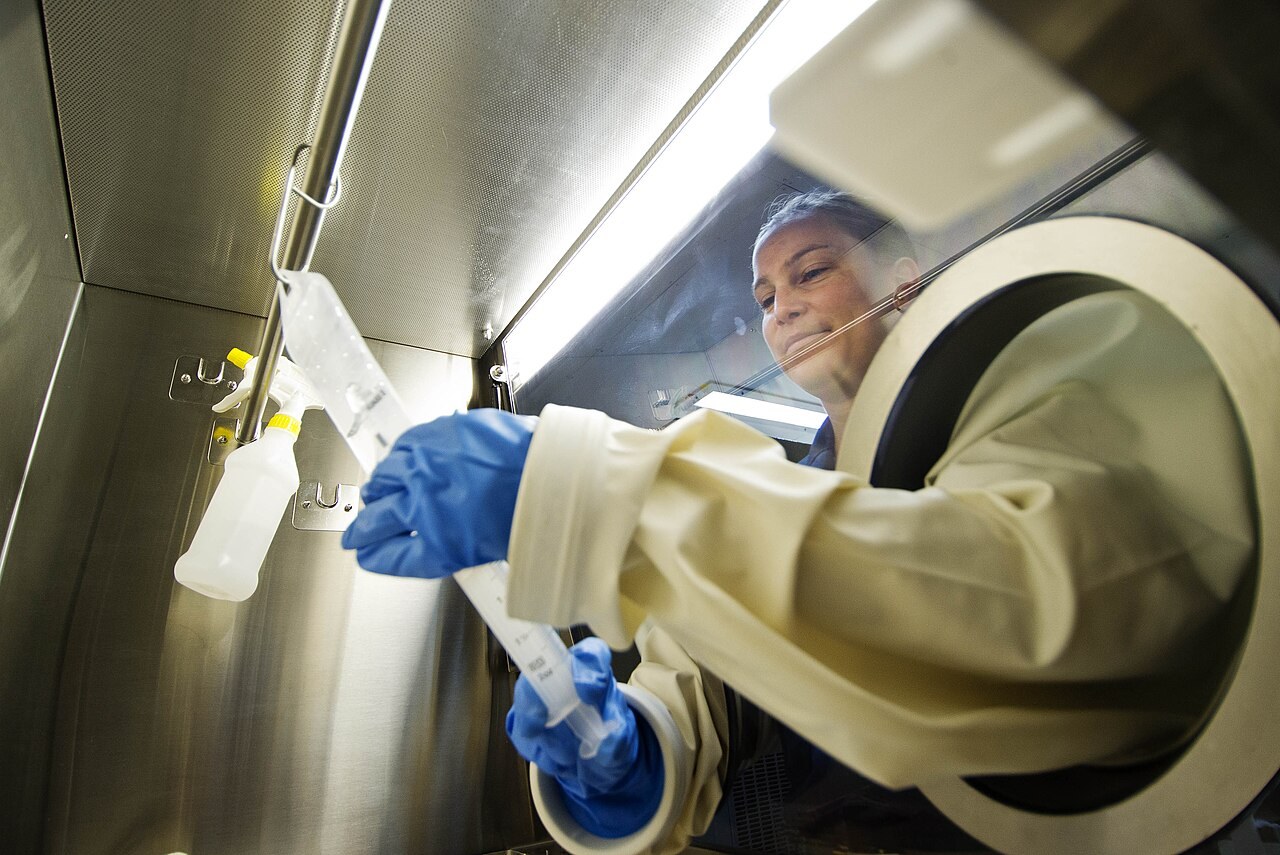
Preparing an IV Solution. A pharmacist prepares an intravenous solution aboard the hospital ship USNS Mercy. Preparing solutions requires control of concentration as well as appropriate sterile technique.
Credits: Intravenous solution preparation aboard USNS Mercy — U.S. Navy / Laurie Dexter, Public domain. Images resized for the web.
Exercises
Solution to Exercise 3 #
Dilution is a decrease in a solution’s concentration, whereas concentration is an increase in a solution’s concentration.
Solution to Exercise 5 #
0.484 M
Solution to Exercise 7 #
2.25 mL
Solution to Exercise 9 #
401 mL
Solution to Exercise 11 #
24.6 mL