Concentration can be a conversion factor between the amount of solute and the amount of solution or solvent (depending on the definition of the concentration unit). As such, concentrations can be useful in a variety of stoichiometry problems. In many cases, it is best to use the original definition of the concentration unit; it is that definition that provides the conversion factor.
A simple example of using a concentration unit as a conversion factor is one in which we use the definition of the concentration unit and rearrange; we can do the calculation again as a unit conversion, rather than as a definition. For example, suppose we ask how many moles of solute are present in 0.108 L of a 0.887 M NaCl solution. Because 0.887 M means 0.887 mol/L, we can use this second expression for the concentration as a conversion factor:
0.108 L NaCl× L NaCl0.887 mol NaCl=0.0958 mol NaCl
(There is an understood 1 in the denominator of the conversion factor.) If we used the definition approach, we get the same answer, but now we are using conversion factor skills. Like any other conversion factor that relates two different types of units, the reciprocal of the concentration can be also used as a conversion factor.
This is a two-step conversion, first using concentration as a conversion factor to determine the number of moles and then the molar mass of NaOH (40.0 g/mol) to convert to mass:
0.765 L× L solution1.93 mol NaOH×1 mol NaOH40.0 g NaOH=59.1 g NaOH
More complex stoichiometry problems using balanced chemical reactions can also use concentrations as conversion factors. For example, suppose the following equation represents a chemical reaction:
If we wanted to know what volume of 0.555 M CaCl2 would react with 1.25 mol of AgNO3, we first use the balanced chemical equation to determine the number of moles of CaCl2 that would react and then use concentration to convert to liters of solution:
1.25 mol AgNO3×2 mol AgNO31 mol CaCl2×0.555 mol CaCl21 L solution=1.13 L CaCl2
Here, we first must convert the mass of Ag to moles before using the balanced chemical equation and then the definition of molarity as a conversion factor:
3.66 g Ag×107.97 g Ag1 mol Ag×3 mol Ag1 mol Al(NO3)3×0.0995 mol Al(NO3)31 L solution=0.114 L
We can extend our skills even further by recognizing that we can relate quantities of one solution to quantities of another solution. Knowing the volume and concentration of a solution containing one reactant, we can determine how much of another solution of another reactant will be needed using the balanced chemical equation.
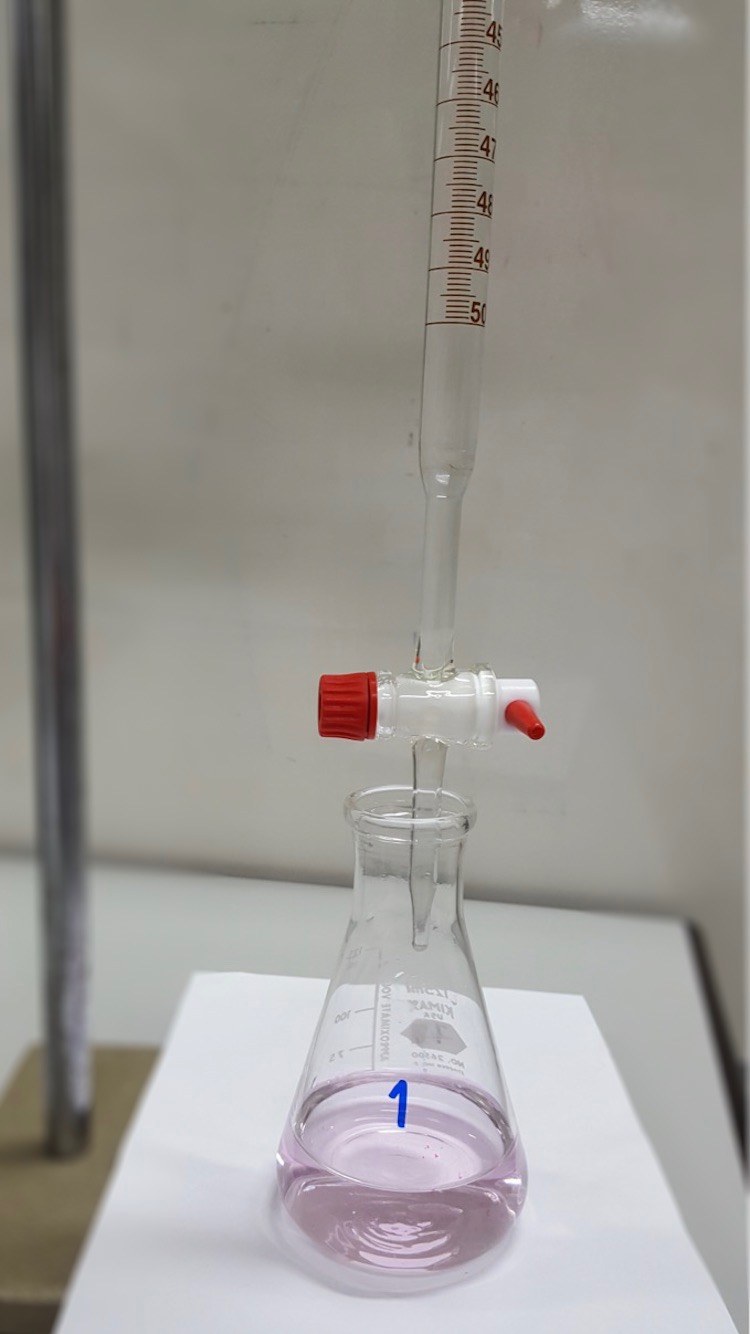
Measuring a Titration. A burette delivers a measured volume of solution during a titration. Combining the delivered volume with a known concentration allows the amount of reacting solute to be calculated.
First we need to determine the number of moles of Na2C2O4 that reacted. We will convert the volume to liters and then use the concentration of the solution as a conversion factor:
Then we determine the concentration of FeCl3 in the original solution. Converting 10.00 mL into liters (0.01000 L), we use the definition of molarity directly:
We have used molarity exclusively as the concentration of interest, but that will not always be the case. The next example shows a different concentration unit being used.
Because we are given an initial amount in moles, all we need to do is use the balanced chemical equation to determine the number of moles of H2O2 and then convert to find the mass of H2O2. Knowing that the H2O2 solution is 3.00% by mass, we can determine the mass of solution needed:
0.355 mol MnO4−×2 mol MnO4−5 mol H2O2× mol H2O234.02 g H2O2×3 g H2O2100 g solution=1,006 g solution
The first conversion factor comes from the balanced chemical equation, the second conversion factor is the molar mass of H2O2, and the third conversion factor comes from the definition of percentage concentration by mass.