Whether or not a given isotope is radioactive is a characteristic of that particular isotope. Some isotopes are stable indefinitely, while others are radioactive and decay through a characteristic form of emission. As time passes, less and less of the radioactive isotope will be present, and the level of radioactivity decreases. An interesting and useful aspect of radioactive decay is half-life (The amount of time it takes for one-half of a radioactive isotope to decay.), which is the amount of time it takes for one-half of a radioactive isotope to decay. The half-life of a specific radioactive isotope is constant; it is unaffected by conditions and is independent of the initial amount of that isotope.
Consider the following example. Suppose we have 100.0 g of tritium (a radioactive isotope of hydrogen). It has a half-life of 12.3 y. After 12.3 y, half of the sample will have decayed from hydrogen-3 to helium-3 by emitting a beta particle, so that only 50.0 g of the original tritium remains. After another 12.3 y—making a total of 24.6 y—another half of the remaining tritium will have decayed, leaving 25.0 g of tritium. After another 12.3 y—now a total of 36.9 y—another half of the remaining tritium will have decayed, leaving 12.5 g. This sequence of events is illustrated in Figure 15.1 "Radioactive Decay".
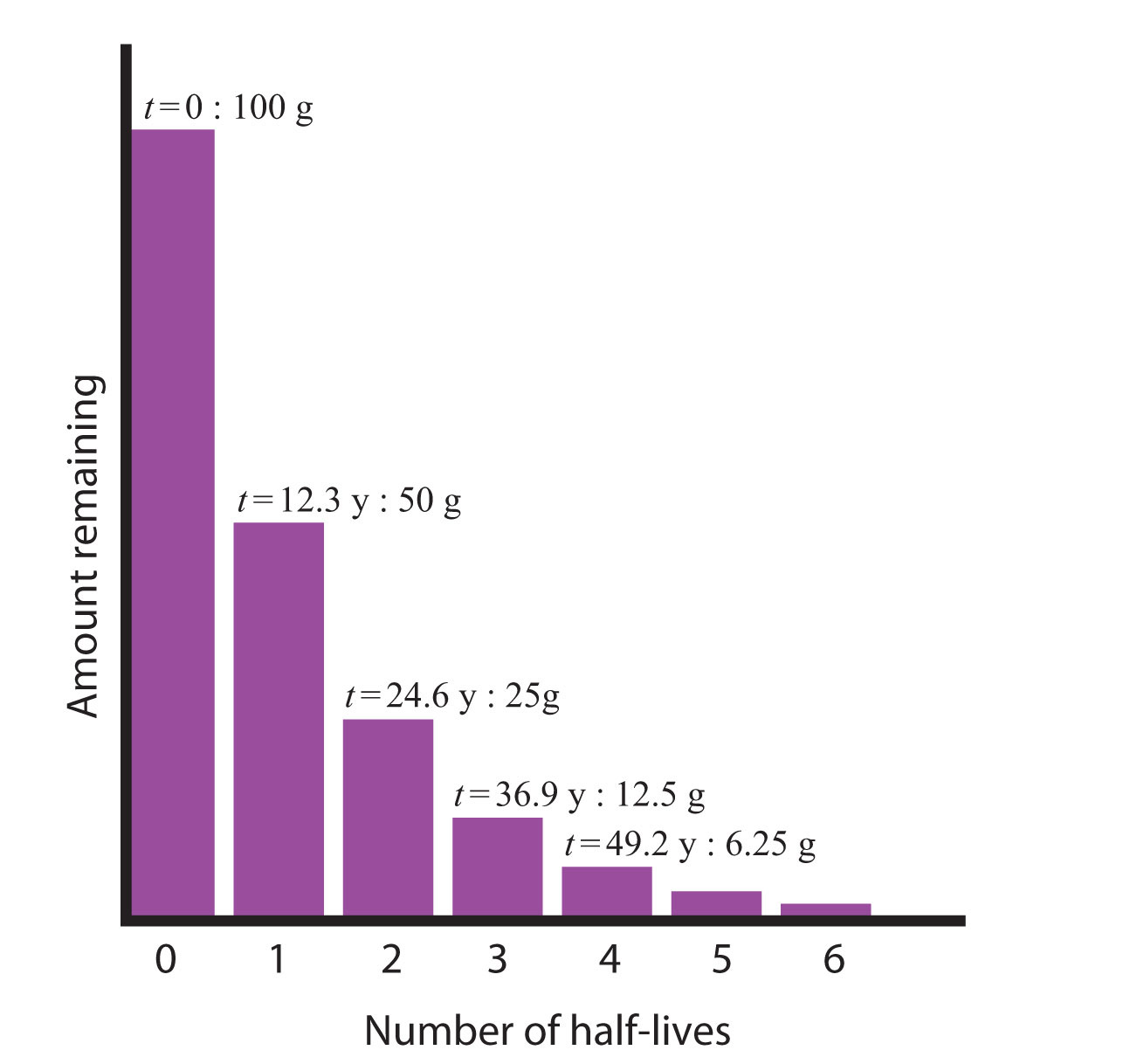
Figure 1:Radioactive Decay. During each successive half-life, half of the initial amount will radioactively decay.
We can determine the amount of a radioactive isotope remaining after a given number of half-lives by using the following expression:
where n is the number of half-lives. This expression works even if the number of half-lives is not a whole number.
Solution to Exercise 1 #
If we compare the time that has passed to the isotope’s half-life, we note that 44.0 s is exactly 4 half-lives, so using the previous expression, n = 4. Substituting and solving results in the following:
Less than one-third of a gram of fluorine-20 remains.
Solution to Exercise 2 #
0.0375 g
Half-lives of isotopes range from fractions of a microsecond to billions of years. Table 15.2 "Half-Lives of Various Isotopes" lists the half-lives of some isotopes.
Table 1:Half-Lives of Various Isotopes
| Isotope | Half-Life |
|---|---|
| 3H | 12.3 y |
| 14C | 5730 y |
| 40K | 1.26 × 10⁹ y |
| 51Cr | 27.70 d |
| 90Sr | 29.1 y |
| 131I | 8.04 d |
| 222Rn | 3.823 d |
| 235U | 7.04 × 10⁸ y |
| 238U | 4.47 × 10⁹ y |
| 241Am | 432.7 y |
| 248Bk | 23.7 h |
| 260Sg | 4 ms |
The amount remaining can also be calculated from the elapsed time directly, without first converting that time into a number of half-lives. The equation is
where e is the base of natural logarithms (2.71828182…), t is the elapsed time, and t1/2 is the half-life of the radioactive isotope. The variables t and t1/2 should have the same units of time, and you may need to make sure you know how to evaluate natural-logarithm powers on your calculator (for many calculators, there is an “inverse logarithm” function that you can use; consult your instructor if you are not sure how to use your calculator). This is the same relationship as the expression above, with n = t / t1/2. The elapsed time does not have to be an exact multiple of the half-life.
Solution to Exercise 3 #
Although similar to Example 3, the amount of time is not an exact multiple of a half-life. Here we identify the initial amount as 5.00 g, t = 60.0 s, and t1/2 = 11.0 s. Substituting into the equation:
Evaluating the exponent (and noting that the s units cancel), we get
Solving, the amount remaining is 0.114 g. (You may want to verify this answer to confirm that you are using your calculator properly.)
Solution to Exercise 4 #
0.189 g
Exercises
Solution to Exercise 5 #
Only radioactive isotopes have a half-life.
Solution to Exercise 7 #
51.0 d
Solution to Exercise 9 #
25 y
Solution to Exercise 11 #
2.2 × 10⁻⁷ g; 5.2 × 10⁻⁸ g
Solution to Exercise 13 #
Radioactive decay is an exponential process, not a linear process.
Solution to Exercise 15 #
3.1 × 10⁻⁸ g