Now that we have shown how energy, work, and heat are related, we are ready to consider energy changes in chemical reactions. A fundamental concept is that every chemical reaction occurs with a concurrent change in energy. Now we need to learn how to properly express these energy changes.
Our study of gases in Chapter 6 "Gases" and our definition of work in Section 7.2 "Work and Heat" indicate that conditions like pressure, volume, and temperature affect the energy content of a system. What we need is a definition of energy that holds when some of these conditions are specified (somewhat similar to our definition of standard temperature and pressure in our study of gases). We define the enthalpy change (The heat of a process at constant pressure; denoted .) (ΔH) as the heat of a process when pressure is held constant:
The letter H stands for “enthalpy,” a kind of energy, while the Δ implies a change in the quantity. We will always be interested in the change in H, rather than the absolute value of H itself.
When a chemical reaction occurs, there is a characteristic change in enthalpy. The enthalpy change for a reaction is typically written after a balanced chemical equation and on the same line. For example, when two moles of hydrogen react with one mole of oxygen to make two moles of water, the characteristic enthalpy change is 570 kJ. We write the equation as
A chemical equation that includes an enthalpy change is called a thermochemical equation (A chemical equation that includes an enthalpy change.). A thermochemical equation is assumed to refer to the equation in molar quantities, which means it must be interpreted in terms of moles, not individual molecules.
Solution to Exercise 1 #
The thermochemical equation is
Solution to Exercise 2 #
You may have noticed that the ΔH for a chemical reaction may be positive or negative. The number is assumed to be positive if it has no sign; a + sign can be added explicitly to avoid confusion. A chemical reaction that has a positive ΔH is said to be endothermic (A chemical reaction that has a positive change in enthalpy.), while a chemical reaction that has a negative ΔH is said to be exothermic (A chemical reaction that has a negative change in enthalpy.).
What does it mean if the ΔH of a process is positive? It means that the system in which the chemical reaction is occurring is gaining energy. If one considers the energy of a system as being represented as a height on a vertical energy plot, the enthalpy change that accompanies the reaction can be diagrammed as in part (a) in Figure 7.3 "Reaction Energy": the energy of the reactants has some energy, and the system increases its energy as it goes to products. The products are higher on the vertical scale than the reactants. Endothermic, then, implies that the system gains, or absorbs, energy.
An opposite situation exists for an exothermic process, as shown in part (b) in Figure 7.3 "Reaction Energy". If the enthalpy change of a reaction is negative, the system is losing energy, so the products have less energy than the reactants, and the products are lower on the vertical energy scale than the reactants are. Exothermic, then, implies that the system loses, or gives off, energy.
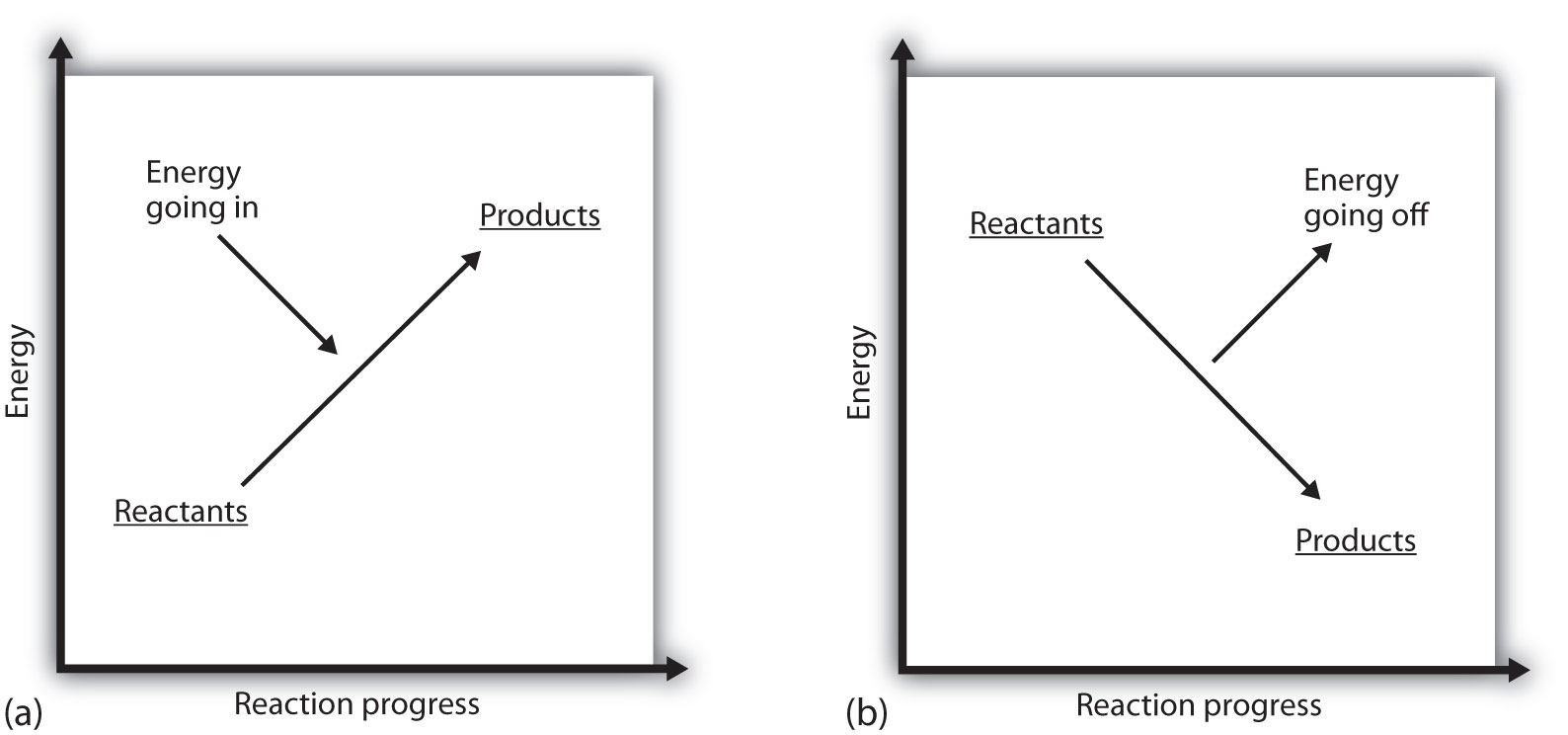
Figure 1:Reaction Energy. (a) In an endothermic reaction, the energy of the system increases (i.e., moves higher on the vertical scale of energy). (b) In an exothermic reaction, the energy of the system decreases (i.e., moves lower on the vertical scale of energy).
Solution to Exercise 3 #
By definition, a chemical reaction that has a negative ΔH is exothermic, meaning that this much energy—in this case, 565 kJ—is given off by the reaction.
Solution to Exercise 4 #
Endothermic; 42 kJ are absorbed.
How are ΔH values measured experimentally? Actually, ΔH is not measured; q is measured. But the measurements are performed under conditions of constant pressure, so ΔH is equal to the q measured.
Experimentally, q is measured by taking advantage of the equation
We premeasure the mass of the chemicals in a system. Then we let the chemical reaction occur and measure the change in temperature (ΔT) of the system. If we know the specific heat of the materials in the system (typically, we do), we can calculate q. That value of q is numerically equal to the ΔH of the process, which we can scale up to a molar scale. The container in which the system resides is typically insulated, so any energy change goes into changing the temperature of the system, rather than being leaked from the system. The container is referred to as a calorimeter (A container used to measure the heat of a chemical reaction.), and the process of measuring changes in enthalpy is called calorimetry (The process of measuring enthalpy changes for chemical reactions.).
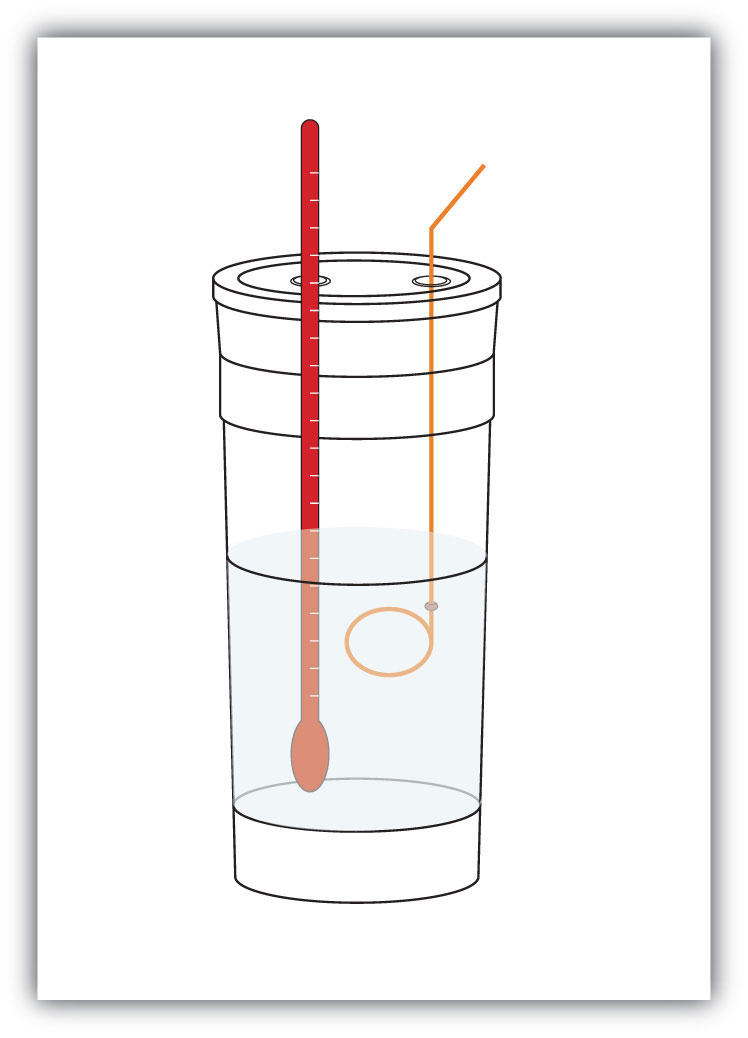
Figure 2:Calorimeters. A simple calorimeter can be constructed from some nested foam coffee cups, a cover, a thermometer, and a stirrer.
For example, suppose 4.0 g of NaOH, or 0.10 mol of NaOH, are dissolved to make 100.0 mL of aqueous solution, while 3.65 g of HCl, or 0.10 mol of HCl, are dissolved to make another 100.0 mL of aqueous solution. The two solutions are mixed in an insulated calorimeter, a thermometer is inserted, and the calorimeter is covered (see Figure 7.4 "Calorimeters" for an example setup). The thermometer measures the temperature change as the following chemical reaction occurs:
An observer notes that the temperature increases from 22.4°C to 29.1°C. Assuming that the heat capacities and densities of the solutions are the same as those of pure water, we now have the information we need to determine the enthalpy change of the chemical reaction. The total amount of solution is 200.0 mL, and with a density of 1.00 g/mL, we thus have 200.0 g of solution. Using the equation for q, we substitute for our experimental measurements and the specific heat of water (Table 7.1 "Specific Heats of Various Substances"):
Solving for q, we get
The heat q is equal to the ΔH for the reaction because the chemical reaction occurs at constant pressure. However, the reaction is giving off this amount of energy, so the actual sign on ΔH is negative:
Thus, we have the following thermochemical equation for the chemical reaction that occurred in the calorimeter:
The 1/10 coefficients are present to remind us that we started with one-tenth of a mole of each reactant, so we make one-tenth of a mole of each product. Typically, however, we report thermochemical equations in terms of moles, not one-tenth of a mole. To scale up to molar quantities, we must multiply the coefficients by 10. However, when we do this, we get 10 times as much energy. Thus, we have
The ΔH can be converted into kJ units, so our final thermochemical equation is
We have just taken our experimental data from calorimetry and determined the enthalpy change of a chemical reaction. Similar measurements on other chemical reactions can determine the ΔH values of any chemical reaction you want to study.
Solution to Exercise 5 #
Because we are given ΔT directly, we can determine the heat of the reaction, which is equal to ΔH:
Solving for q, we get
Therefore, ΔH = −4,400 J.
According to the stoichiometry of the reaction, exactly 0.25 mol of CaF2 will form, so this quantity of heat is for 0.25 mol. For 1 mol of CaF2, we need to scale up the heat by a factor of four:
On a molar basis, the change in enthalpy is
Solution to Exercise 6 #
−891 kJ
Exercises
Solution to Exercise 7 #
under conditions of constant pressure
Solution to Exercise 9 #
H2(g) + Cl2(g) → 2HCl(g) ΔH = −184 kJ
Solution to Exercise 11 #
N2(g) + O2(g) → 2NO(g) ΔH = 180 kJ
Solution to Exercise 13 #
exothermic
Solution to Exercise 15 #
endothermic
Solution to Exercise 17 #
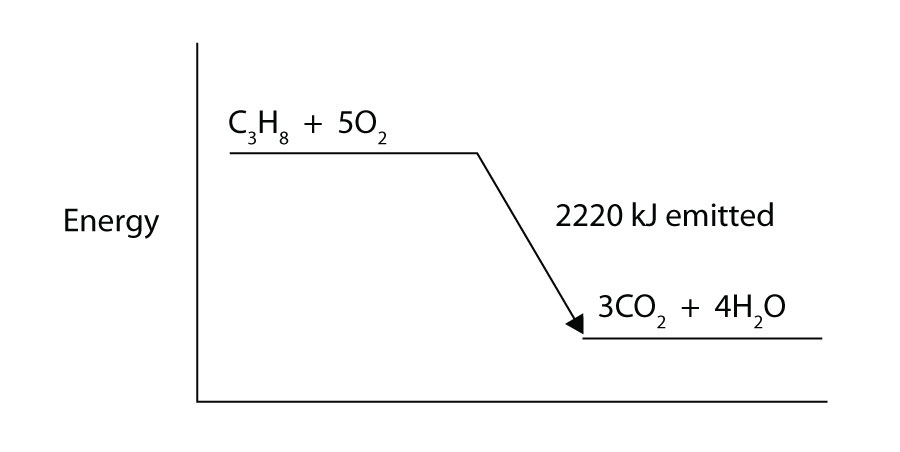
7.3 Enthalpy and Chemical Reactions
Solution to Exercise 19 #
heat of reaction = −14.0 kJ; ΔH = −56.0 kJ/mol of reactants
Solution to Exercise 21 #
heat of reaction = −68.6 kJ; ΔH = −1,370 kJ/mole of ethanol