We have already defined work as a force acting through a distance. It turns out that there are other equivalent definitions of work that are also important in chemistry.
When a certain volume of a gas expands, it works against an external pressure to expand (Figure 7.2 "Volume versus Pressure"). That is, the gas must perform work. Assuming that the external pressure Pext is constant, the amount of work done by the gas is given by the equation
where ΔV is the change in volume of the gas. This term is always the final volume minus the initial volume,
and can be positive or negative, depending on whether Vfinal is larger (is expanding) or smaller (is contracting) than Vinitial. The negative sign in the equation for work is important and implies that as volume expands (ΔV is positive), the gas in the system is losing energy as work. On the other hand, if the gas is contracting, ΔV is negative, and the two negative signs make the work positive, so energy is being added to the system.
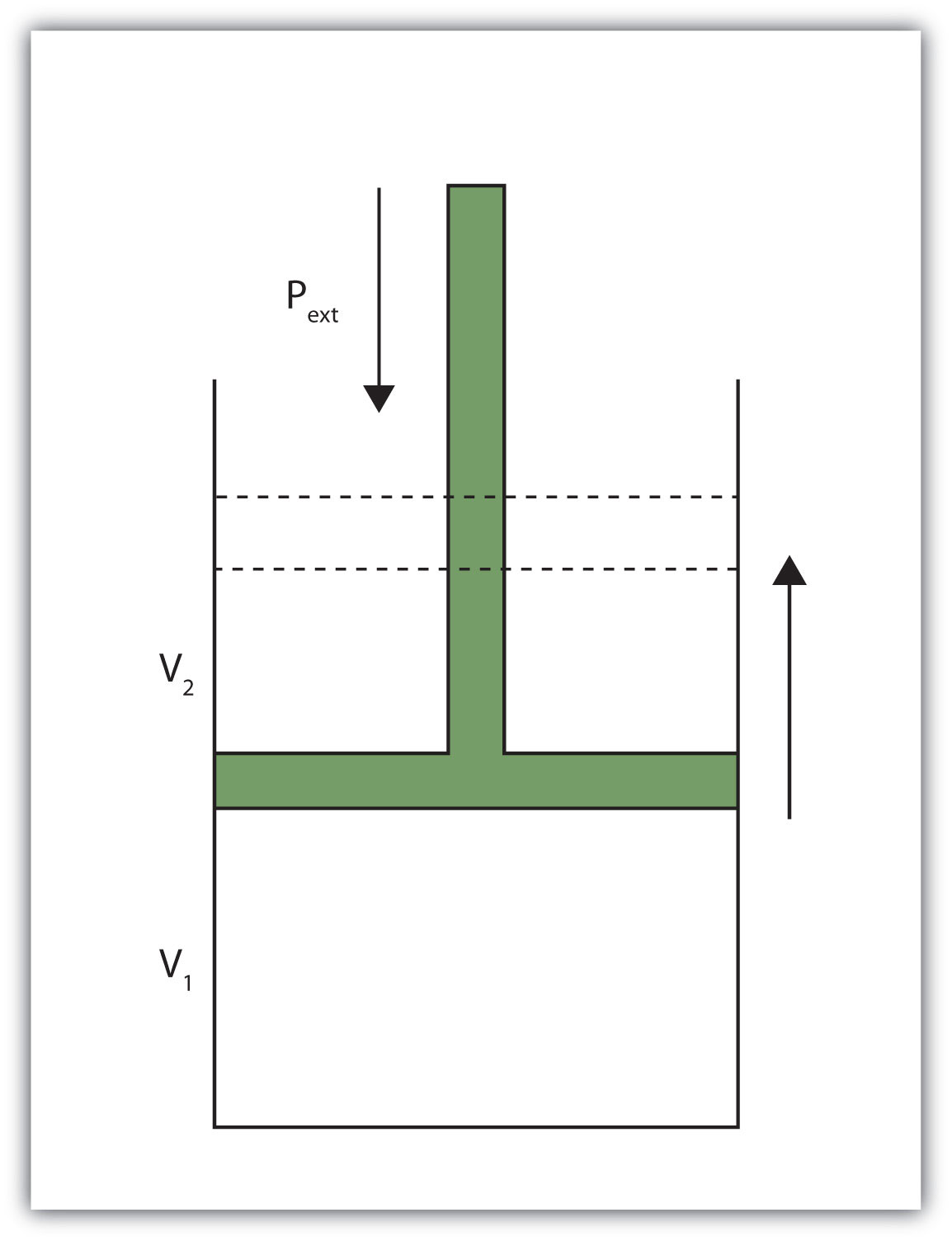
Figure 1:Volume versus Pressure. When a gas expands against an external pressure, the gas does work.
Finally, let us consider units. Volume changes are usually expressed in units like liters, while pressures are usually expressed in atmospheres. When we use the equation to determine work, the unit for work comes out as liter·atmospheres, or L·atm. This is not a very common unit for work. However, there is a conversion factor between L·atm and the common unit of work, joules:
Using this conversion factor and the previous equation for work, we can calculate the work performed when a gas expands or contracts.
Solution to Exercise 1 #
First we need to determine the change in volume, ΔV. A change is always the final value minus the initial value:
Now we can use the definition of work to determine the work done:
Now we construct a conversion factor from the relationship between liter·atmospheres and joules:
We limit the final answer to three significant figures, as appropriate.
Solution to Exercise 2 #
−53 J
Heat is another aspect of energy. Heat (The transfer of energy from one body to another due to a difference in temperature.) is the transfer of energy from one body to another due to a difference in temperature. For example, when we touch something with our hands, we interpret that object as either hot or cold depending on how energy is transferred: If energy is transferred into your hands, the object feels hot. If energy is transferred from your hands to the object, your hands feel cold. Because heat is a measure of energy transfer, heat is also measured in joules.
For a given object, the amount of heat (q) involved is proportional to two things: the mass of the object (m) and the temperature change (ΔT) evoked by the energy transfer. We can write this mathematically as
where ∝ means “is proportional to.” To make a proportionality an equality, we include a proportionality constant. In this case, the proportionality constant is labeled c and is called the specific heat capacity (The proportionality constant between heat, mass, and temperature change; also called specific heat.), or, more succinctly, specific heat:
where the mass, specific heat, and change in temperature are multiplied together. Specific heat is a measure of how much energy is needed to change the temperature of a substance; the larger the specific heat, the more energy is needed to change the temperature. The units for specific heat are or , depending on what the unit of ΔT is. You may note a departure from the insistence that temperature be expressed in Kelvin. That is because a change in temperature has the same value whether the temperatures are expressed in degrees Celsius or kelvins.
Solution to Exercise 3 #
First we need to determine ΔT. A change is always the final value minus the initial value:
Now we can use the expression for q, substitute for all variables, and solve for heat:
Note how the g and °C units cancel, leaving J, a unit of heat. Also note that this value of q is inherently positive, meaning that energy is going into the system.
Solution to Exercise 4 #
2,260 J
As with any equation, when you know all but one variable in the expression for q, you can determine the remaining variable by using algebra.
Solution to Exercise 5 #
Solution to Exercise 6 #
107 g
Table 7.1 "Specific Heats of Various Substances" lists the specific heats of some substances. Specific heat is a physical property of substances, so it is a characteristic of the substance. The general idea is that the lower the specific heat, the less energy is required to change the temperature of the substance by a certain amount.
Table 1:Specific Heats of Various Substances
| Substance | Specific Heat (J/g·°C) |
|---|---|
| water | 4.184 |
| iron | 0.449 |
| gold | 0.129 |
| mercury | 0.139 |
| aluminum | 0.900 |
| ethyl alcohol | 2.419 |
| magnesium | 1.03 |
| helium | 5.171 |
| oxygen | 0.918 |
Exercises
Solution to Exercise 7 #
Work is a force acting through a distance or a volume changing against some pressure.
Solution to Exercise 9 #
−864 J
Solution to Exercise 11 #
248 J
Solution to Exercise 13 #
When heat is positive, the total energy of the system is increasing.
Solution to Exercise 15 #
3.80 × 10³ J
Solution to Exercise 17 #
−58,400 J
Solution to Exercise 19 #
0.163 J/g·°C
Solution to Exercise 21 #
43.0°C
Solution to Exercise 23 #
17.3 g; 0.640 mol