There are some common—and important—functional groups that contain elements other than oxygen. In this section, we will consider three of them.
Nitrogen-Containing Compounds
An amine (An organic derivative of ammonia.) is an organic derivative of ammonia (NH3). In amines, one or more of the H atoms in NH3 is substituted with an organic group. A primary amine has one H atom substituted with an R group:

16.5 Other Functional Groups
A secondary amine has two H atoms substituted with R groups:

16.5 Other Functional Groups
A tertiary amine has all three H atoms substituted with R group:

16.5 Other Functional Groups
Naming simple amines is straightforward: name the R groups as substituents and then add the suffix -amine, using numerical suffixes on the substituent names as necessary. This amine

16.5 Other Functional Groups
is diethylamine (the H atoms on the C atoms are omitted for clarity), while this amine

16.5 Other Functional Groups
is ethyldipropylamine.
Solution to Exercise 1 #
This amine has a methyl group, an ethyl group, and a propyl group. Listing the names in alphabetical order, this amine is ethylmethylpropylamine.
Solution to Exercise 2 #
triethylamine
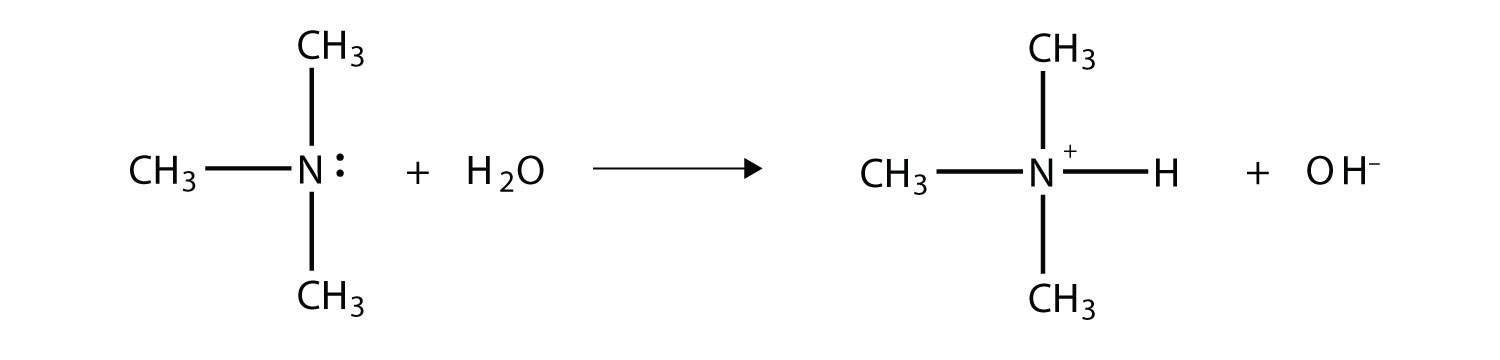
As with NH3, the N atom in amines can accept a proton onto the lone electron pair on the N atom. That is, amines act as Brønsted-Lowry bases (i.e., proton acceptors):
16.5 Other Functional Groups
(For more information on Brønsted-Lowry bases, see Chapter 12 "Acids and Bases", Section 12.2 "Brønsted-Lowry Acids and Bases".) The amine becomes an ion, the organic counterpart of the ammonium (NH4+) ion.
Because no amine is presented in Table 12.2 "Strong Acids and Bases", all amines are weak bases. The weakness of amines is about as the same as that for carboxylic acids. N-containing organic compounds are very common in nature, and they all act as weak bases. Some of these compounds have rather complicated structures. Figure 16.4 "Some Naturally Occurring N-Containing Compounds" shows some N-containing substances that you may recognize.
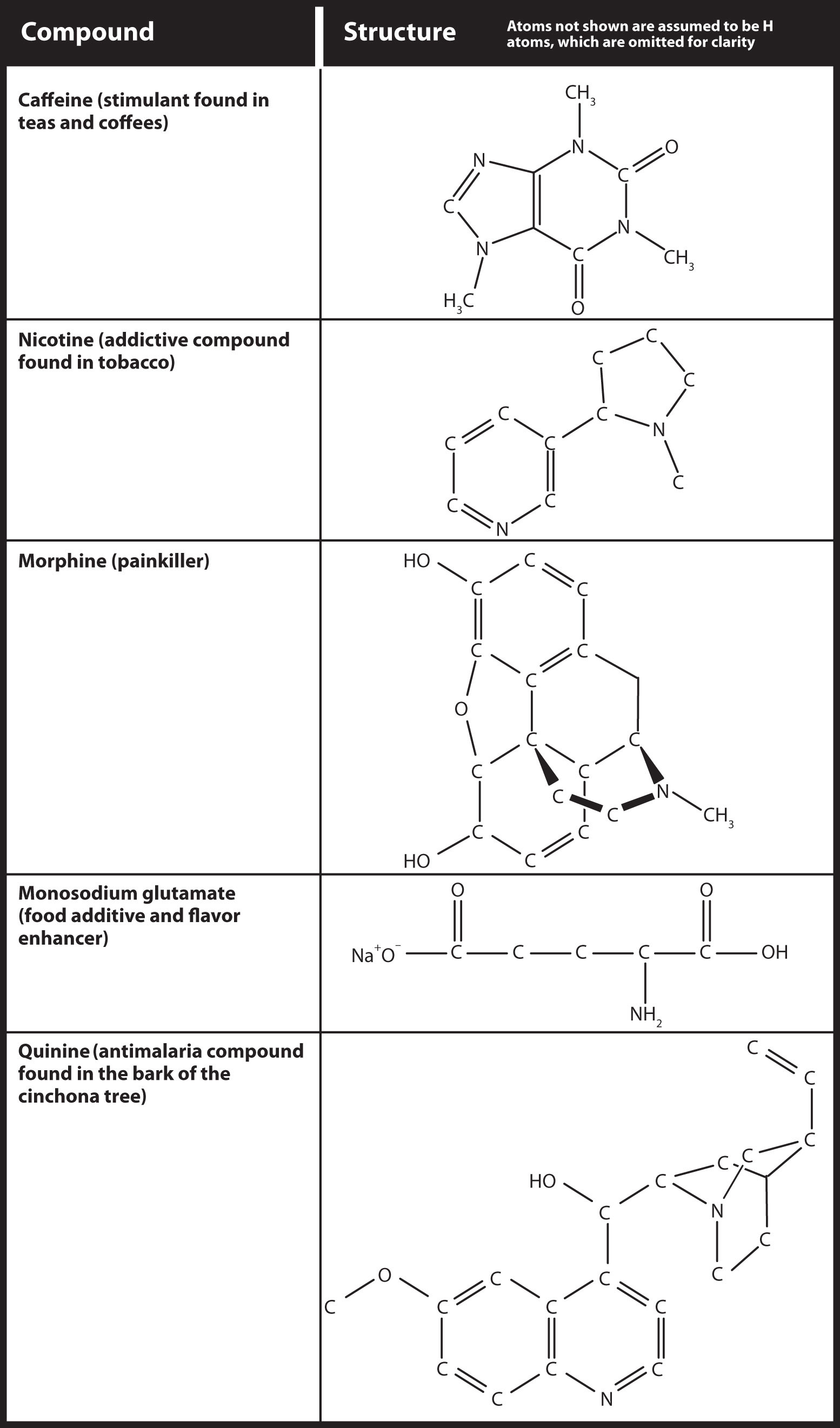
Figure 1:Some Naturally Occurring N-Containing Compounds. Nitrogen-containing compounds occur frequently in nature. Here are some that you might encounter in the course of your everyday life.
An amide (A functional group that is the combination of the amine and carbonyl functional groups.) functional group is a combination of an amine group and a carbonyl group:

16.5 Other Functional Groups
Amides are actually formed by bringing together an amine-containing molecule and a carboxylic acid-containing molecule. A molecule of H2O is lost, much like when an ester forms:

16.5 Other Functional Groups
The bond between the N of the amine group and the C of the carbonyl group is called an amide bond (The bond between the N atom and the C atom in an amide.). Amide bonds are particularly important in biological molecules called proteins, which are composed of strings of amino acids—molecules that have an amine group and a carboxylic acid group in them. The amine group on one amino acid reacts with the carboxylic acid group of another amino acid, making a chain held together by amide bonds. We will consider proteins later in this chapter.
Solution to Exercise 3 #
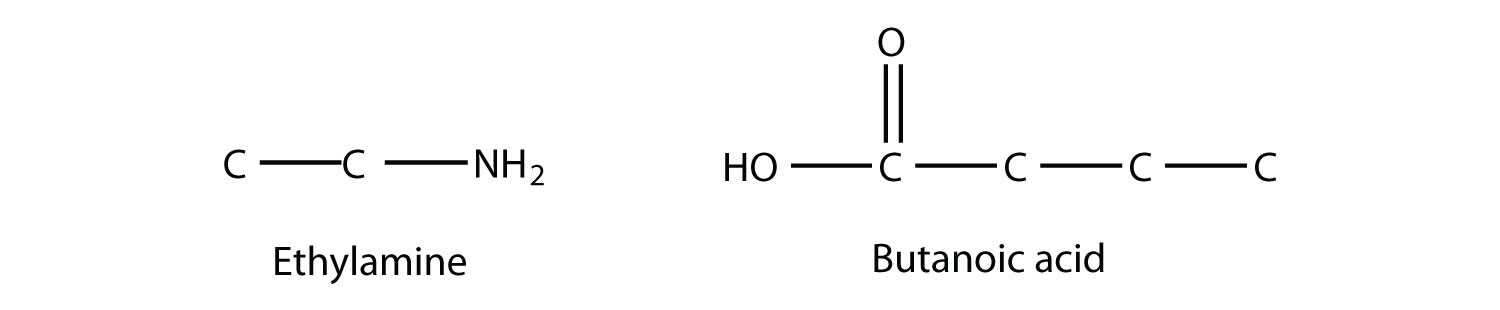
The structures of ethylamine and butanoic acid are as follows:
16.5 Other Functional Groups
When they come together to make an amide, an H2O molecule is lost, and the N of the amine group bonds to the C of the carboxyl group. The resulting molecule is as follows:

16.5 Other Functional Groups
Solution to Exercise 4 #

16.5 Other Functional Groups
Sulfur-Containing Compounds
Sulfur is below oxygen on the periodic table, and it occasionally shows some similar chemistry. One similarity is that an S atom can take the place of an O atom in an alcohol, to make a molecule that looks like this:
The sulfur analog of an alcohol is called a thiol (The sulfur analog of an alcohol.). The formal way of naming a thiol is similar to that of alcohols, except that instead of using the suffix -ol, you use -thiol as the suffix. The following illustrates thiol nomenclature:

16.5 Other Functional Groups
An older system uses the word mercaptan in naming simple thiols, much like the word alcohol is used with small alcohols. These thiols can also be named like this:

16.5 Other Functional Groups
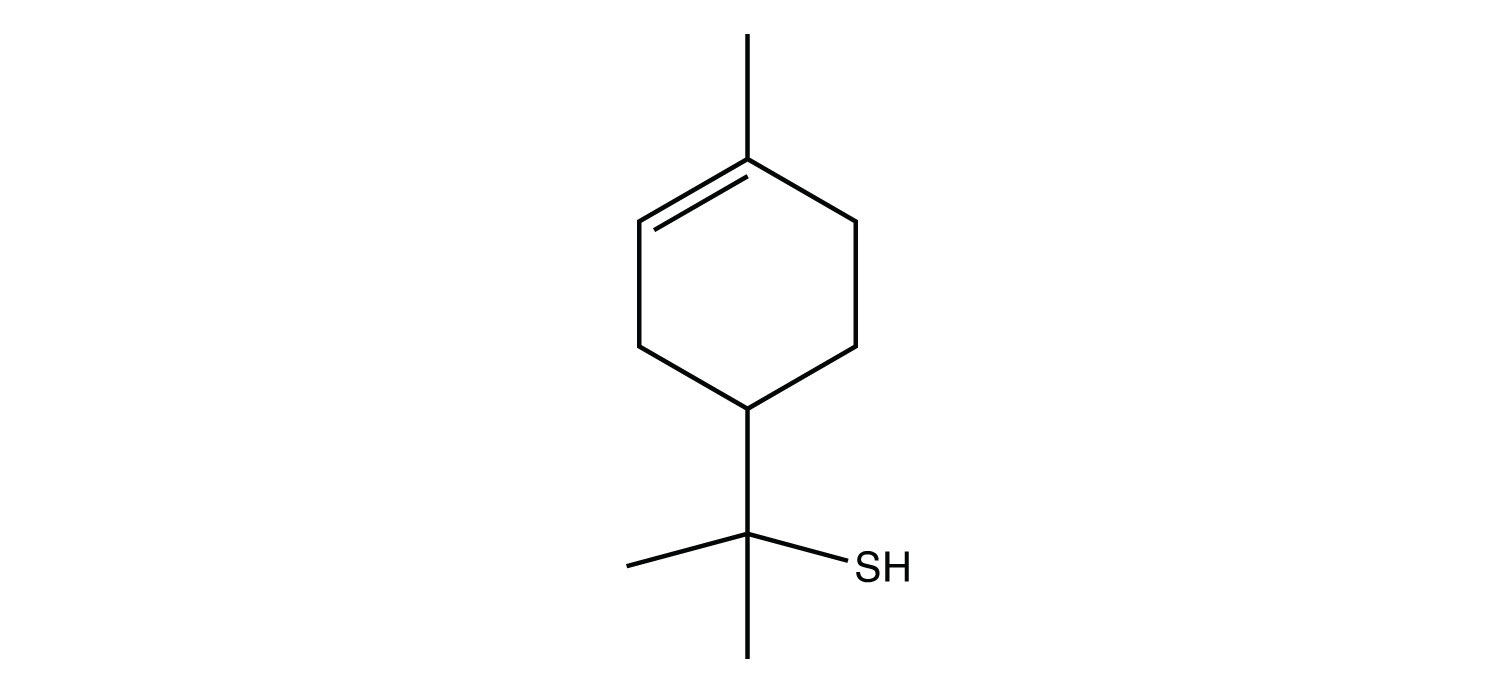
Many thiols have strong, objectionable odors; indeed, the spray from skunks is composed of thiols and is detectable by the human nose at concentrations less than 10 ppb. Because natural gas is odorless, thiols are intentionally added to natural gas—at very low levels, of course—so that gas leaks can be more easily detected. Not all thiols have objectionable odors; this thiol is responsible for the odor of grapefruit:
16.5 Other Functional Groups
One amino acid that is a thiol is cysteine:

16.5 Other Functional Groups
Cysteine plays an important role in protein structure. If two cysteine amino acids in a protein chain approach each other, they can be oxidized, and a S–S bond (also known as a disulfide bond) is formed:
where the R group is the rest of the cysteine molecule. The disulfide bond is strong enough to fix the position of the two cysteine groups, thus imposing a structure on the protein. Hair is composed of about 5% cysteine, and the breaking and remaking of disulfide bonds between cysteine units is the primary mechanism behind straightening and curling hair (hair “perms”).
Exercises
Solution to Exercise 5 #
CH3NH2; methylamine
Solution to Exercise 7 #
a. primary b. tertiary c. secondary
Solution to Exercise 9 #
a. C3H3CO2HSHNH2 + HCl → C3H3CO2HSHNH3Cl b. (C6H11)(C2H5)(CH3)N + HCl → (C6H11)(C2H5)(CH3)NHCl c. (C2H5)(CH3)NH + HCl → (C2H5)(CH3)NH2Cl
Solution to Exercise 11 #
a. ethylmethylamine b. phenylamine
Solution to Exercise 13 #
two
Solution to Exercise 15 #

16.5 Other Functional Groups
Solution to Exercise 17 #
a. cyclohexanethiol b. butanethiol
Solution to Exercise 19 #

16.5 Other Functional Groups