As indicated in Section 12.4 "Strong and Weak Acids and Bases and Their Salts", weak acids are relatively common, even in the foods we eat. But we occasionally encounter a strong acid or base, such as stomach acid, which has a strongly acidic pH of 1.7. By definition, strong acids and bases can produce a relatively large amount of H+ or OH− ions and consequently have marked chemical activities. In addition, very small amounts of strong acids and bases can change the pH of a solution very quickly. If 1 mL of stomach acid [approximated as 0.1 M HCl(aq)] were added to the bloodstream and no correcting mechanism were present, the pH of the blood would decrease from about 7.4 to about 4.7—a pH that is not conducive to continued living. Fortunately, the body has a mechanism for minimizing such dramatic pH changes.
The mechanism involves a buffer (A solution that resists dramatic changes in pH.), a solution that resists dramatic changes in pH. Buffers do so by being composed of certain pairs of solutes: either a weak acid plus a salt derived from that weak acid or a weak base plus a salt of that weak base. For example, a buffer can be composed of dissolved HC2H3O2 (a weak acid) and NaC2H3O2 (the salt derived from that weak acid). Another example of a buffer is a solution containing NH3 (a weak base) and NH4Cl (a salt derived from that weak base).
Let us use an HC2H3O2/NaC2H3O2 buffer to demonstrate how buffers work. If a strong base—a source of OH−(aq) ions—is added to the buffer solution, those OH− ions will react with the HC2H3O2 in an acid-base reaction:
Rather than changing the pH dramatically by making the solution basic, the added OH− ions react to make H2O, so the pH does not change much.
If a strong acid—a source of H+ ions—is added to the buffer solution, the H+ ions will react with the anion from the salt. Because HC2H3O2 is a weak acid, it is not ionized much. This means that if lots of H+ ions and C2H3O2− ions are present in the same solution, they will come together to make HC2H3O2:
Rather than changing the pH dramatically and making the solution acidic, the added H+ ions react to make molecules of a weak acid. Figure 12.2 "The Actions of Buffers" illustrates both actions of a buffer.
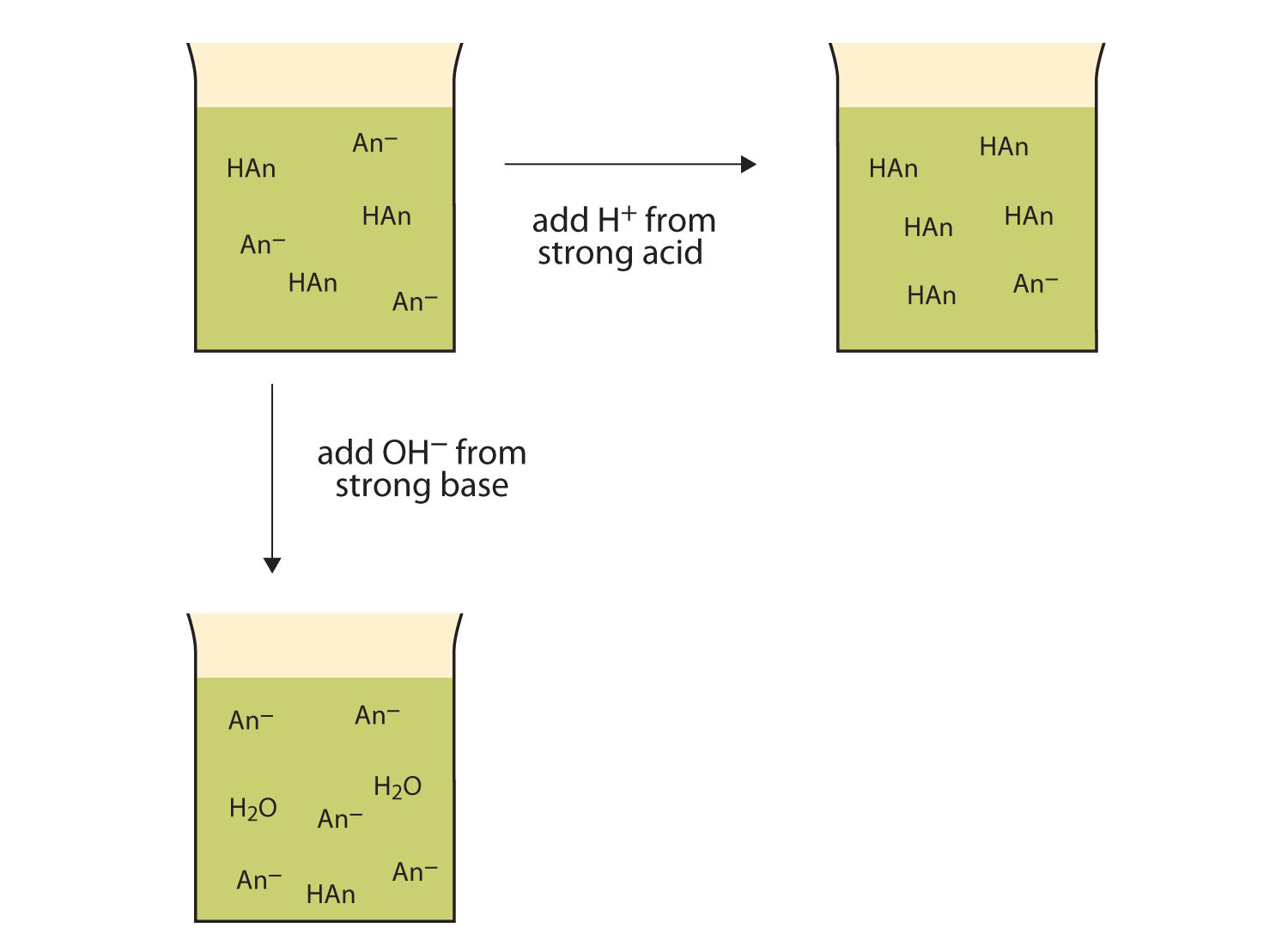
Figure 1:The Actions of Buffers. Buffers can react with both strong acids (top) and strong bases (side) to minimize large changes in pH.
Buffers made from weak bases and salts of weak bases act similarly. For example, in a buffer containing NH3 and NH4Cl, NH3 molecules can react with any excess H+ ions introduced by strong acids:
while the NH4+(aq) ion can react with any OH− ions introduced by strong bases:
Solution to Exercise 1 #
HCHO2 is formic acid, a weak acid, while NaCHO2 is the salt made from the anion of the weak acid (the formate ion [CHO2−]). The combination of these two solutes would make a buffer solution.
HCl is a strong acid, not a weak acid, so the combination of these two solutes would not make a buffer solution.
CH3NH2 is methylamine, which is like NH3 with one of its H atoms substituted with a CH3 group. Because it is not listed in Table 12.2 "Strong Acids and Bases", we can assume that it is a weak base. The compound CH3NH3Cl is a salt made from that weak base, so the combination of these two solutes would make a buffer solution.
NH3 is a weak base, but NaOH is a strong base. The combination of these two solutes would not make a buffer solution.
Solution to Exercise 2 #
no
yes
yes
no
Buffers work well only for limited amounts of added strong acid or base. Once either solute is completely reacted, the solution is no longer a buffer, and rapid changes in pH may occur. We say that a buffer has a certain capacity (The amount of strong acid or base a buffer can counteract.). Buffers that have more solute dissolved in them to start with have larger capacities, as might be expected.
Human blood has a buffering system to minimize extreme changes in pH. One buffer in blood is based on the presence of HCO3− and H2CO3 [the second compound is another way to write CO2(aq)]. With this buffer present, even if some stomach acid were to find its way directly into the bloodstream, the change in the pH of blood would be minimal. Inside many of the body’s cells, there is a buffering system based on phosphate ions.
Exercises
Solution to Exercise 3 #
A buffer is the combination of a weak acid or base and a salt of that weak acid or base.
Solution to Exercise 5 #
a. no b. yes c. no d. yes
Solution to Exercise 7 #
3b: strong acid: NO2− + H+ → HNO2; strong base: HNO2 + OH− → NO2− + H2O; 3d: strong base: NH4+ + OH− → NH3 + H2O; strong acid: NH3 + H+ → NH4+
Solution to Exercise 9 #
Buffers can be made from three combinations: (1) H3PO4 and H2PO4−, (2) H2PO4− and HPO42−, and (3) HPO42− and PO43−. (Technically, a buffer can be made from any two components.)
Solution to Exercise 11 #
The phosphate buffer should have the larger capacity.