One of the properties of gases is that they mix with each other. When they do so, they become a solution—a homogeneous mixture. Some of the properties of gas mixtures are easy to determine if we know the composition of the gases in the mix.
In gas mixtures, each component in the gas phase can be treated separately. Each component of the mixture shares the same temperature and volume. (Remember that gases expand to fill the volume of their container; gases in a mixture continue to do that as well.) However, each gas has its own pressure. The partial pressure (The pressure that an individual gas in a mixture has.) of a gas, Pi, is the pressure that an individual gas in a mixture has. Partial pressures are expressed in torr, millimeters of mercury, or atmospheres like any other gas pressure; however, we use the term pressure when talking about pure gases and the term partial pressure when we are talking about the individual gas components in a mixture.
Dalton’s law of partial pressures (The total pressure of a gas mixture, , is equal to the sum of the partial pressures of the components, .) states that the total pressure of a gas mixture, Ptot, is equal to the sum of the partial pressures of the components, Pi:
Although this may seem to be a trivial law, it reinforces the idea that gases behave independently of each other.
Solution to Exercise 1 #
Dalton’s law of partial pressures states that the total pressure is equal to the sum of the partial pressures. We simply add the two pressures together:
Solution to Exercise 2 #
152 torr
Solution to Exercise 3 #
Because gases act independently of each other, we can determine the resulting final pressures using Boyle’s law and then add the two resulting pressures together to get the final pressure. The total final volume is 2.00 L + 5.00 L = 7.00 L. First, we use Boyle’s law to determine the final pressure of H2:
Solving for P2, we get
Now we do that same thing for the O2:
The total pressure is the sum of the two resulting partial pressures:
Solution to Exercise 4 #
0.51 atm
One of the reasons we have to deal with Dalton’s law of partial pressures is because gases are frequently collected by bubbling through water. As we will see in Chapter 10 "Solids and Liquids", liquids are constantly evaporating into a vapor until the vapor achieves a partial pressure characteristic of the substance and the temperature. This partial pressure is called a vapor pressure (The partial pressure exerted by evaporation of a liquid.). Table 6.2 "Vapor Pressure of Water versus Temperature" lists the vapor pressures of H2O versus temperature. Note that if a substance is normally a gas under a given set of conditions, the term partial pressure is used; the term vapor pressure is reserved for the partial pressure of a vapor when the liquid is the normal phase under a given set of conditions.
Table 1:Vapor Pressure of Water versus Temperature
| Temperature (°C) | Vapor Pressure (torr) | Temperature (°C) | Vapor Pressure (torr) | |
|---|---|---|---|---|
| 5 | 6.54 | 30 | 31.84 | |
| 10 | 9.21 | 35 | 42.20 | |
| 15 | 12.79 | 40 | 55.36 | |
| 20 | 17.54 | 50 | 92.59 | |
| 21 | 18.66 | 60 | 149.5 | |
| 22 | 19.84 | 70 | 233.8 | |
| 23 | 21.08 | 80 | 355.3 | |
| 24 | 22.39 | 90 | 525.9 | |
| 25 | 23.77 | 100 | 760.0 |
Any time a gas is collected over water, the total pressure is equal to the partial pressure of the gas plus the vapor pressure of water. This means that the amount of gas collected will be less than the total pressure suggests.
Solution to Exercise 5 #
We need to take into account that the total pressure includes the vapor pressure of water. According to Table 6.2 "Vapor Pressure of Water versus Temperature", the vapor pressure of water at 22°C is 19.84 torr. According to Dalton’s law of partial pressures, the total pressure equals the sum of the pressures of the individual gases, so
We solve by subtracting:
Now we can use the ideal gas law to determine the number of moles (remembering to convert temperature to kelvins, making it 295 K):
All the units cancel except for mol, which is what we are looking for. So
Solution to Exercise 6 #
0.129 mol
Finally, we introduce a new unit that can be useful, especially for gases. The mole fraction (The ratio of the number of moles of a component in a mixture divided by the total number of moles in the sample.), χi, is the ratio of the number of moles of component i in a mixture divided by the total number of moles in the sample:
(χ is the lowercase Greek letter chi.) Note that mole fraction is not a percentage; its values range from 0 to 1. For example, consider the combination of 4.00 g of He and 5.0 g of Ne. Converting both to moles, we get
The total number of moles is the sum of the two mole amounts:
The mole fractions are simply the ratio of each mole amount and the total number of moles, 1.25 mol:
The sum of the mole fractions equals exactly 1.
For gases, there is another way to determine the mole fraction. When gases have the same volume and temperature (as they would in a mixture of gases), the number of moles is proportional to partial pressure, so the mole fractions for a gas mixture can be determined by taking the ratio of partial pressure to total pressure:
This expression allows us to determine mole fractions without calculating the moles of each component directly.
Solution to Exercise 7 #
According to Dalton’s law, the total pressure is the sum of the partial pressures:
The mole fractions are the ratios of the partial pressure of each component and the total pressure:
Again, the sum of the mole fractions is exactly 1.
Solution to Exercise 8 #
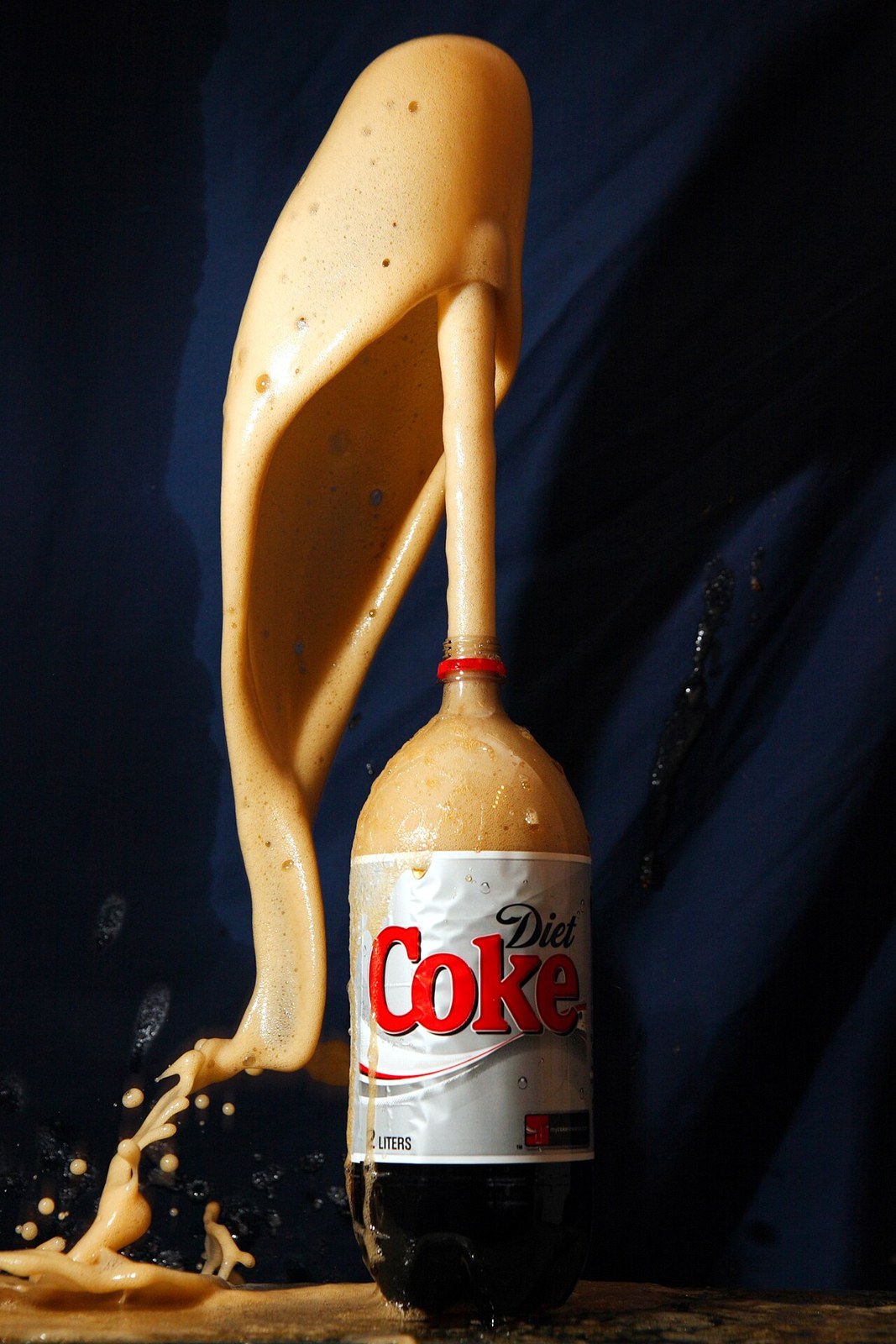
Rapid Release of Dissolved Gas. Adding Mentos to a carbonated drink provides sites where bubbles can form rapidly. The resulting fountain illustrates how quickly dissolved carbon dioxide can leave a liquid.
Credits: Diet Coke Mentos — Michael Murphy, CC BY-SA 3.0. Images resized for the web.
Exercises
Solution to Exercise 9 #
2.70 atm
Solution to Exercise 11 #
162 torr, or 0.213 atm
Solution to Exercise 13 #
PAr = 10.0 atm; PHe = 59.9 atm; Ptot = 69.9 atm
Solution to Exercise 15 #
0.183 mol
Solution to Exercise 17 #
0.113 mol
Solution to Exercise 19 #
0.0440 g
Solution to Exercise 21 #
;
Solution to Exercise 23 #
;