So far, the gas laws we have considered have all required that the gas change its conditions; then we predict a resulting change in one of its properties. Are there any gas laws that relate the physical properties of a gas at any given time?
Consider a further extension of the combined gas law to include n. By analogy to Avogadro’s law, n is positioned in the denominator of the fraction, opposite the volume. So
Because pressure, volume, temperature, and amount are the only four independent physical properties of a gas, the constant in the above equation is truly a constant; indeed, because we do not need to specify the identity of a gas to apply the gas laws, this constant is the same for all gases. We define this constant with the symbol R, so the previous equation is written as
which is usually rearranged as
This equation is called the ideal gas law (A gas law that relates all four independent physical properties of a gas under any conditions.). It relates the four independent properties of a gas at any time. The constant R is called the ideal gas law constant. Its value depends on the units used to express pressure and volume. Table 6.1 "Values of the Ideal Gas Law Constant " lists the numerical values of R.
Table 1:Values of the Ideal Gas Law Constant R
| Numerical Value | Units |
|---|---|
| 0.08205 | |
| 62.36 | |
| 8.314 |
The ideal gas law is used like any other gas law, with attention paid to the unit and making sure that temperature is expressed in Kelvin. However, the ideal gas law does not require a change in the conditions of a gas sample. The ideal gas law implies that if you know any three of the physical properties of a gas, you can calculate the fourth property.
Solution to Exercise 1 #
The first step is to convert temperature to kelvins:
Now we can substitute the conditions into the ideal gas law:
The atm unit is in the numerator of both sides, so it cancels. On the right side of the equation, the mol and K units appear in the numerator and the denominator, so they cancel as well. The only unit remaining is L, which is the unit of volume that we are looking for. We isolate the volume variable by dividing both sides of the equation by 1.21:
Then solving for volume, we get
Solution to Exercise 2 #
3.94 L
Solution to Exercise 3 #
We are not given the number of moles of Hg directly, but we are given a mass. We can use the molar mass of Hg to convert to the number of moles.
Pressure is given in units of millimeters of mercury. We can either convert this to atmospheres or use the value of the ideal gas constant that includes the mmHg unit. We will take the second option. Substituting into the ideal gas law,
The mmHg, L, and mol units cancel, leaving the K unit, the unit of temperature. Isolating T all by itself on one side, we get
Then solving for K, we get
Solution to Exercise 4 #
8.21 L
The ideal gas law can also be used in stoichiometry problems.
Solution to Exercise 5 #
Here we have a stoichiometry problem where we need to find the number of moles of H2 produced. Then we can use the ideal gas law, with the given temperature and pressure, to determine the volume of gas produced. First, the number of moles of H2 is calculated:
Now that we know the number of moles of gas, we can use the ideal gas law to determine the volume, given the other conditions:
All the units cancel except for L, for volume, which means
Solution to Exercise 6 #
0.796 atm
It should be obvious by now that some physical properties of gases depend strongly on the conditions. What we need is a set of standard conditions so that properties of gases can be properly compared to each other. Standard temperature and pressure (STP) (A set of benchmark conditions used to compare other properties of gases; about 1 atm for pressure and 273 K for temperature.) is defined as exactly 100 kPa of pressure (0.986 atm) and 273 K (0°C). For simplicity, we will use 1 atm as standard pressure. Defining STP allows us to compare more directly the properties of gases that differ from each other.
One property shared among gases is a molar volume. The molar volume (The volume of exactly 1 mol of a gas; equal to 22.4 L at STP.) is the volume of 1 mol of a gas. At STP, the molar volume of a gas can be easily determined by using the ideal gas law:
All the units cancel except for L, the unit of volume. So
Note that we have not specified the identity of the gas; we have specified only that the pressure is 1 atm and the temperature is 273 K. This makes for a very useful approximation: any gas at STP has a volume of 22.4 L per mole of gas; that is, the molar volume at STP is 22.4 L/mol (Figure 6.4 "Molar Volume"). This molar volume makes a useful conversion factor in stoichiometry problems if the conditions are at STP. If the conditions are not at STP, a molar volume of 22.4 L/mol is not applicable. However, if the conditions are not at STP, the combined gas law can be used to calculate what the volume of the gas would be if at STP; then the 22.4 L/mol molar volume can be used.
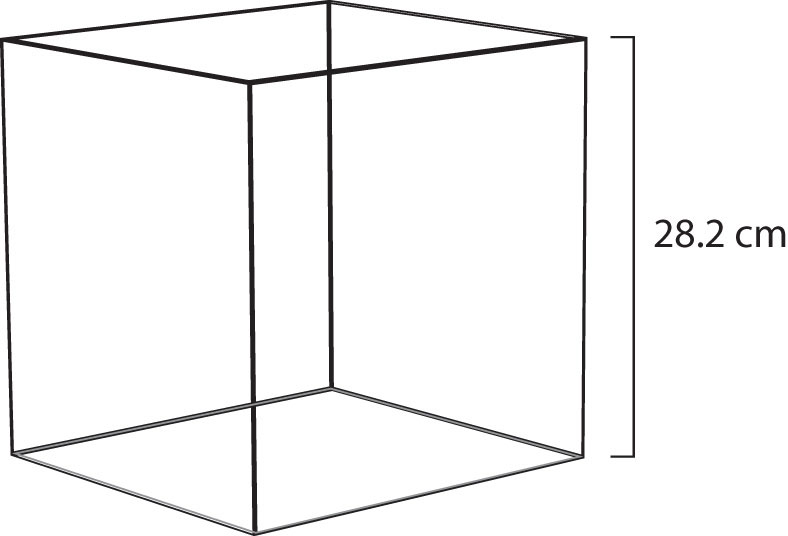
Figure 1:Molar Volume. A mole of gas at STP occupies 22.4 L, the volume of a cube that is 28.2 cm on a side.
Solution to Exercise 7 #
We can use the molar volume, 22.4 L/mol, as a conversion factor, but we need to reverse the fraction so that the L units cancel and mol units are introduced. It is a one-step conversion:
Solution to Exercise 8 #
109 L
Solution to Exercise 9 #
This is a stoichiometry problem with a twist: we need to use the molar volume of a gas at STP to determine the final answer. The first part of the calculation is the same as in a previous example:
Now we can use the molar volume, 22.4 L/mol, because the gas is at STP:
Alternatively, we could have applied the molar volume as a third conversion factor in the original stoichiometry calculation.
Solution to Exercise 10 #
2.17 L
The ideal gas law can also be used to determine the densities of gases. Density, recall, is defined as the mass of a substance divided by its volume:
Assume that you have exactly 1 mol of a gas. If you know the identity of the gas, you can determine the molar mass of the substance. Using the ideal gas law, you can also determine the volume of that mole of gas, using whatever the temperature and pressure conditions are. Then you can calculate the density of the gas by using
Solution to Exercise 11 #
First, we must convert the temperature into kelvins:
If we assume exactly 1 mol of N2, then we know its mass: 28.0 g. Using the ideal gas law, we can calculate the volume:
All the units cancel except for L, the unit of volume. So
Knowing the molar mass and the molar volume, we can determine the density of N2 under these conditions:
Solution to Exercise 12 #
0.019 g/L
Exercises
Solution to Exercise 13 #
The ideal gas law is PV = nRT. R is the ideal gas law constant, which relates the other four variables.
Solution to Exercise 15 #
0.327 mol
Solution to Exercise 17 #
3.64 atm
Solution to Exercise 19 #
8,440 torr
Solution to Exercise 21 #
12.2 g
Solution to Exercise 23 #
0.230 L
Solution to Exercise 25 #
401 L
Solution to Exercise 27 #
157 L
Solution to Exercise 29 #
a. 0.179 g/L b. 0.901 g/L c. 1.78 g/L d. 3.74 g/L
Solution to Exercise 31 #
5.51 g/L