Three classifications of chemical reactions will be reviewed in this section. Predicting the products in some of them may be difficult, but the reactions are still easy to recognize.
A composition reaction (A chemical reaction in which a single substance is produced from multiple reactants.) (sometimes also called a combination reaction or a synthesis reaction) produces a single substance from multiple reactants. A single substance as a product is the key characteristic of the composition reaction. There may be a coefficient other than one for the substance, but if the reaction has only a single substance as a product, it can be called a composition reaction. In the reaction
water is produced from hydrogen and oxygen. Although there are two molecules of water being produced, there is only one substance—water—as a product. So this is a composition reaction.
A decomposition reaction (A chemical reaction in which a single substance becomes more than one substance.) starts from a single substance and produces more than one substance; that is, it decomposes. One substance as a reactant and more than one substance as the products is the key characteristic of a decomposition reaction. For example, in the decomposition of sodium hydrogen carbonate (also known as sodium bicarbonate),
sodium carbonate, carbon dioxide, and water are produced from the single substance sodium hydrogen carbonate.
Composition and decomposition reactions are difficult to predict; however, they should be easy to recognize.
Solution to Exercise 1 #
In this equation, two substances combine to make a single substance. This is a composition reaction.
Two different substances react to make two new substances. This does not fit the definition of either a composition reaction or a decomposition reaction, so it is neither. In fact, you may recognize this as a double-replacement reaction.
A single substance reacts to make multiple substances. This is a decomposition reaction.
Solution to Exercise 2 #
decomposition
A combustion reaction (A chemical reaction in which a reactant combines with oxygen to produce oxides of all other elements as products.) occurs when a reactant combines with oxygen, many times from the atmosphere, to produce oxides of all other elements as products; any nitrogen in the reactant is converted to elemental nitrogen, N2. Many reactants, called fuels, contain mostly carbon and hydrogen atoms, reacting with oxygen to produce CO2 and H2O. For example, the balanced chemical equation for the combustion of methane, CH4, is as follows:
Kerosene can be approximated with the formula C12H26, and its combustion equation is
Sometimes fuels contain oxygen atoms, which must be counted when balancing the chemical equation. One common fuel is ethanol, C2H5OH, whose combustion equation is
If nitrogen is present in the original fuel, it is converted to N2, not to a nitrogen-oxygen compound. Thus, for the combustion of the fuel dinitroethylene, whose formula is C2H2N2O4, we have
Solution to Exercise 3 #
The products of the reaction are CO2 and H2O, so our unbalanced equation is
Balancing (and you may have to go back and forth a few times to balance this), we get
The nitrogen atoms in ammonia will react to make N2, while the hydrogen atoms will react with O2 to make H2O:
To balance this equation without fractions (which is the convention), we get
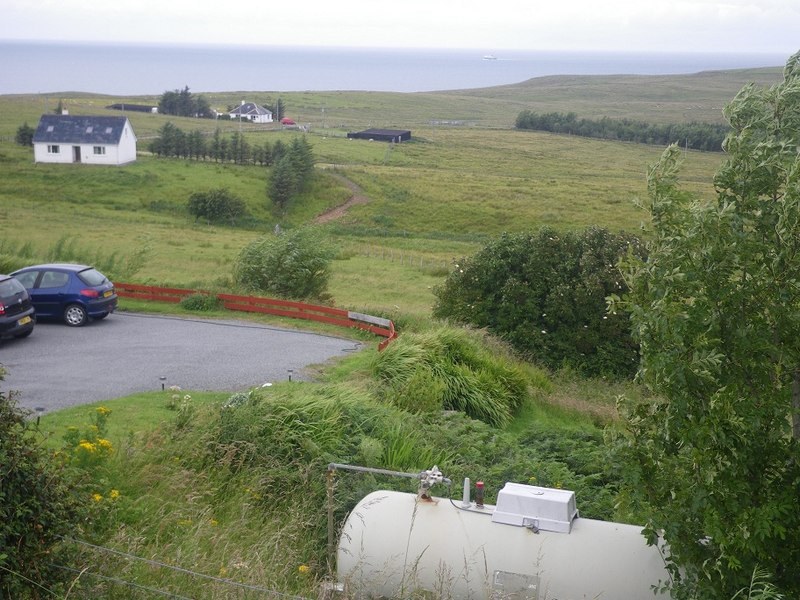
Stored Fuel. A propane tank stores fuel near a house. When propane burns completely in oxygen, it produces carbon dioxide and water and releases heat.
Credits: Propane tank in a coastal scene - geograph.org.uk - 3058337 — C Michael Hogan, CC BY-SA 2.0. Images resized for the web.
Solution to Exercise 4 #
C3H6O + 4O2 → 3CO2 + 3H2O
Exercises
Solution to Exercise 5 #
a. not composition b. composition
Solution to Exercise 7 #
a. composition b. composition
Solution to Exercise 9 #
a. not decomposition b. decomposition
Solution to Exercise 11 #
a. not decomposition b. decomposition
Solution to Exercise 13 #
a. combustion b. combustion
Solution to Exercise 15 #
a. combustion b. combustion
Solution to Exercise 17 #
Yes; 2H2 + O2 → 2H2O (answers will vary)
Solution to Exercise 19 #
a. C4H9OH + 6O2 → 4CO2 + 5H2O b. 4CH3NO2 + 3O2 → 4CO2 + 6H2O + 2N2