There are other units in chemistry that are important, and we will cover others in the course of the entire book. One of the fundamental quantities in science is temperature. Temperature (A measure of the average amount of kinetic energy a system contains.) is a measure of the average amount of energy of motion, or kinetic energy, a system contains. Temperatures are expressed using scales that use units called degrees (The unit of temperature scales.), and there are several temperature scales in use. In the United States, the commonly used temperature scale is the Fahrenheit scale (symbolized by °F and spoken as “degrees Fahrenheit”). On this scale, the freezing point of liquid water (the temperature at which liquid water turns to solid ice) is 32°F, and the boiling point of water (the temperature at which liquid water turns to steam) is 212°F.
Science also uses other scales to express temperature. The Celsius scale (symbolized by °C and spoken as “degrees Celsius”) is a temperature scale where 0°C is the freezing point of water and 100°C is the boiling point of water; the scale is divided into 100 divisions between these two landmarks and extended higher and lower. By comparing the Fahrenheit and Celsius scales, a conversion between the two scales can be determined:
Using these formulas, we can convert from one temperature scale to another. The number 32 in the formulas is exact and does not count in significant figure determination.
Solution to Exercise 1 #
Solution to Exercise 2 #
−17.8°C
414°F
The fundamental unit of temperature (another fundamental unit of science, bringing us to four) in SI is the kelvin (The fundamental unit of temperature in SI.) (K). The Kelvin temperature scale (note that the name of the scale capitalizes the word Kelvin, but the unit itself is lowercase) uses degrees that are the same size as the Celsius degree, but the numerical scale is shifted up by 273.15 units. That is, the conversion between the Kelvin and Celsius scales is as follows:
For most purposes, it is acceptable to use 273 instead of 273.15. Note that the Kelvin scale does not use the word degrees; a temperature of 295 K is spoken of as “two hundred ninety-five kelvins” and not “two hundred ninety-five degrees Kelvin.”
The reason that the Kelvin scale is defined this way is because there exists a minimum possible temperature called absolute zero (The minimum possible temperature, labeled 0 K (zero kelvins).). The Kelvin temperature scale is set so that 0 K is absolute zero, and temperature is counted upward from there. Normal room temperature is about 295 K, as seen in the following example.
Solution to Exercise 3 #
First, we use the formula to determine the temperature in degrees Celsius:
Then we use the appropriate formula above to determine the temperature in the Kelvin scale:
So, room temperature is about 295 K.
Solution to Exercise 4 #
310.2 K
Figure 2.9 "Fahrenheit, Celsius, and Kelvin Temperatures" compares the three temperature scales. Note that science uses the Celsius and Kelvin scales almost exclusively; virtually no practicing chemist expresses laboratory-measured temperatures with the Fahrenheit scale. (The Fahrenheit scale remains common in everyday weather reports in the United States, while many countries use degrees Celsius.)
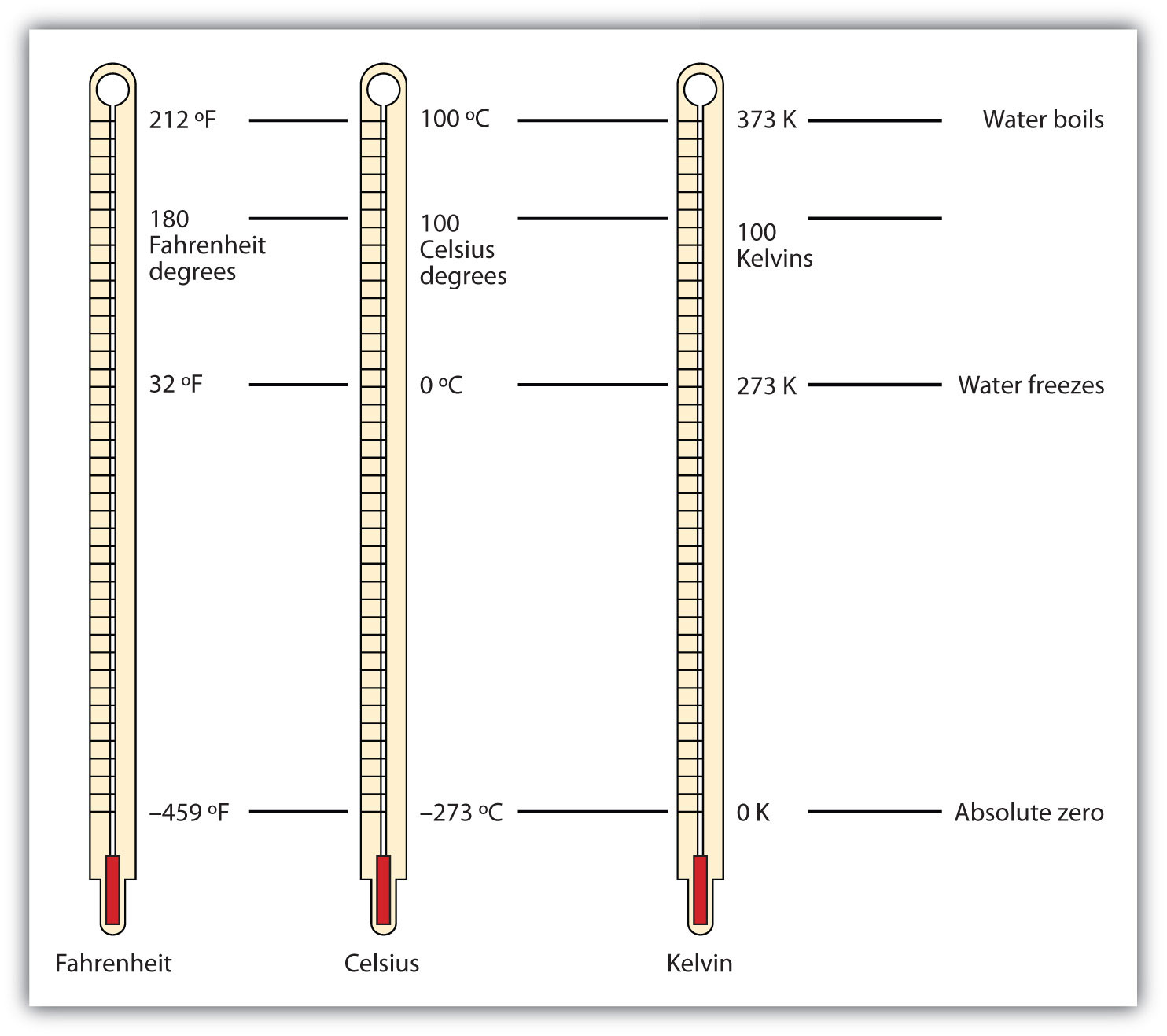
Figure 1:Fahrenheit, Celsius, and Kelvin Temperatures. A comparison of the three temperature scales.
Density (A physical property defined as a substance’s mass divided by its volume.) is a physical property that is defined as a substance’s mass divided by its volume:
Density is usually a measured property of a substance, so its numerical value affects the significant figures in a calculation. Notice that density is defined in terms of two dissimilar units, mass and volume. That means that density overall has derived units, just like velocity. Common units for density include g/mL, g/cm3, g/L, kg/L, and even kg/m3. Densities for some common substances are listed in Table 2.2 "Densities of Some Common Substances".
Table 1:Densities of Some Common Substances
| Substance | Density (g/mL or g/cm3) |
|---|---|
| water | 1.0 |
| gold | 19.3 |
| mercury | 13.6 |
| air | 0.0012 |
| cork | 0.22–0.26 |
| aluminum | 2.7 |
| iron | 7.87 |
Because of how it is defined, density can act as a conversion factor for switching between units of mass and volume. For example, suppose you have a sample of aluminum that has a volume of 7.88 cm3. How can you determine what mass of aluminum you have without measuring it? You can use the volume to calculate it. If you multiply the given volume by the known density (from Table 2.2 "Densities of Some Common Substances"), the volume units will cancel and leave you with mass units, telling you the mass of the sample:
where we have limited our answer to two significant figures.
Solution to Exercise 5 #
Use the density from Table 2.2 "Densities of Some Common Substances" as a conversion factor to go from volume to mass:
The mass of the mercury is 607 g.
Solution to Exercise 6 #
197 g
Density can also be used as a conversion factor to convert mass to volume—but care must be taken. We have already demonstrated that the number that goes with density normally goes in the numerator when density is written as a fraction. Take the density of gold, for example:
Although this was not previously pointed out, it can be assumed that there is a 1 in the denominator:
That is, the density value tells us that we have 19.3 grams for every 1 milliliter of volume, and the 1 is an exact number. When we want to use density to convert from mass to volume, the numerator and denominator of density need to be switched—that is, we must take the reciprocal of the density. In so doing, we move not only the units but also the numbers:
This reciprocal density is still a useful conversion factor, but now the mass unit will cancel and the volume unit will be introduced. Thus, if we want to know the volume of 45.9 g of gold, we would set up the conversion as follows:
Note how the mass units cancel, leaving the volume unit, which is what we’re looking for.
Solution to Exercise 7 #
Solution to Exercise 8 #
0.196 cm3
Care must be used with density as a conversion factor. Make sure the mass units are the same, or the volume units are the same, before using density to convert to a different unit. Often, the unit of the given quantity must be first converted to the appropriate unit before applying density as a conversion factor.
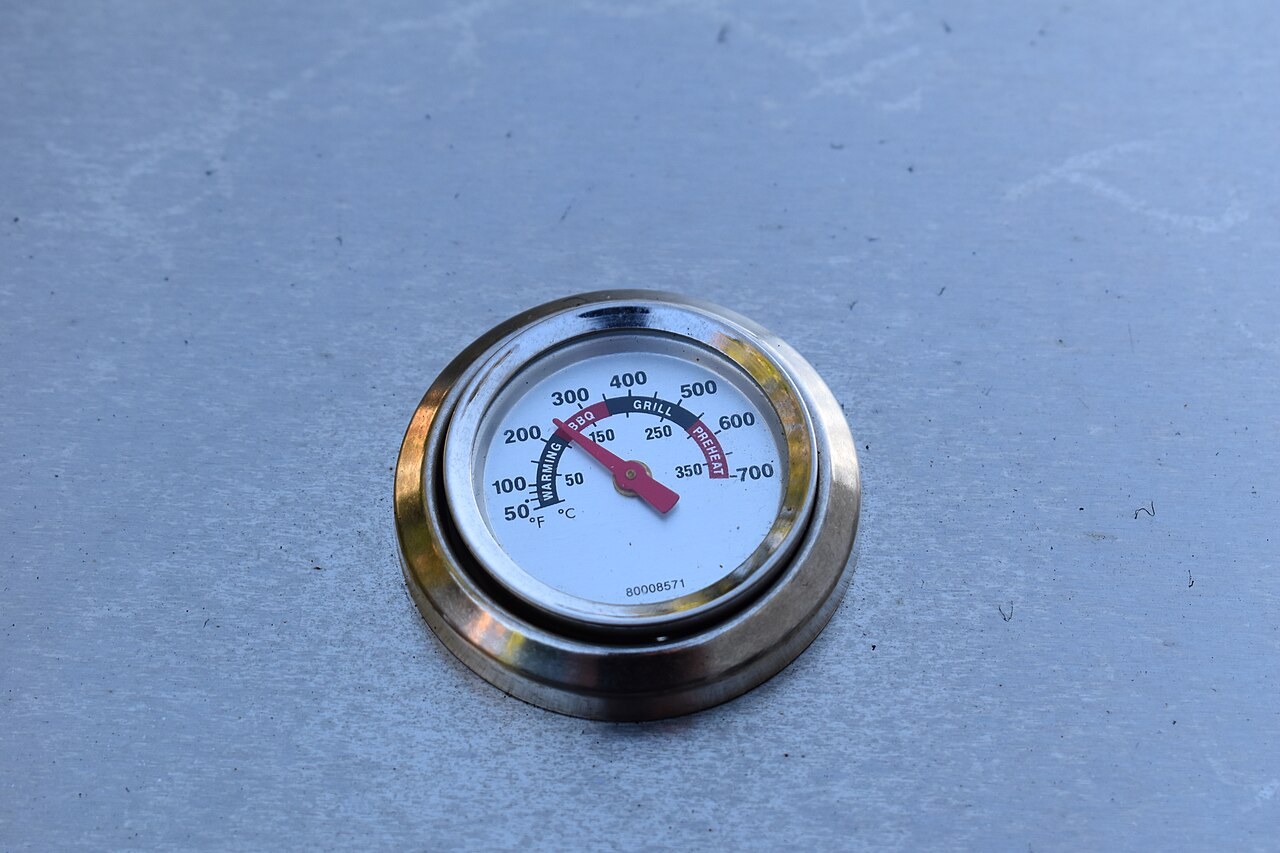
Cooking Temperatures. This oven thermometer includes Fahrenheit and Celsius scales. The same temperature can be expressed by different numerical values on the two scales.
Credits: Oven thermometer 1 2017-07-24 — F ASTILY, CC BY-SA 4.0. Images resized for the web.
Exercises
Solution to Exercise 9 #
a. 124°C b. −159°C c. 122°F d. −58°F
Solution to Exercise 11 #
a. 373 K b. 173 K c. −173°C d. 27°C
Solution to Exercise 13 #
−273°C. This is the lowest possible temperature in degrees Celsius.
Solution to Exercise 15 #
56.7°C; 329.8 K. Using the conversion formulas, °C, and K.
Solution to Exercise 17 #
g/mL, g/L, and kg/L (answers will vary)
Solution to Exercise 19 #
379 g
Solution to Exercise 21 #
1.80 × 10⁷ g
Solution to Exercise 23 #
15 g
Solution to Exercise 25 #
8.818 cm3
Solution to Exercise 27 #
247 L
Solution to Exercise 29 #
The 100.0 g of iron has the greater volume.