We’ll now consider initial value problems of the form
where \(a\), \(b\), and \(c\) are constants (\(a\ne0\)) and \(f\) is piecewise continuous on \([0,\infty)\). Problems of this kind occur in situations where the input to a physical system undergoes instantaneous changes, as when a switch is turned on or off or the forces acting on the system change abruptly.
It can be shown (Exercises 23 and 24) that the differential equation in (8.5.1) has no solutions on an open interval that contains a jump discontinuity of \(f\). Therefore we must define what we mean by a solution of (8.5.1) on \([0,\infty)\) in the case where \(f\) has jump discontinuities. The next theorem motivates our definition. We omit the proof.
Theorem 8.5.1
Suppose \(a,b\), and \(c\) are constants \((a\ne0),\) and \(f\) is piecewise continuous on \([0,\infty).\) with jump discontinuities at \(t_1,\) …, \(t_n,\) where
Let \(k_0\) and \(k_1\) be arbitrary real numbers. Then there is a unique function \(y\) defined on \([0,\infty)\) with these properties:
\(y(0)=k_0\) and \(y'(0)=k_1\).
\(y\) and \(y'\) are continuous on \([0,\infty)\).
\(y''\) is defined on every open subinterval of \([0,\infty)\) that does not contain any of the points \(t_1,\) …, \(t_n\), and
\[ ay''+by'+cy=f(t) \]on every such subinterval.
\(y''\) has limits from the right and left at \(t_1,\) …\(,\) \(t_n\).
We define the function \(y\) of Theorem 8.5.1 to be the solution of the initial value problem (8.5.1).
We begin by considering initial value problems of the form
where the forcing function has a single jump discontinuity at \(t_1\).
We can solve (8.5.2) by the these steps:
Step 1. Find the solution \(y_0\) of the initial value problem
\[ ay''+by'+cy=f_0(t), \quad y(0)=k_0,\quad y'(0)=k_1. \]Step 2. Compute \(c_0=y_0(t_1)\) and \(c_1=y_0'(t_1)\).
Step 3. Find the solution \(y_1\) of the initial value problem
\[ ay''+by'+cy=f_1(t), \quad y(t_1)=c_0,\quad y'(t_1)=c_1. \]Step 4. Obtain the solution \(y\) of (8.5.2) as
\[ y=\left\{\begin{array}{cl} y_0(t),&0\le t<t_1\\[3pt]y_1(t),&t\ge t_1. \end{array}\right. \]
It is shown in Exercise 23 that \(y'\) exists and is continuous at \(t_1\). The next example illustrates this procedure.
Example 8.5.1
Solve the initial value problem
where
Solution The initial value problem in Step 1 is
We leave it to you to verify that its solution is
Doing Step 2 yields \(y_0(\pi/2)=0\) and \(y_0'(\pi/2)=-1\), so the second initial value problem is
We leave it to you to verify that the solution of this problem is
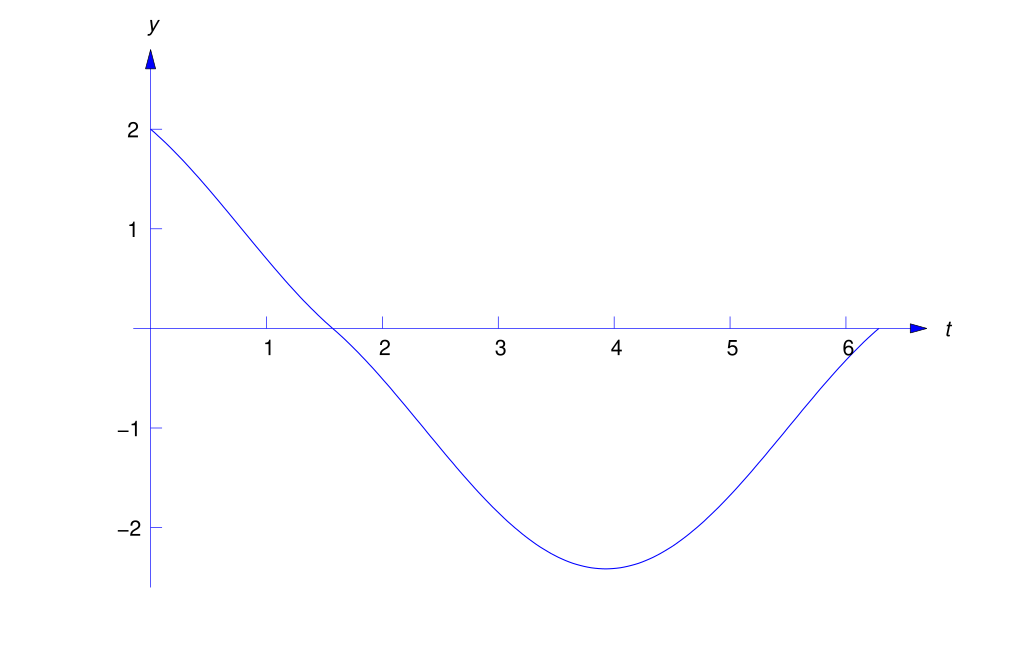
Hence, the solution of (8.5.3) is
(Figure:8.5.1).
If \(f_0\) and \(f_1\) are defined on \([0,\infty)\), we can rewrite (8.5.2) as
and apply the method of Laplace transforms. We’ll now solve the problem considered in Example 8.5.1 by this method.
Example 8.5.2
Use the Laplace transform to solve the initial value problem
where
Solution Here
so Theorem 8.4.1 (with \(g(t)=1\)) implies that
Therefore, transforming (8.5.5) yields
so
with
The form for the partial fraction expansion of \(G\) is
Multiplying through by \(s(s^2+1)\) yields
or
Equating coefficients of like powers of \(s\) on the two sides of this equation shows that \(A=1\), \(B=-A=-1\) and \(C=0\). Hence, from (8.5.7),
Therefore
From this, (8.5.6), and Theorem 8.4.2,
Simplifying this (recalling that \(\cos (t-\pi/2)=\sin t)\) yields
or
which is the result obtained in Example 8.5.1.
Remark
It isn’t obvious that using the Laplace transform to solve (8.5.2) as we did in Example 8.5.2 yields a function \(y\) with the properties stated in Theorem 8.5.1; that is, such that \(y\) and \(y'\) are continuous on \([0,\infty)\) and \(y''\) has limits from the right and left at \(t_1\). However, this is true if \(f_0\) and \(f_1\) are continuous and of exponential order on \([0,\infty)\). A proof is sketched in Exercises 8.6. 11–8.6.13.
Example 8.5.3
Solve the initial value problem
where
Solution Here
so
Since transforming (8.5.8) yields
we see that
where
therefore
Since
we conclude from (8.5.9), (8.5.10), and Theorem 8.4.1 that
or
We leave it to you to verify that \(y\) and \(y'\) are continuous and \(y''\) has limits from the right and left at \(t_1=1\).
Example 8.5.4
Solve the initial value problem
where
Solution Here
so
Since transforming (8.5.12) yields
we see that
where
To simplify the required partial fraction expansions, we first write
Setting \(x=s^2\) and substituting the result in (8.5.14) yields
The inverse transforms are
From (8.5.13) and Theorem 8.4.2,
Since
and
(8.5.15) can be rewritten as
or
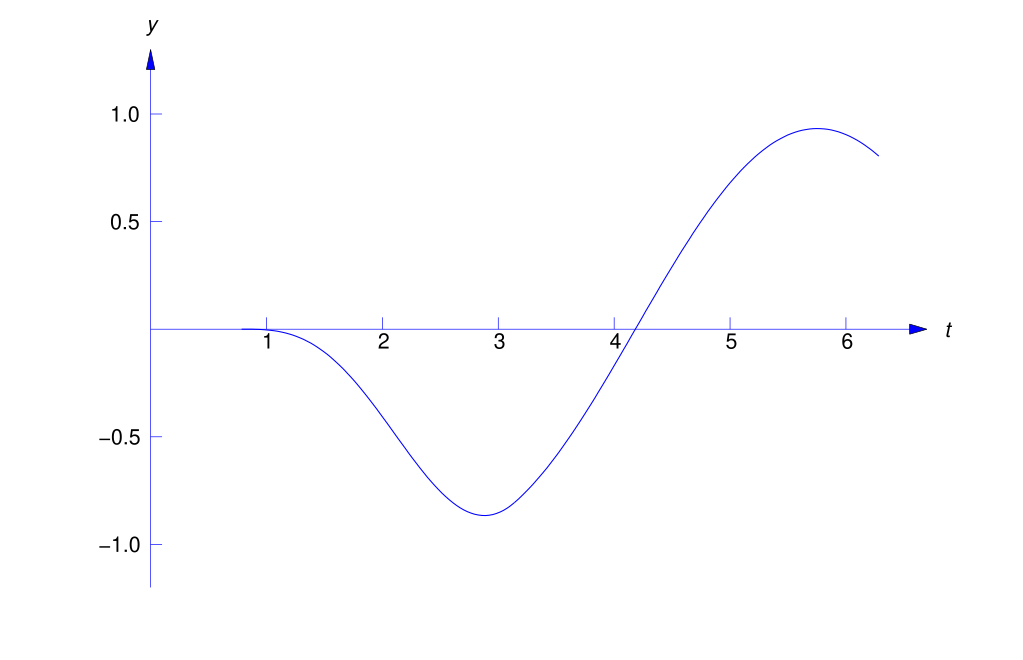
We leave it to you to verify that \(y\) and \(y'\) are continuous and \(y''\) has limits from the right and left at \(t_1=\pi/4\) and \(t_2=\pi\) (Figure 8.5.2).
8.5 Exercises
In Exercises 1–20 use the Laplace
transform to solve the initial value problem.
Where indicated by
C/G , graph the solution.
-
\(\dst{y''+y=\left\{\begin{array}{cl} 3,& 0\le t<\pi,\\[6pt] 0,&t\ge\pi,\end{array}\right.\qquad y(0)=0, \quad y'(0)=0}\)
Show answer
\(y=3(1-\cos t)-3u(t-\pi)(1+\cos t)\)
-
\(\dst{y''+y=\left\{\begin{array}{cl} 3,&0\le t<4,\\; 2t-5,&t > 4,\end{array}\right.\qquad y(0)=1,\quad y'(0)=0}\)
Show answer
\(y=3-2\cos t+2u(t-4)\left(t-4-\sin (t-4)\right)\)
-
\(\dst{y''-2y'= \left\{\begin{array}{cl} 4,&0\le t<1,\\[6pt] 6,&t\ge 1,\end{array}\right.\qquad y(0)=-6,\quad y'(0)=1 }\)
Show answer
\(y=\dst{-{15\over2}+{3\over 2}e^{2t}-2t+{u(t-1)\over2} (e^{2(t-1)}-2t+1)}\)
-
\(\dst{y''-y=\left\{\begin{array}{cl} e^{2t},&0\le t< 2,\\[6pt] 1,&t\ge 2,\end{array}\right.\qquad y(0)=3,\quad y'(0)=-1 }\)
Show answer
\(y=\dst{{1\over2}e^t+{13\over6}e^{-t}+ {1\over 3}e^{2t} +u(t-2)\left(-1+{1\over 2}e^{t-2}+{1\over2}e^{-(t-2)}+ {1\over2}e^{t+2}-{1\over6} e^{-(t-6)}-{1\over3}e^{2t}\right)}\)
-
\(\dst{y''-3y'+2y= \left\{\begin{array}{rl} 0,&0\le t<1,\\[6pt] 1,&1\le t<2,\\[6pt]-1,&t\ge 2, \end{array}\right.\qquad y(0)=-3,\quad y'(0)=1}\)
Show answer
\(y=\dst{-7e^t+4e^{2t}+u(t-1)\left({1\over 2}-e^{t-1}+{1\over2}e^{2(t-1)}\right) -2u(t-2)\left({1\over2}- e^{t-2}+{1\over2}e^{2(t-2)}\right)}\)
-
C/G \(\dst{y''+4y= \left\{\begin{array}{cl}|\sin t|,&0\le t<2\pi,\\[6pt] 0,&t\ge 2\pi,\end{array}\right.\qquad y(0)=-3,\quad y'(0)=1}\)
Show answer
\(y=\dst{{1\over3}\sin2t-3\cos2t+{1\over3}\sin t -2 u(t-\pi)\left({1\over3}\sin t+{1\over6}\sin2t\right) +u(t-2\pi)\left({1\over3}\sin t-{1\over6}\sin2t\right)}\)
-
\(\dst{y''-5y'+4y= \left\{\begin{array}{rl} 1,&0\le t<1\\[6pt] -1,&1\le t<2,\\[6pt] 0,&t\ge 2,\end{array}\right.\qquad y(0)=3,\quad y'(0)=-5}\)
Show answer
\(y=\dst{{1\over4}-{31\over12} e^{4t}+{16\over3} e^t +u(t-1)\left({2\over3}e^{t-1}-{1\over6}e^{4(t-1)}-{1\over2} \right) +u(t-2)\left({1\over4}+{1 \over12} e^{4(t-2)}-{1\over3} e^{t-2}\right)}\)
-
\(\dst{y''+9y= \left\{\begin{array}{cl} \cos t,&0\le t<\dst{{3\pi\over2}},\\[6pt] \sin t,&t\ge\dst{{3\pi\over2}},\end{array}\right.\qquad y(0)=0,\; y'(0)=0}\)
Show answer
\(y=\dst{{1\over8}\left(\cos t-\cos 3t\right) - {1\over8} u\left( t-{3\pi\over2}\right)\left(\sin t-\cos t+ \sin 3t-{1\over3}\cos 3t\right)}\)
-
C/G \(\dst{y''+4y= \left\{\begin{array}{cl} t,&0\le t<\dst{\pi \over2},\\[6pt]\pi,&t\ge\dst{ {\pi\over2}}, \end{array}\right.\quad y(0)=0,\quad y'(0)=0}\)
Show answer
\(y=\dst{ {t\over4}-{1\over8}\sin2t +{1\over8}u\left(t-{\pi\over2}\right) (\pi\cos2t-\sin2t+2\pi-2t)}\)
-
\(\dst{y''+y=\left\{\begin{array}{cl}\phantom{-}t,&0\le t<\pi, \\[6pt]-t,&t\ge\pi ,\end{array}\right.\; y(0)=0,\; y'(0)=0}\)
Show answer
\(y=\dst{t-\sin t-2u(t-\pi)(t+\sin t+\pi\cos t)}\)
-
\(\dst{y''-3y'+2y=\left\{\begin{array}{cl} 0,&0\le t<2,\\2t-4,&t\ge 2,\end{array}\right. ,\quad y(0)=0,\quad y'(0)=0}\)
Show answer
\(y=\dst{u(t-2)\left(t-{1\over2}+{e^{2(t-2)}\over2} -2e^{t-2}\right)}\)
-
\(\dst{y''+y=\left\{\begin{array}{cl} t,&0\le t<2\pi,\\-2t,&t\ge 2\pi,\end{array}\right.\quad y(0)=1,\quad y'(0)=2}\)
Show answer
\(y=\dst{t+\sin t+\cos t-u(t-2\pi)(3t-3\sin t-6\pi\cos t)}\)
-
C/G \(\dst{y''+3y'+2y=\left\{\begin{array}{cl}\phantom{-}1,&0\le t<2,\\-1,&t\ge 2,\end{array}\right.\; y(0)=0,\; y'(0)=0}\)
Show answer
\(y=\dst{{1\over2}+{1\over2}e^{-2t}-e^{-t}+u(t-2)\left(2 e^{-(t-2)}-e^{-2(t-2)}-1\right)}\)
-
\(\dst{y''-4y'+3y=\left\{\begin{array}{cl}-1,&0\le t<1,\\\phantom{-}1,&t\ge 1,\end{array}\right.\; y(0)=0,\; y'(0)=0}\)
Show answer
\(y=\dst{-{1\over3}-{1\over6}e^{3t} +{1\over2}e^t+u(t-1)\left({2\over3}+{1\over3}e^{3(t-1)} -e^{t-1}\right)}\)
-
\(\dst{y''+2y'+y=\left\{\begin{array}{cl} e^t,&0\le t<1,\\e^t-1,&t\ge 1,\end{array}\right.\; y(0)=3,\; y'(0)=-1}\)
Show answer
\(y=\dst{{1\over4}\left(e^t+e^{-t}(11+6t)\right) +u(t-1)(te^{-(t-1)}-1)}\)
-
\(\dst{y''+2y'+y=\left\{\begin{array}{cl} 4e^t,&0\le t<1,\\0,&t\ge 1,\end{array}\right.\; y(0)=0,\; y'(0)=0}\)
Show answer
\(y=e^t-e^{-t}-2te^{-t}-u(t-1)\left(e^t-e^{-(t-2)}-2(t-1)e^{-(t-2)}\right)\)
-
\(\dst{y''+3y'+2y=\left\{\begin{array}{cl} e^{-t},&0\le t<1,\\0,&t\ge 1,\end{array}\right.\; y(0)=1,\; y'(0)=-1}\)
Show answer
\(y=\dst{te^{-t}+e^{-2t}+u(t-1)\left(e^{-t}(2-t)-e^{-(2t-1)}\right)}\)
-
\(\dst{y''-4y'+4y=\left\{\begin{array}{rl} e^{2t},&0\le t<2,\\-e^{2t},&t\ge 2,\end{array}\right.\; y(0)=0,\; y'(0)=-1}\)
Show answer
\(y=y=\dst{t^2e^{2t}\over2}-te^{2t}-u(t-2)(t-2)^2e^{2t}\)
-
C/G \(\dst{y''=\left\{\begin{array}{cl}t^2,&0\le t<1,\\-t,&1\le t<2,\\t+1,&t\ge 2,\end{array}\right.\; y(0)=1,\; y'(0)=0}\)
Show answer
\(y=\dst{{t^4\over12}+1-{1\over12}u(t-1)(t^4+2t^3-10t+7)+ {1\over6}u(t-2)(2t^3+3t^2-36t+44)}\)
-
\(\dst{y''+2y'+2y=\left\{\begin{array}{rl}1,&0\le t<2\pi,\\t,&2\pi\le t<3\pi,\\-1,&t\ge 3\pi,\end{array}\right.\; y(0)=2,\quad y'(0)=-1}\)
Show answer
\(y=\dst{{1\over2}e^{-t}(3\cos t+\sin t)+{1\over2}}\)
\(\dst{-u(t-2\pi)\left( e^{-(t-2\pi)}\left((\pi-1)\cos t+{2\pi-1\over2}\sin t\right)+ 1-{t\over2}\right)}\)
\(\dst{-{1\over2}u(t-3\pi)\left(e^{-(t-3\pi)}(3\pi\cos t+(3\pi+1)\sin t )+t\right)}\)
-
Solve the initial value problem
\[ y''=f(t), \quad y(0)=0,\quad y'(0)=0, \]where
\[ f(t)=m+1,\quad m\le t<m+1,\quad m=0,1,2,\dots. \]Show answer
\(y=\dst{{t^2\over2}+\sum_{m=1}^\infty u(t-m){(t-m)^2\over2}}\)
-
Solve the given initial value problem and find a formula that does not involve step functions and represents \(y\) on each interval of continuity of \(f\).
\(y''+y=f(t), \quad y(0)=0,\quad y'(0)=0\);
\(f(t)=m+1,\quad m\pi\le t<(m+1)\pi,\quad m=0,1,2,\dots\).
\(y''+y=f(t), \quad y(0)=0,\quad y'(0)=0\);
\(f(t)=(m+1)t, \quad 2m\pi\le t<2(m+1)\pi,\quad m=0,1,2,\dots\) Hint: You’ll need the formula
\[ 1+2+\cdots+m={m(m+1)\over2}. \]\(y''+y=f(t), \quad y(0)=0,\quad y'(0)=0\);
\(f(t)=(-1)^m,\quad m\pi\le t<(m+1)\pi,\quad m=0,1,2,\dots.\)
\(y''-y=f(t), \quad y(0)=0,\quad y'(0)=0\);
\(f(t)=m+1,\quad m\le t<(m+1),\quad m=0,1,2,\dots.\)
Hint
You will need the formula
\[ 1+r+\cdots+r^m={1-r^{m+1}\over1-r}\; (r\ne1). \]\(y''+2y'+2y=f(t), \quad y(0)=0,\quad y'(0)=0\);
\(f(t)=(m+1)(\sin t+2\cos t),\quad 2m\pi\le t<2(m+1)\pi,\quad m=0,1,2,\dots.\)
(See the hint in (d).)
\(y''-3y'+2y=f(t), \quad y(0)=0,\quad y'(0)=0\);
\(f(t)=m+1,\quad m\le t<m+1,\quad m=0,1,2,\dots.\)
(See the hints in (b) and (d).)
Show answer
(a) \(y=\dst{\left\{\begin{array}{cll}2m+1-\cos t,&2m\pi\le t<(2m+1)\pi&(m=0,1,\dots)\\[3pt] 2m,&(2m-1)\pi\le t<2m\pi&(m=1,2,\dots)\end{array}\right.}\)
(b) \(y=(m+1)(t-\sin t-m\pi\cos t),\; 2m\pi\le t<(2m+2)\pi\quad (m=0,1,\dots)\)
(c) \(y=(-1)^m-(2m+1)\cos t,\; m\pi\le t<(m+1)\pi\quad(m=0,1,\dots)\)
(d) \(y=\dst{{e^{m+1}-1\over2(e-1)}(e^{t-m}+e^{-t})-m-1,\quad m\le t<m+1 \; (m=0,1\dots)}\)
(e) \(y=\dst{\left(m+1-\left({e^{2(m+1)\pi}-1\over e^{2\pi}-1}\right)e^{-t}\right)\sin t\; 2m\pi\le t<2(m+1)\pi\quad (m=0,1,\dots)}\)
(f) \(y=\dst{{m+1\over2}-e^{t-m}{e^{m+1}-1\over e-1}+{1\over2}e^{2(t-m)}{e^{2m+2}-1\over e^2-1}, \; m\le t<m+1\quad(m=0,1,\dots)}\)
-
Let \(g\) be continuous on \((\alpha,\beta)\) and differentiable on the \((\alpha,t_0)\) and \((t_0,\beta)\). Suppose \(A=\lim_{t\to t_0-}g'(t)\) and \(B=\lim_{t\to t_0+}g'(t)\) both exist. Use the mean value theorem to show that
\[ \lim_{t\to t_0-}{g(t)-g(t_0)\over t-t_0}=A\quad\mbox{ and }\quad \lim_{t\to t_0+}{g(t)-g(t_0)\over t-t_0}=B. \]Conclude from (a) that \(g'(t_0)\) exists and \(g'\) is continuous at \(t_0\) if \(A=B\).
Conclude from (a) that if \(g\) is differentiable on \((\alpha,\beta)\) then \(g'\) can’t have a jump discontinuity on \((\alpha,\beta)\).
-
Let \(a\), \(b\), and \(c\) be constants, with \(a\ne0\). Let \(f\) be piecewise continuous on an interval \((\alpha,\beta)\), with a single jump discontinuity at a point \(t_0\) in \((\alpha,\beta)\). Suppose \(y\) and \(y'\) are continuous on \((\alpha,\beta)\) and \(y''\) on \((\alpha,t_0)\) and \((t_0,\beta)\). Suppose also that
\[ ay''+by'+cy=f(t) \tag*{\rm (A)} \]on \((\alpha,t_0)\) and \((t_0,\beta)\). Show that
\[ y''(t_0+)-y''(t_0-)={f(t_0+)-f(t_0-)\over a}\ne0. \]Use (a) and Exercise 23(c) to show that (A) does not have solutions on any interval \((\alpha,\beta)\) that contains a jump discontinuity of \(f\).
-
Suppose \(P_0,P_1\), and \(P_2\) are continuous and \(P_0\) has no zeros on an open interval \((a,b)\), and that \(F\) has a jump discontinuity at a point \(t_0\) in \((a,b)\). Show that the differential equation
\[ P_0(t)y''+P_1(t)y'+P_2(t)y=F(t) \]has no solutions on \((a,b)\).Hint: Generalize the result of Exercise \(\ref{exer:8.5.24}\) and use Exercise \(\ref{exer:8.5.23}\part{c}\).
-
Let \(0=t_0<t_1<\cdots <t_n\). Suppose \(f_m\) is continuous on \([t_m,\infty)\) for \(m=1,\dots,n\). Let
\[ f(t)= \left\{\begin{array}{cl} f_m(t),&t_m\le t< t_{m+1},\quad m=1,\dots,n-1,\\ f_n(t),&t\ge t_n. \end{array}\right. \]Show that the solution of
\[ ay''+by'+cy=f(t), \quad y(0)=k_0,\quad y'(0)=k_1, \]as defined following Theorem 8.5.1, is given by
\[ y=\left\{\begin{array}{cl} z_0(t),&0\le t<t_1,\\[3pt] z_0(t)+ z_1(t),&t_1\le t<t_2,\\ &\vdots\\ z_0+\cdots+z_{n-1}(t),&t_{n-1}\le t<t_n,\\[3pt] z_0+\cdots+ z_n(t),&t\ge t_n, \end{array}\right. \]where \(z_0\) is the solution of
\[ az''+bz'+cz=f_0(t), \quad z(0)=k_0,\quad z'(0)=k_1 \]and \(z_m\) is the solution of
\[ az''+bz'+cz=f_m(t)-f_{m-1}(t), \quad z(t_m)=0,\quad z'(t_m)=0 \]for \(m=1,\dots,n\).