Notes
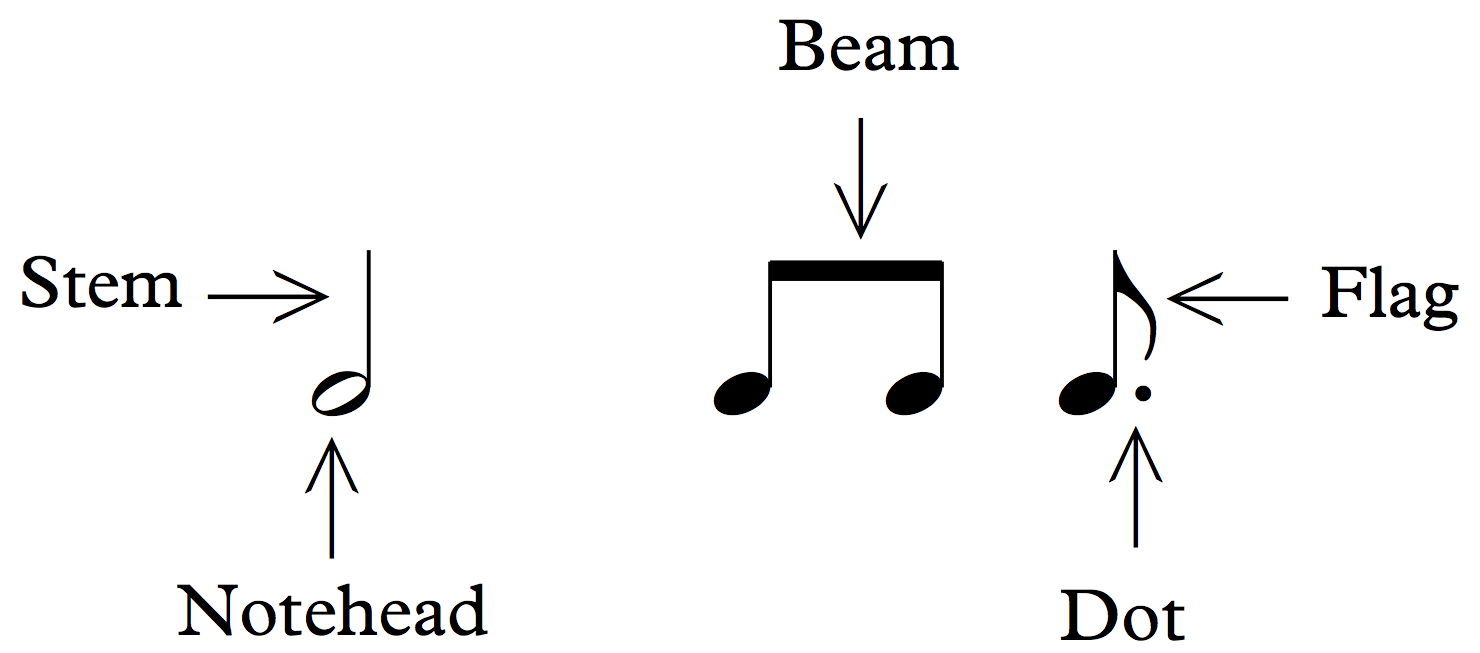
When written on a staff, a note indicates a pitch and rhythmic value. The notation consists of a notehead (either empty or filled in), and optionally can include a stem, beam, dot, or flag.
Staff
Notes can’t convey their pitch information without being placed on a staff. A staff consists of five horizontal lines, evenly spaced. The plural of staff is staves.
Clefs
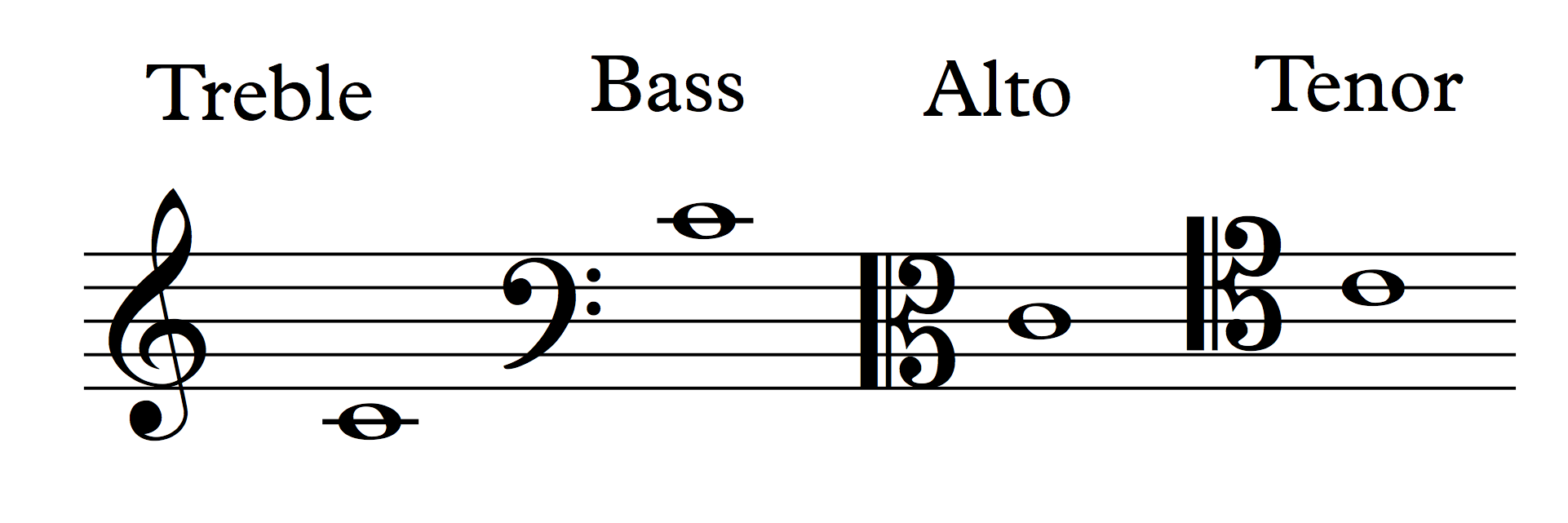
Notes still can’t convey their pitch information if the staff doesn’t include a clef. A clef indicates which pitches are assigned to the lines and spaces on a staff. The two most commonly used clefs are the treble and bass clef; others that you’ll see relatively frequently are alto and tenor clef.
Here is the pitch C4 placed on the treble, bass, alto, and tenor clefs.
Grand staff
The grand staff consists of two staves, one that uses a treble clef, and one that uses a bass clef. The staves are connected by a curly brace. Grand staves are used frequently for notating piano music and other polyphonic instruments.
Ledger lines
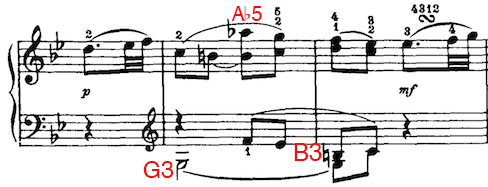
When the music’s range exceeds what can be written on the staff, extra lines are drawn so that we can still clearly read the pitch. These extra lines are called ledger lines. In the example below, From Haydn’s Piano Sonata in G (Hob. XVI: 39), Ab5 occurs just above the treble staff in the right hand, and G3 and B3 occur just below the treble staff in the left hand.
Accidentals
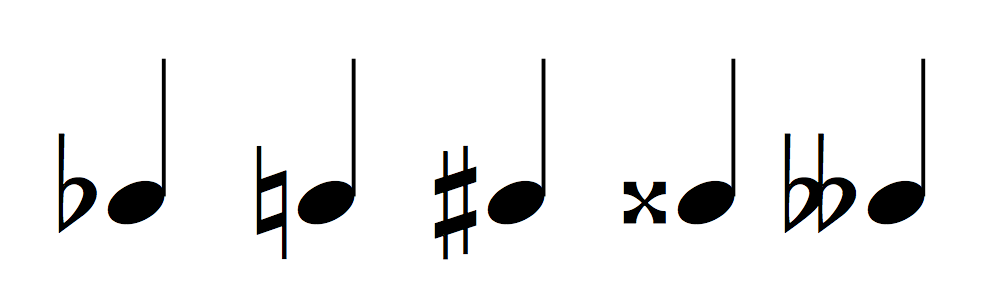
Accidentals are used to indicate when a pitch has been raised or lowered. They are written to the left of the pitch.
When you lower one of the white notes of the piano by a semitone, you add a flat.
When you raise one of the white notes of the piano by a semitone, you add a sharp.
When you raise a note that is already flat by a semitone, you add a natural.
When you lower a note that is already flat by a semitone, you add a double flat.
When you raise a note that is already sharp by a semitone, you add a double sharp.
The example below shows the symbols for flat, natural, sharp, double sharp, and double flat, respectively.