Consider this chemical reaction:
The reactants are two electrically neutral elements; they have the same number of electrons as protons. The product, however, is ionic; it is composed of Mg2+ and Cl− ions. Somehow, the individual Mg atoms lose two electrons to make the Mg2+ ion, while the Cl atoms gain an electron to become Cl− ions. This reaction involves the transfer of electrons between atoms.
The process of losing and gaining electrons occurs simultaneously. However, mentally we can separate the two processes. Oxidation (The loss of one or more electrons by an atom; an increase in oxidation number.) is defined as the loss of one or more electrons by an atom. Reduction (The gain of one or more electrons by an atom; a decrease in oxidation number.) is defined as the gain of one or more electrons by an atom. So oxidation and reduction always occur together; it is only mentally that we can separate them. Chemical reactions that involve the transfer of electrons are called oxidation-reduction (or redox) reactions (A chemical reaction that involves the transfer of electrons.).
Redox reactions require that we keep track of the electrons assigned to each atom in a chemical reaction. How do we do that? We use oxidation numbers (A number assigned to an atom that helps keep track of the number of electrons on the atom.) to keep track of electrons in atoms. Oxidation numbers are assigned to atoms based on four rules. Oxidation numbers are not necessarily equal to the charge on the atom (although sometimes they can be); we must keep the concepts of charge and oxidation numbers separate.
The rules for assigning oxidation numbers to atoms are as follows:
Atoms in their elemental state are assigned an oxidation number of 0.
Atoms in monatomic (i.e., one-atom) ions are assigned an oxidation number equal to their charge. Oxidation numbers are usually written with the sign first, then the magnitude, to differentiate them from charges.
In compounds, fluorine is assigned a −1 oxidation number; oxygen is usually assigned a −2 oxidation number [except in peroxide compounds (where it is −1) and in binary compounds with fluorine (where it is positive)]; and hydrogen is usually assigned a +1 oxidation number [except when it exists as the hydride ion (H−), in which case rule 2 prevails].
In compounds, all other atoms are assigned an oxidation number so that the sum of the oxidation numbers on all the atoms in the species equals the charge on the species (which is zero if the species is neutral).
Here are some examples for practice. In H2, both H atoms have an oxidation number of 0 by rule 1. In MgCl2, magnesium has an oxidation number of +2, while chlorine has an oxidation number of −1 by rule 2. In H2O, the H atoms each have an oxidation number of +1, while the O atom has an oxidation number of −2, even though hydrogen and oxygen do not exist as ions in this compound (rule 3). By contrast, by rule 3, each H atom in hydrogen peroxide (H2O2) has an oxidation number of +1, while each O atom has an oxidation number of −1. We can use rule 4 to determine oxidation numbers for the atoms in SO2. Each O atom has an oxidation number of −2; for the sum of the oxidation numbers to equal the charge on the species (which is zero), the S atom is assigned an oxidation number of +4. Does this mean that the sulfur atom has a 4+ charge on it? No, it means only that the S atom is assigned a +4 oxidation number by our rules of apportioning electrons among the atoms in a compound.
Solution to Exercise 1 #
Cl2 is the elemental form of chlorine. Rule 1 states each atom has an oxidation number of 0.
By rule 3, oxygen is normally assigned an oxidation number of −2. For the sum of the oxidation numbers to equal the charge on the species (zero), the Ge atom is assigned an oxidation number of +4.
Ca(NO3)2 can be separated into two parts: the Ca2+ ion and the NO3− ion. Considering these separately, the Ca2+ ion has an oxidation number of +2 by rule 2. Now consider the NO3− ion. Oxygen is assigned an oxidation number of −2, and there are three of them. According to rule 4, the sum of the oxidation numbers on all atoms must equal the charge on the species, so we have the simple algebraic equation
where x is the oxidation number of the N atom and the −1 represents the charge on the species. Evaluating for x,
Thus the oxidation number on the N atom in the NO3− ion is +5.
Solution to Exercise 2 #
H: +1; O: −2; P: +5
All redox reactions occur with a simultaneous change in the oxidation numbers of some atoms. At least two elements must change their oxidation numbers. When an oxidation number of an atom is increased in the course of a redox reaction, that atom is being oxidized. When an oxidation number of an atom is decreased in the course of a redox reaction, that atom is being reduced. Thus oxidation and reduction can also be defined in terms of increasing or decreasing oxidation numbers, respectively.
Solution to Exercise 3 #
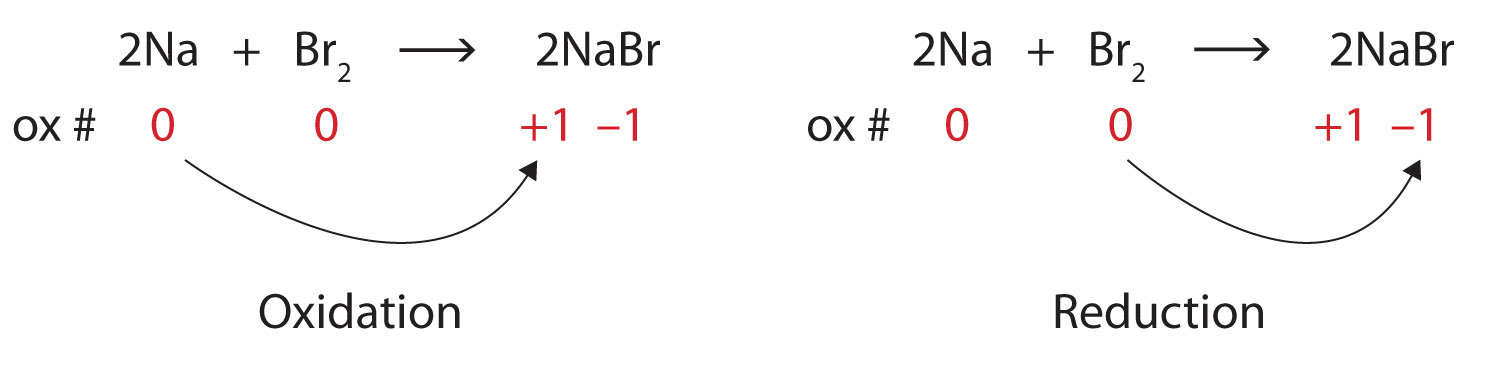
Both reactants are the elemental forms of their atoms, so the Na and Br atoms have oxidation numbers of 0. In the ionic product, the Na+ ions have an oxidation number of +1, while the Br− ions have an oxidation number of −1.
Sodium is increasing its oxidation number from 0 to +1, so it is being oxidized; bromine is decreasing its oxidation number from 0 to −1, so it is being reduced:
14.1 Oxidation-Reduction Reactions
Because oxidation numbers are changing, this is a redox reaction. The total number of electrons being lost by sodium (two, one lost from each Na atom) is gained by bromine (two, one gained for each Br atom).
Solution to Exercise 4 #
C is being oxidized from 0 to +4; O is being reduced from 0 to −2.
Oxidation reactions can become quite complex, as attested by the following redox reaction:
To demonstrate that this is a redox reaction, the oxidation numbers of the species being oxidized and reduced are listed; can you determine what is being oxidized and what is being reduced? This is also an example of a net ionic reaction; spectator ions that do not change oxidation numbers are not displayed in the equation. Eventually, we will need to learn techniques for writing correct (i.e., balanced) redox reactions.
Exercises
Solution to Exercise 5 #
yes because oxidation numbers are changing
Solution to Exercise 7 #
lose: Mg; gain: O
Solution to Exercise 9 #
oxidized: Li; reduced: O
Solution to Exercise 11 #
increase in oxidation number; loss of electrons
Solution to Exercise 13 #
a. P: 0 b. S: +6; O: −2 c. S: +4; O: −2 d. Ca: +2; P: +3; O: −2
Solution to Exercise 15 #
a. N: +2; O: −2 b. N: +4; O: −2 c. Cr: +2; Cl: −1 d. Cr: +3; Cl: −1
Solution to Exercise 17 #
a. C: 0; H: +1; O: −2 b. N: −3; H: +1 c. Rb: +1; S: +6; O: −2 d. Zn: +2; C: 0; H: +1; O: −2
Solution to Exercise 19 #
oxidized: N; reduced: Cl
Solution to Exercise 21 #
oxidized: O; reduced: Kr
Solution to Exercise 23 #
oxidized: Rb; reduced: Mg