Once equilibrium is established, the reaction is over, right? Not exactly. An experimenter has some ability to affect the equilibrium.
Chemical equilibria can be shifted by changing the conditions that the system experiences. We say that we “stress” the equilibrium. When we stress the equilibrium, the chemical reaction is no longer at equilibrium, and the reaction starts to move back toward equilibrium in such a way as to decrease the stress. The formal statement is called Le Chatelier’s principle (If an equilibrium is stressed, then the reaction shifts to reduce the stress.): If an equilibrium is stressed, then the reaction shifts to reduce the stress.
There are several ways to stress an equilibrium. One way is to add or remove a product or a reactant in a chemical reaction at equilibrium. When additional reactant is added, the equilibrium shifts to reduce this stress: it makes more product. When additional product is added, the equilibrium shifts to reactants to reduce the stress. If reactant or product is removed, the equilibrium shifts to make more reactant or product, respectively, to make up for the loss.
Solution to Exercise 1 #
If H2 is added, there is now more reactant, so the reaction will shift toward products to reduce the added H2.
If NH3 is added, there is now more product, so the reaction will shift toward reactants to reduce the added NH3.
If NH3 is removed, there is now less product, so the reaction will shift toward products to replace the product removed.
Solution to Exercise 2 #
toward reactants
toward reactants
It is worth noting that when reactants or products are added or removed, the value of the Keq does not change. The chemical reaction simply shifts, in a predictable fashion, to reestablish concentrations so that the Keq expression reverts to the correct value.
How does an equilibrium react to a change in pressure? Pressure changes do not markedly affect the solid or liquid phases. However, pressure strongly impacts the gas phase. Le Chatelier’s principle implies that a pressure increase shifts an equilibrium to the side of the reaction with the fewer number of moles of gas, while a pressure decrease shifts an equilibrium to the side of the reaction with the greater number of moles of gas. If the number of moles of gas is the same on both sides of the reaction, pressure has no effect.
Solution to Exercise 3 #
According to Le Chatelier’s principle, if pressure is increased, then the equilibrium shifts to the side with the fewer number of moles of gas. This particular reaction shows a total of 4 mol of gas as reactants and 2 mol of gas as products, so the reaction shifts toward the products side.
Solution to Exercise 4 #
Reaction shifts toward reactants.
What is the effect of temperature changes on an equilibrium? It depends on whether the reaction is endothermic or exothermic. Recall that endothermic means that energy is absorbed by a chemical reaction, while exothermic means that energy is given off by the reaction. As such, energy can be thought of as a reactant or a product, respectively, of a reaction:
Because temperature is a measure of the energy of the system, increasing temperature can be thought of as adding energy. The reaction will react as if a reactant or a product is being added and will act accordingly by shifting to the other side. For example, if the temperature is increased for an endothermic reaction, essentially a reactant is being added, so the equilibrium shifts toward products. Decreasing the temperature is equivalent to decreasing a reactant (for endothermic reactions) or a product (for exothermic reactions), and the equilibrium shifts accordingly.
Solution to Exercise 5 #
Because energy is listed as a product, it is being produced, so the reaction is exothermic. If the temperature is increasing, a product is being added to the equilibrium, so the equilibrium shifts to minimize the addition of extra product: it shifts back toward reactants.
Solution to Exercise 6 #
Equilibrium shifts toward reactants.
In the case of temperature, the value of the equilibrium has changed because the Keq is dependent on temperature. That is why equilibria shift with changes in temperature.
A catalyst (A substance that increases the speed of a reaction.) is a substance that increases the speed of a reaction. Overall, a catalyst is not a reactant and is not used up, but it still affects how fast a reaction proceeds. However, a catalyst does not affect the extent or position of a reaction at equilibrium. It helps a reaction achieve equilibrium faster.
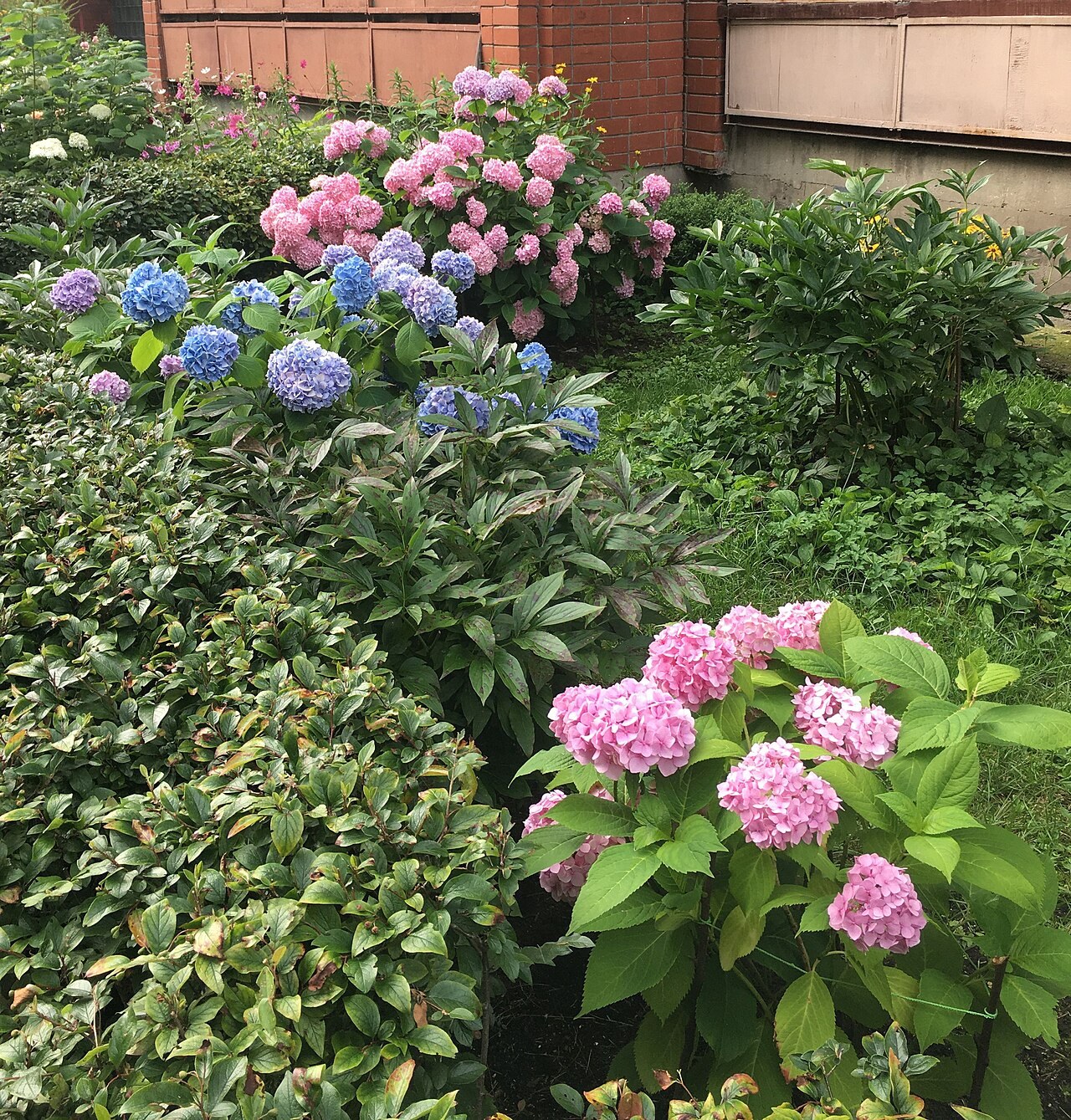
Figure 13.1:Garden Equilibria. Hydrangea macrophylla can produce pink or blue flowers. Soil conditions affect the availability of aluminum to the plant, which influences the flower color.
Credits: Hydrangea macrophylla pink and blue — Gustamons, CC0. Images resized for the web.
Exercises
Solution to Exercise 7 #
When an equilibrium is stressed, the equilibrium shifts to minimize that stress.
Solution to Exercise 9 #
a. toward reactants b. toward reactants c. toward products
Solution to Exercise 11 #
a. toward products b. toward products c. toward products
Solution to Exercise 13 #
increased pressure, decreased temperature, removal of NH3