In all the previous calculations we have performed involving balanced chemical equations, we made two assumptions: (1) the reaction goes exactly as written, and (2) the reaction proceeds completely. In reality, such things as side reactions occur that make some chemical reactions rather messy. For example, in the actual combustion of some carbon-containing compounds, such as methane, some CO is produced as well as CO2. However, we will continue to ignore side reactions, unless otherwise noted.
The second assumption, that the reaction proceeds completely, is more troublesome. Many chemical reactions do not proceed to completion as written, for a variety of reasons (some of which we will consider in Chapter 13 "Chemical Equilibrium"). When we calculate an amount of product assuming that all the reactant reacts, we calculate the theoretical yield (An amount that is theoretically produced as calculated using the balanced chemical reaction.), an amount that is theoretically produced as calculated using the balanced chemical reaction.
In many cases, however, this is not what really happens. In many cases, less—sometimes much less—of a product is made during the course of a chemical reaction. The amount that is actually produced in a reaction is called the actual yield (The amount that is actually produced in a chemical reaction.). By definition, the actual yield is less than or equal to the theoretical yield. If it is not, then an error has been made.
Both theoretical yields and actual yields are expressed in units of moles or grams. It is also common to see something called a percent yield. The percent yield (Actual yield divided by theoretical yield times 100% to give a percentage between 0% and 100%.) is a comparison between the actual yield and the theoretical yield and is defined as
It does not matter whether the actual and theoretical yields are expressed in moles or grams, as long as they are expressed in the same units. However, the percent yield always has units of percent. Proper percent yields are between 0% and 100%—again, if percent yield is greater than 100%, an error has been made.
A mass-mass calculation can be performed to determine the theoretical yield. We need the molar masses of Zn (65.39 g/mol) and Zn(NO3)2 (189.41 g/mol). In three steps, the mass-mass calculation is
30.5 g Zn×65.39 g Zn1 mol Zn×1 mol Zn1 mol Zn(NO3)2×1 mol Zn(NO3)2189.41 g Zn(NO3)2=88.3 g Zn(NO3)2
Thus, the theoretical yield is 88.3 g of Zn(NO3)2. The actual yield is the amount that was actually made, which was 65.2 g of Zn(NO3)2. To calculate the percent yield, we take the actual yield and divide it by the theoretical yield and multiply by 100:
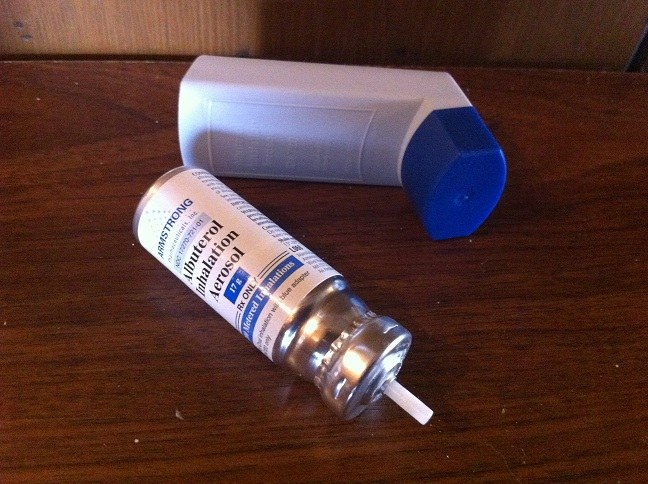
(a)An albuterol inhaler and its removable medicine canister.
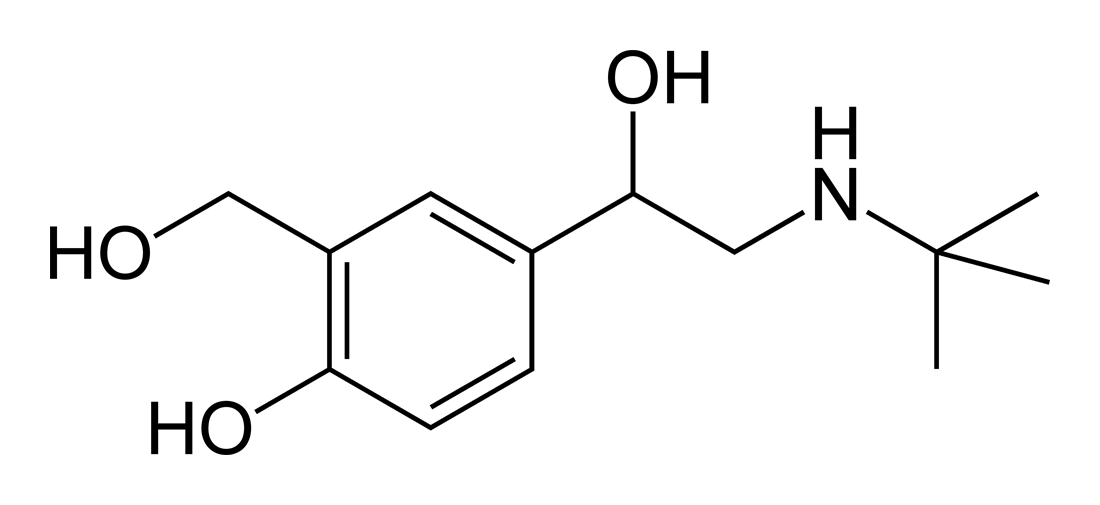
(b)A skeletal structural formula of albuterol showing its alcohol and amine groups.
Albuterol and Drug Purification. An albuterol inhaler and a structural formula of albuterol. Drug manufacture and purification often require several steps, so the overall yield depends on the yield of each step.