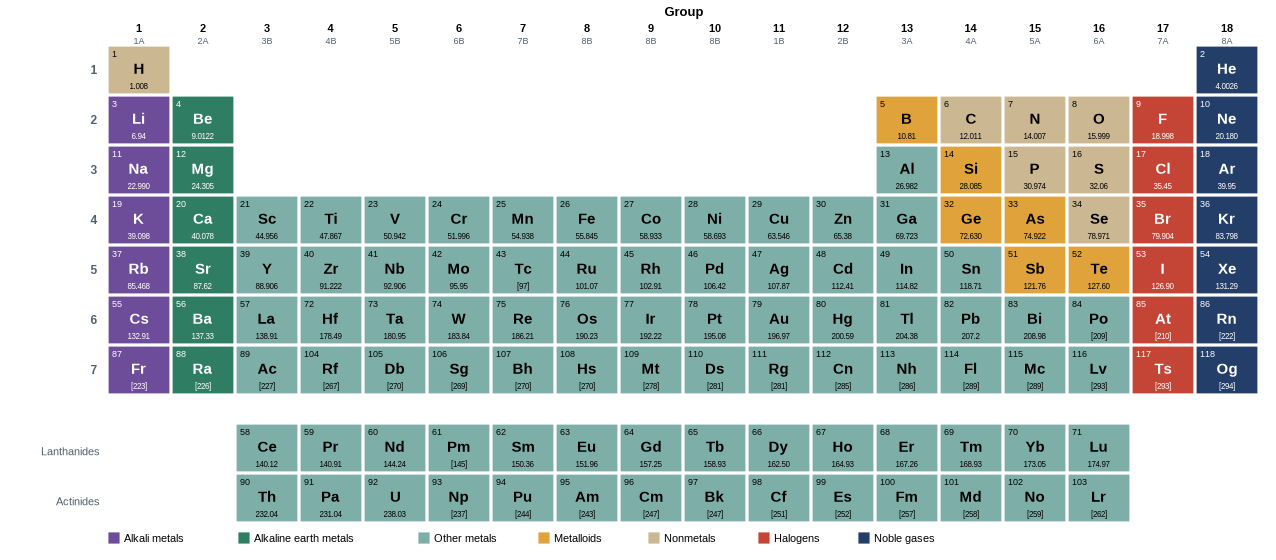
Diagram credit: original diagram for this edition (CC BY-NC-SA 3.0). Abridged atomic masses follow the 2024 standard atomic weights of the IUPAC Commission on Isotopic Abundances and Atomic Weights. A bracketed value is the mass number of the longest-lived isotope.
Two systems for numbering periodic groups are shown: 1--18 is the system currently recommended by the International Union of Pure and Applied Chemistry (IUPAC); an older U.S. system, in which letters designate main group elements (A) and transition elements (B), is given in parentheses.
An atomic mass in brackets indicates the mass number of the longest-lived isotope of an element that has no standard atomic weight. The figure shows abridged values. The list below is the reference table.
IUPAC has assigned official names and symbols to elements 113–118: nihonium (Nh), flerovium (Fl), moscovium (Mc), livermorium (Lv), tennessine (Ts), and oganesson (Og). None of them has a stable isotope.
List of Elements | List of Elements | List of Elements | List of Elements |
|---|---|---|---|
Name | Symbol | Atomic Number | Atomic Mass |
Actinium | Ac | 89 | [227]* |
Aluminum | Al | 13 | 26.9815384(3) |
Americium | Am | 95 | [243]* |
Antimony | Sb | 51 | 121.760(1) |
Argon | Ar | 18 | 39.95‡ |
Arsenic | As | 33 | 74.921595(6) |
Astatine | At | 85 | [210]* |
Barium | Ba | 56 | 137.327(7) |
Berkelium | Bk | 97 | [247]* |
Beryllium | Be | 4 | 9.0121831(5) |
Bismuth | Bi | 83 | 208.98040(1) |
Bohrium | Bh | 107 | [270]* |
Boron | B | 5 | 10.81‡ |
Bromine | Br | 35 | 79.904‡ |
Cadmium | Cd | 48 | 112.414(4) |
Calcium | Ca | 20 | 40.078(4) |
Californium | Cf | 98 | [251]* |
Carbon | C | 6 | 12.011‡ |
Cerium | Ce | 58 | 140.116(1) |
Cesium | Cs | 55 | 132.90545196(6) |
Chlorine | Cl | 17 | 35.45‡ |
Chromium | Cr | 24 | 51.9961(6) |
Cobalt | Co | 27 | 58.933194(3) |
Copernicium | Cn | 112 | [285]* |
Copper | Cu | 29 | 63.546(3) |
Curium | Cm | 96 | [247]* |
Darmstadtium | Ds | 110 | [281]* |
Dubnium | Db | 105 | [270]* |
Dysprosium | Dy | 66 | 162.500(1) |
Einsteinium | Es | 99 | [252]* |
Erbium | Er | 68 | 167.259(3) |
Europium | Eu | 63 | 151.964(1) |
Fermium | Fm | 100 | [257]* |
Flerovium | Fl | 114 | [289]* |
Fluorine | F | 9 | 18.998403162(5) |
Francium | Fr | 87 | [223]* |
Gadolinium | Gd | 64 | 157.249(2) |
Gallium | Ga | 31 | 69.723(1) |
Germanium | Ge | 32 | 72.630(8) |
Gold | Au | 79 | 196.966570(4) |
Hafnium | Hf | 72 | 178.486(6) |
Hassium | Hs | 108 | [270]* |
Helium | He | 2 | 4.002602(2) |
Holmium | Ho | 67 | 164.930329(5) |
Hydrogen | H | 1 | 1.008‡ |
Indium | In | 49 | 114.818(1) |
Iodine | I | 53 | 126.90447(3) |
Iridium | Ir | 77 | 192.217(2) |
Iron | Fe | 26 | 55.845(2) |
Krypton | Kr | 36 | 83.798(2) |
Lanthanum | La | 57 | 138.90547(7) |
Lawrencium | Lr | 103 | [262]* |
Lead | Pb | 82 | 207.2‡ |
Lithium | Li | 3 | 6.94‡ |
Livermorium | Lv | 116 | [293]* |
Lutetium | Lu | 71 | 174.96669(5) |
Magnesium | Mg | 12 | 24.305‡ |
Manganese | Mn | 25 | 54.938043(2) |
Meitnerium | Mt | 109 | [278]* |
Mendelevium | Md | 101 | [258]* |
Mercury | Hg | 80 | 200.592(3) |
Molybdenum | Mo | 42 | 95.95(1) |
Moscovium | Mc | 115 | [289]* |
Neodymium | Nd | 60 | 144.242(3) |
Neon | Ne | 10 | 20.1797(6) |
Neptunium | Np | 93 | [237]* |
Nickel | Ni | 28 | 58.6934(4) |
Nihonium | Nh | 113 | [286]* |
Niobium | Nb | 41 | 92.90637(1) |
Nitrogen | N | 7 | 14.007‡ |
Nobelium | No | 102 | [259]* |
Oganesson | Og | 118 | [294]* |
Osmium | Os | 76 | 190.23(3) |
Oxygen | O | 8 | 15.999‡ |
Palladium | Pd | 46 | 106.42(1) |
Phosphorus | P | 15 | 30.973761998(5) |
Platinum | Pt | 78 | 195.084(9) |
Plutonium | Pu | 94 | [244]* |
Polonium | Po | 84 | [209]* |
Potassium | K | 19 | 39.0983(1) |
Praseodymium | Pr | 59 | 140.90766(1) |
Promethium | Pm | 61 | [145]* |
Protactinium | Pa | 91 | 231.03588(1)* |
Radium | Ra | 88 | [226]* |
Radon | Rn | 86 | [222]* |
Rhenium | Re | 75 | 186.207(1) |
Rhodium | Rh | 45 | 102.90549(2) |
Roentgenium | Rg | 111 | [281]* |
Rubidium | Rb | 37 | 85.4678(3) |
Ruthenium | Ru | 44 | 101.07(2) |
Rutherfordium | Rf | 104 | [267]* |
Samarium | Sm | 62 | 150.36(2) |
Scandium | Sc | 21 | 44.955907(4) |
Seaborgium | Sg | 106 | [269]* |
Selenium | Se | 34 | 78.971(8) |
Silicon | Si | 14 | 28.085‡ |
Silver | Ag | 47 | 107.8682(2) |
Sodium | Na | 11 | 22.98976928(2) |
Strontium | Sr | 38 | 87.62(1) |
Sulfur | S | 16 | 32.06‡ |
Tantalum | Ta | 73 | 180.94788(2) |
Technetium | Tc | 43 | [97]* |
Tellurium | Te | 52 | 127.60(3) |
Tennessine | Ts | 117 | [293]* |
Terbium | Tb | 65 | 158.925354(7) |
Thallium | Tl | 81 | 204.38‡ |
Thorium | Th | 90 | 232.0377(4)* |
Thulium | Tm | 69 | 168.934219(5) |
Tin | Sn | 50 | 118.710(7) |
Titanium | Ti | 22 | 47.867(1) |
Tungsten | W | 74 | 183.84(1) |
Uranium | U | 92 | 238.02891(3)* |
Vanadium | V | 23 | 50.9415(1) |
Xenon | Xe | 54 | 131.293(6) |
Ytterbium | Yb | 70 | 173.045(10) |
Yttrium | Y | 39 | 88.905838(2) |
Zinc | Zn | 30 | 65.38(2) |
Zirconium | Zr | 40 | 91.222(3) |
*Element has no stable isotope. A value enclosed in brackets, e.g. [209], indicates the mass number of the longest-lived isotope of the element. Three such elements (Th, Pa, and U) do have a characteristic terrestrial isotopic composition, and a standard atomic weight is given for them. An uncertainty in the last digit is shown by the number in parentheses; e.g., 4.002602(2) indicates ±0.000002. | *Element has no stable isotope. A value enclosed in brackets, e.g. [209], indicates the mass number of the longest-lived isotope of the element. Three such elements (Th, Pa, and U) do have a characteristic terrestrial isotopic composition, and a standard atomic weight is given for them. An uncertainty in the last digit is shown by the number in parentheses; e.g., 4.002602(2) indicates ±0.000002. | *Element has no stable isotope. A value enclosed in brackets, e.g. [209], indicates the mass number of the longest-lived isotope of the element. Three such elements (Th, Pa, and U) do have a characteristic terrestrial isotopic composition, and a standard atomic weight is given for them. An uncertainty in the last digit is shown by the number in parentheses; e.g., 4.002602(2) indicates ±0.000002. | *Element has no stable isotope. A value enclosed in brackets, e.g. [209], indicates the mass number of the longest-lived isotope of the element. Three such elements (Th, Pa, and U) do have a characteristic terrestrial isotopic composition, and a standard atomic weight is given for them. An uncertainty in the last digit is shown by the number in parentheses; e.g., 4.002602(2) indicates ±0.000002. |
‡The standard atomic weight is an interval. The value shown is the conventional atomic weight for calculations. The intervals are H [1.00784, 1.00811], Li [6.938, 6.997], B [10.806, 10.821], C [12.0096, 12.0116], N [14.00643, 14.00728], O [15.99903, 15.99977], Mg [24.304, 24.307], Si [28.084, 28.086], S [32.059, 32.076], Cl [35.446, 35.457], Ar [39.792, 39.963], Br [79.901, 79.907], Tl [204.382, 204.385], and Pb [206.14, 207.94]. | ‡The standard atomic weight is an interval. The value shown is the conventional atomic weight for calculations. The intervals are H [1.00784, 1.00811], Li [6.938, 6.997], B [10.806, 10.821], C [12.0096, 12.0116], N [14.00643, 14.00728], O [15.99903, 15.99977], Mg [24.304, 24.307], Si [28.084, 28.086], S [32.059, 32.076], Cl [35.446, 35.457], Ar [39.792, 39.963], Br [79.901, 79.907], Tl [204.382, 204.385], and Pb [206.14, 207.94]. | ‡The standard atomic weight is an interval. The value shown is the conventional atomic weight for calculations. The intervals are H [1.00784, 1.00811], Li [6.938, 6.997], B [10.806, 10.821], C [12.0096, 12.0116], N [14.00643, 14.00728], O [15.99903, 15.99977], Mg [24.304, 24.307], Si [28.084, 28.086], S [32.059, 32.076], Cl [35.446, 35.457], Ar [39.792, 39.963], Br [79.901, 79.907], Tl [204.382, 204.385], and Pb [206.14, 207.94]. | ‡The standard atomic weight is an interval. The value shown is the conventional atomic weight for calculations. The intervals are H [1.00784, 1.00811], Li [6.938, 6.997], B [10.806, 10.821], C [12.0096, 12.0116], N [14.00643, 14.00728], O [15.99903, 15.99977], Mg [24.304, 24.307], Si [28.084, 28.086], S [32.059, 32.076], Cl [35.446, 35.457], Ar [39.792, 39.963], Br [79.901, 79.907], Tl [204.382, 204.385], and Pb [206.14, 207.94]. |
Source of data: Standard atomic weights 2024, IUPAC Commission on Isotopic Abundances and Atomic Weights, https://