In Section 12.3 we solved boundary value problems for Laplace’s equation over a rectangle with sides parallel to the \(x,y\)-axes. Now we’ll consider boundary value problems for Laplace’s equation over regions with boundaries best described in terms of polar coordinates. In this case it’s appropriate to regard \(u\) as function of \((r,\theta)\) and write Laplace’s equation in polar form as
where
We begin with the case where the region is a circular disk with radius \(\rho\), centered at the origin; that is, we want to define a formal solution of the boundary value problem
(Figure 12.4.1). Note that (12.4.2) imposes no restriction on \(u(r,\theta)\) when \(r=0\). We’ll address this question at the appropriate time.
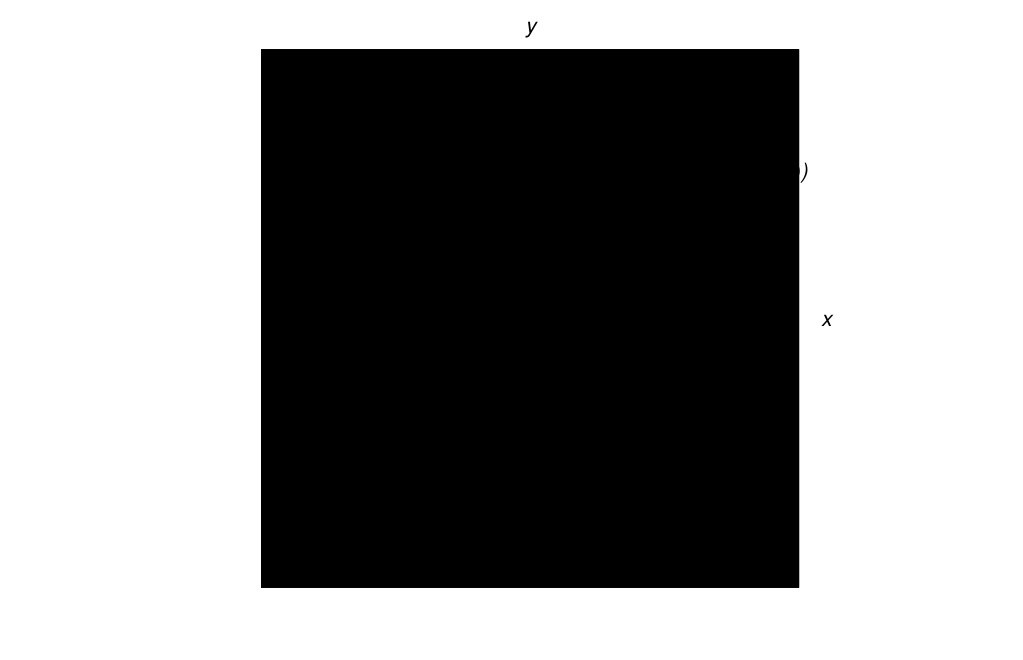
We first look for products \(v(r,\theta)=R(r)\Theta(\theta)\) that satisfy (12.4.1). For this function,
for all \((r,\theta)\) with \(r\ne0\) if
where \(\lambda\) is a separation constant. (Verify.) This equation is equivalent to
and
Since \((r,\pi)\) and \((r,-\pi)\) are the polar coordinates of the same point, we impose periodic boundary conditions on \(\Theta\); that is,
Since we don’t want \(R\Theta\) to be identically zero, \(\lambda\) must be an eigenvalue of (12.4.4) and \(\Theta\) must be an associated eigenfunction. From Theorem 11.1.6, the eigenvalues of (12.4.4) are \(\lambda_0=0\) with associated eigenfunctions \(\Theta_0=1\) and, for \(n=1,2,3,\dots,\) \(\lambda_n=n^2\), with associated eigenfunction \(\cos n\theta\) and \(\sin n\theta\) therefore,
where \(\alpha_n\) and \(\beta_n\) are constants.
Substituting \(\lambda=0\) into (12.4.3) yields the
so
and
If \(c_1\ne0\) then
which doesn’t make sense if we interpret \(u_0(r,\theta)=R_0(r)\Theta_0(\theta)=R_0(r)\) as the steady state temperature distribution in a disk whose boundary is maintained at the constant temperature \(R_0(\rho)\). Therefore we now require \(R_0\) to be bounded as \(r\to0+\). This implies that \(c_1=0\), and we take \(c_2=1\). Thus, \(R_0=1\) and \(v_0(r,\theta)=R_0(r)\Theta_0(\theta)=1\). Note that \(v_0\) satisfies (12.4.2) with \(f(\theta)=1\).
Substituting \(\lambda=n^2\) into (12.4.3) yields the Euler equation
for \(R_n\). The indicial polynomial of this equation is
so the general solution of (12.4.6) is
by Theorem 7.4.3. Consistent with our previous assumption on \(R_0\), we now require \(R_n\) to be bounded as \(r\to0+\). This implies that \(c_2=0\), and we choose \(c_1=\rho^{-n}\). Then \(R_n(r)=r^n/\rho^n\), so
Now \(v_n\) satisfies (12.4.2) with
More generally, if \(\alpha_0\), \(\alpha_1\),…, \(\alpha_m\) and \(\beta_1\), \(\beta_2\), …, \(\beta_m\) are arbitrary constants then
satisfies (12.4.2) with
This motivates the next definition.
Definition 12.4.1
The bounded formal solution of the boundary value problem (12.4.2) is
where
is the Fourier series of \(f\) on \([-\pi,\pi]\); that is,
and
Since \(\sum_{n=0}^\infty n^k(r/\rho)^n\) converges for every \(k\) if \(0< r<\rho\), Theorem 12.1.2 can be used to show that if \(0< r<\rho\) then (12.4.8) can be differentiated term by term any number of times with respect to both \(r\) and \(\theta\). Since the terms in (12.4.8) satisfy Laplace’s equation if \(r>0\), (12.4.8) satisfies Laplace’s equation if \(0<r<\rho\). Therefore, since \(u(\rho,\theta)=F(\theta)\), \(u\) is an actual solution of (12.4.2) if and only if
From Theorem 11.2.4, this is true if \(f\) is continuous and piecewise smooth on \([-\pi,\pi]\) and \(f(-\pi)=f(\pi)\).
Example 12.4.1
Find the bounded formal solution of (12.4.2) with \(f(\theta)=\theta(\pi^2-\theta^2)\).
Solution From Example 11.2.6,
so
Example 12.4.2
Define the formal solution of
where \(0<\rho_0<\rho\) (Figure 12.4.2).
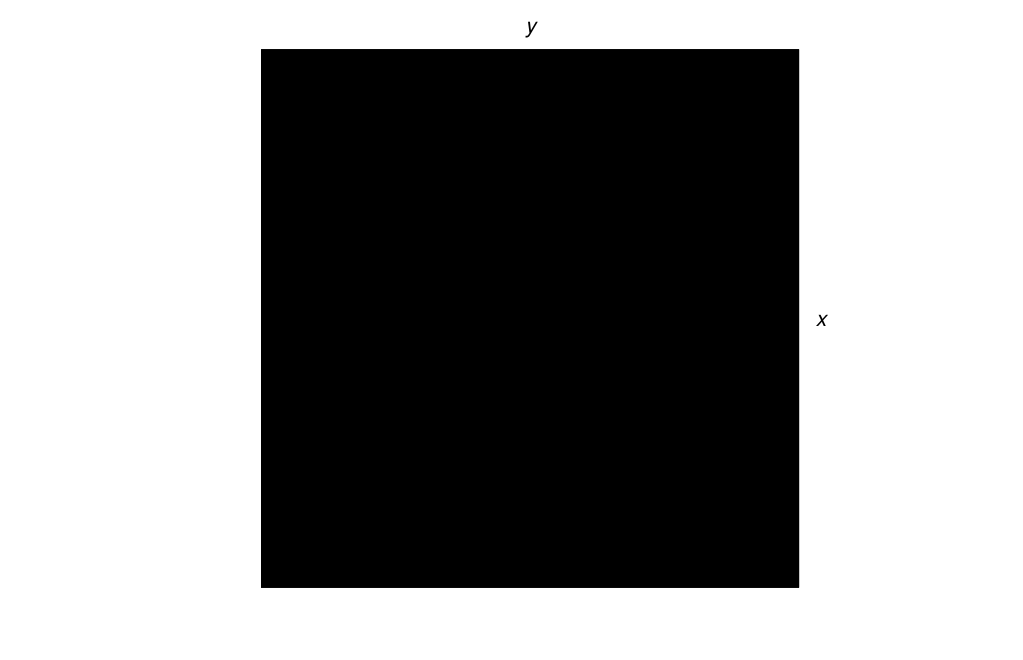
Solution We use separation of variables exactly as before, except that now we choose the constants in (12.4.5) and (12.4.7) so that \(R_n(\rho_0)=0\) for \(n=0\), \(1\), \(2\),…. In view of the nonhomogeneous Dirichlet condition on the boundary \(r=\rho\), it’s also convenient to require that \(R_n(\rho)=1\) for \(n=0\), \(1\), \(2\),…. We leave it to you to verify that
satisfy these requirements. Therefore
and
where \(\alpha_n\) and \(\beta_n\) are arbitrary constants.
If \(\alpha_0\), \(\alpha_1\),…, \(\alpha_m\) and \(\beta_1\), \(\beta_2\), …, \(\beta_m\) are arbitrary constants then
satisfies (12.4.9), with
This motivates us to define the formal solution of (12.4.9) for general \(f\) to be
where
is the Fourier series of \(f\) on \([-\pi,\pi]\).
Example 12.4.3
Define the bounded formal solution of
where \(0<\gamma<2\pi\) (Figure 12.4.3).
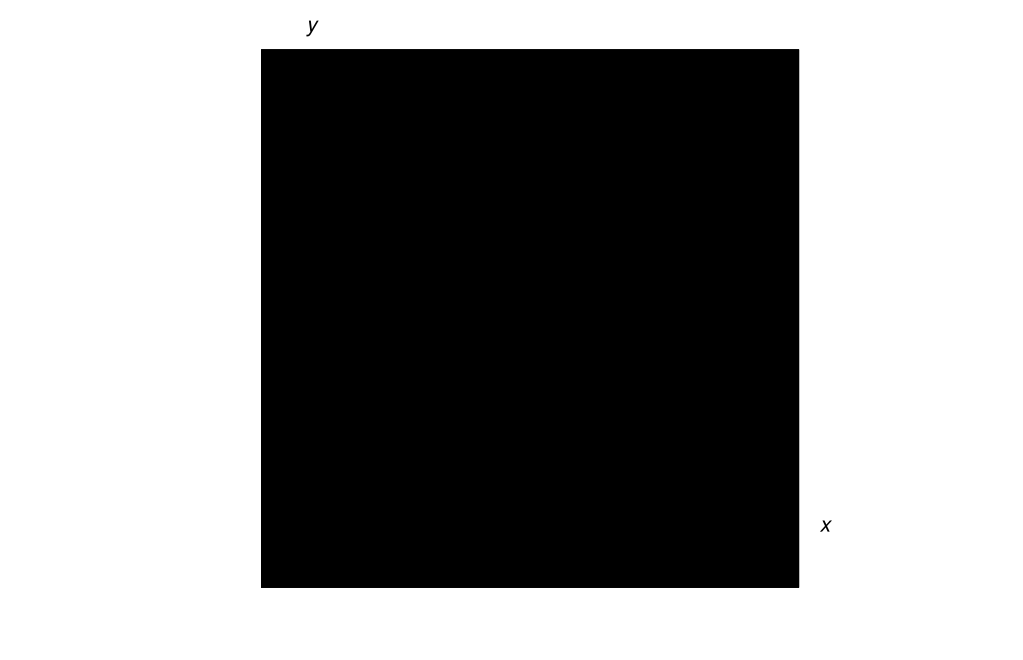
Solution Now \(v(r,\theta)=R(r)\Theta(\theta)\), where
and
From Theorem 11.1.2, the eigenvalues of (12.4.12) are \(\lambda_n=n^2\pi^2/\gamma^2\), with associated eigenfunction \(\Theta_n=\sin n\pi\theta/\gamma\), \(n=1\), \(2\), \(3\),…. Substituting \(\lambda=n^2\pi^2/\gamma^2\) into (12.4.11) yields the Euler equation
The indicial polynomial of this equation is
so
by Theorem 7.4.3. To obtain a solution that remains bounded as \(r\to0+\) we let \(c_2=0\). Because of the Dirichlet condition at \(r=\rho\), it’s convenient to have \(r(\rho)=1\); therefore we take \(c_1=\rho^{-n\pi/\gamma}\), so
Now
satisfies (12.4.10) with
More generally, if \(\alpha_1\), \(\alpha_2\), …, \(\alpha_m\) and are arbitrary constants then
satisfies (12.4.10) with
This motivates us to define the bounded formal solution of (12.4.10) to be
where
is the Fourier sine expansion of \(f\) on \([0,\gamma]\); that is,
12.4 Exercises
-
Define the formal solution of
\[ \begin{array}{c} \dst u_{rr}+\frac{1}{r}u_r+\frac{1}{r^2}u_{\theta\theta}=0,\quad \rho_0<r<\rho,\quad -\pi\le\theta<\pi,\\[6pt] u(\rho_0,\theta)=f(\theta),\quad u(\rho,\theta)=0,\quad -\pi\le\theta<\pi, \end{array} \]where \(0<\rho_0<\rho\).
Show answer
\(u(r,\theta)=\dst\alpha_0\frac{\ln r/\rho}{\ln\rho_0/\rho}+ \sum_{n=1}^\infty \frac{r^n\rho^{-n}-\rho^nr^{-n}} {\rho_0^n\rho^{-n}-\rho^n\rho_0^{-n}} (\alpha_n\cos n\theta+\beta_n\sin n\theta)\) \(\dst\alpha_0=\frac{1}{2\pi}\int_{-\pi}^\pi f(\theta)\,d\theta\),
and \(\dst\alpha_n=\frac{1}{\pi}\int_{-\pi}^\pi f(\theta)\cos n\theta\,d\theta\), \(\dst\beta_n=\frac{1}{\pi}\int_{-\pi}^\pi f(\theta)\sin n\theta\,d\theta\), \(n=1\), \(2\), \(3\), …
-
Define the formal solution of
\[ \begin{array}{c} \dst u_{rr}+\frac{1}{r}u_r+\frac{1}{r^2}u_{\theta\theta}=0,\quad \rho_0<r<\rho,\quad 0<\theta<\gamma,\\[6pt] u(\rho_0,\theta)=0,\quad u(\rho,\theta)=f(\theta),\quad 0\le\theta\le\gamma,\\[6pt] u(r,0)=0,\quad u(r,\gamma)=0,\quad \rho_0<r<\rho, \end{array} \]where \(0<\gamma<2\pi\) and \(0<\rho_0<\rho\).
Show answer
\(\dst u(r,\theta)=\sum_{n=1}^\infty\alpha_n \dst\frac{\rho_0^{-n\pi/\gamma}r^{n\pi/\gamma}-\rho_0^{n\pi/\gamma} r^{-n\pi/\gamma}}{\rho_0^{-n\pi/\gamma}\rho^{n\pi/\gamma}-\rho_0^{n\pi/\gamma} \rho^{-n\pi/\gamma}} \sin\frac{n\pi\theta}{\gamma}\)
\(\alpha_n=\dst\frac{1}{\gamma}\int_0^\gamma f(\theta)\sin\frac{n\pi\theta}{\gamma}\,d\theta\), \(n=1\), \(2\), \(3\),…
-
Define the formal solution of
\[ \begin{array}{c} \dst u_{rr}+\frac{1}{r}u_r+\frac{1}{r^2}u_{\theta\theta}=0,\quad \rho_0<r<\rho,\quad 0<\theta<\gamma,\\[6pt] u(\rho_0,\theta)=0,\quad u_r(\rho,\theta)=g(\theta),\quad 0\le\theta\le\gamma,\\[6pt] u_\theta(r,0)=0,\quad u_\theta(r,\gamma)=0,\quad \rho_0<r<\rho, \end{array} \]where \(0<\gamma<2\pi\) and \(0<\rho_0<\rho\).
Show answer
\(\dst u(r,\theta)= \rho\alpha_0\dst\ln\frac{r}{\rho_0}+\frac{\rho\gamma}{\pi}\sum_{n=1}^\infty\frac{\alpha_n}{n} \dst\frac{\rho_0^{-n\pi/\gamma}r^{n\pi/\gamma}-\rho_0^{n\pi/\gamma} r^{-n\pi/\gamma}} {\rho_0^{-n\pi/\gamma}\rho^{n\pi/\gamma}+\rho_0^{n\pi/\gamma} \rho^{-n\pi/\gamma}} \dst\cos\frac {n\pi\theta}{\gamma}\)
\(\alpha_0=\dst\frac{1}{\gamma}\int_0^\gamma f(\theta)\,d\theta\), \(\alpha_n=\dst\frac{2}{\gamma}\int_0^\gamma f(\theta)\cos\frac{n\pi\theta}{\gamma}\,d\theta\), \(n=1\), \(2\), \(3\),…
-
Define the bounded formal solution of
\[ \begin{array}{c} \dst u_{rr}+\frac{1}{r}u_r+\frac{1}{r^2}u_{\theta\theta}=0,\quad 0<r<\rho,\quad 0<\theta<\gamma,\\[6pt] u(\rho,\theta)=f(\theta),\quad 0\le\theta\le\gamma,\\[6pt] u_\theta(r,0)=0,\quad u(r,\gamma)=0,\quad 0<r<\rho, \end{array} \]where \(0<\gamma<2\pi\).
Show answer
\(u(r,\theta)=\dst\sum_{n=1}^\infty\alpha_n \dst\frac{r^{(2n-1)\pi/2\gamma}}{\rho^{(2n-1)\pi/2\gamma}} \cos\frac {(2n-1)\pi\theta}{2\gamma}\)
\(\alpha_n=\dst\frac{2}{\gamma}\int_0^\gamma f(\theta)\cos\frac{(2n-1)\pi\theta}{2\gamma}\,d\theta\), \(n=1\), \(2\), \(3\),…
-
Define the formal solution of
\[ \begin{array}{c} \dst u_{rr}+\frac{1}{r}u_r+\frac{1}{r^2}u_{\theta\theta}=0,\quad \rho_0<r<\rho,\quad 0<\theta<\gamma,\\[6pt] u_r(\rho_0,\theta)=g(\theta),\quad u_r(\rho,\theta)=0,\quad 0\le\theta\le\gamma,\\[6pt] u(r,0)=0,\quad u_\theta(r,\gamma)=0,\quad \rho_0<r<\rho, \end{array} \]where \(0<\gamma<2\pi\) and \(0<\rho_0<\rho\).
Show answer
\(u(r,\theta)=\dst\frac{2\gamma\rho_0}{\pi}\sum_{n=1}^\infty \frac{\alpha_n}{2n-1} \frac{\rho^{-(2n-1)\pi/2\gamma}r^{(2n-1)\pi/2\gamma}+ \rho^{(2n-1)\pi/2\gamma}r^{-(2n-1)\pi/2\gamma}} {\rho^{-(2n-1)\pi/2\gamma}\rho_0^{(2n-1)\pi/2\gamma}- \rho^{(2n-1)\pi/2\gamma}\rho_0^{-(2n-1)\pi/2\gamma}} \dst\sin\frac {(2n-1)\pi\theta}{2\gamma}\),
\(\alpha_n=\dst\frac{2}{\gamma}\int_0^\gamma g(\theta)\sin\frac{(2n-1)\pi\theta}{2\gamma}\,d\theta\), \(n=1\), \(2\), \(3\),…
-
Define the bounded formal solution of
\[ \begin{array}{c} \dst u_{rr}+\frac{1}{r}u_r+\frac{1}{r^2}u_{\theta\theta}=0,\quad 0<r<\rho,\quad 0<\theta<\gamma,\\[6pt] u(\rho,\theta)=f(\theta),\quad 0\le\theta\le\gamma,\\[6pt] u_\theta(r,0)=0,\quad u_\theta(r,\gamma)=0,\quad 0<r<\rho, \end{array} \]where \(0<\gamma<2\pi\).
Show answer
\(\dst{u(r,\theta)=\alpha_0+\sum_{n=1}^\infty\alpha_n \dst\frac{r^{n\pi/\gamma}}{\rho^{n\pi/\gamma}}\cos\frac{n\pi\theta}{\gamma}}\) \(\alpha_0=\dst\frac{1}{\gamma}\int_0^\gamma f(\theta)\,d\theta\),
\(\alpha_n=\dst\frac{2}{\gamma}\int_0^\gamma f(\theta)\cos\frac{n\pi\theta}{\gamma}\,d\theta\), \(n=1\), \(2\), \(3\),…
-
Show that the Neumann problem
\[ \begin{array}{c} \dst u_{rr}+\frac{1}{r}u_r+\frac{1}{r^2}u_{\theta\theta}=0,\quad 0<r<\rho,\quad -\pi\le\theta<\pi,\\[6pt] u_r(\rho,\theta)=f(\theta),\quad -\pi\le\theta<\pi \end{array} \]has no bounded formal solution unless \(\int_{-\pi}^\pi f(\theta)\,d\theta=0\). In this case it has infinitely many solutions. Find those solutions.
Show answer
\(\dst{ v_n(r,\theta)=\frac{r^n}{n\rho^{n-1}}(\alpha_n\cos n\theta+\sin n\theta)}\)
\(u(r,\theta)=\dst{ c+\sum_{n=1}^\infty\frac{r^n}{n\rho^{n-1}}(\alpha_n\cos n\theta+\beta_n\sin n\theta)}\) \(\alpha_n=\dst{\frac{1}{\pi}\int_{-\pi}^\pi f(\theta)\cos n\theta\,d\theta}\),
\(\dst{\beta_n=\frac{1}{\pi}\int_{-\pi}^\pi f(\theta)\sin n\theta\,d\theta}\), \(n=1\), \(2\), \(3\),…